 Скачать презентацию Unit 6 Reconstruction 1864 -1877 Rebuilding of the
a78a1fbd46f7b56c51a09fe388fa1e4d.ppt
- Количество слайдов: 19



Unit 6 Reconstruction 1864 -1877 Rebuilding of the South after the Civil War 1
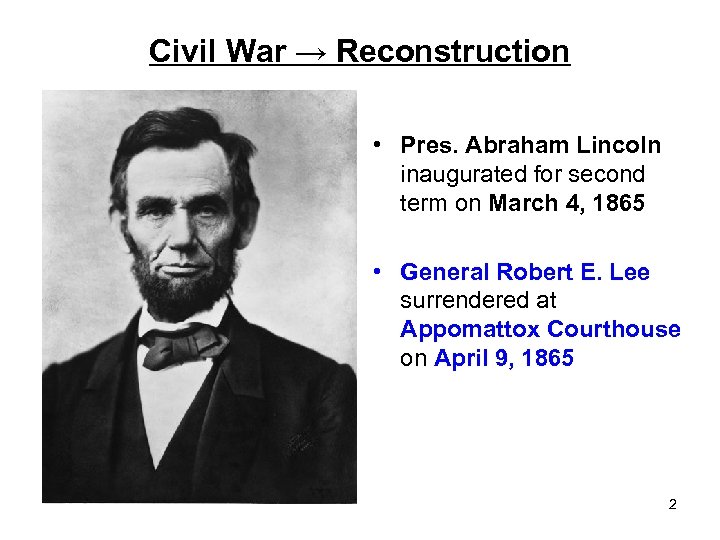
Civil War → Reconstruction • Pres. Abraham Lincoln inaugurated for second term on March 4, 1865 • General Robert E. Lee surrendered at Appomattox Courthouse on April 9, 1865 2
First Steps Toward Reunion • Wade-Davis Bill – Required majority of white men in each southern state to swear loyalty to Union – Denied right to vote or hold office anyone who had volunteered to fight for Confederacy – Lincoln refused to sign the bill 3
First Steps Toward Reunion • 10% Plan – Southern state could form a new government after 10% of voters swore an oath of loyalty to the U. S. – State’s new government • Had to abolish slavery • Then elected members to Congress 4
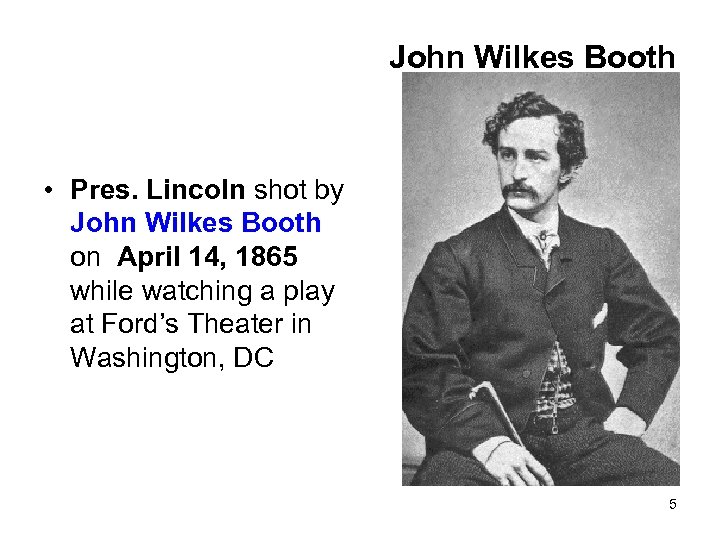
John Wilkes Booth • Pres. Lincoln shot by John Wilkes Booth on April 14, 1865 while watching a play at Ford’s Theater in Washington, DC 5
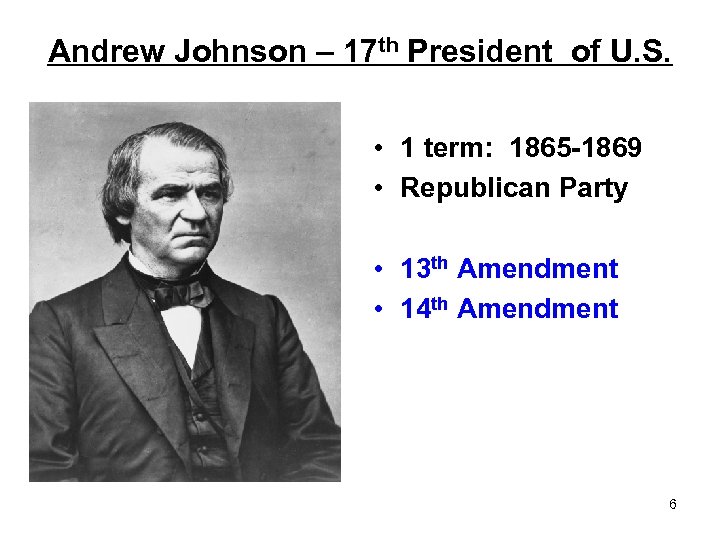
Andrew Johnson – 17 th President of U. S. • 1 term: 1865 -1869 • Republican Party • 13 th Amendment • 14 th Amendment 6
Reconstruction: 1864 -1877 • 13 th Amendment – Ended slavery • Banned slavery in U. S. • 14 th Amendment – Made former slaves citizens • Made discrimination illegal 7
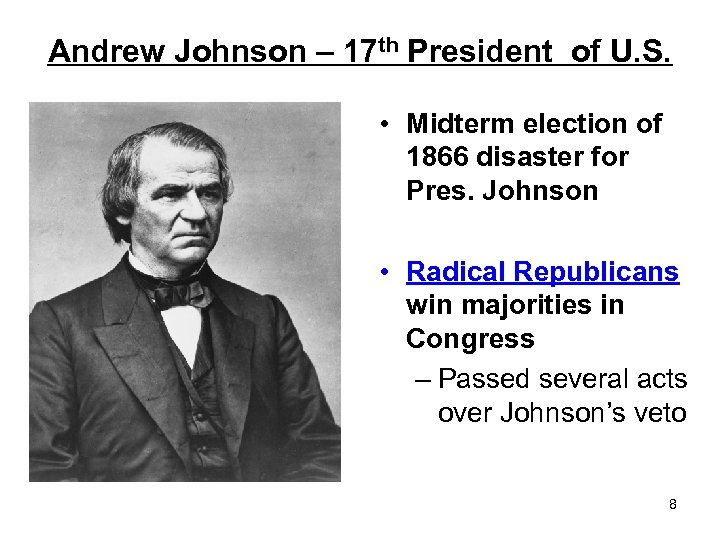
Andrew Johnson – 17 th President of U. S. • Midterm election of 1866 disaster for Pres. Johnson • Radical Republicans win majorities in Congress – Passed several acts over Johnson’s veto 8
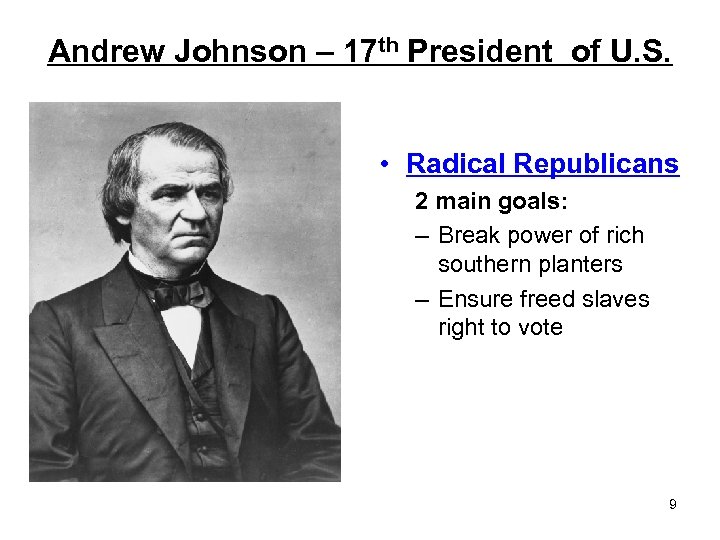
Andrew Johnson – 17 th President of U. S. • Radical Republicans 2 main goals: – Break power of rich southern planters – Ensure freed slaves right to vote 9
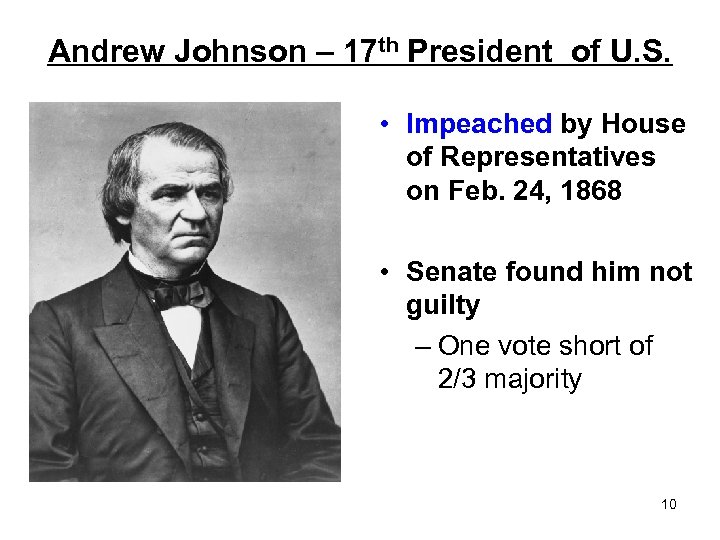
Andrew Johnson – 17 th President of U. S. • Impeached by House of Representatives on Feb. 24, 1868 • Senate found him not guilty – One vote short of 2/3 majority 10
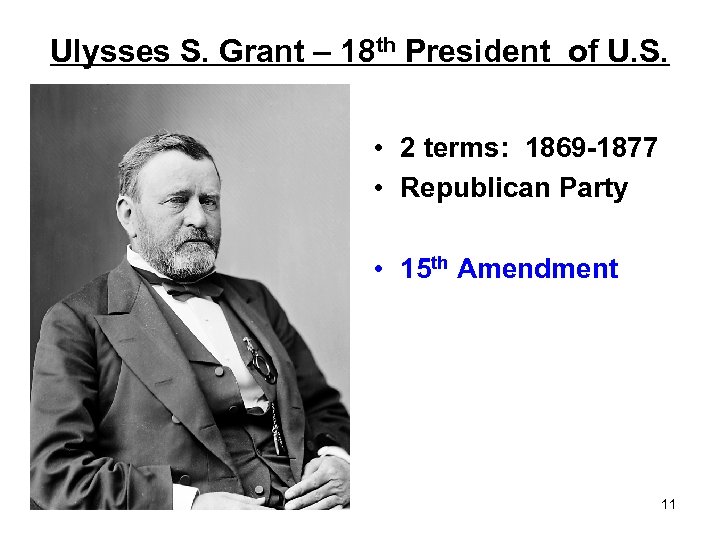
Ulysses S. Grant – 18 th President of U. S. • 2 terms: 1869 -1877 • Republican Party • 15 th Amendment 11
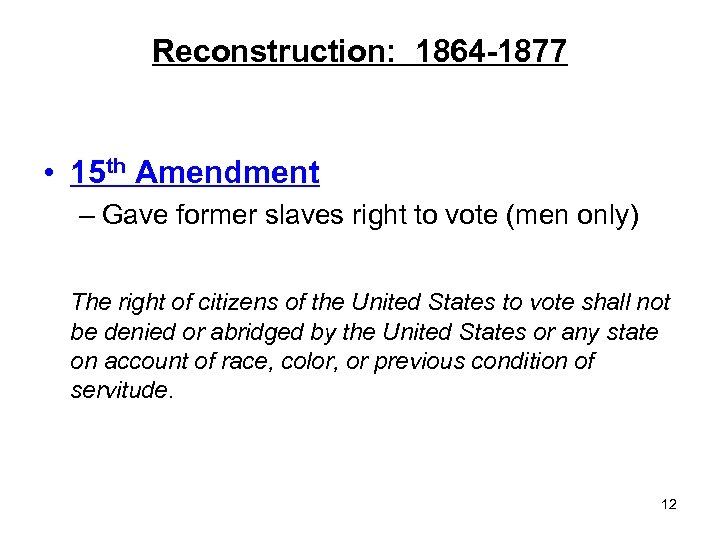
Reconstruction: 1864 -1877 • 15 th Amendment – Gave former slaves right to vote (men only) The right of citizens of the United States to vote shall not be denied or abridged by the United States or any state on account of race, color, or previous condition of servitude. 12
Reconstruction: 1864 -1877 • Carpetbaggers – Northerners who moved to the South to work for Reconstruction • Scalawags – White southerners who supported Reconstruction • Sharecroppers – Rent land to grow food & give owner share of crops • Ku Klux Klan – Secret organization – White southerners use fear & violence to keep African Americans from voting or entering politics 13
Reconstruction: 1864 -1877 • By 1872, most former Confederates were again allowed to vote • By late 1870 s, conservative whites had regained control of the South – Northerners grew weary of trying to change the South • Time to let Southerners run their own government again, even if African Americans lose rights gained – Government of the Southern states was once again in the hands of the Southerners 14
End of Reconstruction • Election of 1876 – Samuel Tilden – Democratic candidate • Won popular vote • One electoral vote short of number needed to win election – Rutherford B. Hayes – Republican candidate • Promised to end Reconstruction • Selected by Congress to be President 15
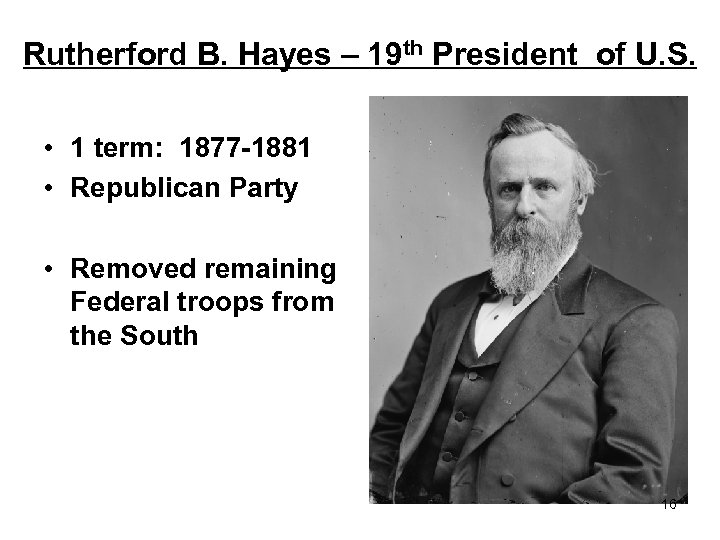
Rutherford B. Hayes – 19 th President of U. S. • 1 term: 1877 -1881 • Republican Party • Removed remaining Federal troops from the South 16
End of Reconstruction • Southern white conservatives use violence to keep African Americans from voting • Voting restrictions in Southern states – Poll taxes • Voters pay tax each time they vote – Literacy tests • Prove a voter could read & write • Grandfather clauses – Excused voters from poll taxes or literacy tests if voter’s father or grandfather had voted before 1867 17
End of Reconstruction • Segregation became law of the South • Jim Crow laws – Laws separating whites and blacks • schools, restaurants, theaters, trains, streetcars, playgrounds, hospitals, cemeteries • 1896 Plessy v. Ferguson – Supreme Court said segregation was legal if facilities were equal 18
End of Reconstruction • Laws passed during Reconstruction (such as 14 th Amendment) became basis of civil rights movement almost 100 years later 19
Скачать презентацию Unit 6 Reconstruction 1864 -1877 Rebuilding of the
a78a1fbd46f7b56c51a09fe388fa1e4d.ppt