


 Скачать презентацию Unit 6 Politics in America I
3d1693dd7b13cc4e9746fac4ad175784.ppt
- Количество слайдов: 44
 Unit 6 – Politics in America
 I. Parties
 A. The Meaning of Party 1. Political Party: – A “team seeking control of governing by gaining office in an election. ” 2. Parties can be thought of in three parts: a. Electorate b. Organization c. In government
 3. Tasks of the Parties a. Linkage Institution: channels which people’s concerns become political issues. b. Pick Candidates c. Run Campaigns d. Give Cues to Voters e. Articulate Policies f. Coordinate Policymaking
 B. The Party Organizations 1. 2. Local Parties The 50 State Party Systems a. b. c. 3. Closed primaries: voters must be registered with their party vote in the spring Open primaries: voters in the nomination process of one party Blanket primaries: voters get a list of all candidates and can vote for one name for each office, regardless of party label The National Party Organizations a. b. c. National Convention: party delegates meet every four years to choose a presidential ticket and party’s platform. National Committee: keeps the party operating between conventions. National Chairperson: Responsible for day-to-day activities
 C. Party History
 1. Pre-Revolution a. Loyalists – wanted to stay with England b. Patriots – wanted to revolt c. Neutral – did not favor with side 2. Constitution 1. Federalists – favored creation, strong, central government. 2. Anti-federalists – opposed creation, favored states. 3. Madison warned of “factions”
 3. Early Republic A. Federalists i. iii. iv. Loose constructionists. Alexander Hamilton John Marshall George Washington favored them B. Democratic Republicans i. Strict constructionists ii. Thomas Jefferson iii. Common man should have rights
 Early Republic continued… C. Federalists lose elections to Jefferson. D. They oppose the War of 1812 and looked like traitors. E. The party dies. F. Nation enters period known as “Era of Good Feelings, ” cause there was only one party (D-R).
 4. Split a. Too many people that disagree run for president in 1824. b. Speaker Henry Clay “gives” election to John Q. Adams. c. Jackson supporters are mad and break off to form Democrats. d. Adams supporters become Whigs.
 5. Jackson Era a. Jackson wins in 1828. b. Supports common man. c. Builds “party machine. ” i. Organizes in cities ii. Hires workers to promote party iii. Distributes pamphlets.
 6. Slavery a. Whigs support nationalism, but are divided over slavery. b. Party splits between North and South. c. Northerners abolitionists join Free Soil party to make the Republicans. d. They are able to win election 1860 with Abe Lincoln. e. Democrats are weakened by divisions till 1930’s.
 7. Gilded Age A. After Reconstruction ends, parties become friends of monopolies and trusts. B. Corruption, bribery, and graft are common. C. 1896 election revolved around the gold standard
 8. Progressive Era a. Socialists and Populists favor worker’s rights and opportunity for poor. b. Democrats and Republicans make liberal ideas their own. c. Other progressive issues: i. iii. iv. Prohibition. Women’s Suffrage Labor Unions Conservation
 9. New Deal a. b. People are disappointed with conservative Republicans. New Deal coalition is an umbrella of supporters for Dems. i. iii. iv. v. vii. c. Southerners (conservative) Eastern and Southern Europeans. Unions Jews African-Americans. Intelligentsia All hope for economic intervention. They hold onto most of the White House 1932 -1968 and most of Congress 1930 -1994.
 10. Change in Politics a. Reagan (R) makes party more conservative. i. Supports a big military to end Cold War. ii. Dislikes big taxes and government. iii. Makes American proud again after troubled 1970’s. b. Clinton (D) brings party to a central point to compete with GOP. i. Cut taxes for middle class. ii. Tones down support for abortion and gays. iii. Used military to protect people of Kosovo from persecution. iv. Starts welfare to work. v. Balances the budget.
 D. Parties Today
 1. Republicans a. Family Values (Christian-Judean) i. ii. b. c. d. e. f. g. Pro-life Favor traditional marriage Low taxes, equal for all people. Small government Big military Isolationist (? ) Pro-gun Midwest and South, rural areas.
 2. Democrats a. Pro-choice b. Favor civil unions c. Use government to create economic opportunity. d. Civil rights. e. Internationalists – use peace, United Nations. f. Taxes should be progressive, heavier for the rich. g. West Coast, Great Lakes, Northeast, urban areas.
 E. Third Parties
 1. Ideological a. Philosophy or way of thinking that impacts many issues. b. Communists and Socialists = Karl Marx. c. Constitutional Party = Strict Constructionist d. Libertarian = John Locke, Thomas Jefferson and protecting rights. e. Reform Party = fix problematic gov’t.
 2. Economic Issues a. One specific money issue. b. Taxpayers = low taxes
 3. Single Issue a. Only concerned about one issue. b. Prohibition = no drinking c. Green Party = started to fix environment, now covers more issues.
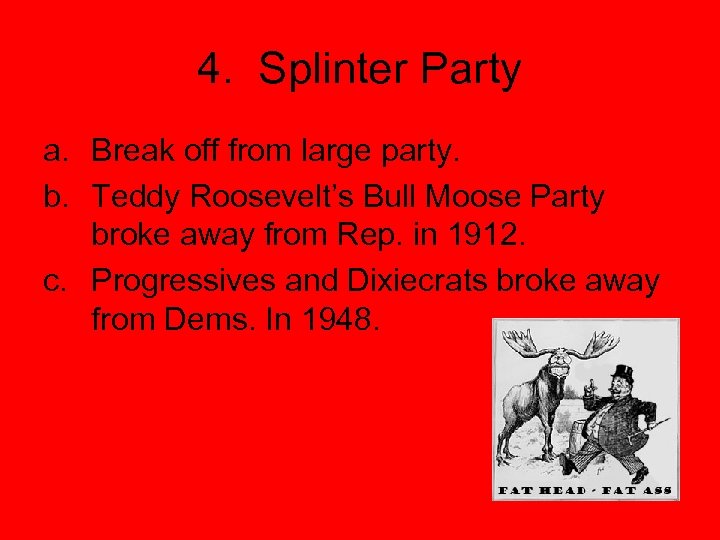 4. Splinter Party a. Break off from large party. b. Teddy Roosevelt’s Bull Moose Party broke away from Rep. in 1912. c. Progressives and Dixiecrats broke away from Dems. In 1948.
 L. Organization 1. Party meetings at county and state level. 2. National committee decides platform and election strategy. 3. Chairperson runs committee, can be selected by president if he is in same party. 4. Conventions are every four years to nominate president.
 II. Elections
 A. Primaries 1. 2. 3. 4. Spring Different in each state. Choose candidates for party In PA they are closed, you can only vote within your party.
 B. General 1. First Tuesday following the first Monday of November. 2. All voters select the winners for offices.
 C. Presidential Elections 1. 2. 3. Exploratory committee is set up to find out if they have a chance. Candidates visit New Hampshire for first primary in January. They visit Iowa for first caucuses (where party officials choose candidate). 4. They gather as many delegate votes for their convention in the summer. 5. Electoral College actually elects the President - founders wanted him chosen by the elite of the country 6. States choose the electors 7. Winner-Take-All system gives bigger emphasis to more populated states 8. State electoral vote count = # of Reps + # of Senators. 9. DC gets minimal amount (3) for a total of 538. 10. A candidate must get a majority (270) or the House gets to decide.
 D. Referendums • • State voters approve or disapprove proposed legislation. Often used for constitutional amendments.
 E. Whether to Vote: A Citizen’s First Choice 1. U. S. typically has low voter turnouts. 2. Some argue it is a rational choice to not vote. 3. Political Efficacy: The belief that one’s political participation really matters. 4. Civic Duty: The belief the in order to support democratic government, a citizen should always vote.
 F. Whether to Vote: A Citizen’s First Choice 1. Who Votes? a. Education: More education = more likely to vote. Most important factor. b. Age: Older = more likely to vote. c. Race: Caucasian = more likely to vote. BUT, other ethnicities are higher with comparable education. d. Gender: Female = more likely to vote. e. Marital Status: Married = more likely to vote. f. Union Membership: Union member = more likely to vote. g. Traits are cumulative - possessing several adds up.

 III. Civics
 A. Civics 1. Study of citizenship and the relationship between you and the community. 2. Citizenship – a. b. “a productive, responsible, caring, and contributing member of society. ” USA i. ii. Natural born – born in USA or internationally to American citizens. Naturalized – Foreign born person meets requirements. a. ) Permanent resident for 5 years. b. ) Good moral character c. ) Read and write basic English d. ) Passes test on gov’t and history
 B. Civic Responsibility 1. Musts: a. b. c. d. Jury duty Selective Service Taxes Obey the law 2. Voluntary: a. b. c. d. e. f. Courteous, respect others Community service Education Work, contribute to economy Vote Knowledgeable of events
 g. Critical of government i. Declaration of Independence – a. ) Government should protect rights. b. ) People should protest if they do not. c. ) People may destroy the gov’t and create a new one. ii. Unalienable rights – life, liberty, and pursuit of happiness. iii. Constitution – Bill of rights (first ten amendments). iv. Teddy Roosevelt “duty to criticize the president. ”
 C. Historical Roots 1. George Washington gave up power so his position would not be a dictatorship. 2. Founding fathers risked life to revolt in 1776 and form Constitution in 1787. 3. Men and women served in military to protect nation and keep peace in world. 4. Martin Luther King Jr. used peaceful protest or civil disobedience to right what was wrong.
 IV. Media
 A. Basics 1. Mass Media: 2. Television, radio, newspapers, magazines, Internet. 3. TV top, Internet catching up
 The Mass Media Today • Media Events: – Events purposely staged for the media that nonetheless look spontaneous. Media events can be staged by almost anybody. • Other items to consider: – 60% presidential campaign spending is TV ads – Image making / news management is important, especially for presidents
 The Development of Media Politics • Introduction – The news media wasn’t always so important. – Press Conferences: meetings of public officials with reporters - Roosevelt used many of these. – Investigative Journalism: the use of in-depth reporting to unearth scandals, scams & schemes putting reporters & politicians opposite each other. – Sound Bites: Short video clips of approximately 15 seconds.
 Reporting the News • Bias in the News – Many people believe the news favors one point of view over another. – Generally are not very biased along liberal / conservative lines. – Generally are biased towards what will draw the largest audience.
 Polling • • • Radom samples taken Quotas used Predicting the universe Margin of Error Gallup, Pew, Zogby