


 Скачать презентацию Unit 6 C Operant Conditioning Mr Mc Cormick
9b1dfa916000cdbddc0adec75c2d1cd6.ppt
- Количество слайдов: 22
 Unit 6 (C): Operant Conditioning Mr. Mc. Cormick A. P. Psychology
 Do-Now: (Discussion) n Describe the following phenomena of Classical Conditioning: n n n Generalization Discrimination Extinction Spontaneous Recovery Learned Helplessness What is Operant Conditioning and how does it differ from Classical Conditioning?
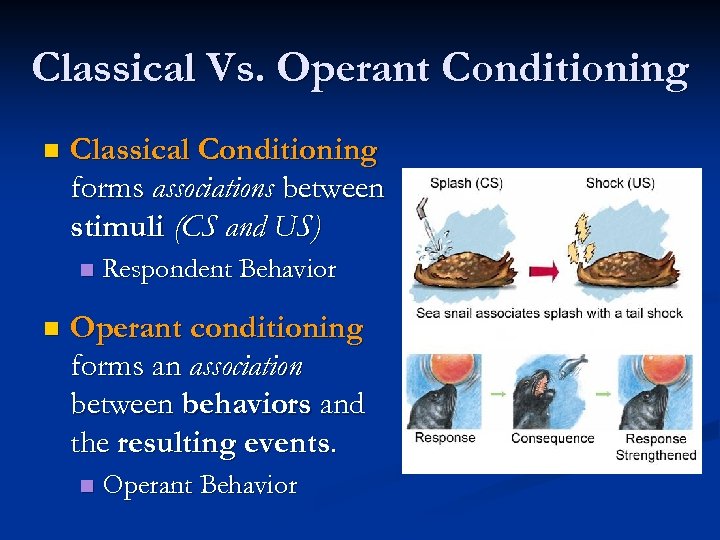 Classical Vs. Operant Conditioning n Classical Conditioning forms associations between stimuli (CS and US) n n Respondent Behavior Operant conditioning forms an association between behaviors and the resulting events. n Operant Behavior
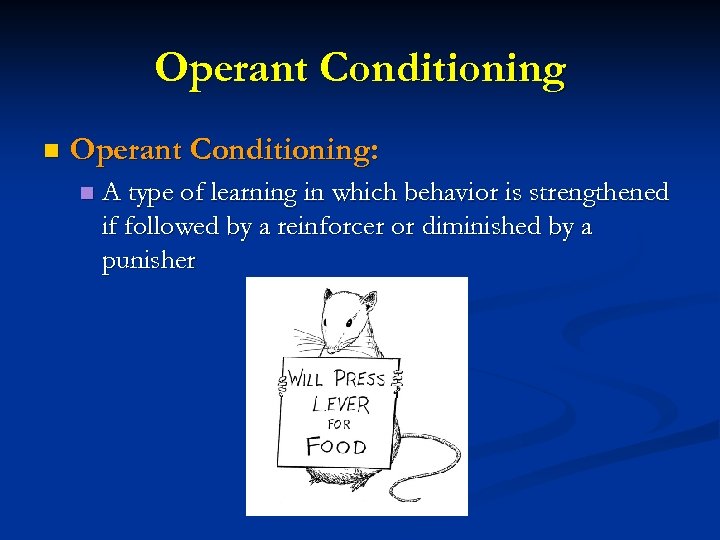 Operant Conditioning n Operant Conditioning: n A type of learning in which behavior is strengthened if followed by a reinforcer or diminished by a punisher
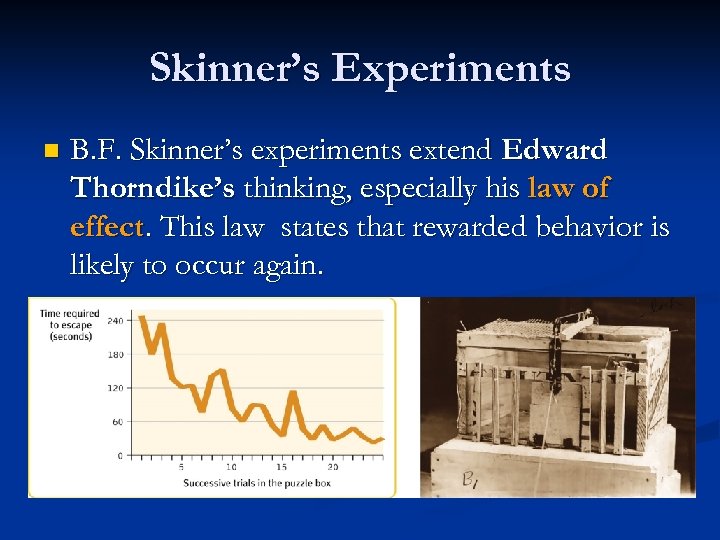 Skinner’s Experiments n B. F. Skinner’s experiments extend Edward Thorndike’s thinking, especially his law of effect. This law states that rewarded behavior is likely to occur again.
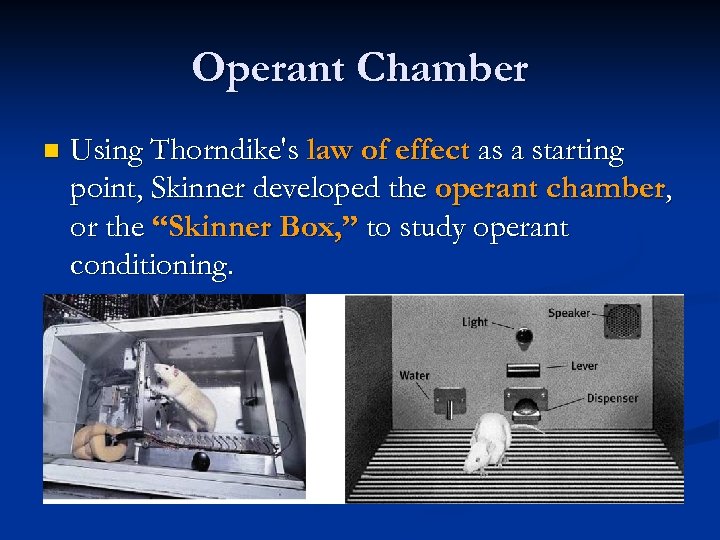 Operant Chamber n Using Thorndike's law of effect as a starting point, Skinner developed the operant chamber, or the “Skinner Box, ” to study operant conditioning.
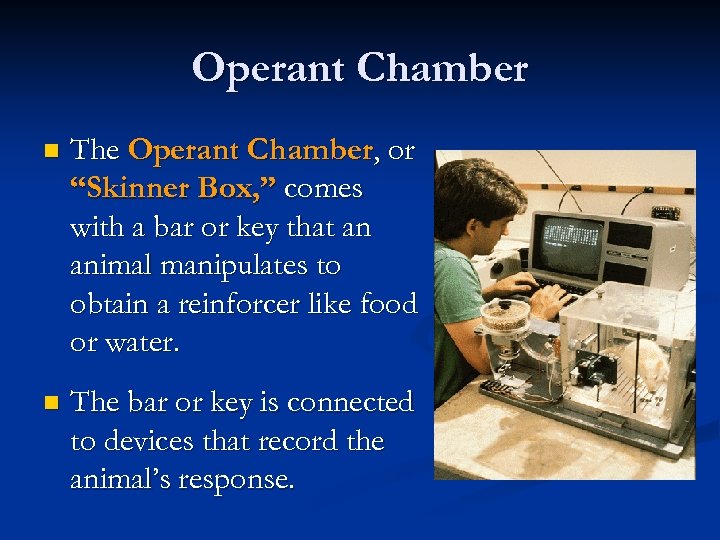 Operant Chamber n The Operant Chamber, or “Skinner Box, ” comes with a bar or key that an animal manipulates to obtain a reinforcer like food or water. n The bar or key is connected to devices that record the animal’s response.
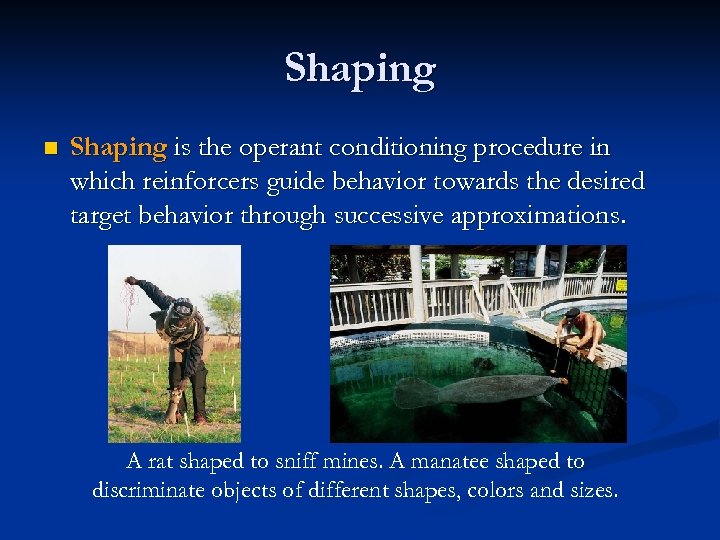 Shaping n Shaping is the operant conditioning procedure in which reinforcers guide behavior towards the desired target behavior through successive approximations. A rat shaped to sniff mines. A manatee shaped to discriminate objects of different shapes, colors and sizes.
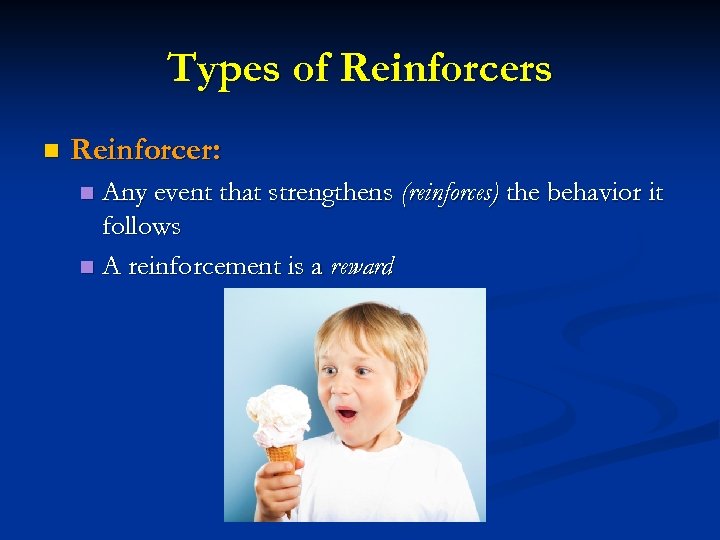 Types of Reinforcers n Reinforcer: Any event that strengthens (reinforces) the behavior it follows n A reinforcement is a reward n
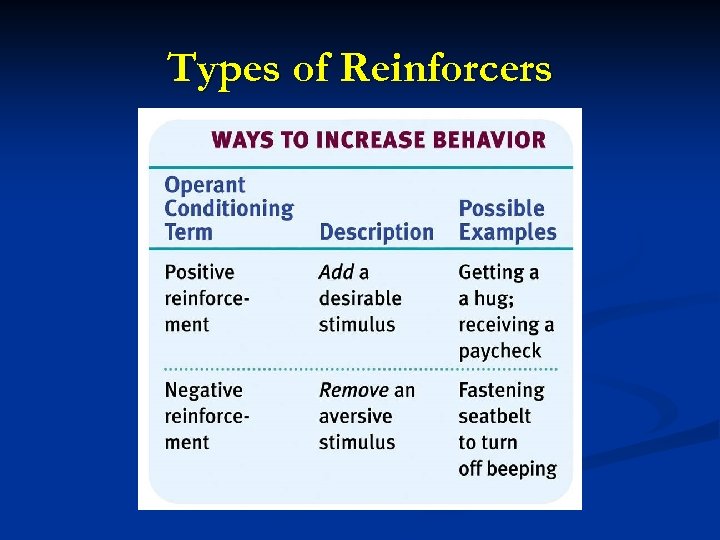 Types of Reinforcers
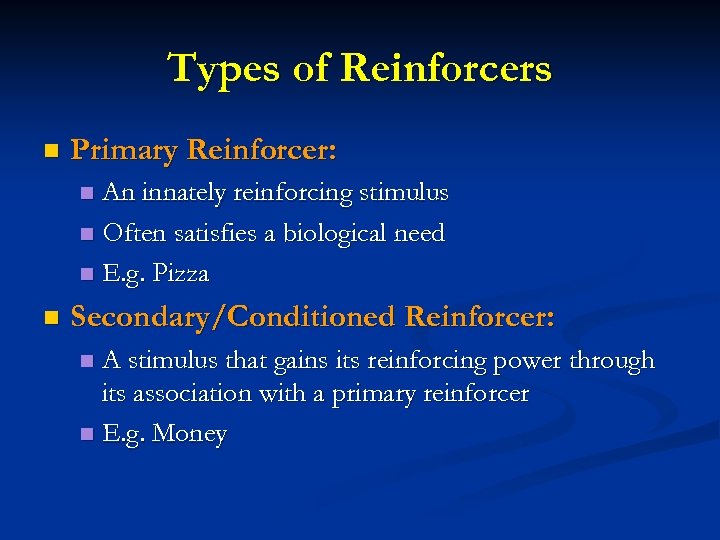 Types of Reinforcers n Primary Reinforcer: An innately reinforcing stimulus n Often satisfies a biological need n E. g. Pizza n n Secondary/Conditioned Reinforcer: A stimulus that gains its reinforcing power through its association with a primary reinforcer n E. g. Money n
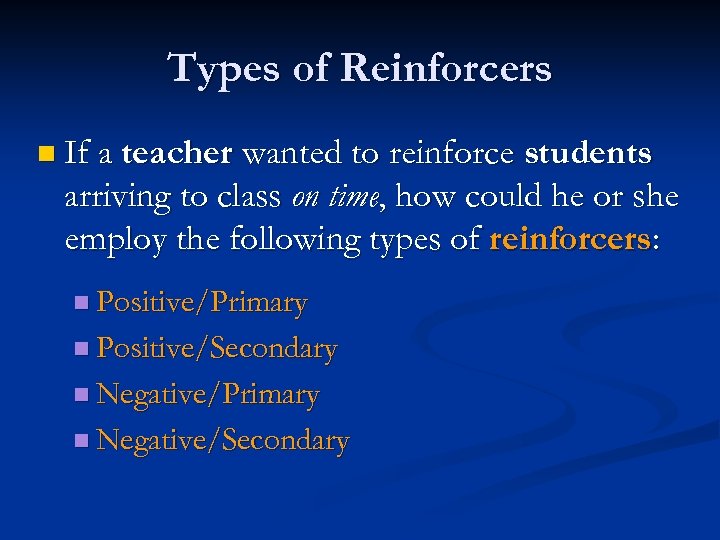 Types of Reinforcers n If a teacher wanted to reinforce students arriving to class on time, how could he or she employ the following types of reinforcers: n Positive/Primary n Positive/Secondary n Negative/Primary n Negative/Secondary
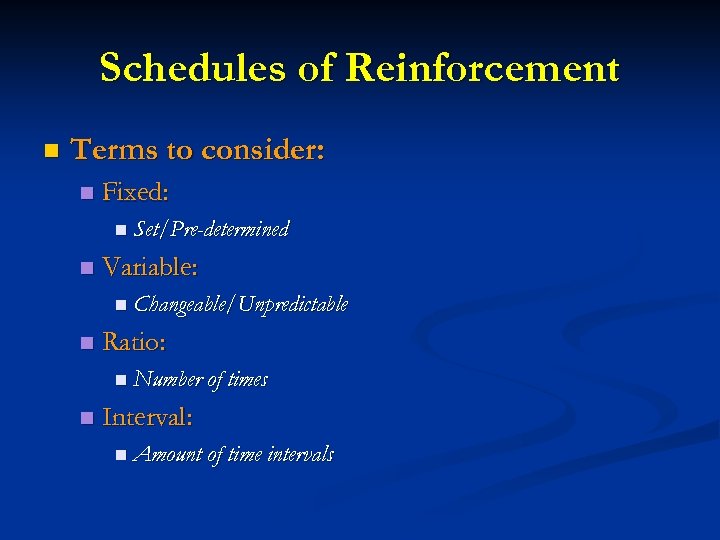 Schedules of Reinforcement n Terms to consider: n Fixed: n Set/Pre-determined n Variable: n Changeable/Unpredictable n Ratio: n Number of times n Interval: n Amount of time intervals
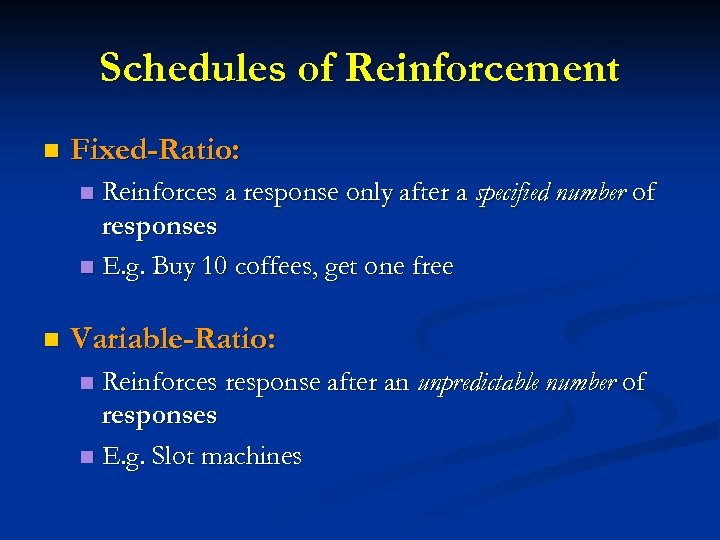 Schedules of Reinforcement n Fixed-Ratio: Reinforces a response only after a specified number of responses n E. g. Buy 10 coffees, get one free n n Variable-Ratio: Reinforces response after an unpredictable number of responses n E. g. Slot machines n
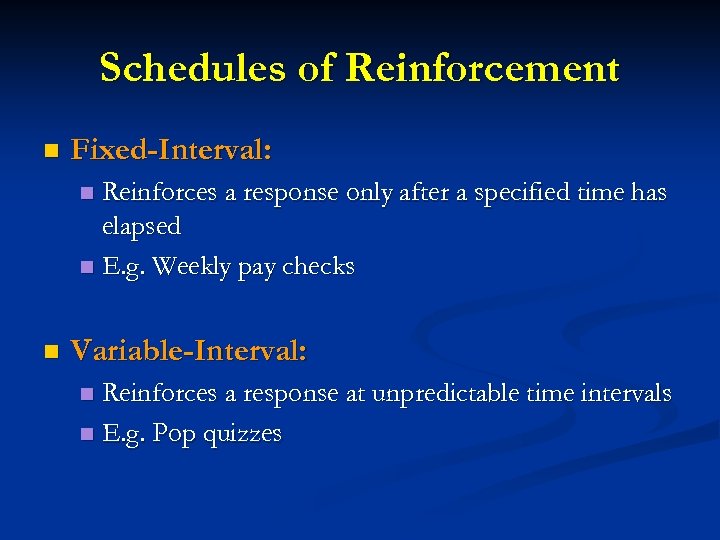 Schedules of Reinforcement n Fixed-Interval: Reinforces a response only after a specified time has elapsed n E. g. Weekly pay checks n n Variable-Interval: Reinforces a response at unpredictable time intervals n E. g. Pop quizzes n
 Schedules of Reinforcement n Provide an example of each of the following schedules of reinforcement: Fixed-Ratio n Variable-Ratio n Fixed-Interval n Variable-Interval n Which one do you think is least effective? n Which one do you think is most addictive? n
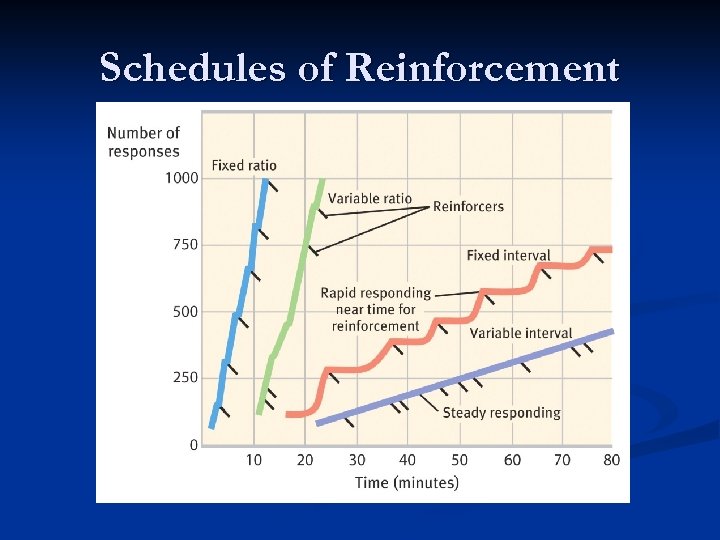 Schedules of Reinforcement
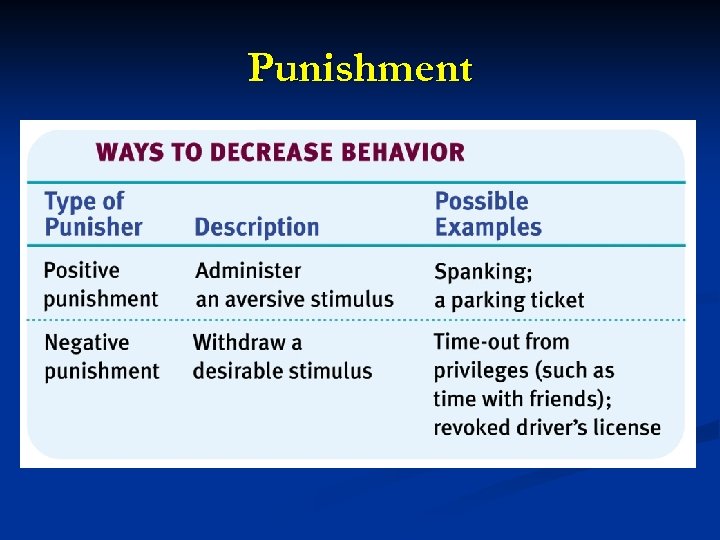 Punishment
 Punishment n Do you feel that punishment is effective, and under what types of circumstances? n If not, what other do you support? alternatives
 Punishment n Effects of Punishment on Behavior: n Punished behavior is suppressed, not forgotten n Punishment does not teach appropriate behavior n Punishment causes unwanted behaviors to reappear in its absence n Punishment can teach fear n Justifies pain to others n Physical punishment may increase aggressiveness by modeling aggression as a way to cope with problems
 Review n n What is Operant Conditioning? Describe the following types of reinforcement: n n n Describe the following schedules of reinforcement: n n n Positive Negative Primary Secondary (Conditioned) Fixed-Ratio Variable-Ratio Fixed-Interval Variable-Interval What are some ways that punishment affects behavior?
 Homework n Research Study # 10: “Little Emotional Albert” (Pgs. 72 -78) n Unit 6 Quiz: “Learning” n Unit 6 FRQ n Unit 6 Test: “Learning” n Chapter 8 Outline: “Memory”