 Скачать презентацию Unit 5 Who Is the Basic Procedure in
Unit 5. - basic procedure.pptx
- Количество слайдов: 15



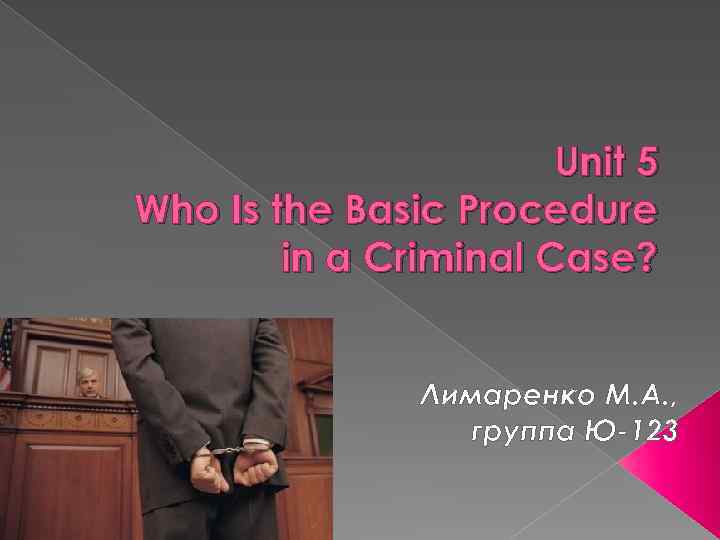
Unit 5 Who Is the Basic Procedure in a Criminal Case? Лимаренко М. А. , группа Ю-123
Key terms: To affect – влиять Indictment – обвинение, обвинительный акт probable cause – вероятна причина immediate release – немедленное освобождение Stationhouse – полицейский участок to arraign – обвинять, привлекать к суду a plea of guilty – заявление подсудимого о признании вины pretrial –досудебный motions – ходатайство
bench – состав суда, коллегия судей pool – пул присяжных stand – место для дачи показаний cross-examination – перекрестный допрос pivotal – центральный, важнейший unanimous – единогласный hang jury – жюри, не достигшее единогласного решения jury foreperson – старшина присяжных probation – пробация, передача под надзор
Vocabulary Give the English equivalents for the legal terms below. Use them when speaking on the basic procedure in a criminal case: Grand jury bench or court trial voir dire Direct examination Summations Jury charge Hung jury Verdict Sentencing Hearings Pre-sentencing report
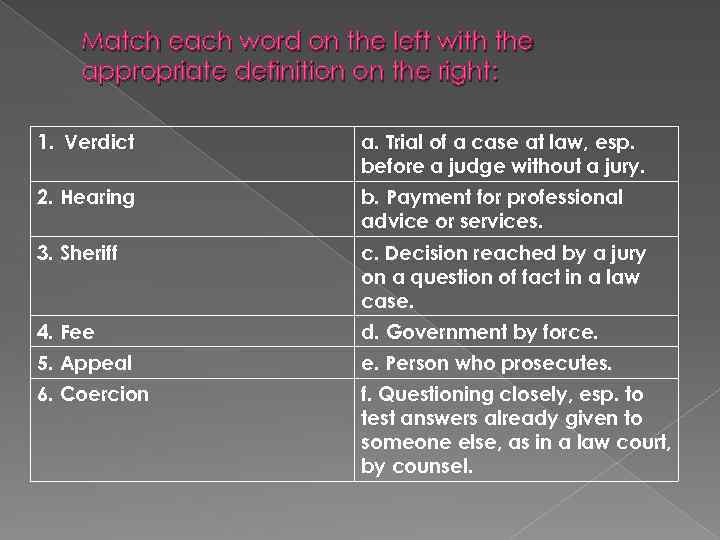
Match each word on the left with the appropriate definition on the right: 1. Verdict a. Trial of a case at law, esp. before a judge without a jury. 2. Hearing b. Payment for professional advice or services. 3. Sheriff c. Decision reached by a jury on a question of fact in a law case. 4. Fee d. Government by force. 5. Appeal e. Person who prosecutes. 6. Coercion f. Questioning closely, esp. to test answers already given to someone else, as in a law court, by counsel.
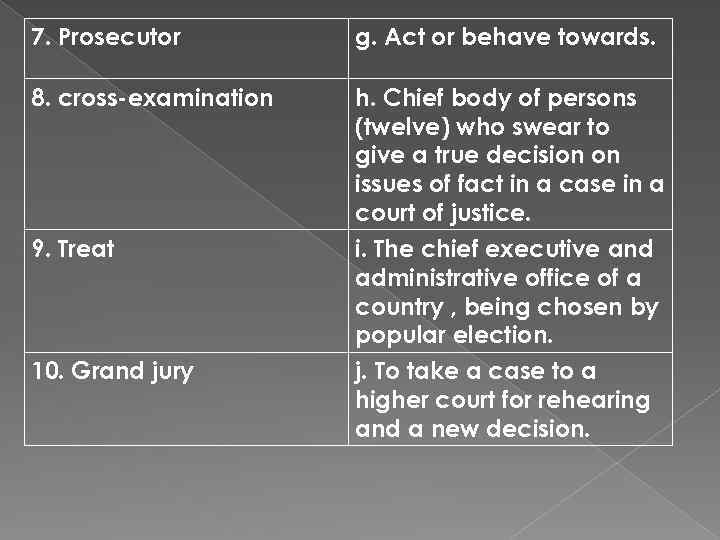
7. Prosecutor g. Act or behave towards. 8. cross-examination h. Chief body of persons (twelve) who swear to give a true decision on issues of fact in a case in a court of justice. i. The chief executive and administrative office of a country , being chosen by popular election. 9. Treat 10. Grand jury j. To take a case to a higher court for rehearing and a new decision.
Listening Listen to the text about the difference between criminal cases and civil ones in the USA. Make sure you know the meaning of the following words: Major; to seek punishment; amendment; to compel; plaintiff; to allege; money damages; crucial; burden of proof; preponderance of evidence; beyond reasonable doubt.
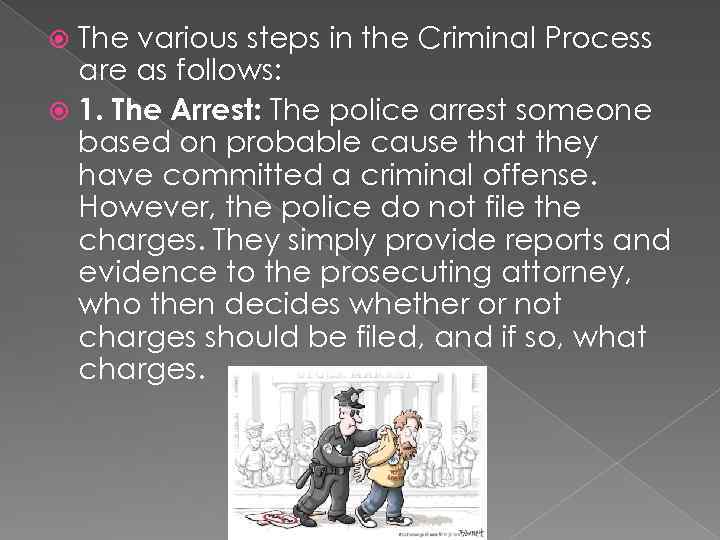
The various steps in the Criminal Process are as follows: 1. The Arrest: The police arrest someone based on probable cause that they have committed a criminal offense. However, the police do not file the charges. They simply provide reports and evidence to the prosecuting attorney, who then decides whether or not charges should be filed, and if so, what charges.
2. Filing of the Complaint: The police arrest someone based on probable cause that they have committed a criminal offense. However, the police do not file the charges. They simply provide reports and evidence to the prosecuting attorney, who then decides whether or not charges should be filed, and if so, what charges. The prosecuting attorney files the document with the court, which alleges the charges against you.
3. Arraignment/First Appearance: At the arraignment, you are formally advised of the charges and your constitutional rights. Bail is often set during the arraignment. Bail is used by the court almost like an "insurance policy" that you will appear on future court dates. The amount of bail is determined by the judge. The judge will look to two factors in deciding bail: your risk of flight and whether you pose a danger to the community. Bail amounts can range from being released on your own recognizance, all the way up to millions of dollars. In some cases no bail is allowed.
4. Preliminary Hearing: Preliminary Hearings are held in all felony offenses to review probable cause. This is necessary for the judge to determine whethere is sufficient evidence to support the charges against you. Once a Judge determines that there is probable cause, he sends the case to the Superior Court for trial. During the Preliminary Hearing, the district attorney or the judge can additional charges and/or readjust the bail. 5. Arraignment in the Superior Court: If the judge has determined that there is probable cause to support the charges, the prosecutor will file a charging document called an Information in the Superior Court. The Information alleges the charges which you are facing at trial. At this time, you are formally advised of the charges and your constitutional rights. Again, you enter a plea of not guilty.
6. Pre-trial Conference: At the pre-trial conference, the defense attorney discusses the case with the prosecuting attorney and often may include the judge in this process. This is a good opportunity to speak with the prosecution in order to obtain the best possible deal, or plea-bargain. It also allows the defense attorney to provide information which may prove your innocence. 7. Trial: During the jury trial you are entitled to have a jury of twelve impartial jurors. Both the defense attorney and the prosecuting attorney have an opportunity to make opening statements, introduce witnesses and evidence in favor of their case, crossexamine witnesses and offer closing arguments. During the deliberation phase of the case, the jury decides whether the prosecution has met the burden of proving guilt beyond a reasonable doubt. If the jury finds you not guilty, you are free to go and not subject to further prosecution based on the same offenses.
8. Sentencing: If you are found guilty, the sentencing hearing is where the judge determines and imposes the appropriate punishment. You may be sentenced to probation instead of a term in state prison. Different crimes carry different possible penalties. You are entitled to a sentencing hearing to propose why you believe the judge should give you the lowest possible penalty. 9. Collateral Consequences: In addition to any sentence imposed by the court, conviction can have a number of additional consequences. In felony cases, these consequences can include, but are not limited to: loss of the right to vote, loss of the right to possess a firearm, loss of the right to associate with other known criminals, registration as a sexual offender, registration as a narcotics offender, or increased penalties for future convictions.
10. Appeals & Writs: If convicted, you may file an appeal to an appellate level court with the argument that the trial court made legal errors. If the defense can prove that the trial court made legal errors, or you were denied due process of law or a fair trial, it may result in the reversal of your conviction. 11. Parole: Parole is a conditional release from prison which entitles you to serve the remainder of your term outside of prison. However, you are still under the supervision of the department of corrections. 12. Expungement: Expungement is a process where, in some cases, your conviction may be removed from your record.
 Скачать презентацию Unit 5 Who Is the Basic Procedure in
Unit 5. - basic procedure.pptx