 Скачать презентацию Unit 4 What would you do Section B
24766b9985492939d15e5363a5186e52.ppt
- Количество слайдов: 35



Unit 4 What would you do? Section B
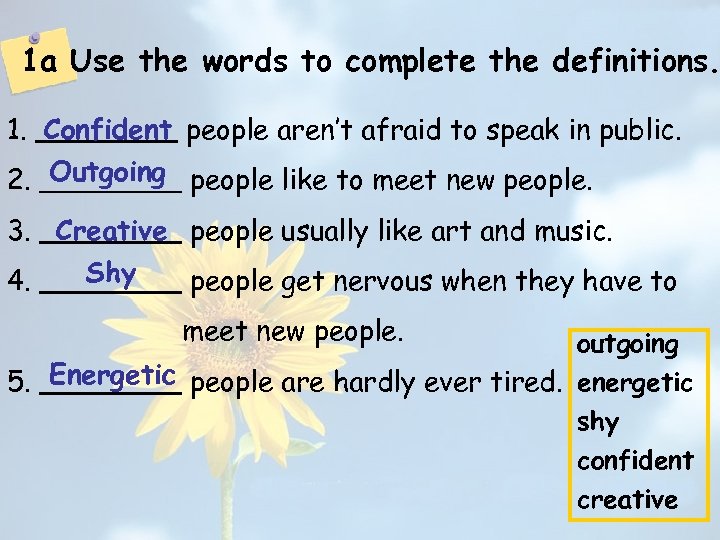
1 a Use the words to complete the definitions. 1. Confident people aren’t afraid to speak in public. 2. Outgoing people like to meet new people. 3. Creative people usually like art and music. Shy 4. people get nervous when they have to meet new people. outgoing 5. Energetic people are hardly ever tired. energetic shy confident creative
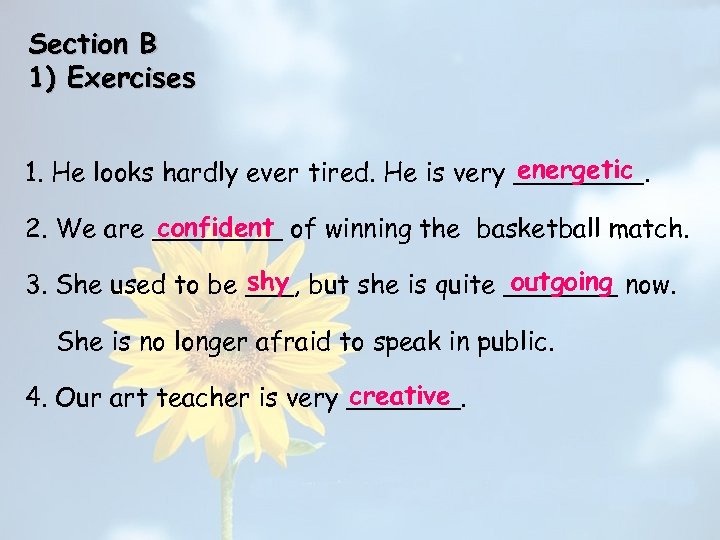
Section B 1) Exercises energetic 1. He looks hardly ever tired. He is very ____. confident 2. We are ____ of winning the basketball match. shy outgoing 3. She used to be ___, but she is quite _______ now. She is no longer afraid to speak in public. creative 4. Our art teacher is very _______.
1 b Which words describe you? You can add some more words! outgoing energetic shy confident creative A: What are you like? B: I think I’m creative and outgoing.
Sample conversation 1: A: What are you like? B: I think I’m shy and unconfident. I don’t know what to say in front of strangers and I always get nervous.
Sample conversation 2: A: What are you like? B: I think I’m outgoing and energetic. I like to make friends everywhere. I like talking with drivers or passengers when I take a bus or a taxi. I never feel tired during my study.
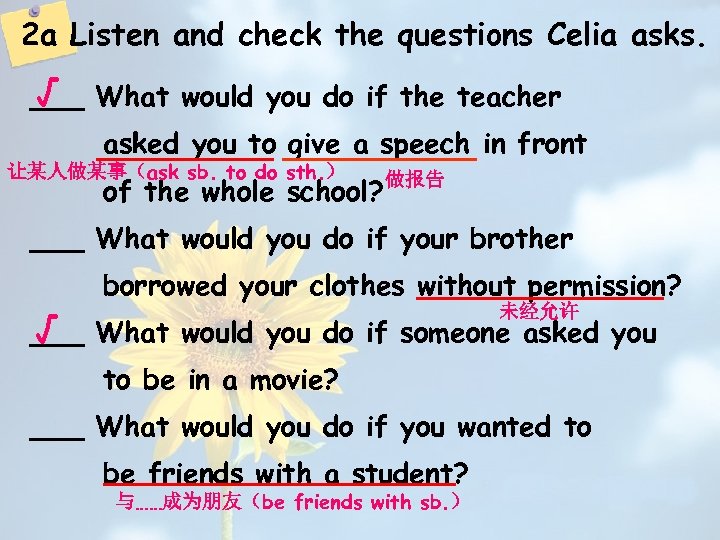
2 a Listen and check the questions Celia asks. √ ___ What would you do if the teacher asked you to give a speech ___________ in front 让某人做某事(ask sb. to do sth. ) of the whole school? 做报告 ___ What would you do if your brother borrowed your clothes without permission? _______ 未经允许 ___ What would you do if someone asked you √ to be in a movie? ___ What would you do if you wanted to __________ be friends with a student? 与……成为朋友(be friends with sb. )
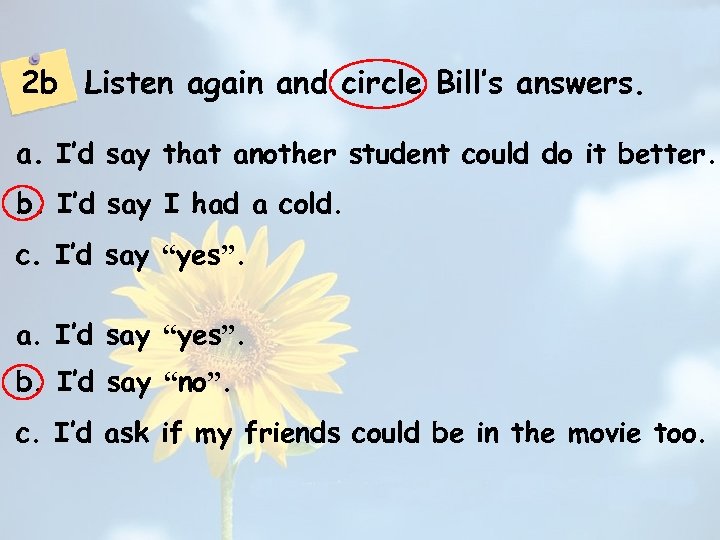
2 b Listen again and circle Bill’s answers. a. I’d say that another student could do it better. b. I’d say I had a cold. c. I’d say “yes”. a. I’d say “yes”. b. I’d say “no”. c. I’d ask if my friends could be in the movie too.
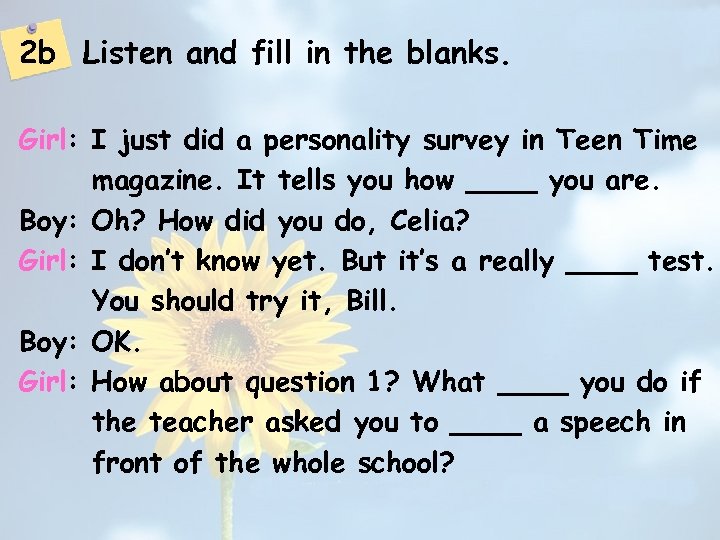
2 b Listen and fill in the blanks. Girl: I just did a personality survey in Teen Time magazine. It tells you how ____ you are. Boy: Oh? How did you do, Celia? Girl: I don’t know yet. But it’s a really ____ test. You should try it, Bill. Boy: OK. Girl: How about question 1? What ____ you do if the teacher asked you to ____ a speech in front of the whole school?
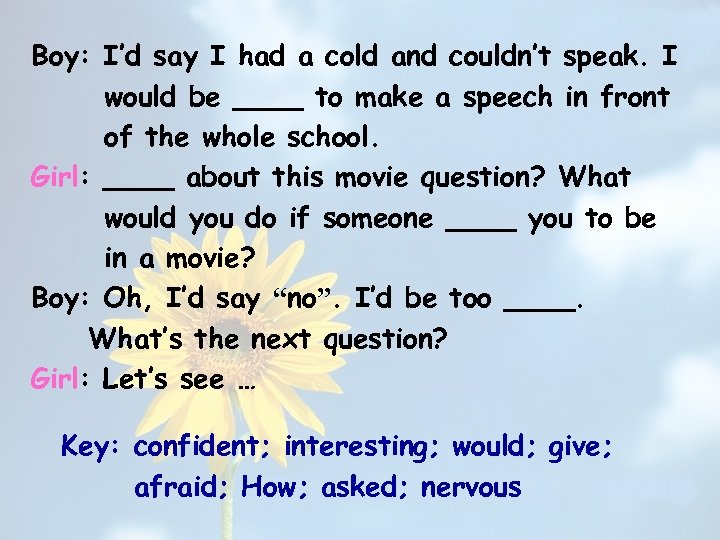
Boy: I’d say I had a cold and couldn’t speak. I would be ____ to make a speech in front of the whole school. Girl: ____ about this movie question? What would you do if someone ____ you to be in a movie? Boy: Oh, I’d say “no”. I’d be too ____. What’s the next question? Girl: Let’s see … Key: confident; interesting; would; give; afraid; How; asked; nervous
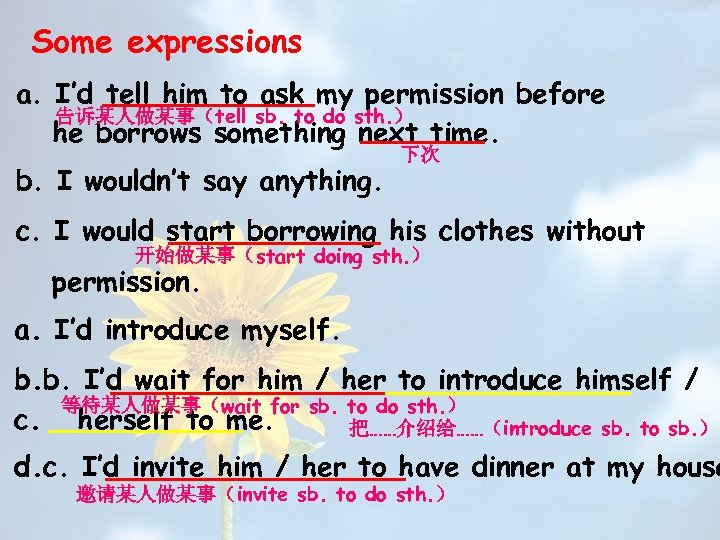
Some expressions a. I’d ______ my permission before tell him to ask 告诉某人做某事(tell sb. to do sth. ) _______ he borrows something next time. b. I wouldn’t say anything. 下次 ______ c. I would start borrowing his clothes without 开始做某事(start doing sth. ) permission. a. I’d introduce myself. b. b. I’d wait for him / her_______ to introduce himself / ____________ 等待某人做某事(wait for sb. to do sth. ) ______ c. herself to me. 把……介绍给……(introduce sb. to sb. ) _________ d. c. I’d invite him / her to have dinner at my house 邀请某人做某事(invite sb. to do sth. )
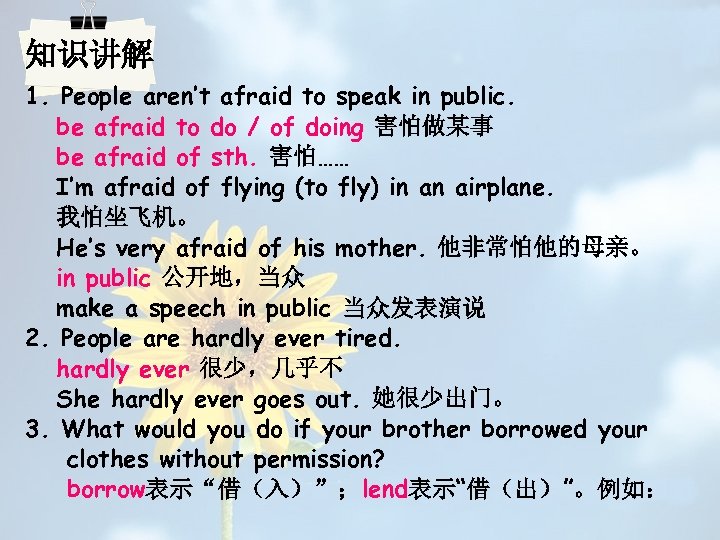
知识讲解 1. People aren’t afraid to speak in public. be afraid to do / of doing 害怕做某事 be afraid of sth. 害怕…… I’m afraid of flying (to fly) in an airplane. 我怕坐飞机。 He’s very afraid of his mother. 他非常怕他的母亲。 in public 公开地,当众 make a speech in public 当众发表演说 2. People are hardly ever tired. hardly ever 很少,几乎不 She hardly ever goes out. 她很少出门。 3. What would you do if your brother borrowed your clothes without permission? borrow表示“借(入)”;lend表示“借(出)”。例如:
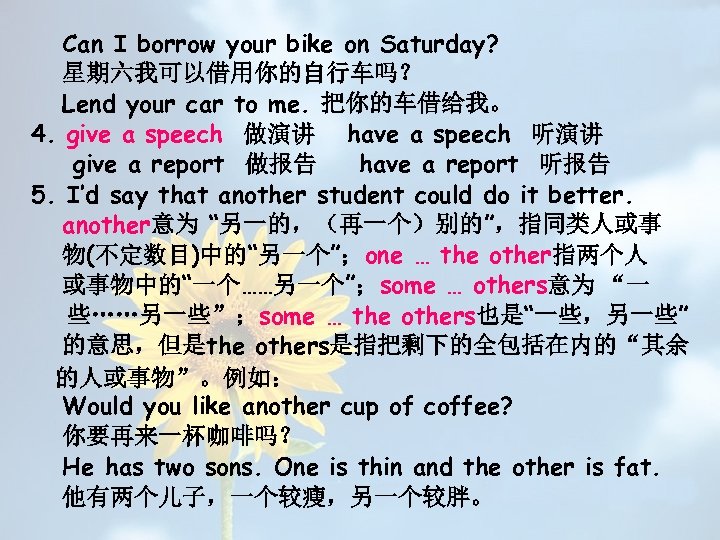
Can I borrow your bike on Saturday? 星期六我可以借用你的自行车吗? Lend your car to me. 把你的车借给我。 4. give a speech 做演讲 have a speech 听演讲 give a report 做报告 have a report 听报告 5. I’d say that another student could do it better. another意为 “另一的,(再一个)别的”,指同类人或事 物(不定数目)中的“另一个”;one … the other指两个人 或事物中的“一个……另一个”;some … others意为 “一 些……另一些”;some … the others也是“一些,另一些” 的意思,但是the others是指把剩下的全包括在内的“其余 的人或事物”。例如: Would you like another cup of coffee? 你要再来一杯咖啡吗? He has two sons. One is thin and the other is fat. 他有两个儿子,一个较瘦,另一个较胖。
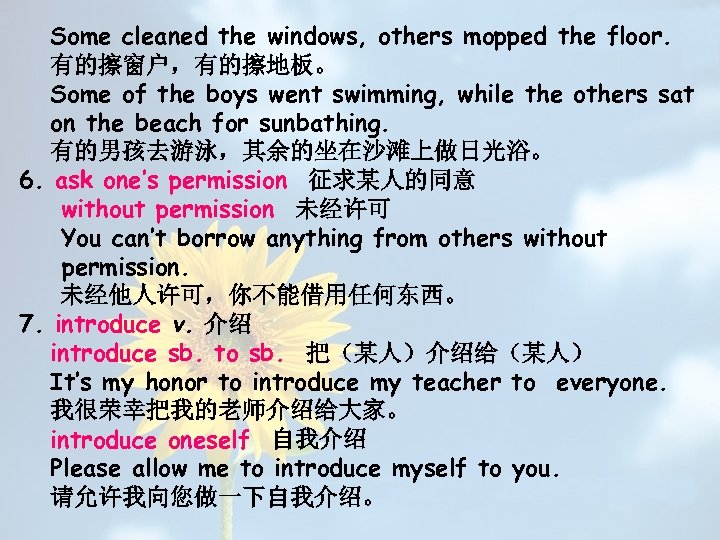
Some cleaned the windows, others mopped the floor. 有的擦窗户,有的擦地板。 Some of the boys went swimming, while the others sat on the beach for sunbathing. 有的男孩去游泳,其余的坐在沙滩上做日光浴。 6. ask one’s permission 征求某人的同意 without permission 未经许可 You can’t borrow anything from others without permission. 未经他人许可,你不能借用任何东西。 7. introduce v. 介绍 introduce sb. to sb. 把(某人)介绍给(某人) It’s my honor to introduce my teacher to everyone. 我很荣幸把我的老师介绍给大家。 introduce oneself 自我介绍 Please allow me to introduce myself to you. 请允许我向您做一下自我介绍。
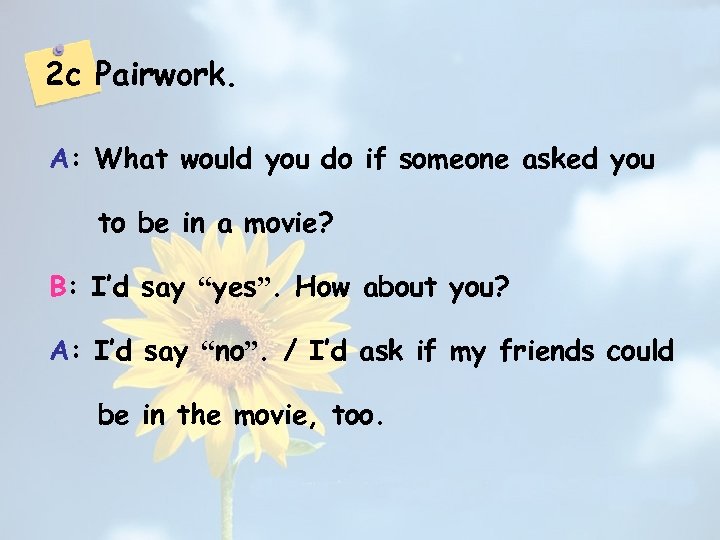
2 c Pairwork. A: What would you do if someone asked you to be in a movie? B: I’d say “yes”. How about you? A: I’d say “no”. / I’d ask if my friends could be in the movie, too.
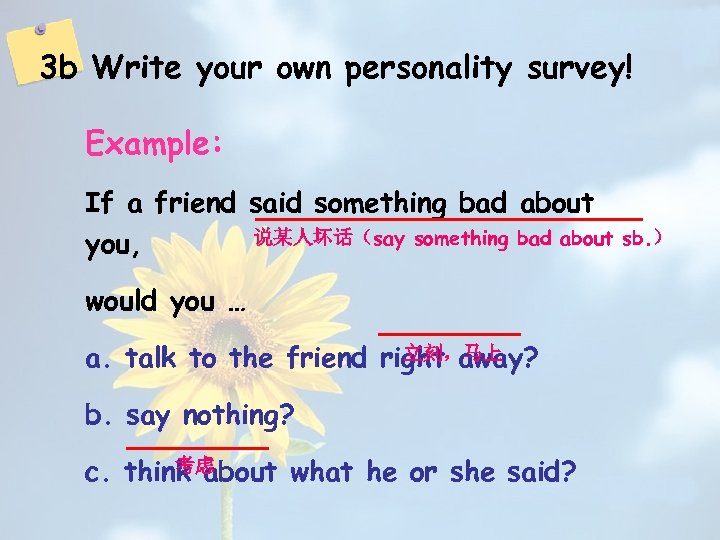
3 b Write your own personality survey! Example: If a friend said something bad about ___________ 说某人坏话(say something bad about sb. ) you, would you … ____ 立刻,马上 a. talk to the friend right away? b. say nothing? ____ 考虑 c. think about what he or she said?
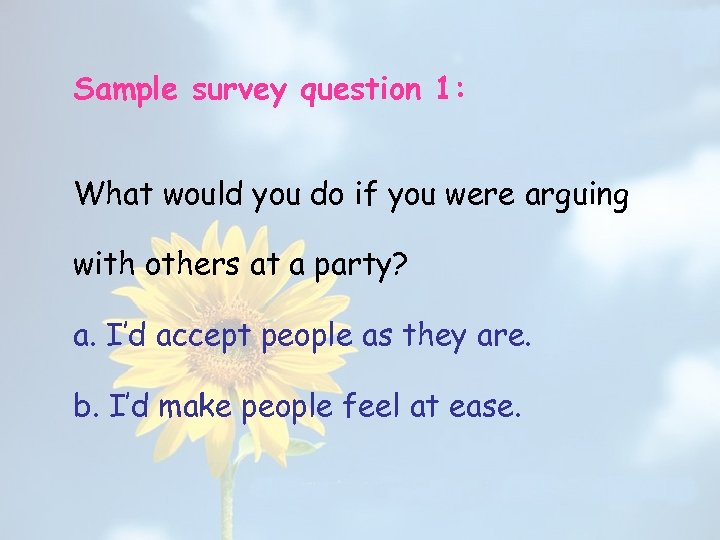
Sample survey question 1: What would you do if you were arguing with others at a party? a. I’d accept people as they are. b. I’d make people feel at ease.
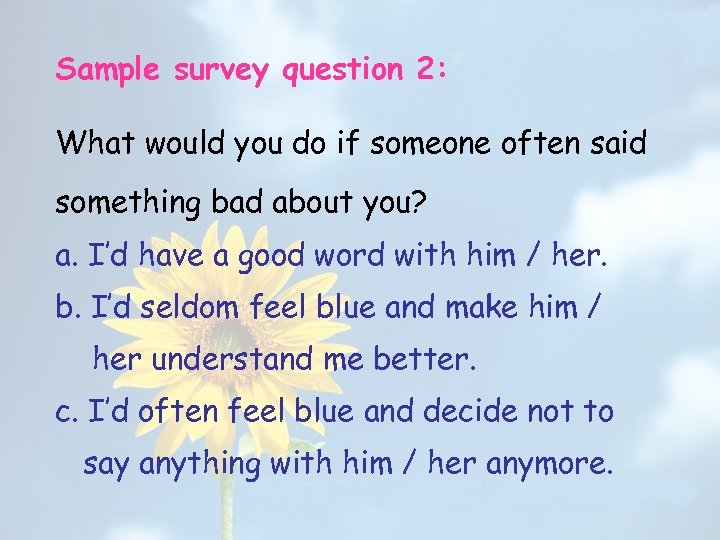
Sample survey question 2: What would you do if someone often said something bad about you? a. I’d have a good word with him / her. b. I’d seldom feel blue and make him / her understand me better. c. I’d often feel blue and decide not to say anything with him / her anymore.
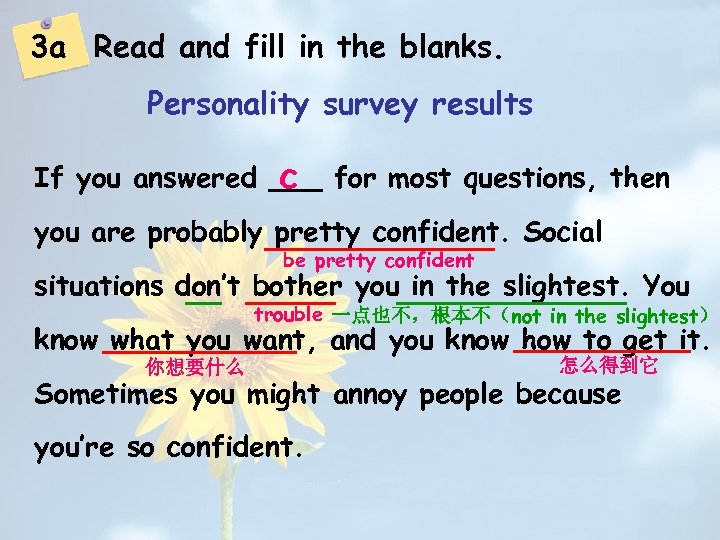
3 a Read and fill in the blanks. Personality survey results If you answered ___ for most questions, then c you are probably _______ Social pretty confident. be pretty confident situations don’t _____ you_______ You in the slightest. __ bother trouble 一点也不,根本不(not in the slightest) know ______ and you know _____ what you want, how to get it. 你想要什么 怎么得到它 Sometimes you might annoy people because you’re so confident.
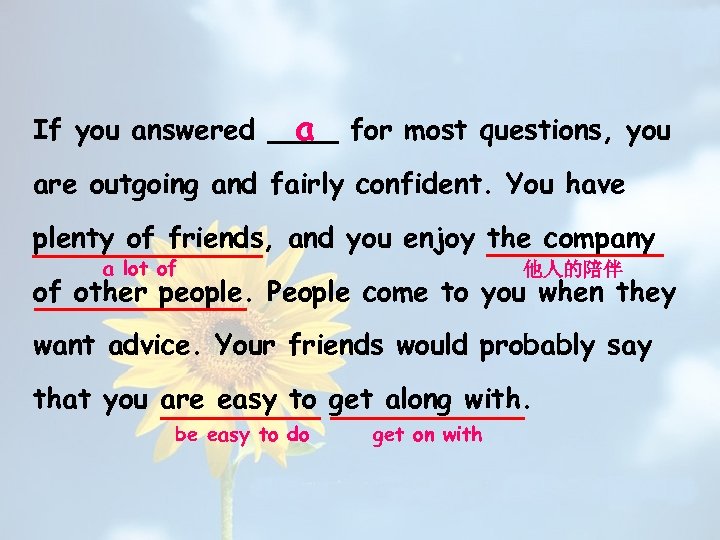
If you answered ____ for most questions, you a are outgoing and fairly confident. You have plenty of friends, and you enjoy the company _____________ a lot of 他人的陪伴 of other people. People come to you when they ______ want advice. Your friends would probably say that you are easy to get along with. ___________ be easy to do get on with
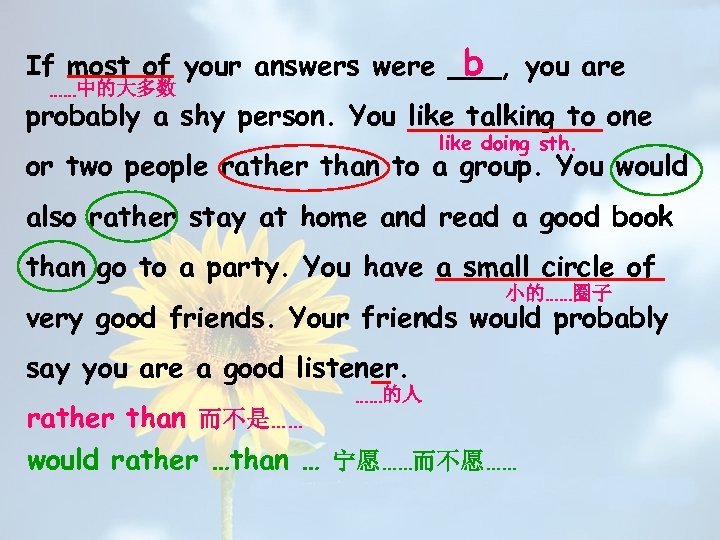
______ If most of your answers were ___, you are b ……中的大多数 probably a shy person. You like talking to one ______ like doing sth. or two people rather than to a group. You would also rather stay at home and read a good book than go to a party. You have _______ a small circle of 小的……圈子 very good friends. Your friends would probably say you are a good listener. _ ……的人 rather than 而不是…… would rather …than … 宁愿……而不愿……
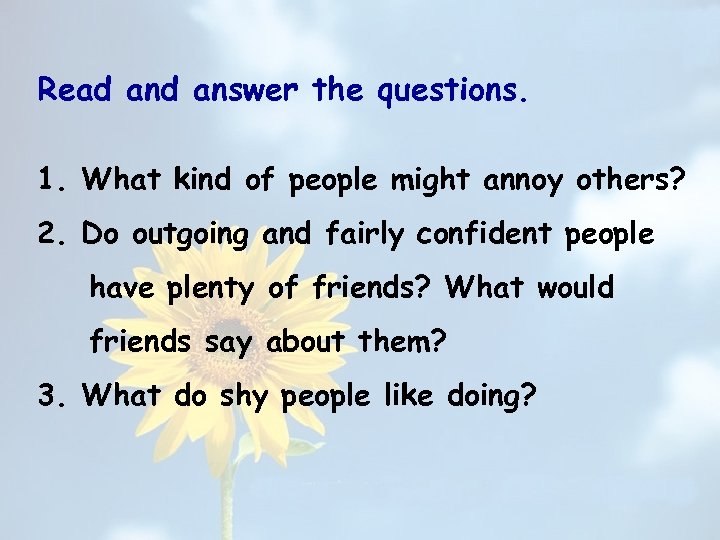
Read answer the questions. 1. What kind of people might annoy others? 2. Do outgoing and fairly confident people have plenty of friends? What would friends say about them? 3. What do shy people like doing?
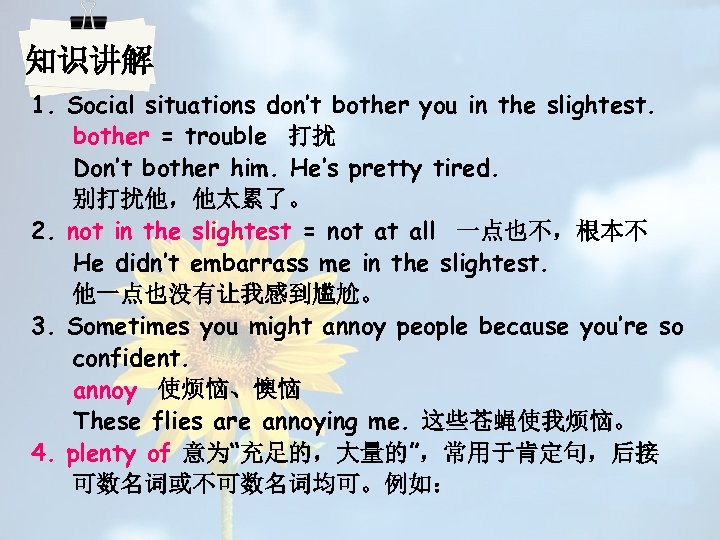
知识讲解 1. Social situations don’t bother you in the slightest. bother = trouble 打扰 Don’t bother him. He’s pretty tired. 别打扰他,他太累了。 2. not in the slightest = not at all 一点也不,根本不 He didn’t embarrass me in the slightest. 他一点也没有让我感到尴尬。 3. Sometimes you might annoy people because you’re so confident. annoy 使烦恼、懊恼 These flies are annoying me. 这些苍蝇使我烦恼。 4. plenty of 意为“充足的,大量的”,常用于肯定句,后接 可数名词或不可数名词均可。例如:
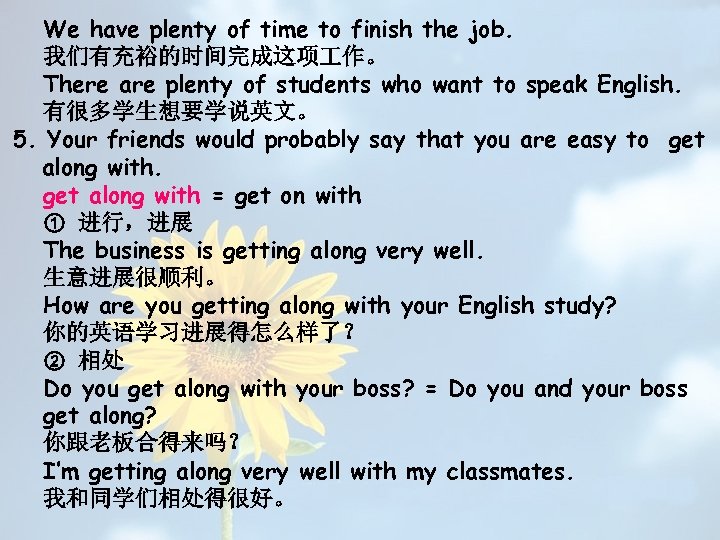
We have plenty of time to finish the job. 我们有充裕的时间完成这项 作。 There are plenty of students who want to speak English. 有很多学生想要学说英文。 5. Your friends would probably say that you are easy to get along with = get on with ① 进行,进展 The business is getting along very well. 生意进展很顺利。 How are you getting along with your English study? 你的英语学习进展得怎么样了? ② 相处 Do you get along with your boss? = Do you and your boss get along? 你跟老板合得来吗? I’m getting along very well with my classmates. 我和同学们相处得很好。
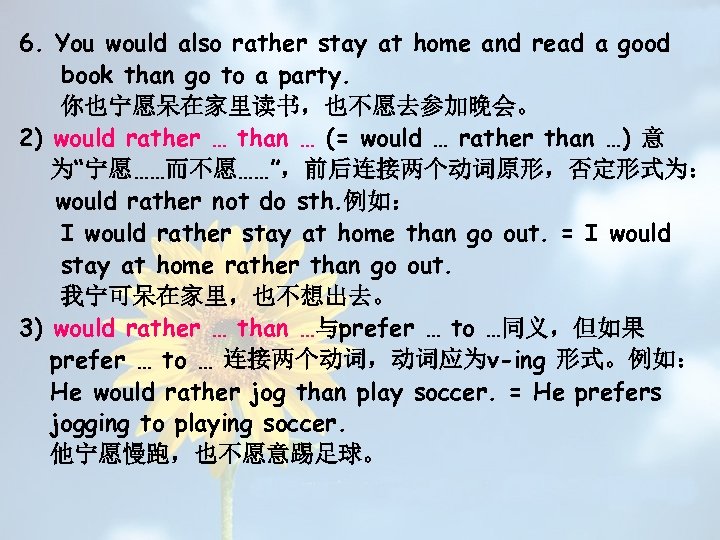
6. You would also rather stay at home and read a good book than go to a party. 你也宁愿呆在家里读书,也不愿去参加晚会。 2) would rather … than … (= would … rather than …) 意 为“宁愿……而不愿……”,前后连接两个动词原形,否定形式为: would rather not do sth. 例如: I would rather stay at home than go out. = I would stay at home rather than go out. 我宁可呆在家里,也不想出去。 3) would rather … than …与prefer … to …同义,但如果 prefer … to … 连接两个动词,动词应为v-ing 形式。例如: He would rather jog than play soccer. = He prefers jogging to playing soccer. 他宁愿慢跑,也不愿意踢足球。
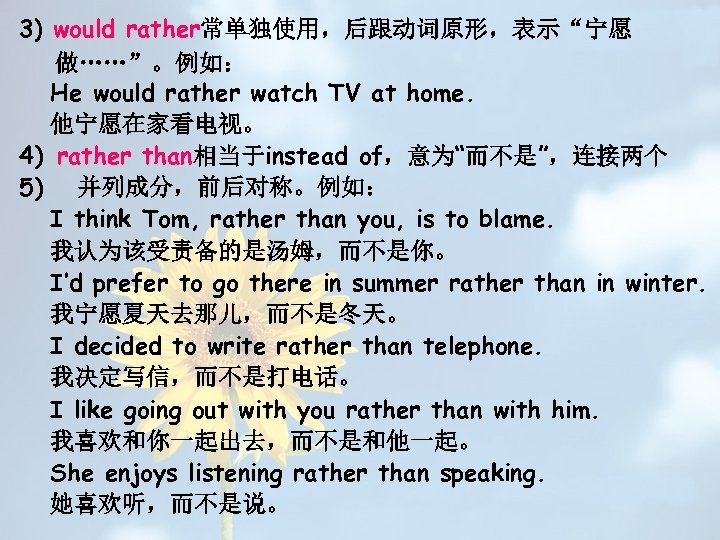
3) would rather常单独使用,后跟动词原形,表示“宁愿 做……”。例如: He would rather watch TV at home. 他宁愿在家看电视。 4) rather than相当于instead of,意为“而不是”,连接两个 5) 并列成分,前后对称。例如: I think Tom, rather than you, is to blame. 我认为该受责备的是汤姆,而不是你。 I’d prefer to go there in summer rather than in winter. 我宁愿夏天去那儿,而不是冬天。 I decided to write rather than telephone. 我决定写信,而不是打电话。 I like going out with you rather than with him. 我喜欢和你一起出去,而不是和他一起。 She enjoys listening rather than speaking. 她喜欢听,而不是说。
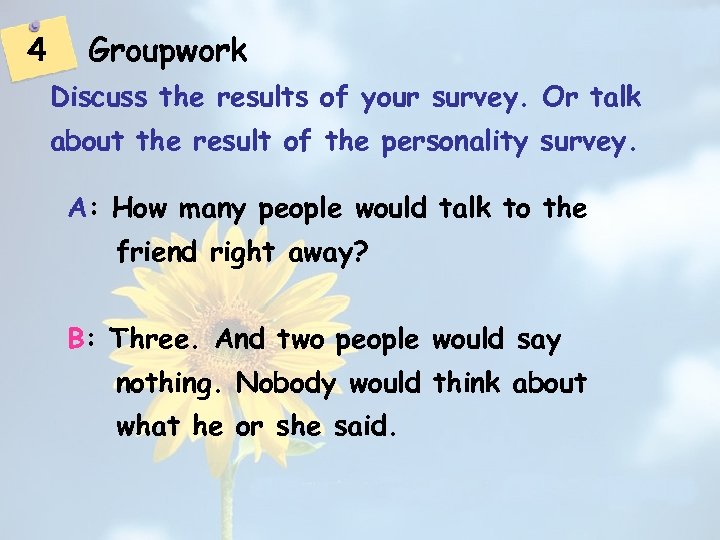
4 Groupwork Discuss the results of your survey. Or talk about the result of the personality survey. A: How many people would talk to the friend right away? B: Three. And two people would say nothing. Nobody would think about what he or she said.
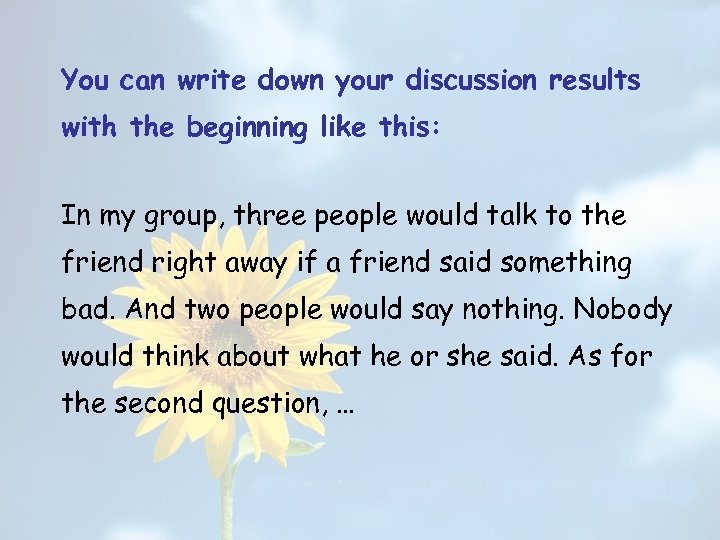
You can write down your discussion results with the beginning like this: In my group, three people would talk to the friend right away if a friend said something bad. And two people would say nothing. Nobody would think about what he or she said. As for the second question, …
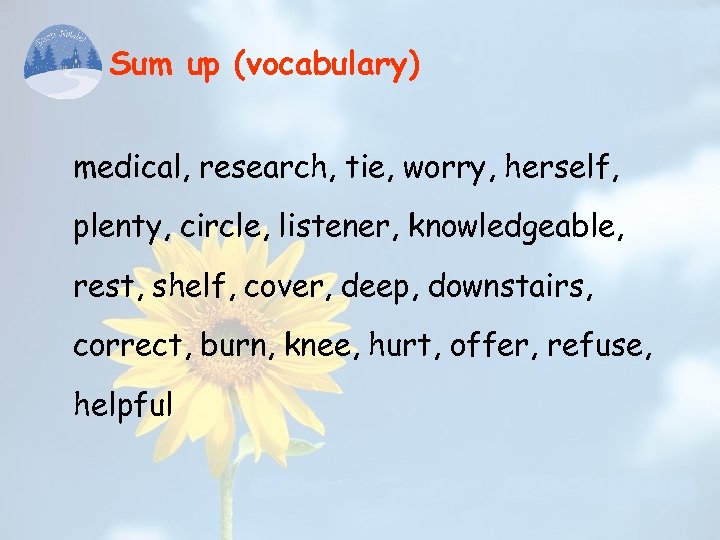
Sum up (vocabulary) medical, research, tie, worry, herself, plenty, circle, listener, knowledgeable, rest, shelf, cover, deep, downstairs, correct, burn, knee, hurt, offer, refuse, helpful
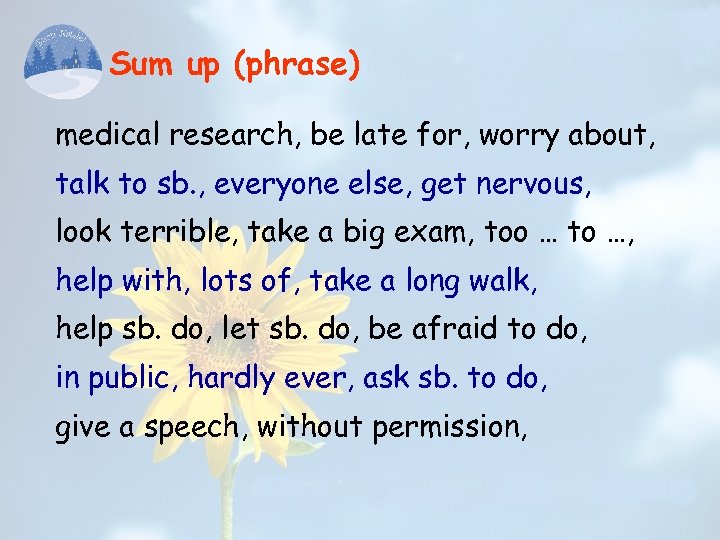
Sum up (phrase) medical research, be late for, worry about, talk to sb. , everyone else, get nervous, look terrible, take a big exam, too … to …, help with, lots of, take a long walk, help sb. do, let sb. do, be afraid to do, in public, hardly ever, ask sb. to do, give a speech, without permission,
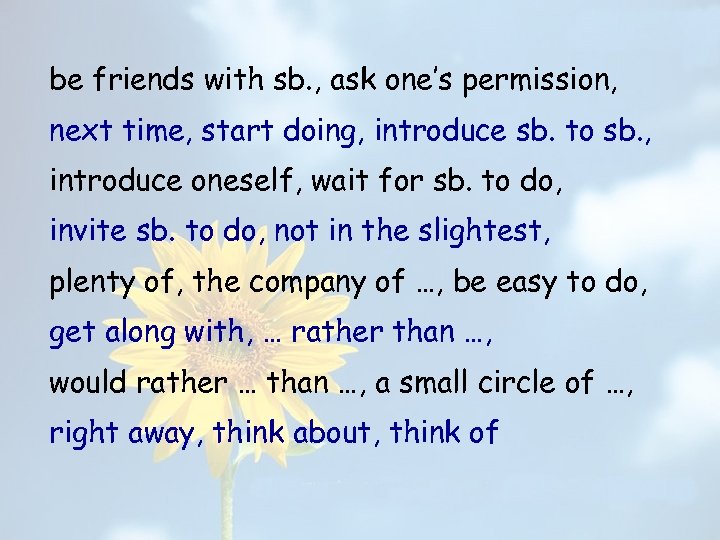
be friends with sb. , ask one’s permission, next time, start doing, introduce sb. to sb. , introduce oneself, wait for sb. to do, invite sb. to do, not in the slightest, plenty of, the company of …, be easy to do, get along with, … rather than …, would rather … than …, a small circle of …, right away, think about, think of
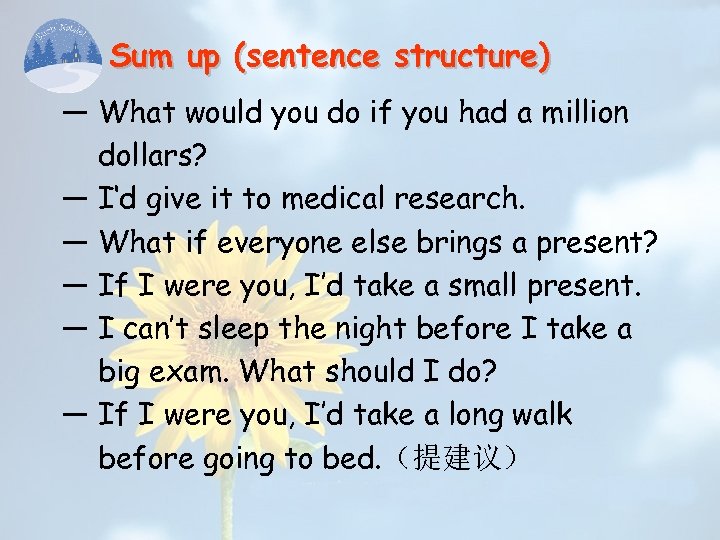
Sum up (sentence structure) — What would you do if you had a million dollars? — I‘d give it to medical research. — What if everyone else brings a present? — If I were you, I’d take a small present. — I can’t sleep the night before I take a big exam. What should I do? — If I were you, I’d take a long walk before going to bed. (提建议)
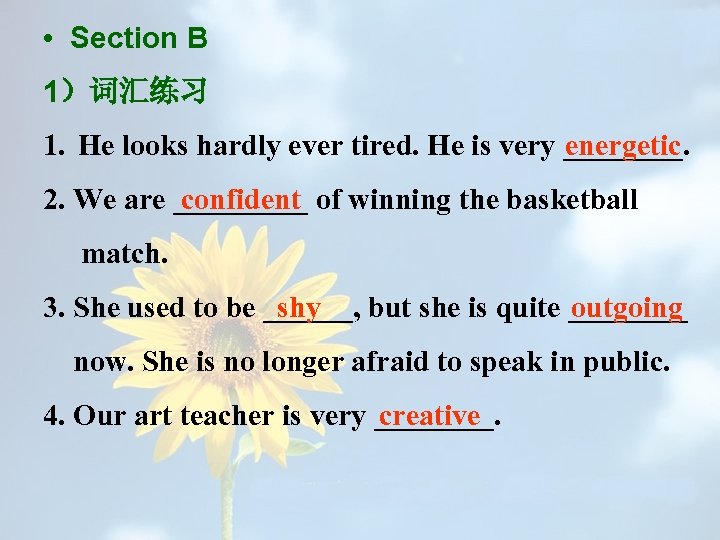
• Section B 1)词汇练习 energetic 1. He looks hardly ever tired. He is very ____. confident 2. We are _____ of winning the basketball match. shy outgoing 3. She used to be ______, but she is quite ____ now. She is no longer afraid to speak in public. creative 4. Our art teacher is very ____.
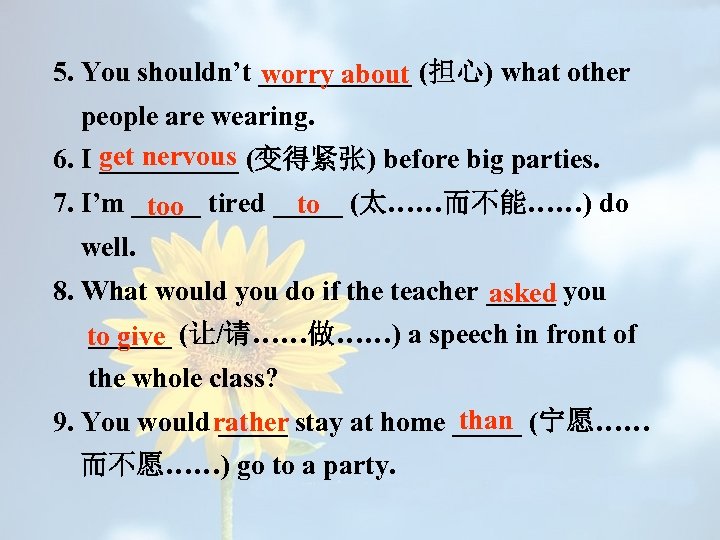
5. You shouldn’t ______ (担心) what other worry about people are wearing. get nervous 6. I _____ (变得紧张) before big parties. 7. I’m _____ tired _____ (太……而不能……) do to too well. 8. What would you do if the teacher _____ you asked ______ to give (让/请……做……) a speech in front of the whole class? than 9. You would rather stay at home _____ (宁愿…… _____ 而不愿……) go to a party.
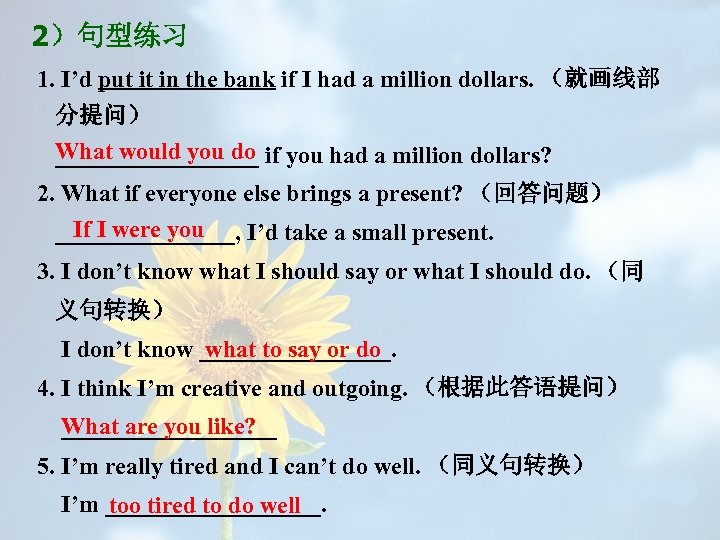
2)句型练习 1. I’d put it in the bank if I had a million dollars. (就画线部 分提问) What would you do if you had a million dollars? _________ 2. What if everyone else brings a present? (回答问题) If I were you ________, I’d take a small present. 3. I don’t know what I should say or what I should do. (同 义句转换) what to say or do I don’t know ________. 4. I think I’m creative and outgoing. (根据此答语提问) What are you like? _________ 5. I’m really tired and I can’t do well. (同义句转换) I’m _________. too tired to do well
Скачать презентацию Unit 4 What would you do Section B
24766b9985492939d15e5363a5186e52.ppt