


 Скачать презентацию Unit 4 Institutions Part One Congress 1
6869417eb77cb5a406107712a12b3da8.ppt
- Количество слайдов: 149
 Unit 4: Institutions Part One: Congress 1
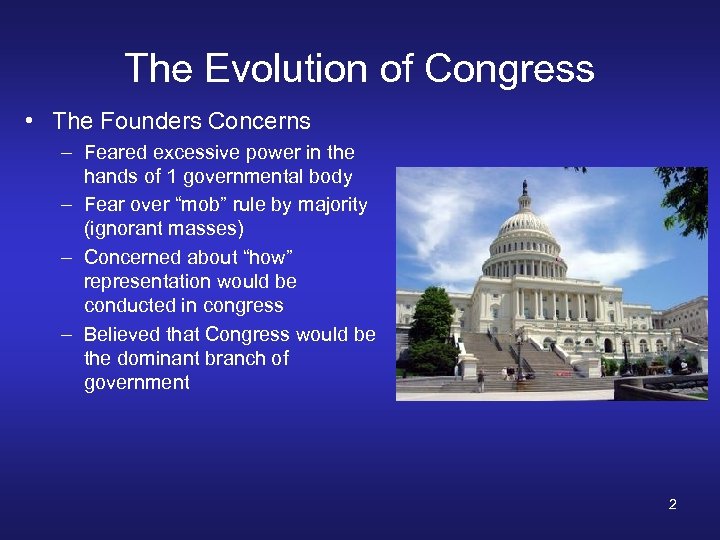 The Evolution of Congress • The Founders Concerns – Feared excessive power in the hands of 1 governmental body – Fear over “mob” rule by majority (ignorant masses) – Concerned about “how” representation would be conducted in congress – Believed that Congress would be the dominant branch of government 2
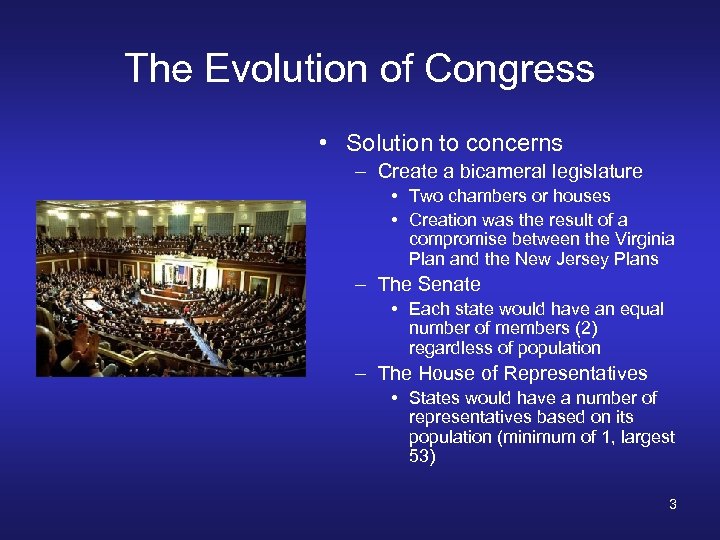 The Evolution of Congress • Solution to concerns – Create a bicameral legislature • Two chambers or houses • Creation was the result of a compromise between the Virginia Plan and the New Jersey Plans – The Senate • Each state would have an equal number of members (2) regardless of population – The House of Representatives • States would have a number of representatives based on its population (minimum of 1, largest 53) 3
 The Evolution of Congress • Centralization v Decentralization – Centralization: • Advantages / Disadvantages – Would allow Congress to act quickly and decisively but at the expense of individual members and the constituents they represent – Decentralization: • Advantages / Disadvantages – Would protect and enhance the interests of individual members and their constituents but would prevent Congress from acting quickly and decisively 4
 Overview of Congress • Terms and Sessions – – Each term of Congress lasts 2 years Begin Jan 3 rd of every odd-numbered year Terms are numbered consecutively (current 110 th Congress) Adjournment: the end of term (session) must be agreed upon by both houses • Prior to WWII the term lasted only 4 months • Today, the duties of office are such that they must meet considerably longer – There are two regular session each term with a short recess between sessions • The recess allows members to work with their states / constituents 5
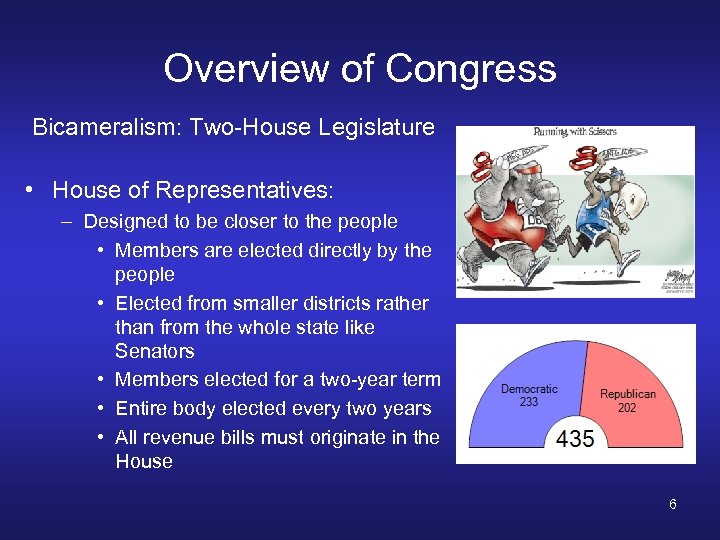 Overview of Congress Bicameralism: Two-House Legislature • House of Representatives: – Designed to be closer to the people • Members are elected directly by the people • Elected from smaller districts rather than from the whole state like Senators • Members elected for a two-year term • Entire body elected every two years • All revenue bills must originate in the House 6
 Overview of Congress • The Senate: – designed to be more removed from the people • Members were originally elected by the state legislatures • Members elected “at large” by the states voting population • Members elected for a 6 year term • Only 1/3 of Senate is up for election every two years – Provides more stability / continuity 7
 Overview of Congress • The House of Representatives – Size • • Determined by Congress, 435 members since 1911 Members elected by districts, not states The number of representatives per state is determined by population Demographic trends show a larger number of reps in Sun Belt states vs. Frost (Rust) Belt states – Terms of office (fixed) • • Elected every two years Subject to greater change / turnover By design to be kept in check by Senate Term limits declared unconstitutional (US Term Limits v. Thornton, 1995) – Qualifications: • 25 years old • citizen for 7 years • resident of state from which elected 8
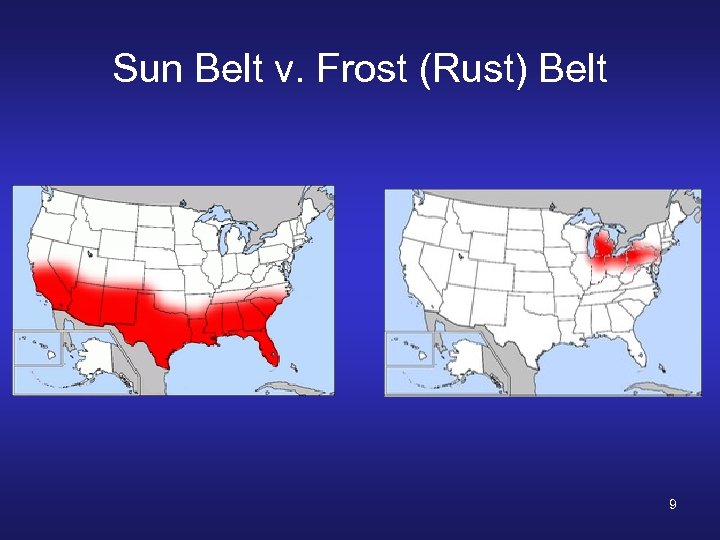 Sun Belt v. Frost (Rust) Belt 9
 Overview of Congress • Senate – Size • 100 members chosen in statewide (at large) elections – Since the Senate is smaller, it has less need formality, with less strict procedures than the House of Representatives – Terms of office • Senators serve 6 year terms • 1/3 of Senators are up for election every 2 years – Terms are staggered to provide stability in government – No term limits – Qualifications • 30 years old • citizen for 9 years • must be a resident of state from which elected 10
 Overview of Congress • Compensation – Members set their own salary • 27 th Amendment prevents salary raises taking effect until the following term • Current Congressional salary, $165, 200 • Congressmen can no longer charge “speaking fees” – Other Perks “fringe benefits” • • Special tax break (for maintaining two houses) Travel allowance Life insurance and health benefits Retirement plan (up to $150, 000 per year) Given office space and a staff Franking privilege “Immunity Clause” Members of Congress cannot be arrested / detained while going to or from a session of Congress 11
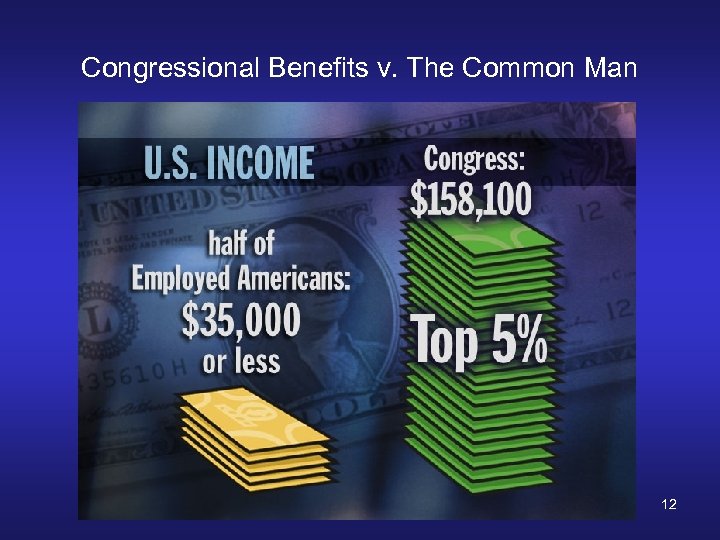 Congressional Benefits v. The Common Man 12
 Overview of Congress • Personal and Political Backgrounds – Congress members are not a representative crosssection of the American people • Majority of members are; – – White males 50+ years old Protestant Upper-middle class lawyers – Recent developments • More women and minorities have been elected in recent years • It is reasonable to assume that since they were elected by the people, the members of Congress are capable of meeting the needs of the poor within their communities regardless of their personal economic backgrounds 13
 The Incumbency Advantage • House of Representatives – 90% of incumbents are reelected • Senate – 80% of incumbents are reelected • As a result, few seats are seriously contested in the House, leading to charges that Congress is permanent – Most seats that open in Congress are a result of retirement rather than serious election challenges 14
 The Incumbency Advantage • Advantages of Incumbency – Franking privilege – Staffers (having a permanent staff that is not paid for out of your budget) – Patronage (people whom you have helped in the past who are willing to help run your reelection campaign) – Name recognition – Casework (work done for the benefit of your constituents) – Access to money (multiple PAC’s provide the majority of campaign funds) 15
 The Incumbency Advantage • Special advantage for House incumbents – Gerrymandering (understand the role reapportionment plays) • Reapportionment: the redistribution of the 435 seats in the House on the basis of changes in state populations – The number of Representatives per state is determined by population – Census is conducted every 10 years – Census shows changes in state populations • If a state shows a significant increase in its population it will likely gain seats • Any state that shows a significant decrease in population or does not grow as much as other states will likely lose seats 16
 The Incumbency Advantage • Redistricting – If a state has a change in the number of seats, its district boundaries must change – Redistricting is carried out by the party in power of the state legislature – One form of redistricting is Gerrymandering • Gerrymandering – The redrawing of district boundaries in such a way as to favor the party in power of the state legislature 17
 The Incumbency Advantage • Gerrymandering – Term was coined by the actions of Massachusetts governor Elbridge Gerry who drew his states district lines himself – Some districts were shaped like salamanders prompting some critics to use the term gerrymanders • How it works: State legislatures can – Packing • Draw district lines in such a way as to concentrate the opposing party in a few districts, thus preserving the majority of the seats for itself – Cracking • Draw the district lines in such as way as to disperse the opposing party throughout the state and thus dilute that party’s strength in order to preserve a majority of the seats for the majority party 18
 The Incumbency Advantage • Effects of Gerrymandering – The party in power stays in power – Safe seats are created for incumbents, leading to further difficulties for challengers – It breaks up “communities of interest” (areas where people have lived for a long time and who share the same beliefs / political views) – Creates districts that are shaped strangely – Creates “majority-minority” districts when racial gerrymandering is used 19
 The Incumbency Advantage • Redistricting requirements – Baker v. Carr, 1962 • In this case, the state of Tennessee was sued by Representative Charles Baker over the challenge that he was denied his rights (14 th Amendment “Equal Protection Clause”) as a result of the failure of state legislatures to properly redraw district lines to account for the migration of the population within his district • Ruling: – District reapportionment must be conducted in a fair manner that takes into account the “fairness” of representation. Each district members vote must count equally (one man, one vote) – Redistricting must been done is such a way as to prevent overrepresentation (malapportionment) – Wesberry v. Sanders, 1964 • Ruling: – The population of Representative districts must be equal 20
 The Incumbency Advantage • Redistricting requirement (continued) – District lines must be contiguous – Racial Gerrymandering is prohibited • Shaw v. Reno, 1993 – Race cannot be the sole method of deciding inclusion in a district • Miller v. Johnson, 1995 – Redrawing of district lines to increase minority political participation is ruled unconstitutional 21
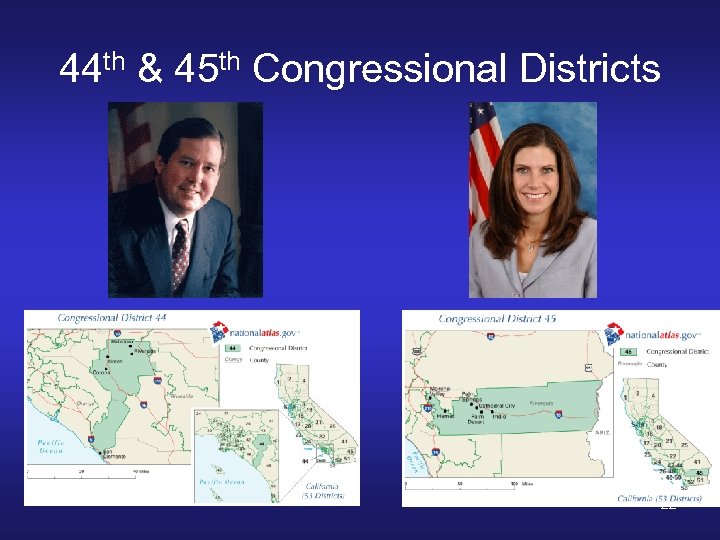 44 th & 45 th Congressional Districts 22
 The Structure and Powers of Congress • Bicameral Structure – Based on British system of two house legislature – Designed to protect against an overly powerful legislature – House of Reps was expected to reflect the popular will of the average citizen – Senate is to provide more stability, continuity, and in-depth deliberation – Bicameralism acts as a moderating force that prevents government from steamrolling ahead and infringing on people’s rights – Bicameralism was part of the Connecticut (Great) Compromise at the Constitutional Convention 23
 The Structure and Powers of Congress • Expressed / Enumerated Powers (condensed list: be familiar with other powers on list) • Legislature may only exercise those powers that are stated in the Constitution – Levy taxes (revenue bills must begin in the House) – Spend money for common defense and public welfare – Regulate foreign, interstate, and Indian commerce (commerce clause [Article I, sect. 8, clause 3]) • The commerce clause has been challenged repeatedly due to its broad interpretation by Congress – Declare war – Coin money – Raise and support an army and navy 24
 The Structure and Powers of Congress • Implied Powers – Based upon the Elastic Clause (Article I, Section 8, Clause 18) • Also known as the Necessary and Proper Clause – Examples: • Creation of a national bank • The creation of paper money • Expansion of government agencies for defense; Air Force, CIA, etc. – Strict v. Loose Constructionist approaches • Strict: what is the literal meaning? • Loose: what did the Founders intend? Also views the Constitution as a living document that adapts with the times and is subject to interpretation 25
 The Structure and Powers of Congress • Institutional Powers • Powers related to the system of checks and balances – Senate ratifies treaties with 2/3 vote – Senate approves Presidential appointments with majority vote • Provides power to the President when Congressional majority is from the same political party. – House votes for impeachment (majority vote) – Senate tries the impeachment (2/3 vote necessary to convict) • Only ranking officials (President, Vice President, and “all civil officers of the United States”) are subject to impeachment – House elects President if there is no clear majority winner (no candidate reaches 270 electoral votes) • Senate elects the Vice President – Propose Constitutional Amendments (need 2/3 vote in both houses) – Both houses can seat, unseat, and punish (censure) its own members 26
 The Structure and Powers of Congress • Powers Denied to Congress – Passing Ex Post Facto laws – Passing Bills of Attainder • Laws that punish without the benefit of a trial – Suspending Habeas Corpus except in cases of rebellion or invasion 27
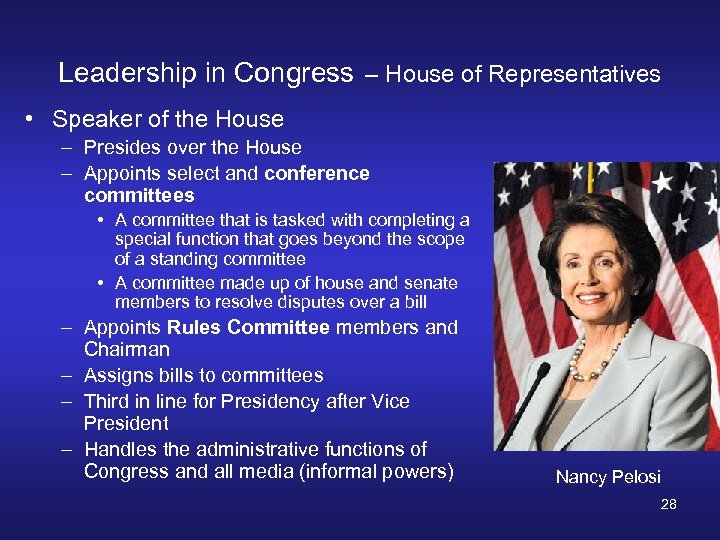 Leadership in Congress – House of Representatives • Speaker of the House – Presides over the House – Appoints select and conference committees • A committee that is tasked with completing a special function that goes beyond the scope of a standing committee • A committee made up of house and senate members to resolve disputes over a bill – Appoints Rules Committee members and Chairman – Assigns bills to committees – Third in line for Presidency after Vice President – Handles the administrative functions of Congress and all media (informal powers) Nancy Pelosi 28
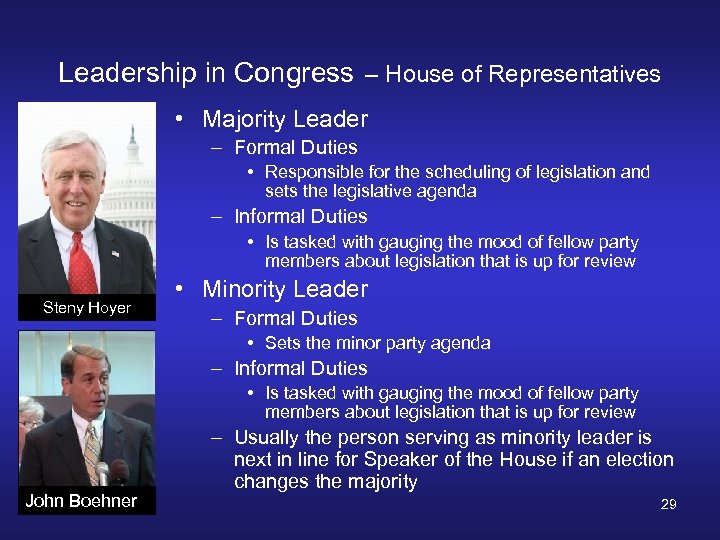 Leadership in Congress – House of Representatives • Majority Leader – Formal Duties • Responsible for the scheduling of legislation and sets the legislative agenda – Informal Duties • Is tasked with gauging the mood of fellow party members about legislation that is up for review Steny Hoyer • Minority Leader – Formal Duties • Sets the minor party agenda – Informal Duties • Is tasked with gauging the mood of fellow party members about legislation that is up for review John Boehner – Usually the person serving as minority leader is next in line for Speaker of the House if an election changes the majority 29
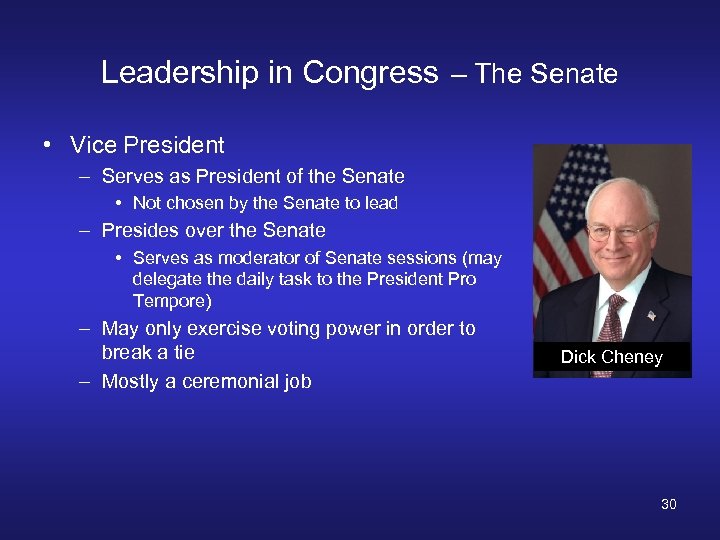 Leadership in Congress – The Senate • Vice President – Serves as President of the Senate • Not chosen by the Senate to lead – Presides over the Senate • Serves as moderator of Senate sessions (may delegate the daily task to the President Pro Tempore) – May only exercise voting power in order to break a tie – Mostly a ceremonial job Dick Cheney 30
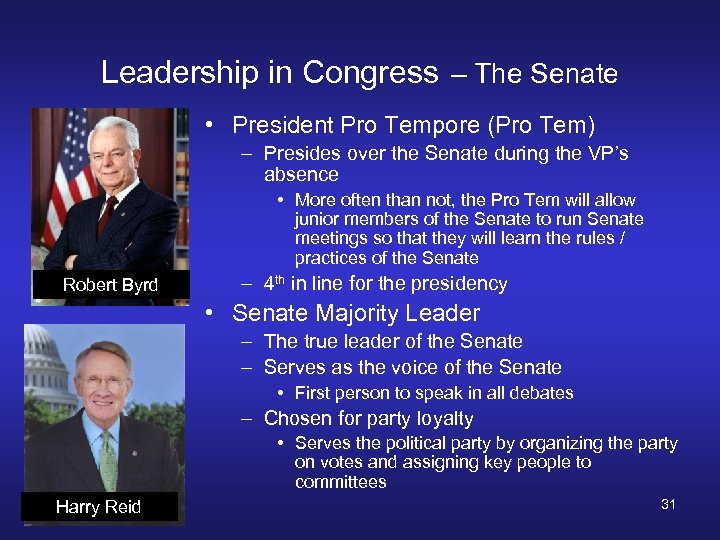 Leadership in Congress – The Senate • President Pro Tempore (Pro Tem) – Presides over the Senate during the VP’s absence • More often than not, the Pro Tem will allow junior members of the Senate to run Senate meetings so that they will learn the rules / practices of the Senate Robert Byrd – 4 th in line for the presidency • Senate Majority Leader – The true leader of the Senate – Serves as the voice of the Senate • First person to speak in all debates – Chosen for party loyalty • Serves the political party by organizing the party on votes and assigning key people to committees Harry Reid 31
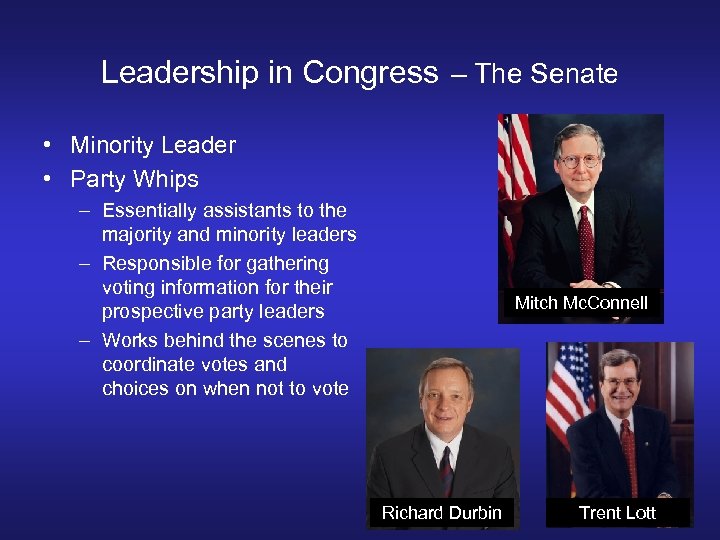 Leadership in Congress – The Senate • Minority Leader • Party Whips – Essentially assistants to the majority and minority leaders – Responsible for gathering voting information for their prospective party leaders – Works behind the scenes to coordinate votes and choices on when not to vote Mitch Mc. Connell Richard Durbin Trent Lott 32
 Influences on Members of Congress • Constituents – Congressmen are assumed to be following the will of the people in his/her district • This is called representational voting – Reasons for not following the will of the people • It is difficult to gauge the opinion of the constituents on any single issue • Due to lack of knowledge or interest, most constituents are not aware of the issues before Congress • Interests within the district are often divided • There is no law compelling the Congressman to follow the will of his district 33
 Influences on Members of Congress • Members convictions – Congressman follows his/her own will or votes their conscience • This is known as attitudinal voting • Other members of Congress – Member influence range from showing support for ones political party or working with members who share similar interests • Organizational voting: voting with the support of a group • Reciprocity: the exchanging of favors that occurs in Congress. “I’ll argue on behalf for your bill if you will support me on this bill”. • Logrolling: the exchanging of votes among members of Congress. “I’ll vote in favor of your bill if you will vote against this one over here”. 34
 Influences on Members of Congress • Congressional Staff Members – A Congressman’s staff can influence his/her decisions in a myriad of ways • • • Controlling the information received Granting or denying access to members Helping to set committee agendas Making recommendations on legislation Helping to write the legislation Analyzing information form the Presidential staff – What is wrong with this picture? How does this effect the idea/concept of democracy? 35
 Influences on Members of Congress • Interest Groups / Lobbies / PAC’s – Influence through the use of: • • • Campaign contributions “Report cards” on key issues Targeting politicians with attack ads Providing information (a very powerful tool) Testifying before a committee (again providing key information) Paying for “junkets” (offering free trips to tour facilities, discuss issues, etc. ) • Congressional Caucuses – Congressional members typically hold a closed meeting prior to the start of each term – During the caucus they choose a leader (majority or minority as the case may be) – They also use this time to develop their stand on issues and to pull the team together – Specialized caucuses also influence members (Black Caucus, Hispanic Caucus, etc. ) 36
 Influences on Members of Congress • The President – By choosing to support or oppose a Congressman, the President can gain leverage • Choosing to attend or not attend a fundraising event for a Congressional member • Speak in favor of or speak against the member • President may choose to reward or punish party members • Campaign Contributors – May or may not have a strong impact • The Media – Serves as a watchdog 37
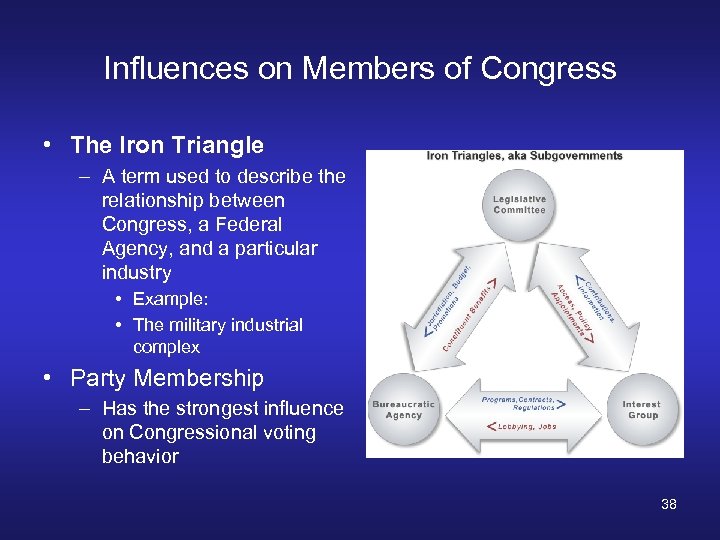 Influences on Members of Congress • The Iron Triangle – A term used to describe the relationship between Congress, a Federal Agency, and a particular industry • Example: • The military industrial complex • Party Membership – Has the strongest influence on Congressional voting behavior 38
 How a Bill Becomes a Law • Types of Bills – Public bills: measures applying to the nation as a whole • Example: a tax measure or an amendment to a copyright law – Private bills: measures that apply to certain persons or places rather than to the entire nation • Example: Congress passed an act to give an Idaho farmer $85000. 00 to an Idaho sheep rancher for his losses resulting from attacks by grizzly bears which had been removed from Yellowstone Park onto nearby public lands on which he grazed his flock • Types of Resolutions – Joint Resolutions: a proposal for some action that has the force of law when passed; usually deals with special circumstances or temporary matters • Example: correct an error in a statute that has already passed or to appropriate money for the Presidential inauguration – Concurrent Resolutions: a statement of position on an issue, adopted by the House and Senate acting jointly; does not have the force of law; does not require the President’s signature • Used to show displeasure with the President or to clearly define Congress’s opinion on a matter 39
 How a Bill Becomes a Law • Types of Resolutions (continued) – Resolution (simple resolution): a measure dealing with some matter in one house; does not have the force of law; does not require the President’s signature • Used to set internal rules or procedures within on house of Congress • Riders: a provision (addition) that is not likely to pass on its own is sometimes attached to an important matter that is likely to pass – Its sponsors hope that it will “ride” through the legislative process on the strength of the main measure – Most riders are attached to appropriation (funding) measures – “Christmas Trees”: sometimes measures are hung with so many riders that they are referred to as Christmas trees • Opponents of those “decorations” are forced to accept them if they want the bills major provisions to become law 40
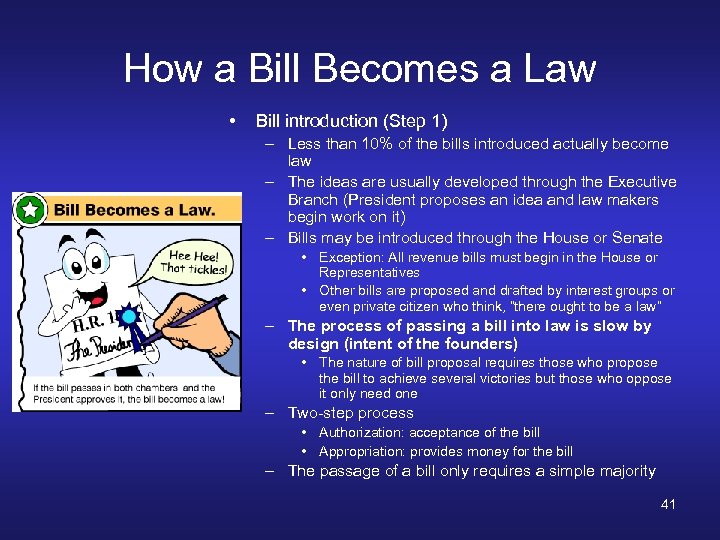 How a Bill Becomes a Law • Bill introduction (Step 1) – Less than 10% of the bills introduced actually become law – The ideas are usually developed through the Executive Branch (President proposes an idea and law makers begin work on it) – Bills may be introduced through the House or Senate • Exception: All revenue bills must begin in the House or Representatives • Other bills are proposed and drafted by interest groups or even private citizen who think, “there ought to be a law” – The process of passing a bill into law is slow by design (intent of the founders) • The nature of bill proposal requires those who propose the bill to achieve several victories but those who oppose it only need one – Two-step process • Authorization: acceptance of the bill • Appropriation: provides money for the bill – The passage of a bill only requires a simple majority 41
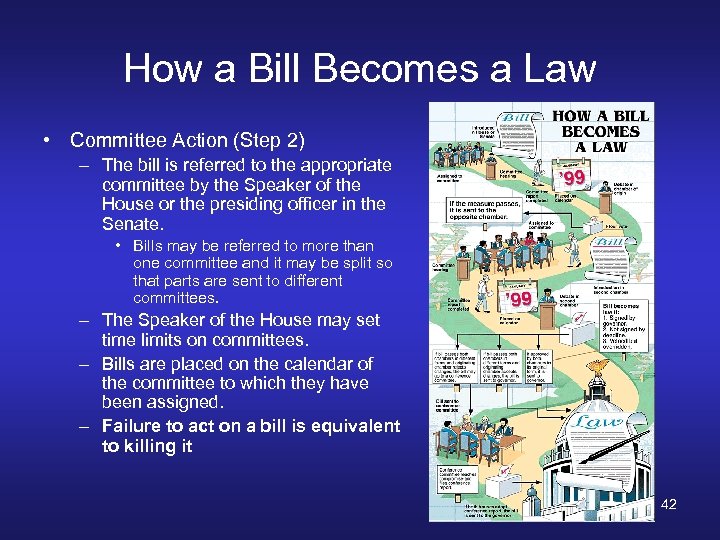 How a Bill Becomes a Law • Committee Action (Step 2) – The bill is referred to the appropriate committee by the Speaker of the House or the presiding officer in the Senate. • Bills may be referred to more than one committee and it may be split so that parts are sent to different committees. – The Speaker of the House may set time limits on committees. – Bills are placed on the calendar of the committee to which they have been assigned. – Failure to act on a bill is equivalent to killing it 42
 How a Bill Becomes a Law – Standing Committees: Permanent committee to which bills in a specified subject-matter area are referred • Standing committees act as sieves by sifting through all of the many bills referred to them • Most bills (90%) never get past committee • The fate of most bills is decided in committee rather than on the floor of Congress • Pigeonholed: Bills that the committee deems unacceptable are “set aside” to die in committee • Discharge Petition: If a committee buries a measure that a majority of the House wants to consider, a majority vote can attempt to force the measure out of committee and onto the floor for consideration – The process rarely works and is not often tried – Subcommittee: A division of an existing committee that is formed to address specific issues – Committee as a Whole: the entire House sits in committee on a bill in order to speed up the process • Amendments are added using a voting process 43
 How a Bill Becomes a Law • Committee Actions (the process) – Report on the bill favorably (Pass) • The bill is then “reported out” to the full house for consideration – Refuse to report on the bill (pigeonholed) – Report the bill in an amended form • Many bills are changed in committee during the “mark-up” session • Riders may be attached to a bill at this stage (earmarked funds) • Multiple bills covering the same topic may be combined as part of the amending process – Report the bill unfavorably and let the house kill the bill – Introduce their own bill (a committee bill) • While in committee an entirely new form of the bill may be substituted for the bill under review 44
 How a Bill Becomes a Law • Floor Action (Step 3) – Differences between House and Senate • House places limits on debates on bills before the members • Senate allows for a filibusters, an ongoing discussion of the issue until the member surrenders the floor – This tactic is used to oppose a bill before Congress by wearing down its supporters – Topic of debate is not limited to the measure at hand – A filibuster may be stopped with a 3/5 vote of cloture • The Senate only allows for non-germane riders, “Christmas Tree” bills are the result • Senate allows any member to place a hold on a bill or Presidential nomination – Not in the Constitution but accepted by tradition – Used as a temporary delay so that a Senator could have more time to decide on a bill – Also used for when a Senator would be out of Washington as a request to delay the bill until he/she returned – Today it is used as a means of killing a bill 45
 How a Bill Becomes a Law • Conference Committee Action – Comprised of members from both houses whose purpose is to reconcile different versions of House-Senate bills and sends them back to each house for a vote • Presidential Action (Step 4) – Once the bill has been approved by Congress it goes to the President for the final step. The President may: • Sign the bill in full (accept it as is and make it a law) • Veto (refuse) the bill in full (can be overridden by a 2/3 vote in Congress) • Ignore the bill – After 10 days of sending bill to President the bill automatically becomes law – If Congress adjourns before the end of the 10 day period the bill is pocket vetoed • In 1990’s congress gave President Clinton the power to Line-Item. Veto (strike down parts of a bill, usually riders) but the Supreme Court declared it unconstitutional (Clinton v. New York) – Allowed President to legislate (Congressional Power not Presidential) – Most governors have the power to Line-Item-Veto 46
 The Committee System • The Importance of Committees – All of the real work in Congress is done in Committee, not on the floor of Congress – Bills must pass (discharge) through committee before being released to the floor for debate • Committees may attempt to “pigeonhole” the bill to prevent its release to the floor • An order of Cloture can force the committee to discharge the bill for consideration – Committee Functions • Analyze the legislation (bills) • Investigate the actions of the Executive Branch on an “as-needed” basis • Serves as oversight of the agencies of the Executive Branch on an “on-going” basis 47
 The Committee System • The Selection of Committee Members – It is extremely important for a Congressman to get on the “correct” committee • The correct committee is one that will best serve his/her constituents and will lead to reelection – Members are assigned to committees by either the Committee on Committees or the Steering and Policy Committee – Whichever party has the majority in the House will have a majority of members on each committee • This is to put the power more closely in the hands of the people – The chairman of each committee is of the majority party with the number two person (ranking member) coming from the minority party • This assures that the leadership is indirectly chosen by the people • This also assures that compromise must occur thus slowing down the process of government 48
 The Committee System • The Selection of Committee Chairmen – The power of the chairman is substantial over • Setting the committee agenda – Dictating what bills will be discussed and in what order • Responsible for hiring the committee staff • Determines who will be assigned to subcommittees • Places limits on what the subcommittees can and cannot do (jurisdiction) – The Secret Ballot System • Chairmen are chosen during the Party Caucuses or Conferences prior to the start of the term • A secret ballot is cast but most members are chosen based on their seniority • Currently there is a term limit of 6 years for House Chairmen (part of the reforms of Speaker of the House, Newt Gingrich) 49
 The Committee System • Advantages of the Seniority System – Experienced members lead the committee – Provides the stability of consistent leadership for years – Leaders bring to the table expertise in their chosen fields thanks to years of service – Reduces the chance of conflict between party members • Disadvantages of the Seniority System – There is a tendency to take the conservative route by maintaining the status quo – Because of the nature of incumbency, party leaders tend to come from the rural areas creating a rural bias in the committees 50
 The Committee System • The Need for Committee Reform (prior to 1970’s) – Committee chairmen held near absolute power – Lesser party members were given little power and authority – The work of committees was conducted behind closed doors (the public was kept uninformed) • Reforms of the 1970’s (the class of ’ 74) – Chairmen are elected by secret ballot • Staves off inter-party conflict – Chairmen share more power and authority with lower-ranking members – Subcommittees were given more autonomy – Junior party members are granted more committee leadership in the subcommittees – All hearings are open to the public (allows for public scrutiny) – No member may chair more than one standing committee – In the Senate, junior senators are granted staff assistance – In the House, all members received membership on at least one major committee 51
 The Committee System • The Major Standing Committees – Standing committees are the permanent committees of Congress – They have legislative, investigative, and oversight powers • The House – The Rules Committee • The most powerful of all • Sets the legislative calendar (agenda) and establishes the “rules” for debate and amendment – The Ways and Means Committee • Deals with all tax bills – Appropriation Committee • Deals with spending bills – Authorization Bills allow for the spending of money – Appropriation Bills provide funding for programs – Budget Committee • Monitors the Federal Budget – Armed Services Committee • Deals with all aspects of the military 52
 The Committee System • The Senate – Finance Committee • Deals with tax bills – Appropriations Committee • Deals with spending bills – Budget – Foreign Relations • Highly prestigious due to Senates larger role in foreign affairs than the House • Senate is given Treaty Ratification Powers by the Constitution – Judiciary Committee • Screens judicial nominees to the Supreme Court • Judicial nominees are scrutinized closely since they serve life terms • The committee has held up many judicial appointments for both Republican and Democratic Presidents 53
 The Committee System • Conference Committees – Temporary committees comprised of members from both houses – Creates a compromise on bills that differ after coming out of committee – After the Conference Committee fixes the bill, it is sent back to each house for ratification • No further changes can be made to the bill once it is released by the Conference Committee • Once released from the Conference Committee the bill generally passes – Conference Committees are so powerful that they are sometimes referred to as “the third house of Congress” • Other Types of Committees – Select Committees • Appointed by the House for a limited or temporary purpose such as conducting research on an issue (note the importance of interest groups) – Joint Committees • The same as a select committee but composed of members from both houses 54
 The Committee System • The Case Against Congress – – – Inefficiency Unrepresentative Unethical Irresponsible Congress delegates excessive power to the Executive Branch (Imperial Presidency) • Review your notes for specific details 55
 Unit 5: Institutions Part Two: The Executive Branch 56
 Evolution of the Presidency • Deliberations at the Constitutional Convention – Alternatives to current Presidential system • A plural executive (more than one President chosen in order to divide the power, based on Roman model) • Some wanted an executive council with veto power over Presidential actions • Hamilton and others wanted the President to serve for life • Compromise is reached with a single, elected President with a fixed term of office – Concerns of the Founders • Feared an excessively strong President – Too strong? Becomes a tyrant king – Also feared no term limits • Feared for an excessively weak President – Too weak? Puppet of the Senate • “Make him too weak: the legislature will usurp his powers. Make him too 57 strong: he will usurp the legislature. ” – Governor Morris
 Evolution of the Presidency • Election of the President – Some wanted Congress to elect the President • Risked Congressional dominance – Others called for direct elections • Problems: • Gives too much power to large (populous) states • Demagogues (charismatic speakers) might be able to coerce the masses • Illiteracy made voting questionable • Poor systems of communication were in place – Compromise: The Electoral College • The people had some input • Balanced power of large and small states • In the event of a tie, small states had more power • Term of office problem solved when Washington chose to not run for a third term 58
 Evolution of the Presidency • The first Presidents: Washington-Monroe 1789 -1825 – Men with great reputations who led the fight for independence • All but Adams served two terms • All but Adams were Virginians – Political parties developed despite the warnings of Washington – Appointments for major positions in government were chosen based on the “rule of fitness” • Partisanship was a factor but generally only well-respected men received appointments – The role of the President was much smaller then since Congress was to be the most powerful of the branches • Andrew Jackson 1829 -1837 (the first Imperial President) – The expansion of Presidential power – Jackson used the spoils system to appoint friends and supporters to key political positions – Jackson used the Presidential veto power to expand Presidential influence • He vetoed 12 Acts of Congress, more than all of his predecessors combined – He ignored a Supreme Court order about Indian Removal 59
 Evolution of the Presidency • The Reemergence of Congress 1837 -1932 – Congress reestablished its power after Jackson left office – The President was able to briefly establish his power mostly during times of war but Congress generally was the dominant branch • The next 8 Presidents after Jackson only served a single term of office – With the exceptions of Theodore Roosevelt and Woodrow Wilson, the Presidency was seen as a negative force working against Congress not a source of positive change / leadership • Cleveland vetoed 414 bills – Today the President is viewed as a source of leadership and an initiator of bills with Congress responding – In the past it took a strong personality or a crisis for the President to become the central figure of government 60
 Evolution of the Presidency • Emergence of the Presidency – The Great Depression (crisis) led to increased Presidential powers • The New Deal Legislation – WWII led to continued Presidential power – The Cold War facilitated continued Presidential power – In the 1970’s Congress tried to reassert its power but was only successful in the short-term • President Reagan restored the power and prestige of the Presidency – The current President Bush strengthened Presidential authority through the use of war powers and the Patriot Act 61
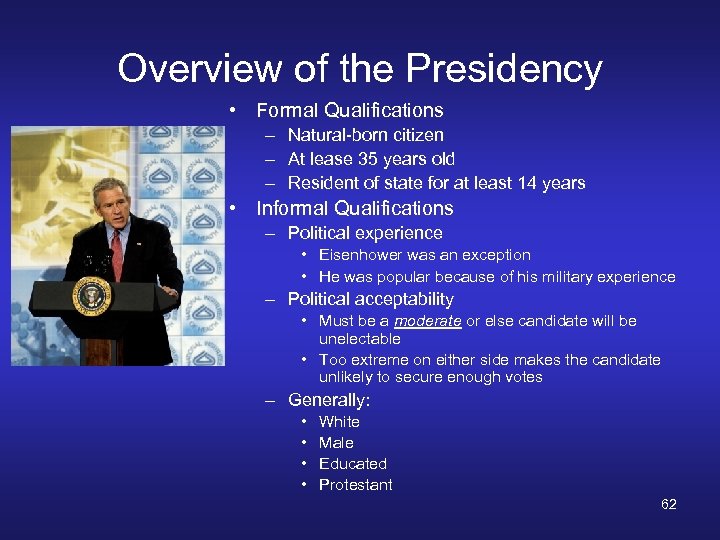 Overview of the Presidency • Formal Qualifications – Natural-born citizen – At lease 35 years old – Resident of state for at least 14 years • Informal Qualifications – Political experience • Eisenhower was an exception • He was popular because of his military experience – Political acceptability • Must be a moderate or else candidate will be unelectable • Too extreme on either side makes the candidate unlikely to secure enough votes – Generally: • • White Male Educated Protestant 62
 Overview of the Presidency • Term of Office – Four Years – Maximum of two elected terms • Tradition / precedent of Washington was formalized by the 22 nd Amendment • 22 nd Amendment was passed in response to Republicans who feared the FDR had acquired too much power and wanted to prevent such an occurrence in the future • It is possible to serve for 10 years – If VP becomes President just after the midpoint of a President’s term of office – If he serves less than half of a President’s term he is eligible for election twice – If he serves more than half of a President’s term he may only be elected once 63
 Overview of the Presidency • Compensation – Set by Congress and cannot be raised or lowered during President’s term of office in order to prevent undo influence – Salary was raised from $200, 000 to $400, 000 in 2001 • First time a President received a raise since 1969 – Many “perks” • $50, 000 a year for travel, entertainment, and other official expenses • The right to live in the White House – 132 -room mansion on 18 acres of land equipped with a staff of over 80 persons, tennis courts, bowling alley, and a private movie theater • Access to a fleet of vehicles – Automobiles (Presidential Limousines) – Air Force One and Marine Corp One • The use of Camp David a resort in the mountains of Maryland • Full medical and dental • Secret Service protection for life 64
 Overview of the Presidency • Compensation continued… – Opportunities to make money after leaving office • Speaking fees: fees paid to have the person speak at an event – Reagan earned $2 million for giving three speeches in Japan – Clinton earns $300, 000 per speech • Writing memoirs about time in office – Nixon and Carter are the most famous – Clinton received a $12 million dollar advance from a publisher – Serving on corporate board of directors 65
 Overview of the Presidency • Succession – Vacant due to death, resignation, or impeachment and removal • Vice President (if he can’t serve it then goes to) • Presidential Succession Act of 1947 – Speaker of the House, Senate President Pro Tem, Secretary of State, Secretary of the Treasury, Secretary of Defense, cabinet members in the order of the creation of their offices – If the President is disabled, the 25 th Amendment applies • President informs the Congress of disability and VP becomes acting President • If unable to inform Congress, VP and Cabinet go to Congress to receive approval • When President is able to return, he informs Congress and is reinstated 66
 Growth of Presidential Power • Original intent of Founders – Congress, not the President, was to be the dominate power • Some Presidents underestimated their power and allowed Congress to take the initiative • In modern times the President has taken a more active role • Non-Constitutional sources of Presidential Power – The office of President is held by only one man, not 535 Congressmen – Personality traits of the President • Note the impact of mass media – Public dependency on the Federal government – Congress delegates authority to Executive Branch • Poorly worded legislation, Congress defers to President during times of economic or foreign crisis, President appeals directly to the people to promote an agenda forcing Congresses hand – Emergence of US as a world power after WWII (Imperial Presidency) • Cold War puts US into non-stop crisis • President is chosen to deal with international crisis 67
 Growth of Presidential Power • Maximizing Presidential Power and Effectiveness – “Move it or lose it” • Push legislation early in their terms when popularity is highest • Popularity declines over time – “Avoid details” • Don’t attempt too much, concentrate on a few top priorities – “Cabinets don’t get much done; people do” • White House staff accomplish more • Cabinet secretaries have divided loyalties 68
 Roles of the President • Constitutional Roles – Powers • Propose legislation • Veto legislation – Denied line item veto by Supreme Court • Calls special sessions of Congress • Makes State of the Union Address to Congress – Checks on Powers • Congress can block proposed legislation • Congress can override Presidential veto with a 2/3 majority in both houses 69
 Roles of the President • Chief Executive – Powers • Enforce laws, treaties, and court decisions • Appoints officials to office and can fire them • Issues Executive Orders to carry out laws – Executive Orders do not need Congressional approval – Qualifications: President must have the authority to issue the order and the ability to implement them – Checks on Powers • Congress passes laws and has the power to spend money • Senate can reject Presidential appointments and treaties • Congress has the power to impeach (House) and remove from power (Senate) • Supreme Court can strike down Executive Orders 70
 Roles of the President • Commander in Chief – Power • Head of the Armed Forces – President may deploy troops without the authorization of Congress for a limited time – Congress often enacts joint resolutions to authorize the Presidents deployment of troops rather than declare war – Checks on Power • Congress appropriates funds for the military • Congress declares war • War Powers Act of 1973 71
 Roles of the President • Chief Diplomat – Powers • Set foreign policy – Power to make foreign policy was confirmed by US v. Curtiss-Wright (FDR blocked an American company from trading arms to countries involved in a civil war (Bolivia) • Appoints and received ambassadors – May also declare ambassadors persona non grata • Negotiates treaties and executive agreements – Treaty: a formal agreement between two sovereign states, requires Congressional approval – Executive Agreement: a pact between the President and the head of a foreign state, does not require Congressional approval – Gives diplomatic recognition to foreign governments – Checks on Power • Congress appropriates funds foreign affairs • Senate can reject ambassadors and treaties 72
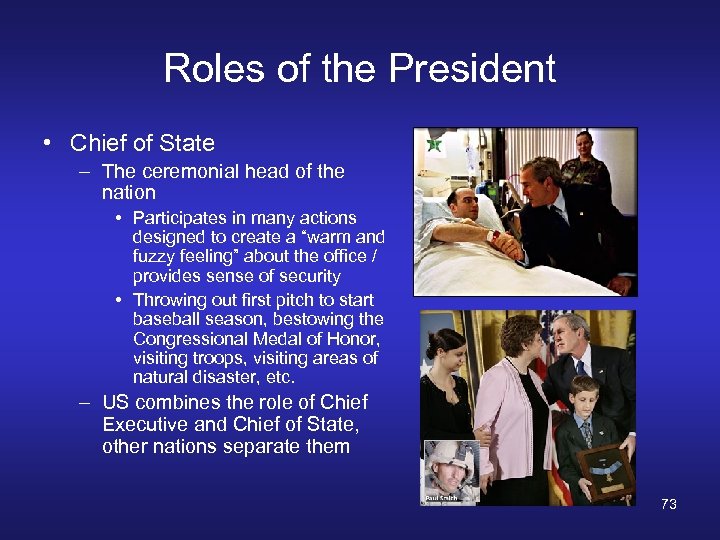 Roles of the President • Chief of State – The ceremonial head of the nation • Participates in many actions designed to create a “warm and fuzzy feeling” about the office / provides sense of security • Throwing out first pitch to start baseball season, bestowing the Congressional Medal of Honor, visiting troops, visiting areas of natural disaster, etc. – US combines the role of Chief Executive and Chief of State, other nations separate them 73
 Roles of the President • Chief Jurist – Powers • Appoints federal judges • May issue pardons and amnesty – Pardon: the forgiveness of a crime and the penalty associated with it – Amnesty: an act of justice by which the supreme power in a state restores those who may have been guilty of any offence against it to the position of innocent persons – Checks on Powers • Senate can reject judicial appointments • Senators can place holds on appointments • Senators can filibuster nominations – Just the threat of blocking appointments can often force President to choose another candidate or to compromise on an issue 74
 Roles of the President • Non-Constitutional Roles – Head of Political Party • Selects the party chairman of the national committee and Vice President nominee • Provides political patronage – The practice of appointing party members into positions of power as a reward for their loyalty – Chief Economist • Responsible for the overall health of the economy • Proposes the federal budget – Congress has the right to alter it 75
 Presidential Support Staff • Historical growth of support staff – Refer to notes for details • Executive Office of the President – White House Office / White House Staff • The immediate staff of the President: – Hold office space in the White House (the West Wing) in order to be closer to the President and to be at his beck-and-call – Staffers often jockey for position to hold the ear of the President 76
 Presidential Support Staff • Organization Methods: – Circular Method: President is the hub, staff are the spokes • Allows for greater access and more information but at the expense of efficiency • Presidents may become overwhelmed with details and lose sight of the big picture – Pyramid Method: Assistants report through hierarchy with Chief of Staff at the top who reports to the President • Allows for greater efficiency but a the expense of access to information • Presidents may be kept in the dark and lose touch with what is really going on 77
 Presidential Support Staff • White House Staff cont. – OMB (Office of Management and Budget) • Prepares the annual budget and reviews federal programs – NSC (National Security Council) • Coordinates foreign military / policy • National Security Advisor has grown in importance since the Nixon Presidency – CEA (Council of Economic Advisors) • Three person advisory group on economic policy – Council on Environmental Quality 78
 Presidential Support Staff • Cabinets – Collectively the heads of the 15 cabinet departments (see research assignment for names) and 5 other positions that are considered “Cabinet Rank” • • • OMB Director CIA Director Counselor to the President (White House Counselor) UN Ambassador US Trade Representative – Cabinet heads are chosen by the President with the consent of the Senate (appointees must be confirmed by the Senate) • Purpose of the cabinet – Serve as head of their prospective Executive Department – Advise the President • Some presidents rely on their cabinets more that others • Andrew Jackson appointed his friends to cabinet posts and chose to meet with them in the kitchen rather than in the West Wing. His group became known as “the Kitchen Cabinet”. 79
 Presidential Support Staff • US cabinet system (review system under parliamentary governments) – Cabinet members cannot serve as Congressmen while serving on the cabinet (conflict of interest) – Cabinet meets at the request of the President – Cabinet appointments create a conflict of interest • Cabinet Secretaries want to widen their departments role in politics, this often puts them in conflict with the President • Where do their loyalties lay? – – The President? (who hired them and can fire them) To Congress? (the people in charge of their departments’ funding) To their client groups? (the groups they represent) Their personnel? (who they must work with on a daily basis) • The President’s goals may come in conflict with goals of the Cabinet – Spending cuts could drastically shrink a cabinet 80
 Presidential Support Staff • Presidential influence over cabinets – Influence is generally limited – President can fire cabinet heads but has little control over the cabinet staff • 90% of the cabinet is composed of civil service employees who are nearly impossible to fire • Selection of Cabinet Secretaries – Party affiliation: sometimes the Presidents wants to include members from the same political party, other times he/she seeks differing opinions – Interest Group influence: this provides the President with access to information – Race: creating ethnic diversity can bring to the table alternate perspectives and improve the Presidential approval ratings – Gender: gender equity is becoming a greater factor in appointing people to cabinet posts – Geographical diversity: choosing someone from the mid-west to serve as the head of the Secretary of Agriculture makes sense, they will be the most familiar with the needs of farmers – “Confirmability”: can this person make it past Congress? • Most cabinet appointees are passed through Congress with little trouble, occasionally, Congress will block an appointee for political reasons 81
 Presidential Support Staff • Background of cabinet appointees – Most often come from private industry, universities, law firms, think tanks (interest groups), Congress (though they can no longer serve), and state/local governments – Most have had some federal experience – Some have had some federal experience just prior to appointment – Some move in and out of the private and public sector (the revolving door) 82
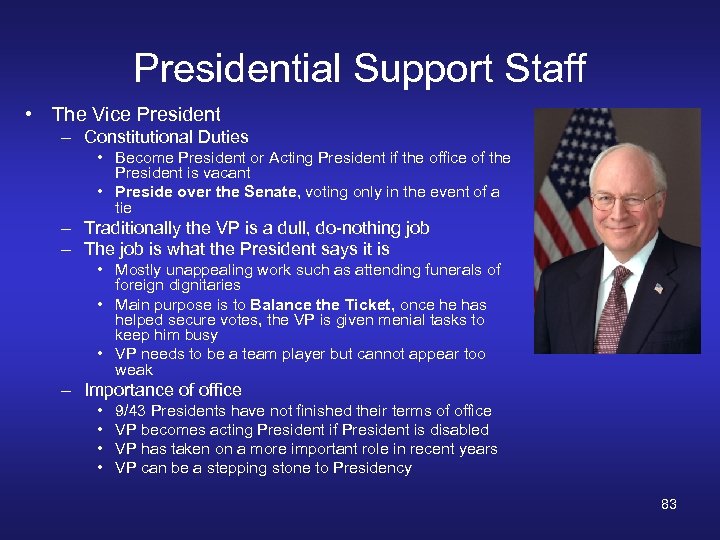 Presidential Support Staff • The Vice President – Constitutional Duties • Become President or Acting President if the office of the President is vacant • Preside over the Senate, voting only in the event of a tie – Traditionally the VP is a dull, do-nothing job – The job is what the President says it is • Mostly unappealing work such as attending funerals of foreign dignitaries • Main purpose is to Balance the Ticket, once he has helped secure votes, the VP is given menial tasks to keep him busy • VP needs to be a team player but cannot appear too weak – Importance of office • • 9/43 Presidents have not finished their terms of office VP becomes acting President if President is disabled VP has taken on a more important role in recent years VP can be a stepping stone to Presidency 83
 Making the Presidency Safe and Effective • Power of the office of the Presidency – Presidential powers are not as clearly defined in the Constitution as are Congress’ • Constitution refers to “executive power” but fails to define what it means – In times of emergency, Presidential power grows – In normal times the President has to deal with the system of checks and balances 84
 Making the Presidency Safe and Effective • Checks that weaken the President – Traditional (Constitutional) • Congress • The Courts – Non-Traditional (New) • • • Congressional leaders Cabinet members Bureaucrats (civil servants) Political Parties Interest Groups The Media: investigatory journalism designed to • • Impeachment by Congress Blocking of Pres. Nominations (filibuster) Divided government Changing world view “attack” the President and his policies 85
 Congress vs. the President • Background – Founders intended Congress to be dominant branch of gov. – In the 20 th century the power of the Presidency has grown – Congress occasionally reasserts its authority • Sources of conflict – Separation of powers • Constitution deliberately creates conflict – Conflict over areas of interest • Congress represents state/local interests • President represents national interest 86
 Congress vs. the President • Sources of conflict (continued) – Different times of election • Neither party is able to maintain dominance because of midterm elections – Political partisanship • Presidents often face a Congress that has had a majority of the opposing party • Forces compromise • Intra-party struggles are common further weakening the political parties (President is the head of his political party) – Presidents unity of office vs. Congress’ division of power – Divisions over foreign and domestic policy • Congress supportive on foreign policy • Less cooperative on domestic policy 87
 Congress vs. the President • Presidential influence on Congress – The use of media • President receives more press coverage than Congress • Gains the support of the people – Mandate of the people • Congress is hesitant to go against the will of the people • As popularity wanes, so to does the Presidents power over Congress – Patronage • Helps curry favor with Congressmen looking for appointments – Threat of veto (93% of vetoes are not overridden) – National emergency 88
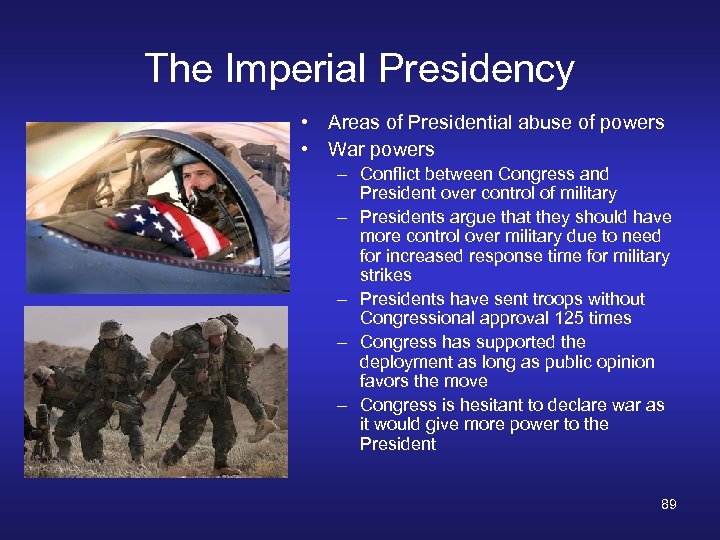 The Imperial Presidency • Areas of Presidential abuse of powers • War powers – Conflict between Congress and President over control of military – Presidents argue that they should have more control over military due to need for increased response time for military strikes – Presidents have sent troops without Congressional approval 125 times – Congress has supported the deployment as long as public opinion favors the move – Congress is hesitant to declare war as it would give more power to the President 89
 The Imperial Presidency • Emergency Powers – In time of war or emergency, the President assumes greater powers – He may • • Suspend Habeas corpus Impose the censorship of mail Can take control of manufacturing, communications, and transportation Can declare martial law • The use of Executive Agreements rather than treaties – See notes for specifics • Executive Privilege – The right of a President to not divulge conversations between himself and his advisors – Presidents claim that they need executive privilege so that their advisors can be honest (not subject to public scrutiny) – Critics claim that Presidents have abused the privilege under “national security” – In US v Nixon (1974), the Supreme Court denied the President the use of executive privilege in criminal cases 90
 The Imperial Presidency • Impoundment – The refusal of the President to spend money that has been appropriated by Congress – Without the line item veto, Presidents must either sign and entire bill or veto it. As a result, Presidents may be unhappy with funding amounts for certain parts of a bill and want to withhold such funding – Congress considers the impoundment of funds to be unconstitutional since the funds were lawfully appropriated by legislation • The Supreme Court has made no such ruling 91
 The Imperial Presidency • The Presidential use of the veto – The threat of a veto can influence changes in legislation – It is difficult for Congress to achieve the 2/3 vote to override a veto – This gives the President a great advantage – 93% of vetoes are sustained (not overturned) 92
 Congress Responds to the Imperial Presidency • The War Powers Clause – Article 1, Section 8, Clause 11 grants Congress the power to declare war, but Article 2, Section 2, Clause 1 makes the President the Commander in Chief of the armed forces • This creates a division in military power that had to be resolved through the War Powers Act 1973 • War Powers Act 1973 – The President is required to consult with Congress prior to the start of hostilities – Troops must be removed within 60 days unless Congress declares war or passes a resolution authorizing the use of force – The time can be extended for 30 days upon request of the President for the purpose of facilitating troop withdrawal – Must consult with Congress if troops are to engage in combat – Congress can pass a resolution to withdraw troops 93
 Congress Responds to the Imperial Presidency • Criticism of War Powers Act – Some argue that it is unconstitutional since it usurps the President’s authority as Commander in Chief – It places too many limits on the President, it is too inflexible – Places limits that the enemy can use to their advantage • Just wait 60 or 90 days and the troops will go away – Presidents have claimed the act to be unconstitutional and have ignored it but it has yet to be challenged with a lawsuit 94
 Congress Responds to the Imperial Presidency • The National Emergencies Act, 1976 – President must inform Congress in advance of powers to be used in emergencies – The state of emergency automatically ends after 6 months – President can declare another 6 months of emergency, subject to Congressional review 95
 Congress Responds to the Imperial Presidency • Congress and the CIA (Central Intelligence Agency) – The CIA has been involved in questionable practices in the past – Church Committee Investigations • A special committee of Congress, led by Senator Frank Church, to investigate CIA activities for illegalities • The panel discovered that the CIA was involved in assassination attempts on world leaders and was guilty of spying on US citizens (illegally) – Hughes-Ryan Amendment, 1974 • Requires the President to disclose all covert CIA operations within a set time limit • Established oversight committees to oversee CIA activities – Foreign Intelligence Surveillance Act, 1978 • Creates a secret court to authorize surveillance of US citizens and foreign diplomats for national security purposes 96
 Congress Responds to the Imperial Presidency • Budget and Impoundment Control Act, 1974 – If the President impounds funds temporarily (deferral), either house can override – If the President impounds funds permanently (rescission) that act is automatically voided unless both houses of Congress approve within 45 days – Created the Congressional Budget Office (CBO) as a check on the OMB – Congress is given 3 additional months to consider President’s proposed budget – Establishes Budget Committees in each house 97
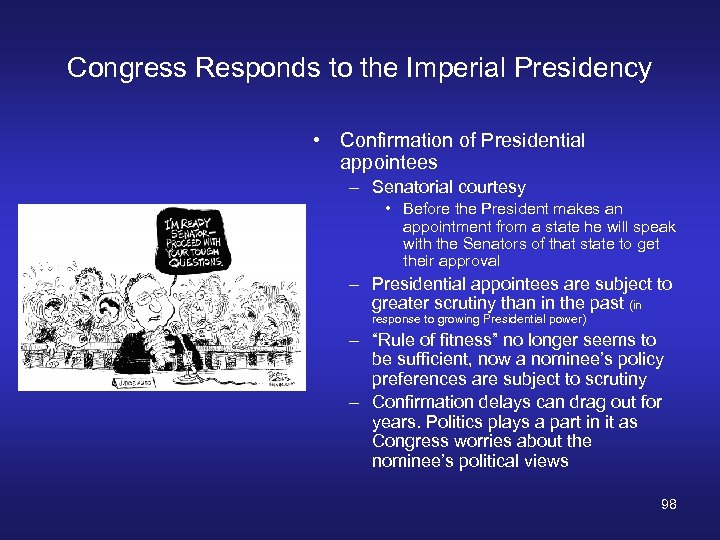 Congress Responds to the Imperial Presidency • Confirmation of Presidential appointees – Senatorial courtesy • Before the President makes an appointment from a state he will speak with the Senators of that state to get their approval – Presidential appointees are subject to greater scrutiny than in the past (in response to growing Presidential power) – “Rule of fitness” no longer seems to be sufficient, now a nominee’s policy preferences are subject to scrutiny – Confirmation delays can drag out for years. Politics plays a part in it as Congress worries about the nominee’s political views 98
 Congress Responds to the Imperial Presidency • The legislative veto – Allowed Congress to veto a Presidential action such as reorganizing a executive department. – The legislative veto was a way to force the bureaucracy to conform to Congressional intent – INS v Chada (1983) • Supreme Court ruled the legislative veto unconstitutional – Congressional Review Act (1996) allows for a modified legislative veto • Congress can repeal regulations with the approval of the President • Congress and Foreign Affairs – As the role of the US in foreign affairs increases, Congress is scrutinizing Presidential actions more closely – Congress has been especially critical of the Patriot Act and the domestic surveillance programs of the NSA 99
 The Imperial Congress Argument • Some worry about Congress attaining too much power – Congress engages in too many investigations – Senate is too critical of Presidential appointees – Senate accused of using holds and filibusters to delay federal court appointments for political reasons – Congress is responsible for the weakening of the CIA, leaving the US open for terrorist attacks – Congress institutes “witch hunts” on the Executive Branch – Congress micromanages the government by utilizing its oversight powers 100
 Unit 4: Institutions Part Three: The Federal Courts 101
 Introduction to the Federal Courts p. 83 • Types of Law – Statutory (written law) – Common • Based on unwritten law • Unwritten laws are based on precedents – Stare decisis (let the decision stand) or rule according to the precedent • Basic system of law in Britain 102
 Introduction to the Federal Courts p. 83 – Criminal • Deals with crimes against society – Civil • Disputes (torts) between two parties • Examples: breach of contract, slander, medical malpractice, etc. • Writ of Mandamus: court order for one party to perform a certain act • Injunction: court order that forbids one party from performing a certain act • Class Action Lawsuit: a suit brought by a group of people who share a common complaint 103
 Introduction to the Federal Courts p. 83 • Judicial Power is Passive – Courts cannot search for cases, the cases must come to them – Courts cannot create cases, there must be an actual controversy in order to make a ruling • Cases may only be championed by a person who has a standing (directly effected) – Laws cannot be challenged on the basis of it is not well liked 104
 Introduction to the Federal Courts p. 84 • Judicial Law-making – Judges interpret the law and so, make law – This is necessary because: • Statutes are broadly-worded, unclear, or contradictory • The Constitution is broadly-worded, and requires interpretation • Interpretation of the Constitution makes law – Evidence of judicial law-making • (see notes for examples) 105
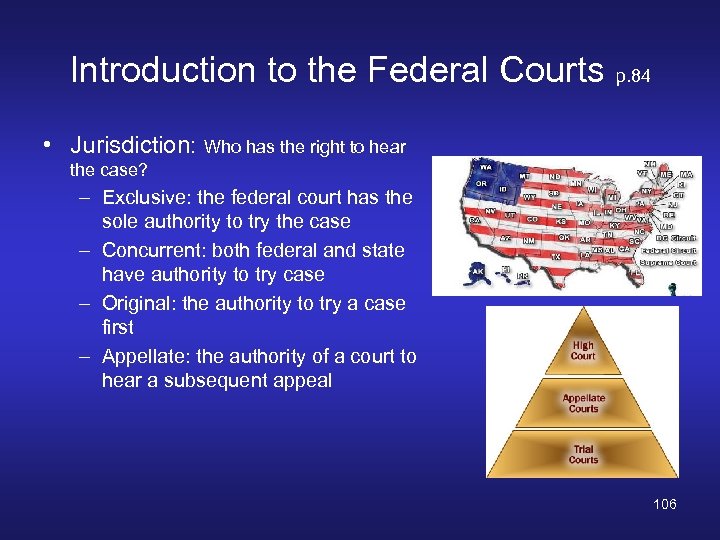 Introduction to the Federal Courts p. 84 • Jurisdiction: Who has the right to hear the case? – Exclusive: the federal court has the sole authority to try the case – Concurrent: both federal and state have authority to try case – Original: the authority to try a case first – Appellate: the authority of a court to hear a subsequent appeal 106
 Introduction to the Federal Courts p. 84 • Jurisdiction of Federal Courts: Federal courts may try a case if it involves – The Constitution, a federal law, or a treaty – Admiralty law (matters on the high seas) or maritime law (matters on land but relating to water) – Disputes between states – The US government as a party in the suit – Citizens of different states – Ambassadors or diplomats 107
 Introduction to the Federal Courts p. 85 • Dual system of courts – State courts: deal with matters within the state of origin – Federal courts: see previous list of jurisdictions • Structure of the Federal Court System – Article 1 Courts (legislative or special courts) • Created to carry out the enumerated powers of Congress • Judges serve for a fixed term (not life) • See notes for examples 108
 Introduction to the Federal Courts p. 85 • Article 3: Constitutional Courts – Article 3 deals with the Judiciary and creates a Supreme Court while granting Congress the power to create “inferior” courts – Judges in these courts serve for life • Understand Hamilton’s rationale (Federalist 78 reading assignment- handout) 109
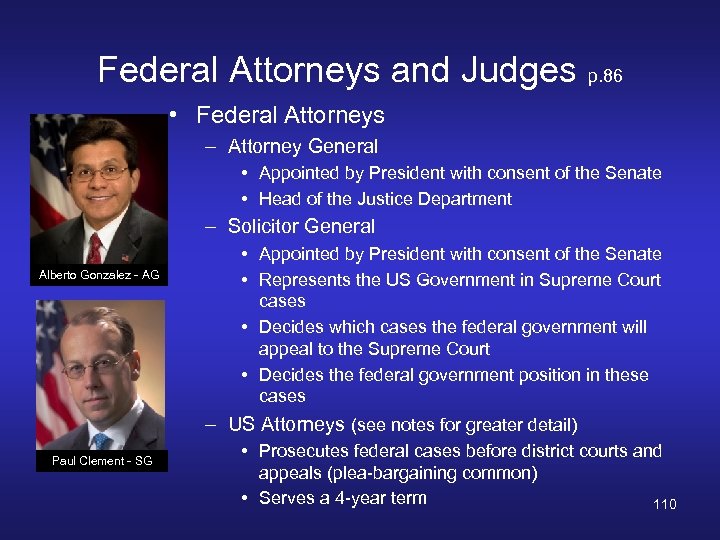 Federal Attorneys and Judges p. 86 • Federal Attorneys – Attorney General • Appointed by President with consent of the Senate • Head of the Justice Department – Solicitor General Alberto Gonzalez - AG • Appointed by President with consent of the Senate • Represents the US Government in Supreme Court cases • Decides which cases the federal government will appeal to the Supreme Court • Decides the federal government position in these cases – US Attorneys (see notes for greater detail) Paul Clement - SG • Prosecutes federal cases before district courts and appeals (plea-bargaining common) • Serves a 4 -year term 110
 Introduction to the Federal Courts p. 85 • 3 Levels of Constitutional Courts – District Courts (see notes for greater details) • • Handle 90% of cases Cases tried by a judge and jury, grand juries issue indictments May try civil, criminal, or constitutional cases Decisions may be appealed to Courts of Appeals – Courts of Appeals (Circuit Courts) • 12 courts of appeals spread around the country in 12 districts “circuits” • Cases are tried by a panel of 3 judges except when all of the judges of a circuit court hear a case “en banc” • Appellate court hear appeals from district courts • Decisions may be appealed to the Supreme Court – Supreme Court • (More details to follow as a separate lecture) 111
 Federal Attorneys and Judges p. 86 • Federal Judges – Appointed by President with Senate approval – Article 3 states that they shall hold their offices “during good behavior” (life) • They can be impeached and removed by Congress – Compensation is determined by Congress • District Court: $165, 200 • Courts of Appeals: $175, 100 • Supreme Court: $203, 000 – Chief Justice: $212, 100 112
 Federal Attorneys and Judges p. 86 -87 • Factors affecting selection of federal judges – Senatorial courtesy – Senate Judiciary Committee • Screens the nominees and sends recommendation to Senate floor for approval or rejection • More scrutiny given to candidates in recent years • Committee has held up confirmation for years – Senate Vote • A simple majority is needed for confirmation – Political parties • Judges are generally from the same political party as the President – Race (mostly white) – Gender (mostly male) – Age • Generally older (40’s to 50’s) • With lifetime appointments Presidential influence continues after they leave office 113
 Federal Attorneys and Judges p. 87 – Ideology of prospective judges • Presidents generally appoint people of similar philosophy • This is difficult to ensure – It is difficult to predict the future behavior of judges – New issues may develop that could not be foreseen – Judges serve for life, so Presidents have not influence over their behavior after they are appointed – Approximately 25% of Supreme Court judges stray from the philosophy that was anticipated when they were appointed • Ideology may also affect the judges decision on when to retire – They may postpone retirement until a time when there is a President who shares their political view 114
 Federal Attorneys and Judges p. 87 – American Bar Association (ABA) evaluates nominees • The Judiciary Committee uses ABA evaluations as part of its own evaluation of nominees – The nominees past history or “paper trail” • The committee reviews the nominees previous rulings as an indicator on how he/she will decide future cases if selected – Increasing the number of judges • Congress may increase or decrease the number of courts and judges • Congress is unlikely to do so if there is a sitting President of the opposing party – If a judicial opening becomes available during a time of an unfavorable President, Congress may eliminate the position rather than allow it to be filled by the President 115
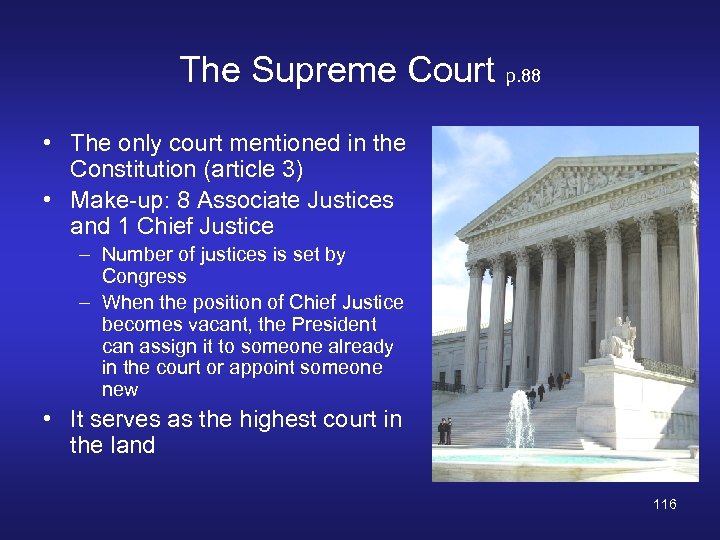 The Supreme Court p. 88 • The only court mentioned in the Constitution (article 3) • Make-up: 8 Associate Justices and 1 Chief Justice – Number of justices is set by Congress – When the position of Chief Justice becomes vacant, the President can assign it to someone already in the court or appoint someone new • It serves as the highest court in the land 116
 The Supreme Court p. 88 • Key powers – Power of Judicial Review established by Marbury v Madison, 1803 • >1000 state laws have been declared unconstitutional • >120 federal laws have been declared unconstitutional • Some Presidential actions have also been declared unconstitutional – Power to interpret broadly-worded laws of Congress and the Constitution – Power to overrule earlier Supreme Court decisions 117
 The Supreme Court p. 88 • Jurisdiction – Original in cases involving • States • Ambassadors – Appellate in cases from • Courts of Appeals • State Supreme Courts – Cases from appellate jurisdiction are far more numerous than from original jurisdiction 118
 The Supreme Court p. 88 • How cases reach the Supreme Court – Thousands of requests are made each year for Supreme Court decisions • Relatively few requests are granted • The trend is for fewer and fewer cases each year (<80 -90 per year) – Rule of 4 • In order for the courts to decide a case, 4 justices must agree to do so • Denying a decision may mean: – Case lacks a substantial federal issue – Party lacks standing – Court agrees with lower court decision – Case is a political “hot potato” that the court does not want to touch 119
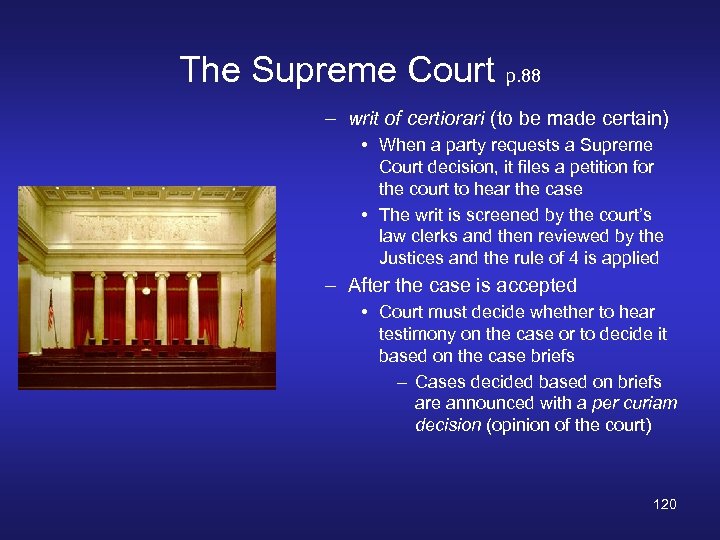 The Supreme Court p. 88 – writ of certiorari (to be made certain) • When a party requests a Supreme Court decision, it files a petition for the court to hear the case • The writ is screened by the court’s law clerks and then reviewed by the Justices and the rule of 4 is applied – After the case is accepted • Court must decide whether to hear testimony on the case or to decide it based on the case briefs – Cases decided based on briefs are announced with a per curiam decision (opinion of the court) 120
 The Supreme Court p. 89 • The Supreme Court at work – Term begins on 1 st Monday in October and continues until the end of June – Cases are heard Monday – Thursday provided that there is a quorum of 6 justices present – Before the oral arguments the justices read the attorney’s briefs – Justices also read the amicus curiae (friend of the court) briefs • Amicus curiae briefs are testimony given by refers to someone, not a party to a case, who volunteers to offer information on a point of law or some other aspect of the case to assist the court in deciding a matter before it – Justice’s hear oral arguments for 30 minutes from each side of the case – At the Friday conference the case is discussed – A simple majority is needed for a decision to be made • In the event of a tie, the lower court ruling stands – The court then drafts its written opinion (ruling) 121
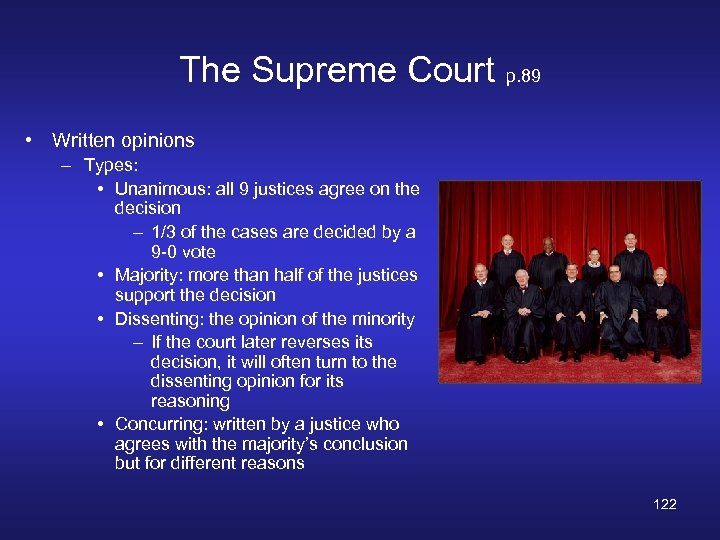 The Supreme Court p. 89 • Written opinions – Types: • Unanimous: all 9 justices agree on the decision – 1/3 of the cases are decided by a 9 -0 vote • Majority: more than half of the justices support the decision • Dissenting: the opinion of the minority – If the court later reverses its decision, it will often turn to the dissenting opinion for its reasoning • Concurring: written by a justice who agrees with the majority’s conclusion but for different reasons 122
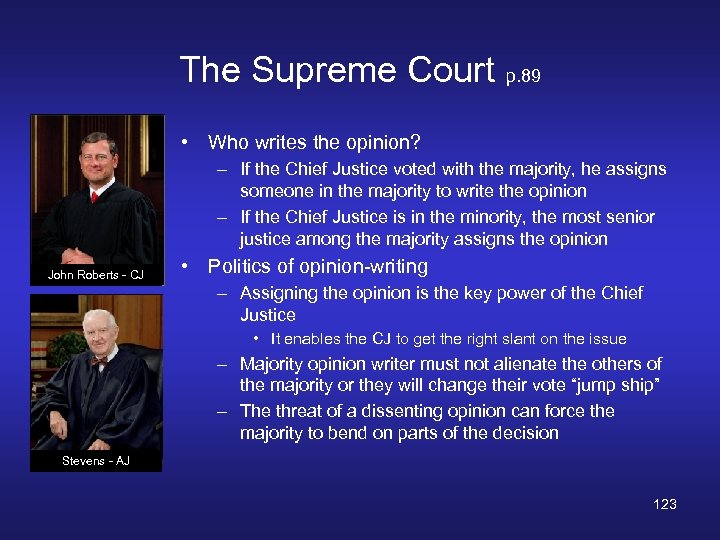 The Supreme Court p. 89 • Who writes the opinion? – If the Chief Justice voted with the majority, he assigns someone in the majority to write the opinion – If the Chief Justice is in the minority, the most senior justice among the majority assigns the opinion John Roberts - CJ • Politics of opinion-writing – Assigning the opinion is the key power of the Chief Justice • It enables the CJ to get the right slant on the issue – Majority opinion writer must not alienate the others of the majority or they will change their vote “jump ship” – The threat of a dissenting opinion can force the majority to bend on parts of the decision Stevens - AJ 123
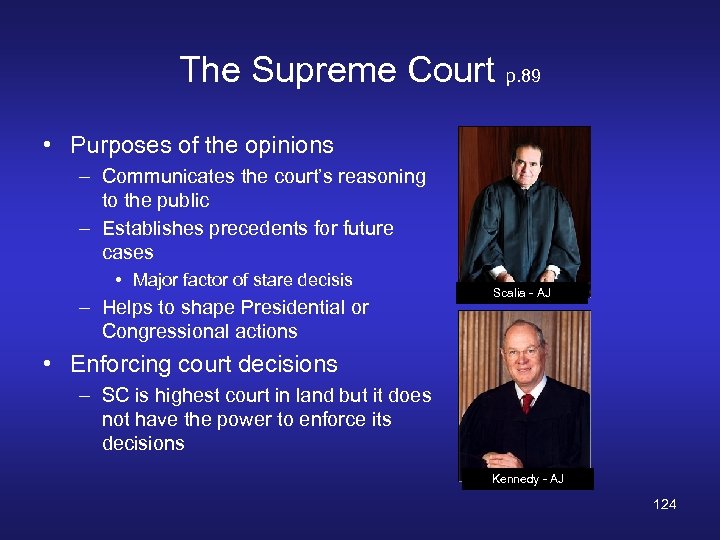 The Supreme Court p. 89 • Purposes of the opinions – Communicates the court’s reasoning to the public – Establishes precedents for future cases • Major factor of stare decisis – Helps to shape Presidential or Congressional actions Scalia - AJ • Enforcing court decisions – SC is highest court in land but it does not have the power to enforce its decisions Kennedy - AJ 124
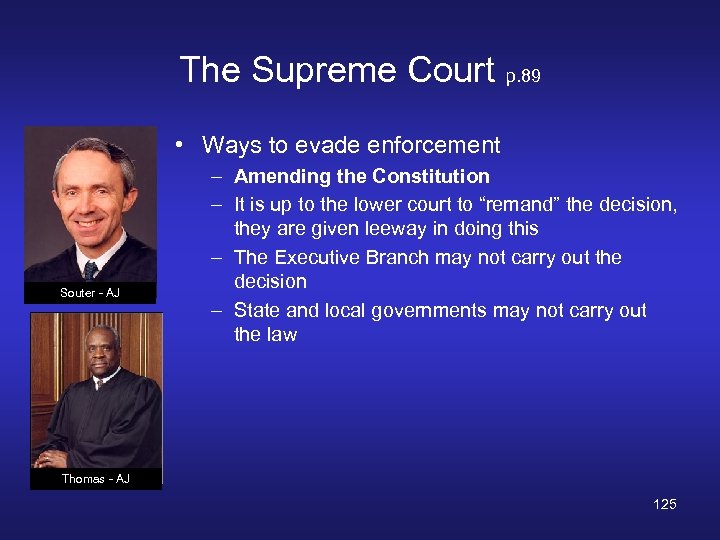 The Supreme Court p. 89 • Ways to evade enforcement Souter - AJ – Amending the Constitution – It is up to the lower court to “remand” the decision, they are given leeway in doing this – The Executive Branch may not carry out the decision – State and local governments may not carry out the law Thomas - AJ 125
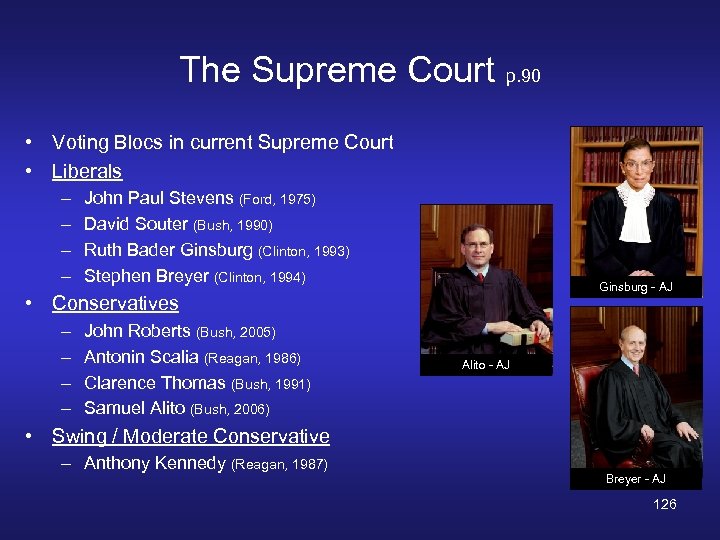 The Supreme Court p. 90 • Voting Blocs in current Supreme Court • Liberals – – John Paul Stevens (Ford, 1975) David Souter (Bush, 1990) Ruth Bader Ginsburg (Clinton, 1993) Stephen Breyer (Clinton, 1994) Ginsburg - AJ • Conservatives – – John Roberts (Bush, 2005) Antonin Scalia (Reagan, 1986) Clarence Thomas (Bush, 1991) Samuel Alito (Bush, 2006) Alito - AJ • Swing / Moderate Conservative – Anthony Kennedy (Reagan, 1987) Breyer - AJ 126
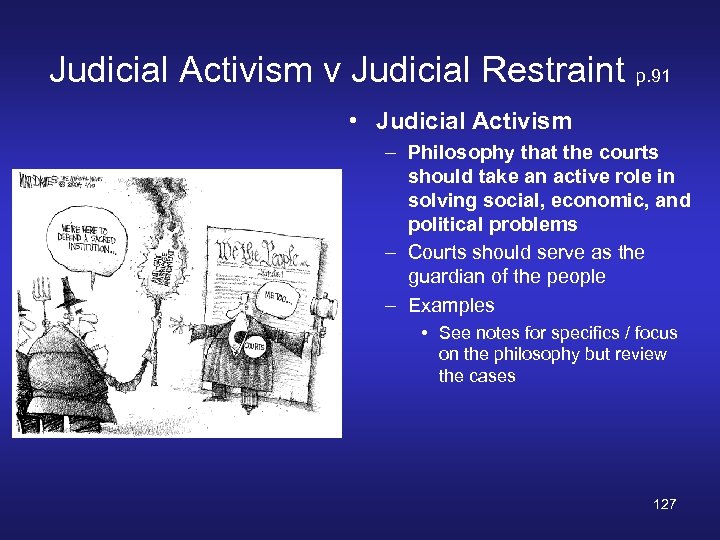 Judicial Activism v Judicial Restraint p. 91 • Judicial Activism – Philosophy that the courts should take an active role in solving social, economic, and political problems – Courts should serve as the guardian of the people – Examples • See notes for specifics / focus on the philosophy but review the cases 127
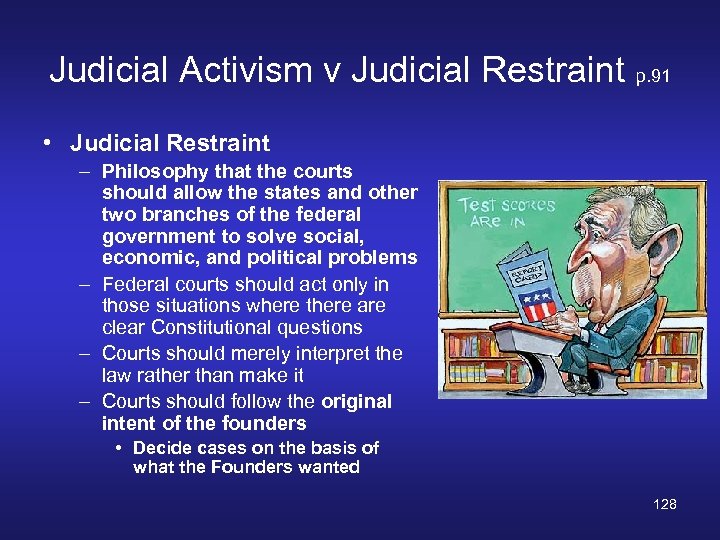 Judicial Activism v Judicial Restraint p. 91 • Judicial Restraint – Philosophy that the courts should allow the states and other two branches of the federal government to solve social, economic, and political problems – Federal courts should act only in those situations where there are clear Constitutional questions – Courts should merely interpret the law rather than make it – Courts should follow the original intent of the founders • Decide cases on the basis of what the Founders wanted 128
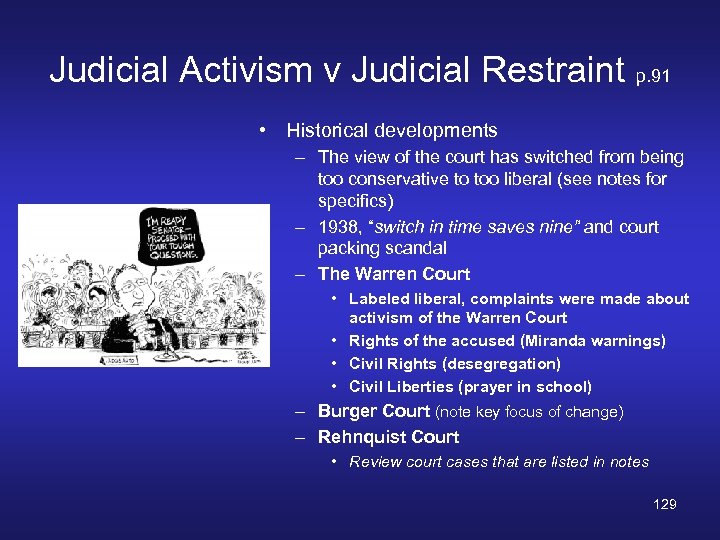 Judicial Activism v Judicial Restraint p. 91 • Historical developments – The view of the court has switched from being too conservative to too liberal (see notes for specifics) – 1938, “switch in time saves nine” and court packing scandal – The Warren Court • Labeled liberal, complaints were made about activism of the Warren Court • Rights of the accused (Miranda warnings) • Civil Rights (desegregation) • Civil Liberties (prayer in school) – Burger Court (note key focus of change) – Rehnquist Court • Review court cases that are listed in notes 129
 Judicial Activism v Judicial Restraint p. 92 • Restraints on judicial power – Courts can make decisions but, but cannot enforce them – Courts cannot reach out and take cases, but must wait for cases to come to them – Courts can only rule on real live controversies; they cannot create cases – Judges are appointed by the President – Congress • • • – – Senate confirmation of judges Impeachment and removal Increasing number of courts and judges Constitutional Amendments overturn court decisions Submitting laws again in hopes that the court will change its mind Determining jurisdiction of courts Stare decisis Existing laws The Constitution Public opinion (court reflects the opinion of the times they were appointed) 130
 Unit 4: Institutions The Federal Bureaucracy 131
 Structure of the American Bureaucracy p. 93 • Bureaucracy: the agencies, departments, commissions, etc. within the Executive Branch – A large, complex administrative structure that handles the everyday business of an organization – Federal employees deliver the mail, regulate business practices, collect taxes, the list goes on. • Executive Office of the President • Presidential Cabinet • Independent Agencies – Similar to cabinets but lack cabinet status – NASA and Small Business Administration (SBA) are examples 132
 Structure of the American Bureaucracy p. 93 • Independent Regulatory Commissions – Created by Congress to regulate important aspects of nations economy – The commissions generally operate independently of the President – Commissioners are appointed by the President with Senate approval – Rules of commissions • • Terms of office are long Rules require a mixture of political affiliations The service terms are staggered Commissioners may be fired by the President but Congress sets the terms. – Commissions have quasi-legislative powers • They can make rules and regulations that have the force of law 133
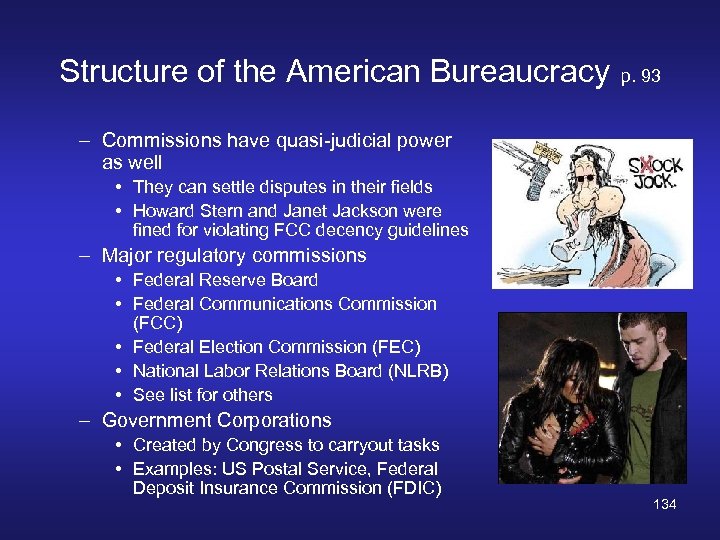 Structure of the American Bureaucracy p. 93 – Commissions have quasi-judicial power as well • They can settle disputes in their fields • Howard Stern and Janet Jackson were fined for violating FCC decency guidelines – Major regulatory commissions • Federal Reserve Board • Federal Communications Commission (FCC) • Federal Election Commission (FEC) • National Labor Relations Board (NLRB) • See list for others – Government Corporations • Created by Congress to carryout tasks • Examples: US Postal Service, Federal Deposit Insurance Commission (FDIC) 134
 Growth of the Bureaucracy p. 94 • Development of the Civil Service System – Prior to 1800’s federal appointments were done using the spoils system – In 1881 Congress passes the Pendleton Act, after President Garfield is assassinated over a federal appointment • Creates the Civil Service industry • Applicants must pass a merit-based exam in order to earn governmental jobs • The Civil Service Commission was created to administer the exams, those duties are now handled by the Office of Personnel Management – >90% of federal employees are civil service workers – <10% of the top-level federal jobs are appointed by the President (political appointees) 135
 Growth of the Bureaucracy p. 94 • Size of bureaucracy – There approximately 3 million civilian employees working today – The number has stayed stable since 1950 with huge cuts under Clinton (250, 000) • Either the bureaucracy has become more efficient with fewer people called upon to administer more programs –or- • The bureaucracy has shifted away from the federal government into the hands of the state governments with federal funding backing the transition 136
 Growth of the Bureaucracy p. 94 • Power of the bureaucracy – Discretionary authority: agencies have the power to choose a variety of actions when congress writes broadly worded laws • In other words, bureaucracies tend to assume ever-increasing authority – Power to pass rules and regulations that must be followed • OSHA safety regulations • IRS tax code regulations (7, 500 pages) – Helps Congress draft legislation – Provides information / advice to White House – Settles disputes over conflicting policies • Reasons for growth – National growth: population increase creates need for greater administration – Technology: new technology requires new agencies to cope – International crises: increasing power of the defense department – Demands of citizens: more people expect the government to protect the welfare of the nation – Agencies will to survive: agencies strive to grow and expand, it’s the nature of bureaucracy 137
 Influences on Bureaucratic Behavior p. 95 • Recruitment and Retention – >90% of bureaucrats are appointed using some sort of merit exam, but there are ways around it • Writing job qualifications that fit only the person that the manager wants to hire • Making “temporary appointments” then renewing them yearly • Bringing a person into a lower level job then giving them the duties of the actual job – Collectively referred to as the “buddy system” or “the good ol’ boys network” – Priority placement is given to veterans, minorities, and women 138
 Influences on Bureaucratic Behavior p. 95 – It is extremely difficult to fire a civil servant – Effects • Many bureaucrats have a loyal or agency point of view • Agencies rarely change their behavior • The bureaucrats are experts in their field with an emphasis on creating policy and procedures (paperwork will solve all problems) • Agency managers rely on subordinates to get the job done, they must cultivate their support • Characteristics of bureaucrats – Lower and mid-level bureaucrats are representative of the American people – Upper-level bureaucrats are mostly middle-aged white males with college degrees from an advantaged background • The Left believes that upper-level bureaucrats favor class privilege and show a conservative bias • The Right believes that upper-level bureaucrats are trained by liberal faculty and thus demonstrate a liberal bias 139
 Influences on Bureaucratic Behavior p. 95 – Bureaucrats tend to be more liberal than the general public – Those who work in “activist” agencies (Environmental Protection Agency) tend to be the more liberal than those who work in “traditional” agencies (Justice Department) – See other attributes • Legal restraints on bureaucracy – Freedom of Information Act – Hatch Act: prevents civil servants from participating in questionable political activities • During the 1930’s, WPA officials were soliciting campaign funds in exchange for government contracts • Affirmative Action hiring guidelines • Required to file environmental impact reports prior to starting projects 140
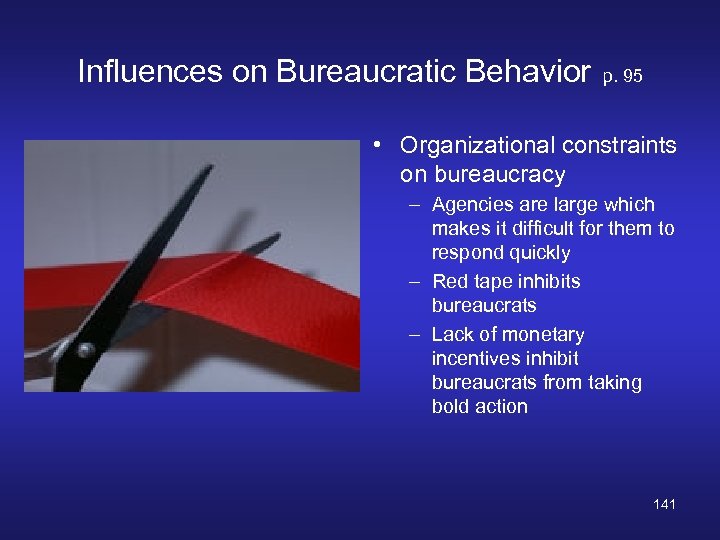 Influences on Bureaucratic Behavior p. 95 • Organizational constraints on bureaucracy – Agencies are large which makes it difficult for them to respond quickly – Red tape inhibits bureaucrats – Lack of monetary incentives inhibit bureaucrats from taking bold action 141
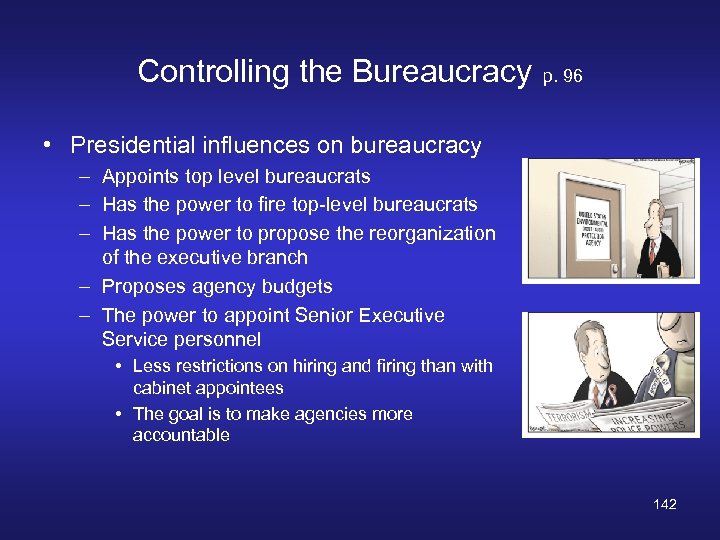 Controlling the Bureaucracy p. 96 • Presidential influences on bureaucracy – Appoints top level bureaucrats – Has the power to fire top-level bureaucrats – Has the power to propose the reorganization of the executive branch – Proposes agency budgets – The power to appoint Senior Executive Service personnel • Less restrictions on hiring and firing than with cabinet appointees • The goal is to make agencies more accountable 142
 Controlling the Bureaucracy p. 96 • Checks on Presidential influence over Bureaucracy – Senate must confirm top personnel – President limited on who can and cannot be fired – Reorganization must occur through Congress • Congressional influences on the Bureaucracy – Responsible for appropriating the agency’s budget – Standing Committee has oversight powers • May investigate agency actions and call for hearings • Government Accountability Office (GAO) serves as a watchdog – Ensures that allocated funds are spent appropriately – Has the power to reorganize agencies – Power to confirm Presidential appointments – Sunset Laws • Agencies are established for a limited time and therefore must justify their continued existence 143
 Controlling the Bureaucracy p. 96 • Limits on Congressional influence over Bureaucracy – Congress may lack the will to place limits on the Bureaucracy – Congressional members benefit by having Bureaucratic agencies in their states • Military bases create civilian jobs • Welfare programs generate income within the state 144
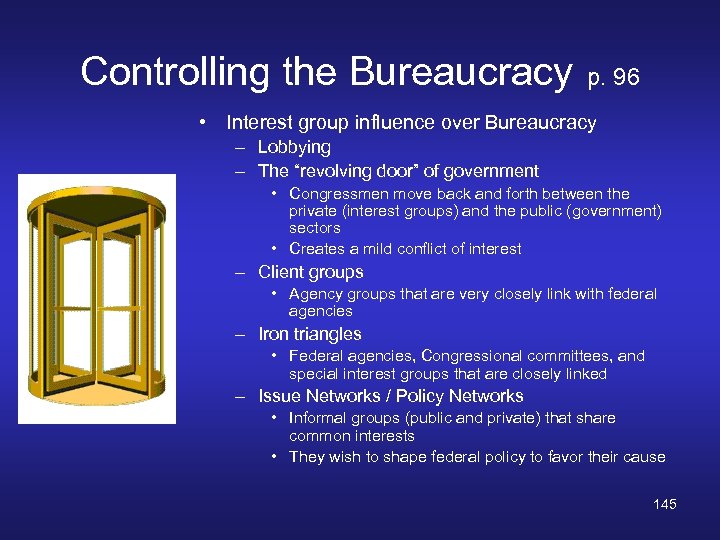 Controlling the Bureaucracy p. 96 • Interest group influence over Bureaucracy – Lobbying – The “revolving door” of government • Congressmen move back and forth between the private (interest groups) and the public (government) sectors • Creates a mild conflict of interest – Client groups • Agency groups that are very closely link with federal agencies – Iron triangles • Federal agencies, Congressional committees, and special interest groups that are closely linked – Issue Networks / Policy Networks • Informal groups (public and private) that share common interests • They wish to shape federal policy to favor their cause 145
 Controlling the Bureaucracy p. 97 • Media’s influence over the Bureaucracy – Serves as bureaucratic watchdog, investigating the actions of the Bureaucracy – Whistle Blowers within agencies leak information to the media in order to fix problems within the agency • VA hospital scandal • The Court’s influence over Bureaucracy – Courts may issue injunctions and writs of mandamus to block Bureaucratic action • Privatization – Many agencies have transferred control away from the government to private agencies which operate more efficiently 146
 Evaluation of the Bureaucracy p. 98 • Public view of Bureaucracy – Bureaucracy is generally viewed in a negative light • Viewed as wasteful and inefficient – Bureaucrats often become the scapegoats of politicians • Criticism of Bureaucracy – Excessive red tape – Agencies contradict each other • Agricultural Department subsidizes tobacco while Surgeon General warns against its use – Multiple agencies doing the same task (numerous drug enforcement agencies) – Excessively wasteful of time and money – Agencies have grown excessively • While federal jobs have not increased dramatically, federal grants support many more state programs which create Bureaucratic jobs – Lack of incentives to encourage efficiency – Bureaucracy fights change – Charges that Bureaucrats are permanent (it is almost impossible to fire a federal employee) • Defense of Bureaucracy (see notes) 147
 Evaluation of the Bureaucracy p. 98 • “Laws” of Bureaucratic Procedure • Not actual laws but a way of viewing bureaucratic behavior – Boren’s Laws: when in doubt, mumble. When in trouble, delegate. When in charge, ponder. – Smith’s Principle: Never do anything for the first time. – Peter Principle: In every hierarchy, each employee rises to his level of incompetence. – Parkinson’s 2 nd Law: Expenditures rise to meet income. 148
 149
149