Скачать презентацию Unit 4 Earthquake Language points Language points
b39592fe86e94fcfd8e8815ef730e1c0.ppt
- Количество слайдов: 41
 Unit 4 Earthquake Language points
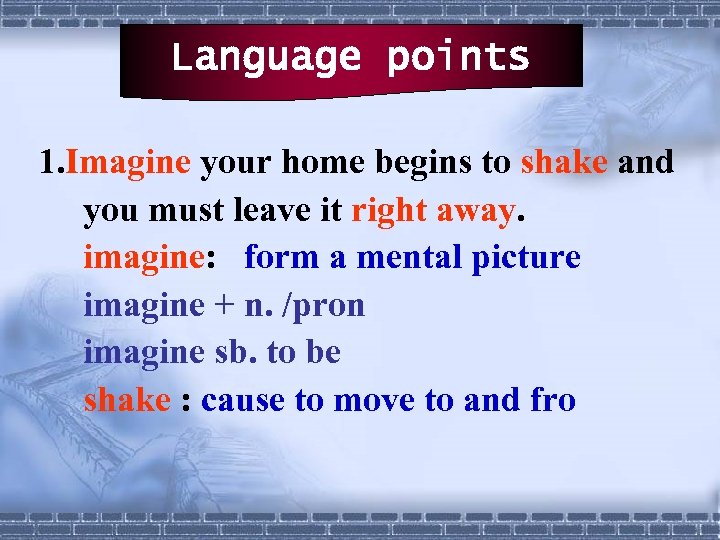 Language points 1. Imagine your home begins to shake and you must leave it right away. imagine: form a mental picture imagine + n. /pron imagine sb. to be shake : cause to move to and fro
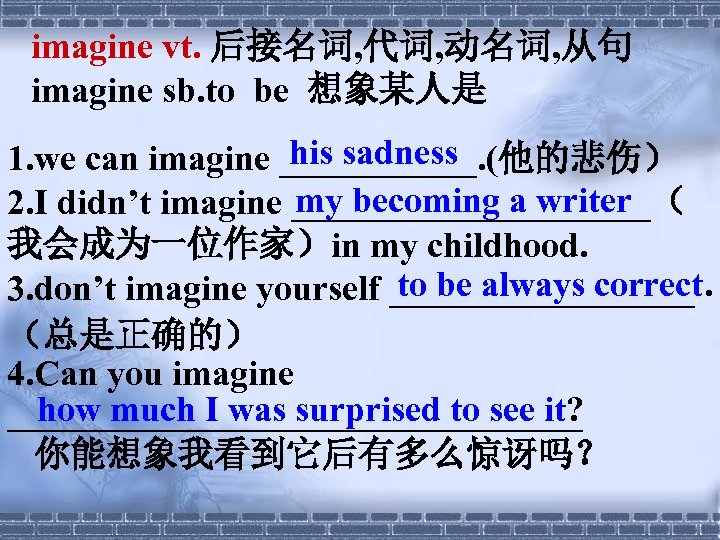 imagine vt. 后接名词, 代词, 动名词, 从句 imagine sb. to be 想象某人是 his sadness 1. we can imagine ______. (他的悲伤) my becoming a writer 2. I didn’t imagine __________( 我会成为一位作家)in my childhood. to be always correct. 3. don’t imagine yourself _________ (总是正确的) 4. Can you imagine how much I was surprised to see it? ________________ 你能想象我看到它后有多么惊讶吗?
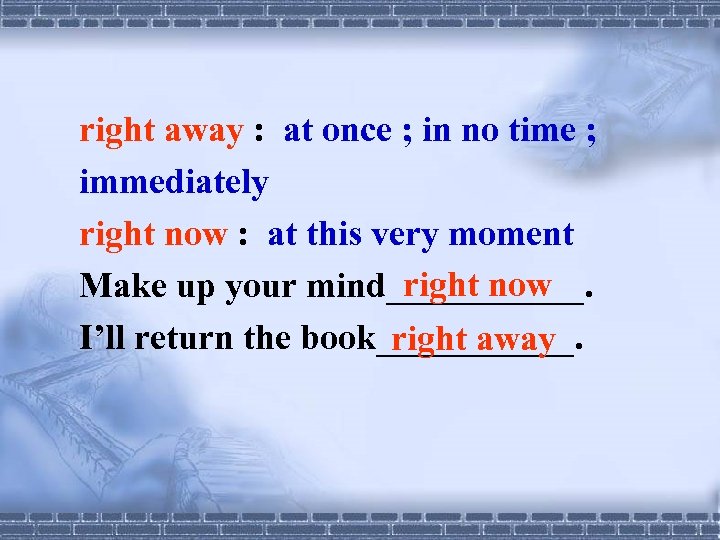 right away : at once ; in no time ; immediately right now : at this very moment right now Make up your mind______. I’ll return the book______. right away
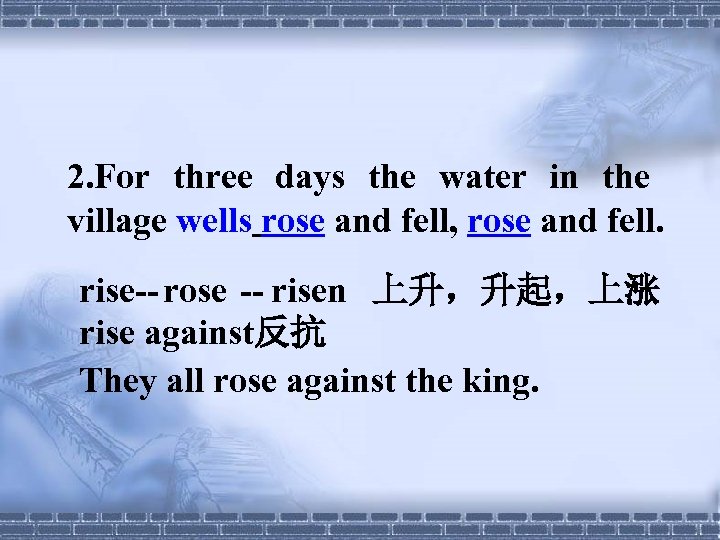 2. For three days the water in the village wells rose and fell, rose and fell. rise-- 上升,升起,上涨 rose risen rise against反抗 They all rose against the king.
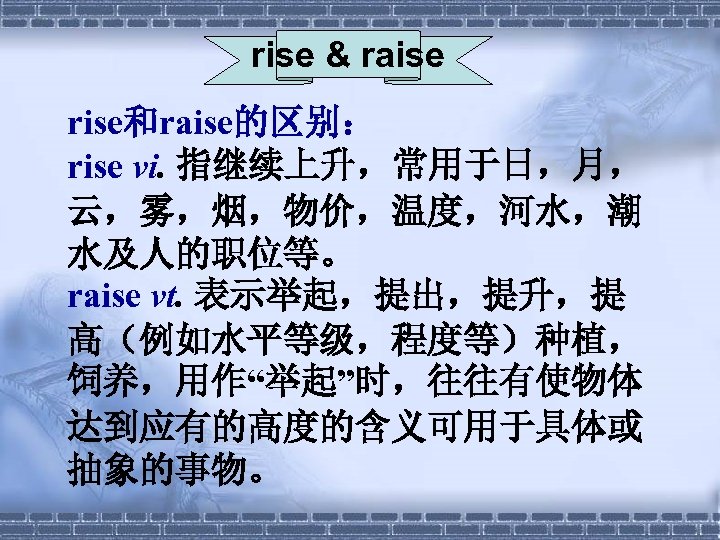 rise & raise rise和raise的区别: rise vi. 指继续上升,常用于日,月, 云,雾,烟,物价,温度,河水,潮 水及人的职位等。 raise vt. 表示举起,提出,提升,提 高(例如水平等级,程度等)种植, 饲养,用作“举起”时,往往有使物体 达到应有的高度的含义可用于具体或 抽象的事物。
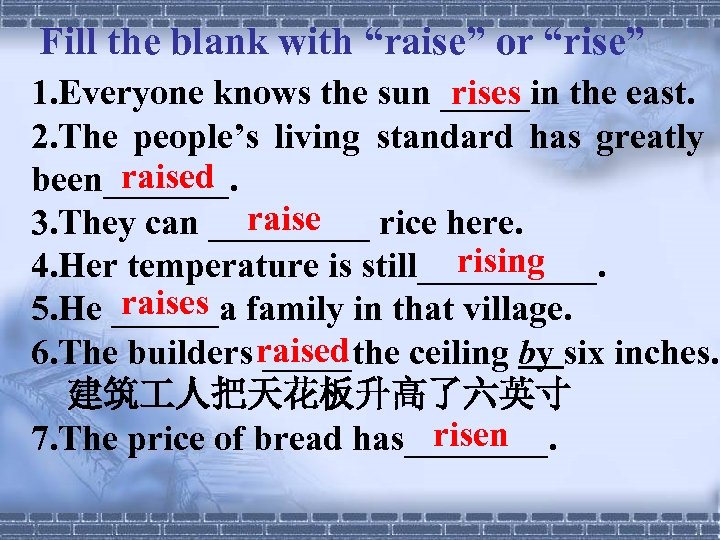 Fill the blank with “raise” or “rise” rises 1. Everyone knows the sun _____in the east. 2. The people’s living standard has greatly raised been_______. raise 3. They can _____ rice here. rising 4. Her temperature is still_____. raises 5. He ______a family in that village. raised 6. The builders _____the ceiling by six inches. 建筑 人把天花板升高了六英寸 risen 7. The price of bread has____.
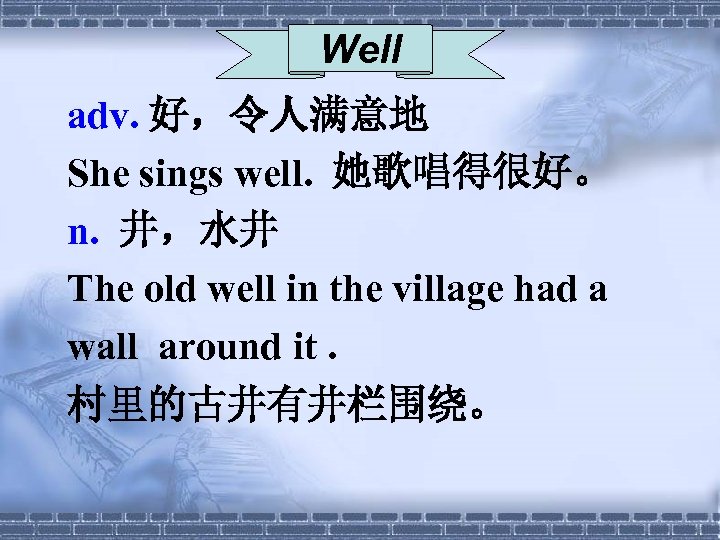 Well adv. 好,令人满意地 She sings well. 她歌唱得很好。 n. 井,水井 The old well in the village had a wall around it. 村里的古井有井栏围绕。
 smelly 3. A ______ gas came out of the cracks. smelly adj. = smell(n. )+y有臭味的 smelly socks 臭袜子 smell v. smelled / smelt 1闻,嗅 I smell gas. 我闻到了煤气味。 They were all hungry and the food ______ smelt good. 2发出臭气The meat had started to smell.
![smell n. [C] 1) 气味 (of) There was a smell of burning. 有一股 焦的气味。](https://present5.com/presentation/b39592fe86e94fcfd8e8815ef730e1c0/image-10.jpg "smell n. [C] 1) 气味 (of) There was a smell of burning. 有一股 焦的气味。") smell n. [C] 1) 气味 (of) There was a smell of burning. 有一股 焦的气味。 2)臭味,臭气 The new air freshener gets rid of smells fast.
smell n. [C] 1) 气味 (of) There was a smell of burning. 有一股 焦的气味。 2)臭味,臭气 The new air freshener gets rid of smells fast.
 4. … the water pipes in some buildings cracked and _____. burst : to come open or fly apart suddenly The balloon suddenly burst into + n. Some robbers burst into that house. burst out + doing They burst out laughing.
 burst into+ n. burst out + doing…… He burst into laughter. = He burst out laughing He burst into tears. = He burst out crying.
 Burst & Crack burst –burst – v. (使)破裂; (使) 爆炸 crack v. (使)裂开; n. 裂缝 1. The windows was cracked but not broken. 窗玻璃裂了但没有碎。 2. The balloon burst. 气球吹炸了。
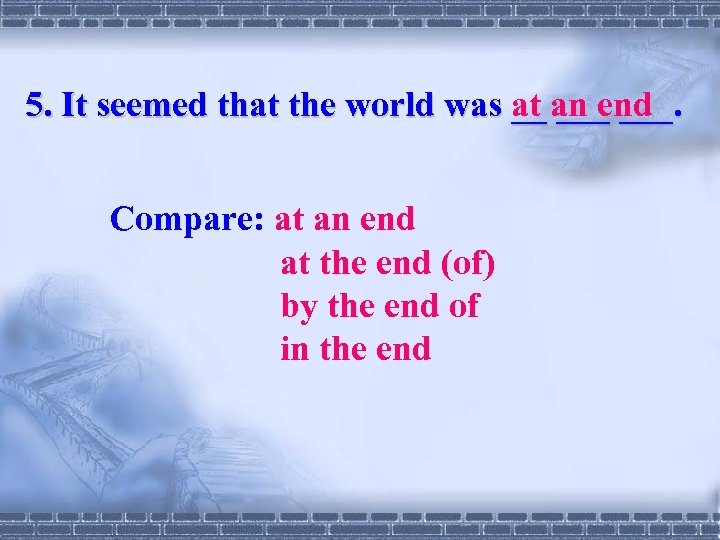 5. It seemed that the world was __ ___. at an end Compare: at an end at the end (of) by the end of in the end
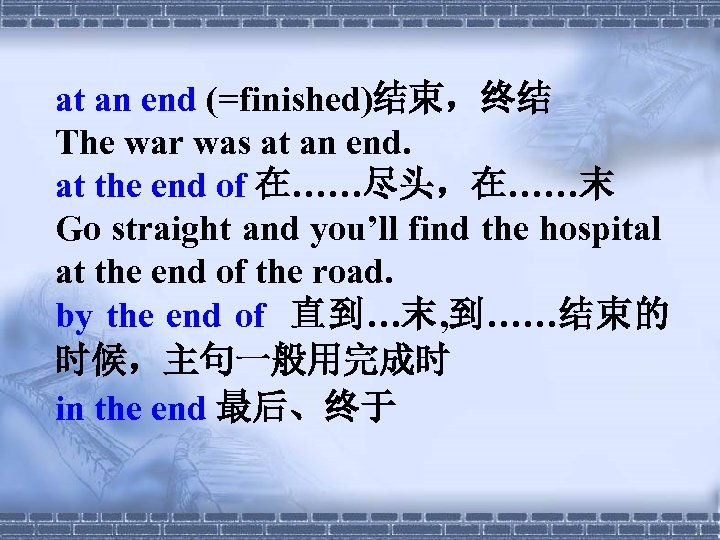 at an end (=finished)结束,终结 The war was at an end. at the end of 在……尽头,在……末 Go straight and you’ll find the hospital at the end of the road. by the end of 直到…末, 到……结束的 时候,主句一般用完成时 in the end 最后、终于
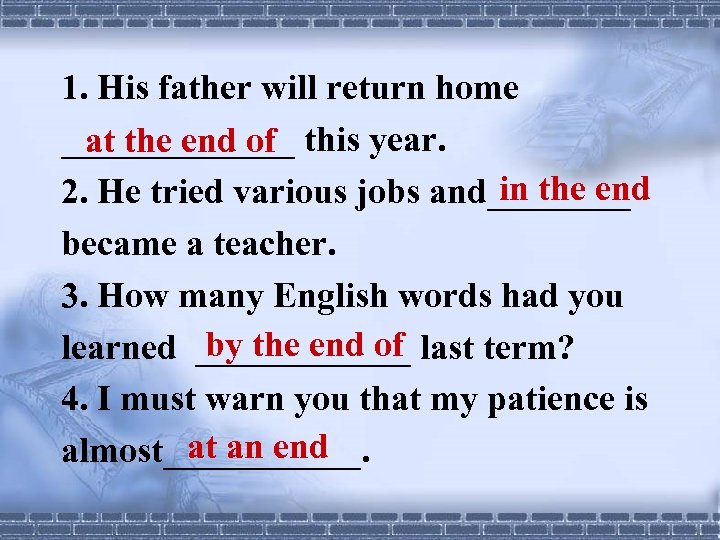 1. His father will return home _______ this year. at the end of in the end 2. He tried various jobs and____ became a teacher. 3. How many English words had you by the end of learned ______ last term? 4. I must warn you that my patience is at an end almost______.
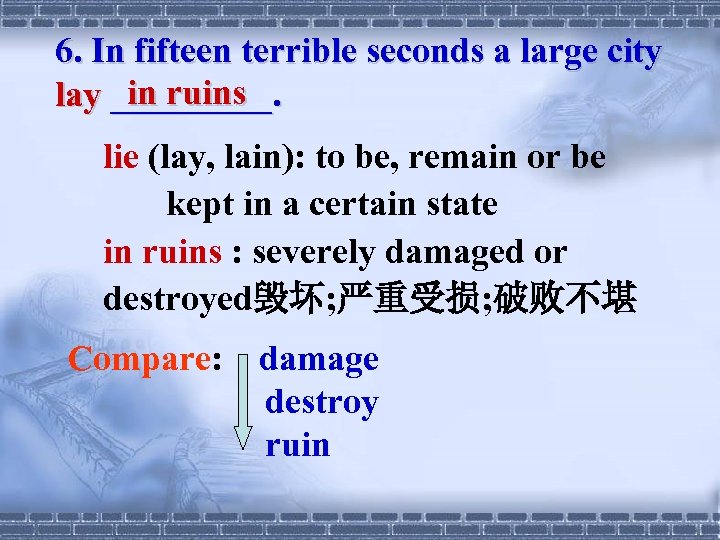 6. In fifteen terrible seconds a large city in ruins lay _____. lie (lay, lain): to be, remain or be kept in a certain state in ruins : severely damaged or destroyed毁坏; 严重受损; 破败不堪 Compare: damage destroy ruin
 damage vt. to harm or spoil sth. 指部分“损 坏”、“损害”、“破坏”或指使用价值有所降 低。 Many buildings were badly damaged during the war. n. [U] harm or injury +to sth. Strong winds had caused serious damage to the roof. The doctors were worried that he might have suffered brain damage.
 destroy vt. to damage sth. so badly that it does not exist or cannot be used彻底破坏, 摧 毁, 以致不可能修复, 也可指希望、计划等破灭。 Most of the old part of the city was destroyed by bombs during the war. The accident seemed to have completely/totally destroyed his confidence.
 ruin vt. 1 to spoil or destroy severely or completely 使毁灭; 使崩溃; 弄糟 Huge modern hotels have ruined this once unspoilt coastline. Her injury ruined her chances of winning the race. 2 to cause a person or company to lose all their money or their reputation使破产; 毁 灭 Cheap imported goods are ruining many businesses. If there's a scandal I'll be ruined!
![ruin n. 1 [U] when sth. is spoilt or destroyed毁坏; 毁灭 The car accident](https://present5.com/presentation/b39592fe86e94fcfd8e8815ef730e1c0/image-21.jpg "ruin n. 1 [U] when sth. is spoilt or destroyed毁坏; 毁灭 The car accident") ruin n. 1 [U] when sth. is spoilt or destroyed毁坏; 毁灭 The car accident meant the ruin of all her hopes. They let the palace fall into ruin. The company is facing ruin. 2[C] the broken parts that are left from an old building or town废墟 We visited a Roman ruin. the ruins of the ancient city of Carthage
ruin n. 1 [U] when sth. is spoilt or destroyed毁坏; 毁灭 The car accident meant the ruin of all her hopes. They let the palace fall into ruin. The company is facing ruin. 2[C] the broken parts that are left from an old building or town废墟 We visited a Roman ruin. the ruins of the ancient city of Carthage
 ruin表示破坏严重, 以致不能修复, 但这 种破坏不像destroy那样毁灭某物, 而是 强调致使该物的使用价值发生了问题。 用作名词时, 它表示 “毁灭”、 “瓦解”、 “废墟”等抽象概念。ruin也有借喻的用 法。
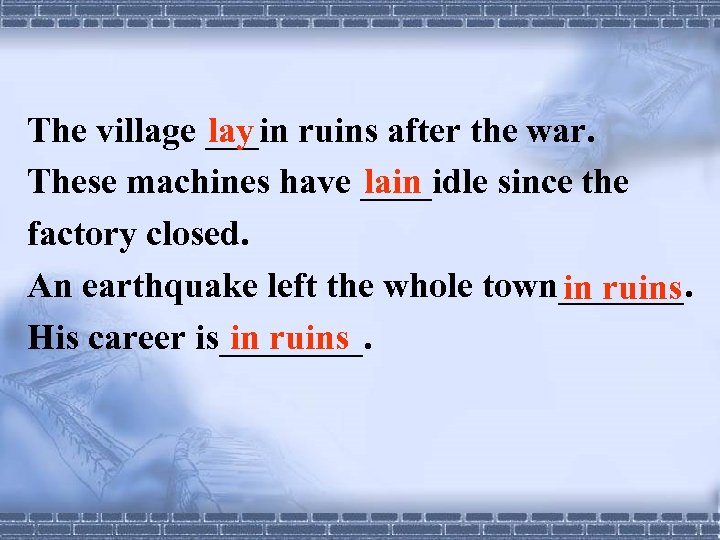 The village ___in ruins after the war. lay lain These machines have ____idle since the factory closed. An earthquake left the whole town_______. in ruins His career is____.
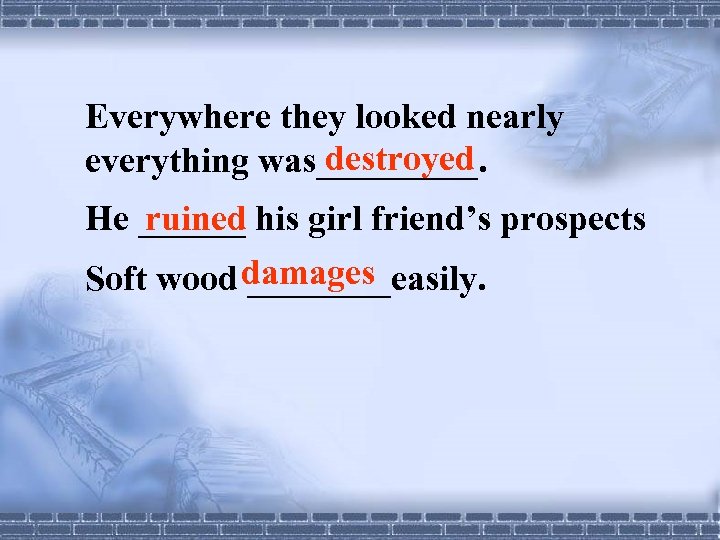 Everywhere they looked nearly destroyed everything was_____. He ______ his girl friend’s prospects ruined damages Soft wood ____easily.
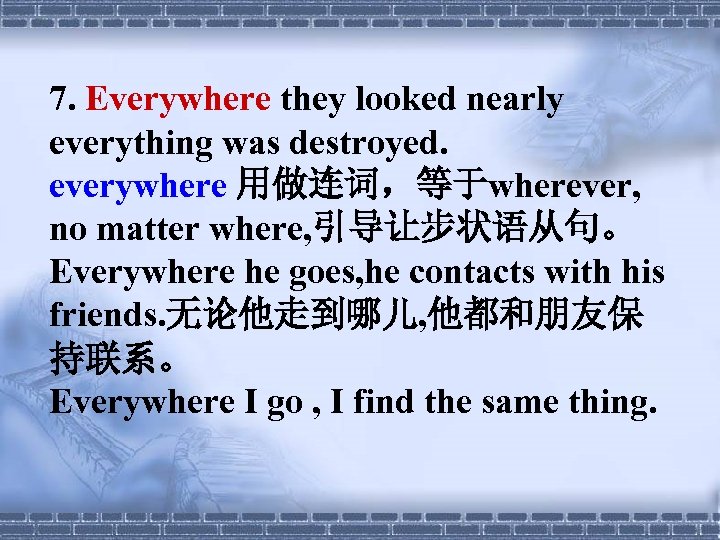 7. Everywhere they looked nearly everything was destroyed. everywhere 用做连词,等于wherever, no matter where, 引导让步状语从句。 Everywhere he goes, he contacts with his friends. 无论他走到哪儿, 他都和朋友保 持联系。 Everywhere I go , I find the same thing.
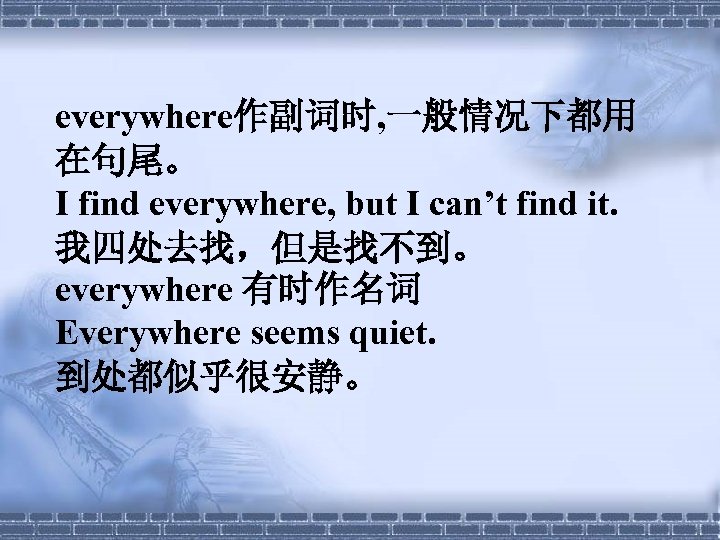 everywhere作副词时, 一般情况下都用 在句尾。 I find everywhere, but I can’t find it. 我四处去找,但是找不到。 everywhere 有时作名词 Everywhere seems quiet. 到处都似乎很安静。
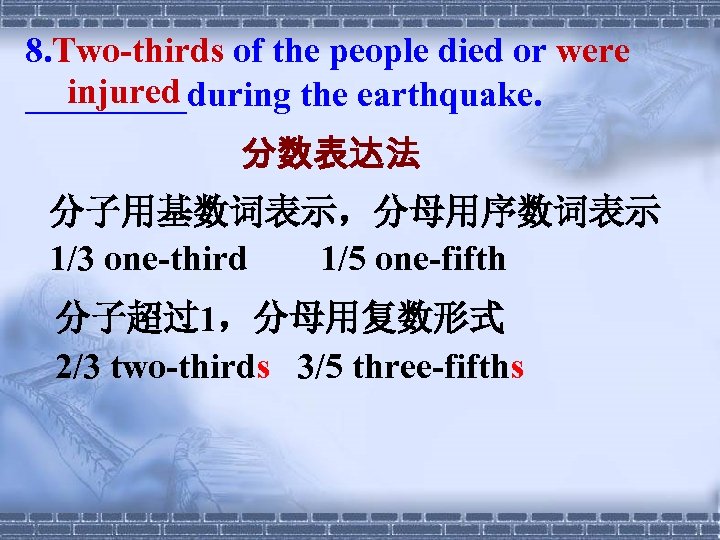 8. Two-thirds of the people died or were injured _____during the earthquake. 分数表达法 分子用基数词表示,分母用序数词表示 1/3 one-third 1/5 one-fifth 分子超过1,分母用复数形式 2/3 two-thirds 3/5 three-fifths
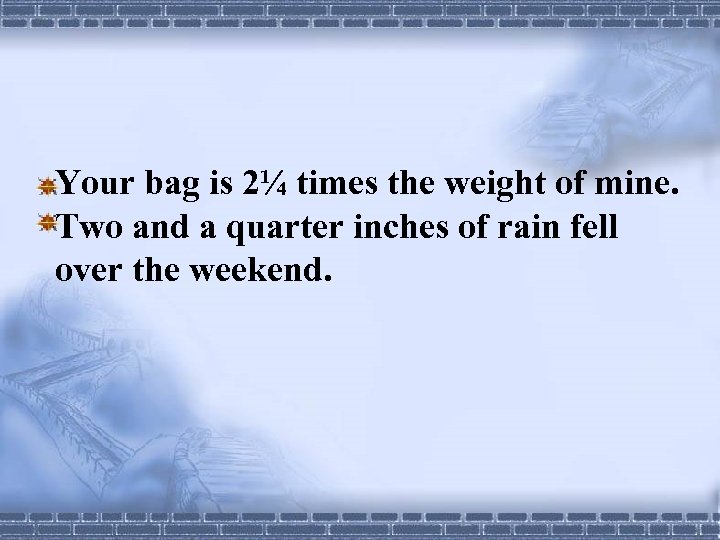 Your bag is 2¼ times the weight of mine. Two and a quarter inches of rain fell over the weekend.
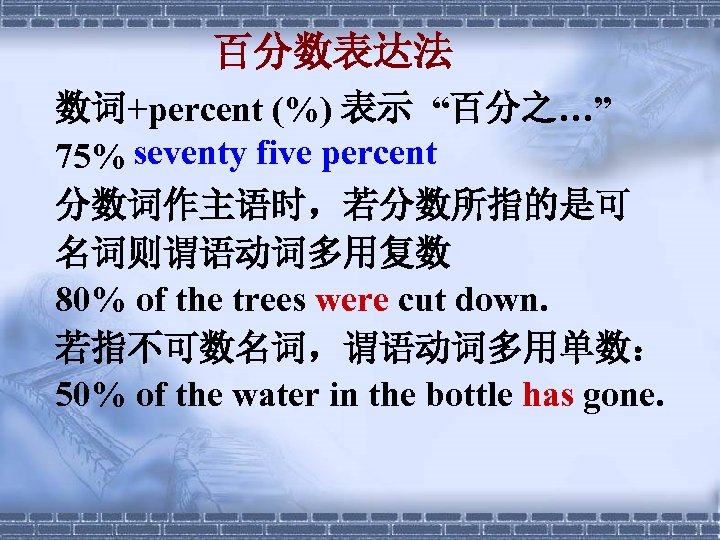 百分数表达法 数词+percent (%) 表示 “百分之…” 75% seventy five percent 分数词作主语时,若分数所指的是可 名词则谓语动词多用复数 80% of the trees were cut down. 若指不可数名词,谓语动词多用单数: 50% of the water in the bottle has gone.
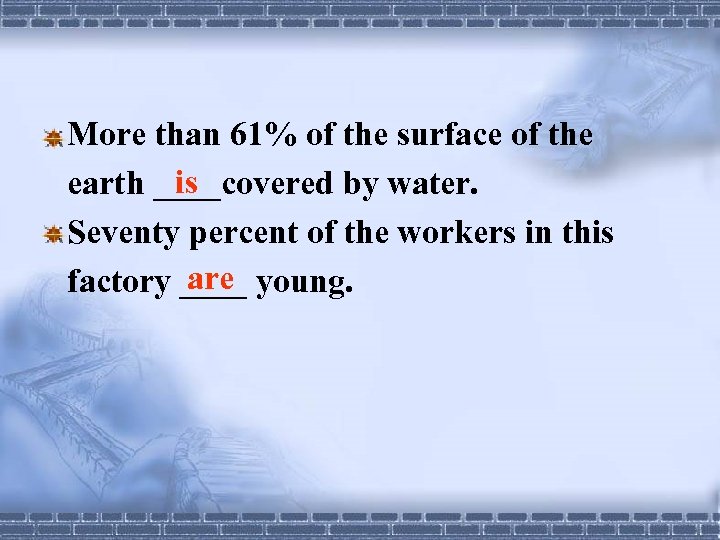 More than 61% of the surface of the is earth ____covered by water. Seventy percent of the workers in this are factory ____ young.
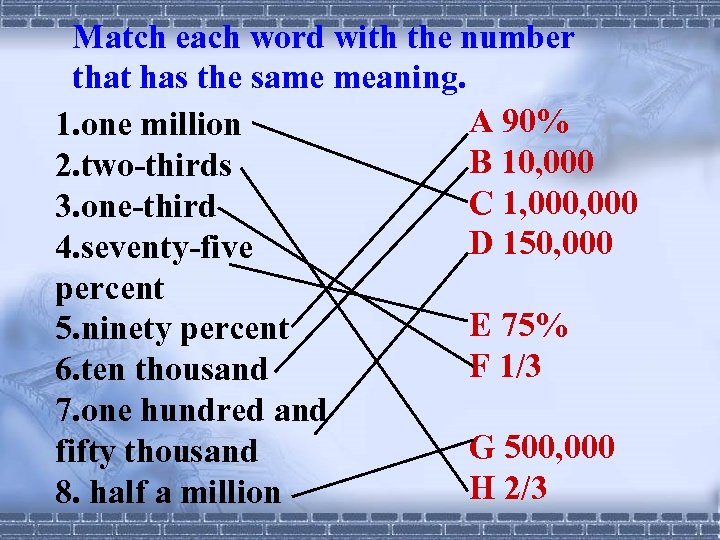 Match each word with the number that has the same meaning. A 90% 1. one million B 10, 000 2. two-thirds C 1, 000 3. one-third D 150, 000 4. seventy-five percent E 75% 5. ninety percent F 1/3 6. ten thousand 7. one hundred and G 500, 000 fifty thousand H 2/3 8. half a million
 injure vt. to hurt or cause physical harm to a person or animal使受伤, 伤害, 可以 表示“损害名誉, 伤害感情等” A bomb exploded at the embassy, injuring several people. He was badly injured in the crash. He claimed that working too hard was injuring his health.
 the injured plural n. people who are injured, considered as a group The injured were taken to several nearby hospitals.
 harm, injure, hurt, wound harm 的含义侧重于“损害,伤害”,可指 精神或肉体的伤害,程度较轻 Don't harm your eyes by reading in dim light. injure指“损害,受伤”,着重容貌、机能 的损坏,例如:She was injured badly in the accident. 事故中她受了伤。 [词义辨析]
 hurt指“伤害;刺痛”,尤指在精神或 肉体上的伤害,含有强烈的疼痛 No feelings were hurt though the criticism was sharp. 批评虽然尖锐, 却未伤感情。 wound指外伤,如枪伤, 刀伤, 剑伤, 尤 指在战斗中受伤。
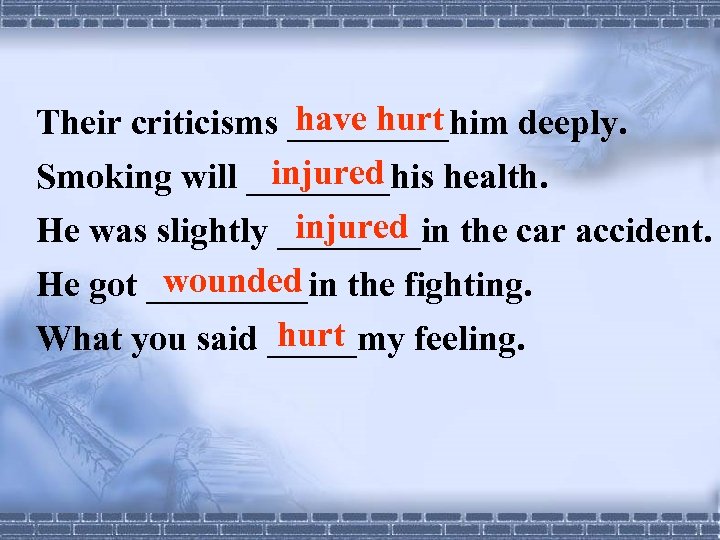 have hurt Their criticisms _____him deeply. injured Smoking will ____his health. injured He was slightly ____in the car accident. wounded He got _____in the fighting. hurt What you said _____my feeling.
 9. Sand now filled the wells instead of water. instead of 代替, 而不是, 后接名词,动 词,动名词等,但不能接句子) instead是副词,在句中单独作状语, 置于句首时,意为“相反地”
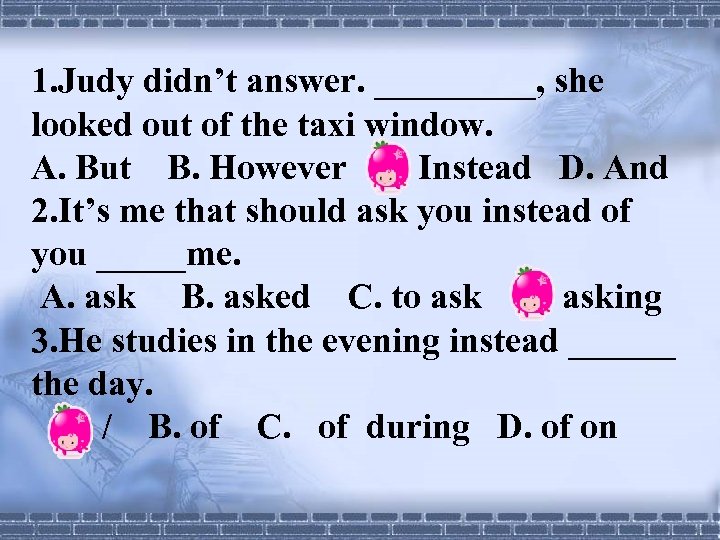 1. Judy didn’t answer. _____, she looked out of the taxi window. A. But B. However C. Instead D. And 2. It’s me that should ask you instead of you _____me. A. ask B. asked C. to ask D. asking 3. He studies in the evening instead ______ the day. A. / B. of C. of during D. of on
 10. All hopes was not lost. 并没有丧失 所有希望。= Not all hope was lost. 该句为不完全否定,也可称之为部分 否定。 all…not…= not all …, some but not all 一些, 但不是全部 当not与all, everyone, everything, both连用时,皆表示不完 全的否定。
 1. Not all the girls left. (=Only some of them left. ) 2. Not all the children are noisy. (= Some of the children are not noisy. ) 3. 闪光的并不都是金子。 Not all glitter is gold. 4. 并不是人人都在。 Not all people are here.