 Скачать презентацию Unit 3 The Legislative Branch Political Parties
d6827aeec642c92e41539bf8f3e7461f.ppt
- Количество слайдов: 35



Unit 3 – The Legislative Branch, Political Parties, Interest Groups Mr. Borkowski
Congressional Term (a “Congress”) n Takes place over a two year period with two sessions per term. The 102 nd Congress met from Jan. 1991 -Jan. 1993. Right now we are in the 114 th Congress, first session.
Congress n n n Each house of Congress has its own meeting room called a chamber. Floor action is when legislation (laws) are being discussed and voted on in Congress. Adjournment is the end of the congressional session. Recess is a break from the session. The President can call a special session of Congress in case of an emergency. Joint sessions occur when both houses of Congress meet together.
Qualifications for Congress n n Senate 30 years old citizen of the U. S. for 9 years resident of the state represented n n House 25 years old citizen of the U. S. for 7 years resident of the district represented
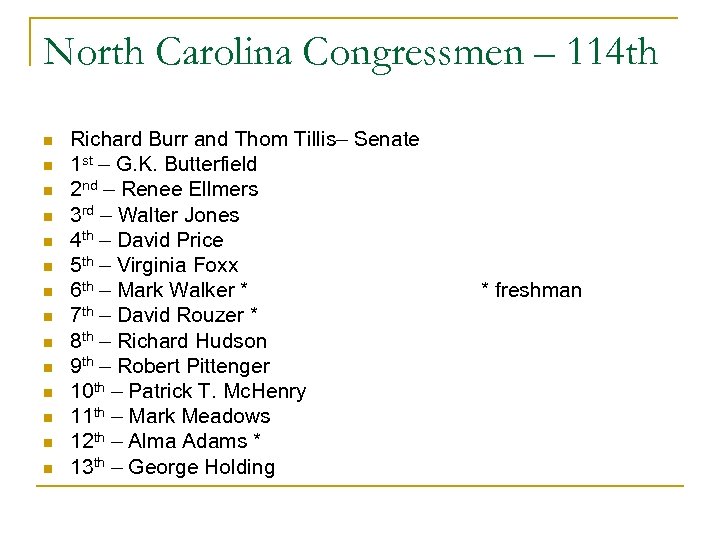
North Carolina Congressmen – 114 th n n n n Richard Burr and Thom Tillis– Senate 1 st – G. K. Butterfield 2 nd – Renee Ellmers 3 rd – Walter Jones 4 th – David Price 5 th – Virginia Foxx 6 th – Mark Walker * 7 th – David Rouzer * 8 th – Richard Hudson 9 th – Robert Pittenger 10 th – Patrick T. Mc. Henry 11 th – Mark Meadows 12 th – Alma Adams * 13 th – George Holding * freshman
Congressmen n n n occupation – law, business, banking education – most have college degrees ethnicity – most are white gender – 70 women in House, 14 in Senate age – avg. age in House is 57 (51 in late 90 s), avg. age in Senate is 62 (57 in late 90 s) income – all are wealthy religion – most are Protestant
Pay and Benefits n n n 2014 - $174, 000 a year. (Speaker - $223, 500 Majority and Minority Leaders - $193, 400) Most have outside income. Perks – staff and supplies, franking privilege, travel allowance, free medical, health facilities, low-cost meals
Rules n n Formal rules – the Senate has fewer formal rules than the House Informal rules – loyalty, civility, specialization, reciprocity, compromise, seniority
Leadership – n n th 114 Congress House – Speaker of the House is the leader (John Boehner), Majority Leader (Kevin Mc. Carthy), Majority Whip (Steve Scalise), Minority Leader (Nancy Pelosi), Minority Whip (Steny Hoyer) Senate – President of the Senate (Vice. President of the U. S. ), President Pro Tempore (Sen. Orrin Hatch), Majority Leader (Sen. Mitch Mc. Connell), Minority Leader (Sen. Harry Reid)
Support Staff n n n Library of Congress General Accounting Office Congressional Budget Office of Technical Assessment Staff
Committees n n Standing Committees – permanent and deal with bills in a particular subject area. Usually very large so divided into subcommittees Select – for a specific purpose for a limited time Conference – made up of members of both houses and used to settle disputes on bills Committees on committees – make appointments to the committees
Committee assignments n n the majority party determines the ratio on committees Factors for assignment to a committee – expertise or specialty, seniority, party loyalty Selecting chairpersons – always from the majority party, seniority plays a part but they are elected. Special interest caucuses
Powers of Congress n n n n Sovereign powers – naturalization, create and fund armed forces, exclusive power to make laws Financial powers – can place duties and imposts (fees on imported goods) and excise taxes (taxes on the production of goods like alcohol, tobacco, gas) Regulating and Promoting Trade – sets standards, post roads, copyrights, patents Judicial powers – establish courts Advice and consent – confirms (approves) all Presidential appointments (hirings) Impeachment – House of Reps. impeaches, Senate convicts Watchdog
Making a law n n n Laws begin as bills and have a sponsor which does not have to be only one person. Sources for bills: the President, interest groups, constituents. 2 types of bills: public – applies to the general public; and private – deals with individual citizens Resolutions – formal statements expressing an opinion
Making a law continued n n n n Bill is introduced in House or Senate. Bill is assigned to a standing committee –the committee can pigeonhole the bill – refuse to let the bill out of committee thereby killing it – or report the bill out of committee with a favorable recommendation for its passage. Bill is placed on the calendar – formal schedule to consider the bill. Debate on bill Filibuster – talking a bill to death cloture – vote to end debate on the bill Action – table, pass, attach a rider, amend
Distribution of House seats n n n Census – count of population taken every 10 years Some states gain in population while some states lose people. Reapportionment – redistribution of House seats If a state gains or loses a House seat, they must redistrict – redrawing congressional district lines. Gerrymandering – redrawing districts along racial lines shifts in representation – movement from N. E. to South
Political Party n n n a group of citizens that attempt to control government through the electoral process Major Function – nominate candidates for office Majority party – party in power or in control Minority (opposition) party – party out of power, not in control House – 247 Republicans, 188 Democrats Senate – 54 Republicans, 44 Democrats, 2 Independents
Functions of parties n provide information n simplify political decisions
Two-Party System n n n Two-party system – Democrats and Republicans One-party system – usually found in dictatorships Multi-party system – found in Europe, unstable
Reasons for the maintenance of two-party system n n n agreement on basic ideas, goals, and focus legal barriers for minor parties – difficult to get on ballots, money-high filing fee patterns of voting
Third Parties and Minor Parties n n n Issue parties – anti-slavery, economic Ideological parties – Communist, Socialist, Libertarian, Green, Constitution, Justice Splinter parties – from Republicans – Bull Moose (1912), Progressive (1924); and from Democrats – Dixiecrat (1948), American Independent (1968)
History of the Two-Party System – First System (1796 -1824) n Federalists – led by John Adams, made up of businessmen, faded and died in 1820 n Anti-Federalists – AKA Democratic. Republicans; led by Jefferson, Madison, Monroe; made up of farmers and commoners; fractured and split to form two new parties
History of the Two-Party System – Second System (1828 -1856) n Whigs – led by H. Clay and D. Webster; made up of industrialists and southern farmers; won White House with Harrison (1840) and Taylor (1848) n Democrats – led by A. Jackson and M. Van Buren; made up of southerners, immigrants and westerners; sought to broaden political opportunity
SLAVERY – divided both parties 1860 -1932 Era of Republican Dominance n Republicans – led by Abraham Lincoln; after the Civil War, Republicans held control of the government for 60 years n Democrats – led by William Jennings Bryan, held control of the South
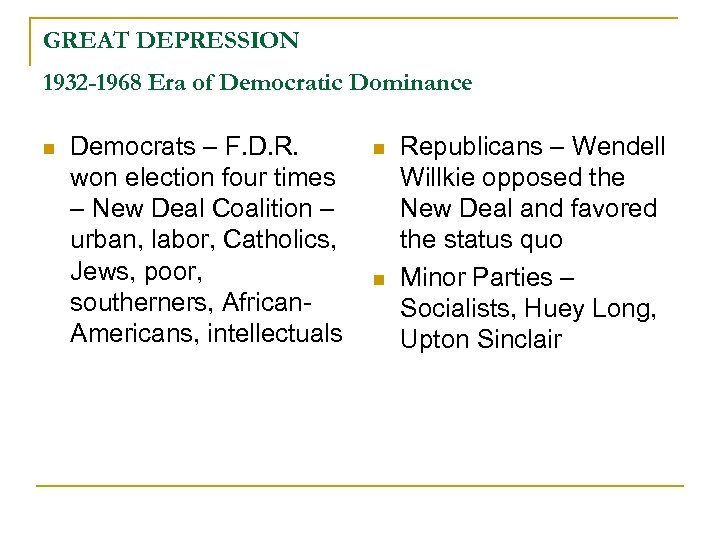
GREAT DEPRESSION 1932 -1968 Era of Democratic Dominance n Democrats – F. D. R. won election four times – New Deal Coalition – urban, labor, Catholics, Jews, poor, southerners, African. Americans, intellectuals n n Republicans – Wendell Willkie opposed the New Deal and favored the status quo Minor Parties – Socialists, Huey Long, Upton Sinclair
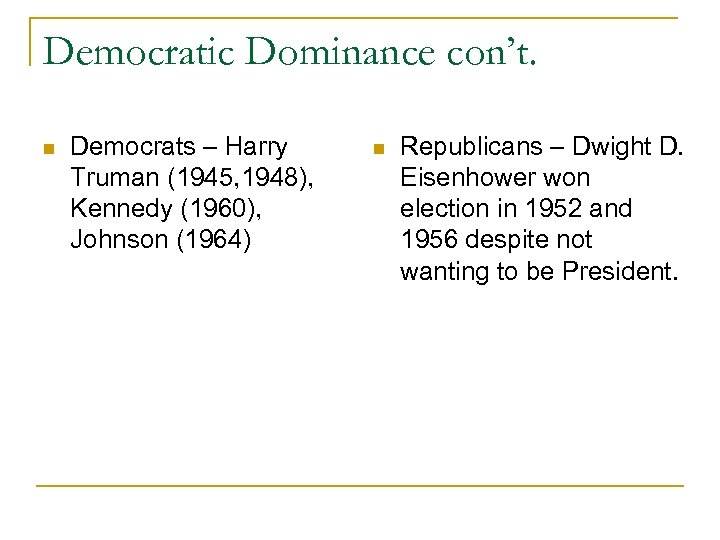
Democratic Dominance con’t. n Democrats – Harry Truman (1945, 1948), Kennedy (1960), Johnson (1964) n Republicans – Dwight D. Eisenhower won election in 1952 and 1956 despite not wanting to be President.
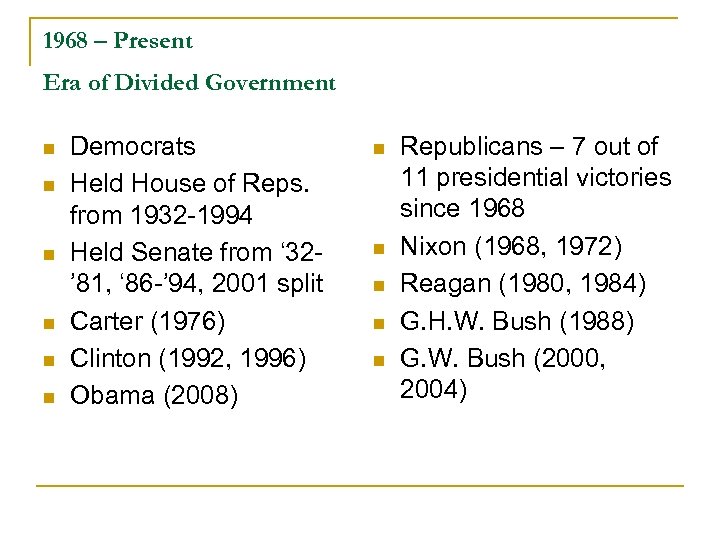
1968 – Present Era of Divided Government n n n Democrats Held House of Reps. from 1932 -1994 Held Senate from ‘ 32’ 81, ‘ 86 -’ 94, 2001 split Carter (1976) Clinton (1992, 1996) Obama (2008) n n n Republicans – 7 out of 11 presidential victories since 1968 Nixon (1968, 1972) Reagan (1980, 1984) G. H. W. Bush (1988) G. W. Bush (2000, 2004)
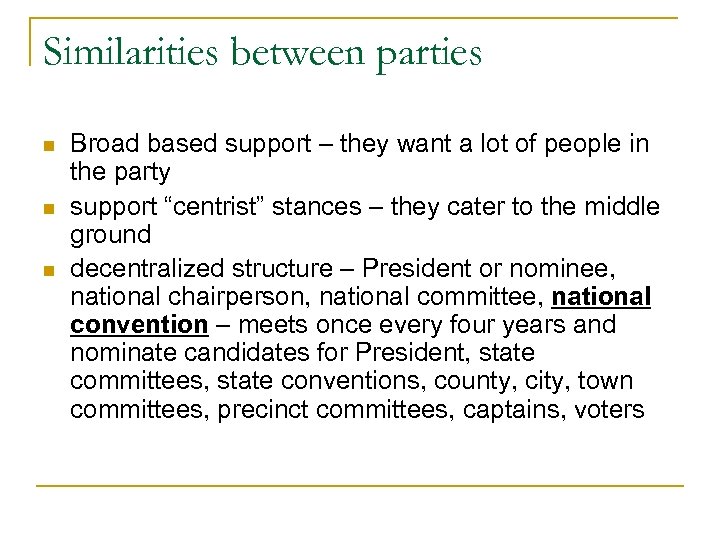
Similarities between parties n n n Broad based support – they want a lot of people in the party support “centrist” stances – they cater to the middle ground decentralized structure – President or nominee, national chairperson, national committee, national convention – meets once every four years and nominate candidates for President, state committees, state conventions, county, city, town committees, precinct committees, captains, voters
Interest Groups n n An organized group of people who share ideas and seek to influence public policy through governmental action Pluralist theory – interest groups bring representation to all Elite theory – only a few groups have power (influence) Hyperpluralist theory – too many groups get too much of what they want
Advantages of Interest Groups n n n Provide an important linkage between people and the government Help maintain a positive balance of power and stability Provide information to legislators and voters
How Interest Groups Influence the Government n n n Lobbying – source of information, political strategy, source of ideas, friendship Electioneering – aiding candidates financially and strategically Political Action Committees (PACs) – enables interest groups to legally funnel money to campaigns that support their interests Litigation – file lawsuits/briefs to get favorable rulings leading to policy Going public – market their issue stances
Economic Interest Groups n n Professional groups – AMA, ABA, NEA Business groups – Chamber of Commerce, Nat. Assoc. of Manufacturers Labor groups – AFL-CIO, Teamsters Agriculture groups – Amer. Farm Bureau Federation, NFO, the Grange
Social Action Interest Groups n n Equality groups – NAACP, NOW Environmental groups – Ducks Unlimited, Greenpeace, Sierra Club, Nat. Audubon Society Public Interest Groups – Common Cause Religious Groups – Christian Coalition
Free Rider Problem n n n Potential group – all people who might be group members due to common interest Actual group – those in the potential group who choose to join the interest group Collective good – something of value that cannot be withheld from a potential group member Common good – something of value that everyone receives regardless of membership Why join a group if you are going to receive the benefit without joining?
Success? n n n Size – some argue that smaller groups are more successful, others see large groups as being more effective Intensity – small groups focusing on a singleissue can be more successful Financial resources – wealthier groups are more effective
Скачать презентацию Unit 3 The Legislative Branch Political Parties
d6827aeec642c92e41539bf8f3e7461f.ppt