


 Скачать презентацию Unit 3 The Civil War and Reconstruction
23e773f94705ac5c80cc5df67f2996cf.ppt
- Количество слайдов: 25
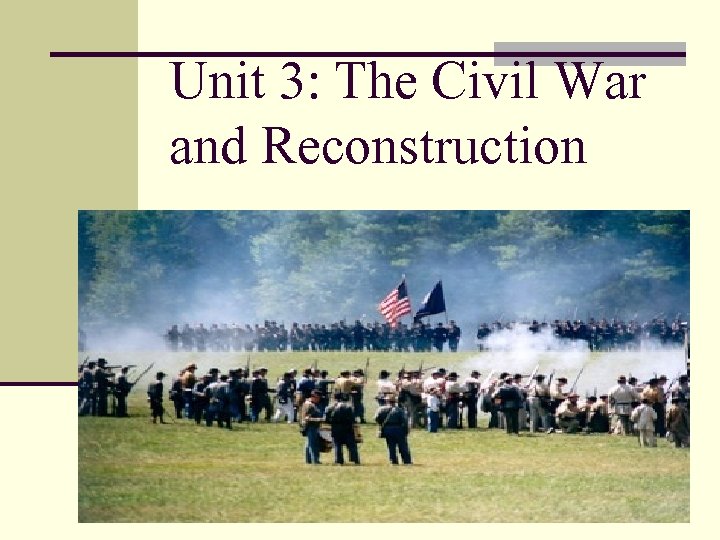 Unit 3: The Civil War and Reconstruction
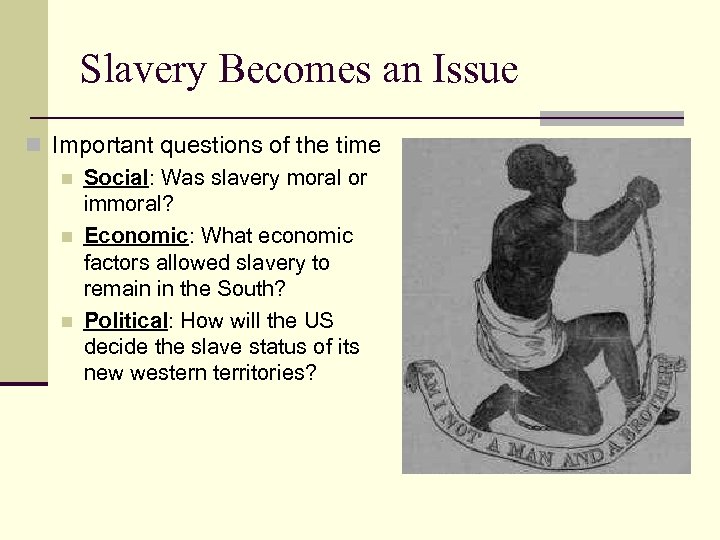 Slavery Becomes an Issue n Important questions of the time n Social: Was slavery moral or immoral? n Economic: What economic factors allowed slavery to remain in the South? n Political: How will the US decide the slave status of its new western territories?
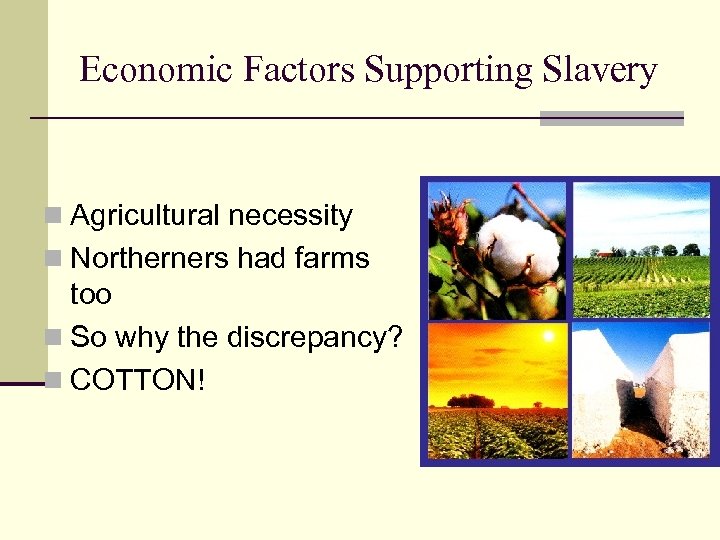 Economic Factors Supporting Slavery n Agricultural necessity n Northerners had farms too n So why the discrepancy? n COTTON!
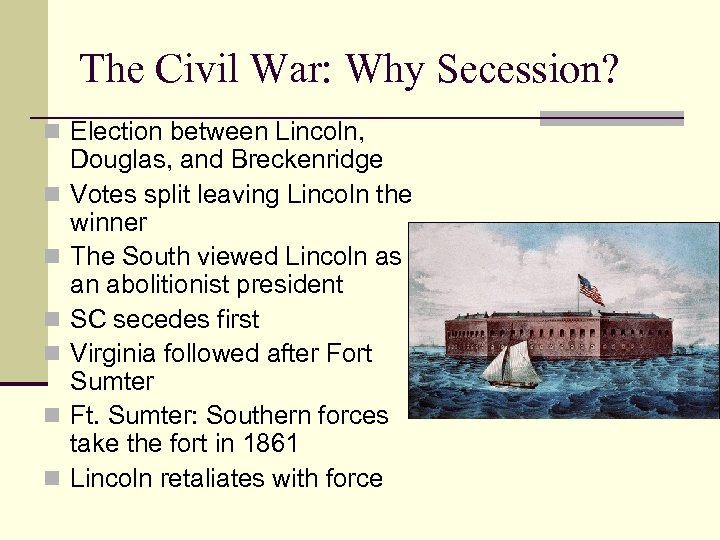 The Civil War: Why Secession? n Election between Lincoln, n n n Douglas, and Breckenridge Votes split leaving Lincoln the winner The South viewed Lincoln as an abolitionist president SC secedes first Virginia followed after Fort Sumter Ft. Sumter: Southern forces take the fort in 1861 Lincoln retaliates with force
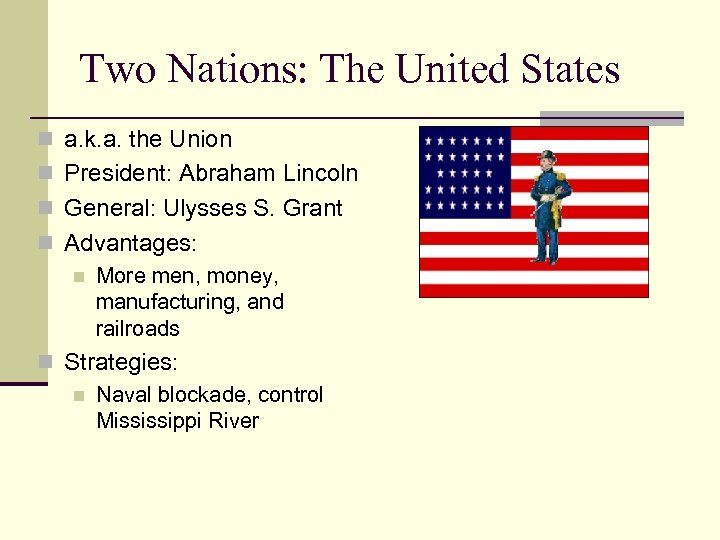 Two Nations: The United States n a. k. a. the Union n President: Abraham Lincoln n General: Ulysses S. Grant n Advantages: n More men, money, manufacturing, and railroads n Strategies: n Naval blockade, control Mississippi River
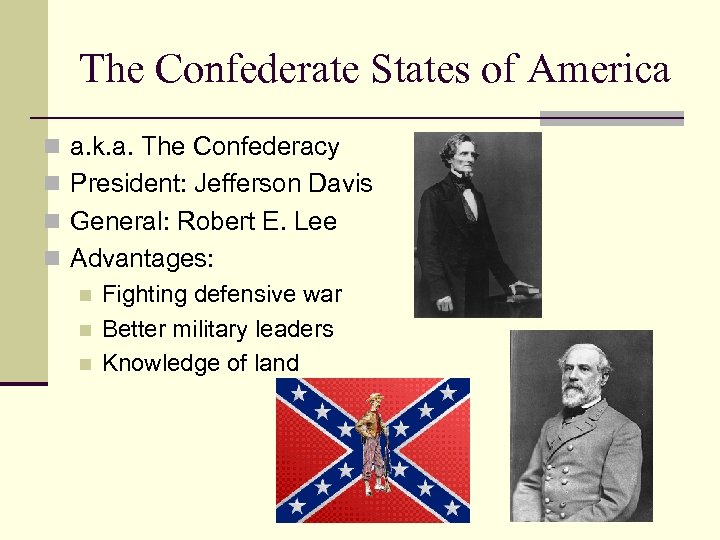 The Confederate States of America n a. k. a. The Confederacy n President: Jefferson Davis n General: Robert E. Lee n Advantages: n Fighting defensive war n Better military leaders n Knowledge of land
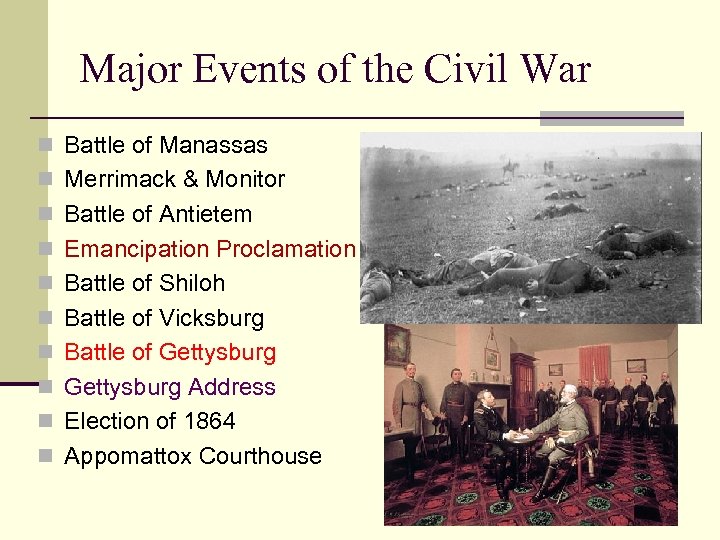 Major Events of the Civil War n Battle of Manassas n Merrimack & Monitor n Battle of Antietem n Emancipation Proclamation n Battle of Shiloh n Battle of Vicksburg n Battle of Gettysburg n Gettysburg Address n Election of 1864 n Appomattox Courthouse
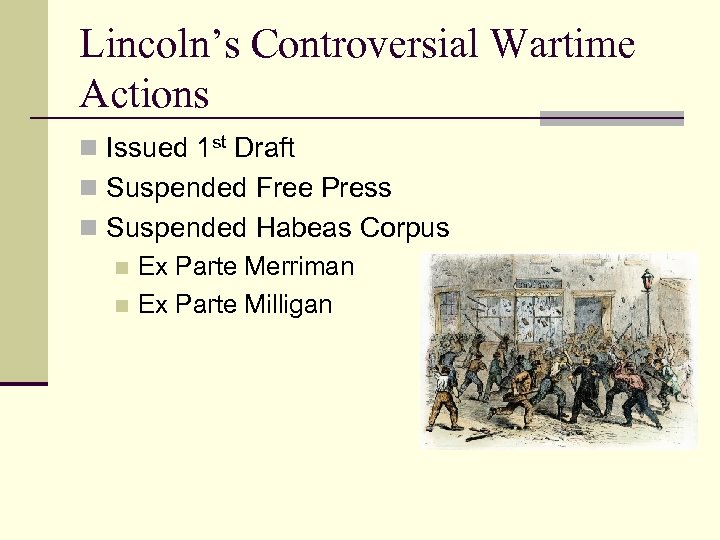 Lincoln’s Controversial Wartime Actions n Issued 1 st Draft n Suspended Free Press n Suspended Habeas Corpus n Ex Parte Merriman n Ex Parte Milligan
 Reputation as the “Great Emancipator” n Allowing African-American Regiments to Fight n 54 th Massachusetts n “Glory”- Movie n The Emancipation Proclamation n January 1, 1863 n “Freed” slaves in rebelling states (not border) n Made ending slavery an official war goal n Pushing for the Ratification of the 13 th Amendment- “Lincoln”- Movie
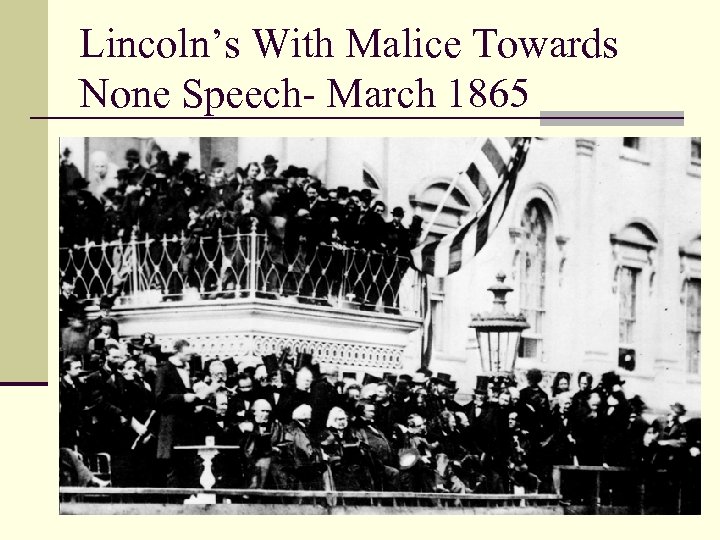 Lincoln’s With Malice Towards None Speech- March 1865
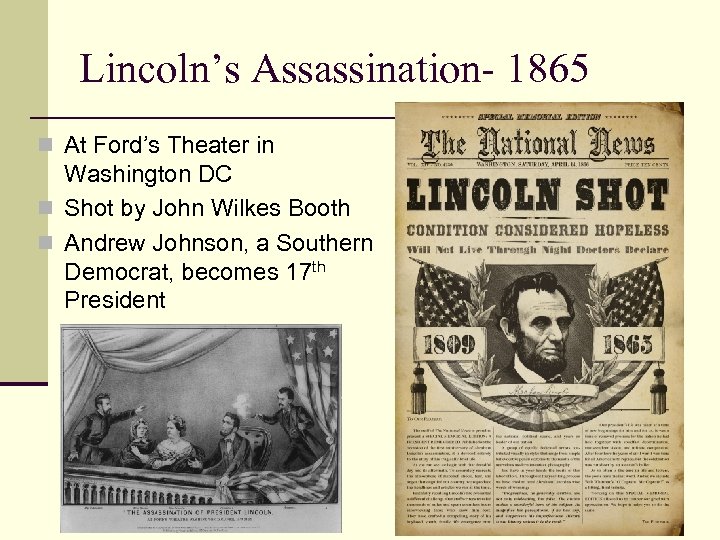 Lincoln’s Assassination- 1865 n At Ford’s Theater in Washington DC n Shot by John Wilkes Booth n Andrew Johnson, a Southern Democrat, becomes 17 th President
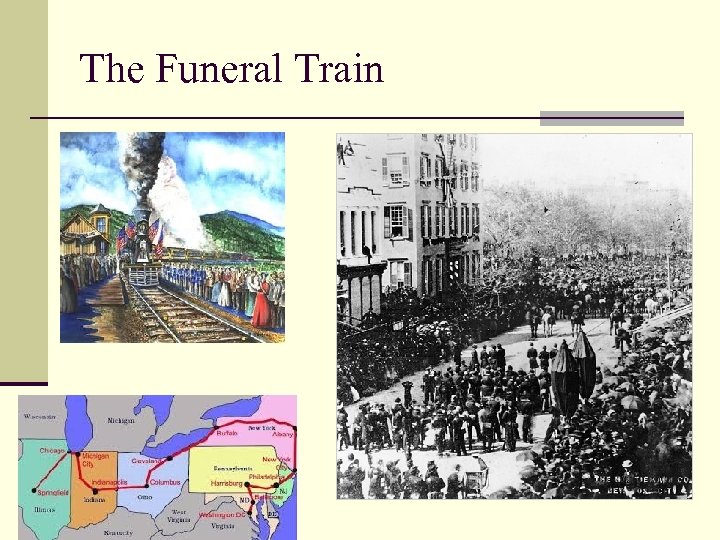 The Funeral Train
 Lincoln wanted to Forgive With malice toward none; with charity for all; with firmness in the right, as God gives us to see the right, let us strive on to finish the work we are in; to bind up the nation's wounds; to care for him who shall have borne the battle, and for his widow, and for his orphan -- do all which may achieve and cherish a just, and a lasting peace, among ourselves, and with all nations” “ March 1865 Abraham Lincoln
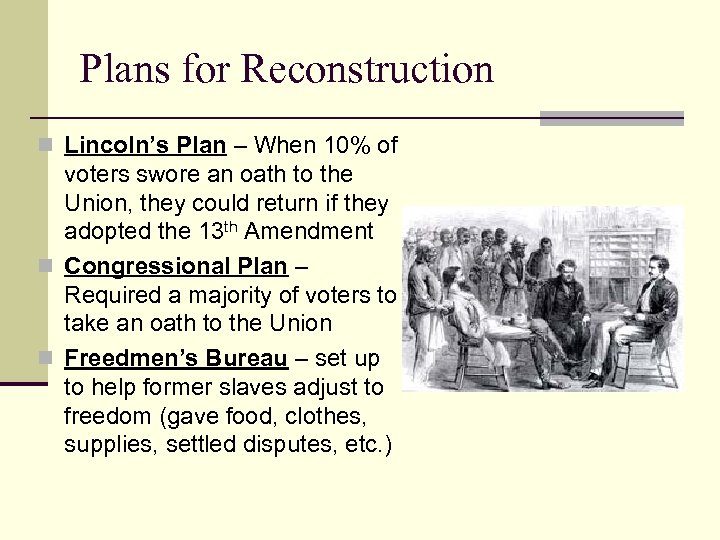 Plans for Reconstruction n Lincoln’s Plan – When 10% of voters swore an oath to the Union, they could return if they adopted the 13 th Amendment n Congressional Plan – Required a majority of voters to take an oath to the Union n Freedmen’s Bureau – set up to help former slaves adjust to freedom (gave food, clothes, supplies, settled disputes, etc. )
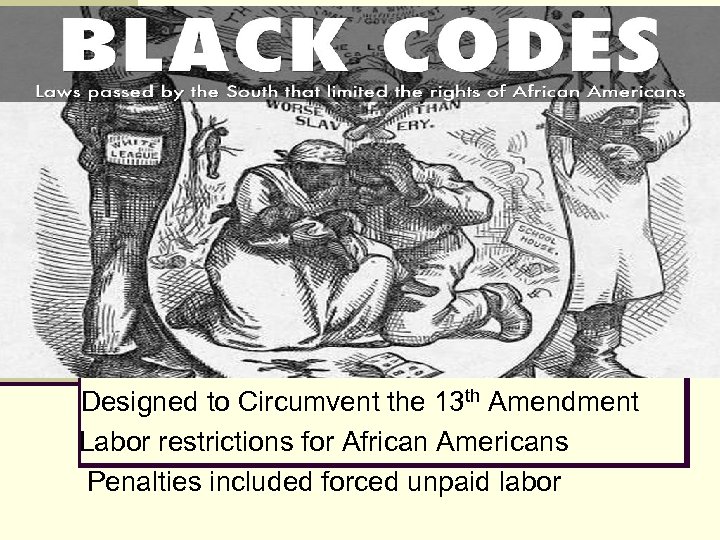 Designed to Circumvent the 13 th Amendment Labor restrictions for African Americans Penalties included forced unpaid labor
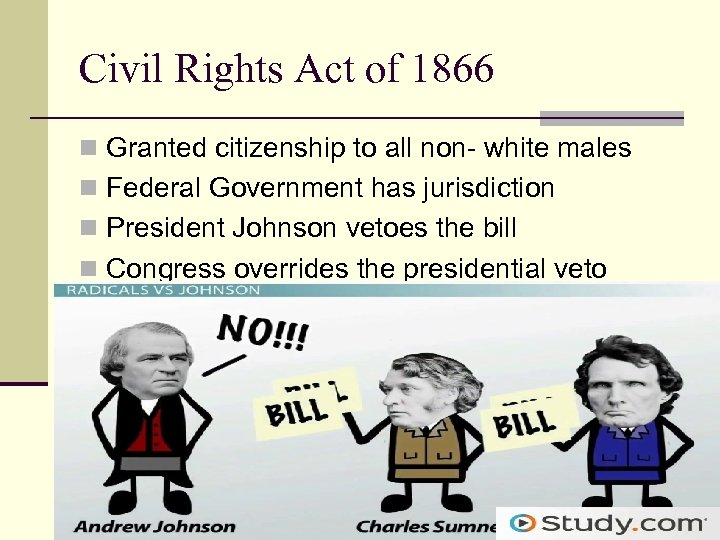 Civil Rights Act of 1866 n Granted citizenship to all non- white males n Federal Government has jurisdiction n President Johnson vetoes the bill n Congress overrides the presidential veto
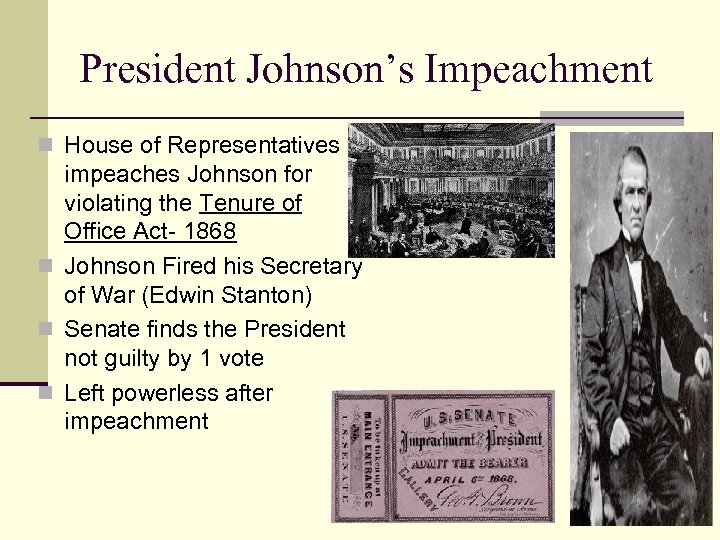 President Johnson’s Impeachment n House of Representatives impeaches Johnson for violating the Tenure of Office Act- 1868 n Johnson Fired his Secretary of War (Edwin Stanton) n Senate finds the President not guilty by 1 vote n Left powerless after impeachment
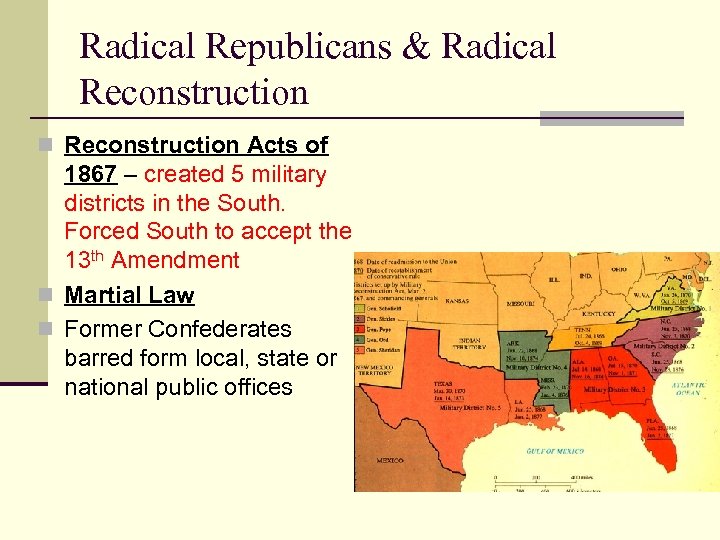 Radical Republicans & Radical Reconstruction n Reconstruction Acts of 1867 – created 5 military districts in the South. Forced South to accept the 13 th Amendment n Martial Law n Former Confederates barred form local, state or national public offices
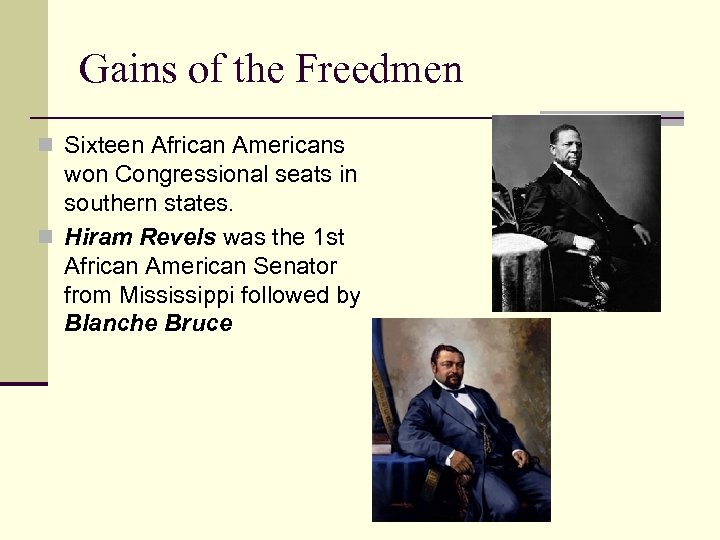 Gains of the Freedmen n Sixteen African Americans won Congressional seats in southern states. n Hiram Revels was the 1 st African American Senator from Mississippi followed by Blanche Bruce
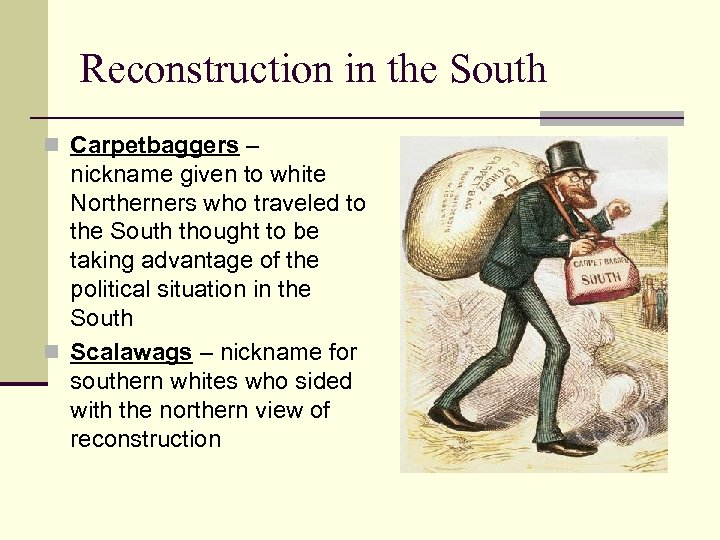 Reconstruction in the South n Carpetbaggers – nickname given to white Northerners who traveled to the South thought to be taking advantage of the political situation in the South n Scalawags – nickname for southern whites who sided with the northern view of reconstruction
 Reconstruction Amendments • 13 TH AMENDMENT- ABOLISHED SLAVERY 14 TH AMENDMENT- EQUAL PROTECTION UNDER THE LAW, DEFINES CITIZENSHIP 15 TH AMENDMENT- VOTING RIGHTS CANNOT BE DENIED BASED ON RACE, COLOR OR PREVIOUS CONDITIONS OF SERVITUDE
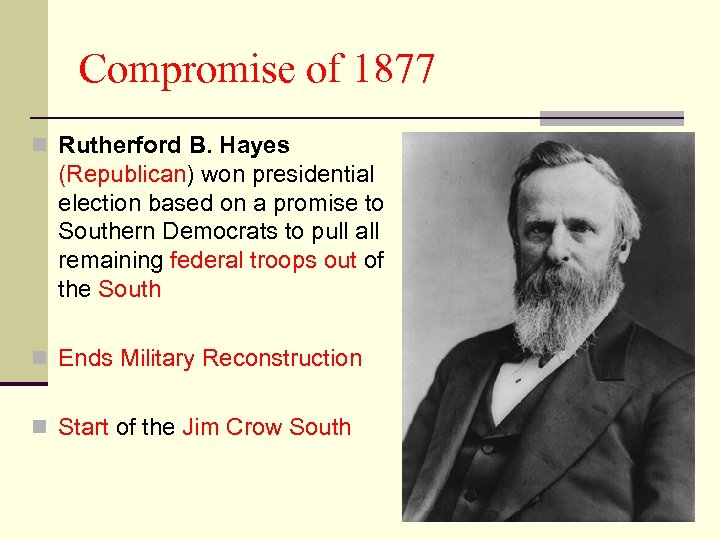 Compromise of 1877 n Rutherford B. Hayes (Republican) won presidential election based on a promise to Southern Democrats to pull all remaining federal troops out of the South n Ends Military Reconstruction n Start of the Jim Crow South
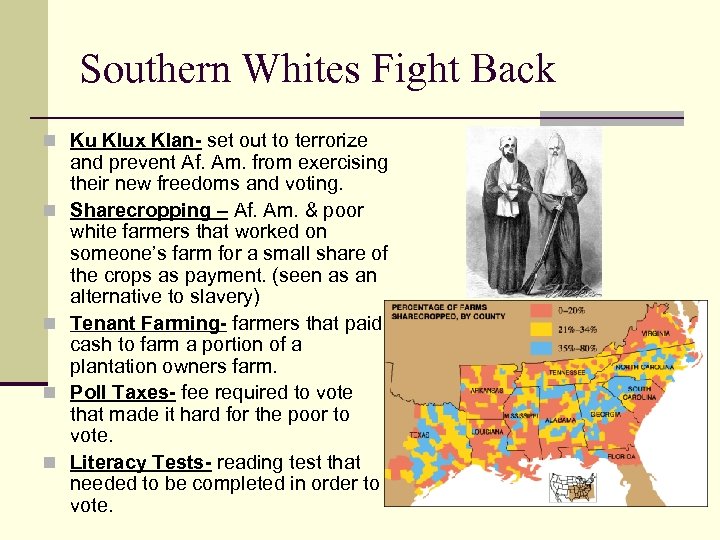 Southern Whites Fight Back n Ku Klux Klan- set out to terrorize n n and prevent Af. Am. from exercising their new freedoms and voting. Sharecropping – Af. Am. & poor white farmers that worked on someone’s farm for a small share of the crops as payment. (seen as an alternative to slavery) Tenant Farming- farmers that paid cash to farm a portion of a plantation owners farm. Poll Taxes- fee required to vote that made it hard for the poor to vote. Literacy Tests- reading test that needed to be completed in order to vote.
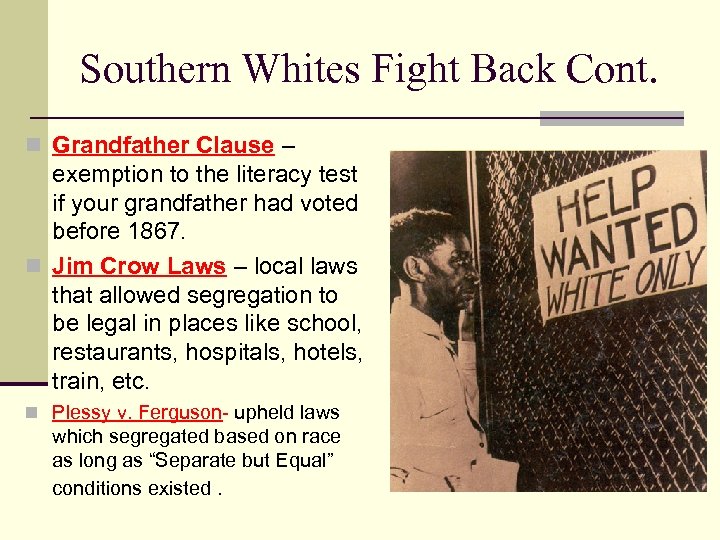 Southern Whites Fight Back Cont. n Grandfather Clause – exemption to the literacy test if your grandfather had voted before 1867. n Jim Crow Laws – local laws that allowed segregation to be legal in places like school, restaurants, hospitals, hotels, train, etc. n Plessy v. Ferguson- upheld laws which segregated based on race as long as “Separate but Equal” conditions existed.
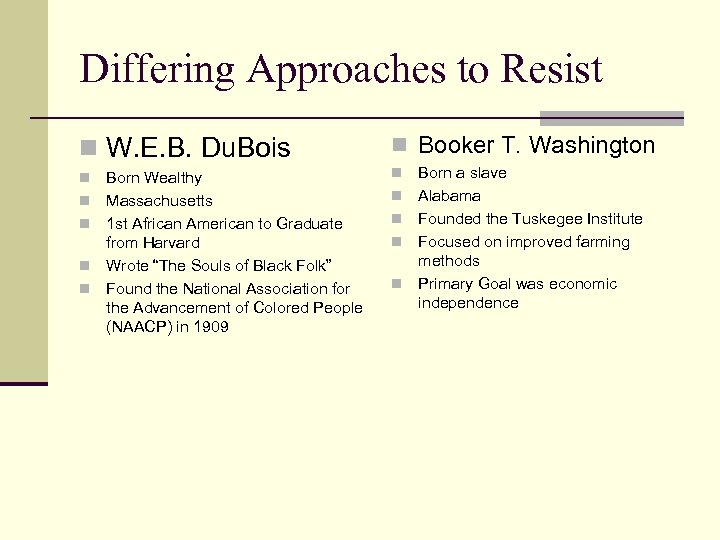 Differing Approaches to Resist n W. E. B. Du. Bois n n n Born Wealthy Massachusetts 1 st African American to Graduate from Harvard Wrote “The Souls of Black Folk” Found the National Association for the Advancement of Colored People (NAACP) in 1909 n Booker T. Washington n n Born a slave Alabama Founded the Tuskegee Institute Focused on improved farming methods Primary Goal was economic independence