


 Скачать презентацию Unit 3 One Dimensional Kinematics
af61efcdf7d49dd30c299d5843e12fbc.ppt
- Количество слайдов: 45
 + Unit 3: One Dimensional Kinematics
 + Section A: Velocity and Acceleration n Corresponding n 2. 2, n PA Book Sections: 2. 4 Assessment Anchors: n S 11. C. 3 2
 + What is kinematics? n Kinematics n The study of motion and how to describe it n Does not consider what causes the motion n One Dimensional (1 D) Kinematics n Motion in a straight line n Left/right, up/down, east/west, etc 3
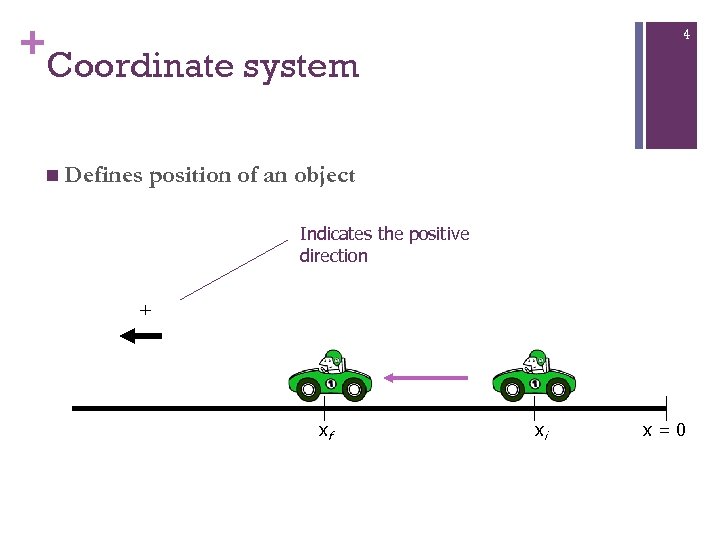 + Coordinate system n Defines 4 position of an object Indicates the positive direction + xf xi x=0
 + Basics of a coordinate system n Establish a positive direction n Establish an origin (0 point) n The origin and positive direction must remain the same for the entire problem 5
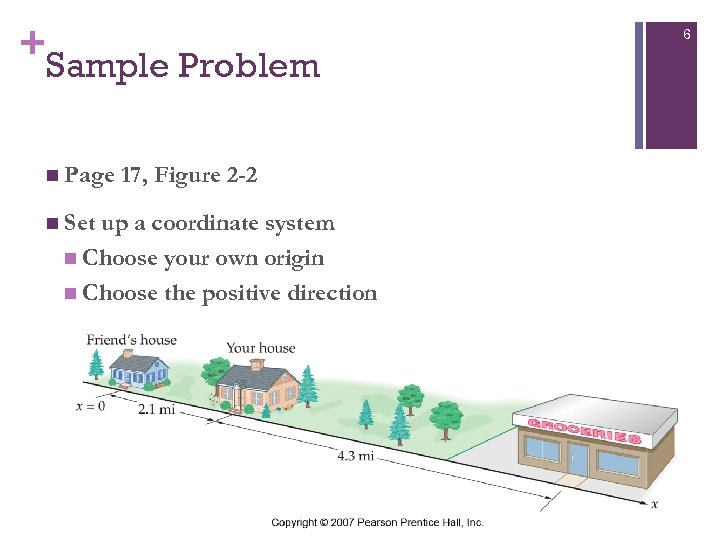 + Sample Problem n Page n Set 17, Figure 2 -2 up a coordinate system n Choose your own origin n Choose the positive direction 6
 + Distance vs. Displacement n Distance n Total length of travel n Units: m, cm, mm, km n Displacement n Change in position = final - initial n x = xf - xi Greek letter “delta”…stands for “Change in” 7
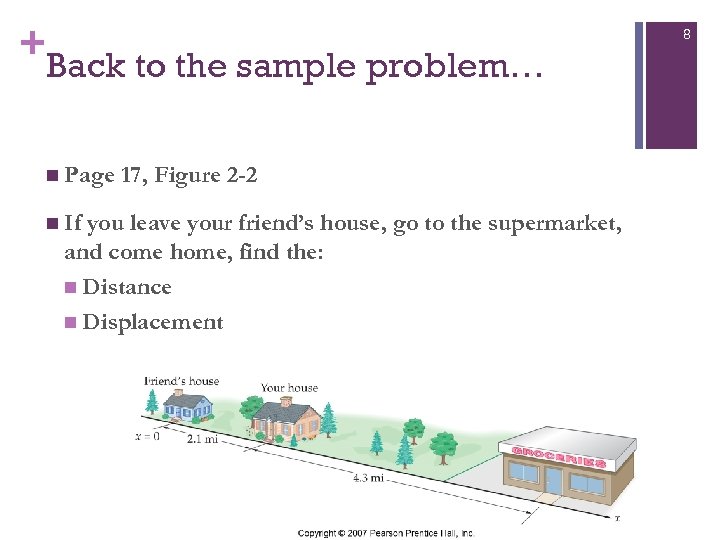 + Back to the sample problem… n Page n If 17, Figure 2 -2 you leave your friend’s house, go to the supermarket, and come home, find the: n Distance n Displacement 8
 + Another example… n Suppose you leave the grocery store, stop at your house, go back to the grocery store, and then go to your friend’s house. Find the: n Distance n Displacement 9
 + Last example… n Suppose you walk from the grocery store to your friend’s house. Find the: n Distance n Displacement 10
 + What does the negative mean? n Remember that we set a certain direction as positive… n Getting a negative simply means that we are in the opposite direction as the one we established as positive n This DOES NOT mean that a negative number is less than a positive value 11
 + Before we go any further… n We need to consistently set up problems to make sure we’re following the right steps and make our work clear (And to receive full credit ) 12
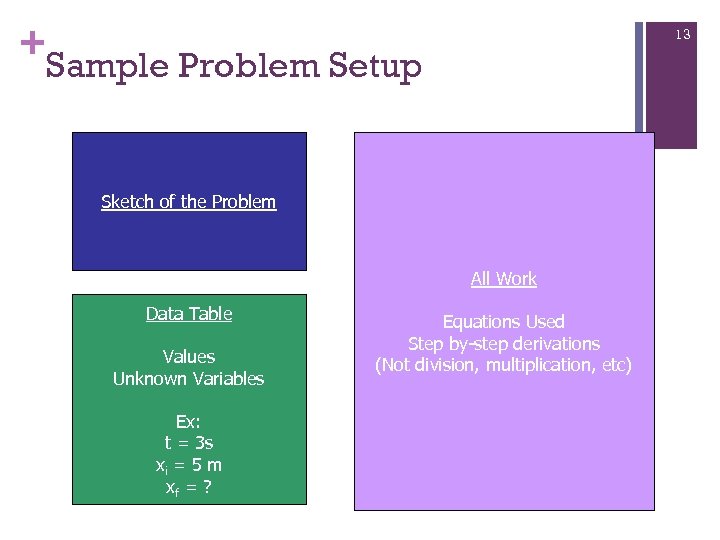 + Sample Problem Setup 13 Sketch of the Problem All Work Data Table Values Unknown Variables Ex: t = 3 s xi = 5 m xf = ? Equations Used Step by-step derivations (Not division, multiplication, etc)
 + It takes practice… n It will take practice to start setting up problems (and not just jumping in to solving them) n In the end, you’ll be more accurate n You MUST set up problems like this on ALL tests, homework assignments, classwork, etc to receive full credit! 14
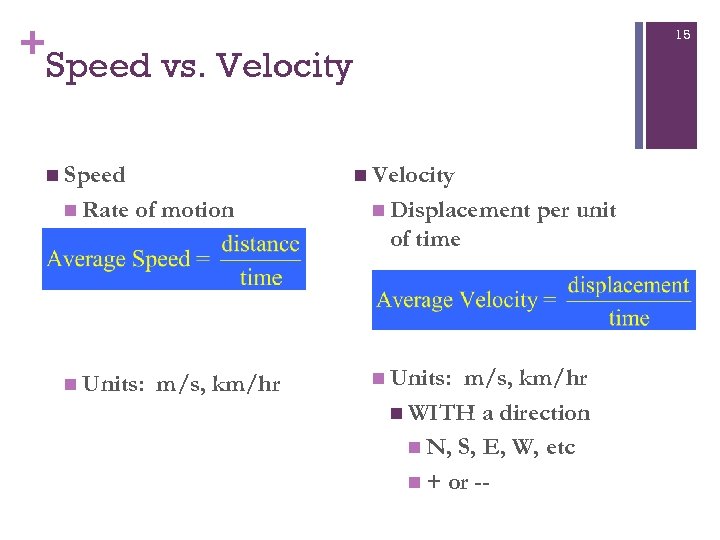 + Speed vs. Velocity n Speed n Rate 15 n Velocity of motion n Displacement per unit of time n Units: m/s, km/hr n WITH a direction n N, S, E, W, etc n + or --
 + Sample Problem n You drive 4. 0 hr at 30. 0 mph and then another 4. 0 hr at 50 mph. Is your average speed: n Greater than 40 mph n Equal to 40 mph n Less than 40 mph 16
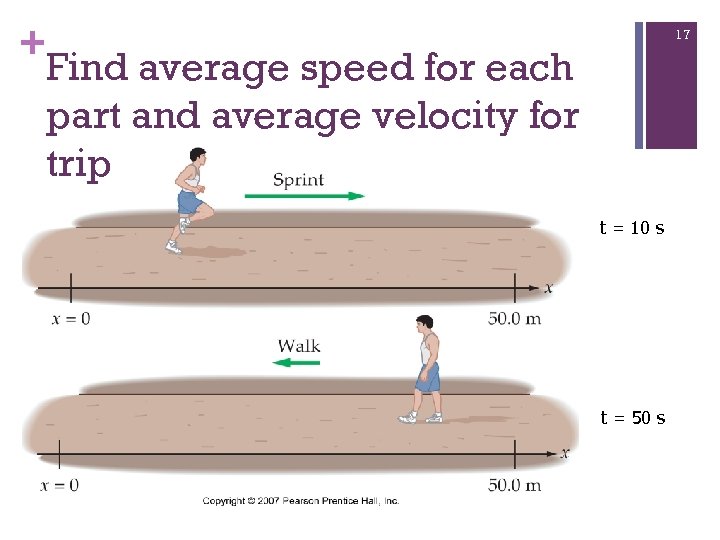 + 17 Find average speed for each part and average velocity for trip t = 10 s t = 50 s
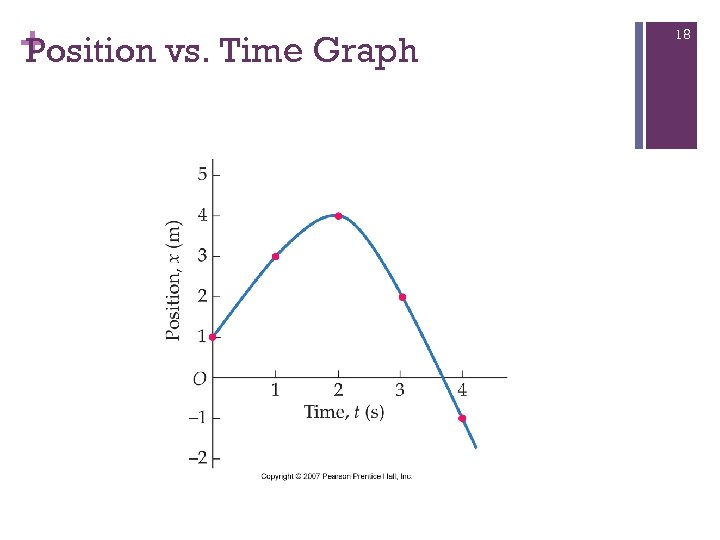 + Position vs. Time Graph 18
 + Practice problem #1 n Draw a position vs. time graph for the following situation: n You walk 2 m from your house in 3 seconds n You walk another 3 m in 5 seconds n You stop for 4 seconds to rest n You turn around and walk back to your house in 6 seconds 19
 + Answer… 20
 + Practice problem #2 n Draw a position vs. time graph for the following situation: n You walk 10 m toward the school in 5 seconds n You stop to answer your phone for 10 seconds n You walk back to your car in 5 seconds n You’re late for 1 st pd, so you walk to the 10 m to school in 3 seconds. 21
 + Answer… 22
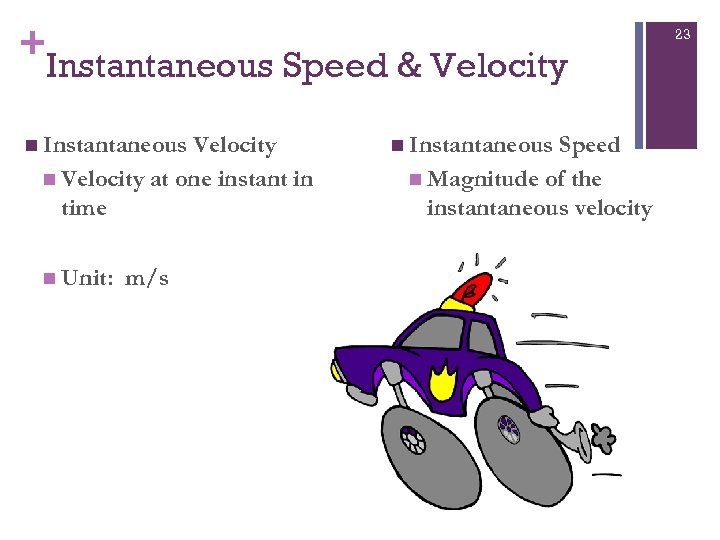 + Instantaneous Speed & Velocity n Instantaneous Velocity n Velocity at one instant in time n Unit: m/s n Instantaneous Speed n Magnitude of the instantaneous velocity 23
 + Speedometer Question n What does a car’s speedometer measure? n Average Speed n Average Velocity n Instantaneous Speed n Instantaneous Velocity n Explain. 24
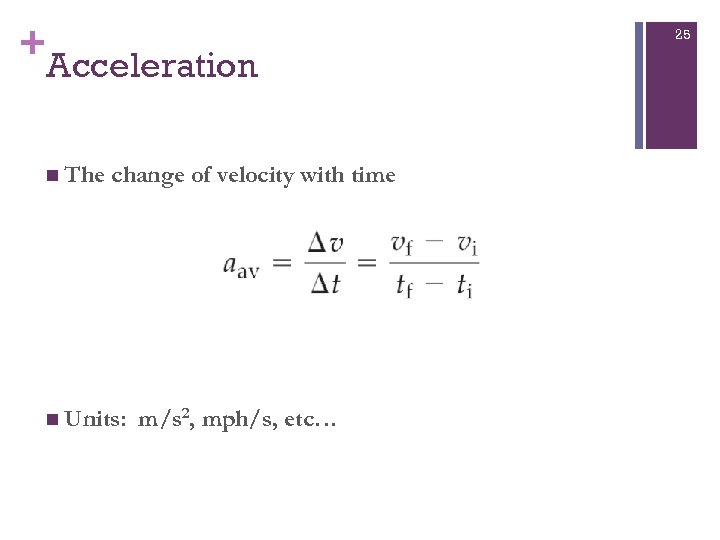 + Acceleration n The change of velocity with time n Units: m/s 2, mph/s, etc… 25
 + Practice Problem #1 n Saab advertises a car that goes from 0 to 60 mph in 6. 2 seconds. Find the average acceleration. 26
 + Practice Problem #2 airplane has an average acceleration of 5. 6 m/s 2 during takeoff. How long does it take for the plane to reach a speed of 150 mph? n An 27
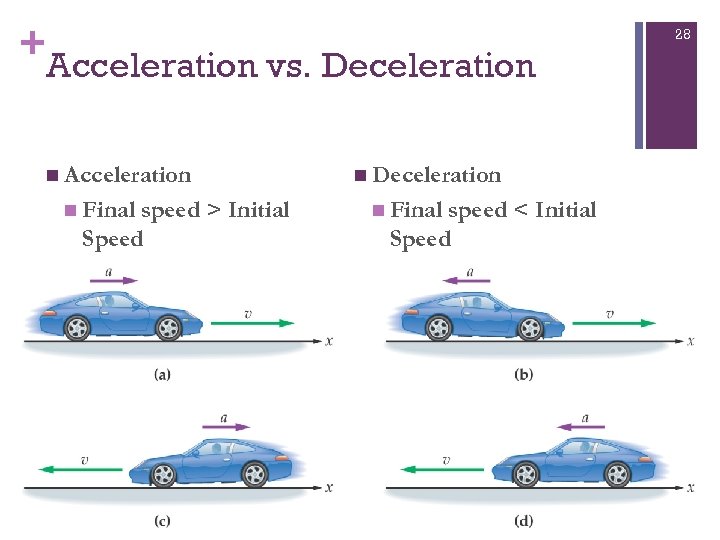 + Acceleration vs. Deceleration n Acceleration n Final speed > Initial Speed n Deceleration n Final speed < Initial Speed 28
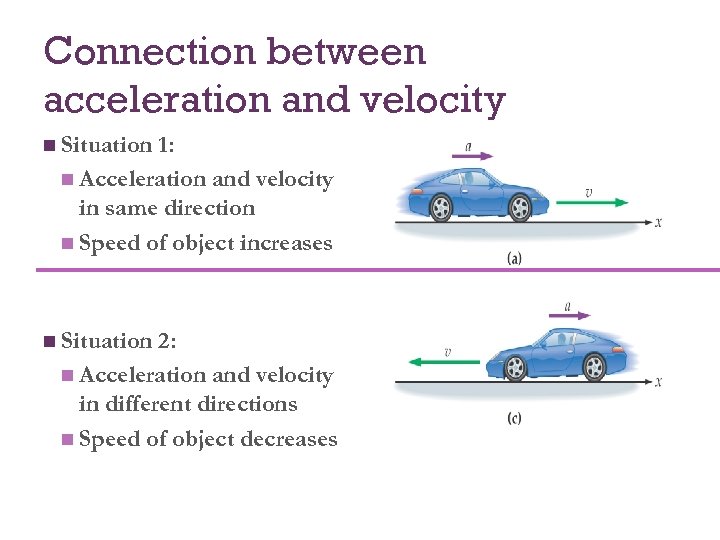 Connection between acceleration and velocity n Situation 1: n Acceleration and velocity in same direction n Speed of object increases n Situation 2: n Acceleration and velocity in different directions n Speed of object decreases 29
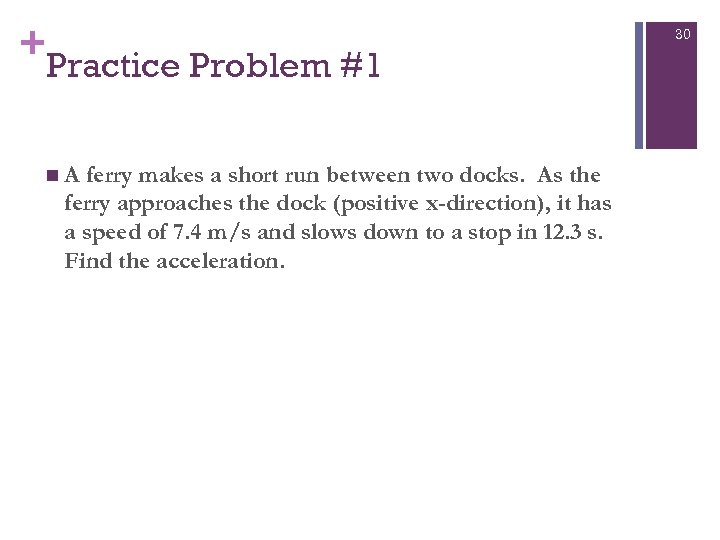 + Practice Problem #1 n. A ferry makes a short run between two docks. As the ferry approaches the dock (positive x-direction), it has a speed of 7. 4 m/s and slows down to a stop in 12. 3 s. Find the acceleration. 30
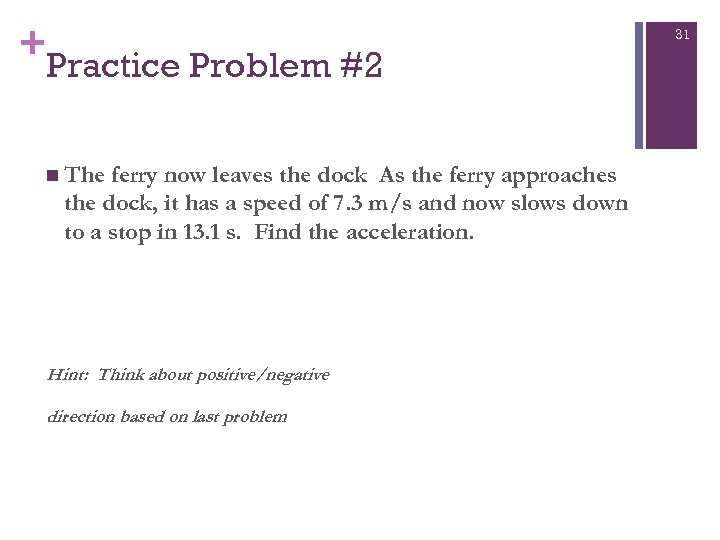 + Practice Problem #2 n The ferry now leaves the dock As the ferry approaches the dock, it has a speed of 7. 3 m/s and now slows down to a stop in 13. 1 s. Find the acceleration. Hint: Think about positive/negative direction based on last problem 31
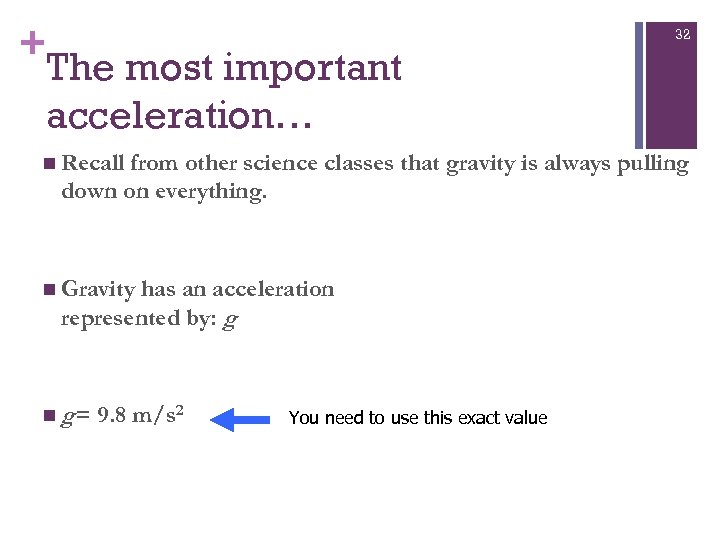 + 32 The most important acceleration… n Recall from other science classes that gravity is always pulling down on everything. n Gravity has an acceleration represented by: g n g= 9. 8 m/s 2 You need to use this exact value
 + Section B: Kinematics Equations n Corresponding n 2. 5, n PA Book Sections: 2. 6, 2. 7 Assessment Anchors: n S 11. C. 3 33
 + 34 Motion with Constant Acceleration n Object is either speeding up or slowing down is just speeding up / slowing down at a constant rate (same acceleration at all times)
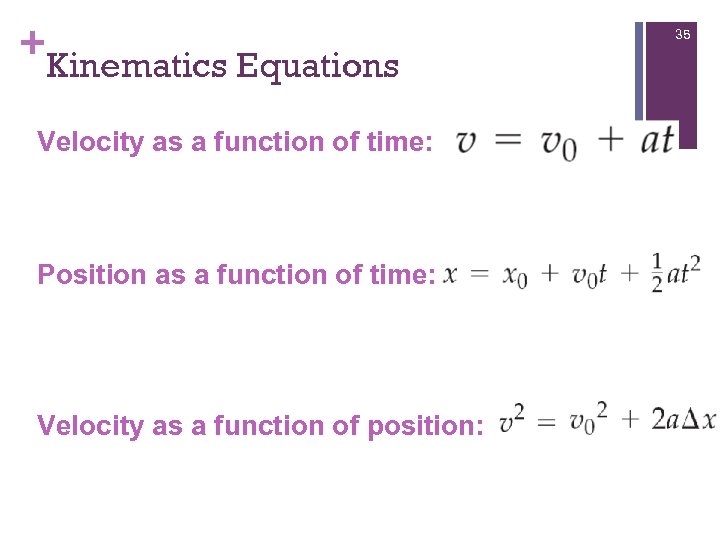 + Kinematics Equations Velocity as a function of time: Position as a function of time: Velocity as a function of position: 35
 + 36 How do I know when to use each equation? n That’s where the sketch and data table will come in handy… n Look at what you have, what you’re looking for, and find the equation that will include all of those variables n You may need to use more than one equation in a problem
 + Practice Problem #1 n. A ball is thrown straight upward with an initial velocity of 8. 2 m/s. If the acceleration of the ball is that of gravity, find the velocity after: n 0. 50 s n 1. 0 s 37
 + Practice Problem #2 n. A boat moves slowly inside a marina with a constant speed of 1. 50 m/s. As soon as it leaves the marina, it accelerates at 2. 40 m/s 2. Find the: n Speed it’s moving after 5. 0 s n Distance it’s traveled after 5. 0 s of acceleration 38
 + Practice Problem #3 n. A drag racer starts from rest and accelerates at 7. 40 m/s 2. How far has it traveled in: n 1. 0 s n 2. 0 s n 3. 0 s 39
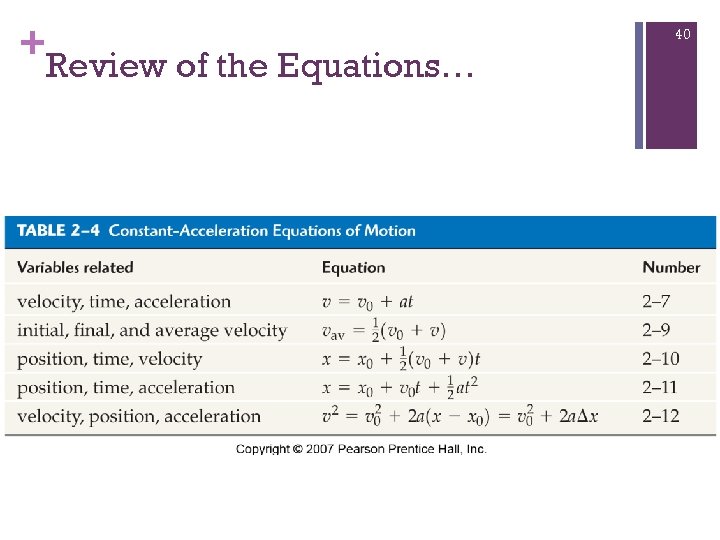 + Review of the Equations… 40
 + Freely Falling Objects n Free Fall -- the motion of an object falling only under the influence of gravity. n An object is in free fall the moment it is released, whether it’s thrown upward, downward, or just dropped. n Why don’t we have true free fall on Earth? 41
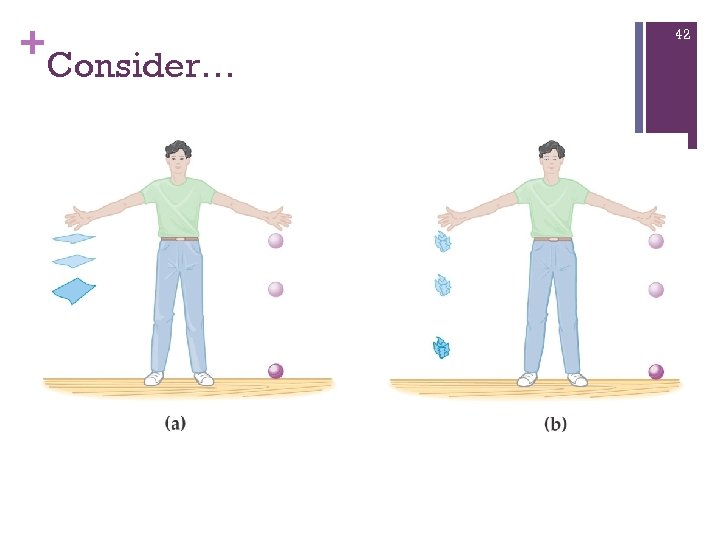 + Consider… 42
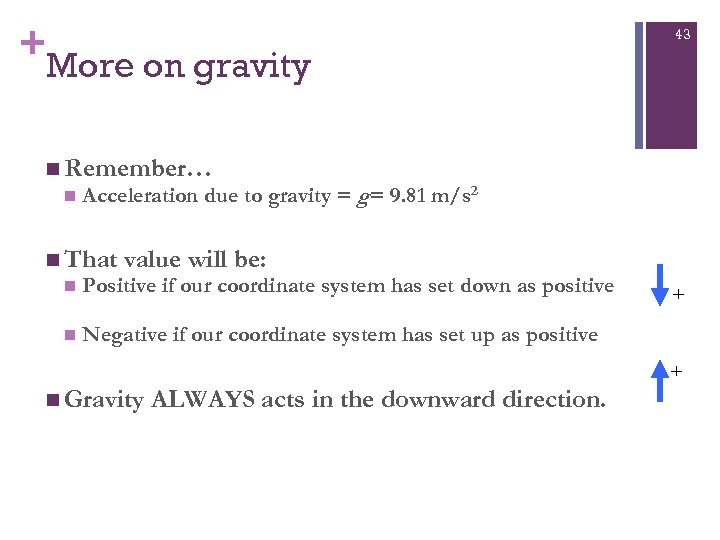 + More on gravity 43 n Remember… n Acceleration due to gravity = g = 9. 81 m/s 2 n That value will be: n Positive if our coordinate system has set down as positive n Negative if our coordinate system has set up as positive + + n Gravity ALWAYS acts in the downward direction.
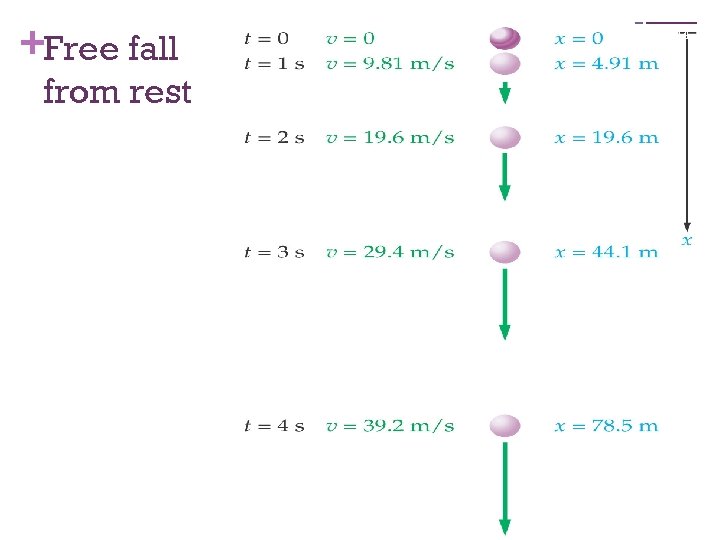 +Free fall from rest 44
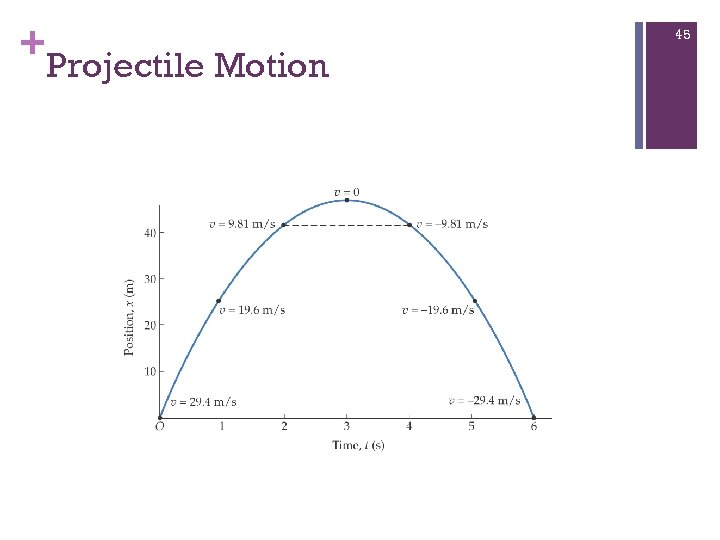 + Projectile Motion 45