


 Скачать презентацию Unit 3 Constitution Test 1 ST MR YOUNG
e905ef07d62e535fe6f31cf2a016ca1a.ppt
- Количество слайдов: 101
 Unit 3: Constitution Test 1 ST MR. YOUNG AND 6 TH PERIOD
 This section of the Constitution states why it was written, using phrases such as, “We the People, ” and “to establish justice. ” a. Amendments c. Preamble b. Bill of Rights d. Articles
 This section of the Constitution states why it was written, using phrases such as, “We the People, ” and “to establish justice. ” a. Amendments c. Preamble b. Bill of Rights d. Articles
 Article I of the Constitution created the voice of the people in the a. executive branch. c. Senate. b. Supreme Court. d. House of Representatives.
 Article I of the Constitution created the voice of the people in the a. executive branch. c. Senate. b. Supreme Court. d. House of Representatives.
 This elevated the Supreme Court to a higher status, balancing the powers of the other branches, establishing that the Supreme Court could declare laws invalid or unconstitutional. a. enumerated powers c. Constitutional amendment b. judicial review d. judicial activism
 This elevated the Supreme Court to a higher status, balancing the powers of the other branches, establishing that the Supreme Court could declare laws invalid or unconstitutional. a. enumerated powers c. Constitutional amendment b. judicial review d. judicial activism
 The Equal Rights Amendment caused questions because a. of a Supreme Court order. b. of impeachment. c. Congress called a national convention. d. states revoked their ratification.
 The Equal Rights Amendment caused questions because a. of a Supreme Court order. b. of impeachment. c. Congress called a national convention. d. states revoked their ratification.
 This action between the President and the head of a foreign government does NOT require congressional approval. a. b. impeachment c. executive agreement prior restraint d. poll tax
 This action between the President and the head of a foreign government does NOT require congressional approval. a. impeachment c. prior restraint b. executive agreementd. poll tax
 False speech intended to hurt another is a. slander. c. b. libel. d. prior restraint. due process of law.
 False speech intended to hurt another is a. slander. b. libel. d. c. prior restraint. due process of law.
 False speech that is written down in a newspaper or magazine that is intended to hurt someone is known as a. slander c. libel b. prior restraint d. poll tax
 False speech that is written down in a newspaper or magazine that is intended to hurt someone is known as a. slander c. libel b. prior restraint d. poll tax
 This action is required to override a presidential veto. A. a judicial review C. a Constitutional convention B. a Supreme Court ruling D. a 2/3 vote of each house
 This action is required to override a presidential veto. A. a judicial review C. a Constitutional convention B. a Supreme Court ruling D. a 2/3 vote of each house
 The Framers provided this section of the Constitution so that it will grow with a changing nation and could adapt to future concerns of the people. (There are 27 of them). a. Bill of Rights c. Preamble b. Articles d. Amendments
 The Framers provided this section of the Constitution so that it will grow with a changing nation and could adapt to future concerns of the people. (There are 27 of them). a. Bill of Rights c. Preamble b. Articles d. Amendments
 To protect liberty and specify its powers, the Framers gave Congress these powers that were directly stated in the Constitution. a. expressed powers. c. executive powers. b. judicial reviews. d. judicial restraint.
 To protect liberty and specify its powers, the Framers gave Congress these powers that were directly stated in the Constitution. a. expressed powers. c. executive powers. b. judicial reviews. d. judicial restraint.
 Supreme Court decisions can only be overturned by the Court itself or by a. b. congressional vote. c. order of the president. Constitutional amendment. d. judicial activism.
 Supreme Court decisions can only be overturned by the Court itself or by a. congressional vote. c. order of the president. b. Constitutional amendment. d. judicial activism.
 These amendments are known collectively as the Civil War Amendments a. First 10 c. 13 -15 b. 17 -20 d. none of the above
 These amendments are known collectively as the Civil War Amendments a. First 10 c. 13 -15 b. 17 -20 d. none of the above
 A proposed amendment can be ratified by two-thirds vote of each house or by a a. Congressional petition. c. presidential order. b. Supreme Court rule. d. national convention.
 A proposed amendment can be ratified by two-thirds vote of each house or by a a. Congressional petition. c. presidential order. b. Supreme Court rule. d. national convention.
 Ratification of an amendment must come within this time limit. a. six months c. seven years b. the president's term d. one year
 Ratification of an amendment must come within this time limit. a. six months c. seven years b. the president's term d. one year
 The first 10 amendments to the Constitution are called the a. Bill of Rights. b. Constitution. c. d. Preamble. Civil War Amendments
 The first 10 amendments to the Constitution are called the a. Bill of Rights. b. Constitution. c. d. Preamble. Civil War Amendments
 “We must never forget that it is. . . a Constitution intended to endure for ages to come, and, consequently, to be adapted to the various crises of human affairs. ” —Chief Justice John Marshall, 1819 According to Chief Justice John Marshall, the Constitution is: a. a document that should not be altered. b. meant to be changed to reflect the changes in society. c. too difficult to understand. d. a document that means different things to different people.
 “We must never forget that it is. . . a Constitution intended to endure for ages to come, and, consequently, to be adapted to the various crises of human affairs. ” —Chief Justice John Marshall, 1819 According to Chief Justice John Marshall, the Constitution is: a. a document that should not be altered. b. meant to be changed to reflect the changes in society. c. too difficult to understand. d. a document that means different things to different people.
 In this part of the Constitution, there a total of 7 that help to create and setup our government, including the three branches of government. a. Amendments c. Supremacy Clause b. Articles d. Preamble
 In this part of the Constitution, there a total of 7 that help to create and setup our government, including the three branches of government. a. Amendments c. Supremacy Clause b. Articles d. Preamble
 The president can check Congress by this power, meaning to reject its legislation. a. override c. separation of power enactment b. veto d. judicial review
 The president can check Congress by this power, meaning to reject its legislation. a. override c. separation of power enactment b. veto d. judicial review
 This branch of government is the final authority on the Constitution because it can interrupt its meaning. a. Congress c. executive b. legislative d. judicial
 This branch of government is the final authority on the Constitution because it can interrupt its meaning. a. Congress c. executive b. legislative d. judicial
 This final enumerated power gives Congress the right to make all "necessary and proper" laws to help stretch the powers expressed in the other parts of Article 1. a. expressed powers c. judicial review b. jurisdiction d. elastic clause
 This final enumerated power gives Congress the right to make all "necessary and proper" laws to help stretch the powers expressed in the other parts of Article 1. a. expressed powers c. judicial review b. jurisdiction d. elastic clause
 Article II of the Constitution is important because it helps to setup and a. describes expressed powers. b. describes enumerated powers. c. describes the executive branch. d. describes the legislative branch.
 Article II of the Constitution is important because it helps to setup and a. describes expressed powers. b. describes enumerated powers. c. describes the executive branch. d. describes the legislative branch.
 Judicial Philosophy that the Supreme Court should not only interpret the Constitution but should also play a role in shaping public policy, such as gay marriage, African American rights, etc. a. judicial activism. c. Judicial Restraint b. Judicial Petition d. Judicial Belonging
 Judicial Philosophy that the Supreme Court should not only interpret the Constitution but should also play a role in shaping public policy, such as gay marriage, African American rights, etc. a. judicial activism. c. Judicial Restraint b. Judicial Petition d. Judicial Belonging
 The Twenty-fourth Amendment helped African Americans to vote by a. change of venue. b. eliminating poll taxes. c. ratifying voting laws. d. prohibiting government intervention.
 The Twenty-fourth Amendment helped African Americans to vote by a. change of venue. b. eliminating poll taxes. c. ratifying voting laws. d. prohibiting government intervention.
 Which of the following accounts for the ability of the Constitution to endure for more than 200 years? a. Built-in flexibility that allowed it to grow and change with time b. extensive, detailed provisions for resolving political conflicts c. very detailed descriptions of what government should be d. inflexible provisions designed to resist changes to the document
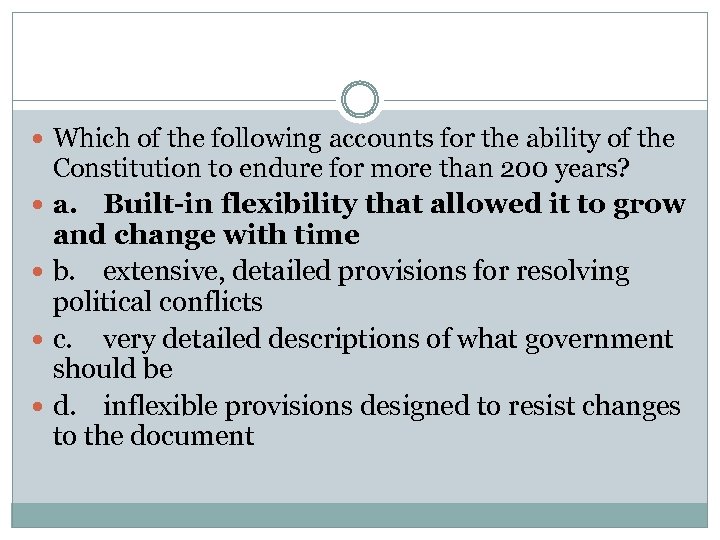 Which of the following accounts for the ability of the Constitution to endure for more than 200 years? a. Built-in flexibility that allowed it to grow and change with time b. extensive, detailed provisions for resolving political conflicts c. very detailed descriptions of what government should be d. inflexible provisions designed to resist changes to the document
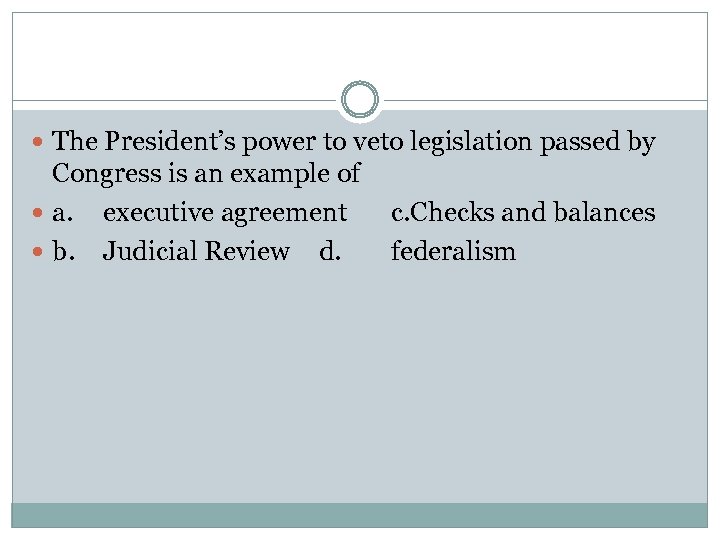 The President’s power to veto legislation passed by Congress is an example of a. executive agreement b. Judicial Review d. c. Checks and balances federalism
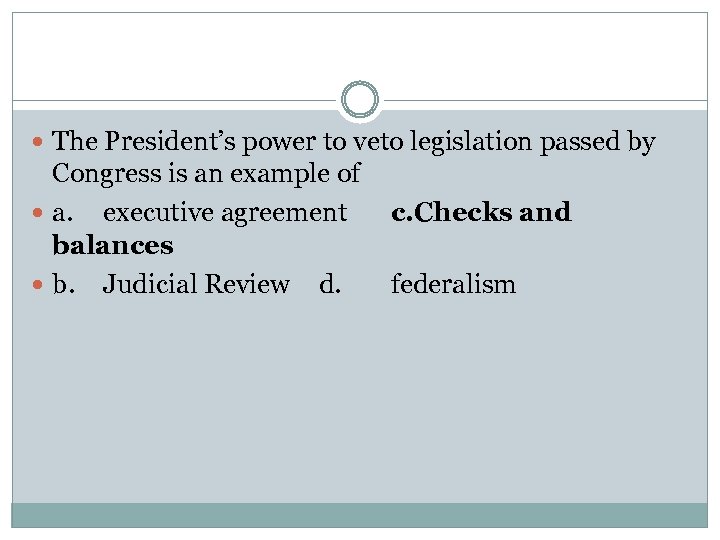 The President’s power to veto legislation passed by Congress is an example of a. executive agreement balances b. Judicial Review d. c. Checks and federalism
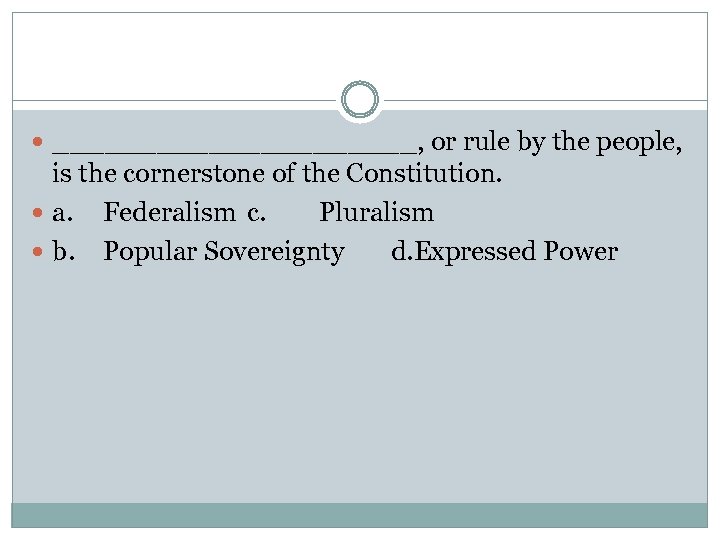 ___________, or rule by the people, is the cornerstone of the Constitution. a. Federalism c. Pluralism b. Popular Sovereignty d. Expressed Power
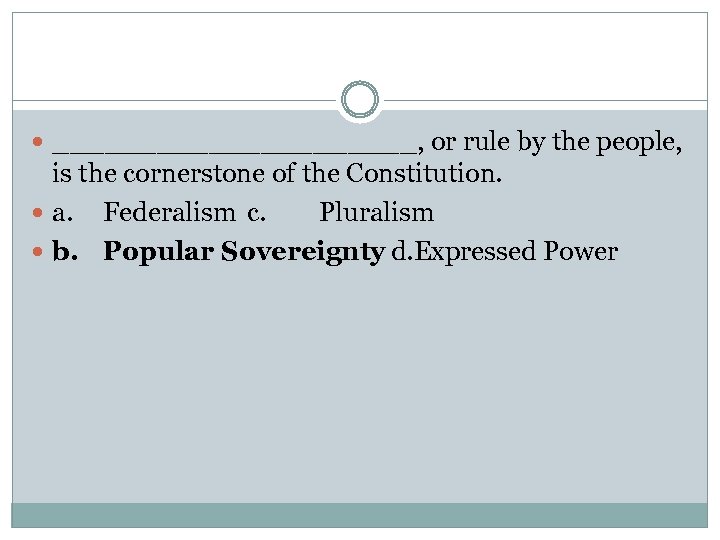 ___________, or rule by the people, is the cornerstone of the Constitution. a. Federalism c. Pluralism b. Popular Sovereignty d. Expressed Power
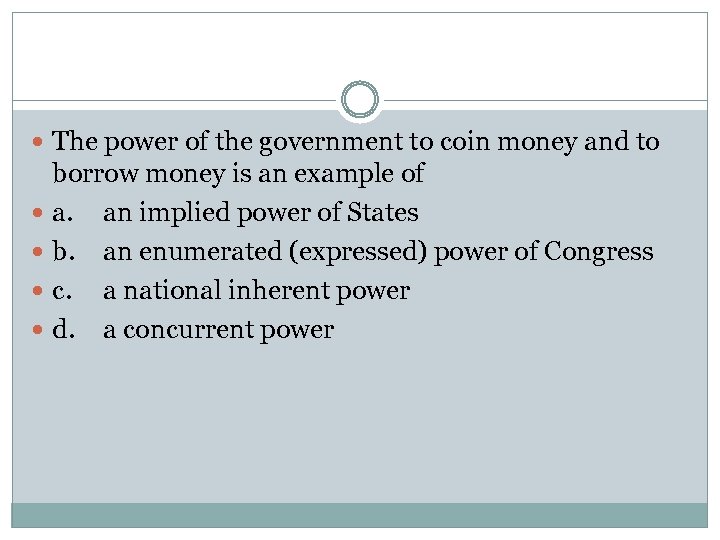 The power of the government to coin money and to borrow money is an example of a. an implied power of States b. an enumerated (expressed) power of Congress c. a national inherent power d. a concurrent power
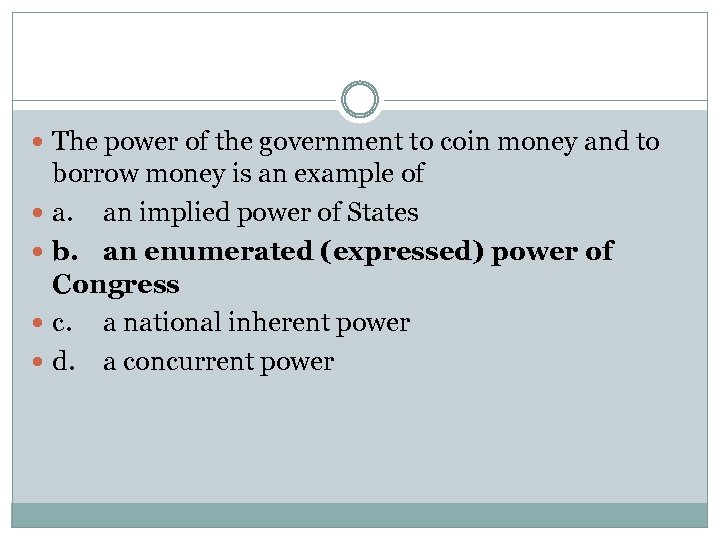 The power of the government to coin money and to borrow money is an example of a. an implied power of States b. an enumerated (expressed) power of Congress c. a national inherent power d. a concurrent power
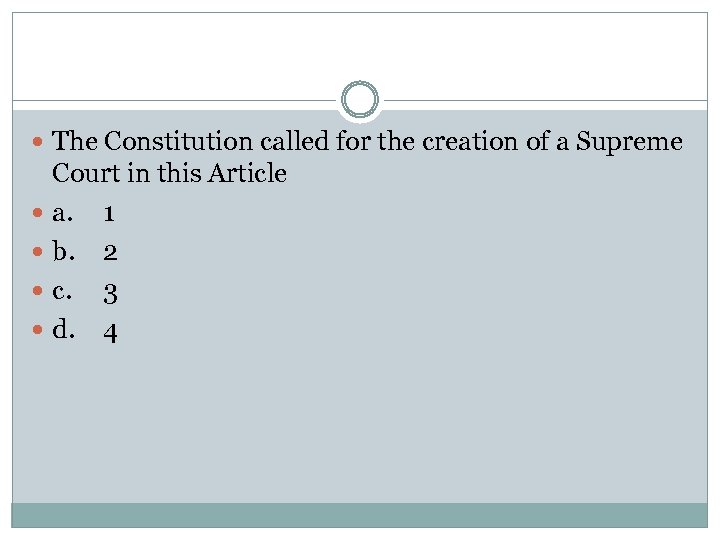 The Constitution called for the creation of a Supreme Court in this Article a. 1 b. 2 c. 3 d. 4
 The Constitution called for the creation of a Supreme Court in this Article a. 1 b. 2 c. 3 d. 4
 Terms for powers directly stated in the Constitution are known as a. Expressed c. Implied b. Exclusive d. Proper
 Terms for powers directly stated in the Constitution are known as a. Expressed c. Implied b. Exclusive d. Proper
 The Constitution set up a federal system of government (federalism) by a. distributing power among the three branches of government b. dividing power between the National Government and the States c. Providing a formal amendment process d. giving the President the power to veto an act of Congress
 The Constitution set up a federal system of government (federalism) by a. distributing power among the three branches of government b. dividing power between the National Government and the States c. Providing a formal amendment process d. giving the President the power to veto an act of Congress
 When a federal official is accused of committing crimes, it is known as a. ratification c. impeachment b. petition d. appeal
 When a federal official is accused of committing crimes, it is known as a. ratification c. impeachment b. petition d. appeal
 The _______ brings about and starts the impeachment process, however, it is the _________ job to determine the accused person’s guilt or innocence. a. Senate; Supreme Court c. Senate; House b. House; Supreme Court d. House; Senate
 The _______ brings about and starts the impeachment process, however, it is the _________ job to determine the accused person’s guilt or innocence. a. Senate; Supreme Court c. Senate; House b. House; Supreme Court d. House; Senate
 Expressed powers of Congress that are itemized #1 - 18 in Article 1 of the Constitution: a. Enumerated Powers c. Concurrent Powers b. Ordinance d. Statutes
 Expressed powers of Congress that are itemized #1 - 18 in Article 1 of the Constitution: a. Enumerated Powers c. Concurrent Powers b. Ordinance d. Statutes
 The process of informally amending the Constitution, or not changing the written words, may take place through a. the activities of political parties b. decisions of the Supreme Court c. actions taken by the President d. all the above
 The process of informally amending the Constitution, or not changing the written words, may take place through a. the activities of political parties b. decisions of the Supreme Court c. actions taken by the President d. all the above
 A proposed Constitutional amendment can be ratified by a. 3/4 of the State legislature’s b. 3/4 of state conventions c. Presidential order d. A or B
 A proposed Constitutional amendment can be ratified by a. 3/4 of the State legislature’s b. 3/4 of state conventions c. Presidential order d. A or B
 Supreme Court case that helped to establish the principle of judicial review. a. Marbury v. Madison b. Roe v. Wade c. Mc. Culloch v. Maryland d. Plessy v. Ferguson
 Supreme Court case that helped to establish the principle of judicial review. a. Marbury v. Madison b. Roe v. Wade c. Mc. Culloch v. Maryland d. Plessy v. Ferguson
 Supreme Court case that lent support to a broad interpretation of the Constitution by upholding Congress’s use of the Necessary and Proper Clause. a. Marbury v. Madison b. Roe v. Wade c. Mc. Culloch v. Maryland d. Plessy v. Ferguson
 Supreme Court case that lent support to a broad interpretation of the Constitution by upholding Congress’s use of the Necessary and Proper Clause. a. Marbury v. Madison b. Roe v. Wade c. Mc. Culloch v. Maryland d. Plessy v. Ferguson
 Judicial philosophy that the Supreme Court should avoid taking the initiative on social or political questions, and uphold the government actions of the other branches when at all possible. a. Judicial Activism c. Pluralism b. Liberal Constructionism d. Judicial Restraint
 Judicial philosophy that the Supreme Court should avoid taking the initiative on social or political questions, and uphold the government actions of the other branches when at all possible. a. Judicial Activism c. Pluralism b. Liberal Constructionism d. Judicial Restraint
 When an amendment is proposed to Congress, it takes this fraction from each house in order for the proposed amendment to be sent to the states for ratification? a. 3/4 c. 3/5 b. 2/3 d. 1/2
 When an amendment is proposed to Congress, it takes this fraction from each house in order for the proposed amendment to be sent to the states for ratification? a. 3/4 c. 3/5 b. 2/3 d. 1/2
 The Amendment process, which is started at the national level and then sent to the state level, shows which major principal of the Constitution in action? a. Judicial Review c. Federalism b. Checks and Balances d. Separation of Powers
 The Amendment process, which is started at the national level and then sent to the state level, shows which major principal of the Constitution in action? a. Judicial Review c. Federalism b. Checks and Balances d. Separation of Powers
 Article 6 of the Constitution contains the __________, establishing that the Constitution and the laws passed by Congress are the supreme law of the land. a. Santa Clause c. Congressional Clause b. Supremacy Clause d. Hierarchy Clause
 Article 6 of the Constitution contains the __________, establishing that the Constitution and the laws passed by Congress are the supreme law of the land. a. Santa Clause c. Congressional Clause b. Supremacy Clause d. Hierarchy Clause
 The Constitution is a short document. Approximately how many words make up the Constitution? a. 7, 000 c. 17, 000 b. 5, 000 d. 3, 000
 The Constitution is a short document. Approximately how many words make up the Constitution? a. 7, 000 c. 17, 000 b. 5, 000 d. 3, 000
 The Constitutional principle of _________ determines that each branch of the government has its own responsibilities that they will fulfill. a. Limited Government c. Popular Sovereignty b. Judicial Review d. Separation of Powers
 The Constitutional principle of _________ determines that each branch of the government has its own responsibilities that they will fulfill. a. Limited Government c. Popular Sovereignty b. Judicial Review d. Separation of Powers
 The Supreme Court, outlined in Article 3, has the _________, or authority, to rule on all federal or national cases. a. Power c. Jurisdiction b. Recommendation d. Necessity
 The Supreme Court, outlined in Article 3, has the _________, or authority, to rule on all federal or national cases. a. Power c. Jurisdiction b. Recommendation d. Necessity
 Article 1 of the Constitution created the voice and interest of the states in the a. House of Representatives c. Executive Branch b. d. Senate Supreme Court
 Article 1 of the Constitution created the voice and interest of the states in the a. House of Representatives c. Executive Branch b. d. Senate Supreme Court
 The First Amendment allows the American press to not be subject to ________, or government censorship of information before it is published or broadcast. a. Slander c. Prior Restraint b. Change of Venue d. Libel
 The First Amendment allows the American press to not be subject to ________, or government censorship of information before it is published or broadcast. a. Slander c. Prior Restraint b. Change of Venue d. Libel
 According to Amendment 4, officers must have __________, or reasonable doubt, before they can search for or arrest someone linked to a crime. a. Search warrant c. Slander b. Probable Cause d. Prior Restraint
 According to Amendment 4, officers must have __________, or reasonable doubt, before they can search for or arrest someone linked to a crime. a. Search warrant c. Slander b. Probable Caused. Prior Restraint
 The Fifth Amendment states that the government may not deprive any person of life, liberty, or property without ________, which means the government must follow constitutional procedures when holding and conducting trials or actions. a. Eminent Domain c. Change of Venue b. Prior Restraint d. Due Process of Law
 The Fifth Amendment states that the government may not deprive any person of life, liberty, or property without ________, which means the government must follow constitutional procedures when holding and conducting trials or actions. a. Eminent Domain c. Change of Venue b. Prior Restraint d. Due Process of Law
 Also another name for the 20 th Amendment, this means when Congressional leaders either retire or are removed from office, and during their remaining time accomplish nothing or have little to no influence. a. Lame-Duck c. Wounded Duck b. Outraged Duck d. Spotted Duck
 Also another name for the 20 th Amendment, this means when Congressional leaders either retire or are removed from office, and during their remaining time accomplish nothing or have little to no influence. a. Lame-Duck c. Wounded Duck b. Outraged Duck d. Spotted Duck
 What Amendment to the Constitution has been the only Amendment to ever be repealed? a. 21 st c. 18 th b. 16 th d. 20 th
 What Amendment to the Constitution has been the only Amendment to ever be repealed? a. 21 st c. 18 th b. 16 th d. 20 th