


 Скачать презентацию Unit 3 Aggregate Demand Supply and Fiscal Policy
16bf1ccfa7d5921e4360871348a54688.ppt
- Количество слайдов: 61
 Unit 3: Aggregate Demand Supply and Fiscal Policy 1
 Aggregate Demand 2
 What is Aggregate Demand? Aggregate means “added all together. ” When we use aggregates we combine all prices and all quantities. Aggregate Demand is all the goods and services (real GDP) that buyers are willing and able to purchase at different price levels. The Demand for everything by everyone in the US. There is an inverse relationship between price level and Real GDP. If the price level: • Increases (Inflation), then real GDP demanded falls. • Decreases (deflation), the real GDP demanded increases. 3
 Aggregate Demand Curve Price Level AD is the demand by consumers, businesses, government, and foreign countries What definitely doesn’t shift the curve? Changes in price level cause a move along the curve AD = C + I + G + Xn Real domestic output (GDPR) 4
 Why is AD downward sloping? 1. Real-Balance Effect 2. Interest-Rate Effect 3. Foreign Trade Effect 5
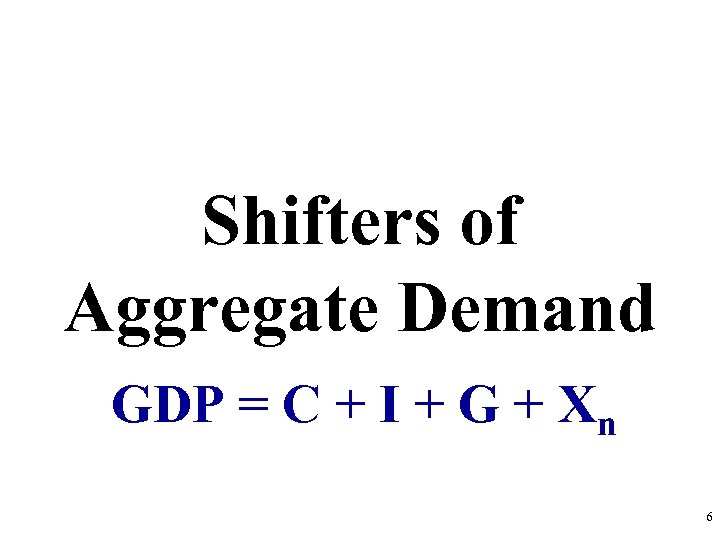 Shifters of Aggregate Demand GDP = C + I + G + Xn 6
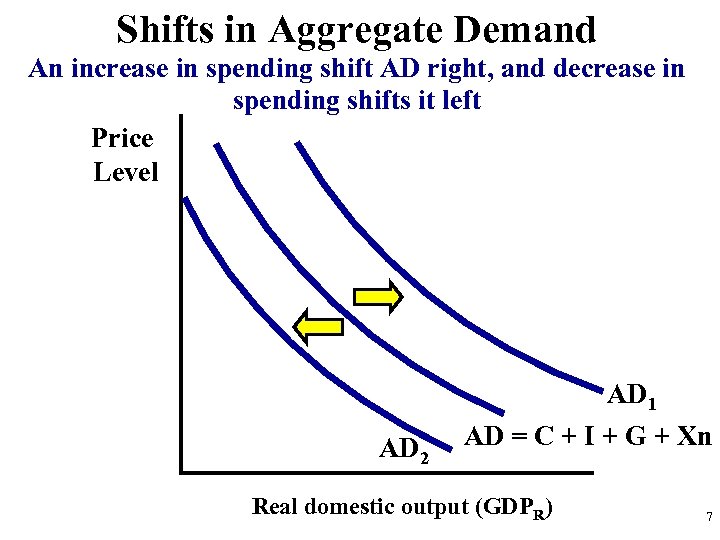 Shifts in Aggregate Demand An increase in spending shift AD right, and decrease in spending shifts it left Price Level AD 1 AD 2 AD = C + I + G + Xn Real domestic output (GDPR) 7
 Unit 3: Aggregate Demand Supply and Fiscal Policy 8
 Aggregate Supply 9
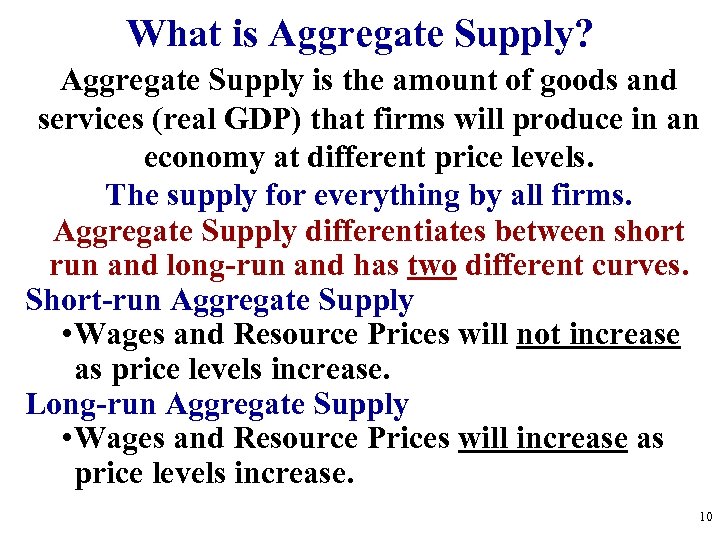 What is Aggregate Supply? Aggregate Supply is the amount of goods and services (real GDP) that firms will produce in an economy at different price levels. The supply for everything by all firms. Aggregate Supply differentiates between short run and long-run and has two different curves. Short-run Aggregate Supply • Wages and Resource Prices will not increase as price levels increase. Long-run Aggregate Supply • Wages and Resource Prices will increase as price levels increase. 10
 Short-Run Aggregate Supply In the Short Run, wages and resource prices will NOT increase as price levels increase. 11
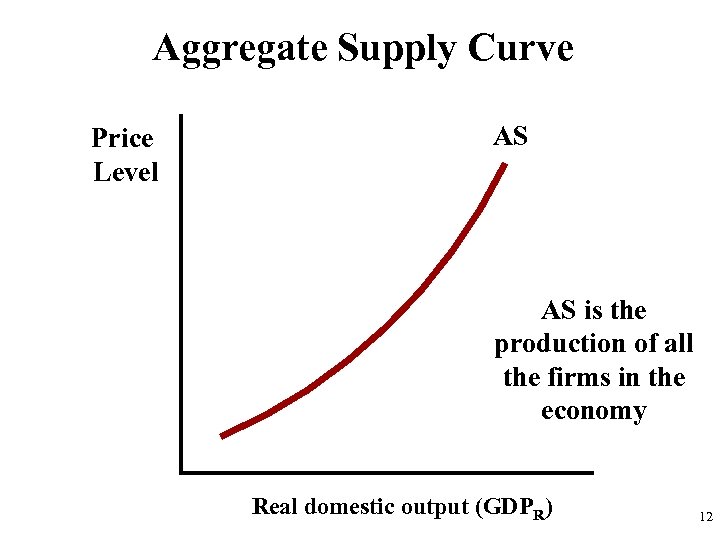 Aggregate Supply Curve Price Level AS AS is the production of all the firms in the economy Real domestic output (GDPR) 12
 Long-Run Aggregate Supply In the Long Run, wages and resource prices WILL increase as price levels increase. 13
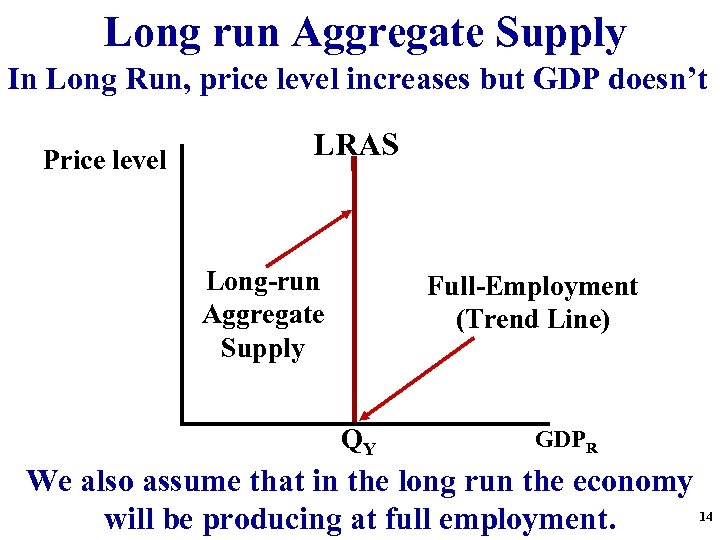 Long run Aggregate Supply In Long Run, price level increases but GDP doesn’t Price level LRAS Long-run Aggregate Supply Full-Employment (Trend Line) QY GDPR We also assume that in the long run the economy 14 will be producing at full employment.
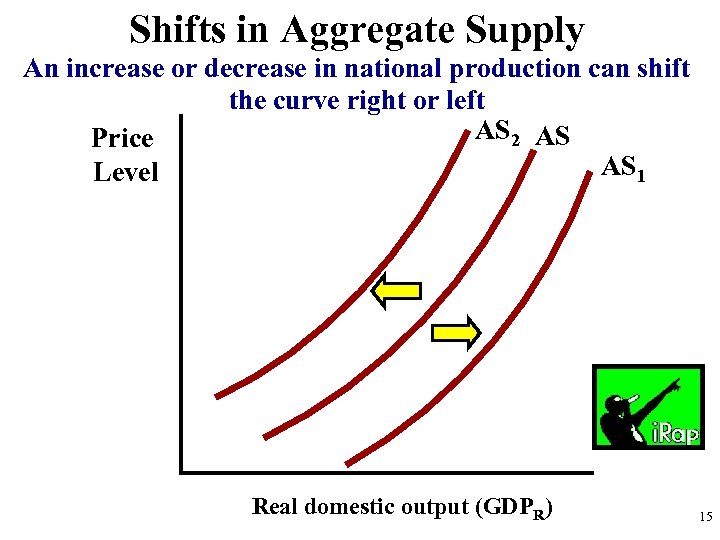 Shifts in Aggregate Supply An increase or decrease in national production can shift the curve right or left AS 2 AS Price AS 1 Level Real domestic output (GDPR) 15
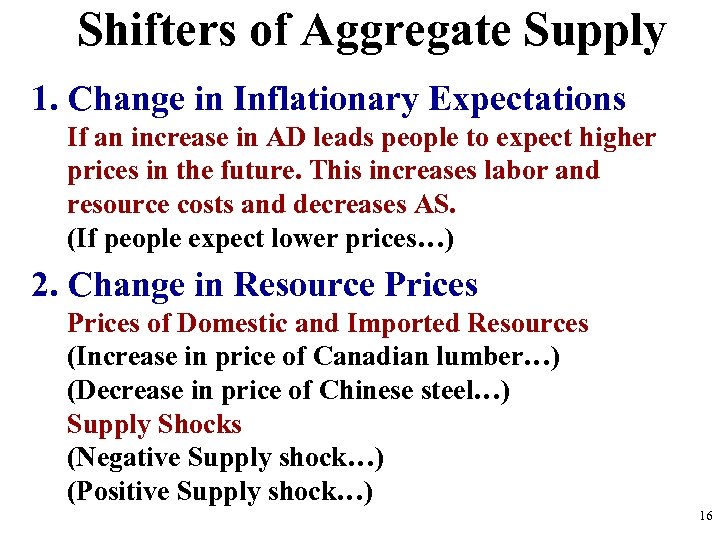 Shifters of Aggregate Supply 1. Change in Inflationary Expectations If an increase in AD leads people to expect higher prices in the future. This increases labor and resource costs and decreases AS. (If people expect lower prices…) 2. Change in Resource Prices of Domestic and Imported Resources (Increase in price of Canadian lumber…) (Decrease in price of Chinese steel…) Supply Shocks (Negative Supply shock…) (Positive Supply shock…) 16
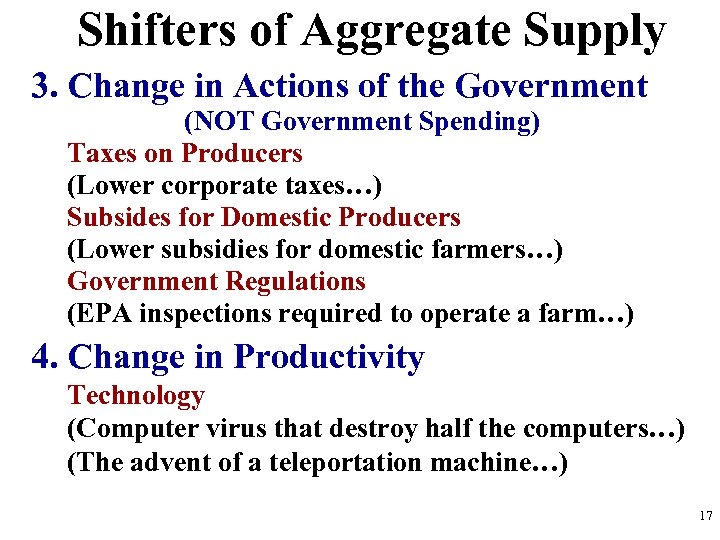 Shifters of Aggregate Supply 3. Change in Actions of the Government (NOT Government Spending) Taxes on Producers (Lower corporate taxes…) Subsides for Domestic Producers (Lower subsidies for domestic farmers…) Government Regulations (EPA inspections required to operate a farm…) 4. Change in Productivity Technology (Computer virus that destroy half the computers…) (The advent of a teleportation machine…) 17
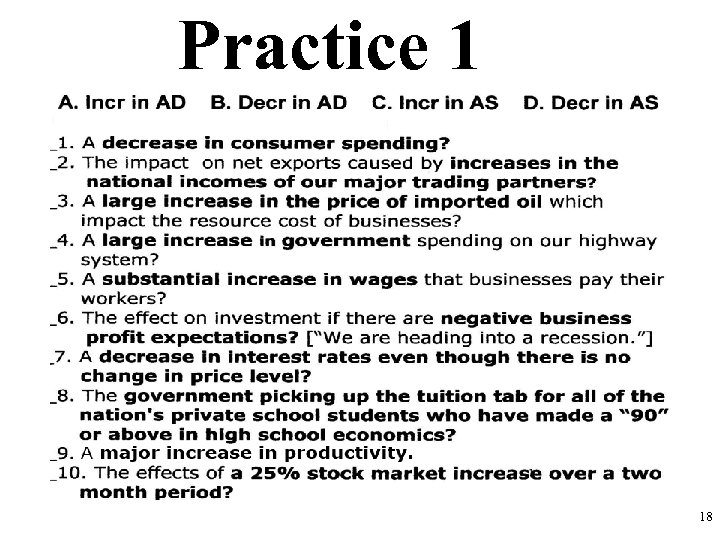 Practice 1 18
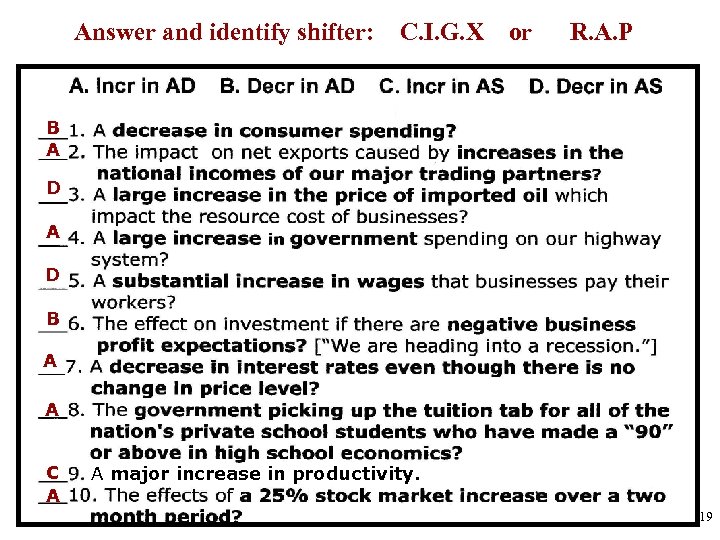 Answer and identify shifter: C. I. G. X or R. A. P B A D B A A C A A major increase in productivity. 19
 Inflationary and Recessionary Gaps 20
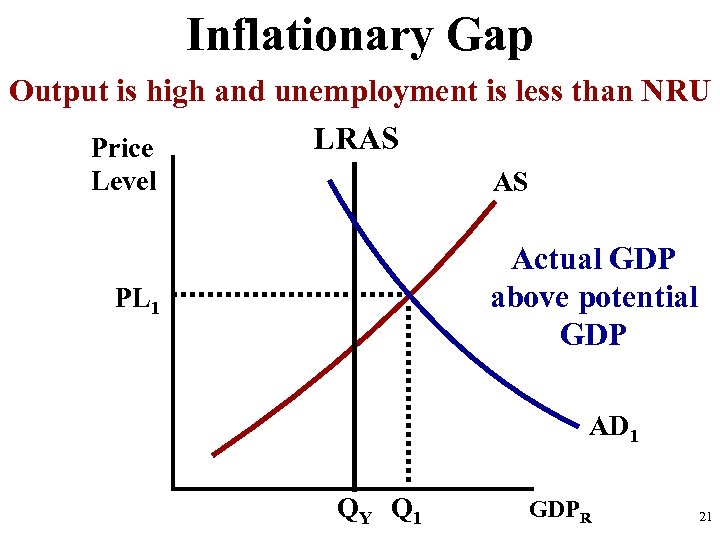 Inflationary Gap Output is high and unemployment is less than NRU LRAS Price Level AS Actual GDP above potential GDP PL 1 AD 1 QY Q 1 GDPR 21
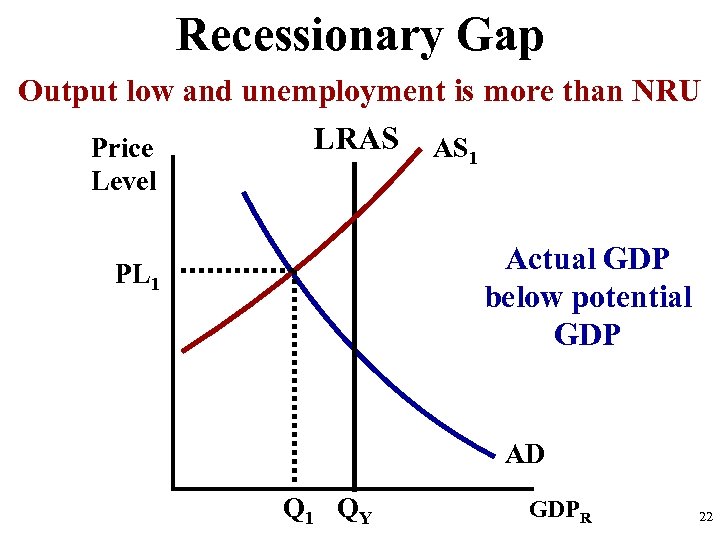 Recessionary Gap Output low and unemployment is more than NRU LRAS AS 1 Price Level Actual GDP below potential GDP PL 1 AD Q 1 QY GDPR 22
 Short Run and Long Run 23
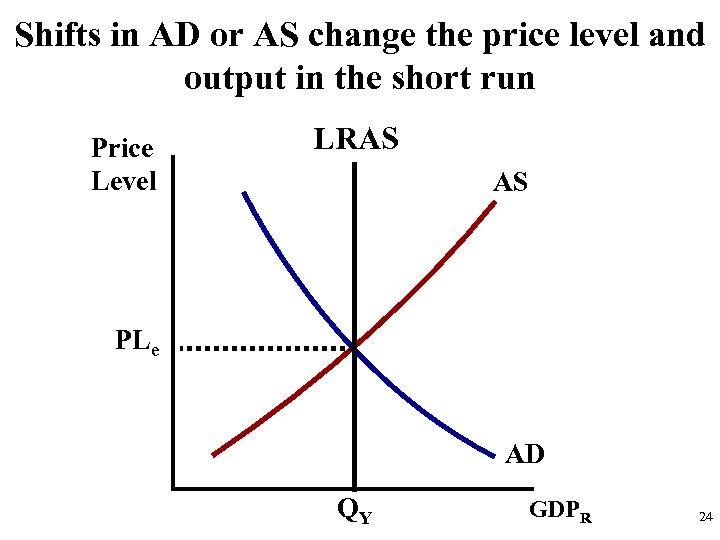 Shifts in AD or AS change the price level and output in the short run Price Level LRAS AS PLe AD QY GDPR 24
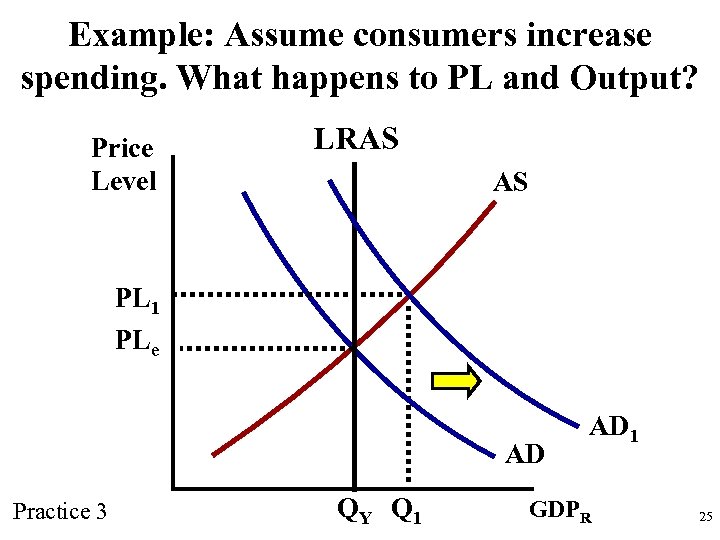 Example: Assume consumers increase spending. What happens to PL and Output? Price Level LRAS AS PL 1 PLe AD Practice 3 QY Q 1 AD 1 GDPR 25
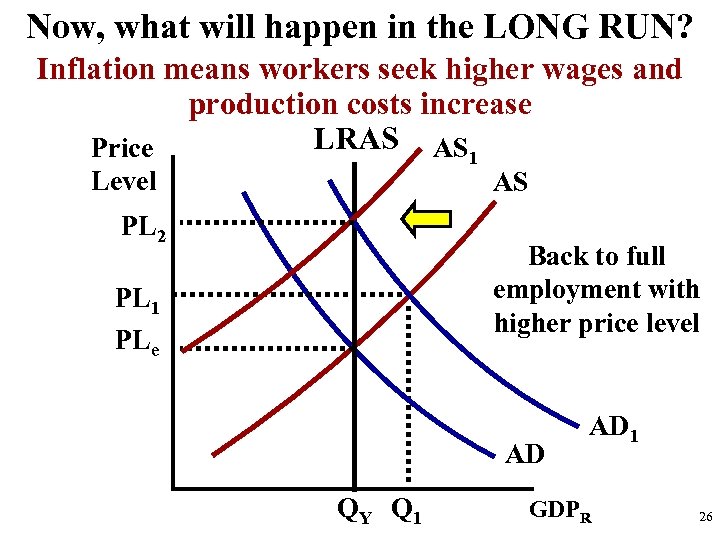 Now, what will happen in the LONG RUN? Inflation means workers seek higher wages and production costs increase LRAS AS 1 Price Level AS PL 2 Back to full employment with higher price level PL 1 PLe AD QY Q 1 AD 1 GDPR 26
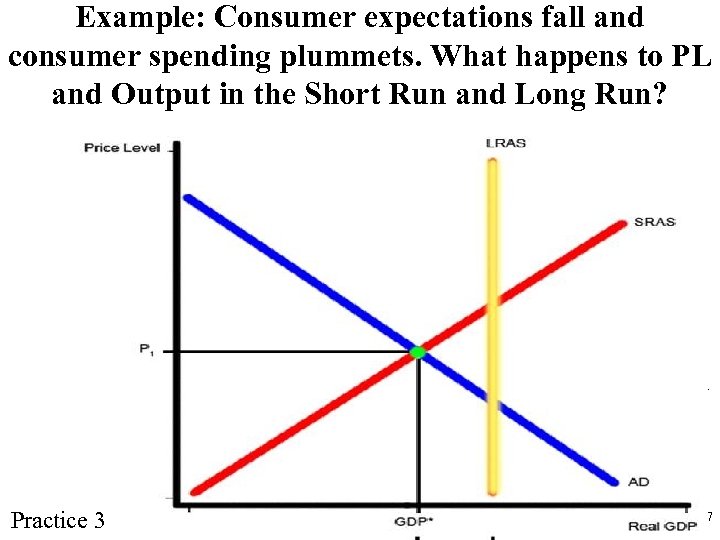 Example: Consumer expectations fall and consumer spending plummets. What happens to PL and Output in the Short Run and Long Run? Price Level LRAS AS AS 1 AS increases as workers accept lower wages and production costs fall PLe PL 1 PL 2 AD 1 Practice 3 Q 1 QY AD GDPR 27
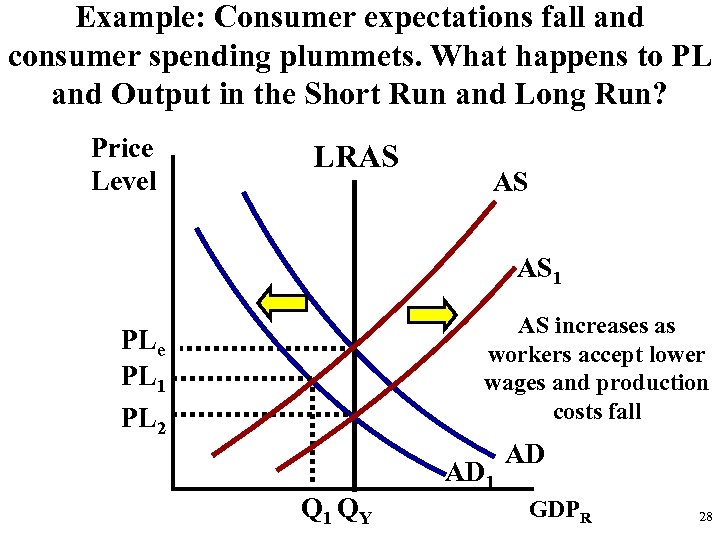 Example: Consumer expectations fall and consumer spending plummets. What happens to PL and Output in the Short Run and Long Run? Price Level LRAS AS AS 1 AS increases as workers accept lower wages and production costs fall PLe PL 1 PL 2 AD 1 QY AD GDPR 28
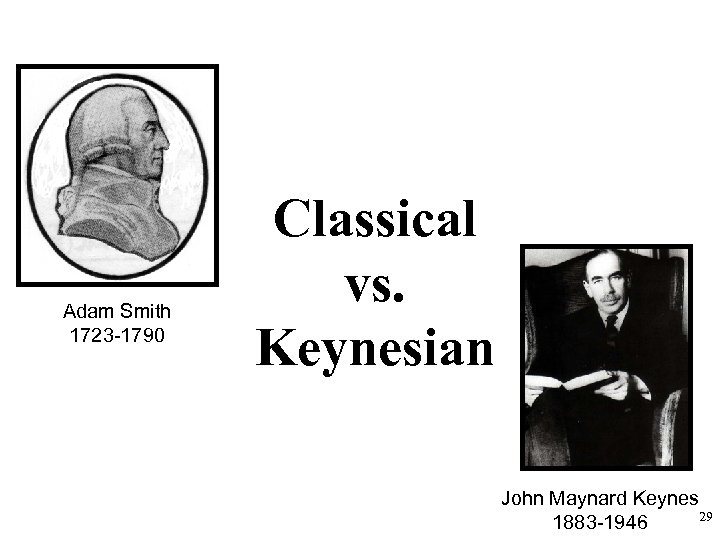 Adam Smith 1723 -1790 Classical vs. Keynesian John Maynard Keynes 29 1883 -1946
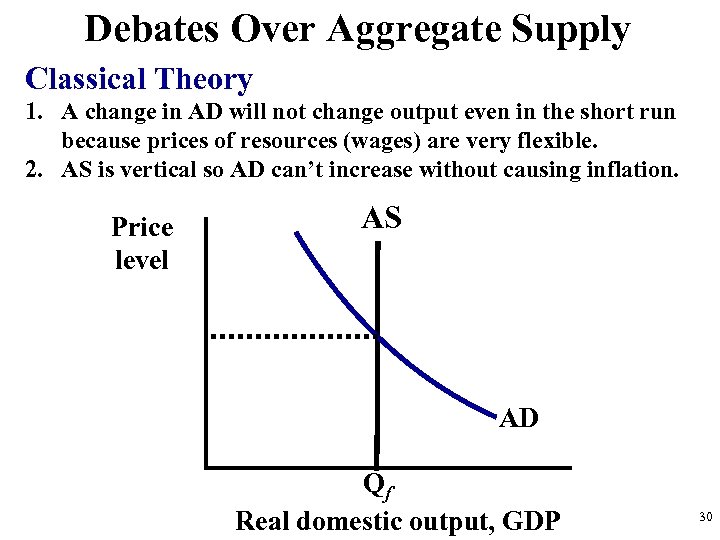 Debates Over Aggregate Supply Classical Theory 1. A change in AD will not change output even in the short run because prices of resources (wages) are very flexible. 2. AS is vertical so AD can’t increase without causing inflation. Price level AS AD Qf Real domestic output, GDP 30
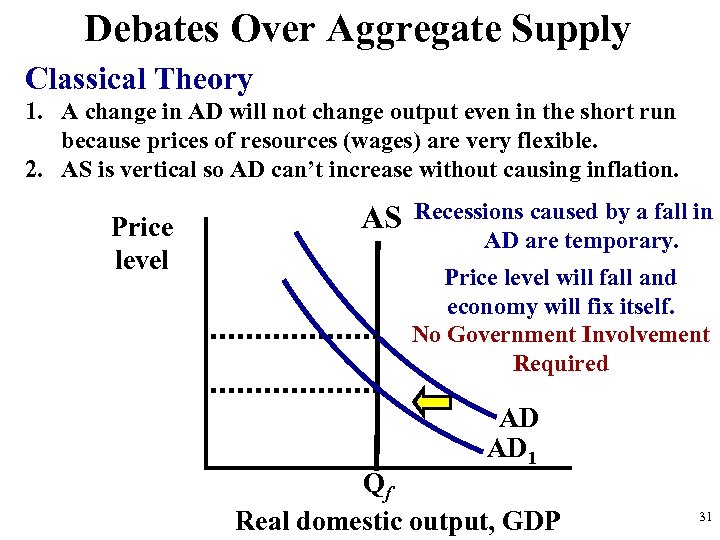 Debates Over Aggregate Supply Classical Theory 1. A change in AD will not change output even in the short run because prices of resources (wages) are very flexible. 2. AS is vertical so AD can’t increase without causing inflation. Price level AS Recessions caused by a fall in AD are temporary. Price level will fall and economy will fix itself. No Government Involvement Required AD AD 1 Qf Real domestic output, GDP 31
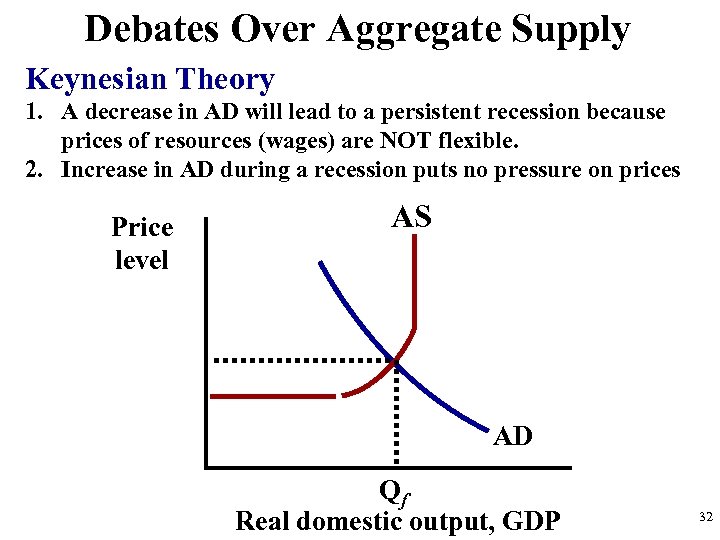 Debates Over Aggregate Supply Keynesian Theory 1. A decrease in AD will lead to a persistent recession because prices of resources (wages) are NOT flexible. 2. Increase in AD during a recession puts no pressure on prices Price level AS AD Qf Real domestic output, GDP 32
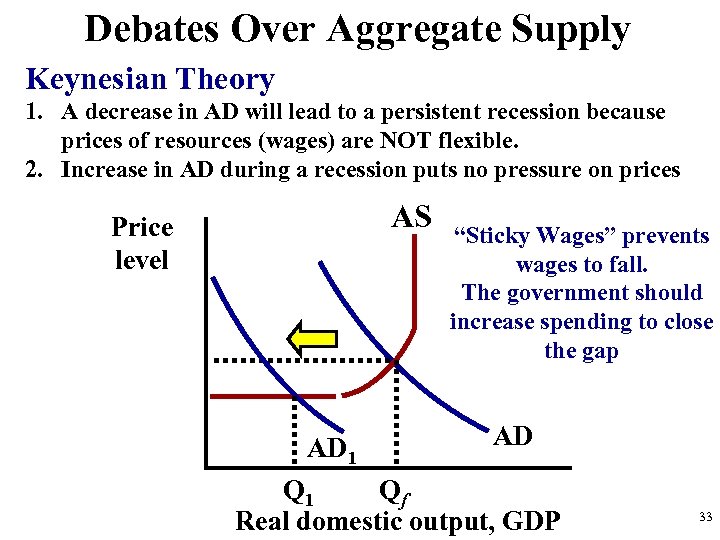 Debates Over Aggregate Supply Keynesian Theory 1. A decrease in AD will lead to a persistent recession because prices of resources (wages) are NOT flexible. 2. Increase in AD during a recession puts no pressure on prices AS Price level AD 1 “Sticky Wages” prevents wages to fall. The government should increase spending to close the gap AD Q 1 Qf Real domestic output, GDP 33
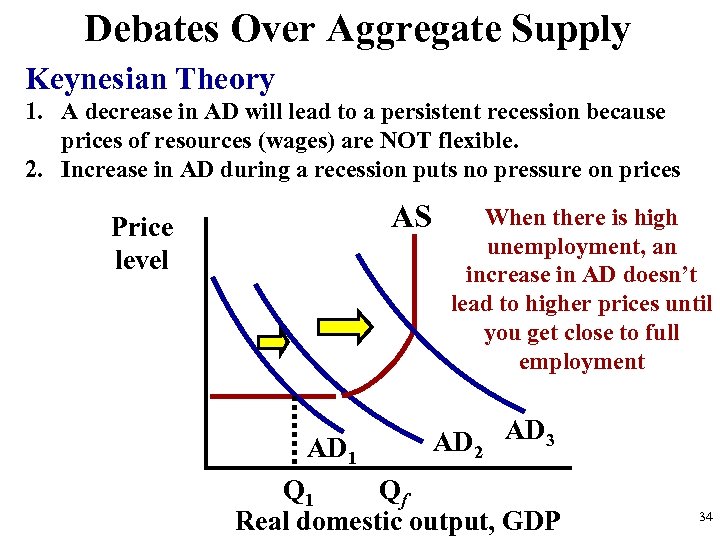 Debates Over Aggregate Supply Keynesian Theory 1. A decrease in AD will lead to a persistent recession because prices of resources (wages) are NOT flexible. 2. Increase in AD during a recession puts no pressure on prices AS Price level AD 1 When there is high unemployment, an increase in AD doesn’t lead to higher prices until you get close to full employment AD 2 AD 3 Q 1 Qf Real domestic output, GDP 34
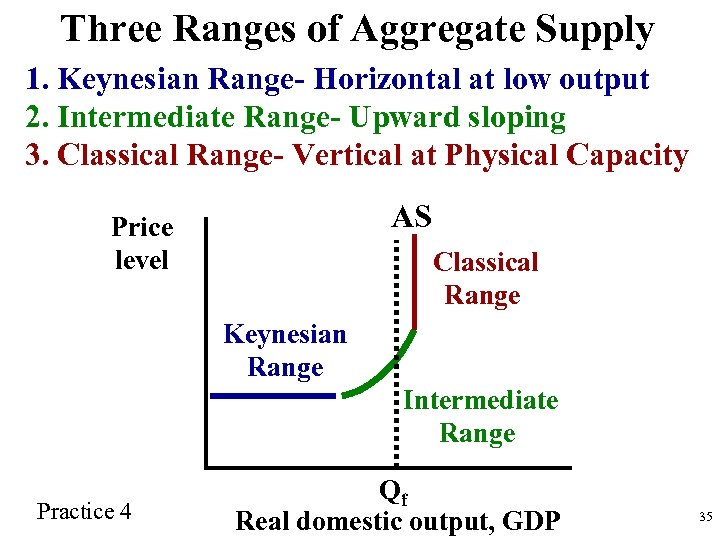 Three Ranges of Aggregate Supply 1. Keynesian Range- Horizontal at low output 2. Intermediate Range- Upward sloping 3. Classical Range- Vertical at Physical Capacity AS Price level Classical Range Keynesian Range Intermediate Range Practice 4 Qf Real domestic output, GDP 35
 The Phillips Curve Shows tradeoff between inflation and unemployment. What happens to inflation and unemployment when AD increase?
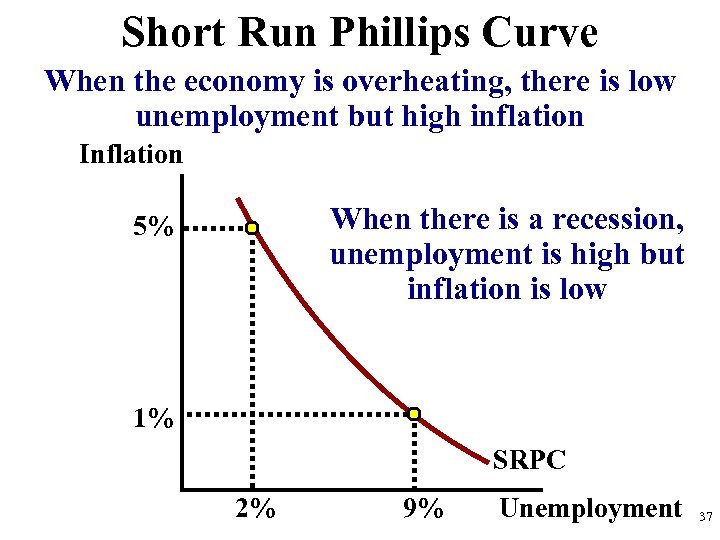 Short Run Phillips Curve When the economy is overheating, there is low unemployment but high inflation Inflation When there is a recession, unemployment is high but inflation is low 5% 1% SRPC 2% 9% Unemployment 37
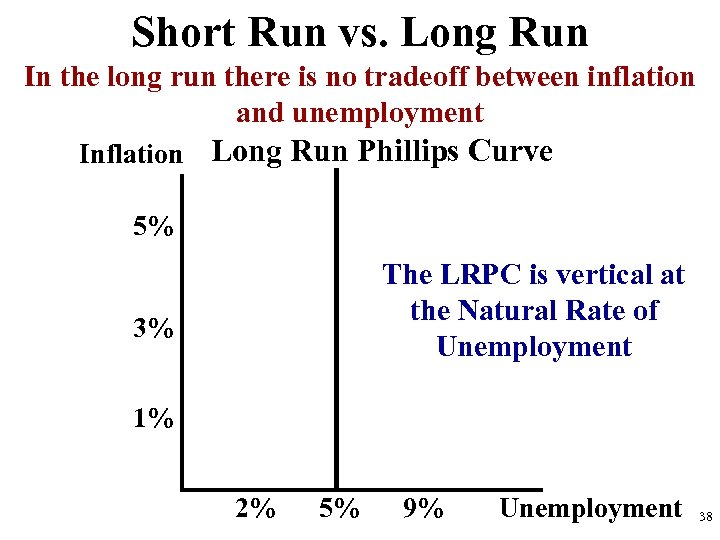 Short Run vs. Long Run In the long run there is no tradeoff between inflation and unemployment Inflation Long Run Phillips Curve 5% The LRPC is vertical at the Natural Rate of Unemployment 3% 1% 2% 5% 9% Unemployment 38
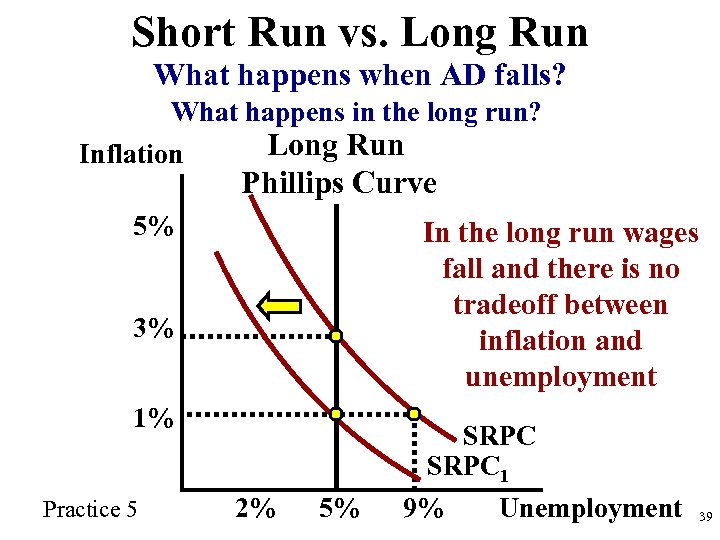 Short Run vs. Long Run What happens when AD falls? What happens in the long run? Inflation Long Run Phillips Curve 5% In the long run wages fall and there is no tradeoff between inflation and unemployment 3% 1% Practice 5 2% 5% SRPC 1 Unemployment 9% 39
 AD/AS and the Phillips Curve
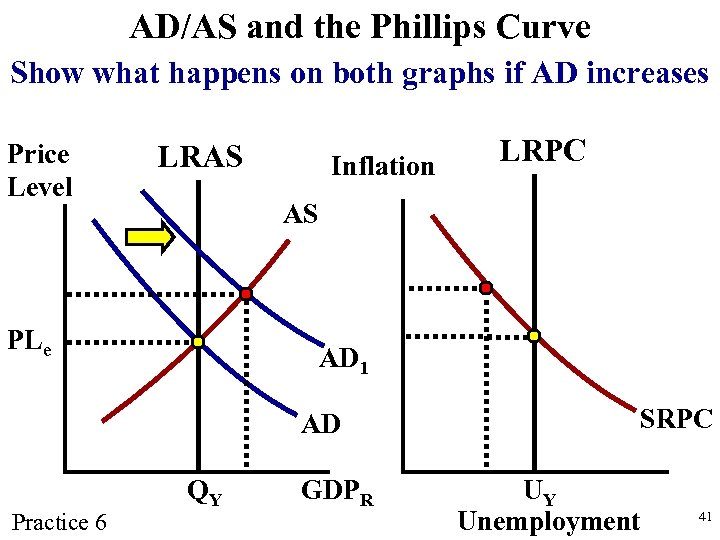 AD/AS and the Phillips Curve Show what happens on both graphs if AD increases Price Level LRAS Inflation AS PLe AD 1 AD Practice 6 LRPC QY GDPR SRPC UY Unemployment 41
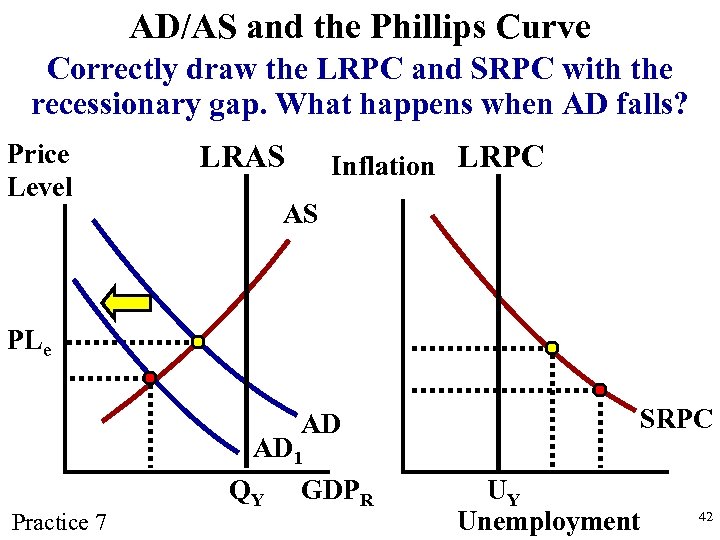 AD/AS and the Phillips Curve Correctly draw the LRPC and SRPC with the recessionary gap. What happens when AD falls? Price Level LRAS Inflation LRPC AS PLe AD Practice 7 AD 1 QY GDPR SRPC UY Unemployment 42
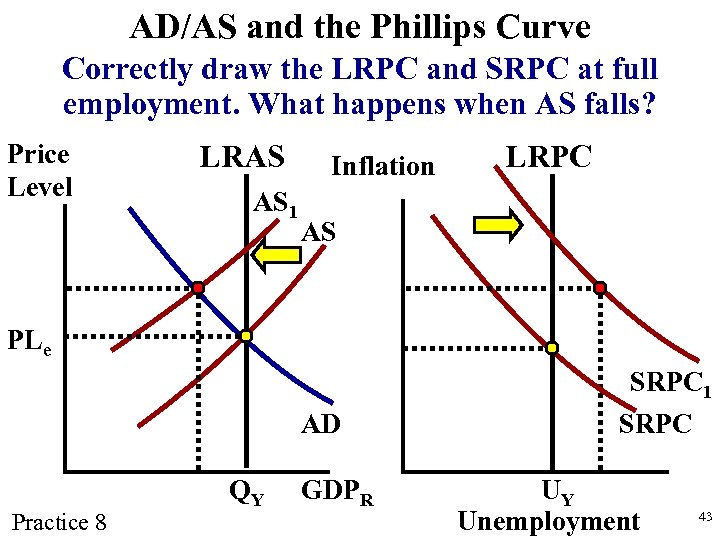 AD/AS and the Phillips Curve Correctly draw the LRPC and SRPC at full employment. What happens when AS falls? Price Level LRAS AS 1 Inflation LRPC AS PLe AD Practice 8 QY GDPR SRPC 1 SRPC UY Unemployment 43
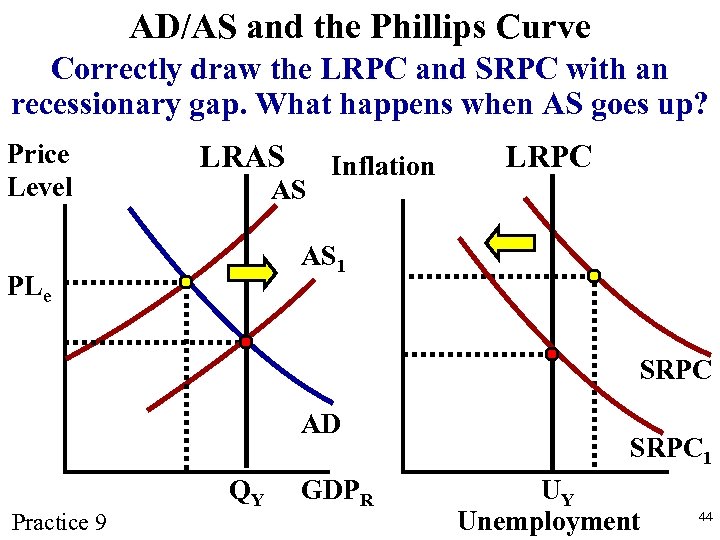 AD/AS and the Phillips Curve Correctly draw the LRPC and SRPC with an recessionary gap. What happens when AS goes up? Price Level LRAS AS Inflation LRPC AS 1 PLe SRPC AD Practice 9 QY GDPR SRPC 1 UY Unemployment 44
 Fiscal Policy 45
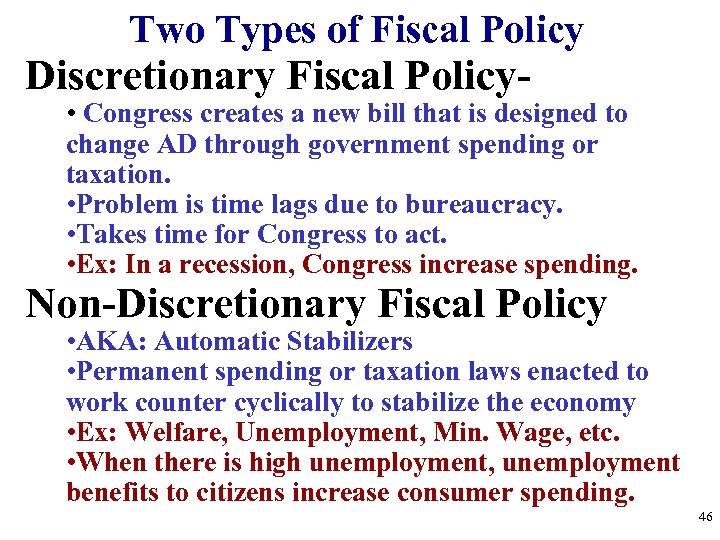 Two Types of Fiscal Policy Discretionary Fiscal Policy- • Congress creates a new bill that is designed to change AD through government spending or taxation. • Problem is time lags due to bureaucracy. • Takes time for Congress to act. • Ex: In a recession, Congress increase spending. Non-Discretionary Fiscal Policy • AKA: Automatic Stabilizers • Permanent spending or taxation laws enacted to work counter cyclically to stabilize the economy • Ex: Welfare, Unemployment, Min. Wage, etc. • When there is high unemployment, unemployment benefits to citizens increase consumer spending. 46
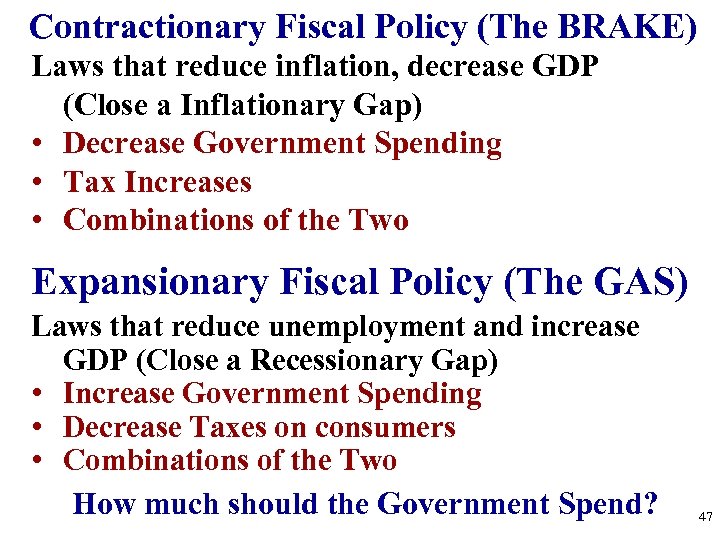 Contractionary Fiscal Policy (The BRAKE) Laws that reduce inflation, decrease GDP (Close a Inflationary Gap) • Decrease Government Spending • Tax Increases • Combinations of the Two Expansionary Fiscal Policy (The GAS) Laws that reduce unemployment and increase GDP (Close a Recessionary Gap) • Increase Government Spending • Decrease Taxes on consumers • Combinations of the Two How much should the Government Spend? 47
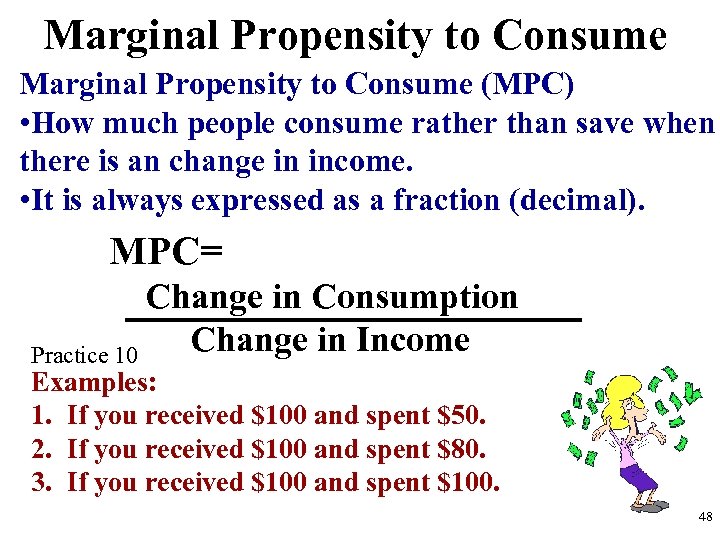 Marginal Propensity to Consume (MPC) • How much people consume rather than save when there is an change in income. • It is always expressed as a fraction (decimal). MPC= Change in Consumption Change in Income Practice 10 Examples: 1. If you received $100 and spent $50. 2. If you received $100 and spent $80. 3. If you received $100 and spent $100. 48
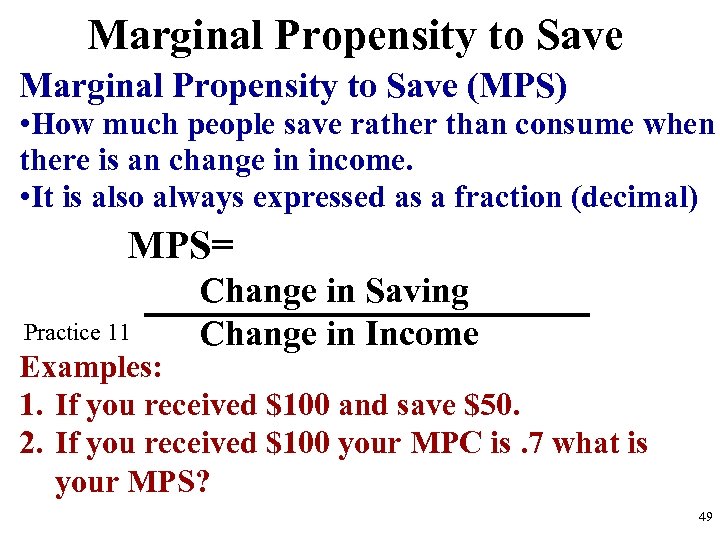 Marginal Propensity to Save (MPS) • How much people save rather than consume when there is an change in income. • It is also always expressed as a fraction (decimal) MPS= Practice 11 Change in Saving Change in Income Examples: 1. If you received $100 and save $50. 2. If you received $100 your MPC is. 7 what is your MPS? 49
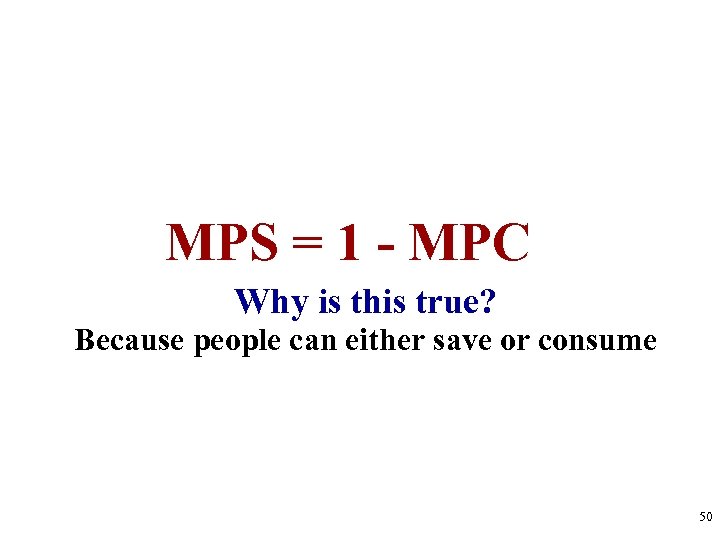 MPS = 1 - MPC Why is this true? Because people can either save or consume 50
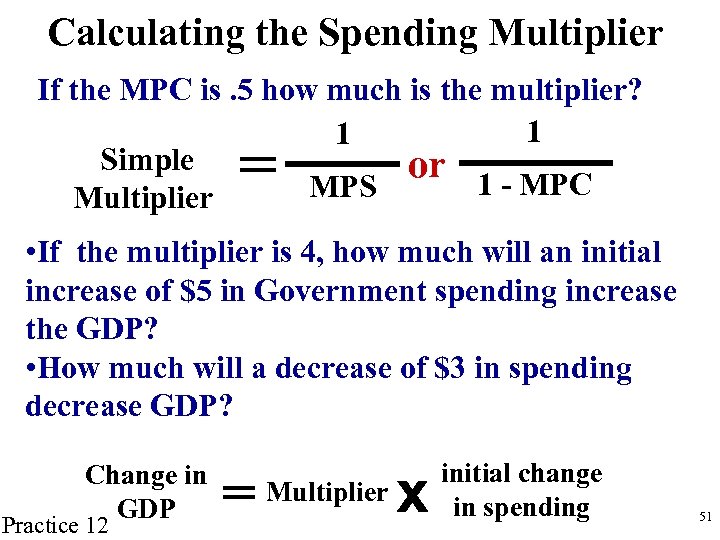 Calculating the Spending Multiplier If the MPC is. 5 how much is the multiplier? 1 1 Simple or 1 - MPC MPS Multiplier = • If the multiplier is 4, how much will an initial increase of $5 in Government spending increase the GDP? • How much will a decrease of $3 in spending decrease GDP? Change in GDP Practice 12 = Multiplier x initial change in spending 51
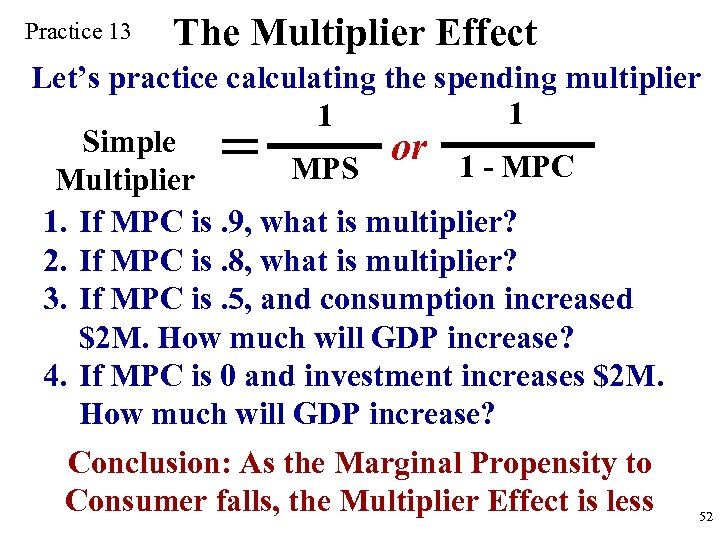 Practice 13 The Multiplier Effect Let’s practice calculating the spending multiplier 1 1 Simple or 1 - MPC MPS Multiplier 1. If MPC is. 9, what is multiplier? 2. If MPC is. 8, what is multiplier? 3. If MPC is. 5, and consumption increased $2 M. How much will GDP increase? 4. If MPC is 0 and investment increases $2 M. How much will GDP increase? = Conclusion: As the Marginal Propensity to Consumer falls, the Multiplier Effect is less 52
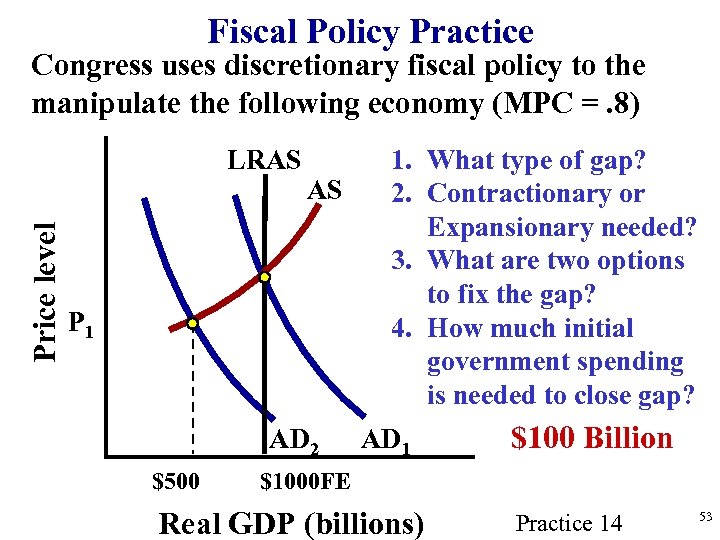 Fiscal Policy Practice Congress uses discretionary fiscal policy to the manipulate the following economy (MPC =. 8) Price level LRAS AS P 1 AD 2 $500 1. What type of gap? 2. Contractionary or Expansionary needed? 3. What are two options to fix the gap? 4. How much initial government spending is needed to close gap? AD 1 $100 Billion $1000 FE Real GDP (billions) Practice 14 53
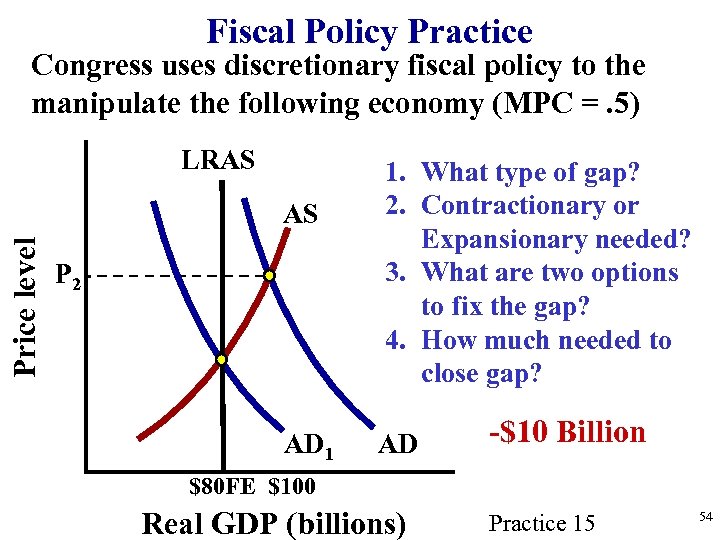 Fiscal Policy Practice Congress uses discretionary fiscal policy to the manipulate the following economy (MPC =. 5) LRAS Price level AS P 2 AD 1 1. What type of gap? 2. Contractionary or Expansionary needed? 3. What are two options to fix the gap? 4. How much needed to close gap? AD -$10 Billion $80 FE $100 Real GDP (billions) Practice 15 54
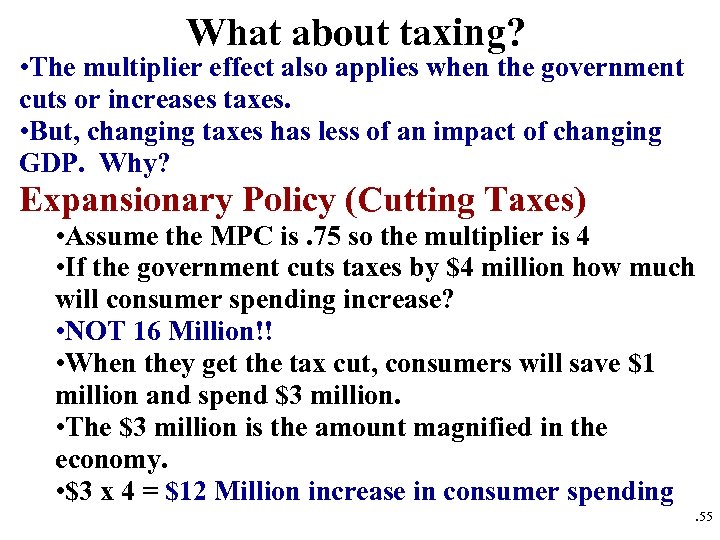 What about taxing? • The multiplier effect also applies when the government cuts or increases taxes. • But, changing taxes has less of an impact of changing GDP. Why? Expansionary Policy (Cutting Taxes) • Assume the MPC is. 75 so the multiplier is 4 • If the government cuts taxes by $4 million how much will consumer spending increase? • NOT 16 Million!! • When they get the tax cut, consumers will save $1 million and spend $3 million. • The $3 million is the amount magnified in the economy. • $3 x 4 = $12 Million increase in consumer spending. 55
 Non-Discretionary Fiscal Policy 56
 Problems With Fiscal Policy 57
 Problems With Fiscal Policy • When there is a recessionary gap what two options does Congress have to fix it? • What’s wrong with combining both? Deficit Spending!!!! • A Budget Deficit is when the government’s expenditures exceeds its revenue. • The National Debt is the accumulation of all the budget deficits over time. • If the Government increases spending without increasing taxes they will increase the annual deficit and the national debt. Most economists agree that budget deficits are a necessary evil because forcing a balanced budget would not allow Congress to stimulate the economy. 58
 Additional Problems with Fiscal Policy 1. Problems of Timing • Recognition Lag- Congress must react to economic indicators before it’s too late • Administrative Lag- Congress takes time to pass legislation • Operational Lag- Spending/planning takes time to organize and execute ( changing taxing is quicker) 2. Politically Motivated Policies • Politicians may use economically inappropriate policies to get reelected. • Ex: A senator promises more welfare and public works programs when there is already an inflationary gap. 59
 Additional Problems with Fiscal Policy 3. Crowding-Out Effect • In basketball, what is “Boxing Out”? • Government spending might cause unintended effects that weaken the impact of the policy. Example: • We have a recessionary gap • Government creates new public library. (AD increases) • Now but consumer spend less on books (AD decreases) Another Example: • The government increases spending but must borrow the money (AD increases) • This increases the price for money (the interest rate). • Interest rates rise so Investment to fall. (AD decrease) The government “crowds out” consumers and/or investors 60
 Additional Problems with Fiscal Policy 4. Net Export Effect International trade reduces the effectiveness of fiscal policies. • • • Example: We have a recessionary gap so the government spends to increase AD. The increase in AD causes an increase in price level and interest rates. U. S. goods are now more expensive and the US dollar appreciates… Foreign countries buy less. (Exports fall) Net Exports (Exports-Imports) falls, decreasing AD. 61