 Скачать презентацию UNIT 22 ONBOARD PASSENGER OPERATIONS WEEK TWO
d6a65cedcb31490a172fefb06c5ba073.ppt
- Количество слайдов: 41



UNIT 22 ONBOARD PASSENGER OPERATIONS
WEEK TWO JANUARY 21, 2017 LEARNING OUTCOMES P 4 Define the role of the senior cabin crew member P 5 Describe the responsibilities of the senior cabin crew member during the stages of a flight P 6 Outline the reporting procedures for ensuring Civil Aviation Authority (CAA) compliance
P 4 DEFINE THE ROLE OF THE SENIOR CABIN CREW MEMBER Who is a Senior Cabin Crew Member • A Senior Cabin Crew Member (SCCM) is also often referred to as the “In. Charge Cabin Crew Member / Flight Attendant/ In- flight Supervisor/ Cabin Supervisor and Cabin Service Directors. • Cabin crew members are required to undergo training prior to assuming duties as a Senior Cabin crew member.
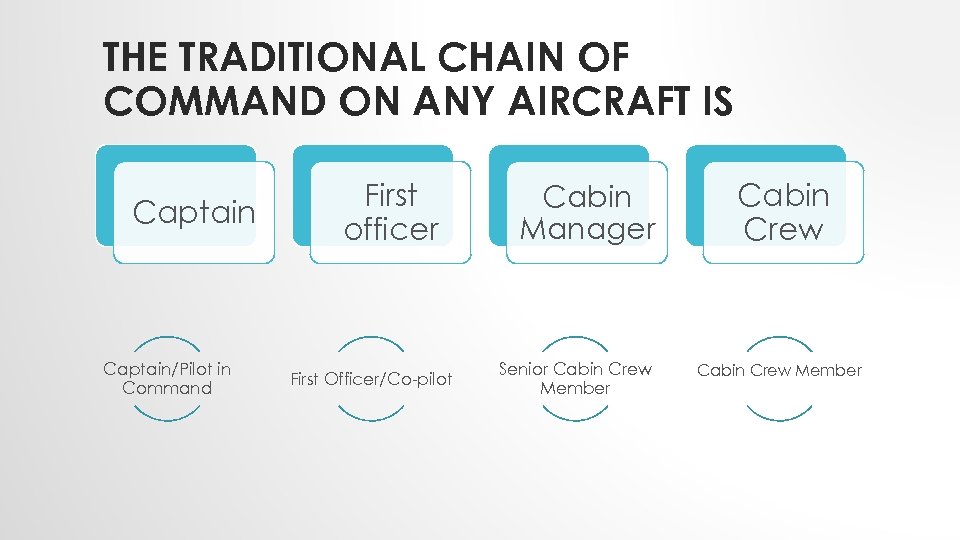
THE TRADITIONAL CHAIN OF COMMAND ON ANY AIRCRAFT IS Captain/Pilot in Command First officer First Officer/Co-pilot Cabin Manager Senior Cabin Crew Member
GENERAL DUTIES OF THE SENIOR CABIN CREW MEMBER / IN CHARGE FLIGHT ATTENDANT INCLUDE THE CONTROLLING AND SUPERVISION OF: All cabin crew members on-board the aircraft All safety related aspects Medical treatment required Passenger service and comfort Liaison between Flight deck and cabin crew members
A CLOSER LOOK AT THE DUTIES OF THE SENIOR CABIN CREW MEMBER CONT. The Delivery of crew briefing and the allocation of Flight Attendant Positions include: • Assign, manage and supervise Cabin Crew to ensure a safe, efficient and professional work environment • Ensure all performance issues are identified early and report to the person in charge • Stipulate and maintain an environment free of harassment and discrimination for all employees and take appropriate corrective action if it is breached
A CLOSER LOOK AT THE DUTIES OF THE SENIOR CABIN CREW MEMBER CONT. • Training new members of staff is also something senior cabin crew member gets involved in • They will be responsible for supervising new recruits on their first flights. • After each flight there is paperwork to complete and flight forms which must be dealt with by senior cabin crew. in charge of the performance of all other cabin crew members – ensuring that the best levels of safety and comfort are met
A CLOSER LOOK AT THE DUTIES OF THE SENIOR CABIN CREW MEMBER CONT. • Ensure pre-flight cabin safety checks, aircraft cabin duties and catering food and equipment are checked, done and supplied • Controls and manages the work place to ensure standard operating procedures (SOP’s) for demonstrations of aircraft safety and emergency procedures are conducted and referenced during all stages of flight • Greets and directs passengers to seats and assures assistance is given if required for their hand luggage • Personally assists any passengers with special needs
A CLOSER LOOK AT THE DUTIES OF THE SENIOR CABIN CREW MEMBER CONT. • Ensures safety belt, smoking regulations and relevant PA’s are adhered to • Ensures that the comfort of passengers address and maintained • Orders in-flight stores and ground services as required • Supervises the service and services which includes galleys, preparing and heating of food for passengers • Meets with management about relevant operational issues
A CLOSER LOOK AT THE DUTIES OF THE SENIOR CABIN CREW MEMBER CONT. Provides leadership and ambassador duties on behalf of the company • Liaise with the Pilot-In-Command to ensure a safe, effective cabin service is delivered • Announce, manage, control passenger pa’s during normal and abnormal phases of flight • Maintain currency with Civil Aviation Orders 20. 11 or country equivalent • Ensure compliance to Occupational Health and Safety rules and regulations
A CLOSER LOOK AT THE DUTIES OF THE SENIOR CABIN CREW MEMBER Preparing and serving meals and drinks; selling duty free goods onboard such as perfume, alcohol, cigarettes and toys. Helping passengers with carry-on luggage, providing leadership in the event of an emergency such as an evacuation of the aircraft or severe weather conditions, Ensure a professional, safe, friendly and efficient cabin crew. Working long hours including holidays and weekends. The hours worked do not get easier with seniority
TRAINING FOR SENIOR CABIN CREW MEMBER TRAINING PROGRAMME INCLUDE: Leadership Skills Regulatory Overview Flight and Duty Roles and Responsibilities of cabin crew members Communication and Coordination Procedures Communication systems and inflight entertainment systems
TRAINING FOR SENIOR CABIN CREW MEMBER TRAINING PROGRAMME INCLUDE CONT. : • Briefings • Authority of the Commander • Identification of roles in the event of an emergency situation • Aviation Medicine / on- board medical emergencies • Security • Dangerous Goods
TRAINING FOR SENIOR CABIN CREW MEMBER TRAINING PROGRAMME INCLUDE CONT. : • Administration and Documentation e. g. Flight Reports, Incident Reports • Passenger Handling • Unscheduled delays / layovers • Post Flight Duties
LET’S EXPLORE • Senior Cabin Crew Training Instructions: Click on the link below and explore the contents of the Senior Cabin Crew Member (SCCM) Course provided by Flitedux. http: //www. flitedux. co. za/index. php? level=flitedux_sub_categor y&pageid=22
P 5 DESCRIBE THE RESPONSIBILITIES OF THE SENIOR CABIN CREW MEMBER DURING THE STAGES OF A FLIGHT
PREFLIGHT BRIEFINGS • The briefing is addressed to all cabin crewmembers. The expectations, tone and the standards for the flight are set during this briefing. • The SCCM must keep in mind the main objectives of the briefing, as well as important information specific to the flight. • A briefing should be prepared for each individual flight otherwise it may become routine and repetitive. • The SCCM should: − Plan and prepare the briefing − Select the relevant information before the briefing (APPROPRIATE)
PREFLIGHT BRIEFINGS CONT. • The SCCM should keep the briefing short to ensure that the attention of all cabin crewmembers is focused on the most important points. (BRIEF) • The briefing must be understood by all crewmembers. It should be interactive, and encourage cabin crewmembers to share information and ask questions. The Purser should adopt good communication methods to encourage feedback. (CLEAR AND CONCISE)
THE PREFLIGHT BRIEFING WILL COVER • INTRODUCTIONS • FLIGHT DETAILS • SPECIAL FLIGHT INFORMATION • WORKLOAD DISTRIBUTION/ TASK SHARING AND RESPONSIBILTIES • CREW COMMUNICATION AND COORDINATION • REVIEW OF THE PROCEDURES • QUESTIONS Cabin crewmembers must be encouraged to report to the SCCM, or the flight crew, anything that they feel may compromise the safety of the flight.

LET’S EXPLORE • Watch the video showcasing Senior Cabin Crew Flight Attendants on the job • https: //www. youtube. com/watch? v=p 2 -Aj. SEx. TJw
P 6 Reporting procedures for ensuring Civil Aviation Authority (CAA) compliance
WHAT DOES THE CIVIL AVIATION AUTHORITY (CAA) DO? IT ENSURES THAT: THE AVIATION INDUSTRY MEETS THE HIGHEST SAFETY STANDARDS CONSUMERS HAVE CHOICE, VALUE FOR MONEY, ARE PROTECTED AND TREATED FAIRLY WHEN THEY FLY THE CAA DRIVES IMPROVEMENTS IN AIRLINES AND AIRPORTS’ ENVIRONMENTAL PERFORMANCE THE AVIATION INDUSTRY MANAGES SECURITY RISKS EFFECTIVELY.
THE CAA IN THE UNITED KINGDOM The Civil Aviation Authority (CAA) is responsible for the regulation of aviation safety in the UK, determining policy for the use of airspace, the economic regulation of Heathrow, Gatwick and Stansted airports, the licensing and financial fitness of airlines and the management of the ATOL financial protection scheme for holidaymakers.
THE CAA IN JAMAICA Ensuring the safe and orderly conduct of all aviation activities in Jamaica and those conducted overseas by Jamaican Operators Providing efficient and user responsive Air Navigation Services to the national and international aviation community Cooperating with other agencies in the facilitation, provision and regulation of a reliable and safe Air Transport System. Providing a conducive environment for the development of its staff
ITEMS TO BE REPORTED A reportable occurrence is: • (i) any incident relating to such an aircraft or any defect in or malfunctioning of such an aircraft or any part or equipment of such an aircraft, being an incident, malfunctioning or defect endangering, or which if not corrected would endanger, the aircraft, its occupants, or any other person; and • (ii) any defect in or malfunctioning of any facility on the ground used or intended to be used for purposes of or in connection with the operation of such an aircraft, being a defect or malfunctioning endangering, or which if not corrected would endanger, such an aircraft or its occupants; and
ITEMS TO BE REPORTED (iii) any incident in flight in which the pilot-in-command of an aircraft has reason to believe that the aircraft has been in collision with one or more than one bird; or (iv) any dangerous goods accident, dangerous goods incident or the finding or undeclared or misdeclared dangerous goods in cargo or passenger’s baggage.
ITEMS TO BE REPORTED (2) A report should also be submitted on any occurrence which involves, for example, a defective condition or unsatisfactory behaviour or procedure which did not immediately endanger the aircraft but which, if allowed to continue uncorrected, or if repeated in different, but likely, circumstances, would create a hazard.
MEDICAL INCIDENTS ON BOARD In-flight medical emergencies can be broadly divided into two categories - injury related or health related situations. Injuries can occur as a result of a turbulence encounter, luggage falling from an overhead bin, an on-board altercation or due to burns or scalds resulting from contact with hot liquids or galley ovens.
MEDICAL INCIDENTS ON BOARD • Health issues for a single passenger can range from fainting or shortness of breath to allergic reaction to missed medication to gastrointestinal issues to stroke, heart attack or even death. • In very rare cases, food poisoning or a commutable disease may affect an number of passengers at the same time.
SECURITY INCIDENTS ON BOARD Some examples • use of a hijacked aircraft as a weapon • Ignition of incendiary devices • attempts to enter the cockpit • security breaches in the cabin • fighting • brandishing of a weapon on passengers and cabin crew
IRREGULAR OPERATIONS REPORT • An Irregular Operations Report (IOR) is filled anytime a Flight Attendant needs to report safety, medical and security incidents. The IOR replaced the previous incident reporting method, paper OSIR reports found on board the aircraft. • Flight attendants are required to report any incident involving customers or crewmembers that is out of the ordinary and/or may require follow-up by the company- in other words, IORs are not a voluntary means of reporting incidents.
LET’S EXPLORE Sample Cabin Safety Report • https: //asrs. arc. nasa. gov/docs/cabin. pdf
AIR SAFETY REPORT • The Aviation Safety Reporting System, or ASRS, is the US Federal Aviation Administration's (FAA) voluntary confidential reporting system that allows pilots and other airplane crew members to confidentially report near misses and close calls in the interest of improving air safety. • The ASRS collects, analyses, and responds to voluntarily submitted aviation safety incident reports in order to lessen the likelihood of aviation accidents. • The confidential and independent nature of the ASRS is key to its success, since reporters do not have to worry about any possible negative consequences of coming forward with safety problems.
AIR SAFETY REPORT • It has a confidentiality and immunity policy. Reporters may, but are not required to, submit their name and contact information. If the ASRS staff has questions regarding a report, it can perform a callback and request further information or clarification from the reporter. • Once the staff is satisfied with the information received, the report is stripped of identifying information and assigned a report number. The part of the reporting form with contact information is detached and returned to the reporter.
AIR SAFETY REPORT CONT. ASRS will issue alerts to relevant parties, such as airlines, air traffic controllers, manufacturers or airport authorities, if it feels it is necessary to improve safety. The ASRS also publishes a monthly newsletter highlighting safety issues, and now has an online database of reports that is accessible by the public.
CAP 382 THE MANDATORY OCCURRENCE REPORTING SCHEME (MORS) • The purpose of occurrence reporting is to improve aviation safety by ensuring that relevant safety information relating to civil aviation is reported, collected, stored, protected, exchanged, disseminated analysed. It is not to attribute blame or liability. • An occurrence means any safety-related event which endangers or which, if not corrected or addressed, could endanger an aircraft, its occupants or any other person.
LET’S EXPLORE Occurrences related to the operation of the aircraft http: //eur-lex. europa. eu/legalcontent/EN/TXT/PDF/? uri=CELEX: 32015 R 1018&from=EN#page=3
CONFIDENTIAL HUMAN FACTORS INCIDENT REPORTING PROGRAMME (CHIRP) • CHIRP is an Aviation and Maritime Confidential Incident Reporting • The aim of CHIRP is to contribute to the enhancement of aviation safety in the UK and maritime safety worldwide, by providing a totally independent confidential (not anonymous) reporting system for all individuals employed in or associated with these industries. • Reports can be submitted online, by email and by post. • When a report is closed, all correspondence and contact details are deleted from the CHIRP system. Paper copies of reports and correspondence are also destroyed.
CONFIDENTIAL HUMAN FACTORS INCIDENT REPORTING PROGRAMME (CHIRP) CONT. CHIRP complements the CAA Mandatory Occurrence Reporting system and other formal reporting systems operated by many UK organisations, by providing a means by which individuals are able to raise safetyrelated issues of concern without being identified to their peer group, management, or the Regulatory Authority.

QUESTIONS?
![SOURCES • Anon, (2017). [online] Available at: http: //Liaison between Flight deck and cabin](https://present5.com/presentation/d6a65cedcb31490a172fefb06c5ba073/image-41.jpg "SOURCES • Anon, (2017). [online] Available at: http: //Liaison between Flight deck and cabin")
SOURCES • Anon, (2017). [online] Available at: http: //Liaison between Flight deck and cabin crew members [Accessed 24 Jan. 2017]. • Anon, (2017). [online] Available at: http: //Stipulate and maintain an environment free of harassment and discrimination for all employees and take appropriate corrective action if it is breached [Accessed 24 Jan. 2017]. • Anon, (2017). [online] Available at: http: //Announce, manage, control passenger pa’s during normal and abnormal phases of flight [Accessed 24 Jan. 2017]. • Anon, (2017). [online] Available at: https: //asrs. arc. nasa. gov/docs/cabin. pdf [Accessed 24 Jan. 2017]. • "Anon, (2017). [online] Available at: http: //"THE JAMAICA CIVIL AVIATION AUTHORITY". Jcaa. gov. jm. N. p. , 2017. Web. 21 Jan. 2017. [Accessed 21 Jan. 2017]. • Caa. co. uk. (2017). Civil Aviation Authority. [online] Available at: https: //www. caa. co. uk/home/ [Accessed 21 Jan. 2017]. • Airsafety. aero. (2017). OTACs, Overseas Territories Aviation Circulars | ASSI | Air Safety Support International. [online] Available at: http: //www. airsafety. aero/Requirements-and-Policy/OTACs/OTAR-Part-13 -Occurrance-Reporting-(1)/Occurrence-Reporting/Subpart-AMandatory-Occurrence-Reporting. aspx [Accessed 24 Jan. 2017]. • Flitedux. co. za. (2017). Flitedux specialise in Safety & Emergency Procedures training for Pilots, Cabin Crew and Ground Staff. [online] Available at: http: //www. flitedux. co. za/index. php? level=flitedux_sub_category&pageid=22 [Accessed 24 Jan. 2017]. • Ltd, H. (2017). The UK Confidential Reporting Programme for Aviation and Maritime. [online] Chirp. co. uk. Available at: https: //www. chirp. co. uk/ [Accessed 24 Jan. 2017]. • Revolvy, L. (2017). "Aviation Safety Reporting System" on Revolvy. com. [online] Revolvy. com. Available at: https: //www. revolvy. com/main/index. php? s=Aviation%20 Safety%20 Reporting%20 System [Accessed 24 Jan. 2017]. • User, S. (2017). Senior Cabin Crew / In. Charge Flight Attendant Course. [online] Eptaviation. com. Available at: http: //www. eptaviation. com/courses-cabin-crew-flight-attendant/235 -senior-cabin-crew-incharge-flight-attendant-course [Accessed 24 Jan. 2017].
Скачать презентацию UNIT 22 ONBOARD PASSENGER OPERATIONS WEEK TWO
d6a65cedcb31490a172fefb06c5ba073.ppt