


 Скачать презентацию Unit 2 What we Know How we
136387bee495184f4cf1a1c6be43f979.ppt
- Количество слайдов: 23
 Unit 2: What we Know & How we Know it.
 Epistemology is the study of knowledge. It comes from the Greek "episteme" which means knowledge. It is sometimes called "theory of knowledge". It must be noted that epistemology as a distinct branch of philosophy is of recent origin. Usually Descartes is considered the first philosopher to seriously work in epistemology. The validity of knowledge was more or less taken for granted by previous philosophers. It was only when Descartes began to systematically doubt the veracity of knowledge that problems of knowledge became apparent.
 Conundrums of Epistemology The problems considered in epistemology are: Is genuine knowledge attainable at all? Is the skeptic right? What are the limits of knowledge? Where is the boundary between the subjective and objective factors? What is the nature of truth?
 SKEPTICISM This is the view that questions whether valid or reliable knowledge is ever attainable by a human being. Some skeptics stated that nothing can be known. Other skeptics stated that they did not know whether knowledge was possible; they suspended judgment on the issue. Some of the common examples used by skeptics are the illusions and deceptions of our senses. Others point to the complexity of any experience and ask how you can know what is the essence or real nature of the things you are experiencing.
 Rationalism This is the view that valid knowledge comes only through the mind. Rationalists hold that the mind knows truths that were not placed there by sensory experience. There are innate ideas which you can know independent of your sensory experience. Mathematics and geometry are examples of abstract truths which are known with certainty, even though the physical illustrations of these truths may vary. An early example was the Greek philosopher Plato (427347 B. C. ), who stated that ideas have an existence independent of human minds
 Empiricism This is the view that valid knowledge comes only through the five senses. Aristotle (384 -322 B. C. ) held the view that whatever was in the mind was first in the senses. John Locke (1632 -1714) was an English philosopher who compared the mind to a blank tablet (Tabula Rasa). When a person is born they know nothing. As they go through life, the experiences they have with their five senses write information on the tablet of their mind.
 Thinking Critically Critical Thinking: Reasonable reflective thinking that is focused on deciding what to believe or do. More precisely, it is assessing the authenticity, accuracy, and/or worth of knowledge claims and arguments. It requires careful, precise, persistent and objective analysis of any knowledge claim or belief to judge its validity and/or worth. If you think critically, what are you doing? You are asking pertinent questions. You are assessing statements and questions. You are able to admit a lack of understanding or a lack of information. You are interested in finding new solutions. You are able to clearly define a set of criteria for analyzing ideas. You are willing to examine beliefs, assumptions, and opinions and weigh them against facts. You look for evidence to support beliefs and assumptions. You are able to listen carefully and give feedback. You are able to see that critical thinking is a life-long process of self-assessment. You are able to suspend judgment until all fact have been gathered and considered. You are able to reject information that is incorrect or irrelevant. You seek alternative views. You are able to identify arguments and issues. You are able to recognize errors in thought and persuasion as well as to recognize good arguments. You are able to see the connections between topics and use knowledge from other disciplines to enhance their reading and learning experiences.
 Evaluating Claims CLAIM EVALUATION The purpose of claim evaluation is to arrive at one of three possible judgments about a claim: Either (1) to regard the evidence as making the probability of the claim high enough for me to accept the claim as true. Or (2) to regard the evidence as making the probability of the claim low enough for me to reject it as false. Or (3) to regard the evidence to be such that I cannot decide which truth value (true or false) the claim has. (The situation in which positive evidence is roughly balanced by negative evidence. ) You can divide assertions into three main logical types: (1) categorical, - they state without conditions that something is the case. – all dogs carry fleas. categorical, (2) hypothetical, - are expressed using a conditional form such as 'if. . . then', - if you are a dog then you carry hypothetical, fleas. (3) intensional. – have simple assertions embedded in them - an example is: Bethany believes that Earth is flat. '. intensional. Categorical generalizations can be classified into three groups: universal - these are either inclusive or exclusive. all universal generalizations can begin with 'all'. Inclusive – all cats are affectionate Exclusive – no cats are affectionate These have to be used with great care. They are much more easily refuted than weaker ones. In fact a single clear counterexample can refute them. (2) qualified, - Qualified generalizations are those prefixed by a modifying term other than 'all' or 'no' You use “most”, “nearly all” un-qualified – no modifying term is used be we realize the speaker does not mean every single one.
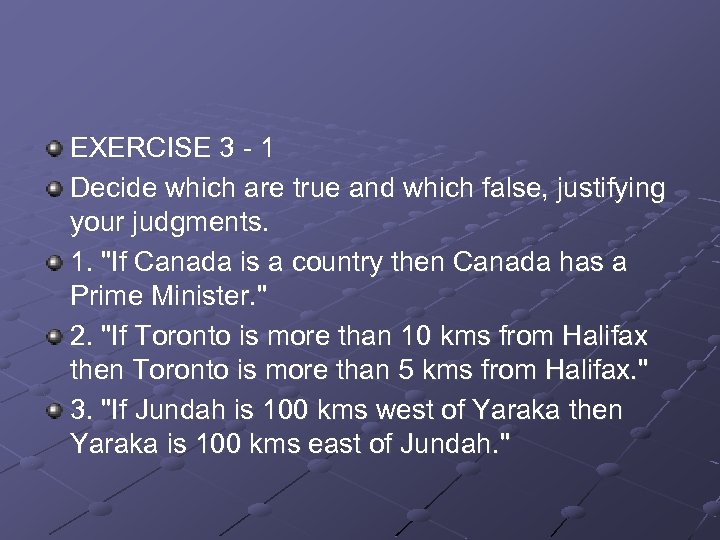 EXERCISE 3 - 1 Decide which are true and which false, justifying your judgments. 1. "If Canada is a country then Canada has a Prime Minister. " 2. "If Toronto is more than 10 kms from Halifax then Toronto is more than 5 kms from Halifax. " 3. "If Jundah is 100 kms west of Yaraka then Yaraka is 100 kms east of Jundah. "
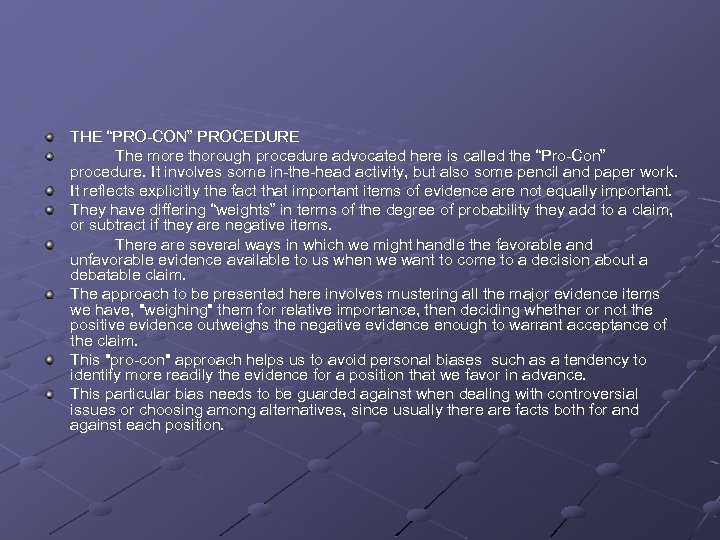 THE “PRO-CON” PROCEDURE The more thorough procedure advocated here is called the “Pro-Con” procedure. It involves some in-the-head activity, but also some pencil and paper work. It reflects explicitly the fact that important items of evidence are not equally important. They have differing “weights” in terms of the degree of probability they add to a claim, or subtract if they are negative items. There are several ways in which we might handle the favorable and unfavorable evidence available to us when we want to come to a decision about a debatable claim. The approach to be presented here involves mustering all the major evidence items we have, "weighing" them for relative importance, then deciding whether or not the positive evidence outweighs the negative evidence enough to warrant acceptance of the claim. This "pro-con" approach helps us to avoid personal biases such as a tendency to identify more readily the evidence for a position that we favor in advance. This particular bias needs to be guarded against when dealing with controversial issues or choosing among alternatives, since usually there are facts both for and against each position.
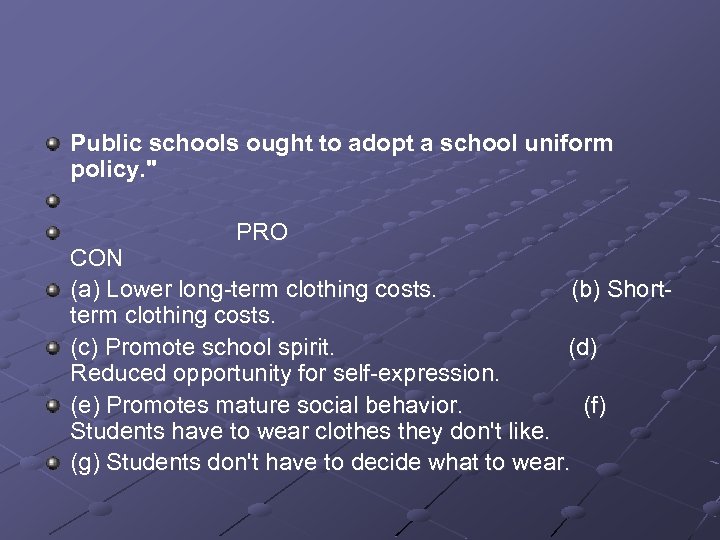 Public schools ought to adopt a school uniform policy. " PRO CON (a) Lower long-term clothing costs. (b) Shortterm clothing costs. (c) Promote school spirit. (d) Reduced opportunity for self-expression. (e) Promotes mature social behavior. (f) Students have to wear clothes they don't like. (g) Students don't have to decide what to wear.
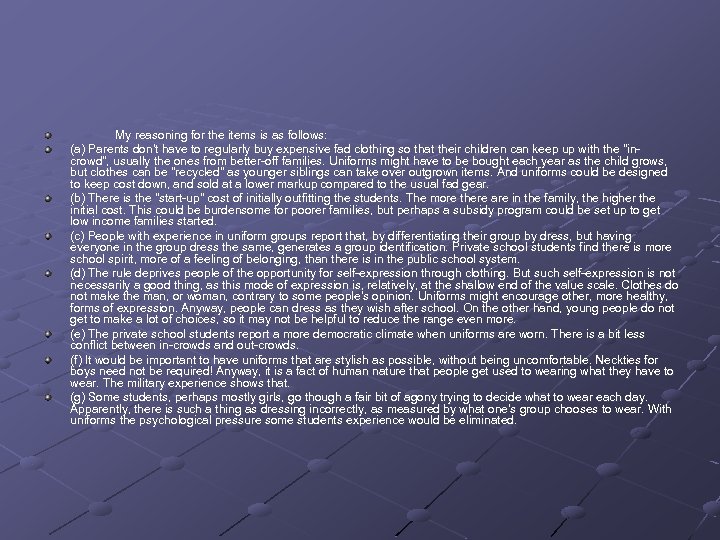 My reasoning for the items is as follows: (a) Parents don't have to regularly buy expensive fad clothing so that their children can keep up with the "incrowd", usually the ones from better-off families. Uniforms might have to be bought each year as the child grows, but clothes can be "recycled" as younger siblings can take over outgrown items. And uniforms could be designed to keep cost down, and sold at a lower markup compared to the usual fad gear. (b) There is the "start-up" cost of initially outfitting the students. The more there are in the family, the higher the initial cost. This could be burdensome for poorer families, but perhaps a subsidy program could be set up to get low income families started. (c) People with experience in uniform groups report that, by differentiating their group by dress, but having everyone in the group dress the same, generates a group identification. Private school students find there is more school spirit, more of a feeling of belonging, than there is in the public school system. (d) The rule deprives people of the opportunity for self-expression through clothing. But such self-expression is not necessarily a good thing, as this mode of expression is, relatively, at the shallow end of the value scale. Clothes do not make the man, or woman, contrary to some people's opinion. Uniforms might encourage other, more healthy, forms of expression. Anyway, people can dress as they wish after school. On the other hand, young people do not get to make a lot of choices, so it may not be helpful to reduce the range even more. (e) The private school students report a more democratic climate when uniforms are worn. There is a bit less conflict between in-crowds and out-crowds. (f) It would be important to have uniforms that are stylish as possible, without being uncomfortable. Neckties for boys need not be required! Anyway, it is a fact of human nature that people get used to wearing what they have to wear. The military experience shows that. (g) Some students, perhaps mostly girls, go though a fair bit of agony trying to decide what to wear each day. Apparently, there is such a thing as dressing incorrectly, as measured by what one's group chooses to wear. With uniforms the psychological pressure some students experience would be eliminated.
 Using the above approach, construct a pro -con table for two of the following positions, and decide on that basis whether to adopt, reject, or suspend judgment on it. Marijuana should be legalized The voting age should be lowered to 16 The age to license drivers should be moved to 20
 Is critical thinking really useful? Discuss these remarks and explain whether you think they are correct or not. We often have to make decisions very quickly without a lot of time for us to think. So critical thinking is not really that useful. Many people do not like to be criticized. So critical thinking is not very useful when it comes to dealing with these people. Emotions are very important in our lives but they are not rational. It is not worth giving up our emotions order to be a good critical thinker.
 Meaning analysis Explaining differences in meaning For each set of statements below, determine whether they have the same truth-conditions. In other words, determine whethere is any situation where one of them is true and the others are false. Everybody is innocent until proven guilty. Everybody Nobody is guilty until proven to be not innocent. You must not sign the document. You It is not the case that you must sign the document. There are many restaurants in Paris, and Maxim is the best. There No restaurant in Paris is better than Maxim. Do not say anything in case the FBI is present. Do Do not say anything if the FBI is present. Manufacturer: We do not add preservatives to our food. Manufacturer: Our food contains no preservatives. If any of the o-rings is broken, the space shuttle will explode. If If every o-ring is broken, the space shuttle will explode. We are going to invite interesting parties to apply to the scholarship. We We are going to invite interested parties to apply to the scholarship. Don’t be evil. (Google’s motto) Don’t Be good. Beckham is a famous soccer player. Beckham is famous and Beckham is a soccer player.
 4. Conversational implicature It is thought by many people that ‘some Xs are Ys’ implies that not all Xs are Ys. In other words, it is supposed to be part of the meaning of the sentence ‘some judges are men’ that not all judges are men. How would you show that this is not the case? Can you show that the implication is not part of the literal meaning but only the conversational implicature? 5. Identifying ambiguity If any statement below is ambiguous, list all its possible interpretations. Put the book on the table by the window in the bedroom. For sale - ten puppies from an Australian terrier and a Boston terrier. Visiting relatives can be boring.
 6. Simplify See if you can simplify these sentences, such as by changing passive voice into active voice, eliminating unnecessary words or using simpler words and grammar. Many of these examples are adapted from actual student writing. All real life creatures share one common goal which is strive for survival of their own selves. Talking to Ann has induced Peter to generate the idea of building a house. The educational system at the moment is predicated on the assumption that lectures are enjoyed by students. For Tom to take preparatory steps to set up a new competing firm while using official time spent in the company that employs him amounts to a serious breach.
 8. Evaluating definitions Evaluate these definitions and see if they have any problems. Some of them may have more than one problem. X leads a meaningful life = X leads a life pursuing aims that are recognized to be important by the members of X's community. A brave man is one who does not run away from danger. Truth = what you can defend against all criticisms. Hatred = the wish to harm others or to ruin something that belongs to or is dear to others.
 10. Original meaning Anything wrong with these arguments? “Philosophy” originally means love of wisdom in Greek. If you are a philosopher, you must have a lot of wisdom. “Art” originally means “to make”. So art is created whenever someone makes something. 11. A definition game Divide the students into two groups. One group identifies an object in the room (e. g. chair, mobile phone) and asks the other group to provide a definition. The first group is responsible for criticizing the definition and the second group will continue to modify the definition to deal with objections from the first group.
 VI. Basic logic 21. Logical equivalence For each set of statements below, determine whether the statements are logically equivalent to each other. If not, how would you describe their logical connections? You cannot come to the party. It is not the case that you can come to the party. If Julie is nice, then Peter is not going to leave her. If Peter is going to leave Julie, then Julie is not nice. If Julie is not nice, then Peter is going to leave her. I don’t know anything. I don’t know everything. 22. Negation For each set of statements below, identify those that are logically equivalent to each other. There is a God. There may be a God. There is no God. There may not be a God. Probably, there is a God. It is not true that there is no God.
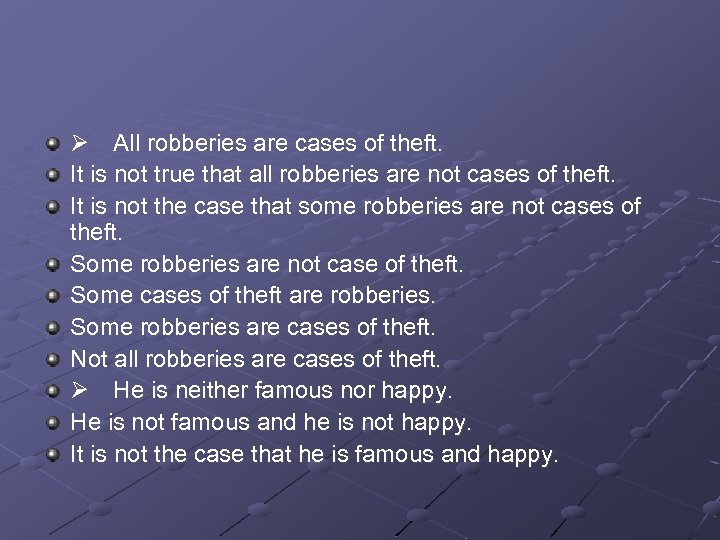 All robberies are cases of theft. It is not true that all robberies are not cases of theft. It is not the case that some robberies are not cases of theft. Some robberies are not case of theft. Some cases of theft are robberies. Some robberies are cases of theft. Not all robberies are cases of theft. He is neither famous nor happy. He is not famous and he is not happy. It is not the case that he is famous and happy.
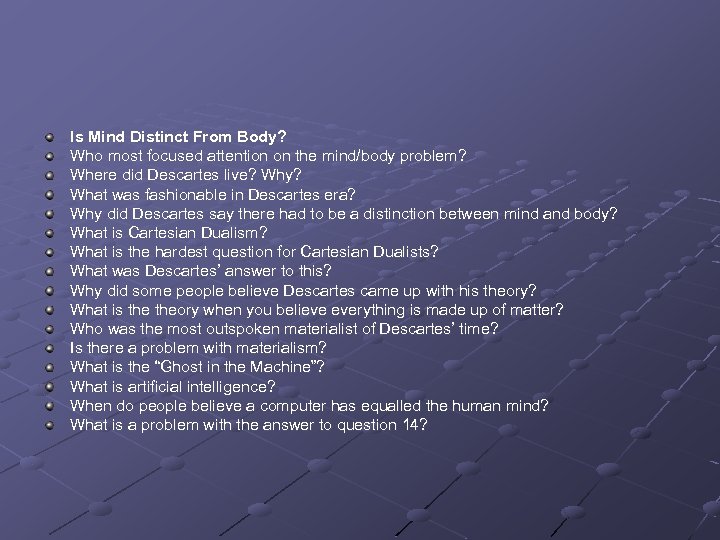 Is Mind Distinct From Body? Who most focused attention on the mind/body problem? Where did Descartes live? Why? What was fashionable in Descartes era? Why did Descartes say there had to be a distinction between mind and body? What is Cartesian Dualism? What is the hardest question for Cartesian Dualists? What was Descartes’ answer to this? Why did some people believe Descartes came up with his theory? What is theory when you believe everything is made up of matter? Who was the most outspoken materialist of Descartes’ time? Is there a problem with materialism? What is the “Ghost in the Machine”? What is artificial intelligence? When do people believe a computer has equalled the human mind? What is a problem with the answer to question 14?
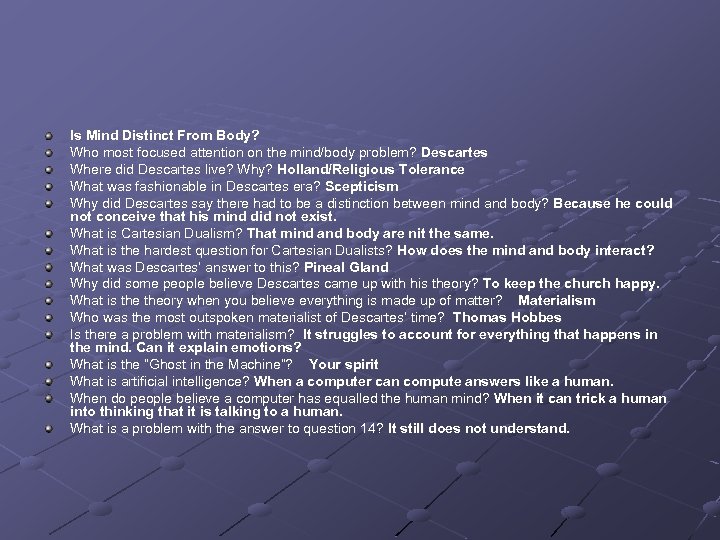 Is Mind Distinct From Body? Who most focused attention on the mind/body problem? Descartes Where did Descartes live? Why? Holland/Religious Tolerance What was fashionable in Descartes era? Scepticism Why did Descartes say there had to be a distinction between mind and body? Because he could not conceive that his mind did not exist. What is Cartesian Dualism? That mind and body are nit the same. What is the hardest question for Cartesian Dualists? How does the mind and body interact? What was Descartes’ answer to this? Pineal Gland Why did some people believe Descartes came up with his theory? To keep the church happy. What is theory when you believe everything is made up of matter? Materialism Who was the most outspoken materialist of Descartes’ time? Thomas Hobbes Is there a problem with materialism? It struggles to account for everything that happens in the mind. Can it explain emotions? What is the “Ghost in the Machine”? Your spirit What is artificial intelligence? When a computer can compute answers like a human. When do people believe a computer has equalled the human mind? When it can trick a human into thinking that it is talking to a human. What is a problem with the answer to question 14? It still does not understand.