 Скачать презентацию Unit 2 Part 3 I ve Been to the
1dcb02e5783d1493bd728dd90777f3de.ppt
- Количество слайдов: 105



Unit 2, Part 3 I’ve Been to the Mountaintop Click the mouse button or press the space bar to continue
Unit 2, Part 3 (pages 375– 388) Before You Reading the Selection After You Read Respond Through Writing
Unit 2, Part 3 For pages 375– 388 10. 6 Evaluate the role of syntax and diction and the effect of voice, tone, and imagery on a speech, literary essay, or other forms of literary nonfiction.
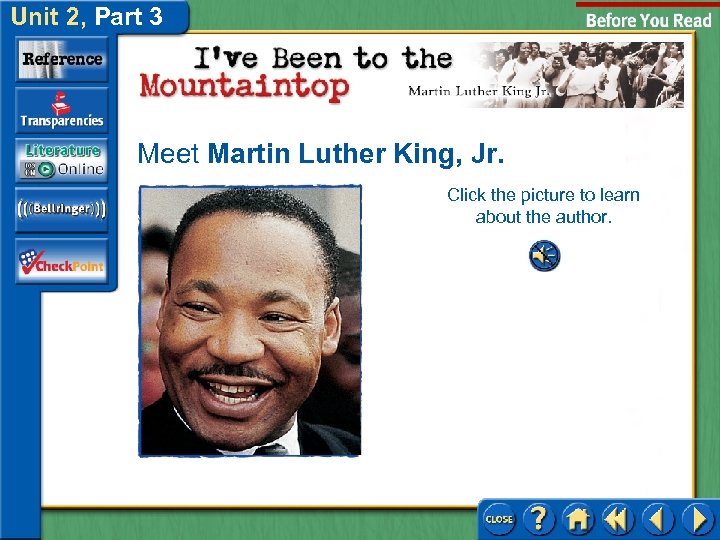
Unit 2, Part 3 Meet Martin Luther King, Jr. Click the picture to learn about the author.
Unit 2, Part 3 Literature and Reading Preview Connect to the Speech Would you be willing to stand up for the rights of other people even if you might be harmed in the process? Discuss this question with a partner.
Unit 2, Part 3 Literature and Reading Preview Build Background In April 1968, Martin Luther King Jr. traveled to Memphis, Tennessee, to support African American sanitation workers who were on strike against the city. Memphis Mayor Henry Loeb had refused to recognize and negotiate with the nearly all-African American union organization that had called the strike.
Unit 2, Part 3 Literature and Reading Preview Set Purposes for Reading Keep Freedom Alive In this speech, King argues that freedom and equality belong to everyone. As you read, ask yourself, What arguments does King give to support his ideas?
Unit 2, Part 3 Literature and Reading Preview Set Purposes for Reading Allusion An allusion is a reference to a character, a place, or a situation from history, music, art, or literature. In his speeches, King uses allusions to make his points clear. As you read, ask yourself, Where and why does King include well-known quotations and examples from history?
Unit 2, Part 3 Literature and Reading Preview Set Purposes for Reading Identify Problem and Solution One purpose of persuasive speeches is to identify a problem and suggest a solution or solutions for that problem. As you read this speech, ask yourself, Which problems does King discuss and which solutions does he propose?
Unit 2, Part 3 Literature and Reading Preview Set Purposes for Reading Identify Problem and Solution Tip: Ask Questions Ask yourself questions as you read, such as: What are the problems? What details about the problems does King provide? What solutions does King suggest? What support does he give for his solutions?
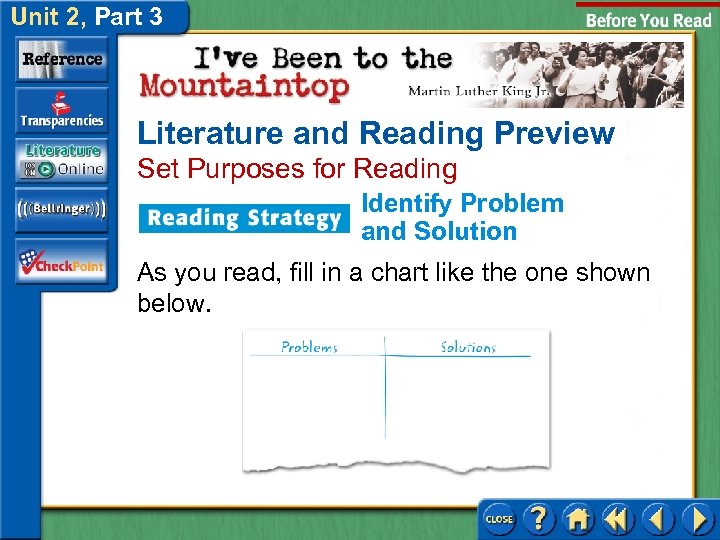
Unit 2, Part 3 Literature and Reading Preview Set Purposes for Reading Identify Problem and Solution As you read, fill in a chart like the one shown below.
Unit 2, Part 3 Literature and Reading Preview Set Purposes for Reading Identify Problem and Solution Click the image to view the animation.
Unit 2, Part 3 Literature and Reading Preview grapple v. to struggle, as though wrestling; to come to terms with. The city council is meeting tonight to discuss how best to grapple with town budget issues. relevant adj. related to the issue at hand. Though pollution is an important issue, it is not relevant to our discussion of the need for a new library. Click a vocabulary term to listen to the definition.
Unit 2, Part 3 Literature and Reading Preview agenda n. an outline of tasks to be accomplished. The agenda lists what we need to discuss during this meeting. compassionate adj. having or showing sympathy for another’s misfortune, combined with a desire to help. A variety of compassionate organizations work to help victims of disasters. Click a vocabulary term to listen to the definition.

Unit 2, Part 3
Unit 2, Part 3 Keeping Freedom Alive Keep the following questions in mind as you read. What is necessary to the achievement of freedom and equality, according to King? How does he say that people should work toward these goals?
Unit 2, Part 3 Answer: King believes that to achieve freedom and equality, people must remain determined, be willing to endure hardship, and stick together and help each other. He stresses that people should fight for these goals in nonviolent ways, such as by withdrawing economic support from racist institutions.
Unit 2, Part 3 Allusion The title of this work uses a Biblical allusion. In the Bible, Moses led the Israelites out of slavery to a land of their own, called the Promised Land. Moses, who never entered the Promised Land, viewed it from a mountaintop. Why may King have chosen this allusion? Answer: King, like Moses, intends to lead African Americans to a better place.
Unit 2, Part 3 Allusion How would you characterize the kinds of people and events that King is alluding to? Answer: King alludes to great and notable people from many eras.
Unit 2, Part 3 Keeping Freedom Alive What issues do you think the people in these places have in common? Answer: People in these places suffer injustice and oppression. Like King’s audience, the people who suffer the most in these places are people of color.
Unit 2, Part 3 Identifying Problem and Solution What problems has King identified? Answer: King alludes to the racial injustice plaguing the United States, the poverty, hurt, and neglect suffered by people of color around the world, and war.
Unit 2, Part 3 Political History The Emancipation Proclamation This proclamation was issued by Abraham Lincoln on January 1, 1863, during the Civil War. It freed all slaves in the areas of the Confederacy still rebelling against the Union.
Unit 2, Part 3 Allusion What point does the allusion to Pharaoh's court help bring home to King’s listeners? Answer: By reminding listeners that Pharaoh was able to keep the slaves subjected only until they unified, King is helping his listeners understand that they need to unify also.
Unit 2, Part 3 Schulke traveled with and documented Martin Luther King Jr. and other civil rights leaders during the 1960 s. What do you think King’s body language here reveals about his speaking style?
Unit 2, Part 3 Answer: The position of King’s hand his overall body language suggest that he is confident and powerful. The way he gazes out over the congregation suggests his vision of freedom.
Unit 2, Part 3 Identifying Problem and Solution What problem does King explain in this sentence? What does he encourage people to do to address this problem?
Unit 2, Part 3 Answer: King explains that minor incidents of violence, such as window-breaking, are distracting people from the real issue behind the strike: the suffering of hard-working people. King encourages people to march in order to support the strikers and to remind people of the real reasons for the strike.
Unit 2, Part 3 Allusion Why does King make these allusions in these two sentences? Answer: You may say that these allusions are friendly ways of connecting with the audience and, possibly, of reminding them of the commitments that come with religious faith.
Unit 2, Part 3 Keeping Freedom Alive What arguments does King make against the court injunction?
Unit 2, Part 3 Answer: King refers to the founding ideas of the United States and of the rights guaranteed in the Constitution, which would seem to permit the march despite the court’s injunction: freedom of assembly, freedom of speech, and freedom of the press.
Unit 2, Part 3 Allusion In one paragraph, King alludes to common ideas of heaven and the afterlife. What point does he make about these ideas?
Unit 2, Part 3 Answer: The ideas of the afterlife are well and fine but it is not enough for ministers and others to comfort the poor and suffering with these ideas. They must also care about what happens to the poor and suffering while they are alive; they must work to make the country more compassionate and fair.
Unit 2, Part 3 Literary History Amos, a prophet of the Israelites, denounced Israel’s sins, particularly those of injustice, corruption, and greed. The Bible verse that King quotes is Amos 5: 24: “I want to see a mighty flood of justice—a torrent of doing good. ”
Unit 2, Part 3 Rhetorical Language Throughout his speech King uses the term “brother” to connect with his audience, suggesting that all members of the human race are brothers. Identify other rhetorical strategies King uses to connect with his audience.
Unit 2, Part 3 Answer: King refers to the audience members as “my friends; ” uses the pronouns you, us, and we.
Unit 2, Part 3 Identifying Problem and Solution What good outcomes could be obtained by pooling economic resources, according to King? Answer: According to King, African Americans would be able to pressure businesses to adopt fairer practices toward their workers.
Unit 2, Part 3 This photograph of a civil rights demonstration focuses on two exuberant young women in a crowd of marchers. What is King’s attitude toward women in this speech? Answer: King believes that all people, regardless of race, religion, or gender, should have equal rights
Unit 2, Part 3 Identifying Problem and Solution What argument does King make for attending the march? Answer: King argues that if the strikers fail, African Americans throughout Memphis will be the losers.
Unit 2, Part 3 Allusion According to King, what kinds of excuses do people make for not stopping to help one another?
Unit 2, Part 3 Answer: Excuses include those used by people who emphasize their busy schedules—even their involvement in worthy activities—to get out of helping others. People may also use technicalities, such as religious laws, to get out of helping others.
Unit 2, Part 3 Keeping Freedom Alive What attitude or spirit does King encourage his listeners to adopt? Answer: King encourages attitudes of responsibility, generosity, caring, and solidarity.
Unit 2, Part 3 Writer’s Technique Irony is when an event happens that is the opposite of what is expected. King uses irony in describing the circumstances in which he was stabbed and almost died. What is ironic about the attack? Answer: It is ironic that it was committed by an African American woman.
Unit 2, Part 3 Style Why does King repeat the phrase “If I had sneezed”?
Unit 2, Part 3 Answer: The repetition reinforces how close King came to death and how glad he is that fate kept him from sneezing—and dying—so that he could participate in the civil rights movement
Unit 2, Part 3 Keeping Freedom Alive What does King hope to illustrate by mentioning these events? Answer: King was reminding his listeners of the many victories the Civil Rights Movement had achieved thus far.
Unit 2, Part 3 Martin Luther King Jr. was awarded the Nobel Peace Prize for 1964. The youngest male recipient of the Peace Prize at that time, King donated all of the prize money to the Civil Rights Movement.
Unit 2, Part 3 Identify Problem and Solution What problem does King identify? What is his solution? Answer: The problem is that King is receiving threats and is concerned for his safety. His solution is to trust in God’s will
Unit 2, Part 3 Allusion In this final passage, King alludes to the “promised land” and ends by quoting the patriotic American song “The Battle Hymn of the Republic. ” What is the meaning of the passage?
Unit 2, Part 3 Answer: You may say that King thinks that he has been blessed to be a part of the struggle. He does not feel the need to actually witness the final victory of justice and freedom in person; he feels privileged enough just knowing that it will happen.
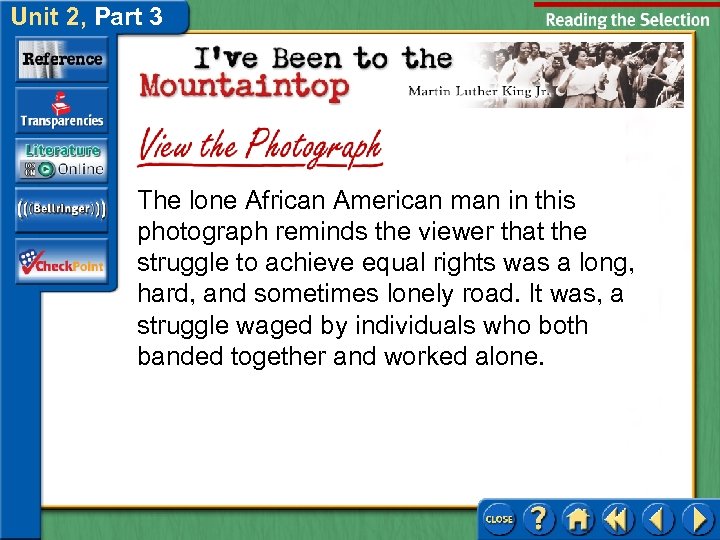
Unit 2, Part 3 The lone African American man in this photograph reminds the viewer that the struggle to achieve equal rights was a long, hard, and sometimes lonely road. It was, a struggle waged by individuals who both banded together and worked alone.

Unit 2, Part 3
Unit 2, Part 3 Respond and Think Critically Respond and Interpret 1. Which sentence or passage made the greatest impression on you? Why? Answer: Answers will vary.
Unit 2, Part 3 Respond and Think Critically Respond and Interpret 2. (a) Summarize King’s mental journey through history. In which age does he want to live? Answer: (a) You should summarize King’s journey through Egypt, Greece, the Roman Empire, the Renaissance, the Protestant Reformation, the Civil War, the Great Depression, and the present. He wants to live in the present.
Unit 2, Part 3 Respond and Think Critically Respond and Interpret 2. (b) What might you infer about King’s character and beliefs on the basis of the age he chooses? Answer: (b) King understands how people can change the present.
Unit 2, Part 3 Respond and Think Critically Respond and Interpret 3. (a) What plan of action does King outline for African American people in Memphis? (b) What is the purpose of King’s plan of action? Answer: (a) That they must stay united and focused on the issue, remain peaceful, and march for their brothers. (b) To get people to support the strikers and to march on their behalf.
Unit 2, Part 3 Respond and Think Critically Respond and Interpret 4. What feelings does King express about the dangers he faces? What reasons does he give for his feelings? Answer: (a) King is happy and not worried. He knows that things are going to turn out right. He has seen a positive future.
Unit 2, Part 3 Respond and Think Critically Analyze and Evaluate 5. What is your opinion of King’s nonviolent approach to political and social change? Answer: King’s nonviolent approach was successful. Its result was social and political change.
Unit 2, Part 3 Respond and Think Critically Analyze and Evaluate 6. How did the prophetic aspects of this speech affect your reaction to it? Explain. Answer: You may indicate that you were amazed at just how prophetic his words were.
Unit 2, Part 3 Respond and Think Critically Connect Keeping Freedom Alive 7. If King were alive today, what issues do you think he might be addressing? Why? Answer: You might mention unemployment, unequal opportunity, and lingering racism.
Unit 2, Part 3 Respond and Think Critically Connect 8. Connect to the Author How is Martin Luther King Jr. ’s experience as a preacher and minister evident in his speech “I’ve Been to the Mountaintop”? Answer: King’s mastery of oratory and ability to engage an audience with biblical allusions are skills that he must have honed in his years of listening to his father preach and preaching to his own congregation.
Unit 2, Part 3 Image of a Leader In the photograph, Reverend Martin Luther King leads a march from Selma to Montgomery, Alabama to protest the lack of suffrage for African Americans. The date is March, 1965.
Unit 2, Part 3 The photographer chooses not to show those who were opposed to racial desegregation. Instead, he focuses on the pride and promise of those leading the march for freedom by showing them with arms linked, flags emblazoned behind them.
Unit 2, Part 3 Group Activity Discuss the following questions in a small group. Refer back to the photograph and cite specific details to use as support.
Unit 2, Part 3 1. How might a person who was against desegregation have viewed the photograph? Answer: A person who was against desegregation may have seen this photograph as desegregationist propaganda and probably would have found the image threatening to his or her way of life.
Unit 2, Part 3 2. What choices did the photographer make in the framing and subject matter of the picture that show his bias?
Unit 2, Part 3 Answer: The photographer lionizes Martin Luther King Jr. and his fellow civil rights leaders by portraying them as an unbreakable wall of linked arms. The photographer also shows the group wearing defiant facial expressions and standing with flags—symbols of freedom— in the background.
Unit 2, Part 3 Allusion In this speech, King uses both historical and biblical allusions. For example, King says, “I would take my mental flight by Egypt through, or rather across the Red Sea, through the wilderness toward the promised land. ” He is alluding to the biblical story in which Moses leads the Israelites out of slavery in Egypt to the promised land of Canaan.
Unit 2, Part 3 Allusion 1. Why do you think King alludes to the Israelites’ flight from Egypt? Answer: The struggle of the Israelites, also slaves, is comparable to the African American journey toward equality.
Unit 2, Part 3 Allusion 2. Locate two more examples of historical allusions in the speech, and explain why they are included. Answer: Lincoln’s signing of the Emancipation Proclamation and Martin Luther and the Protestant Reformation; King compares the current struggle for equality to these momentous events.
Unit 2, Part 3 Review: Tone As you learned, tone is the writer’s attitude toward his or her subject. Tone is conveyed through elements such as word choice, sentence structure, and figurative language. In this speech, King’s tone conveys a variety of attitudes, such as seriousness, sadness, sarcasm, optimism, humor, and sympathy.
Unit 2, Part 3 Review: Tone Partner Activity With a classmate, analyze King’s shifting tone in this speech. Create a web diagram similar to the on the next slide. Fill in the ovals with appropriate examples.
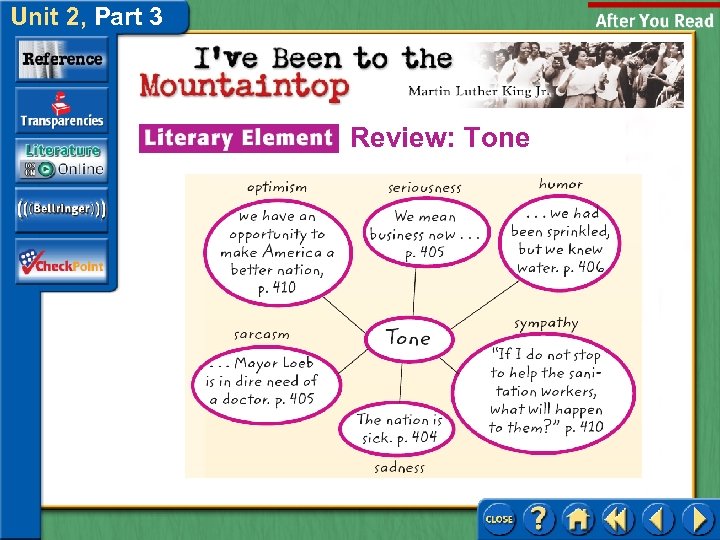
Unit 2, Part 3 Review: Tone
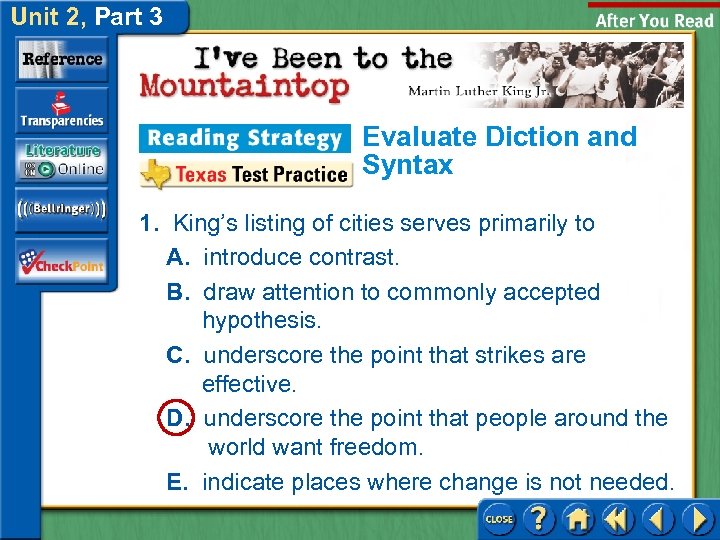
Unit 2, Part 3 Evaluate Diction and Syntax 1. King’s listing of cities serves primarily to A. introduce contrast. B. draw attention to commonly accepted hypothesis. C. underscore the point that strikes are effective. D. underscore the point that people around the world want freedom. E. indicate places where change is not needed.
Unit 2, Part 3 Evaluate Diction and Syntax Persuasive speeches often focus on a specific problem and suggest solutions to that problem.
Unit 2, Part 3 Practice with Synonyms A synonym is a word that has the same or a similar meaning as another word. Match each boldfaced vocabulary word with its synonym. Use a thesaurus or dictionary to check your answers.
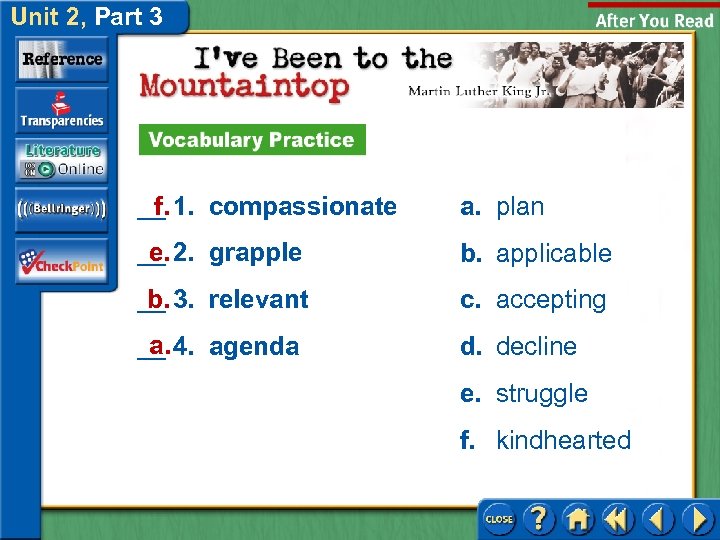
Unit 2, Part 3 __ 1. compassionate f. a. plan __ 2. grapple e. b. applicable b. __ 3. relevant c. accepting a. __ 4. agenda d. decline e. struggle f. kindhearted
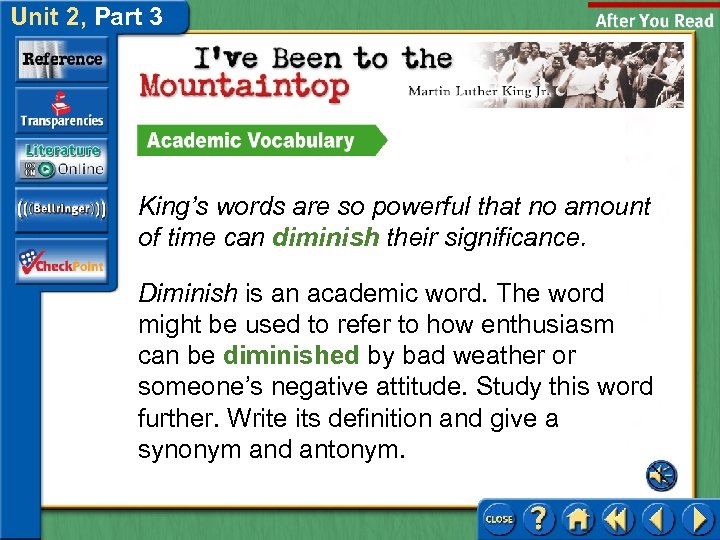
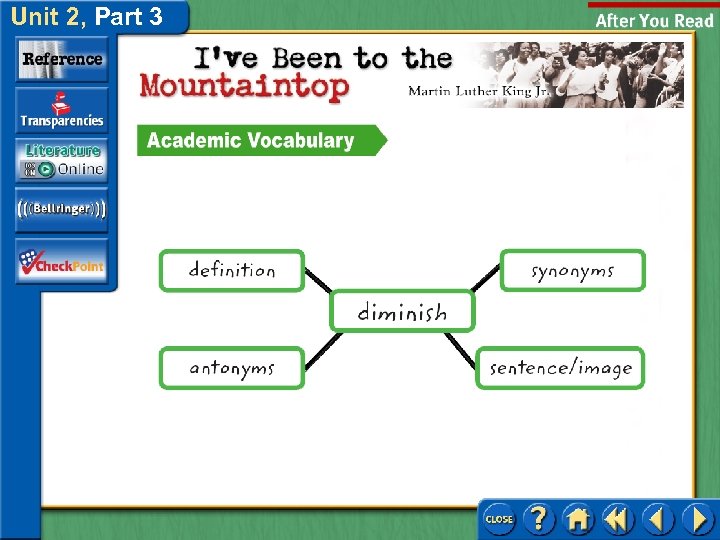
Unit 2, Part 3 King’s words are so powerful that no amount of time can diminish their significance. Diminish is an academic word. The word might be used to refer to how enthusiasm can be diminished by bad weather or someone’s negative attitude. Study this word further. Write its definition and give a synonym and antonym.
Unit 2, Part 3
Unit 2, Part 3 Answer: Answers will vary. Possible responses: Definition: to grow or cause to grow gradually less Synonyms: decrease, dwindle, ebb, wane Antonyms: increase, amplify, augment, swell, wax
Unit 2, Part 3 Sentence/image: sequence diagram showing something getting smaller in size or the moon as it wanes

Unit 2, Part 3
Unit 2, Part 3 Respond Through Writing Summary 10. 9. A Summarize text and distinguish between a summary and a critique and identify non-essential information in a summary and unsubstantiated opinions in a critique.
Unit 2, Part 3 Respond Through Writing Summary Report Main Ideas or Events When you write a summary of nonfiction, you restate the main ideas or events in a short version of the original. A summary does not include personal opinions. In about 100 words, summarize Martin Luther King Jr. ’s speech.
Unit 2, Part 3 Respond Through Writing Summary Purpose and Audience Your purpose is to write a summary in which you restate, or retell written or spoken text in your own words. Your audience for this summary is your teacher.
Unit 2, Part 3 Respond Through Writing Summary Plan Skim the text to find the main ideas or events. Look for answers to the following six questions: who? what? when? where? why? and how? You may find it helpful to make notes in a chart like the on the next slide, which was created for “On Women’s Right to Vote”.
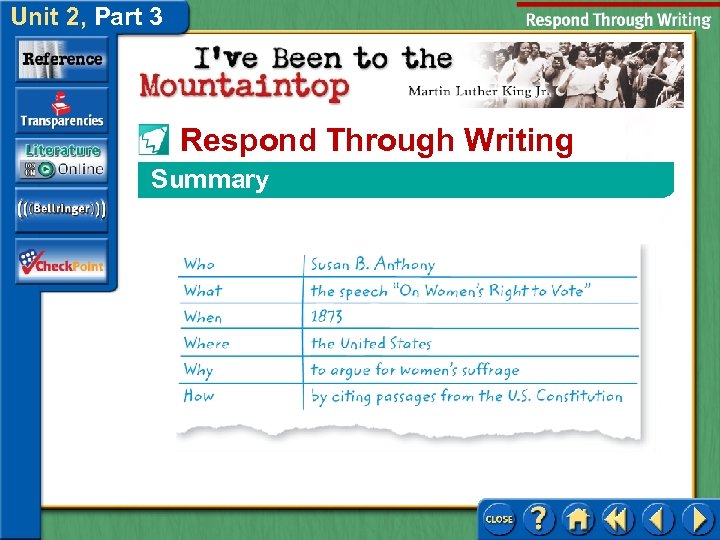
Unit 2, Part 3 Respond Through Writing Summary
Unit 2, Part 3 Respond Through Writing Summary Draft Draw on the answers to the six questions as you draft your summary. Follow a logical order.
Unit 2, Part 3 Respond Through Writing Summary Revise Have a partner read your summary and ask him or her to circle the answers to the six questions listed in the chart. If your partner cannot find the answers to all the questions, you may have to revise your summary.
Unit 2, Part 3 Respond Through Writing Summary Have your partner identify any nonessential information in your summary. Nonessential information is extra information that the reader does not need in order to understand what the nonfiction piece is about. Nonessential information should be cut.
Unit 2, Part 3 Respond Through Writing Summary Edit Proofread your paper, correcting any errors in grammar, spelling, and punctuation. Use the Grammar Tip on the following slides for help with restrictive and nonrestrictive clauses.
Unit 2, Part 3 Respond Through Writing Summary Restrictive and Nonrestrictive Relative Clauses When you are reading, writing and speaking, you may notice that an adjective clause is sometimes needed to make the meaning of a sentence clear. Such a clause is called a restrictive clause.
Unit 2, Part 3 Respond Through Writing Summary Restrictive and Nonrestrictive Relative Clauses Nonviolent protest was the form of pretest that King preferred.
Unit 2, Part 3 Respond Through Writing Summary Restrictive and Nonrestrictive Relative Clauses When an adjective clause is not absolutely needed in order to express the complete meaning of a sentence, it is called a nonrestrictive clause. A nonrestrictive clause must always be set off with commas.
Unit 2, Part 3 Respond Through Writing Summary Restrictive and Nonrestrictive Relative Clauses King, who won a Nobel Peace Prize, supported a movement to help striking janitors.

Unit 2, Part 3
Unit 2, Part 3 “I have a dream my four little children will one day live in a nation where they will not be judged by the color of their skin but by the content of their character. I have a dream today!” —Martin Luther King Jr. What makes King’s words inspiring? Are there any issues today that you feel this strongly about?
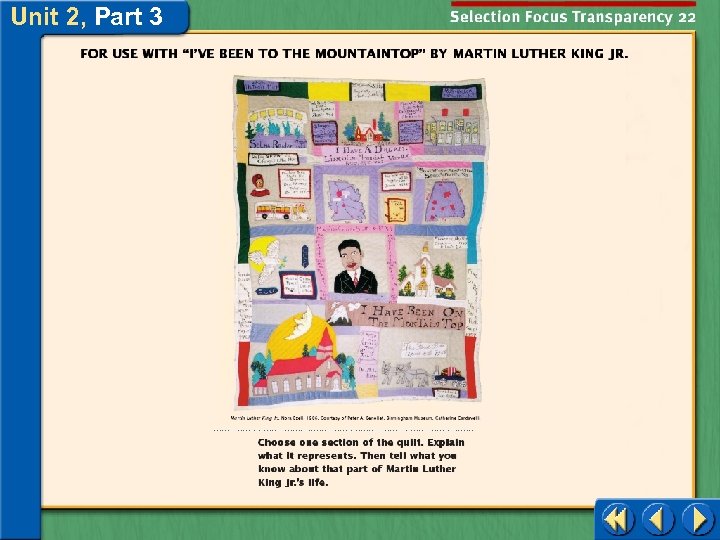
Unit 2, Part 3
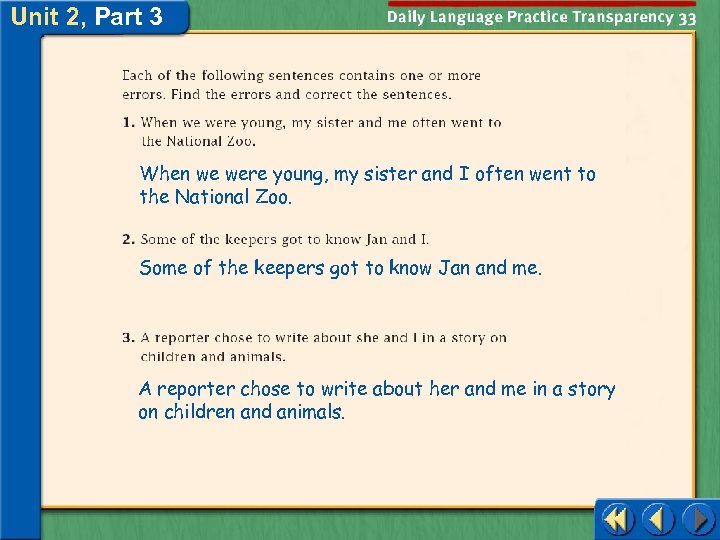
Unit 2, Part 3 When we were young, my sister and I often went to the National Zoo. Some of the keepers got to know Jan and me. A reporter chose to write about her and me in a story on children and animals.
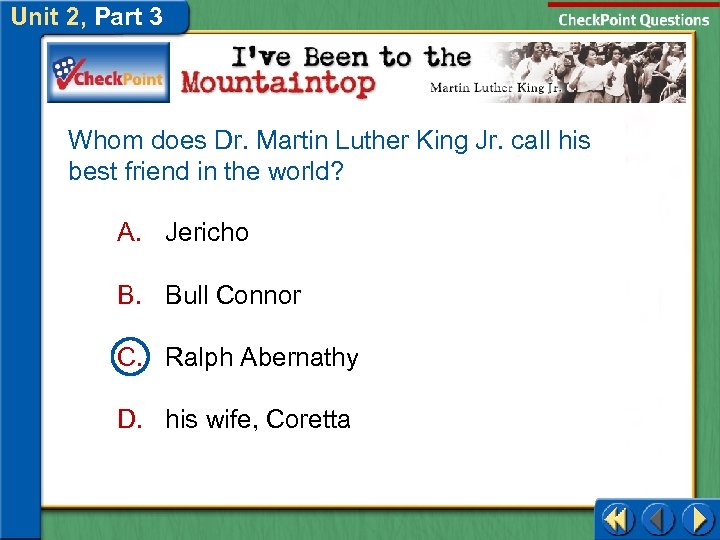
Unit 2, Part 3 Whom does Dr. Martin Luther King Jr. call his best friend in the world? A. Jericho B. Bull Connor C. Ralph Abernathy D. his wife, Coretta
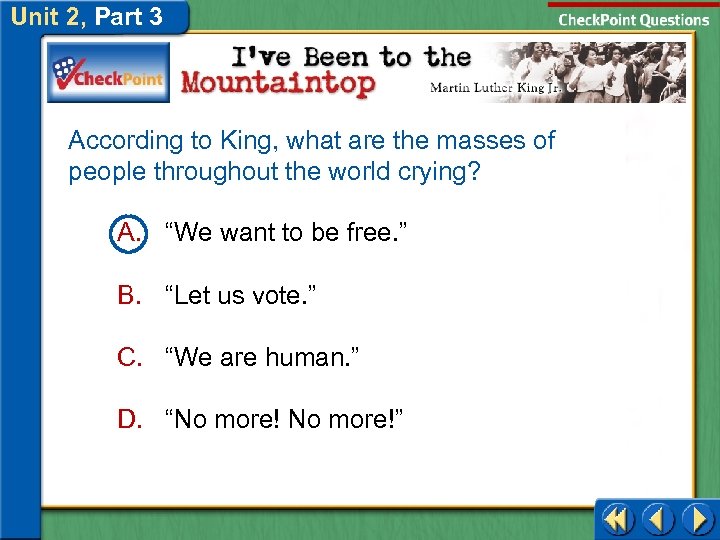
Unit 2, Part 3 According to King, what are the masses of people throughout the world crying? A. “We want to be free. ” B. “Let us vote. ” C. “We are human. ” D. “No more!”
Unit 2, Part 3 What was the start of ending slavery for the slaves in ancient Egypt? A. when the slaves first became educated B. when the slaves fought among themselves C. when the slaves refused to work D. when the slaves gathered together
Unit 2, Part 3 What does King say should be the first item on the agenda of massive industries in the United States? A. environmental concerns B. fair treatment C. higher wagers D. more jobs
Unit 2, Part 3 What is the significance of King not sneezing? A. B. During a knife attack, the tip of the blade would have punctured King’s aorta had he sneezed. King had a life-threatening case of pneumonia. C. He was alluding to a passage in the Bible about a sick man. D. Sneezing was considered a sign of weakness.

Unit 2, Part 3 Help To navigate within this Classroom Presentation Toolkit product: Click the Forward button to go to the next slide. Click the Previous button to return to the previous slide. Click the Section Back button to return to the beginning of the section you are in. If you are viewing a feature, this button returns you to the main presentation. Click the Home button to return to the Chapter Menu. Click the Help button to access this screen. Click the Speaker Off button to stop any playing audio. Click the Close button to end the chapter presentation. Click the Exit button to end the Classroom Presentation Toolkit features such as the Reference Handbook, Literature Online, and others are located in the left margin of most screens. Click on any of these buttons to access a specific feature.
 Скачать презентацию Unit 2 Part 3 I ve Been to the
1dcb02e5783d1493bd728dd90777f3de.ppt