


 Скачать презентацию Unit 2 Manufacturing Operations Sections 1 Manufacturing Industries
0670180e942c9490a507f2ced56463c1.ppt
- Количество слайдов: 27
 Unit 2 Manufacturing Operations Sections: 1. Manufacturing Industries and Products 2. Manufacturing Operations 3. Production Facilities 4. Product/Production Relationships 5. Lean Production 6. Manufacturing Metrics § § § Manufacturing Lead Time Rate of Production Capacity Work in Progress Design Times Utilisation/Availability
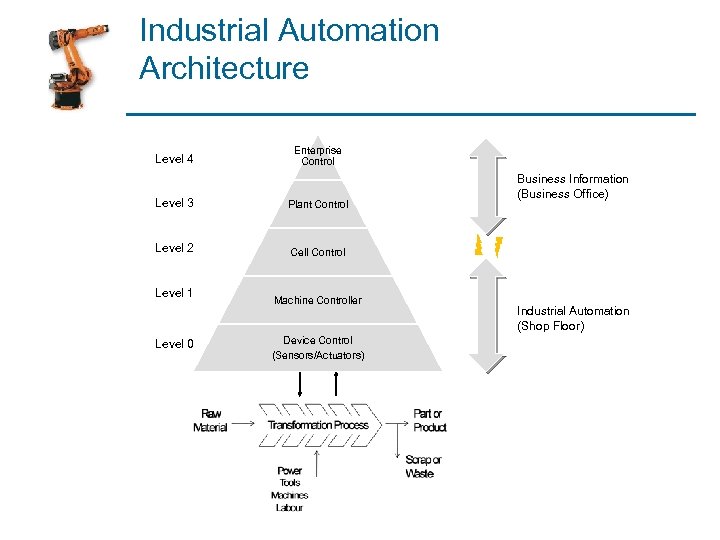 Industrial Automation Architecture Level 4 Enterprise Control Level 3 Plant Control Level 2 Business Information (Business Office) Cell Control Level 1 Level 0 Machine Controller Device Control (Sensors/Actuators) Industrial Automation (Shop Floor)
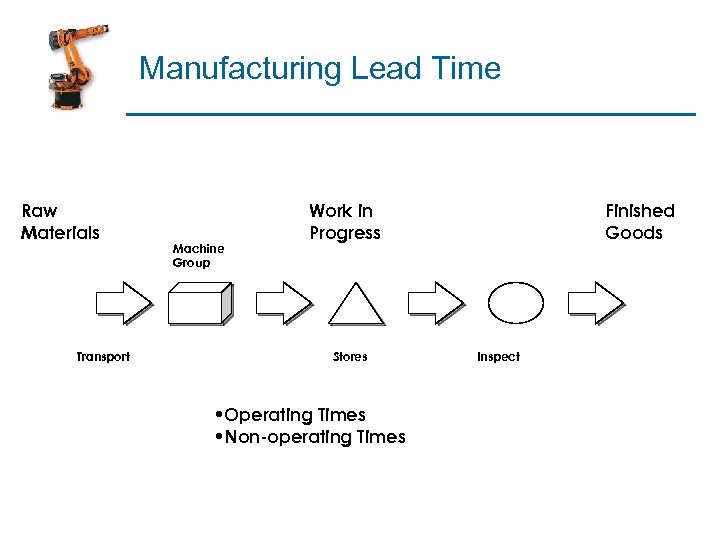 Manufacturing Lead Time Raw Materials Transport Machine Group Work in Progress Stores • Operating Times • Non-operating Times Finished Goods Inspect
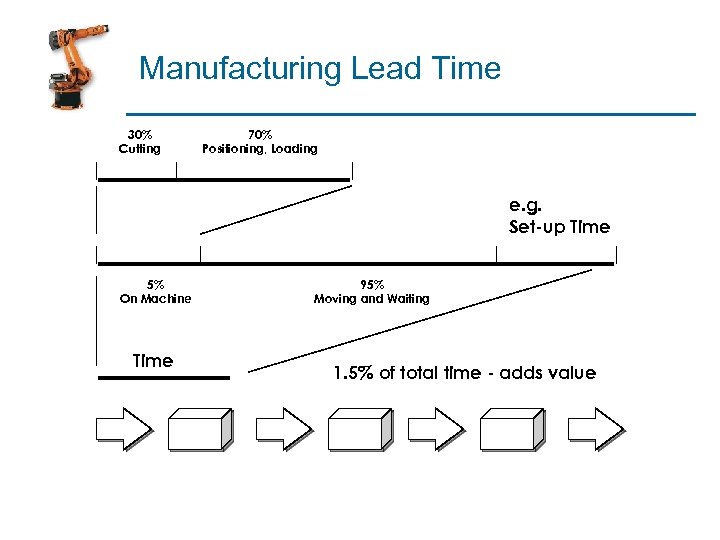 Manufacturing Lead Time 30% Cutting 70% Positioning, Loading e. g. Set-up Time 5% On Machine Time 95% Moving and Waiting 1. 5% of total time - adds value
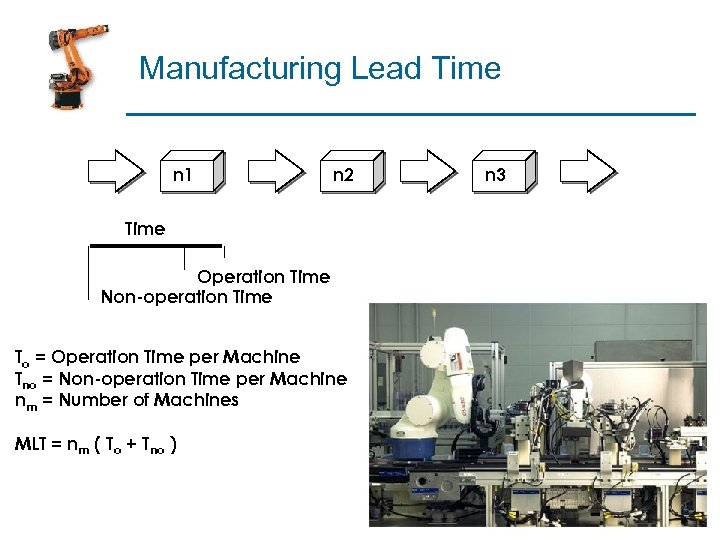 Manufacturing Lead Time n 1 n 2 Time Operation Time Non-operation Time To = Operation Time per Machine Tno = Non-operation Time per Machine nm = Number of Machines MLT = nm ( To + Tno ) n 3
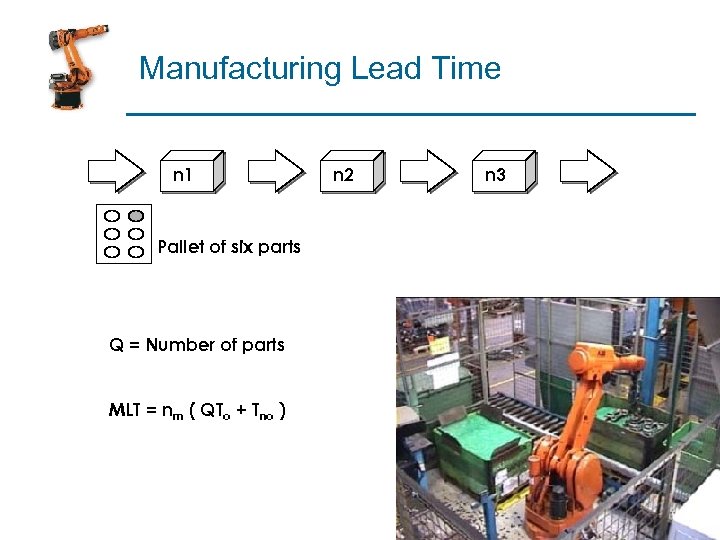 Manufacturing Lead Time n 1 Pallet of six parts Q = Number of parts MLT = nm ( QTo + Tno ) n 2 n 3
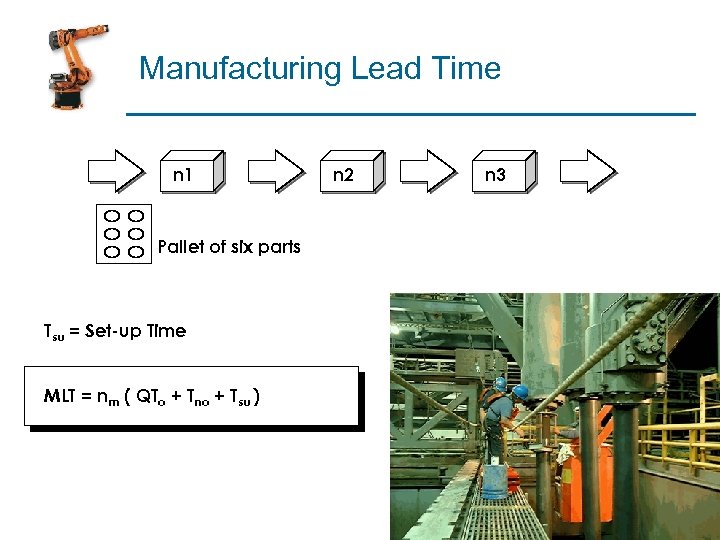 Manufacturing Lead Time n 1 Pallet of six parts Tsu = Set-up Time MLT = nm ( QTo + Tno + Tsu ) n 2 n 3
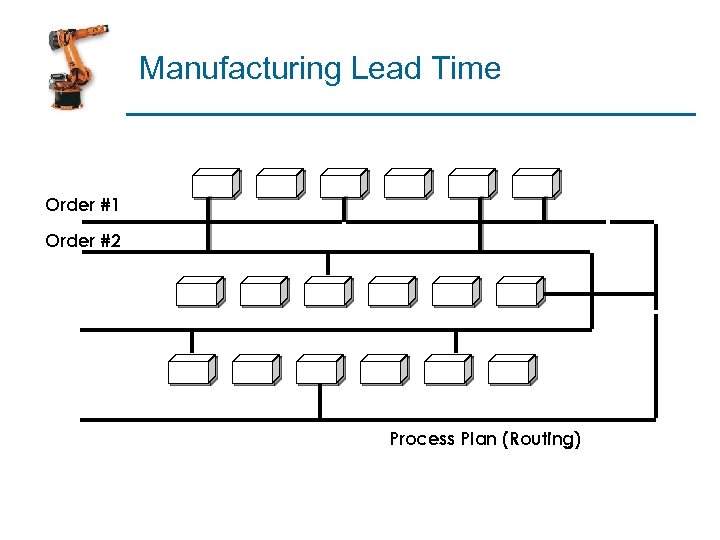 Manufacturing Lead Time Order #1 Order #2 Process Plan (Routing)
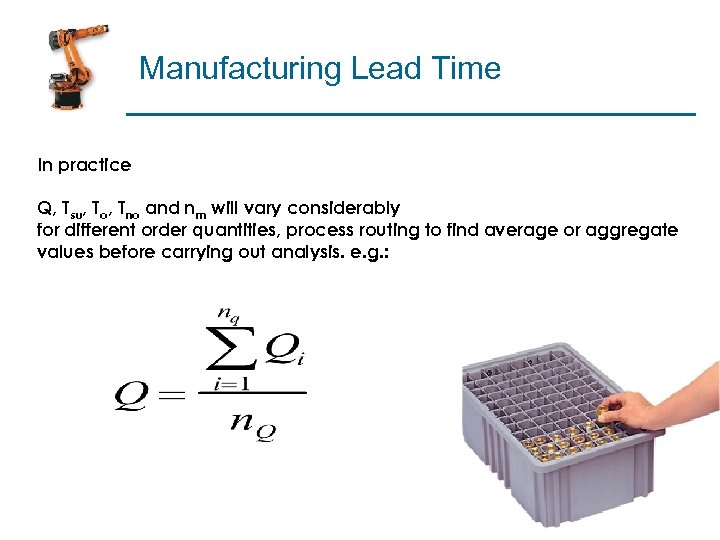 Manufacturing Lead Time In practice Q, Tsu, To, Tno and nm will vary considerably for different order quantities, process routing to find average or aggregate values before carrying out analysis. e. g. :
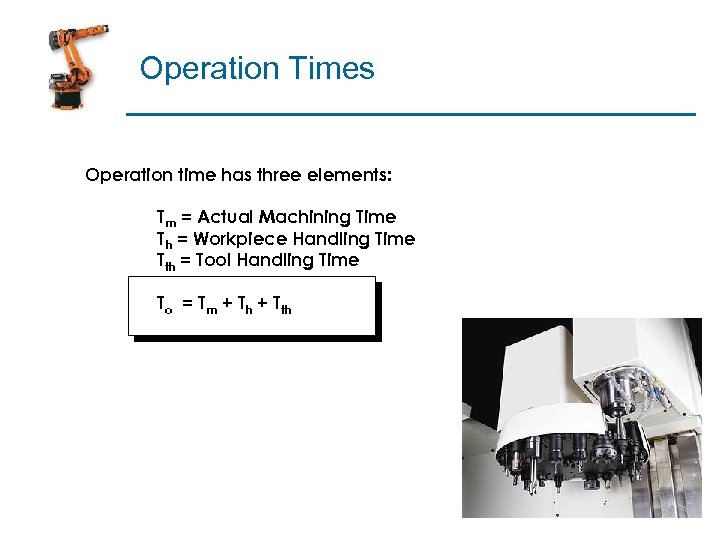 Operation Times Operation time has three elements: Tm = Actual Machining Time Th = Workpiece Handling Time Tth = Tool Handling Time To = Tm + Th + Tth
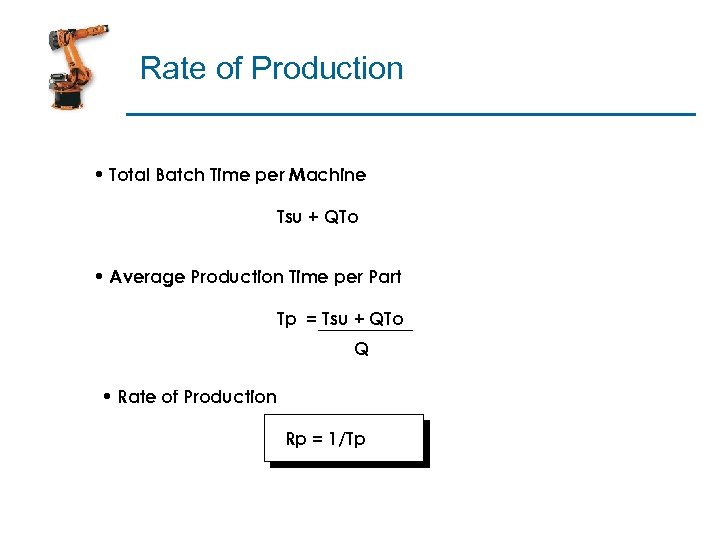 Rate of Production • Total Batch Time per Machine Tsu + QTo • Average Production Time per Part Tp = Tsu + QTo Q • Rate of Production Rp = 1/Tp
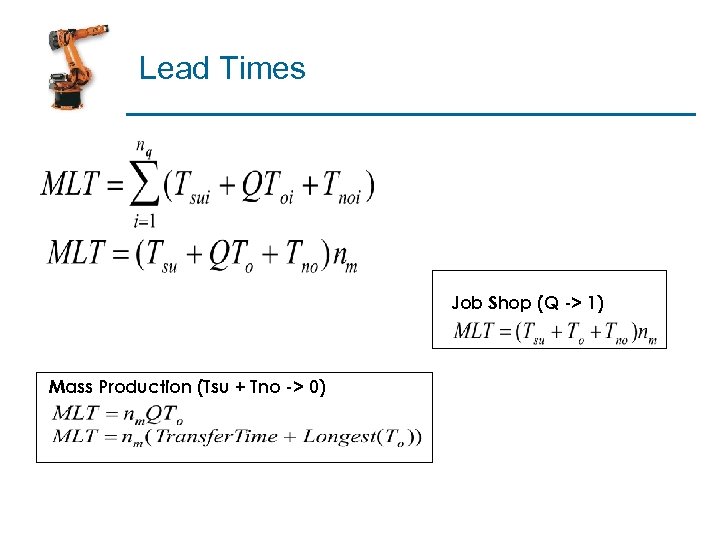 Lead Times Job Shop (Q -> 1) Mass Production (Tsu + Tno -> 0)
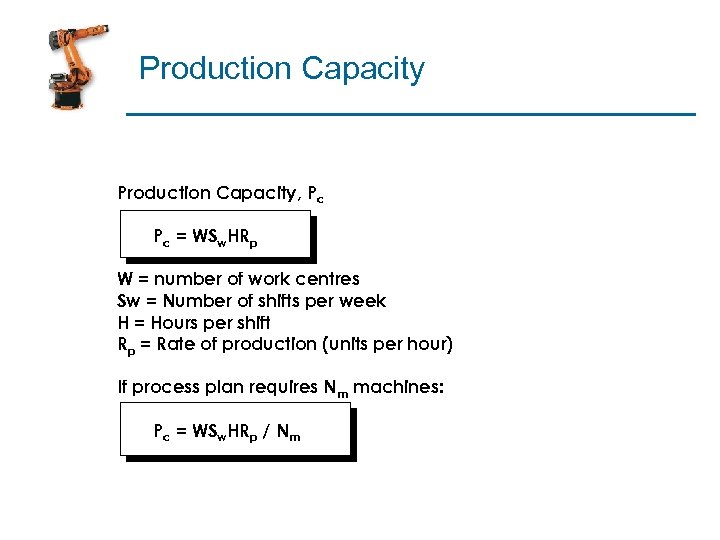 Production Capacity, Pc Pc = WSw. HRp W = number of work centres Sw = Number of shifts per week H = Hours per shift Rp = Rate of production (units per hour) If process plan requires Nm machines: Pc = WSw. HRp / Nm
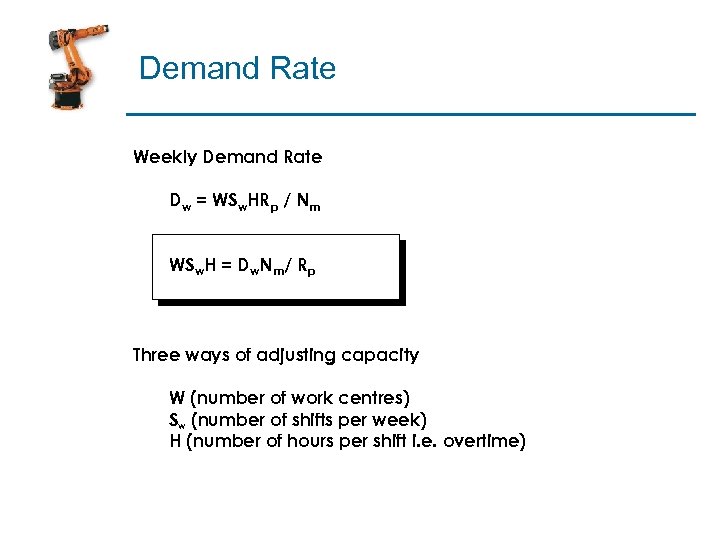 Demand Rate Weekly Demand Rate Dw = WSw. HRp / Nm WSw. H = Dw. Nm/ Rp Three ways of adjusting capacity W (number of work centres) Sw (number of shifts per week) H (number of hours per shift i. e. overtime)
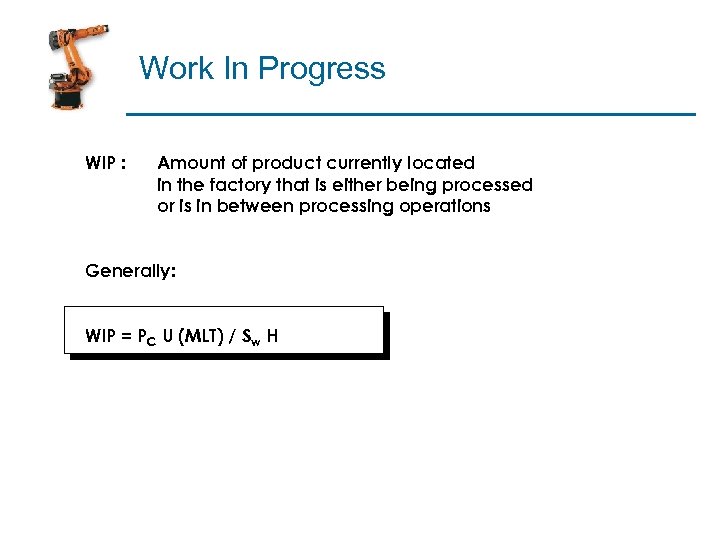 Work In Progress WIP : Amount of product currently located in the factory that is either being processed or is in between processing operations Generally: WIP = PC U (MLT) / Sw H
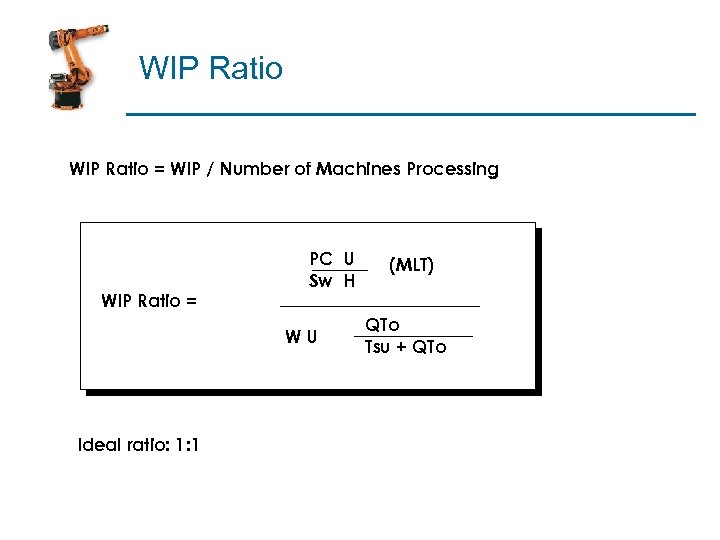 WIP Ratio = WIP / Number of Machines Processing WIP Ratio = PC U Sw H WU Ideal ratio: 1: 1 (MLT) QTo Tsu + QTo
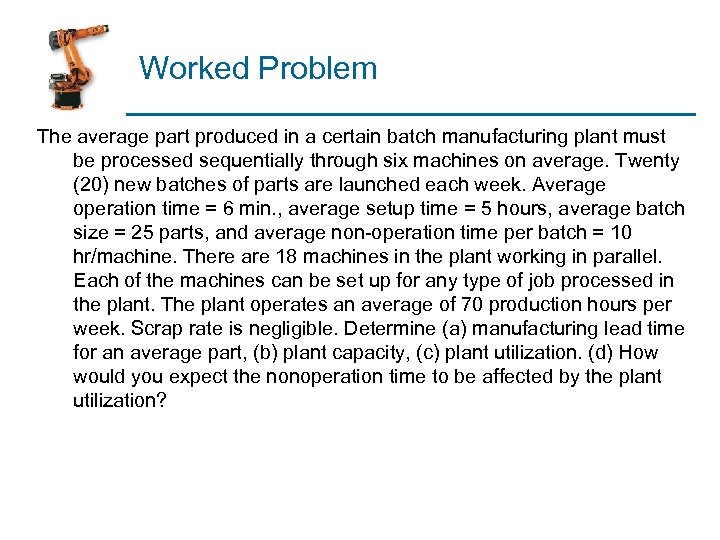 Worked Problem The average part produced in a certain batch manufacturing plant must be processed sequentially through six machines on average. Twenty (20) new batches of parts are launched each week. Average operation time = 6 min. , average setup time = 5 hours, average batch size = 25 parts, and average non-operation time per batch = 10 hr/machine. There are 18 machines in the plant working in parallel. Each of the machines can be set up for any type of job processed in the plant. The plant operates an average of 70 production hours per week. Scrap rate is negligible. Determine (a) manufacturing lead time for an average part, (b) plant capacity, (c) plant utilization. (d) How would you expect the nonoperation time to be affected by the plant utilization?
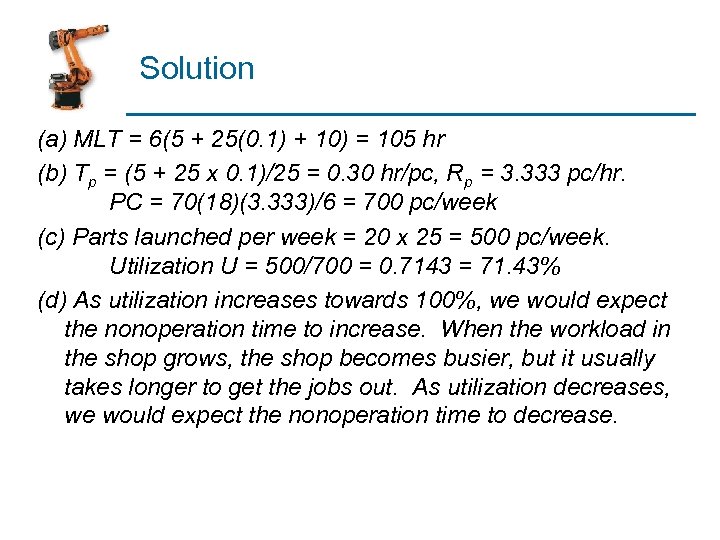 Solution (a) MLT = 6(5 + 25(0. 1) + 10) = 105 hr (b) Tp = (5 + 25 x 0. 1)/25 = 0. 30 hr/pc, Rp = 3. 333 pc/hr. PC = 70(18)(3. 333)/6 = 700 pc/week (c) Parts launched per week = 20 x 25 = 500 pc/week. Utilization U = 500/700 = 0. 7143 = 71. 43% (d) As utilization increases towards 100%, we would expect the nonoperation time to increase. When the workload in the shop grows, the shop becomes busier, but it usually takes longer to get the jobs out. As utilization decreases, we would expect the nonoperation time to decrease.
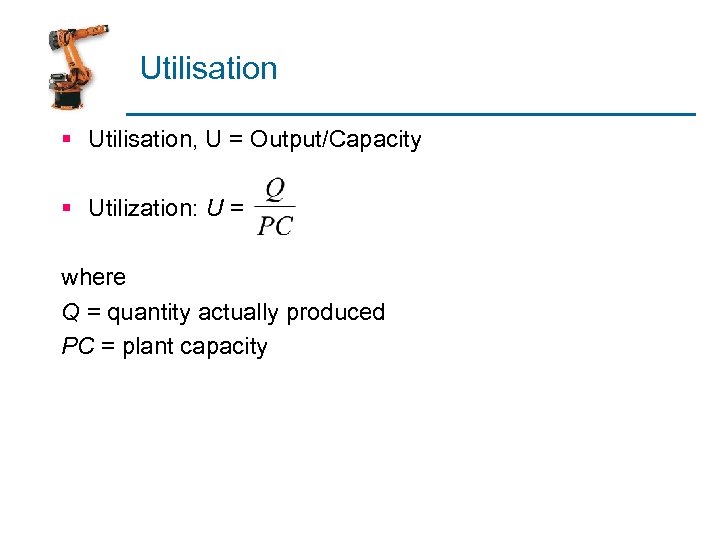 Utilisation § Utilisation, U = Output/Capacity § Utilization: U = where Q = quantity actually produced PC = plant capacity
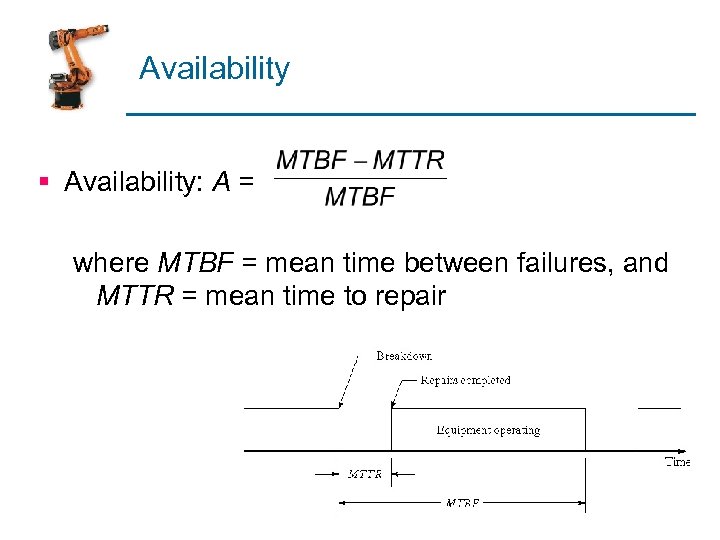 Availability § Availability: A = where MTBF = mean time between failures, and MTTR = mean time to repair
 Costs of Manufacturing Operations Fixed costs - remain constant for any output level Variable costs - vary in proportion to production output level Adding fixed and variable costs TC = FC + VC(Q) where TC = total costs FC = fixed costs (e. g. , building, equipment, taxes) VC = variable costs (e. g. , labor, materials, utilities) Q = output level
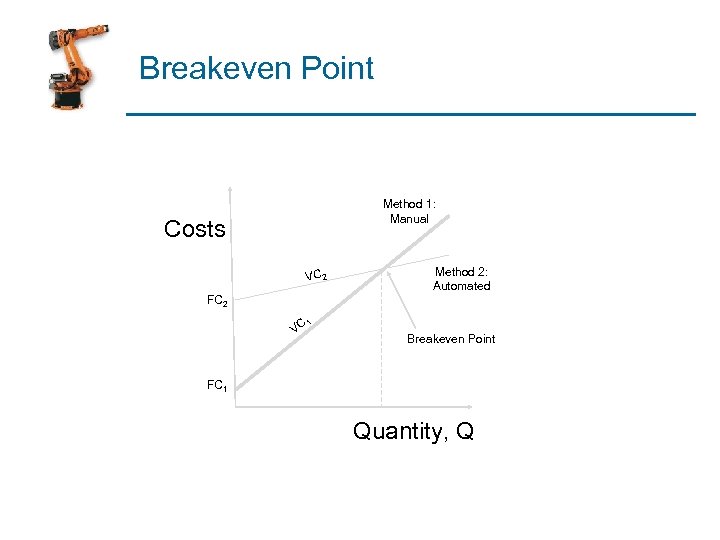 Breakeven Point Method 1: Manual Costs VC 2 Method 2: Automated FC 2 VC 1 Breakeven Point FC 1 Quantity, Q
 Manufacturing Costs § Alternative classification of manufacturing costs: 1. Direct labor - wages and benefits paid to workers 2. Materials - costs of raw materials 3. Overhead - all of the other expenses associated with running the manufacturing firm § Factory overhead § Corporate overhead
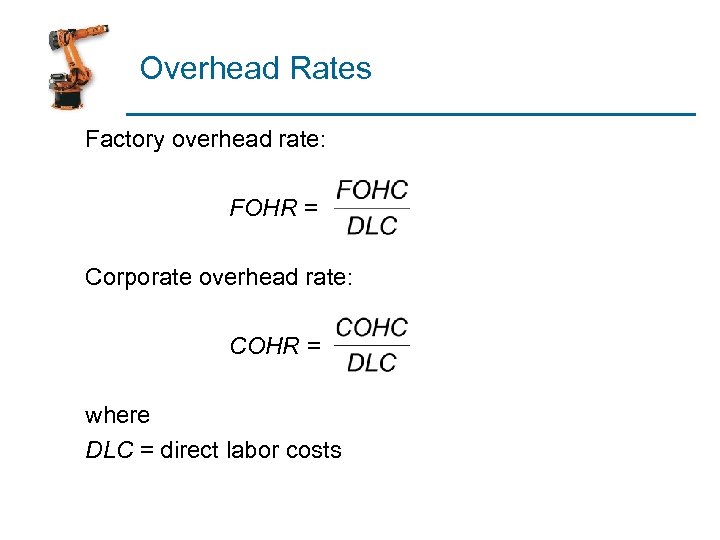 Overhead Rates Factory overhead rate: FOHR = Corporate overhead rate: COHR = where DLC = direct labor costs
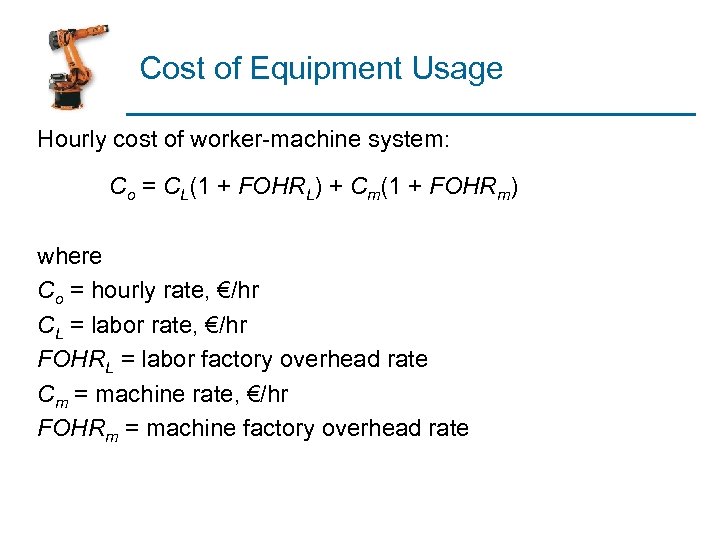 Cost of Equipment Usage Hourly cost of worker-machine system: Co = CL(1 + FOHRL) + Cm(1 + FOHRm) where Co = hourly rate, €/hr CL = labor rate, €/hr FOHRL = labor factory overhead rate Cm = machine rate, €/hr FOHRm = machine factory overhead rate
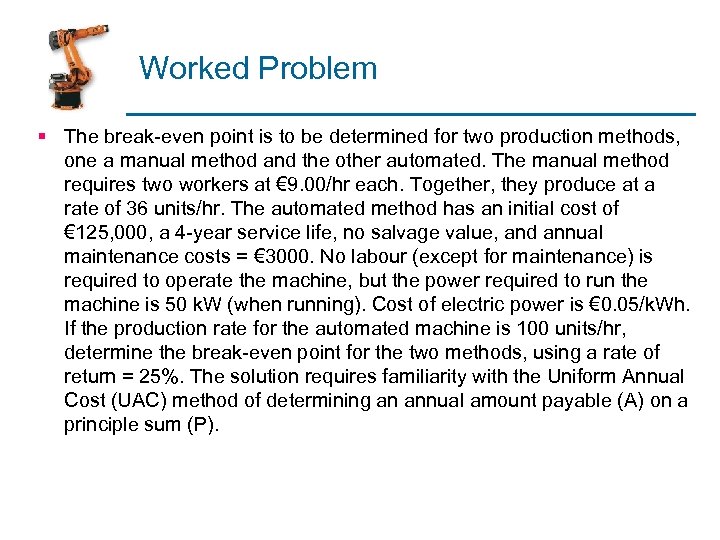 Worked Problem § The break-even point is to be determined for two production methods, one a manual method and the other automated. The manual method requires two workers at € 9. 00/hr each. Together, they produce at a rate of 36 units/hr. The automated method has an initial cost of € 125, 000, a 4 -year service life, no salvage value, and annual maintenance costs = € 3000. No labour (except for maintenance) is required to operate the machine, but the power required to run the machine is 50 k. W (when running). Cost of electric power is € 0. 05/k. Wh. If the production rate for the automated machine is 100 units/hr, determine the break-even point for the two methods, using a rate of return = 25%. The solution requires familiarity with the Uniform Annual Cost (UAC) method of determining an annual amount payable (A) on a principle sum (P).
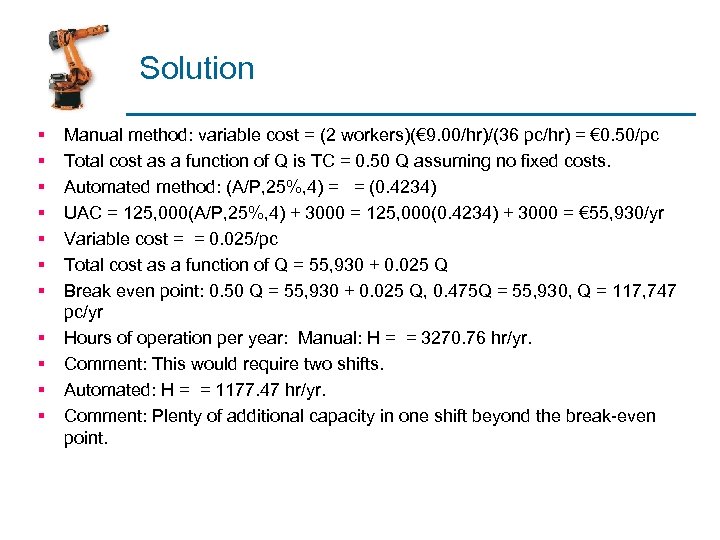 Solution § § § Manual method: variable cost = (2 workers)(€ 9. 00/hr)/(36 pc/hr) = € 0. 50/pc Total cost as a function of Q is TC = 0. 50 Q assuming no fixed costs. Automated method: (A/P, 25%, 4) = = (0. 4234) UAC = 125, 000(A/P, 25%, 4) + 3000 = 125, 000(0. 4234) + 3000 = € 55, 930/yr Variable cost = = 0. 025/pc Total cost as a function of Q = 55, 930 + 0. 025 Q Break even point: 0. 50 Q = 55, 930 + 0. 025 Q, 0. 475 Q = 55, 930, Q = 117, 747 pc/yr Hours of operation per year: Manual: H = = 3270. 76 hr/yr. Comment: This would require two shifts. Automated: H = = 1177. 47 hr/yr. Comment: Plenty of additional capacity in one shift beyond the break-even point.