 Скачать презентацию Unit 2 Imperialism and Revolution The Establishment of
91b14fb2fb45940e9ce095953bfefb1f.ppt
- Количество слайдов: 49



Unit 2: Imperialism and Revolution The Establishment of the American Republic 1763 -1782
• Indian problems and class struggle – Settlers against traders – Frontier people against eastern people – Elites against “have nots”
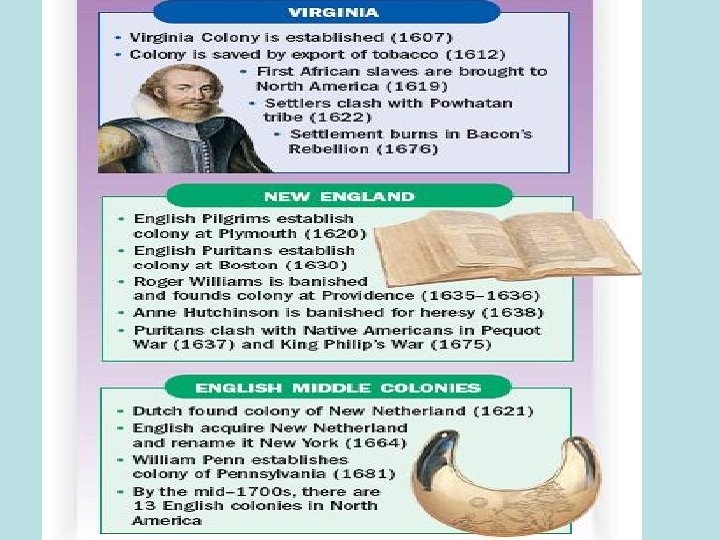
1675 -76 King Philip’s War • Virginia had conflicts with the Indians, so did Massachusetts • From 1675 -1676 there was a bloody conflict named for the Indian leader Metacom, nicknamed “King Philip” by the British settlers • Many colonists died, but the damage to the American Indians was much heavier and more of their land was lost in New England
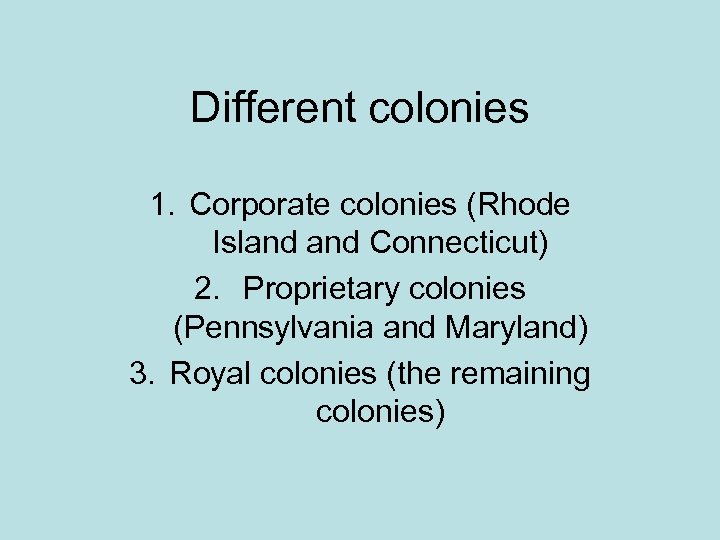
Different colonies 1. Corporate colonies (Rhode Island Connecticut) 2. Proprietary colonies (Pennsylvania and Maryland) 3. Royal colonies (the remaining colonies)
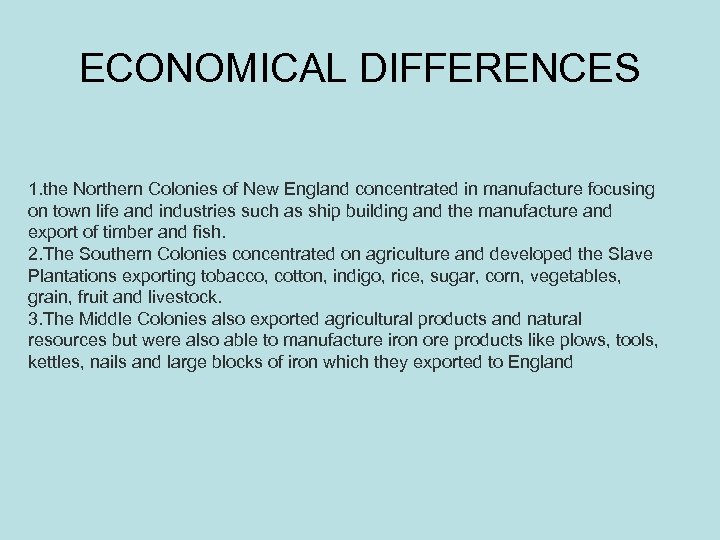
ECONOMICAL DIFFERENCES 1. the Northern Colonies of New England concentrated in manufacture focusing on town life and industries such as ship building and the manufacture and export of timber and fish. 2. The Southern Colonies concentrated on agriculture and developed the Slave Plantations exporting tobacco, cotton, indigo, rice, sugar, corn, vegetables, . grain, fruit and livestock. 3. The Middle Colonies also exported agricultural products and natural resources but were also able to manufacture iron ore products like plows, tools, kettles, nails and large blocks of iron which they exported to England
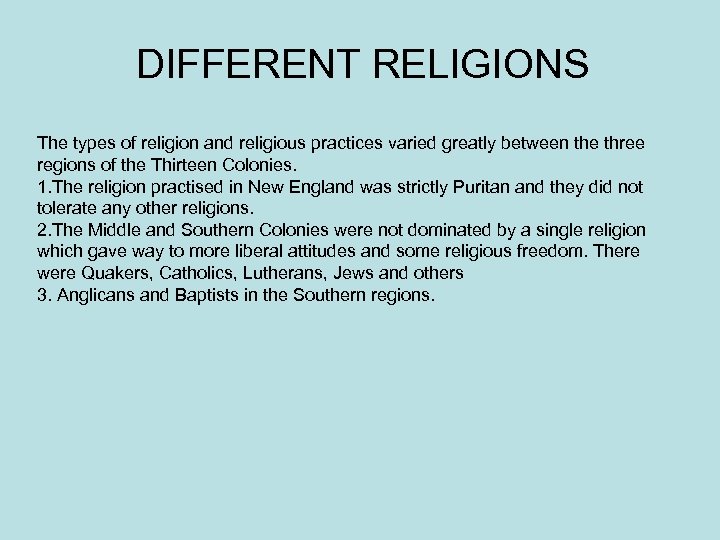
DIFFERENT RELIGIONS The types of religion and religious practices varied greatly between the three regions of the Thirteen Colonies. 1. The religion practised in New England was strictly Puritan and they did not tolerate any other religions. 2. The Middle and Southern Colonies were not dominated by a single religion which gave way to more liberal attitudes and some religious freedom. There were Quakers, Catholics, Lutherans, Jews and others 3. Anglicans and Baptists in the Southern regions.
I. British Colonial Policy Before 1763 • A. All colonial governments have same format – A Governor (appointed by the king) with power much like the monarch – A legislature (bicameral or two house) • The Governor’s Council (appointed, acted mainly to advise) • The Lower House (elected by the colonial voters, they held the power of the purse)
B. Controlling the Colonies up to 1763 • The Board of Trade 1696 -1763 – Liaison between the Crown and the colonies (Appointing officials, reviewing laws, controlled lobbyist) • By 1725, “salutary neglect” sets in with Walpole as P. M. (The Board had rules, but they were not applied/enforced)
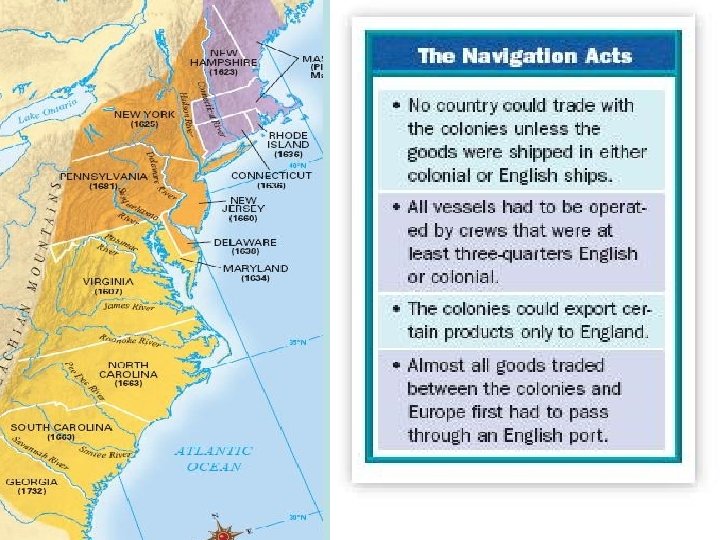
Effects of the Mercantile System • Reflected reality; Colonies provide markets and materials, Britain profited. • Britain viewed the Empire in “broad terms” – What was best for the “mother country” was best for the Empire. • It didn’t work. – Too large, too corrupt – Incompetent officials couldn’t make it work – Colonists learned how to beat the system.
The French & Indian War 1754 -1763 • French & British imperial competition for land in North America led to war in 1754. • American Indians tended to support the French, who they did business with and who they thought were not a permanent threat. • Treaty of Paris, 1763, ended the war with a British victory and the French were pushed off the eastern part of the continent.
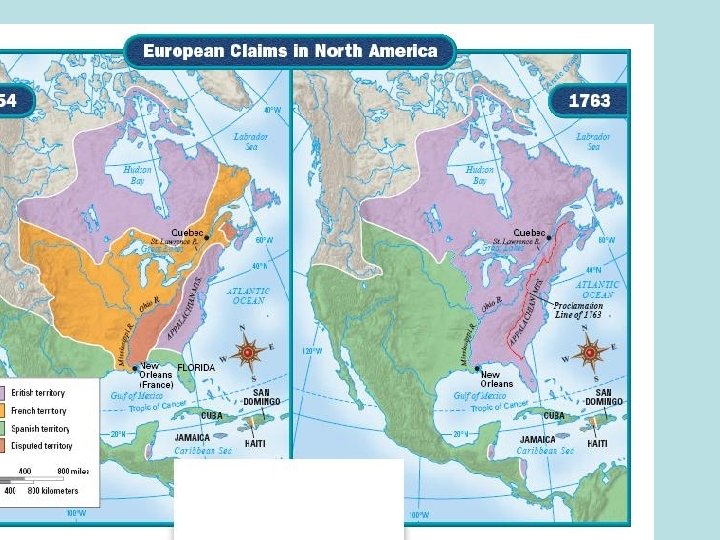
III. From Victory to Revolution 1763 -1776 • Victory provided new lands and large debt – British dilemma: • How pay off war debt • How to govern the new lands/settle conflicting claims • How to avoid future disputes with Indians • British move to tighten control over the colonies – British attempt to control colonial smuggling using writs of assistance (search warrants) – Proclamation of 1763 limits western movement
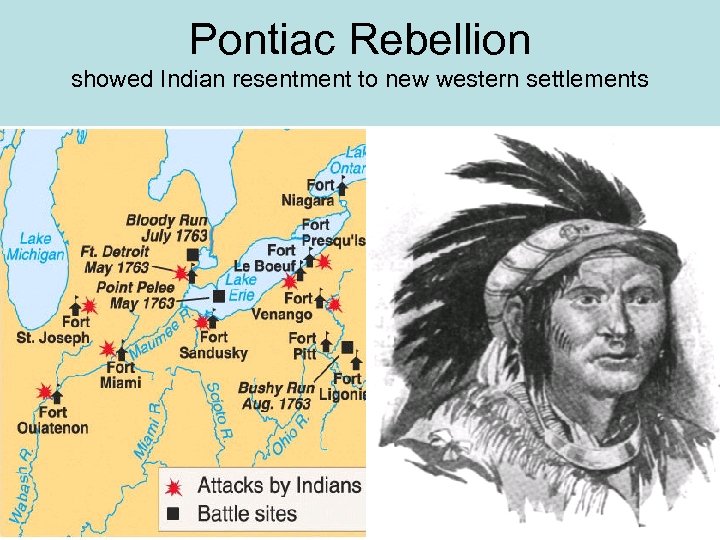
Pontiac Rebellion showed Indian resentment to new western settlements
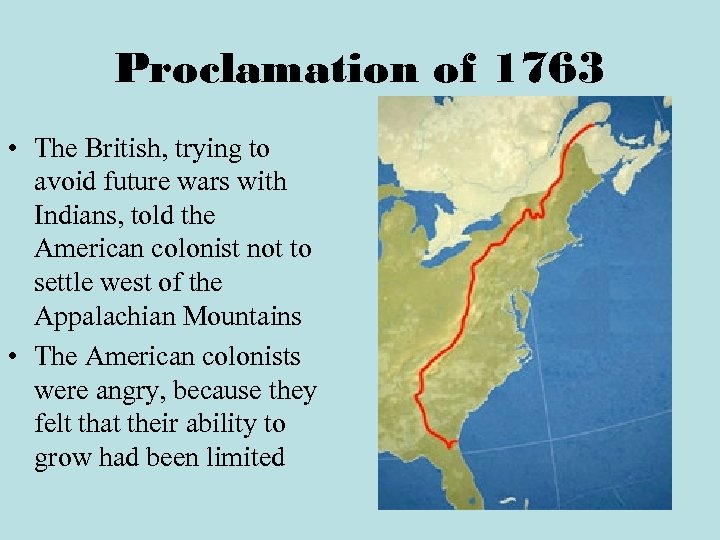
Proclamation of 1763 • The British, trying to avoid future wars with Indians, told the American colonist not to settle west of the Appalachian Mountains • The American colonists were angry, because they felt that their ability to grow had been limited
Grenville will attempt solve economic problems • The time of salutary neglect is over. • Aggressive enforcement of smuggling laws and new revenue taxes cause concern in the colonies. – 1763 the Act for the Encouragement of Officers Making Seizures Tighten (down on smuggling) – 1764 the Revenue Act (Sugar Act) the first tax created to raise revenue)
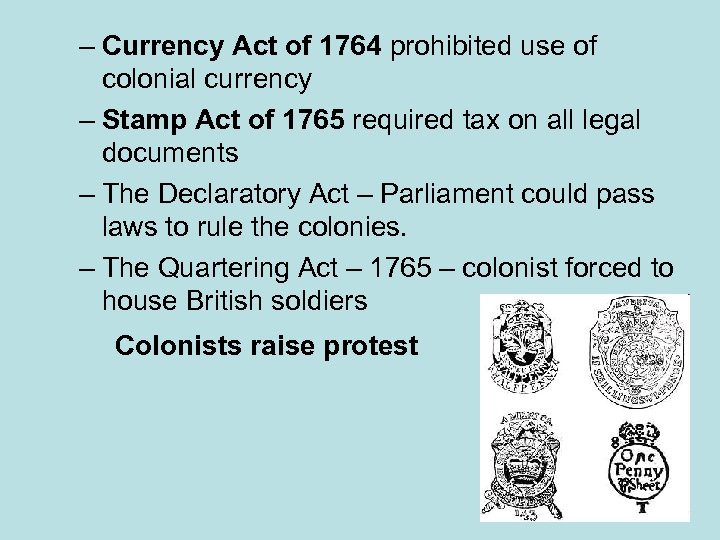
– Currency Act of 1764 prohibited use of colonial currency – Stamp Act of 1765 required tax on all legal documents – The Declaratory Act – Parliament could pass laws to rule the colonies. – The Quartering Act – 1765 – colonist forced to house British soldiers Colonists raise protest
Colonial Response • Pamphlets asserting colonials rights written/published • Colonials create non-importation agreements agreeing to boycott British goods • Patrick Henry introduces “Virginia Resolves” • The Virginia Resolves were a series of resolutions passed by the Virginia House of Burgesses in response to the Stamp Act of 1765.
VIRGINIA RESOLVES • The resolves claimed that in accordance with long established British law, Virginia was subject to taxation only by a parliamentary assembly to which Virginians themselves elected representatives. Since no colonial representatives were elected to the Parliament the only assembly legally allowed to raise taxes would be the Virginia General Assembly • 1765 - Stamp Act Congress calls for repeal, nine colonies attend (The Stamp Act is repealed)
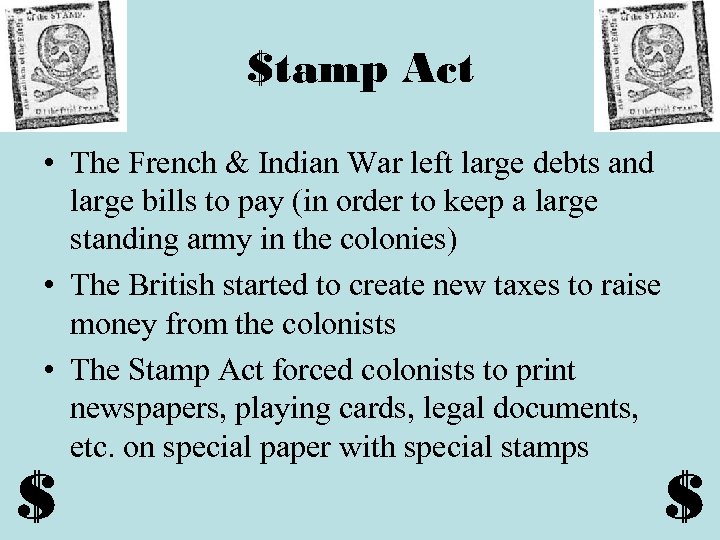
$tamp Act • The French & Indian War left large debts and large bills to pay (in order to keep a large standing army in the colonies) • The British started to create new taxes to raise money from the colonists • The Stamp Act forced colonists to print newspapers, playing cards, legal documents, etc. on special paper with special stamps $ $
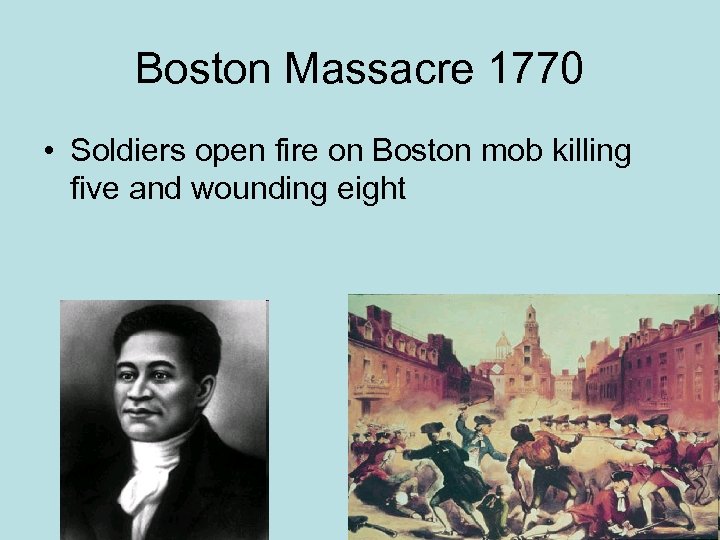
Boston Massacre 1770 • Soldiers open fire on Boston mob killing five and wounding eight
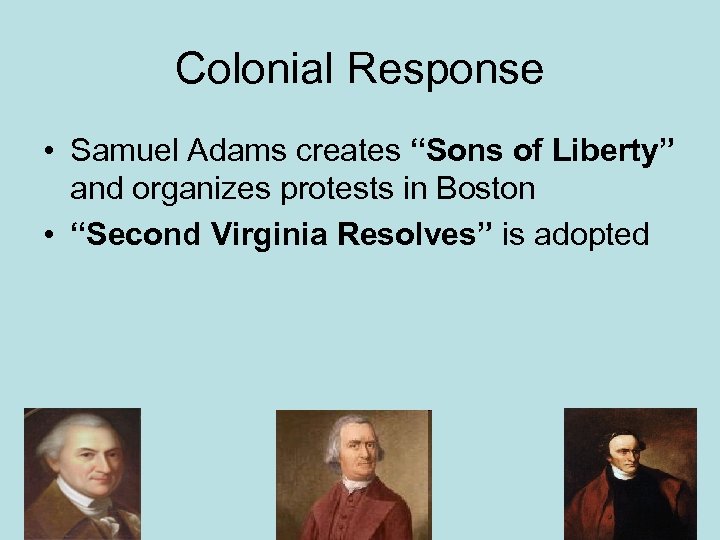
Colonial Response • Samuel Adams creates “Sons of Liberty” and organizes protests in Boston • “Second Virginia Resolves” is adopted
Third Crisis 1772 -1776 • 1773 The Tea Act is passed created tea monopoly • 1774 The Coercive Acts (Intolerable Acts) passed to punish Boston • 1774 The Quebec Act – added fuel to the colonial fire.
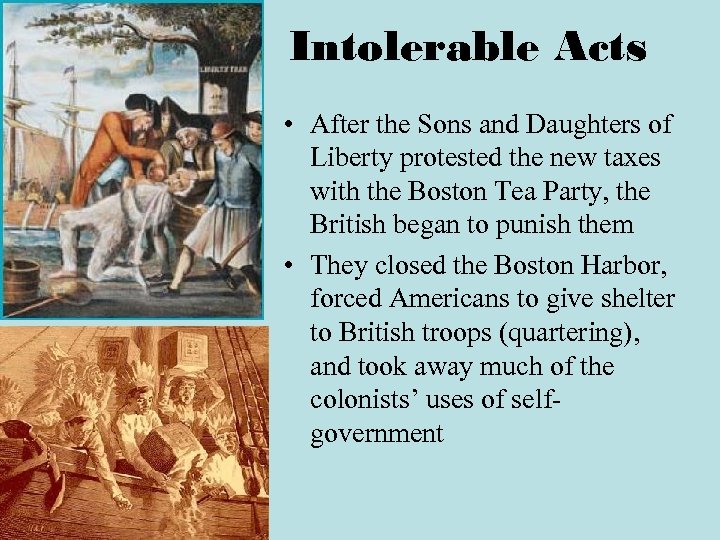
Intolerable Acts • After the Sons and Daughters of Liberty protested the new taxes with the Boston Tea Party, the British began to punish them • They closed the Boston Harbor, forced Americans to give shelter to British troops (quartering), and took away much of the colonists’ uses of selfgovernment
Colonial Response • 1772 - Sam Adams formed Committee of Correspondence to networking • 1773 - Boston Tea Party protests the Tea Act • 1774 First Continental Congress meets in Philadelphia to discuss the Intolerable Acts (12 colonies meet, no Georgia)
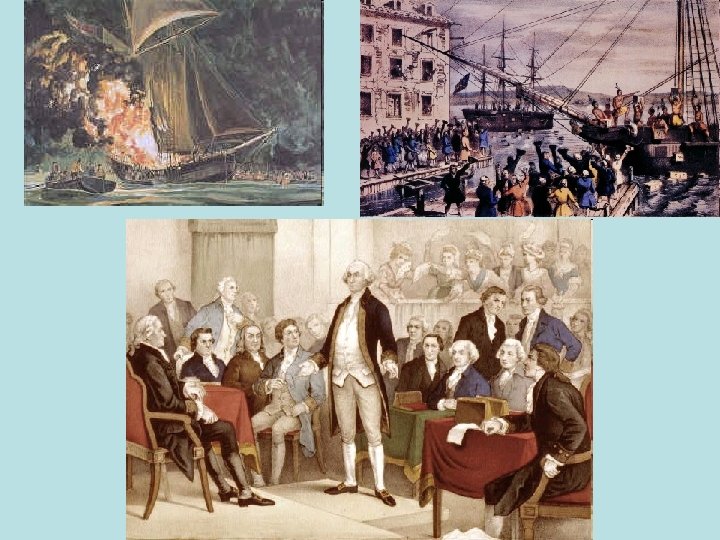
The First Continental Congress 1774 • Adoption of a “Declaration of American Rights” – – – – – Agreed on Parliaments’ right to regulate trade Claimed all “the rights of Englishmen” Denied Parliaments’ authority over internal affairs Each colonial assembly could decide on need of troops Adopted the “Suffolk Resolves” from Massachusetts Intolerable Acts were null and void Massachusetts should defend itself Called for economic sanction (more boycotts) Created the “Continental Association” to organize boycotts
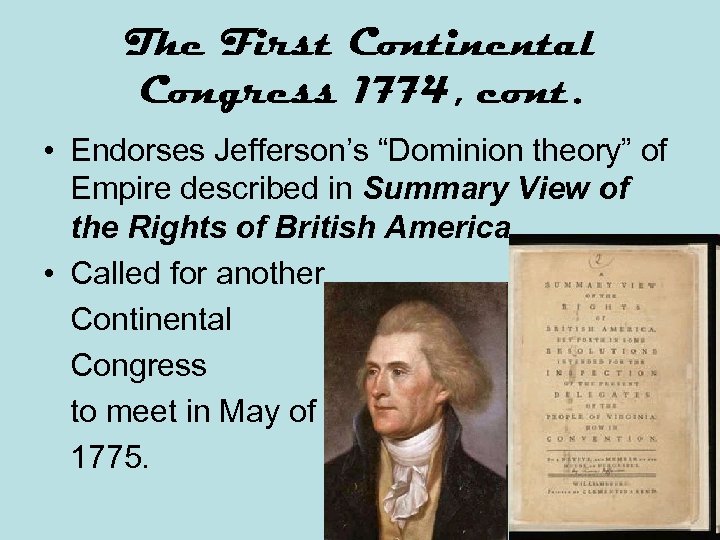
The First Continental Congress 1774, cont. • Endorses Jefferson’s “Dominion theory” of Empire described in Summary View of the Rights of British America • Called for another Continental Congress to meet in May of 1775.
British Response to First Continental Congress • Lord North – a “carrot and stick” strategy – The “carrot” – no new taxes except to regulate trade and colonies agree to help with defense – The “stick” – Massachusetts is declared to be in rebellion, New England trade and fishing rights limited. • The line in the sand in drawn
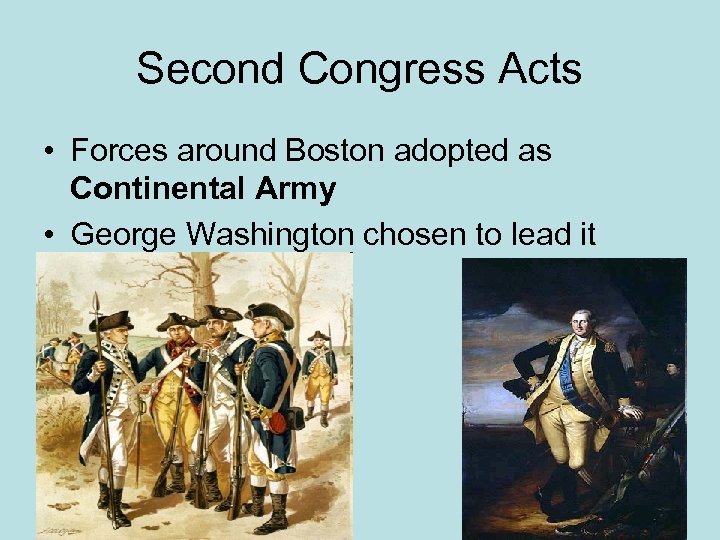
Second Congress Acts • Forces around Boston adopted as Continental Army • George Washington chosen to lead it
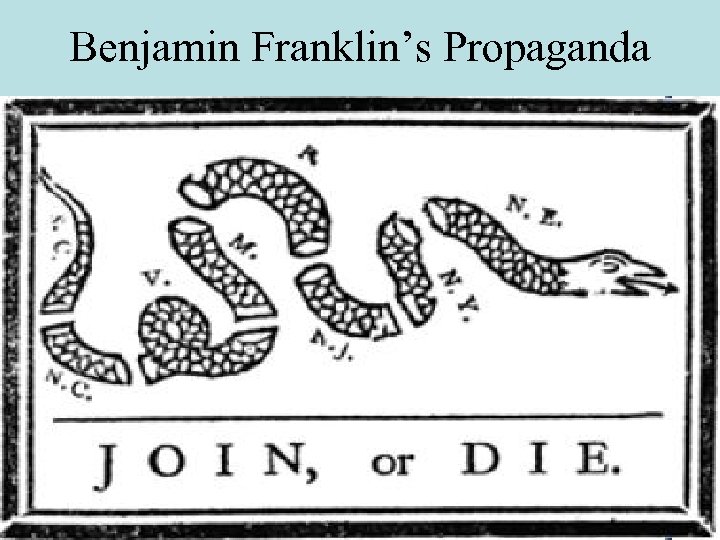
Benjamin Franklin’s Propaganda
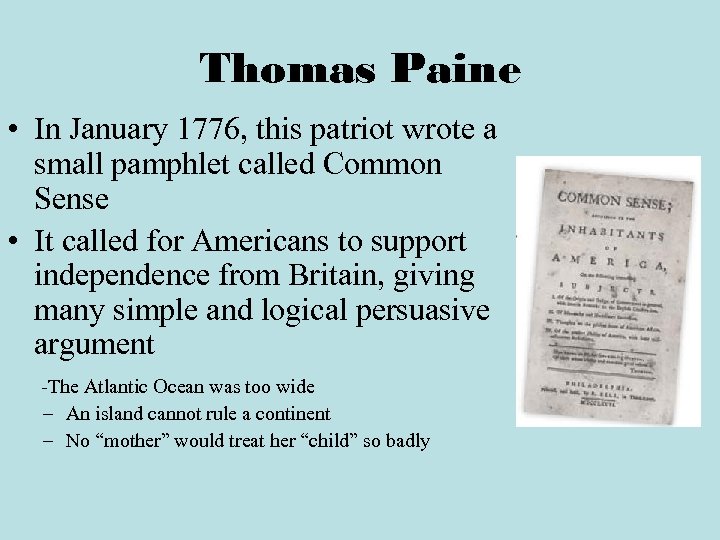
Thomas Paine • In January 1776, this patriot wrote a small pamphlet called Common Sense • It called for Americans to support independence from Britain, giving many simple and logical persuasive argument -The Atlantic Ocean was too wide – An island cannot rule a continent – No “mother” would treat her “child” so badly
Declaration of Independence • One of the most important documents in American history • Written by Thomas Jefferson, edited by John Adams, Ben Franklin and others • Addressed a worldwide audience, using simple and direct language in order to gain sympathy for the American cause • Borrowed from famous philosophers like John Locke and Charles de Montesquieu, to make the arguments sound more official • The longest part of it is the end, which gives numerous examples of how King George III had violated the rights of the American colonists • It also explains how the only way to correct these wrongs is to give the Americans control over their own government
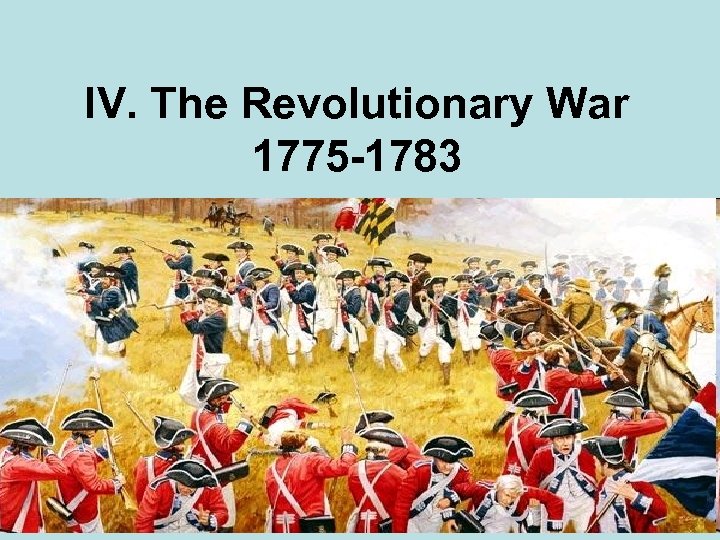
IV. The Revolutionary War 1775 -1783
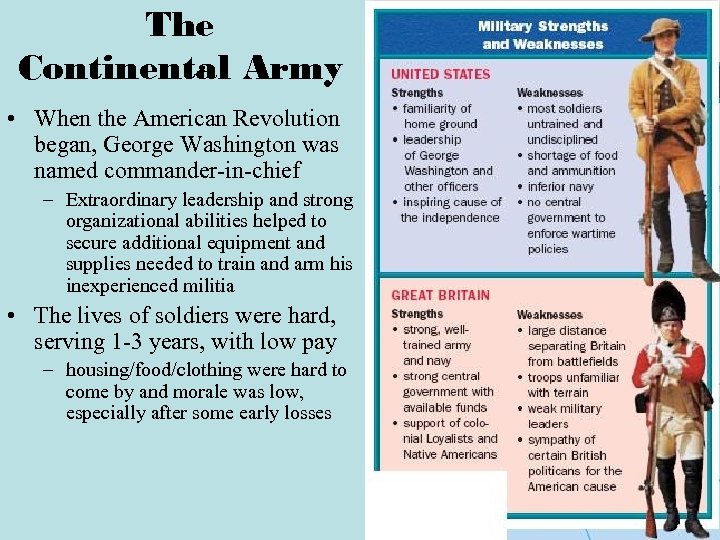
The Continental Army • When the American Revolution began, George Washington was named commander-in-chief – Extraordinary leadership and strong organizational abilities helped to secure additional equipment and supplies needed to train and arm his inexperienced militia • The lives of soldiers were hard, serving 1 -3 years, with low pay – housing/food/clothing were hard to come by and morale was low, especially after some early losses
French Alliance in 1778 • After a convincing American victory at Saratoga, New York, the French decided to help the Americans against their hated rival • Benjamin Franklin helped convince the French to help until the Americans won • A Frenchman, Marquis de Lafayette, commanded American soldiers into many key victories in the Revolutionary War
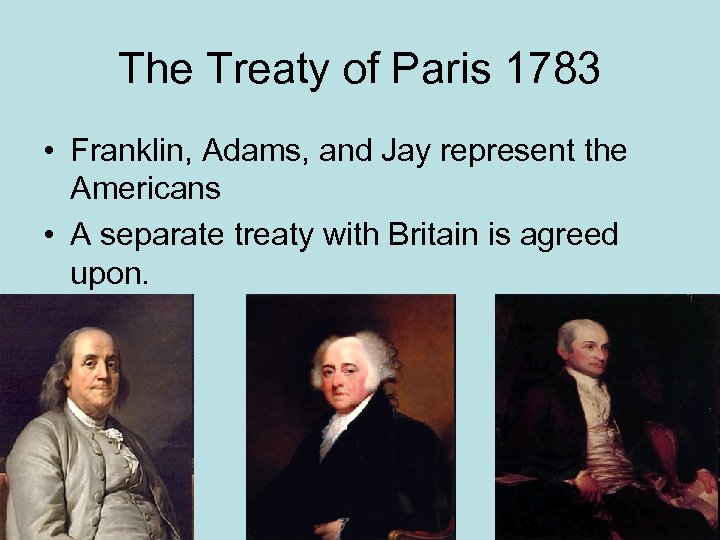
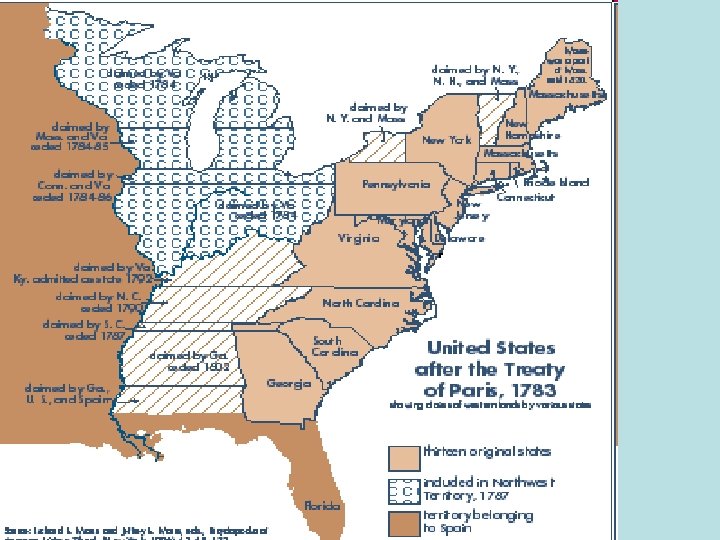
The Treaty of Paris 1783 • Franklin, Adams, and Jay represent the Americans • A separate treaty with Britain is agreed upon.
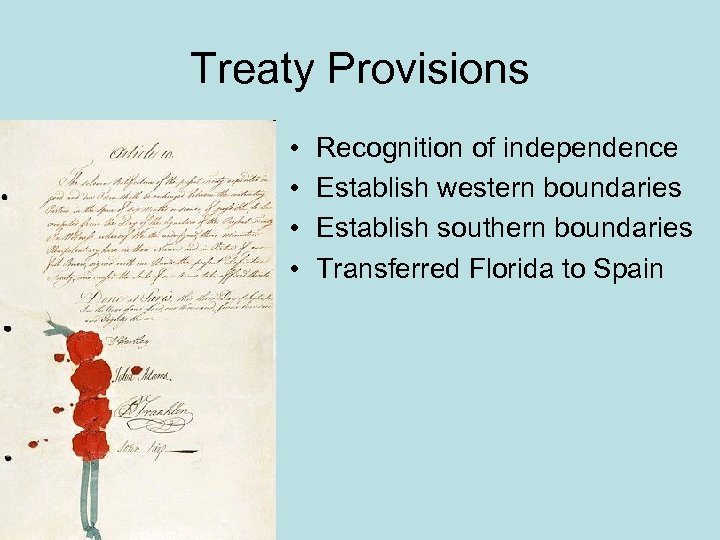
Treaty Provisions • • Recognition of independence Establish western boundaries Establish southern boundaries Transferred Florida to Spain
V. The Revolution as a Revolution • Not just a war, but as a political revolution • Shaped by “Republican ideology” • New state governments were created, influenced by Whig Philosophy and colonial experience. • Massachusetts used a convention to draft its new plan, others soon follow • Thirteen plans differ in detail, but have much in common.
Common Themes in State plans • The “Contract Theory of Government” • Separation of Powers = legislative, executive and judicial • Bills of Rights to guarantee time honored ideas • Reduced powers of elected governors while increasing power of legislatures.
• Attitudes regarding religious freedom grows – Separation of church and state – No religious requirement for holding office
Injustices Remain • The existence of slavery, what about all men created equal? Washington and Jefferson knew better, but did nothing • Status of women remained unchanged – Women often fought: • Margaret Corbin and Mary Ludwig Hays (Molly Pitcher) – Some challenge tradition: Judith Sargent Murray, “On the Equality of the Sexes
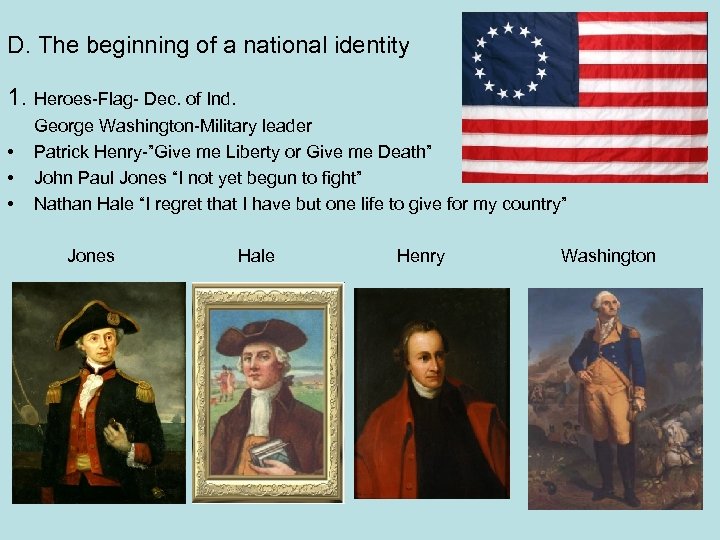
D. The beginning of a national identity 1. Heroes-Flag- Dec. of Ind. • • • George Washington-Military leader Patrick Henry-”Give me Liberty or Give me Death” John Paul Jones “I not yet begun to fight” Nathan Hale “I regret that I have but one life to give for my country” Jones Hale Henry Washington
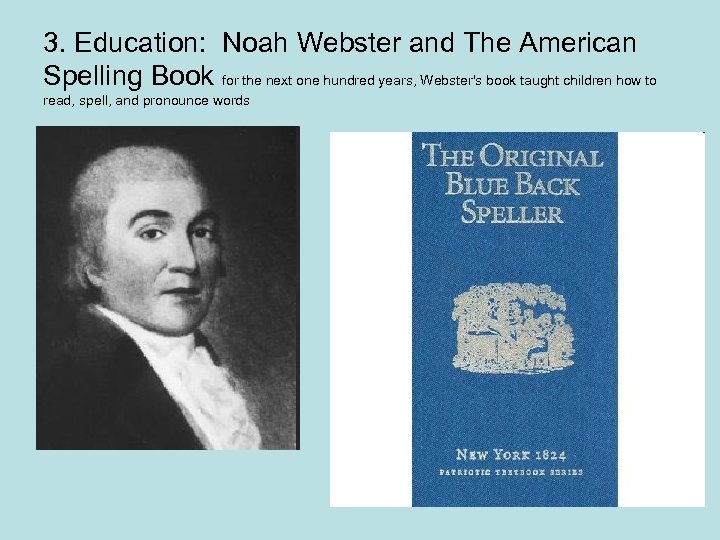
3. Education: Noah Webster and The American Spelling Book for the next one hundred years, Webster's book taught children how to read, spell, and pronounce words
• His most important improvement, he claimed, was to rescue "our native tongue" from "the clamour of pedantry" that surrounded English grammar and pronunciation. • English language had been corrupted by the British aristocracy, which set its own standard for proper spelling and pronunciation
• popular sovereignty in government must be accompanied by popular usage in language
Скачать презентацию Unit 2 Imperialism and Revolution The Establishment of
91b14fb2fb45940e9ce095953bfefb1f.ppt