


 Скачать презентацию Unit 2 Giving Thanks and Expressing Regrets
395531fe27232e0fc87914c562ca851f.ppt
- Количество слайдов: 27
 Unit 2 Giving Thanks and Expressing Regrets
 New Practical English 1 Session 2 Section III Maintaining a Sharp Eye Passage I Unit 2
 New Practical English 1 Passage I Different Attitudes to Gift -Giving Unit 2
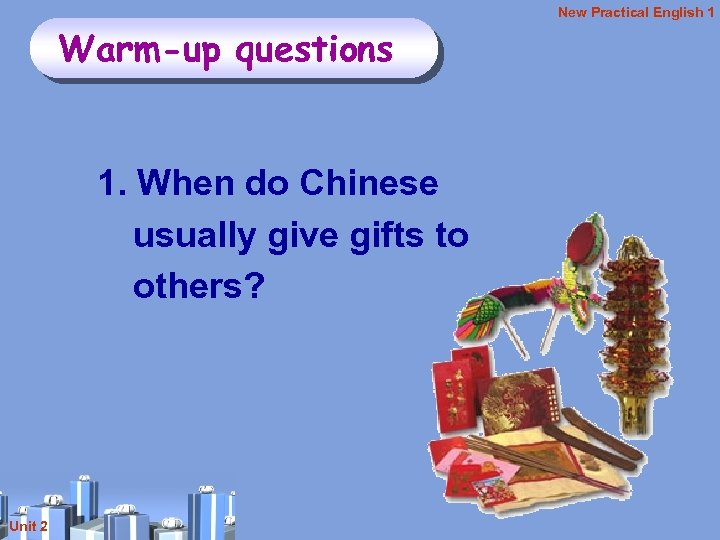 New Practical English 1 Warm-up questions 1. When do Chinese usually give gifts to others? Unit 2
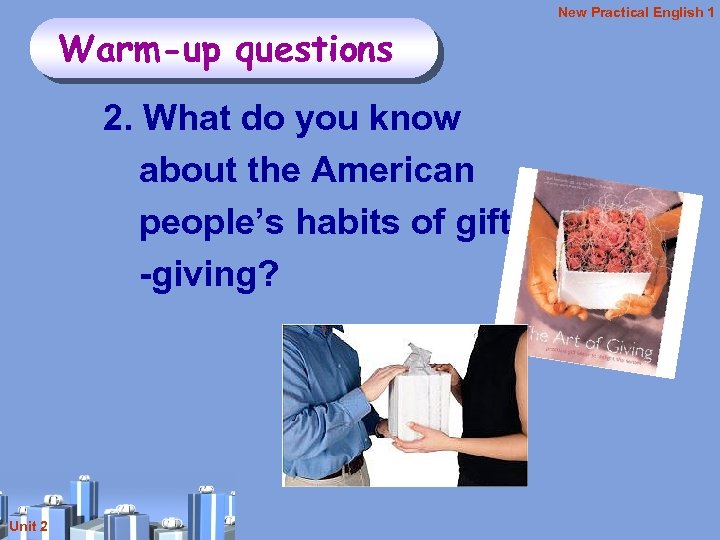 New Practical English 1 Warm-up questions 2. What do you know about the American people’s habits of gift -giving? Unit 2
 Reading of the passage New Practical English 1 Different Attitudes to Gift-Giving Unit 2
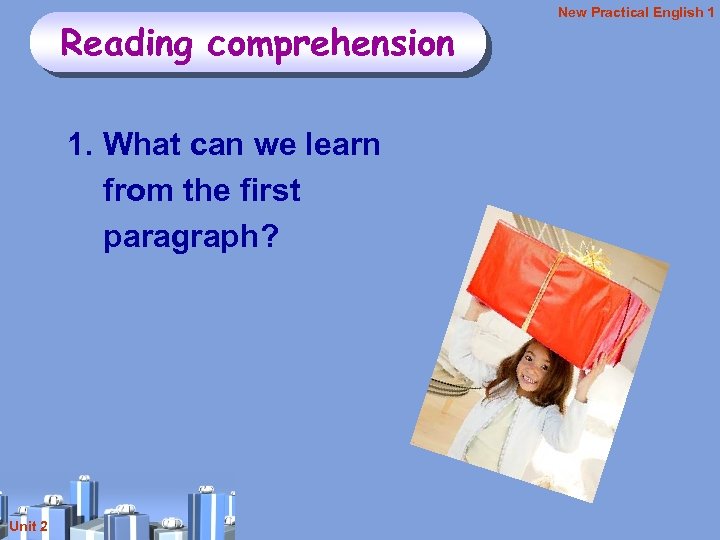 Reading comprehension 1. What can we learn from the first paragraph? Unit 2 New Practical English 1
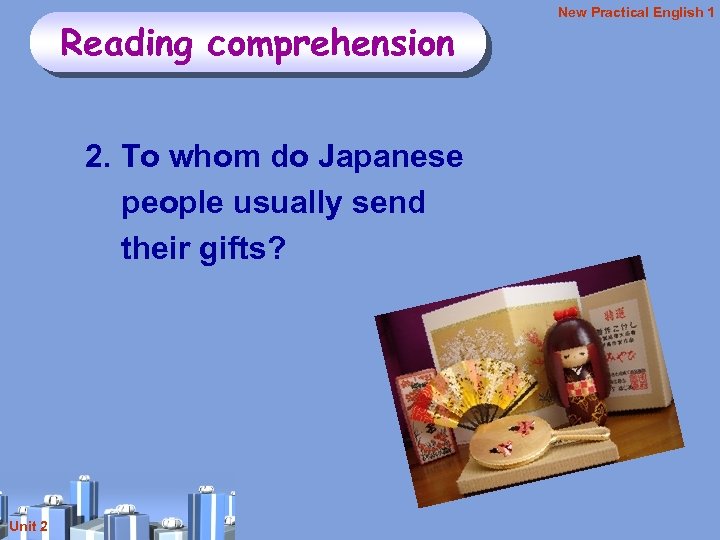 Reading comprehension 2. To whom do Japanese people usually send their gifts? Unit 2 New Practical English 1
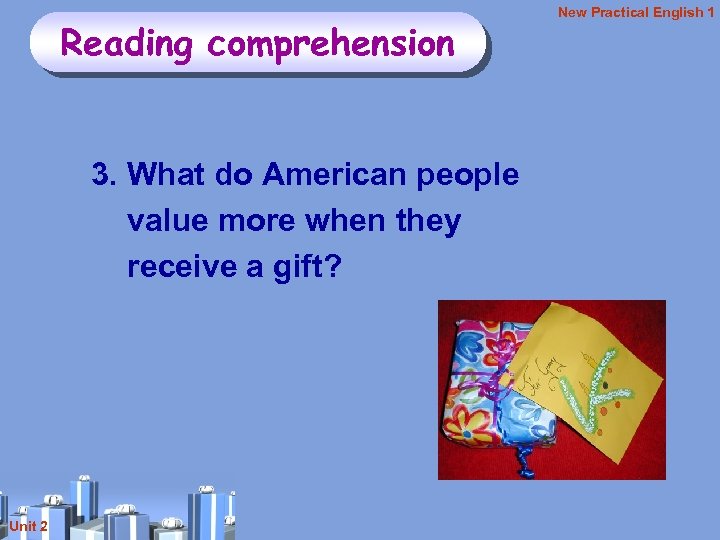 Reading comprehension 3. What do American people value more when they receive a gift? Unit 2 New Practical English 1
 Reading comprehension New Practical English 1 Summarize the different attitudes held by Japanese and Americans towards gift-giving by completing the table below. Unit 2
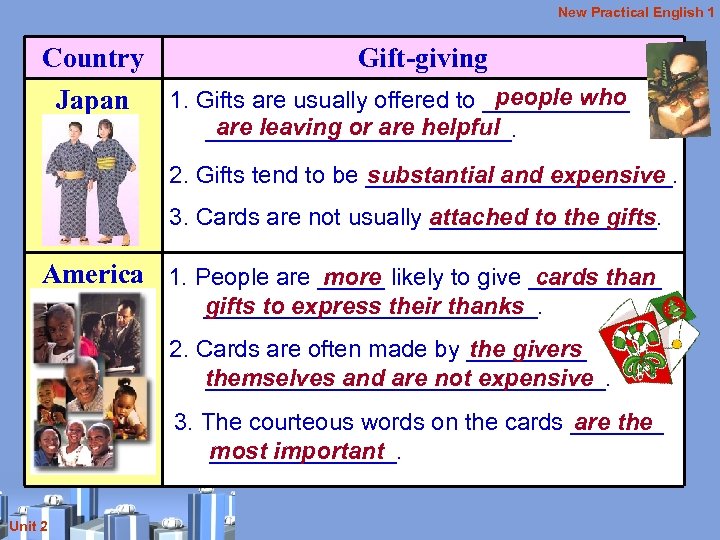 New Practical English 1 Country Gift-giving people who Japan 1. Gifts are usually offered to ______ are leaving or are helpful ____________. 2. Gifts tend to be ____________. substantial and expensive 3. Cards are not usually attached to the gifts _________. America 1. People are _____ likely to give _____ more cards than _____________. gifts to express their thanks 2. Cards are often made by _____ the givers themselves and are not expensive _______________. 3. The courteous words on the cards _______ are the most important _______. Unit 2
 Reading comprehension New Practical English 1 Work out five wh- questions in groups about the details of the passage and then ask the questions for other groups to answer. Unit 2
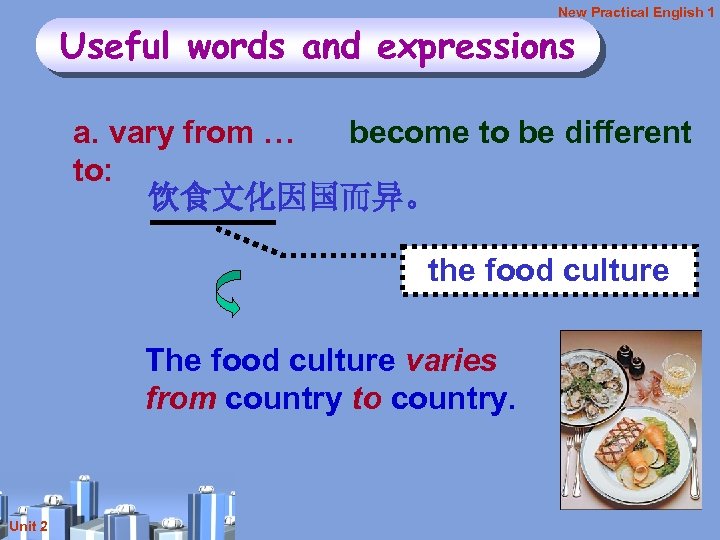 New Practical English 1 Useful words and expressions a. vary from … become to be different to: 饮食文化因国而异。 the food culture The food culture varies from country to country. Unit 2
 New Practical English 1 Useful words and expressions b. illustrate: explain through pictures, examples, etc. A good teacher often illustrates his ideas with examples. Unit 2
 New Practical English 1 Useful words and expressions c. a gift giving country: The form “n. + V-ing” can be used as an adjective modifying a noun. a sports-loving person a tradition-observing country Unit 2
 New Practical English 1 Useful words and expressions d. attach … to: join one thing to another 这种产品都附有说明书。 instructions Instructions are always attached to this kind of products. Unit 2
 New Practical English 1 Useful words and expressions e. tend to do: be likely to do 年轻人一般都喜欢流行歌曲,而老年人 则偏爱戏剧。 traditional opera Young people tend to like pop songs, while old people prefer traditional opera. Unit 2
 New Practical English 1 Useful words and expressions f. all the more: even more The pictures make the book all the more useful. Unit 2
 New Practical English 1 Exercises Key to Ex. 5: 1. Teachers should pay more attention to the students’ individual differences. 2. Professor Yang tends to give the students some substantial and valuable advice. 3. You are not required to give an expensive gift, but at least you should send him a thank-you card. Unit 2
 New Practical English 1 Exercises Key to Ex. 5: 4. We should learn to respect others’ life style. 5. In contrast, many students appreciate all the more the communication with their teachers out of class. 6. As a matter of fact, I prefer to live a quiet country life instead of a modern city life. Unit 2
 New Practical English 1 Exercises Key to Ex. 6: 1. The style of paintings may vary from one artist to another. The flavor of dishes may vary from place to place. Unit 2
 New Practical English 1 Exercises Key to Ex. 6: 2. Here is a book to help you with your English learning. Here is a way to improve our service. Unit 2
 New Practical English 1 Exercises Key to Ex. 6: 3. England is a tradition-observing country. The U. S. is a sports-loving country. Unit 2
 New Practical English 1 Exercises Key to Ex. 6: 4. It is not unusual in England to begin a conversation by talking about the weather. It is not unusual in Singapore to hear people speaking in different languages. Unit 2
 New Practical English 1 Exercises Key to Ex. 6: 5. In contrast, you get fewer friends than enemies in this way. In contrast, you get more pleasure than money in doing this job. Unit 2
 New Practical English 1 Exercises Key to Ex. 6: 6. As a matter of fact, the poem would be appreciated all the more if it is written in modern English. As a matter of fact, our product would be attractive all the more if there is some promotion. Unit 2
 New Practical English 1 1. Recite the first paragraph of Passage I. 2. Preview Passage II and the exercises. Unit 2