


 Скачать презентацию UNIT 2 CRIMINAL LAW 1 CRIME ACT
bcc1e801ef0d18e04355b9fb9877d6f3.ppt
- Количество слайдов: 49
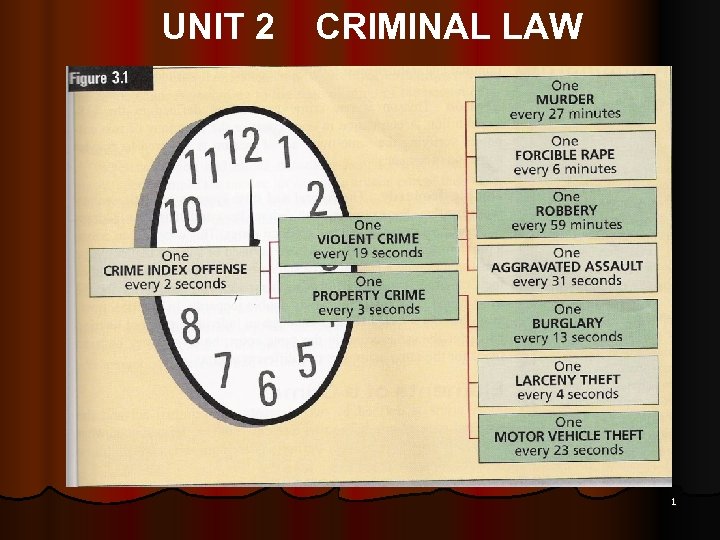 UNIT 2 CRIMINAL LAW 1
 CRIME ACT AGAINST THE PUBLIC GOOD Punishable by: Fine Imprisonment OR Death 2
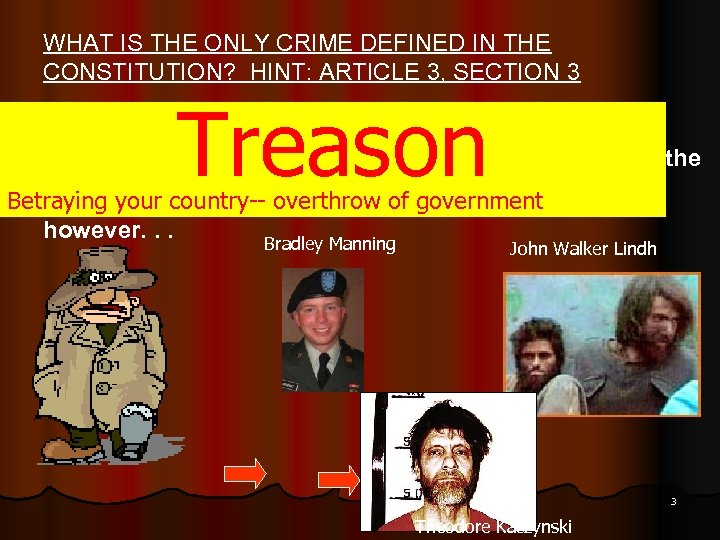 WHAT IS THE ONLY CRIME DEFINED IN THE CONSTITUTION? HINT: ARTICLE 3, SECTION 3 Treason DOUBLE JEOPARDY no person can be tried twice for the same crime (5 th Amendment) Betraying your country-- overthrow of government however. . . Bradley Manning John Walker Lindh 3 Theodore Kaczynski
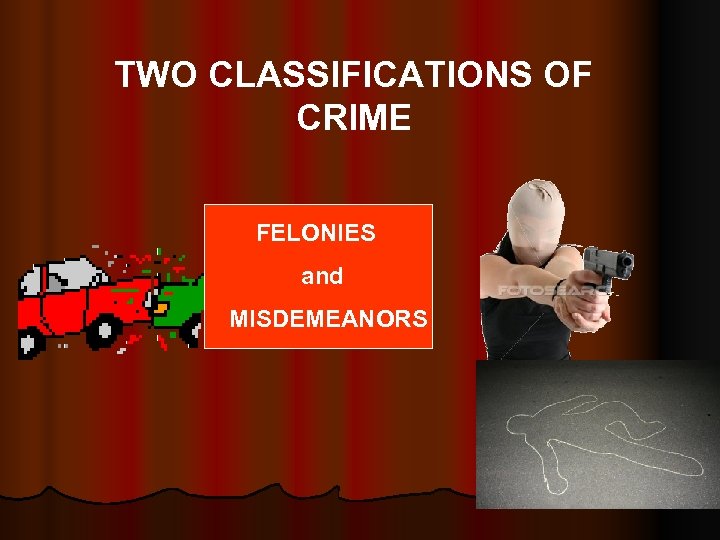 TWO CLASSIFICATIONS OF CRIME FELONIES and MISDEMEANORS 4
 CAN SHOPLIFTING BE A FELONY? 5
 Shoplifting probably accounts for a 1/2 to 1 percent loss each year, which is what contributes to mark-ups in prices. " "We prosecute all shoplifters. “ Court fees vary from $44 to $53, in addition to fines and possible jail time. " Retailers may also charge the shoplifter for the item stolen, regardless of whether or not it is returned undamaged. " Stores are entitled to collect four times the value of the item, or $100, whichever is greater. " AVERAGE YEARLY RETAIL SHOPLIFTING LOSES 6 $35 -$40 BILLION
 The Wal-Mart retail chain has eased its policy on shoplifting and will prosecute only for goods taken worth $25 or more, instead of the previous $3 limit. Feb. 19, 2009 (getechdirect. com) “Shrinkage on the Rise” According to the AP, so-called "shrinkage" at Walmart could rise to more than $3 billion this year. The shrinkage comes from a combination of supplier fraud, employee theft, bad bookkeeping and, of course, shoplifting. What's the reason for the increased shrink? It could be tied to Walmart's decision not to prosecute shoplifters who steal less than $25 worth of merchandise. Wal-Mart also may have been spooked by worries about lawsuits from wrongful death, unlawful imprisonment and other legal issues related to aggressively chasing down shoplifters. In March, Wal-Mart agreed to pay $750, 000 to the family of a suspected shoplifter who suffocated to death as loss prevention workers held him down in a parking lot outside a store in Texas. 7
 FELONY SERIOUS CRIME PUNISHABLE BY IMPRISONMENT OR DEATH. (murder, manslaughter, burglary, robbery, arson, perjury, obstruction of justice, bribery, witness tampering, trafficking) • 6 MONTHS OR MORE IN JAIL PLUS • MORE THAN $1, 000 IN FINES OR DEATH 8
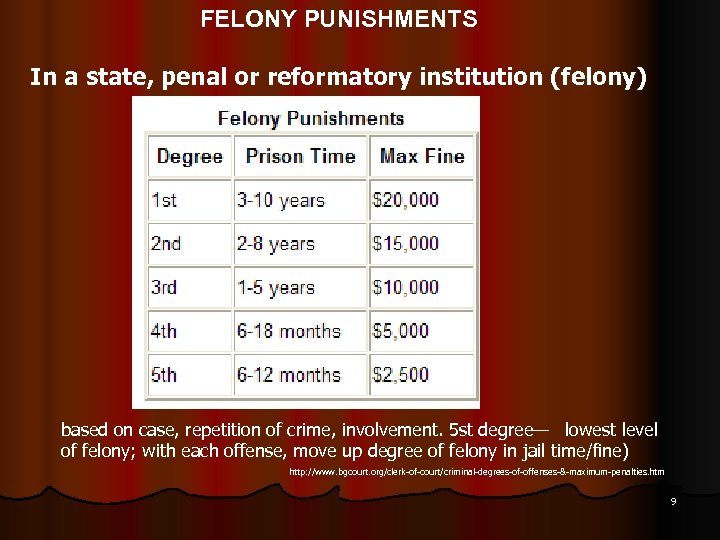 FELONY PUNISHMENTS In a state, penal or reformatory institution (felony) based on case, repetition of crime, involvement. 5 st degree— lowest level of felony; with each offense, move up degree of felony in jail time/fine) http: //www. bgcourt. org/clerk-of-court/criminal-degrees-of-offenses-&-maximum-penalties. htm 9
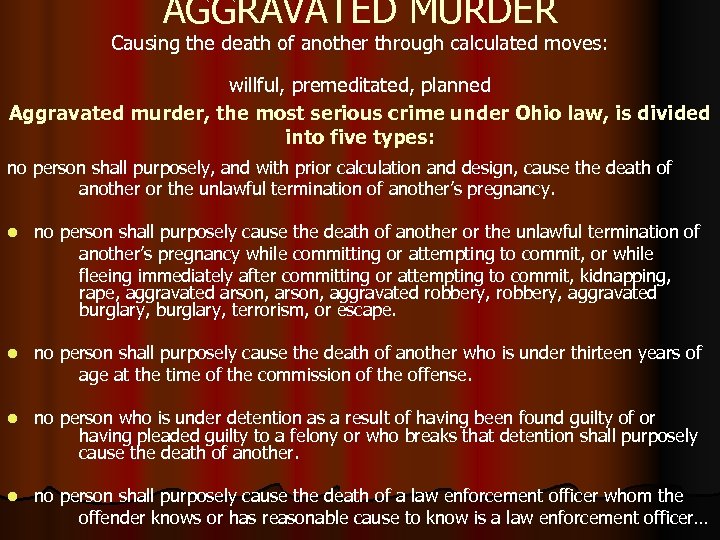 AGGRAVATED MURDER Causing the death of another through calculated moves: willful, premeditated, planned Aggravated murder, the most serious crime under Ohio law, is divided into five types: no person shall purposely, and with prior calculation and design, cause the death of another or the unlawful termination of another’s pregnancy. l no person shall purposely cause the death of another or the unlawful termination of another’s pregnancy while committing or attempting to commit, or while fleeing immediately after committing or attempting to commit, kidnapping, rape, aggravated arson, aggravated robbery, aggravated burglary, terrorism, or escape. l no person shall purposely cause the death of another who is under thirteen years of age at the time of the commission of the offense. l no person who is under detention as a result of having been found guilty of or having pleaded guilty to a felony or who breaks that detention shall purposely cause the death of another. l no person shall purposely cause the death of a law enforcement officer whom the offender knows or has reasonable cause to know is a law enforcement officer…
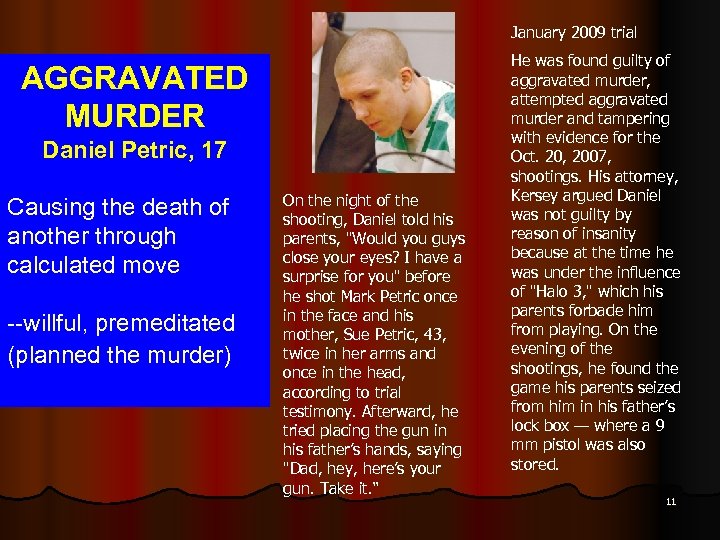 January 2009 trial AGGRAVATED MURDER Daniel Petric, 17 Causing the death of another through calculated move --willful, premeditated (planned the murder) On the night of the shooting, Daniel told his parents, "Would you guys close your eyes? I have a surprise for you" before he shot Mark Petric once in the face and his mother, Sue Petric, 43, twice in her arms and once in the head, according to trial testimony. Afterward, he tried placing the gun in his father’s hands, saying "Dad, hey, here’s your gun. Take it. “ He was found guilty of aggravated murder, attempted aggravated murder and tampering with evidence for the Oct. 20, 2007, shootings. His attorney, Kersey argued Daniel was not guilty by reason of insanity because at the time he was under the influence of "Halo 3, " which his parents forbade him from playing. On the evening of the shootings, he found the game his parents seized from him in his father’s lock box — where a 9 mm pistol was also stored. 11
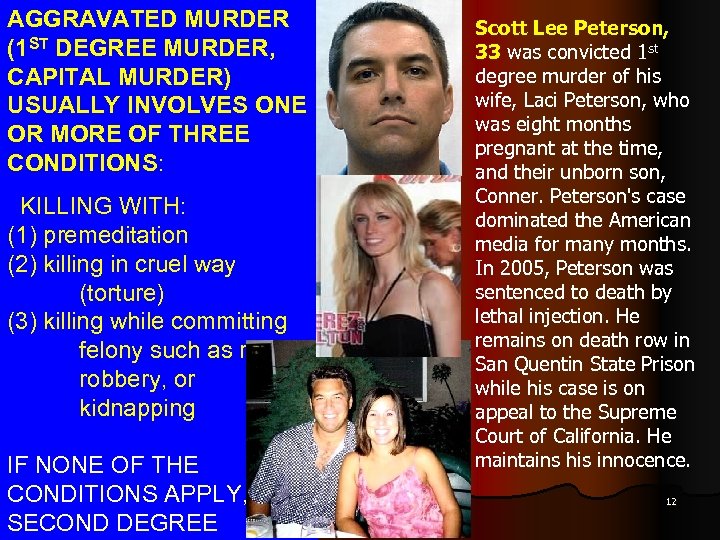 AGGRAVATED MURDER (1 ST DEGREE MURDER, CAPITAL MURDER) USUALLY INVOLVES ONE OR MORE OF THREE CONDITIONS: KILLING WITH: (1) premeditation (2) killing in cruel way (torture) (3) killing while committing felony such as rape, robbery, or kidnapping IF NONE OF THE CONDITIONS APPLY, SECOND DEGREE Scott Lee Peterson, 33 was convicted 1 st degree murder of his wife, Laci Peterson, who was eight months pregnant at the time, and their unborn son, Conner. Peterson's case dominated the American media for many months. In 2005, Peterson was sentenced to death by lethal injection. He remains on death row in San Quentin State Prison while his case is on appeal to the Supreme Court of California. He maintains his innocence. 12
 MURDER (2 ND DEGREE MURDER) 1) Intentional killing but not premeditated or planned nor committed in “heat of passion” 2) Killing caused by dangerous conduct and offender’s lack of concern for human life. • Penalty: Under Ohio law, the penalty for aggravated murder is death or life imprisonment. Note, if none of the five types of aggravated murder are triggered by the facts of the case, the charge becomes murder, not aggravated murder. Does not carry death penalty; • Sentence: 15 yrs. to life, $15, 000 fine. • Example: manslaughter 13
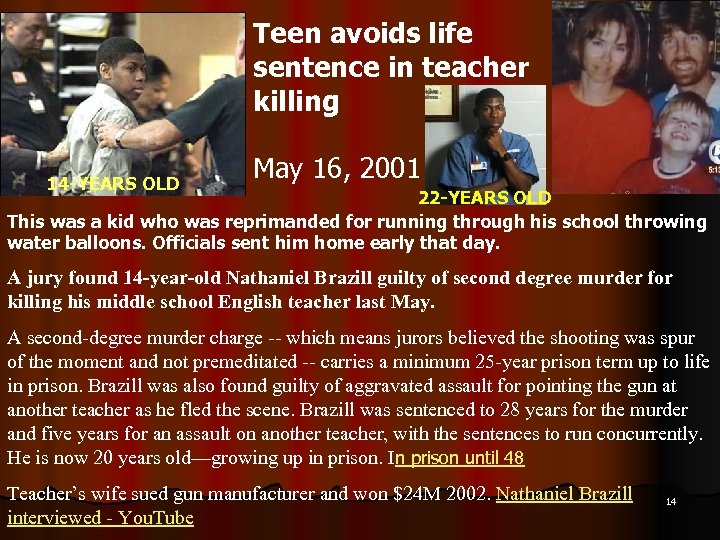 Teen avoids life sentence in teacher killing 14 -YEARS OLD May 16, 2001 22 -YEARS OLD This was a kid who was reprimanded for running through his school throwing water balloons. Officials sent him home early that day. A jury found 14 -year-old Nathaniel Brazill guilty of second degree murder for killing his middle school English teacher last May. A second-degree murder charge -- which means jurors believed the shooting was spur of the moment and not premeditated -- carries a minimum 25 -year prison term up to life in prison. Brazill was also found guilty of aggravated assault for pointing the gun at another teacher as he fled the scene. Brazill was sentenced to 28 years for the murder and five years for an assault on another teacher, with the sentences to run concurrently. He is now 20 years old—growing up in prison. In prison until 48 Teacher’s wife sued gun manufacturer and won $24 M 2002. Nathaniel Brazill interviewed - You. Tube 14
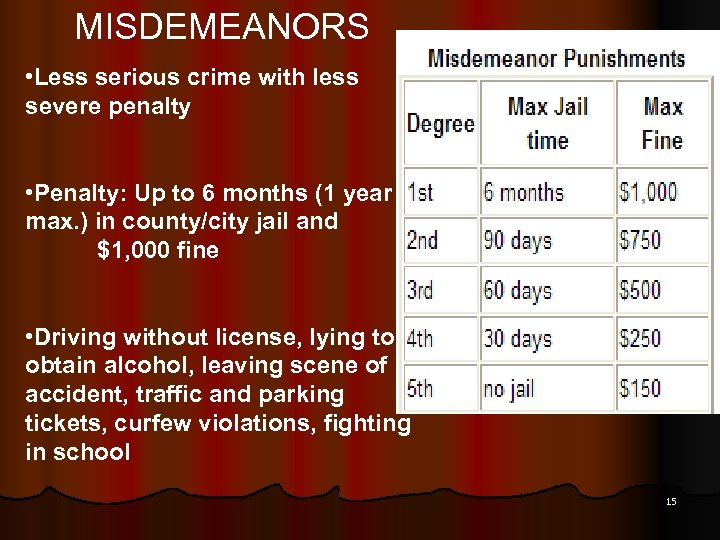 MISDEMEANORS • Less serious crime with less severe penalty • Penalty: Up to 6 months (1 year max. ) in county/city jail and $1, 000 fine • Driving without license, lying to obtain alcohol, leaving scene of accident, traffic and parking tickets, curfew violations, fighting in school 15
 SENTENCING IN OHIO l l l If a defendant is found guilty at trial, or pleads guilty prior to trial, the judge determines the appropriate sentence. Sentencing is the official punishment imposed by the court for the criminal offense. This happens at a sentencing hearing. At the hearing, the prosecutor is given the opportunity to speak on behalf of the State. The defense attorney then speaks on behalf of the defendant to mitigate the offense. After hearing from both sides, the judge makes the decision. There are numerous options that a judge has in sentencing someone convicted of a criminal offense. These options include probation, counseling, community service, jail/prison time, and a host of other options.
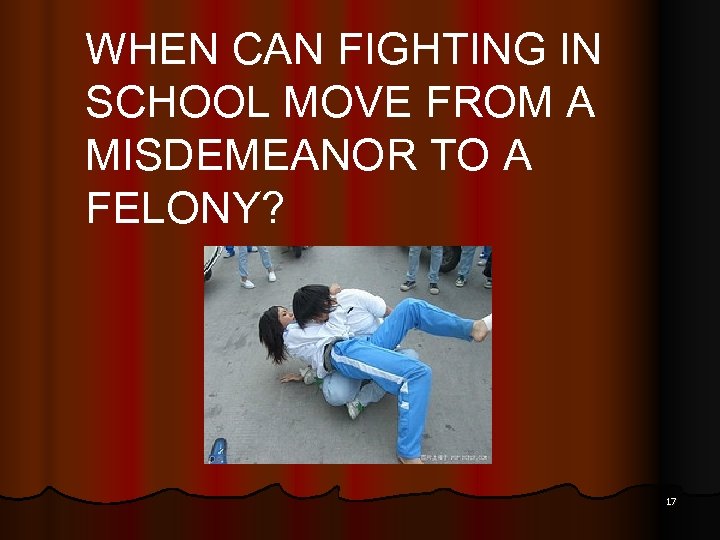 WHEN CAN FIGHTING IN SCHOOL MOVE FROM A MISDEMEANOR TO A FELONY? 17
 IF YOU USE A GUN THREE MORE YEARS ADDED IF YOU HAVE A GUN ON YOU BUT DON’T USE IT ADD ONE YEAR. 18
 WHY PUNISH? Retribution – punishment/ payback if someone hurts you, you hurt back Deterrence – to discourage or hinder: (Two types of deterrence) General – how it affects other people Personal – how it affects the individual person EXAMPLE OF RETRIBUTION/DETERRENCE CAPITAL PUNISHMENT Reform – ability to change a person FYI: The most comprehensive death penalty study in the country found that the death penalty costs North Carolina $2. 16 million more per execution than a nondeath penalty murder case with a sentence of life imprisonment. http: //uspolitics. about. com/od/deathpenalty/i/death_penalty_2. htm 19
 CULPABILITY OF DEFENDANT --degree of guilt of defendant Under common law, must prove two things for conviction: Actus Reas –Guilty Act – committed act Mens Rea – Guilty Mind – meant to do it 20
 How can you have Mens Rea and not Actus Reus Attempted murder? ? Tell your mistress that you are finally going to leave your wife and to get ready to leave the country. You get your passport from the safe deposit box at the bank. You do internet searches on places to live in Mexico. You buy "Teach yourself Spanish" tapes. You research poisons on the internet. You drive down the coast to Mexico and look at the border crossing and how easy it is to get across and if they really check the documents or not. You buy a box of rat poison. You make a pot of tea, and dissolve rat poison in it, and learn how much you can put in the tea before you discolor the tea. You pour the poison tea down the drain and carefully wash and rinse the tea pot before putting it back. Actus Reus present? (GUILTY ACT? ? ) Mens Rea present? (GUILTY MIND? ? ) 21 http: //answers. yahoo. com/question/? qid=20080407192821 AASe. MMf
 CAN YOU HAVE ACTUS REUS WITHOUT MENS REA? A few years back there was a man who had suffered from sleepwalking his entire life. One night, he drove to his mother-in-law's house and stabbed her repeatedly and killed her (he did everything WHILE sleepwalking so he was NOT conscious). Actus Reus present? Mens Rea present? 22 http: //answers. yahoo. com/question/? qid=20080407192821 AASe. MMf
 GUILTY MIND BROKEN INTO TWO AREAS: SERIOUS LESS SERIOUS Every crime must have: Purpose – purposely intend to hurt someone Knowledge – knew what you were doing Recklessness – knowingly expose another to harm Negligence –foresee consequences of planned action but go ahead exposing another to harm BURDEN OF PROOF – “Beyond a Reasonable Doubt” 23
 A, an expert in kayaking, organizes an outing for local children who are learning the sport. They travel to a large lake but, after an hour of paddling, they are overtaken by a violent storm and some of the children drown despite the fact that all are wearing life-preservers. If all the kayaks, paddles and ancillary equipment are shown to have been in good condition, the storm had not been forecasted by the meteorological services, and it was reasonable for these children to undertake this type of outing given their level of skill, WOULD “A” BE LIABLE? But if many of the children were too inexperienced and a storm had been forecast, WOULD “A” BE LIABLE? 24
 TYPES OF CRIMES AGAINST PERSON (CONT. ) ASSAULT/BATTERY Battery –unlawful touching of another person Assault –threat to do harm (lesser form of assault—lst degree misdemeanor) Assault and Battery – make threat and do it 1)tries to or does physically strike another 2)acts in threatening manner to put another in fear of immediate harm. Aggravated assault/battery (more serious— 4 th degree felony) 1)tries to do or does cause severe injury to another. 25 2)causes injury through use of deadly weapon.
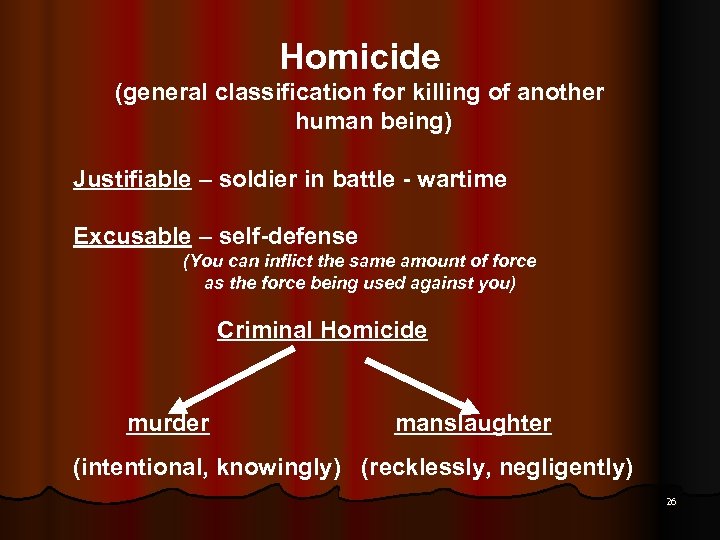 Homicide (general classification for killing of another human being) Justifiable – soldier in battle - wartime Excusable – self-defense (You can inflict the same amount of force as the force being used against you) Criminal Homicide murder manslaughter (intentional, knowingly) (recklessly, negligently) 26
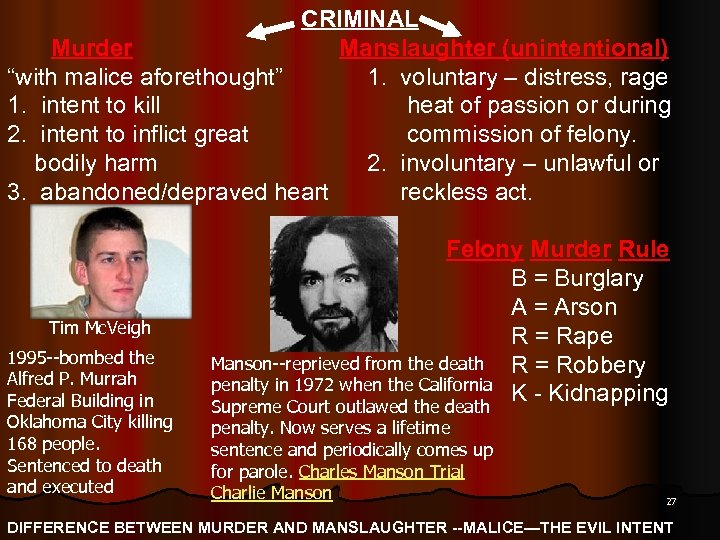 CRIMINAL Murder Manslaughter (unintentional) “with malice aforethought” 1. voluntary – distress, rage 1. intent to kill heat of passion or during 2. intent to inflict great commission of felony. bodily harm 2. involuntary – unlawful or 3. abandoned/depraved heart reckless act. Tim Mc. Veigh 1995 --bombed the Alfred P. Murrah Federal Building in Oklahoma City killing 168 people. Sentenced to death and executed Felony Murder Rule B = Burglary A = Arson R = Rape Manson--reprieved from the death R = Robbery penalty in 1972 when the California K - Kidnapping Supreme Court outlawed the death penalty. Now serves a lifetime sentence and periodically comes up for parole. Charles Manson Trial Charlie Manson 27 DIFFERENCE BETWEEN MURDER AND MANSLAUGHTER --MALICE—THE EVIL INTENT
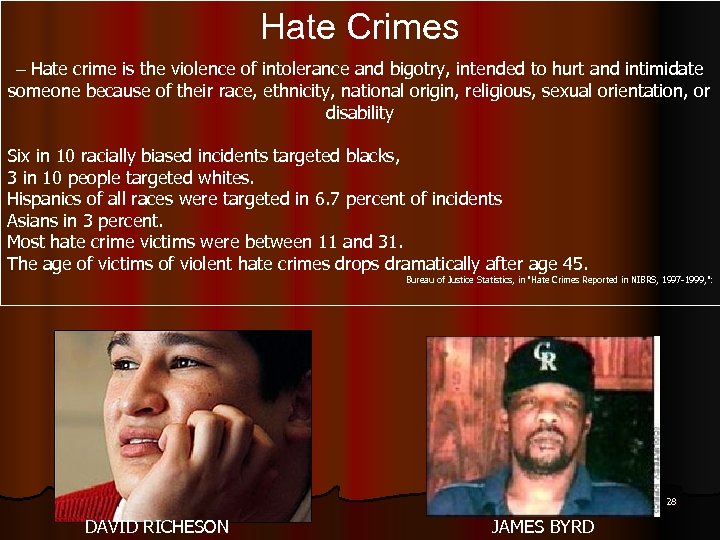 Hate Crimes – Hate crime is the violence of intolerance and bigotry, intended to hurt and intimidate someone because of their race, ethnicity, national origin, religious, sexual orientation, or disability Six in 10 racially biased incidents targeted blacks, 3 in 10 people targeted whites. Hispanics of all races were targeted in 6. 7 percent of incidents Asians in 3 percent. Most hate crime victims were between 11 and 31. The age of victims of violent hate crimes drops dramatically after age 45. Bureau of Justice Statistics, in "Hate Crimes Reported in NIBRS, 1997 -1999, ": 28 DAVID RICHESON JAMES BYRD
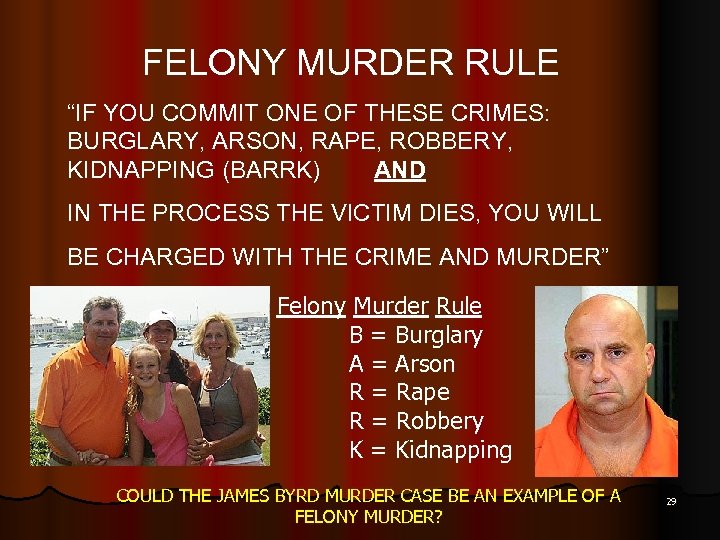 FELONY MURDER RULE “IF YOU COMMIT ONE OF THESE CRIMES: BURGLARY, ARSON, RAPE, ROBBERY, KIDNAPPING (BARRK) AND IN THE PROCESS THE VICTIM DIES, YOU WILL BE CHARGED WITH THE CRIME AND MURDER” Felony Murder Rule B = Burglary A = Arson R = Rape R = Robbery K = Kidnapping COULD THE JAMES BYRD MURDER CASE BE AN EXAMPLE OF A FELONY MURDER? 29
 CRIMES AGAINST PROPERTY Larceny – taking or carrying away of personal property of another with the intent to personally deprive the owner of it (intent to steal at time of taking. ) Larceny – legal term for theft, stealing, shoplifting, pickpocketing Petty Larceny – misdemeanor (under *$300) Grand Larceny – felony (over *$300) *amount may vary 30
 CRIMES AGAINST PROPERTY (cont) THEFT CRIMES Obtaining goods by false pretenses (theft) --ownership transfers the minute you take possession Larceny by Trick (theft) --ownership transfers the minute payment made Embezzlement (theft) – wrongful taking of another’s property by a person who has been entrusted with that property. (entrusted is key word) 31
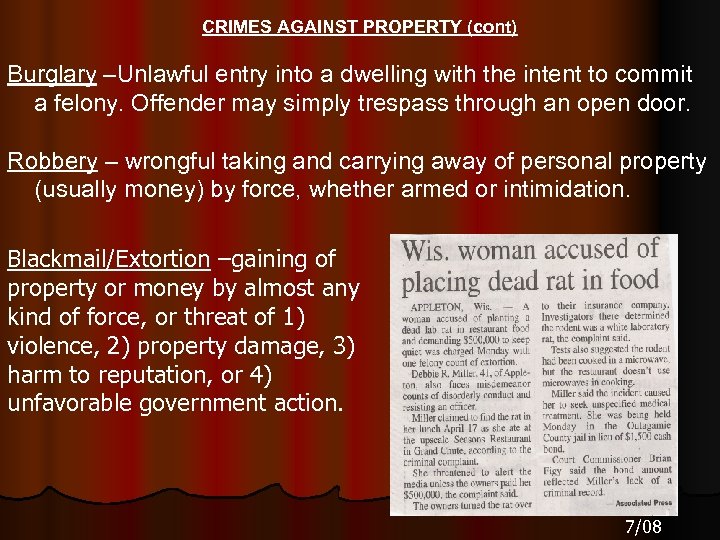 CRIMES AGAINST PROPERTY (cont) Burglary –Unlawful entry into a dwelling with the intent to commit a felony. Offender may simply trespass through an open door. Robbery – wrongful taking and carrying away of personal property (usually money) by force, whether armed or intimidation. Blackmail/Extortion –gaining of property or money by almost any kind of force, or threat of 1) violence, 2) property damage, 3) harm to reputation, or 4) unfavorable government action. 32 7/08
 When two service station attendants in Ionia, Michigan, refused to hand over the cash to an intoxicated robber, the man threatened to call the police. They still refused, so the robber called the police and was arrested? CHARGE? ANY DEFENSE? 33
 CRIMES AGAINST PROPERTY (cont) Arson – Willful and malicious burning of the dwelling house of another Trespass – Entering property that is not yours Vandalism – willful or malicious destruction of property PETTY THEFT Theft of property up to $500 – 1 st degree Misdemeanor If $500 or more but less than $5, 000 --5 th degree felony Prior theft offense can put you at 5 th degree You have to prove theft – specify property 34
 CRIMES AGAINST PROPERTY (cont) Theft – first time– 6 months in jail, $1, 000 fine If $5, 000 or more but less than $100, 000 or dangerous drugs or motor vehicle – 4 th degree felony If $100, 000 or more, dangerous drugs, and prior felony drug abuse offense – 3 rd degree felony 35
 CRIMINAL DEFENSES (Justifications) Self Defense – only as much force as reasonably necessary Stand your ground clause Castle doctrine - 2008 NEW LAW The Columbus Dispatch : Castle doctrine: Ohio self-defense law will start in November RULE ON DEADLY FORCE—you should not use deadly force unless deadly force used against you Duty to Retreat - better to save a life than not retreat 36
 CRIMINAL DEFENSES (Justifications) con’t Rights of an aggressor to use self-defense— Aggressor has a right to change mind. If defender continues fight—defender becomes aggressor—instigator has right to use self-defense to defend self. FUNNY HOW STRANGE THE LAW WORKS— ISN’T IT? 37
 CRIMINAL DEFENSES (Justifications) Defense of Others – helping someone in trouble Majority view – reasonable belief a person needed help Minority view – you are in the shoes of the person you are helping 38
 CRIMINAL DEFENSES (Justifications) Defense of Dwelling (house) USE AS MUCH FORCE AS REASONABLY NECESSARY (see Castle Doctrine) http: //briefcase 8. com/2009/09/02/update-on-the-castledoctrine/ NO ABSOLUTE PRIVILEGE TO KILL ANYONE ON YOUR PROPERTY 39
 CRIMINAL DEFENSES (Justifications) Necessity – protect yourself and/or others Public necessity – act committed out of necessity for greater good Private necessity –act committed to save one’s own life 40
 CRIMINAL DEFENSES (Justifications) Duress - overcoming the will of another person **cannot use duress as defense for taking another’s life Consent – giving permission Entrapment – enticement to commit criminal act Defense must show crime would have been committed anyway. Insanity - people can’t be held responsible for their actions if they didn’t know what they were doing. 41
 WHAT DO YOU THINK? Someone was nabbed by security guards at a store, and the guards questioned the guy before giving him to the police. In the course of his questioning by the guards, he confessed to shoplifting. It was all videotaped and the state produced the videotape in court. His attorney tried to get the confession thrown out because he had not been read his "Miranda rights" before he was questioned. WERE HIS 5 th AMENDMENT CONSTITUTIONAL RIGHTS VIOLATED? 42 http: //www. denbeste. nu/cd_log_entries/2004/03/Entrapmentofpedophiles. shtml
 The court rejected that. The reasoning was that the critical constitutional clause from the Fifth Amendment which was the basis for the Miranda decision applies to how the government and its agents dealt with suspected criminals. It does not apply to how citizens deal with one another, and legally speaking the guards had made a "citizen's arrest" and could not be considered agents of the state. Even though police read people their Miranda rights before questioning, private citizens including these kinds of guards do not have to. Even though a citizen has a right to a lawyer being present when questioned by the police, he has no such right when being questioned by other citizens. His confession to the guards was ruled to be admissible evidence, and he was convicted. On the other hand, there are limits to the extent to which citizens can detain other citizens and question them without violating laws relating to kidnapping, for instance. The reason there are more limits on government action is that the government also is granted more power to detain people and hold them. Factors Considered in an Entrapment Defense 1. The character of the defendant (whether the defendant was more "predisposed" to commit the crime than the ordinary citizen; e. g. having a record of illegal activity of this sort). 2. Who first suggested the criminal activity. 3. Whether the defendant engaged in the activity for profit. 4. Whether the defendant demonstrated reluctance (and not just "no thanks, well ok": more like repeatedly refusing and then eventually, months or years later, giving in). 5. The nature of the government's inducement (how much did they persuade, threaten, coerce, or harass). 43
 On June 20, 2001, after husband left for work at 9: 00 a. m. , Andrea. Yates filled the family bathtub and drowned her three youngest sons, Luke, Paul and John. She placed their bodies next to each other on a bed, placing an arm of each boy over another. The infant, Mary, had been in the bathroom in her bassinet, crying. She became the fourth victim. When her eldest, Noah, entered the room, Mary's body was still in the bathtub; after asking his mother what was wrong with Mary, he attempted to flee. Yates caught him and drowned him next to Mary. Yates took Mary into the other room, laid her next to the first three, and covered all four with a sheet. Noah was left in the tub. Yates called 9 -1 -1 and calmly asked for a police officer to come, asking for an ambulance only after it was suggested by the operator. She then called her husband at work, ordering him to come home. Russell pressed her until she told him she had hurt the children. When Russell rushed home, he found police and medical personnel had already surrounded his house. Russell was kept waiting outside for five hours as the medical examiner processed the children's bodies. Yates received the officers at the door, telling them she had just killed her children. She led them to the master bedroom where they found the four youngest children covered with a sheet, lying face up on the bed, eyes still open. Noah was discovered by another officer face down in the bathtub. Yates calmly explained what she had done, 44 and offered no resistance to the officers as she was led away.
 Excuses Insanity – people can’t be held responsible for their actions if they didn’t know what they were doing. Intoxication Voluntary – get drunk, commit crime Involuntary – confirmed alcoholic Infancy – because of age (under 14) incapable of committing a crime Common law – Under 7 --no crime 7 – 14 --rebuttal presumption 14 & over—can commit crime 45
 Inchoate Crimes --incomplete crimes ex: attempted murder 1. Solicitation – asking someone to commit a crime 2. Conspiracy - group committing a crime 3. Aiding and Abetting/Accessory – aiding a person in committing a crime. Depending on the degree of involvement, the offender's participation in the crime may rise to the level of conspiracy. For example, Andy draws a floor plan of a bank, knowing of Dan's intention to rob it. After Dan commits the robbery, Alice agrees to let him store the stolen money at her house. Both Andy and Alice can be charged with aiding and abetting, or acting as accessories to the robbery. IN OHIO—Aiding and Abetting – theft – 1 st degree misdemeanor if theft under $500 46
 CRIMES INVOLVING DRUGS AND ALCOHOL MERCHANT—can lose license, be imprisoned fined or both UNDERAGE INDIVIDUAL – prosecute for lying, purchase of illegal substances DRUGS – sale of drugs more serious than possess/use MOTOR VEHICLE VIOLATIONS Driving is a privilege – not a right Penalties for violations (recklessness, driving w/o icense, OVI, etc. ) jail time, suspended license, fines, remedial classes, points on license. 47
 COMPUTER CRIMES Computer Fraud and Abuse Ac. T l The Computer Fraud and Abuse Act is a law passed by the United States Congress in 1986 intended to reduce "hacking" of computer systems. l It was amended in 1994, 1996 and in 2001 by the USA PATRIOT Act. l l TAKE A LOOK AT DEPT. OF JUSTICE EFFORTS: http: //www. justice. gov/criminal/cybercrime/CCFact. S heet. pdf l The USA PATRIOT Act increased the scope and penalties of this act by raising the maximum penalty for violations to 10 years (from 5) for a first offense 48 and 20 years (from 10) for a second offense
 EXPUNGEMENT Legal process through which an arrest or conviction may be erased from a person's criminal record. First, you must be a “first offender. ” After offender’s final discharge, (3 YEARS IF FELONY; 1 YEAR IF MISDEMEANOR) l Second, there must be no criminal proceeding currently pending against you. l Third, your rehabilitation must have been completed to the satisfaction of the court. l Lastly, the expungement of the record of your conviction must be consistent with the public interest. l 49