 Скачать презентацию UNIT-2 Acct — 103 College of Business Administration
843825ca5dba6703b02b5c41244811dd.ppt
- Количество слайдов: 45




UNIT-2 Acct - 103 College of Business Administration, Al -Kharj salman bin abdulaziz university KINGDOM OF SAUDI ARABIA
Unit – II (Acct-103) Accounting System: Classifications of accounts, Double Entry system, Accounting Equations. 3/15/2018
AFTER THIS CHAPTER, YOU WOULD BE ABLE TO KNOW: Ø Understand Classification of Accounts Ø Analyze the effect of business transactions on the basic double entry system . Ø State the basic accounting equation and explain the meaning of assets, liabilities, and owner’s equity. 3/15/2018
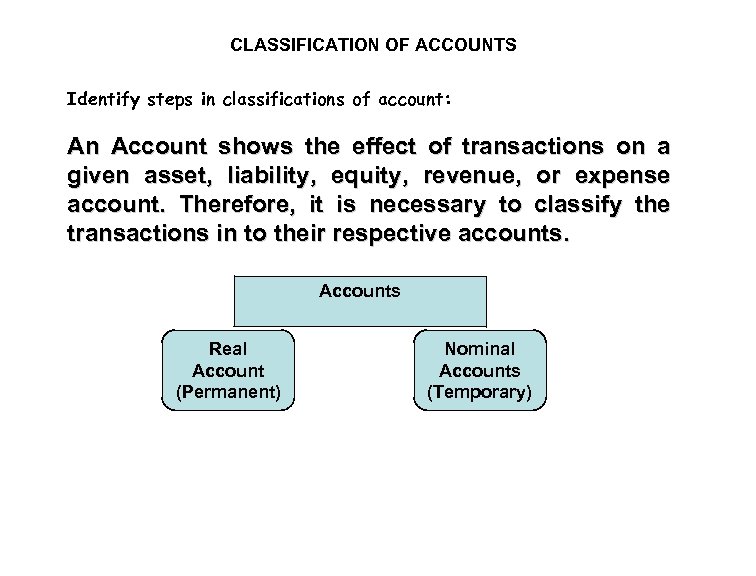
CLASSIFICATION OF ACCOUNTS Identify steps in classifications of account: An Account shows the effect of transactions on a given asset, liability, equity, revenue, or expense account. Therefore, it is necessary to classify the transactions in to their respective accounts. Accounts Real Account (Permanent) Nominal Accounts (Temporary)
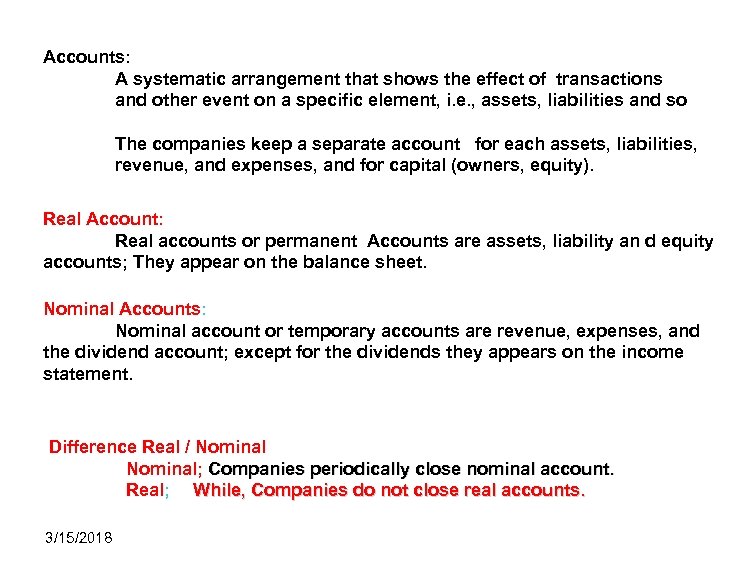
Accounts: A systematic arrangement that shows the effect of transactions and other event on a specific element, i. e. , assets, liabilities and so The companies keep a separate account for each assets, liabilities, revenue, and expenses, and for capital (owners, equity). Real Account: Real accounts or permanent Accounts are assets, liability an d equity accounts; They appear on the balance sheet. Nominal Accounts: Nominal account or temporary accounts are revenue, expenses, and the dividend account; except for the dividends they appears on the income statement. Difference Real / Nominal; Companies periodically close nominal account. Real; While, Companies do not close real accounts. 3/15/2018
Double Entry system Meaning: Every business transaction causes at least two changes in the financial position of a business concern at the same time - hence, both the changes must be recorded in the books of accounts. Otherwise, the books of accounts will remain incomplete and the result ascertained therefore will be inaccurate. For Example; If we buy / purchase machinery for $1, 000. Obviously, it is a business transaction. It has brought two changes - machinery increases by $1, 000 and cash decreases by an equal amount. In accounting language these two changes are termed as "a debit change" and "a credit change“ Other words: each transaction was entered twice (hence "double-entry"), with one side of the transaction being called a DEBIT and the other a 3/15/2018 CREDIT.
Debits and Credits An Account shows the effect of transactions on a given asset, liability, equity, revenue, or expense account. Double-entry accounting system (two-sided effect). Recording done by debiting at least one account and crediting another. DEBITS must equal CREDITS.
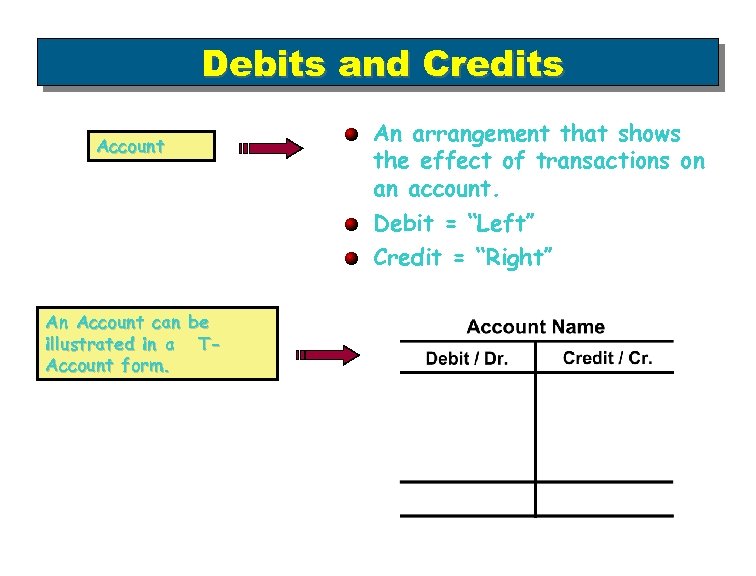
Debits and Credits Account An Account can be illustrated in a TAccount form. An arrangement that shows the effect of transactions on an account. Debit = “Left” Credit = “Right”
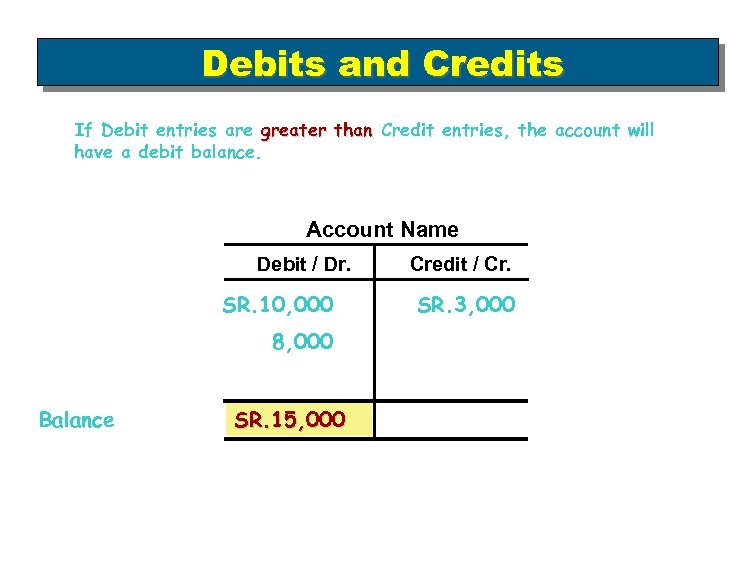
Debits and Credits If Debit entries are greater than Credit entries, the account will have a debit balance. Account Name Debit / Dr. SR. 10, 000 8, 000 Balance SR. 15, 000 Credit / Cr. SR. 3, 000
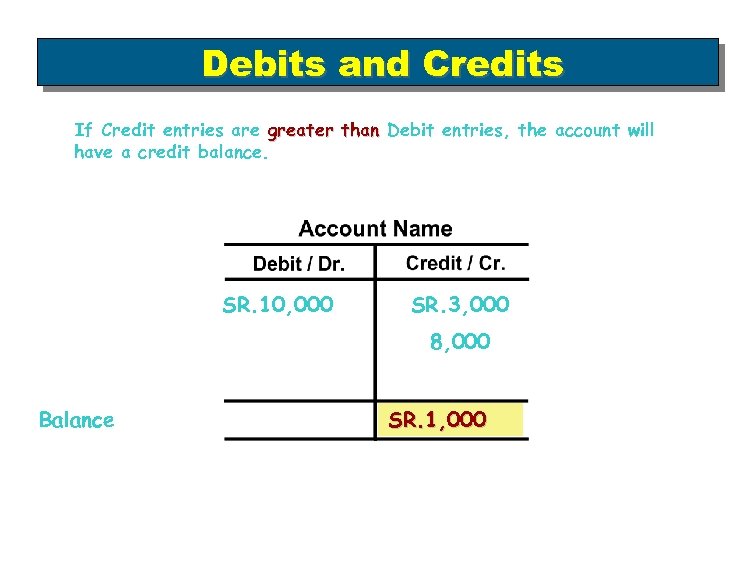
Debits and Credits If Credit entries are greater than Debit entries, the account will have a credit balance. SR. 10, 000 SR. 3, 000 8, 000 Balance SR. 1, 000
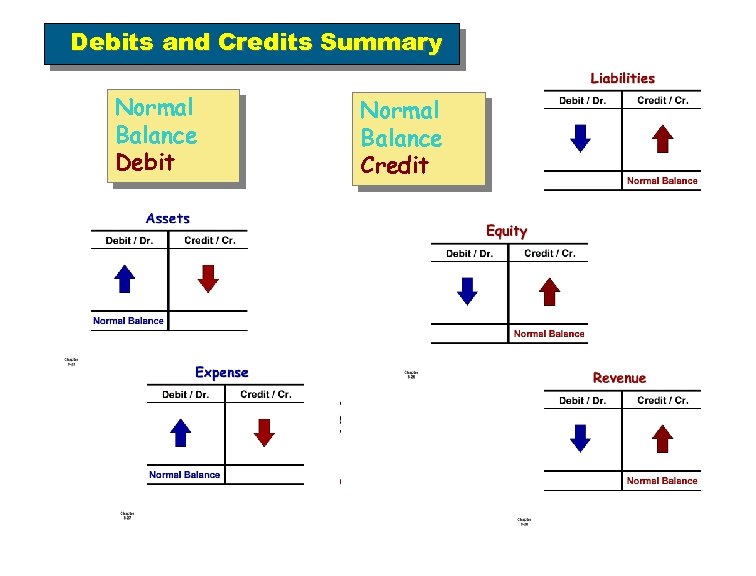
Debits and Credits Summary Normal Balance Debit Normal Balance Credit
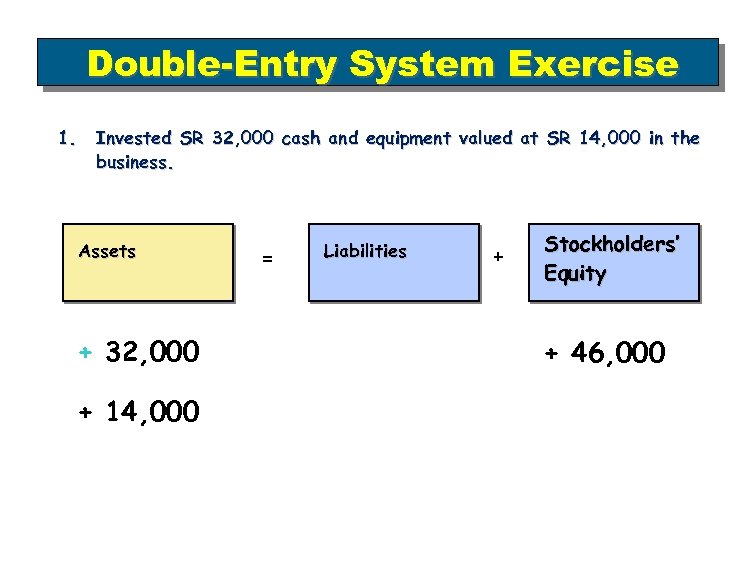
Double-Entry System Exercise 1. Invested SR 32, 000 cash and equipment valued at SR 14, 000 in the business. Assets + 32, 000 + 14, 000 = Liabilities + Stockholders’ Equity + 46, 000
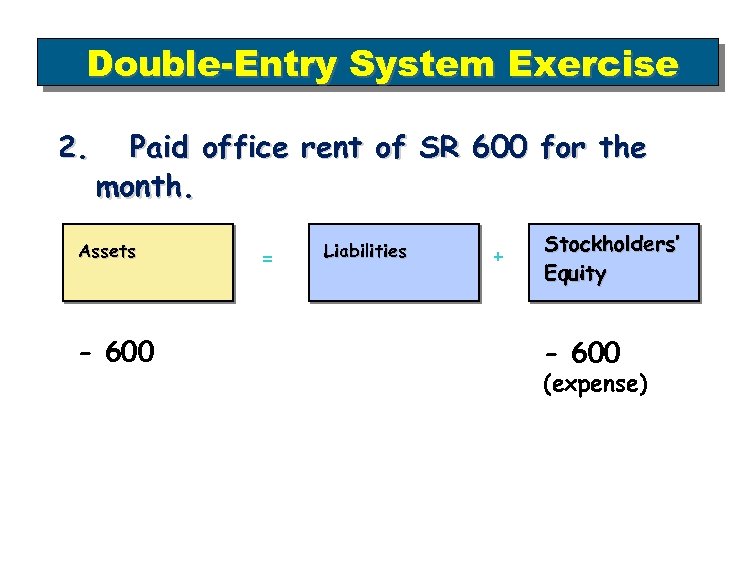
Double-Entry System Exercise 2. Paid office rent of SR 600 for the month. Assets - 600 = Liabilities + Stockholders’ Equity - 600 (expense)
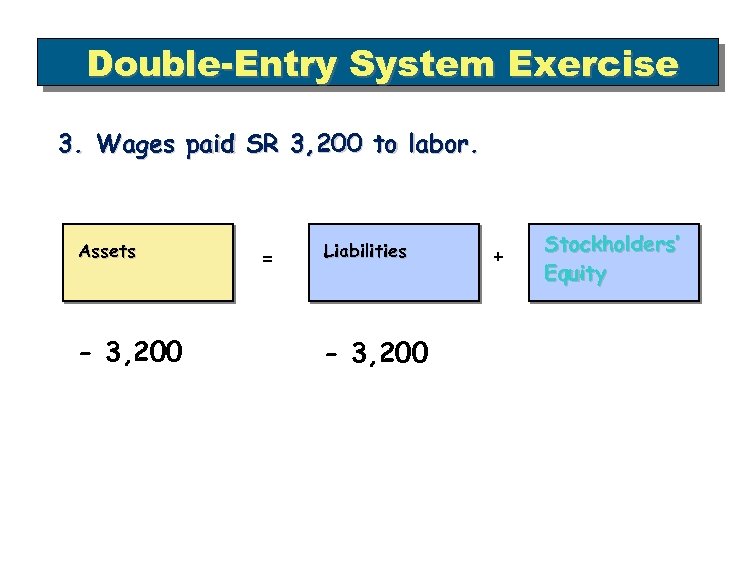
Double-Entry System Exercise 3. Wages paid SR 3, 200 to labor. Assets - 3, 200 = Liabilities - 3, 200 + Stockholders’ Equity
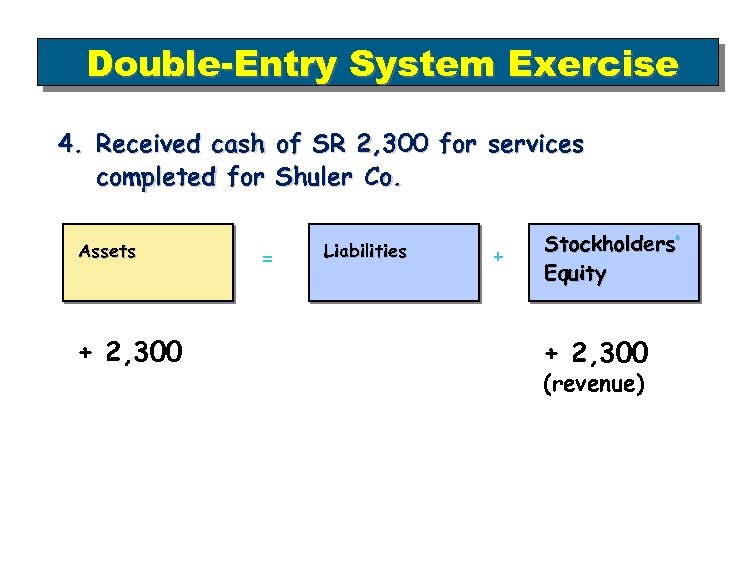
Double-Entry System Exercise 4. Received cash of SR 2, 300 for services completed for Shuler Co. Assets + 2, 300 = Liabilities + Stockholders’ Equity + 2, 300 (revenue)
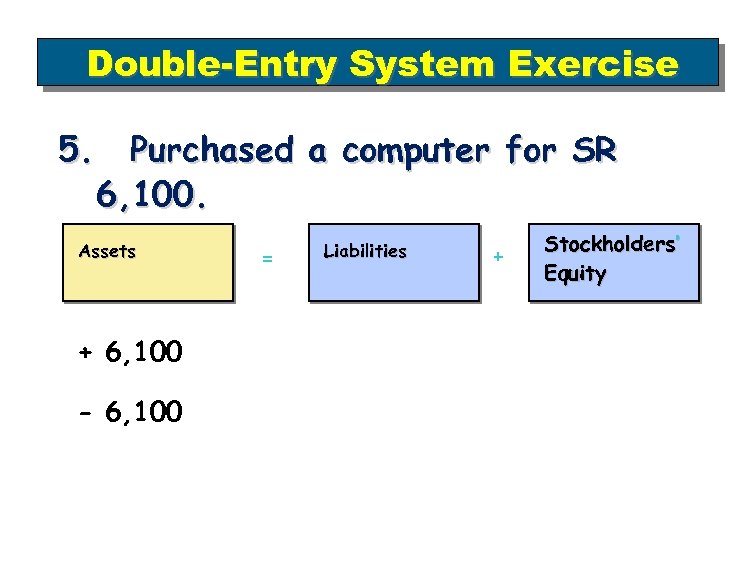
Double-Entry System Exercise 5. Purchased a computer for SR 6, 100. Assets + 6, 100 - 6, 100 = Liabilities + Stockholders’ Equity
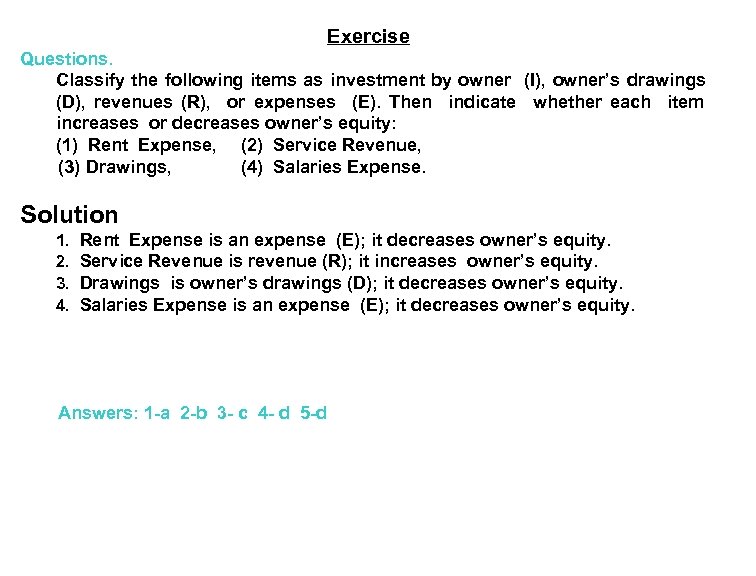
Exercise Questions. Classify the following items as investment by owner (I), owner’s drawings (D), revenues (R), or expenses (E). Then indicate whether each item increases or decreases owner’s equity: (1) Rent Expense, (2) Service Revenue, (3) Drawings, (4) Salaries Expense. Solution 1. Rent Expense is an expense (E); it decreases owner’s equity. 2. Service Revenue is revenue (R); it increases owner’s equity. 3. Drawings is owner’s drawings (D); it decreases owner’s equity. 4. Salaries Expense is an expense (E); it decreases owner’s equity. Answers: 1 -a 2 -b 3 - c 4 - d 5 -d
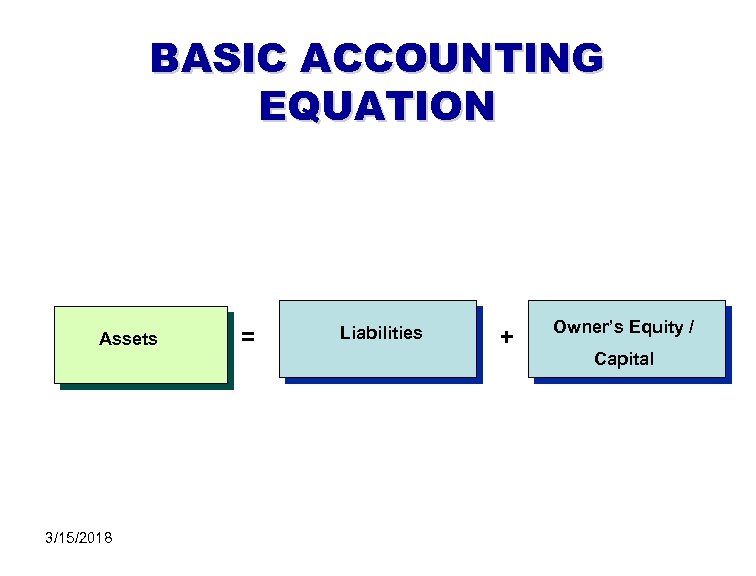
BASIC ACCOUNTING EQUATION Assets 3/15/2018 = Liabilities + Owner’s Equity / Capital
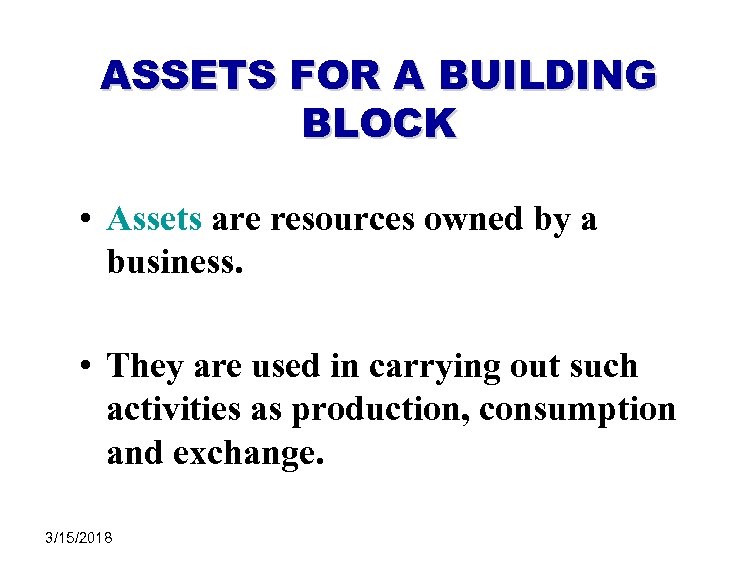
ASSETS FOR A BUILDING BLOCK • Assets are resources owned by a business. • They are used in carrying out such activities as production, consumption and exchange. 3/15/2018

LIABILITIES FOR A BUILDING BLOCK • Liabilities • are creditor claims against assets • are existing debts and obligations 3/15/2018
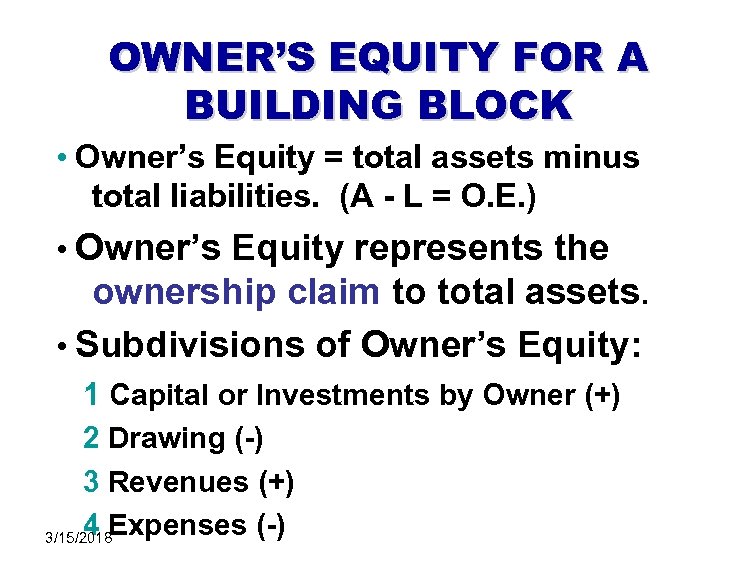
OWNER’S EQUITY FOR A BUILDING BLOCK • Owner’s Equity = total assets minus total liabilities. (A - L = O. E. ) • Owner’s Equity represents the ownership claim to total assets. • Subdivisions of Owner’s Equity: 1 Capital or Investments by Owner (+) 2 Drawing (-) 3 Revenues (+) 4 Expenses (-) 3/15/2018

INVESTMENTS BY OWNERS FOR A BUILDING BLOCK • Investments • are the assets the owner puts in the business • increase owner’s equity 3/15/2018
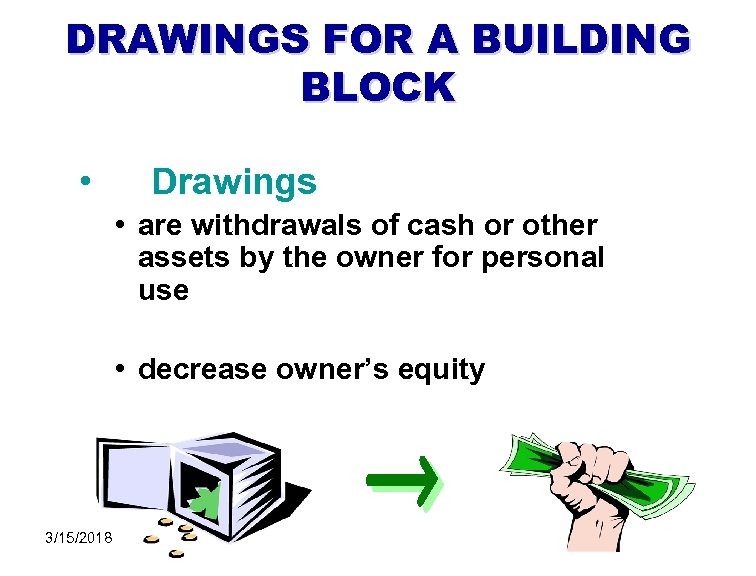
DRAWINGS FOR A BUILDING BLOCK • Drawings • are withdrawals of cash or other assets by the owner for personal use • decrease owner’s equity 3/15/2018
REVENUES FOR A BUILDING BLOCK • Revenues • gross increases in owner’s equity from business activities entered into for the purpose of earning income • may result from sale of merchandise, services, rental of property, or lending money • usually result in an increase in an asset 3/15/2018
EXPENSES FOR A BUILDING BLOCK Expenses • decreases in owner’s equity that result from operating the business • cost of assets consumed or services used in the process of earning revenue • examples: utility expense, rent expense, supplies expense, and tax expense 3/15/2018
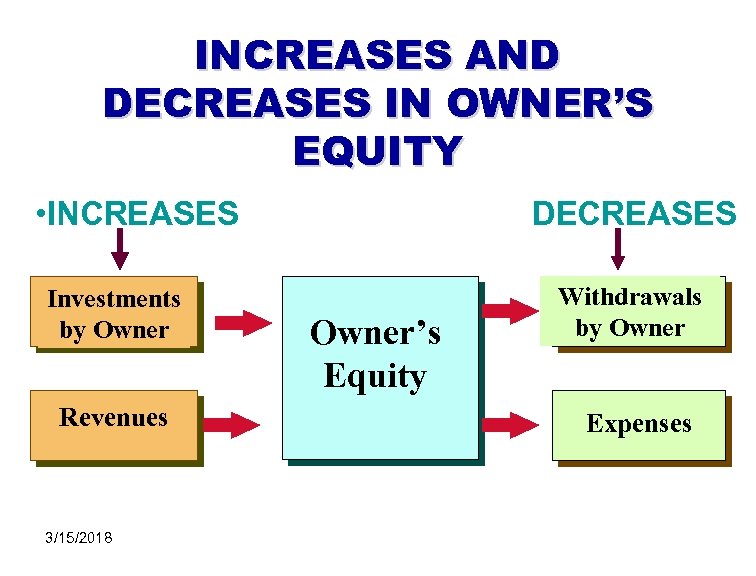
INCREASES AND DECREASES IN OWNER’S EQUITY • INCREASES DECREASES Investments by Owner Revenues 3/15/2018 Owner’s Equity Withdrawals by Owner Expenses
TRANSACTION ANALYSIS TRANSACTION 1 • Mr. Ray decides to open a computer programming service. • On September 1, he invests SR. 15, 000 cash in the business, which he names Soft touch 3/15/2018
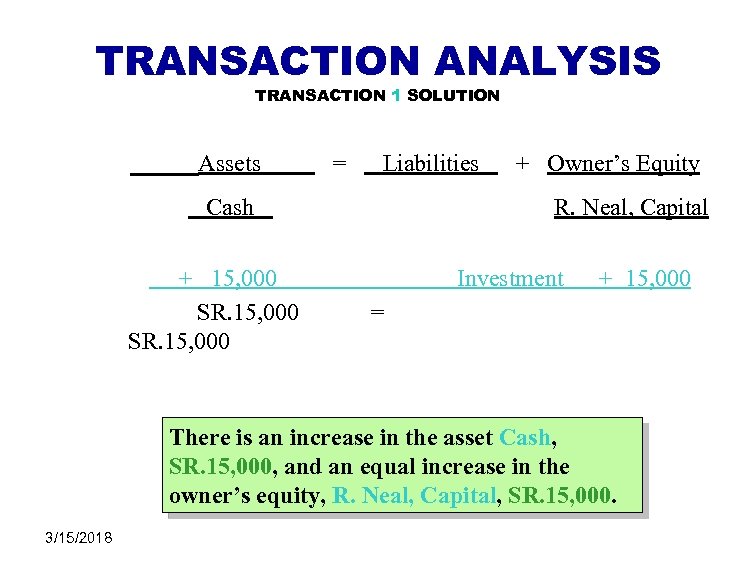
TRANSACTION ANALYSIS TRANSACTION 1 SOLUTION Assets = Liabilities Cash + 15, 000 SR. 15, 000 + Owner’s Equity R. Neal, Capital Investment + 15, 000 = There is an increase in the asset Cash, SR. 15, 000, and an equal increase in the owner’s equity, R. Neal, Capital, SR. 15, 000. 3/15/2018
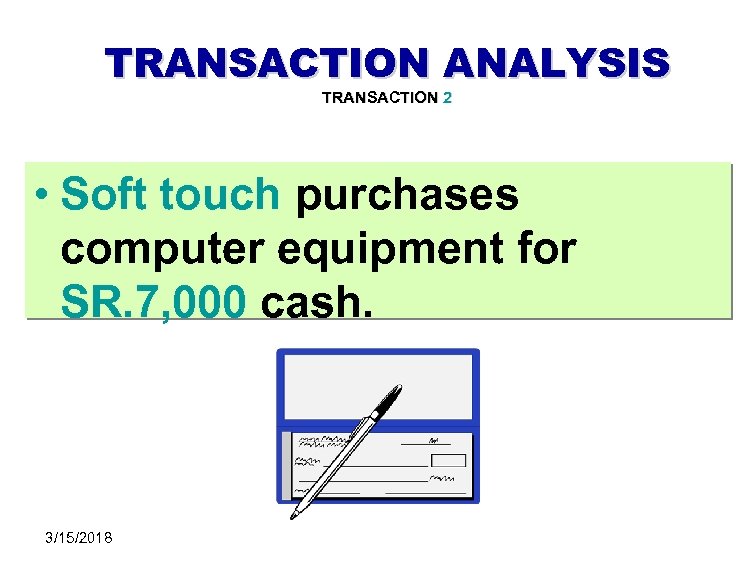
TRANSACTION ANALYSIS TRANSACTION 2 • Soft touch purchases computer equipment for SR. 7, 000 cash. 3/15/2018
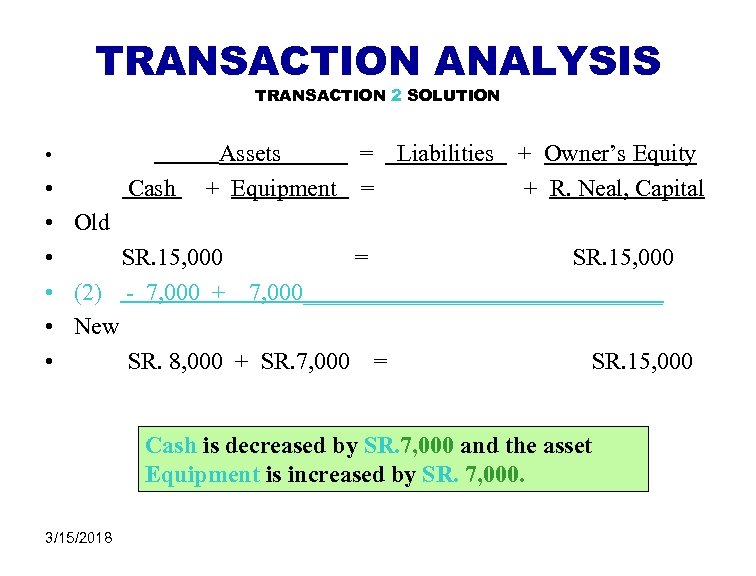
TRANSACTION ANALYSIS TRANSACTION 2 SOLUTION • Assets = Liabilities + Equipment = + Owner’s Equity + R. Neal, Capital • Cash • Old • SR. 15, 000 = SR. 15, 000 • (2) - 7, 000 + 7, 000_______________ • New • SR. 8, 000 + SR. 7, 000 = SR. 15, 000 Cash is decreased by SR. 7, 000 and the asset Equipment is increased by SR. 7, 000. 3/15/2018
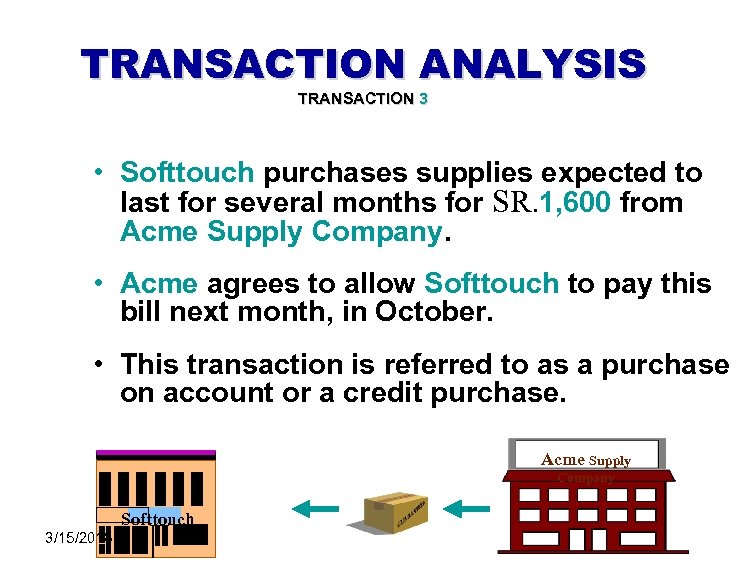
TRANSACTION ANALYSIS TRANSACTION 3 • Softtouch purchases supplies expected to last for several months for SR. 1, 600 from Acme Supply Company. • Acme agrees to allow Softtouch to pay this bill next month, in October. • This transaction is referred to as a purchase on account or a credit purchase. Acme Supply Company Softtouch 3/15/2018
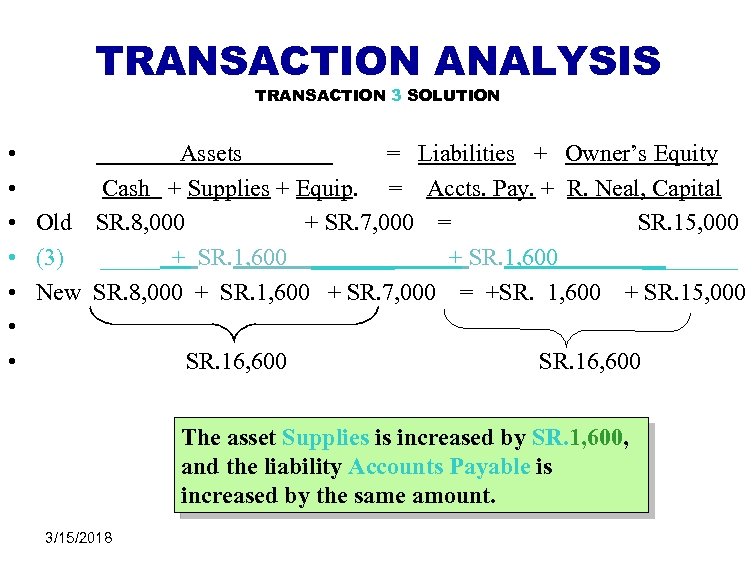
TRANSACTION ANALYSIS TRANSACTION 3 SOLUTION • Assets = Liabilities + Owner’s Equity • Cash + Supplies + Equip. = Accts. Pay. + R. Neal, Capital • Old SR. 8, 000 + SR. 7, 000 = SR. 15, 000 • (3) _____ + SR. 1, 600 ________ • New SR. 8, 000 + SR. 1, 600 + SR. 7, 000 = +SR. 1, 600 + SR. 15, 000 • • SR. 16, 600 The asset Supplies is increased by SR. 1, 600, and the liability Accounts Payable is increased by the same amount. 3/15/2018
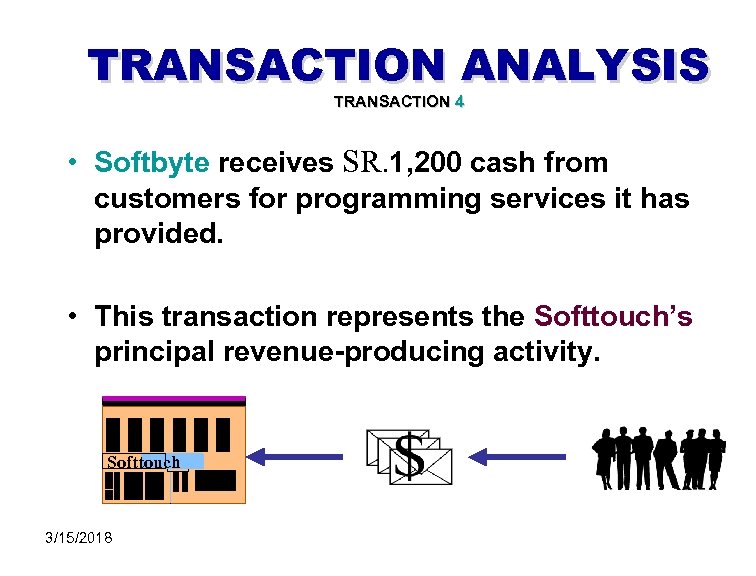
TRANSACTION ANALYSIS TRANSACTION 4 • Softbyte receives SR. 1, 200 cash from customers for programming services it has provided. • This transaction represents the Softtouch’s principal revenue-producing activity. Softtouch 3/15/2018
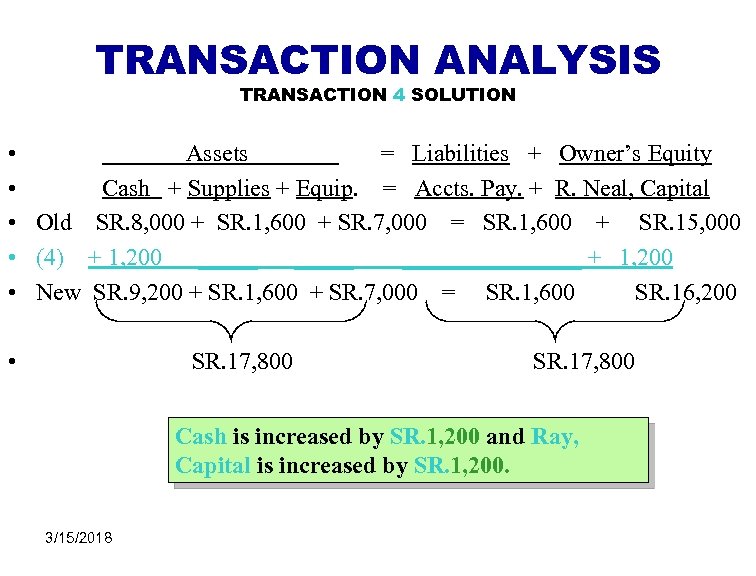
TRANSACTION ANALYSIS TRANSACTION 4 SOLUTION • Assets = Liabilities + Owner’s Equity • Cash + Supplies + Equip. = Accts. Pay. + R. Neal, Capital • Old SR. 8, 000 + SR. 1, 600 + SR. 7, 000 = SR. 1, 600 + SR. 15, 000 • (4) + 1, 200 ________ + 1, 200 • New SR. 9, 200 + SR. 1, 600 + SR. 7, 000 = SR. 1, 600 SR. 16, 200 • SR. 17, 800 Cash is increased by SR. 1, 200 and Ray, Capital is increased by SR. 1, 200. 3/15/2018
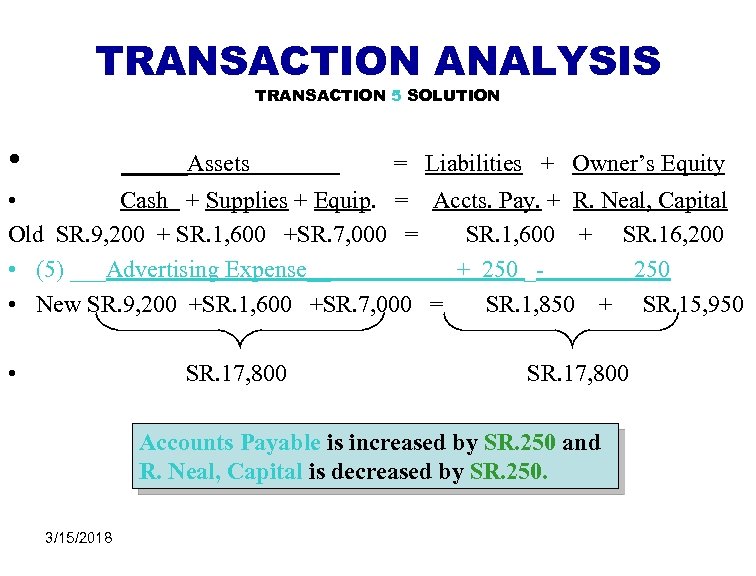
TRANSACTION ANALYSIS TRANSACTION 5 SOLUTION • Assets = Liabilities + Owner’s Equity • Cash + Supplies + Equip. = Accts. Pay. + R. Neal, Capital Old SR. 9, 200 + SR. 1, 600 +SR. 7, 000 = SR. 1, 600 + SR. 16, 200 • (5) ___Advertising Expense__ + 250 _250 • New SR. 9, 200 +SR. 1, 600 +SR. 7, 000 = SR. 1, 850 + SR. 15, 950 • SR. 17, 800 Accounts Payable is increased by SR. 250 and R. Neal, Capital is decreased by SR. 250. 3/15/2018
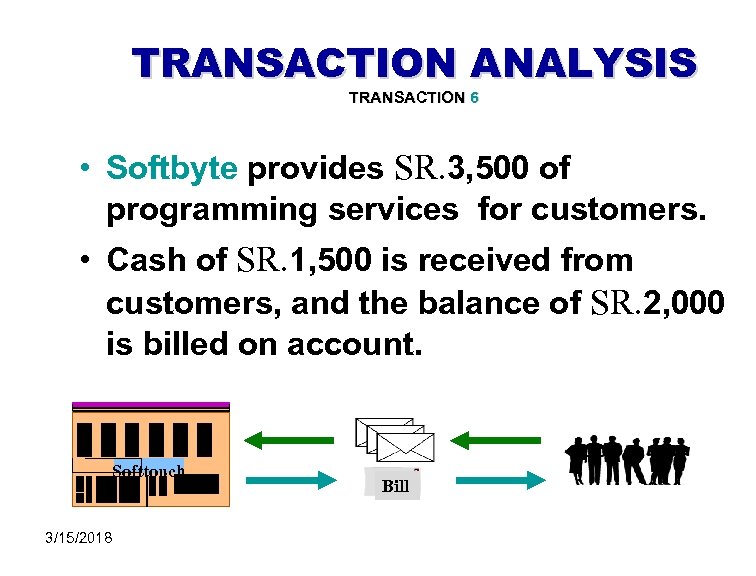
TRANSACTION ANALYSIS TRANSACTION 6 • Softbyte provides SR. 3, 500 of programming services for customers. • Cash of SR. 1, 500 is received from customers, and the balance of SR. 2, 000 is billed on account. Softtouch 3/15/2018 Bill
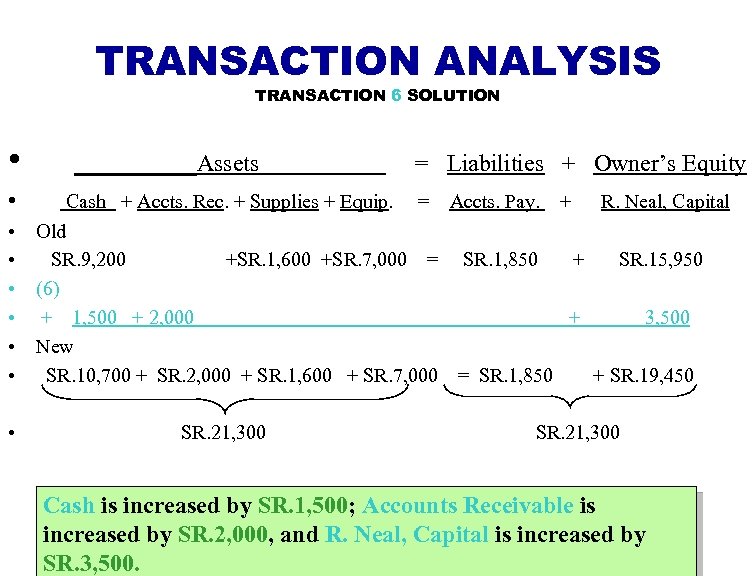
TRANSACTION ANALYSIS TRANSACTION 6 SOLUTION • Assets • Cash + Accts. Rec. + Supplies + Equip. • • = Liabilities + Owner’s Equity = Accts. Pay. + R. Neal, Capital Old SR. 9, 200 +SR. 1, 600 +SR. 7, 000 = SR. 1, 850 + SR. 15, 950 (6) + 1, 500 + 2, 000 + 3, 500 New SR. 10, 700 + SR. 2, 000 + SR. 1, 600 + SR. 7, 000 = SR. 1, 850 + SR. 19, 450 SR. 21, 300 Cash is increased by SR. 1, 500; Accounts Receivable is increased by SR. 2, 000, and R. Neal, Capital is increased by SR. 3, 500.
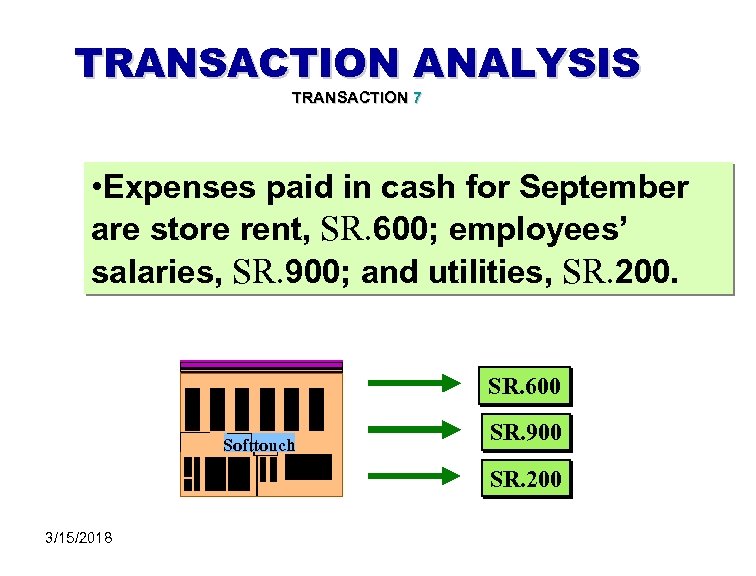
TRANSACTION ANALYSIS TRANSACTION 7 • Expenses paid in cash for September are store rent, SR. 600; employees’ salaries, SR. 900; and utilities, SR. 200. SR. 600 Softtouch SR. 900 SR. 200 3/15/2018
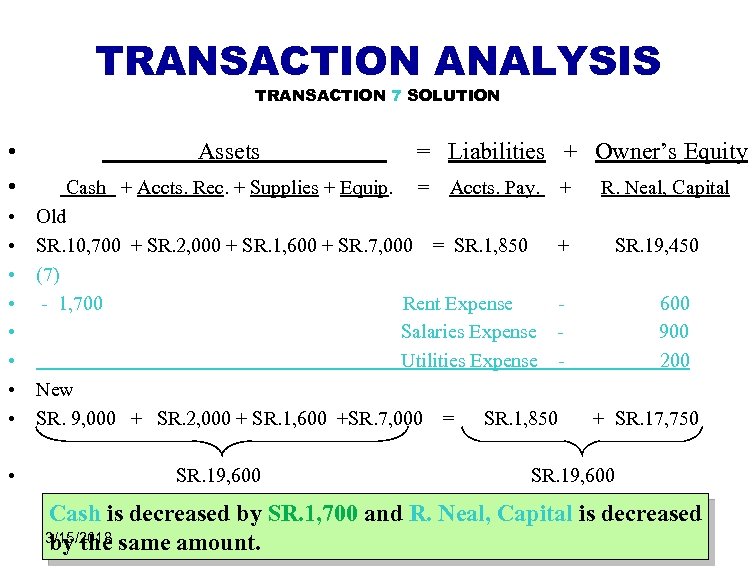
TRANSACTION ANALYSIS TRANSACTION 7 SOLUTION • • • Assets Cash + Accts. Rec. + Supplies + Equip. = Liabilities + Owner’s Equity = Accts. Pay. + Old SR. 10, 700 + SR. 2, 000 + SR. 1, 600 + SR. 7, 000 = SR. 1, 850 + (7) - 1, 700 Rent Expense Salaries Expense Utilities Expense New SR. 9, 000 + SR. 2, 000 + SR. 1, 600 +SR. 7, 000 = SR. 1, 850 SR. 19, 600 R. Neal, Capital SR. 19, 450 600 900 200 + SR. 17, 750 SR. 19, 600 Cash is decreased by SR. 1, 700 and R. Neal, Capital is decreased 3/15/2018 same amount. by the
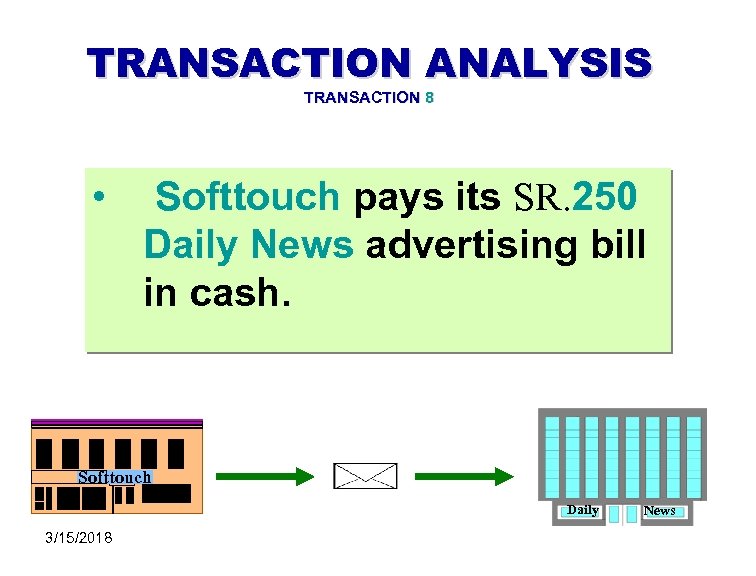
TRANSACTION ANALYSIS TRANSACTION 8 • Softtouch pays its SR. 250 Daily News advertising bill in cash. Softtouch Daily 3/15/2018 News
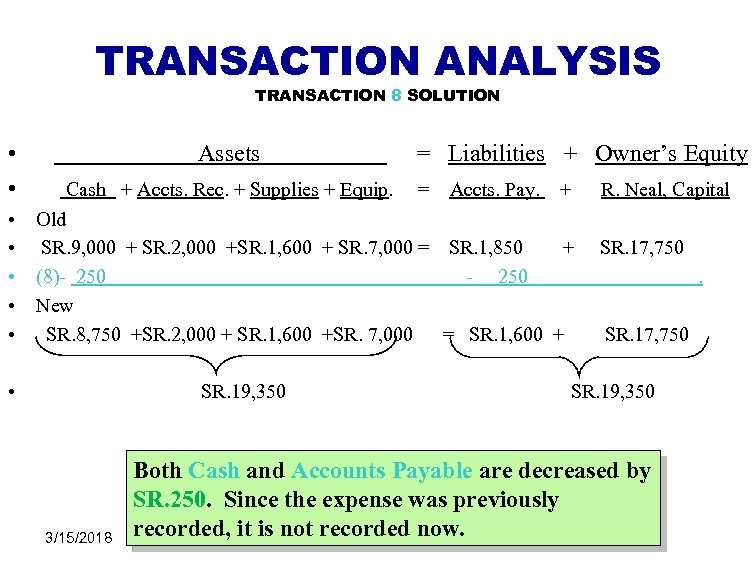
TRANSACTION ANALYSIS TRANSACTION 8 SOLUTION • • Assets Cash + Accts. Rec. + Supplies + Equip. = Liabilities + Owner’s Equity = Accts. Pay. + Old SR. 9, 000 + SR. 2, 000 +SR. 1, 600 + SR. 7, 000 = SR. 1, 850 + (8)- 250 New SR. 8, 750 +SR. 2, 000 + SR. 1, 600 +SR. 7, 000 = SR. 1, 600 + • SR. 19, 350 3/15/2018 R. Neal, Capital SR. 17, 750 SR. 19, 350 Both Cash and Accounts Payable are decreased by SR. 250. Since the expense was previously recorded, it is not recorded now.
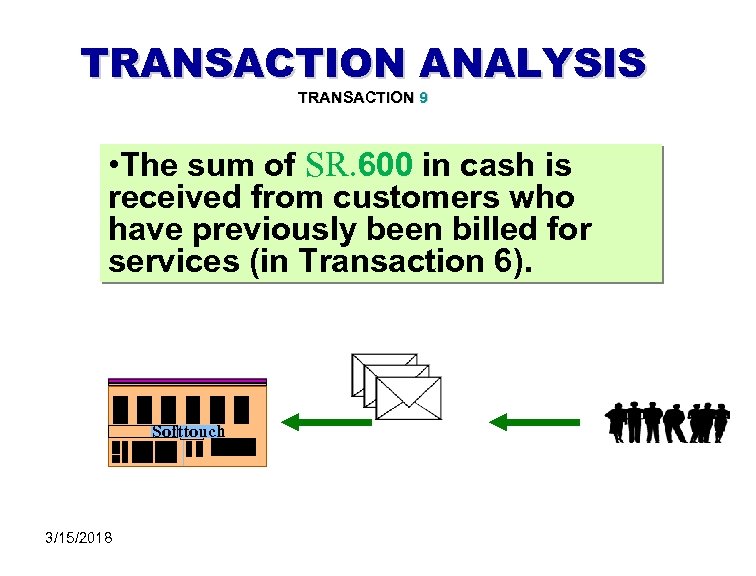
TRANSACTION ANALYSIS TRANSACTION 9 • The sum of SR. 600 in cash is received from customers who have previously been billed for services (in Transaction 6). Softtouch 3/15/2018
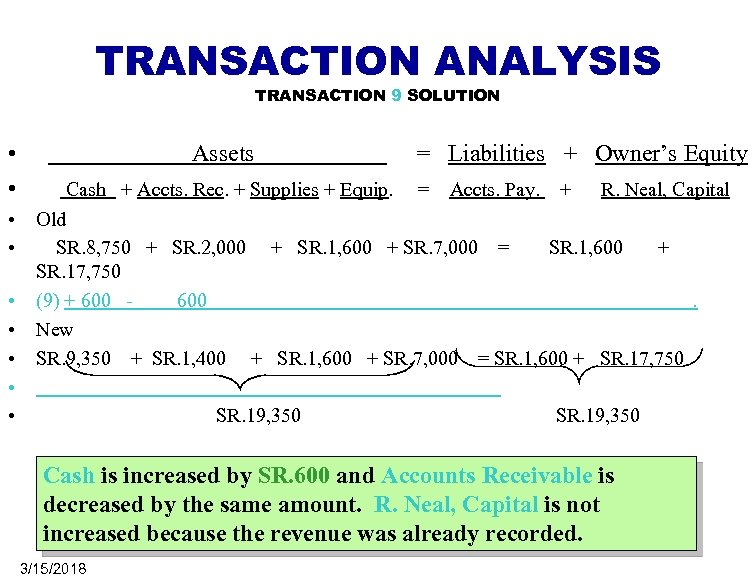
TRANSACTION ANALYSIS TRANSACTION 9 SOLUTION • • • Assets Cash + Accts. Rec. + Supplies + Equip. = Liabilities + Owner’s Equity = Accts. Pay. + R. Neal, Capital Old SR. 8, 750 + SR. 2, 000 + SR. 1, 600 + SR. 7, 000 = SR. 1, 600 + SR. 17, 750 (9) + 600. New SR. 9, 350 + SR. 1, 400 + SR. 1, 600 + SR. 7, 000 = SR. 1, 600 + SR. 17, 750 SR. 19, 350 Cash is increased by SR. 600 and Accounts Receivable is decreased by the same amount. R. Neal, Capital is not increased because the revenue was already recorded. 3/15/2018
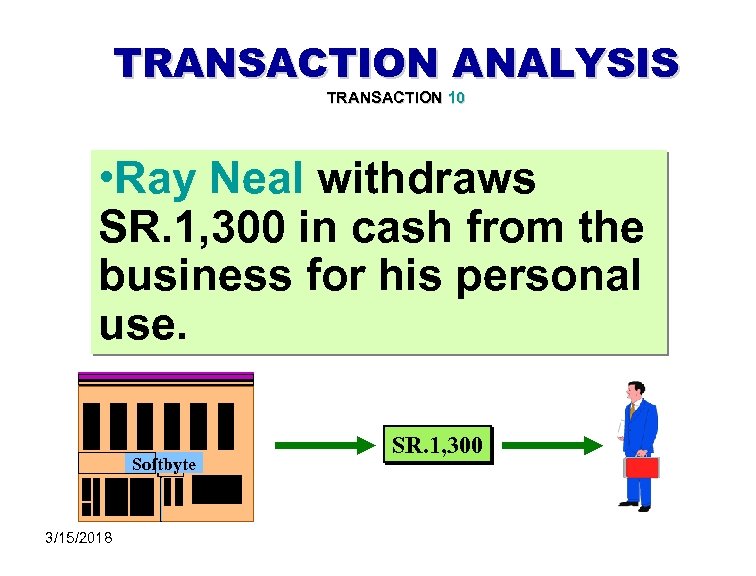
TRANSACTION ANALYSIS TRANSACTION 10 • Ray Neal withdraws SR. 1, 300 in cash from the business for his personal use. Softbyte 3/15/2018 SR. 1, 300
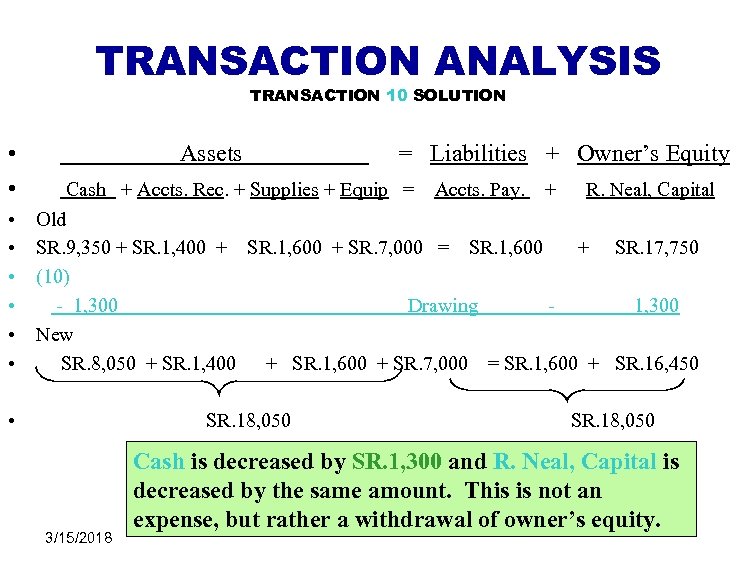
TRANSACTION ANALYSIS TRANSACTION 10 SOLUTION • • Assets = Liabilities + Owner’s Equity Cash + Accts. Rec. + Supplies + Equip = Accts. Pay. + R. Neal, Capital Old SR. 9, 350 + SR. 1, 400 + SR. 1, 600 + SR. 7, 000 = SR. 1, 600 + SR. 17, 750 (10) - 1, 300 Drawing 1, 300 New SR. 8, 050 + SR. 1, 400 + SR. 1, 600 + SR. 7, 000 = SR. 1, 600 + SR. 16, 450 • SR. 18, 050 3/15/2018 SR. 18, 050 Cash is decreased by SR. 1, 300 and R. Neal, Capital is decreased by the same amount. This is not an expense, but rather a withdrawal of owner’s equity.
Скачать презентацию UNIT-2 Acct — 103 College of Business Administration
843825ca5dba6703b02b5c41244811dd.ppt