


 Скачать презентацию Unit 2 Academic Creating the United States
f72e1e473a9b08eb4f708c70be060b05.ppt
- Количество слайдов: 52
 Unit 2 Academic Creating the United States
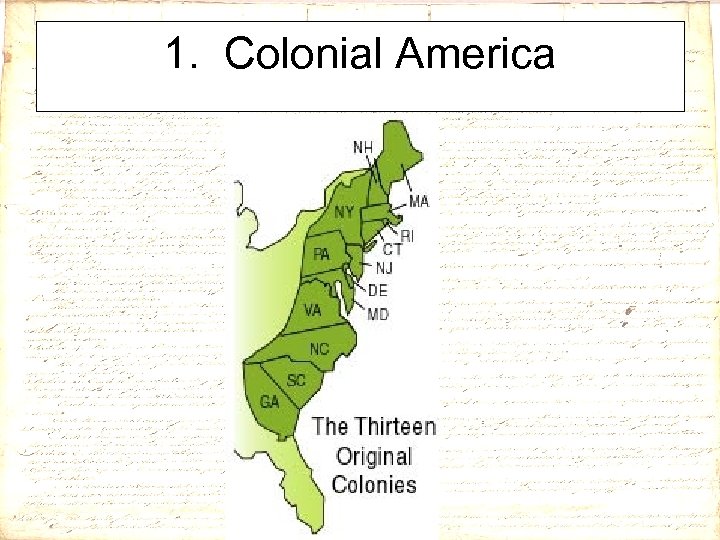 1. Colonial America
 A. Salutary Neglect i. Economic benefits a. Colonies run themselves (and pay for it) b. Little time or money required of England. ii. Colonial Charters a. Joint-Stock – Business owned. b. Royal – controlled by crown. c. Proprietary – Controlled by person or group.
 III. Reasons for Colonization 1. 2. 3. Economics a. Heavy taxes and debt plagued both rich and poor. b. Land ownership was difficult in densely packed Europe. c. Natural resources were abundant in New World. Religion a. Religious wars since the Reformation. b. Many nation-states were dominated by 1 religion, leaving little freedom for minority. c. Some Anglicans left after Charles I was executed. d. Puritans were afraid of persecution once Cromwell’s government fell. e. Quakers sought a new home with Penn. f. Catholics faced persecution throughout Northwestern Europe. Political a. Few people had rights in Europe. b. Nobles held most of the power. c. New World promised new leadership
 B. Colonial Examples i. Pennsylvania a. b. c. d. ii. 21 yr + white men who paid taxes could vote. Representatives had 1 year terms. Unicameral legislature. Many rights given by proprietor (William Penn) Virginia a. b. c. Originally Jamestown Colony. Joint-stock charter by Virginia Company. First elected legislature – House of Burgess.
 iii. Massachusetts a. Plymouth Bay Colony 1) Originally headed to Virginia, but blown off course. 2) Mayflower Compact signed establishing a right of the majority to rule. b. Massachusetts Bay Colony 1) 2) 3) 4) Headquarter in Boston. Many locally elected officials. Taxes paid to church. Eventually joined with Plymouth.
 2. Declaration of Independence
 A. Cause for Break i. French and Indian War a) 1754 -1763 b) French/Indians and British (Americans) attempt to take Ohio River Valley. c) British Prime Minister William Pitt takes out loans and heavily taxes English to win war. d) British win. ii. Proclamation of 1763 a) Peace with Natives. b) OR Valley is placed under military control. c) Americans – no moving west.
 A. Cause for Break iii. Who won the war? a) British - our military. b) Americans- our militia. iv. British want Americans to shoulder burden of debt. v. PM George Grenville = new taxes & laws to help the Americans take care of the military & debt.
 A. Cause for Break vi. Sugar Act 1764 – 1 st enforced. a) Smugglers tried in Admiralty Court b) NO JURY vii. Quartering Act 65’– colonists provide food & housing for troops. viii. Stamp Act 65’ – paper products must be stamped (costs $).
 B. Break Occurs i. Stamp Act Congress 65’ – delegates wrote protest to London. a) Englishman’s rights crushed. b) No taxation without representation. ii. iv. v. Boycotts of British products. Tax collectors tarred and feathered. 66’ Parliament repeals Stamp Act Declaratory Act – We can do what ever we want. vi. Townshend Act – tax on lead, tea, paint, etc 67’.
 B. Break Occurs vii. Boston Massacre – 11 American casualties when troops fire on crowd. viii. Tea Party – Patriots disguised as Indians throw tea over board. ix. Committees of Correspondence – Patriotic writings between colonies. x. Sons of Liberty had organized boycotts. xi. Coercive Acts – passed in anger to Boston. a) b) c) xii. Closed port at Boston. Eliminates most self-government of MA. Quebec Act – gives Ohio to the French-Canadians! First Continental Congress – Cont. boycotts, asks colonists to arm, sends Declaration of Resolves to plead Englishman’s rights.
 C. Violence Occurs i. April, 1775 – Battles of Lexington and Concord. ii. Second Continental Congress Meets a) Olive Branch Petition by John Dickinson asks for peace from king. b) King George III wants rebellion crushed. c) Declaration of Independence is written by Thomas Jefferson. d) Inspired by Enlightenment – John Locke’s ideas of basic rights (life, liberty, property).
 III. Articles of Confederation A. Alliance of States 1. Created in 1777 and adopted by the Continental Congress 2. Established a national government in 1781. 3. Legislative branch only. a. b. c. d. No executive State courts only States sent as many delegates as they wanted States only received one vote
 4. State Constitution a. Most states adopted a list of duties of the government b. Most states also adopted a “bill of rights. ”
 B. Trouble with the Articles 1. Economic hardships faced the nation a. America had $50 million debt. b. Continued to print worthless money. c. Many failed to pay back money owed to wealthy. d. Wealthy complained average citizens had too much power.
 2. Nationalists Arise a. b. c. d. Wanted to restrain unpredictable behavior of states. Feared lack of national courts and economic policy. Expressed concerns in newspapers. Included: i. George Washington ii. James Madison iii. Alexander Hamilton iv. Benjamin Franklin e. Feared America’s culture of challenging authority. f. European and Roman Republics had failed. g. Believed America should be a world model.
 3. Weaknesses of Articles of Confederation a. One vote for each states, no matter what size b. Congress cannot collect taxes c. Congress was powerless to regulate foreign and interstate commerce. d. No separate executive branch to enforce law. e. No national court to interpret law. f. Amendment only possible with unanimous approval. g. 9/13 majorities needed to pass laws. h. “Firm league of friendship. ”
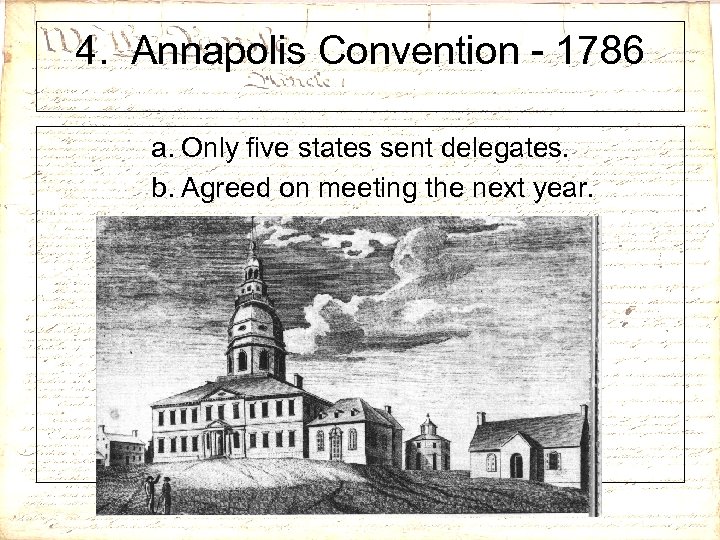 4. Annapolis Convention - 1786 a. Only five states sent delegates. b. Agreed on meeting the next year.
 C. Shays’ Rebellion 1. Daniel Shays the war veteran, led a revolt over unpaid bills and taxes. 2. Rebellion put down. 3. Prominent Americans saw need for order.
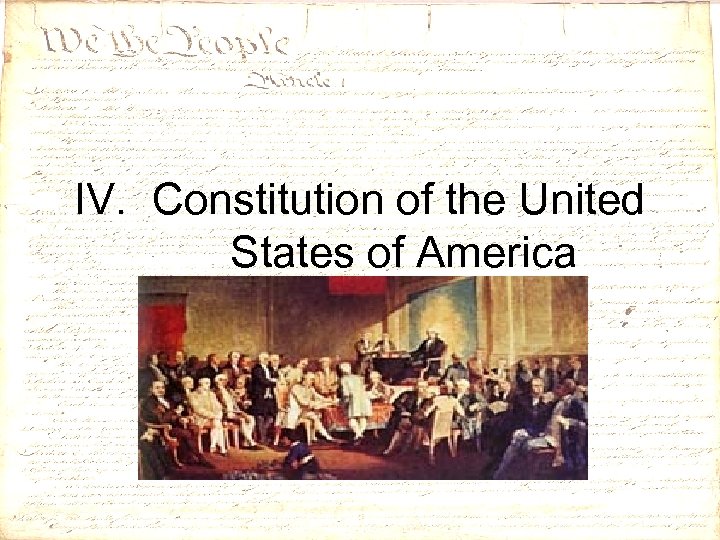 IV. Constitution of the United States of America
 A. Constitutional Convention 1. May – September 1787 2. Meetings kept secretive amongst the hot and humid summer. 3. 55 delegates. a. Familiar with Western philosophy b. Mostly wealthy planters & merchants c. Most were college graduates with some political experience d. Many were coastal residents from the larger cities, not the rural areas
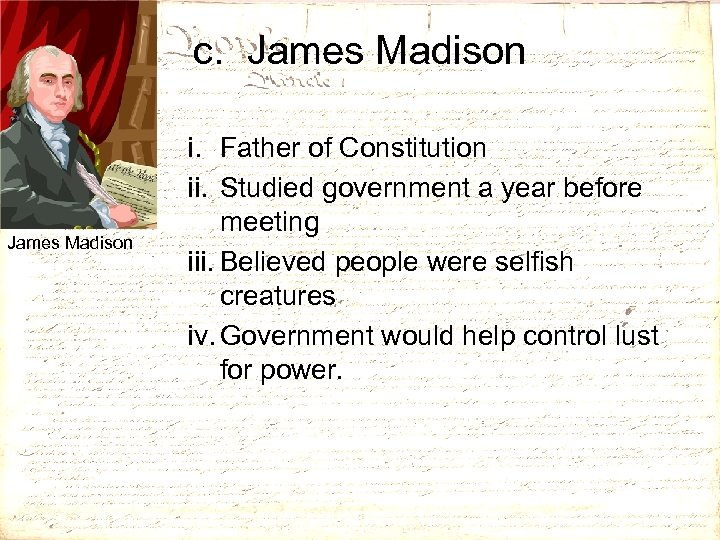 c. James Madison i. Father of Constitution ii. Studied government a year before meeting iii. Believed people were selfish creatures iv. Government would help control lust for power.
 4. Debate would ensue throughout convention a. Amend Articles of Confederation vs. start from scratch i. Federalists wanted new, central government ii. Anti-federalists wanted Articles with strong state governments iii. Federalists dominated and Articles were dropped.
 b. Big vs. Small States i. a) b) ii. Virginia Plan Executive and judicial branch would exist. legislature proportional to population New Jersey Plan – every state gets and equal vote.
 iii. Great Compromise a) Bicameral legislature b) Lower House – House of Representatives by population c) Upper House – Senate by states
 c. Slaves to be counted or not? a) Southerners want slaves to be counted so representation to House would be greater b) Northerners opposed c) Three-Fifths Compromise d) 3/5 counted e) Slaves - no rights
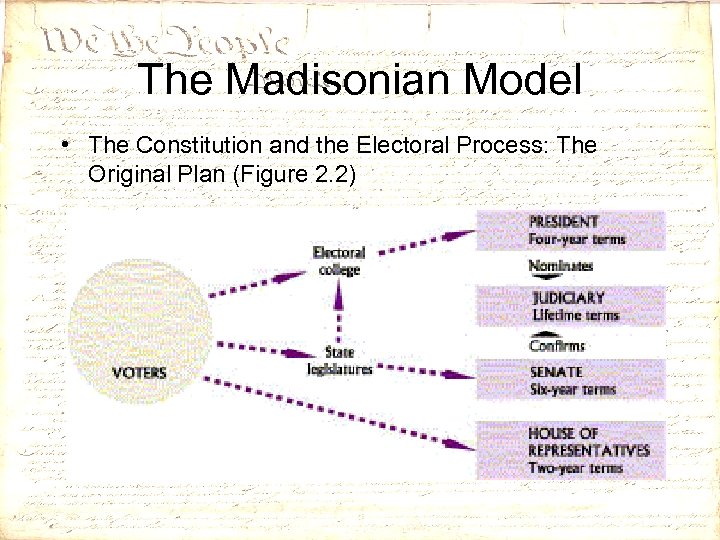 The Madisonian Model • The Constitution and the Electoral Process: The Original Plan (Figure 2. 2)
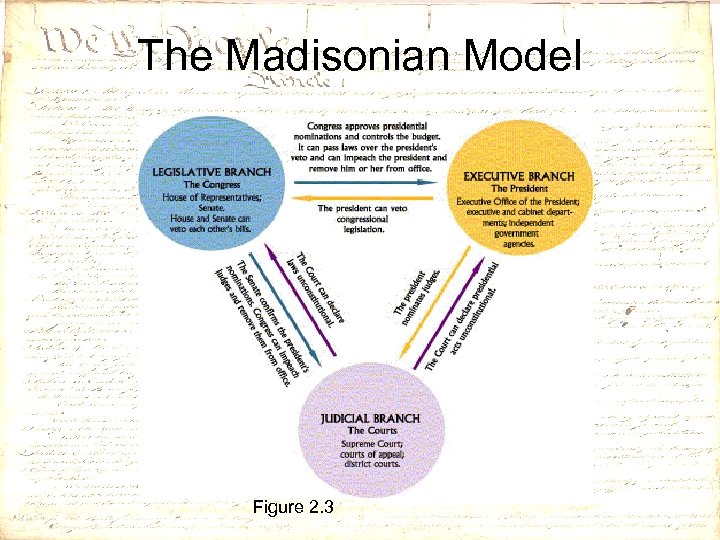 The Madisonian Model Figure 2. 3
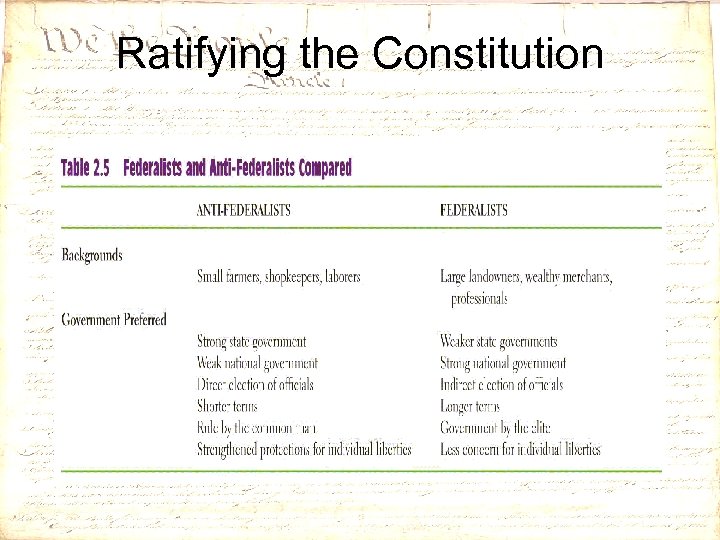 Ratifying the Constitution
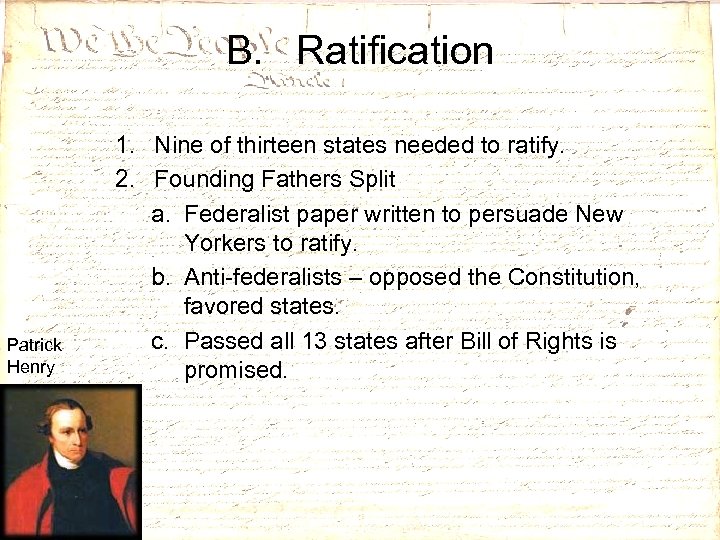 B. Ratification Patrick Henry 1. Nine of thirteen states needed to ratify. 2. Founding Fathers Split a. Federalist paper written to persuade New Yorkers to ratify. b. Anti-federalists – opposed the Constitution, favored states. c. Passed all 13 states after Bill of Rights is promised.
 C. Federalists Convince the States a. Articles were weak. b. Federalists had a plan. c. Federalists were well organized. d. George Washington, national hero, backed the Constitution.
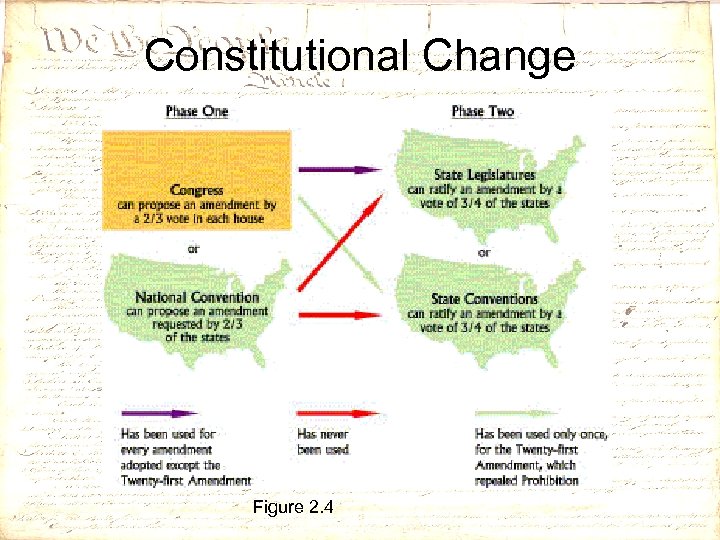 Constitutional Change Figure 2. 4
 D. Bill of Rights a. Added to appease the Anti-Federalists that freedoms would be protected. b. Federalists believed government was “by the people, ” so the people had nothing to fear. c. Concrete, yet debatable set of rules.
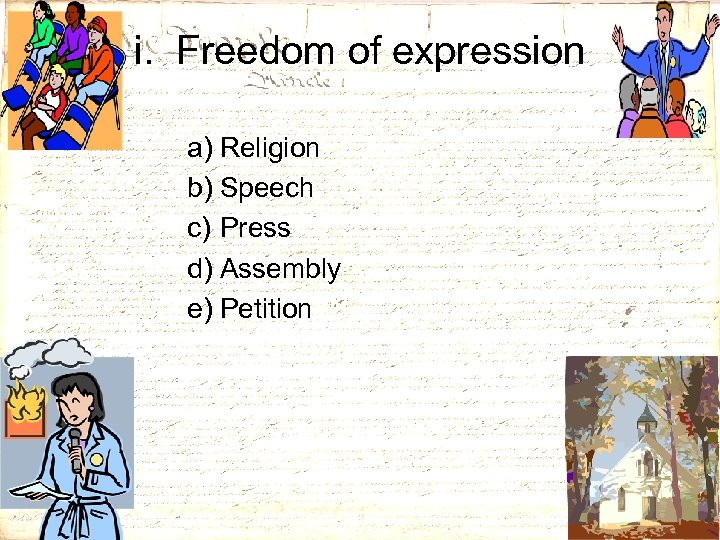 i. Freedom of expression a) Religion b) Speech c) Press d) Assembly e) Petition
 Freedom of Religion • The Establishment Clause – “Congress shall make no law respecting the establishment of religion. ” • The Free Exercise Clause – Prohibits government from interfering with the practice of religion – Some religious practices may conflict with other rights, and then be denied or punished
 Freedom of Expression • Prior Restraint – Definition: A government preventing material from being published. Censorship. – May be permissible during wartime. – May be punished after something is published.
 Freedom of Expression • Free Speech and Public Order – Limited if it presents a “clear and present danger” – Permissible to advocate the violent overthrow of government in abstract, but not to incite anyone to imminent lawless action – Limited if on private property, like a shopping center
 Freedom of Expression • Free Press and Fair Trials – The public has a right to know what happens. – The press’ own information may not be protected. – Shield laws
 Freedom of Expression • Obscenity – No clear definition on what constitutes obscenity. – Miller v. California stated that materials were obscene if the work: • appeals “to a prurient interest in sex” • showed “patently offensive” sexual conduct • lacks “serious literary, artistic, political or scientific value” – Local areas make their own decisions on obscenity
 Freedom of Expression • Libel and Slander – Libel: The publication of false or malicious statements that damage someone’s reputation. – Slander: The same thing, only spoken instead of printed. – Different standards for private individuals and public (politicians, celebrities) individuals – Difficult to prove
 Freedom of Expression • Symbolic Speech – Definition: Nonverbal communication, such as burning a flag or wearing an armband. – Generally protected along with verbal speech.
 Freedom of Expression • Commercial Speech – Definition: Communication in the form of advertising. – Generally the most restricted and regulated form of speech (FTC). • Regulation of the Public Airwaves – Broadcast stations must follow FCC rules. – Cable / satellite has blurred the lines.
 Freedom of Expression • Freedom of Assembly – Right to Assemble • Generally permissible, but must meet reasonable local standards. • Balance between freedom to assemble and order in society. – Right to Associate • Freedom to join groups / associations without government interference.
 ii. Militia and right to bear arms* iii. No quartering of soldiers during peace. iv. Search and seizure – warrants required.
 Defendants’ Rights • Searches and Seizures – Probable Cause: The situation occurring when the police have reason to believe that a person should be arrested. – Unreasonable searches and seizures: Evidence is obtained in a haphazard or random manner. – Exclusionary Rule: The rule that evidence, no matter how incriminating, cannot be introduced into trial if it was not constitutionally obtained.
 iv. Cannot testify against oneself, no double jeopardy, natural rights cannot be taken without due process of law, property cannot be taken without payment.
 Defendants’ Rights • Self-Incrimination – Definition: The situation occurring when an individual accused of a crime is compelled to be a witness against himself or herself in court. – Fifth Amendment – Miranda warnings – Entrapments may be overturned
 vi. Speedy & public trial, accused, right to examine and provide witnesses, right to counsel. vii. Trial by jury. viii. No excessive fines, bail, or cruel and unusual punishment.
 Defendants’ Rights • The Right to Counsel – The state must provide lawyers in most criminal cases. – Sixth Amendment • Trials – Plea bargaining: An actual bargain between the prosecution and defense. – Juries generally consist of 12 people, but unanimity is not always needed to convict.
 Defendants’ Rights • Cruel and Unusual Punishment – The Eighth Amendment forbids cruel and unusual punishment. – The Death Penalty • Varies from state to state • Cannot be mandatory
 ix. Rights not in the Constitution are allowed. x. Powers not in the Constitution are for the states.