


 Скачать презентацию UNIT 16 Federal Legislative Power in the USA
b6c79d25b122e78b0171302d307ed200.ppt
- Количество слайдов: 27
 UNIT 16 Federal Legislative Power in the USA The American Presidency
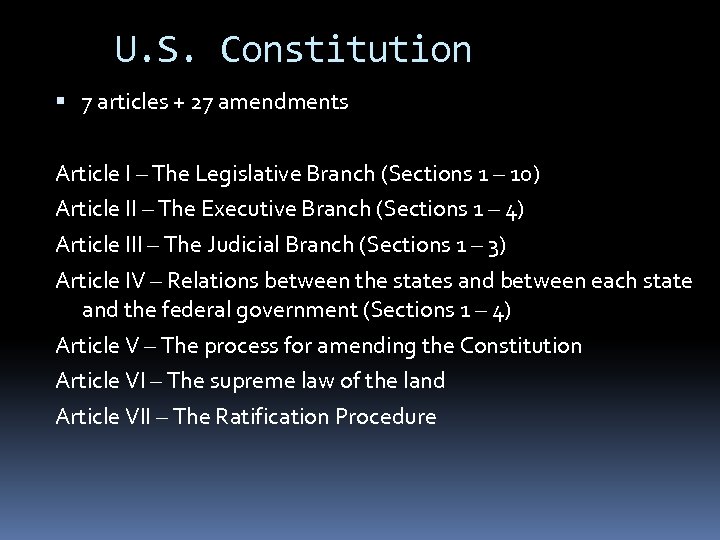 U. S. Constitution 7 articles + 27 amendments Article I – The Legislative Branch (Sections 1 – 10) Article II – The Executive Branch (Sections 1 – 4) Article III – The Judicial Branch (Sections 1 – 3) Article IV – Relations between the states and between each state and the federal government (Sections 1 – 4) Article V – The process for amending the Constitution Article VI – The supreme law of the land Article VII – The Ratification Procedure
 The LEGISLATIVE BRANCH Watch the following video clip and take notes on the structure and powers of the US legislature: http//video. about. com/video/Overview-of-the-Legislative. Branch. htm
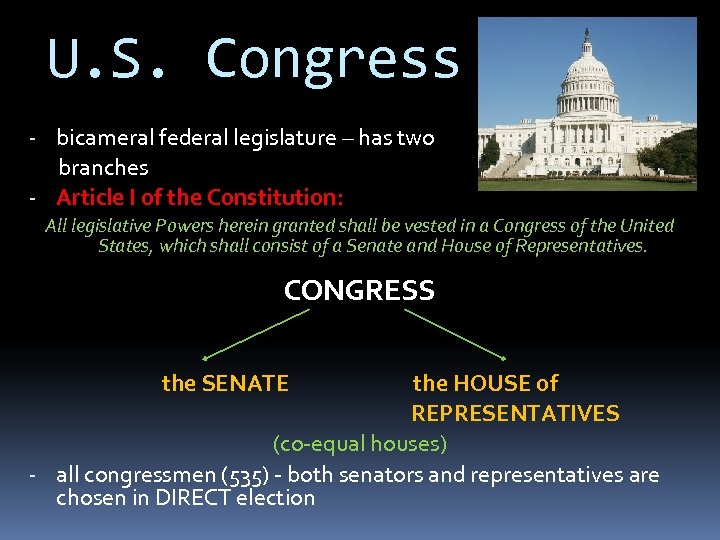 U. S. Congress - bicameral federal legislature – has two branches - Article I of the Constitution: All legislative Powers herein granted shall be vested in a Congress of the United States, which shall consist of a Senate and House of Representatives. CONGRESS the SENATE the HOUSE of REPRESENTATIVES (co-equal houses) - all congressmen (535) - both senators and representatives are chosen in DIRECT election
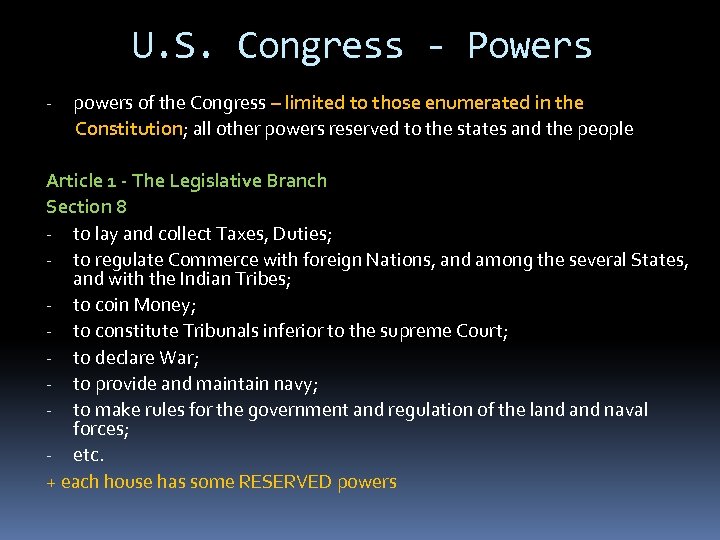 U. S. Congress - Powers - powers of the Congress – limited to those enumerated in the Constitution; all other powers reserved to the states and the people Article 1 - The Legislative Branch Section 8 - to lay and collect Taxes, Duties; - to regulate Commerce with foreign Nations, and among the several States, and with the Indian Tribes; - to coin Money; - to constitute Tribunals inferior to the supreme Court; - to declare War; - to provide and maintain navy; - to make rules for the government and regulation of the land naval forces; - etc. + each house has some RESERVED powers
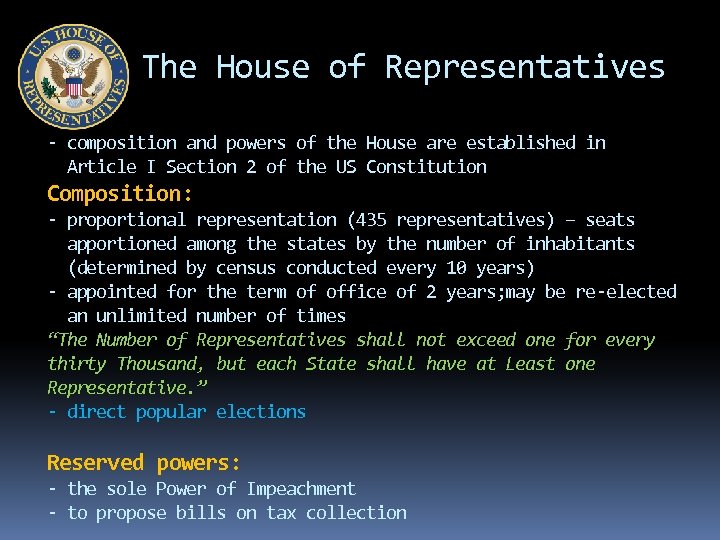 The House of Representatives - composition and powers of the House are established in Article I Section 2 of the US Constitution Composition: - proportional representation (435 representatives) – seats apportioned among the states by the number of inhabitants (determined by census conducted every 10 years) - appointed for the term of office of 2 years; may be re-elected an unlimited number of times “The Number of Representatives shall not exceed one for every thirty Thousand, but each State shall have at Least one Representative. ” - direct popular elections Reserved powers: - the sole Power of Impeachment - to propose bills on tax collection
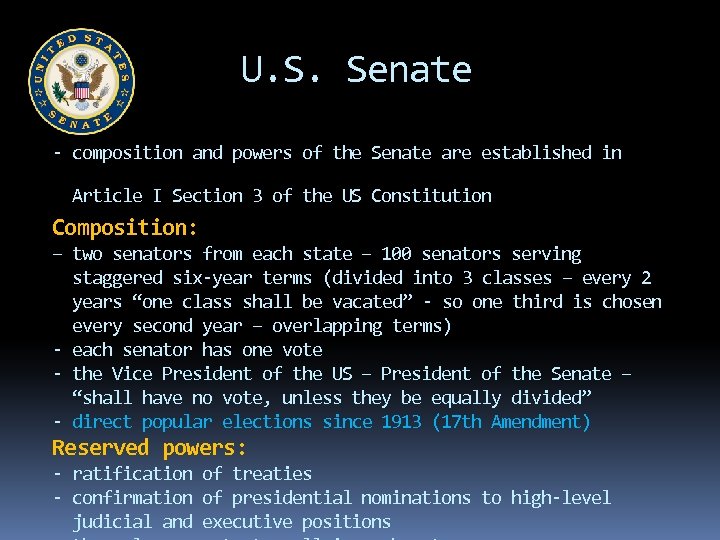 U. S. Senate - composition and powers of the Senate are established in Article I Section 3 of the US Constitution Composition: – two senators from each state – 100 senators serving staggered six-year terms (divided into 3 classes – every 2 years “one class shall be vacated” - so one third is chosen every second year – overlapping terms) - each senator has one vote - the Vice President of the US – President of the Senate – “shall have no vote, unless they be equally divided” - direct popular elections since 1913 (17 th Amendment) Reserved powers: - ratification of treaties - confirmation of presidential nominations to high-level judicial and executive positions
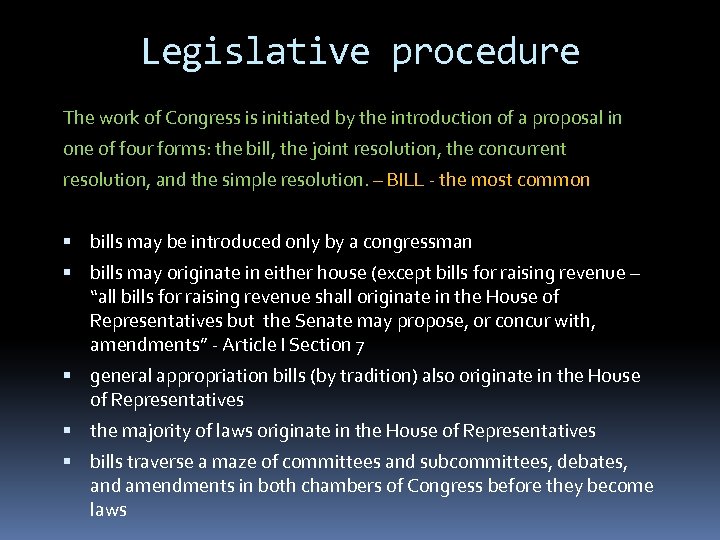 Legislative procedure The work of Congress is initiated by the introduction of a proposal in one of four forms: the bill, the joint resolution, the concurrent resolution, and the simple resolution. – BILL - the most common bills may be introduced only by a congressman bills may originate in either house (except bills for raising revenue – “all bills for raising revenue shall originate in the House of Representatives but the Senate may propose, or concur with, amendments” - Article I Section 7 general appropriation bills (by tradition) also originate in the House of Representatives the majority of laws originate in the House of Representatives bills traverse a maze of committees and subcommittees, debates, and amendments in both chambers of Congress before they become laws
 Legislative procedure There are two types of bills a) PUBLIC - affects the population at large b) PRIVATE - affects a specified individual or a private entity A bill that has been agreed to in identical form by both bodies becomes the law of the land only after: 1. Presidential APPROVAL 2. failure by the President to return it with objections to the House in which it originated within 10 days (Sundays excluded) while Congress is in session – POCKET VETO ( an indirect veto) 3. the overriding of a presidential VETO by a two-thirds vote in each House
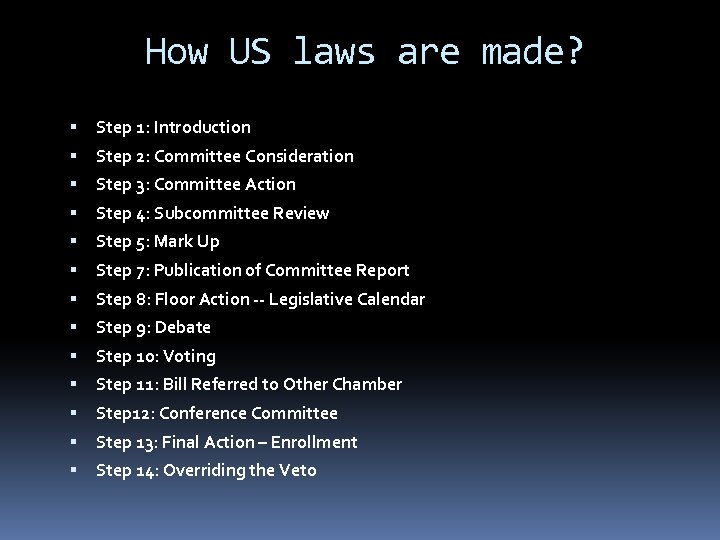 How US laws are made? Step 1: Introduction Step 2: Committee Consideration Step 3: Committee Action Step 4: Subcommittee Review Step 5: Mark Up Step 7: Publication of Committee Report Step 8: Floor Action -- Legislative Calendar Step 9: Debate Step 10: Voting Step 11: Bill Referred to Other Chamber Step 12: Conference Committee Step 13: Final Action – Enrollment Step 14: Overriding the Veto
 Vocabulary practice Complete the text about the United States Congress using the terms given below: bicameral, vote, state, entitled, direct, term, passage, authority, elected, legislature, senators The United States Congress is the ______ of the United States federal government. It is ______, comprising the House of Representatives (or simply the House) and the Senate. Each _____ is represented in the House proportionally to its population, and is ______ to at least one representative. The total number of representatives is currently fixed at 435, though Congress has the ____ to change that number. Each representative serves for a two-year ____ and may be re-elected an unlimited number of times. The House is often considered to be the "lower house, " with the Senate as the "upper house, " although the United States Constitution does not use such language. The Constitution provides that the approval of both houses is necessary for the ______ of legislation.
 Vocabulary practice – cont. Complete the text about the United States Congress using the terms given below: bicameral, vote, state, entitled, direct, term, passage, authority, elected, legislature, senators In the Senate, each state has two _____. Therefore, there are 100 senators, serving staggered six-year terms. Every two years, approximately one-third of the Senate is _____. The Vice President of the United States is the President of the Senate and serves as its presiding officer, but is not a Senator and does not _______. Both Senators and Representatives are chosen through _____ election.
 Vocabulary practice Insert the right verb: sign veto introduce draft approve originate vote on report take 1. Members of the president’s staff may _______ a bill and ask a congressman to ____ it. 2. Bills may _____ either in the House or in the Senate. 3. A bill submitted to the House is ______. 4. If the bill is ______ out of committee it is submitted to the Senate for a vote which may be ______ with or without debate. 5. If the Senate does not change the bill and if a majority _____ , the bill goes to the president for signing. 6. A bill becomes a law if the president ______ it. 7. If the president ______ a bill, two thirds of both House and Senate must approve it again before it becomes a law.
 The EXECUTIVE BRANCH
 The President of the U. S. Article II. of the Constitution: “The executive Power shall be vested in a President of the United States” - Holds office for the term of 4 years, since 1951 limited to two terms - Can be removed from office only on Impeachment Requirements for presidential candidates - must be at least 35 years of age - must be a natural born citizen - must have lived in the USA for at least 14 years
 U. S. Presidential Election - Since 1804 conducted under the Twelfth Amendment (provides the procedure by which the President and Vice President are elected) - Regulated by federal and state laws INDIRECT ELECTION ELECTORAL VOTE – voters vote for members of the U. S. Electoral College - directly elects the President and the Vice President on Election Day (the Tuesday between November 2 nd and 8 th) POPULAR VOTE – each state votes for members of the Electoral College; if one votes for the Republican candidate, he/she really votes for an elector who will be "pledged" to vote for the Republican candidate - the candidate who wins the popular vote in a state wins all the pledged votes of the state's electors – people vote “for the electors of a candidate”
 Electoral College Directly elects the President and Vice President Electors in the College – each state allocated a number of electors equal to the number of its representatives in Congress (House+Senate) + Washington DC (the same number of Electors as the state with the smallest population ) States determine by their state legislation how their electors are to be chosen - generally selected by the political party committees within the states Electors - vote for the candidates they have pledged for (designated candidates) The states and the District of Columbia each conduct their own popular elections on Election Day Do you understand the Electoral College? Watch the video at the following link: https: //www. youtube. com/watch? v=V 6 s 7 j. B 6 -Go. U
 Powers of the U. S. President Read the text in the book and find the powers of the US President. Sort them out under the following headings: Executive powers: _______________ _______________________ Powers related to legislation: ___________ _______________________ Powers related to judiciary: ____________ _______________________
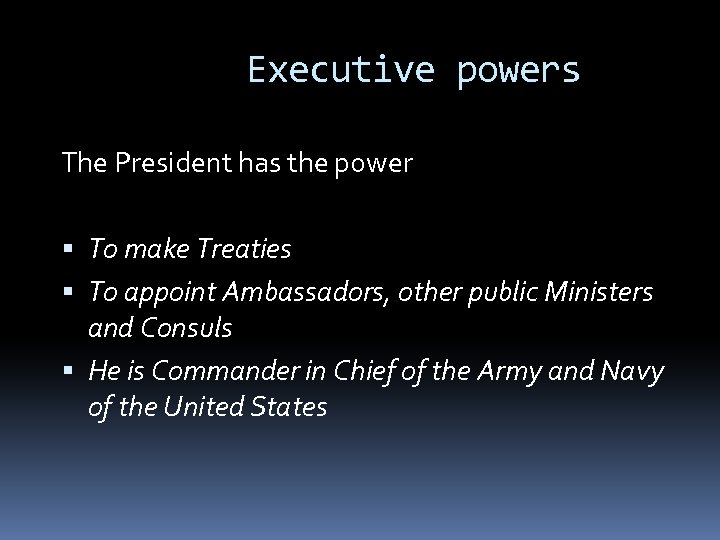 Executive powers The President has the power To make Treaties To appoint Ambassadors, other public Ministers and Consuls He is Commander in Chief of the Army and Navy of the United States
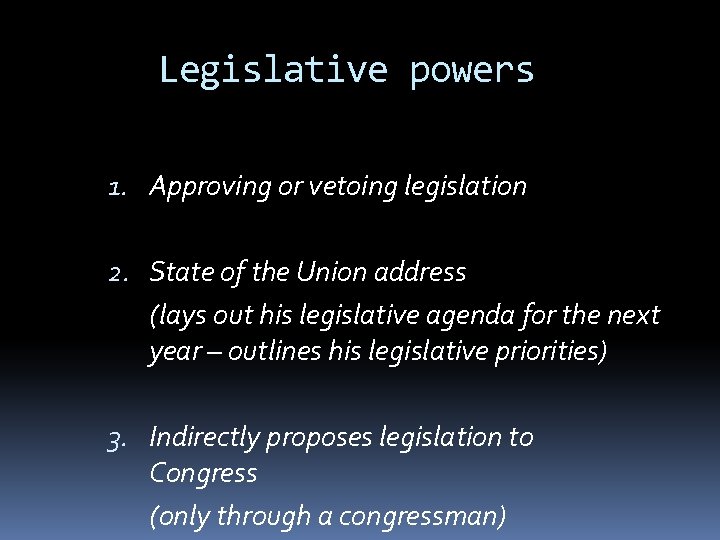 Legislative powers 1. Approving or vetoing legislation 2. State of the Union address (lays out his legislative agenda for the next year – outlines his legislative priorities) 3. Indirectly proposes legislation to Congress (only through a congressman)
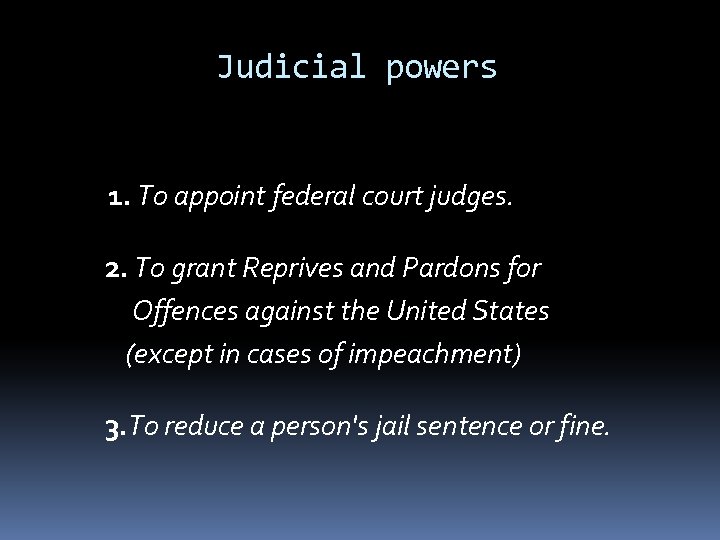 Judicial powers 1. To appoint federal court judges. 2. To grant Reprives and Pardons for Offences against the United States (except in cases of impeachment) 3. To reduce a person's jail sentence or fine.
 Impeachment Read the text and answer the questions: What is impeachment? Who can be impeached? What are the grounds for impeachment? What body has the power of impeachment? What is the role of the House and what of the Senate in the process of impeachment?
 Impeachment The process that enables legislative body to remove a public official from office (President, Vice President all civil officers of the US) Authorized by the Constitution It consists of two parts: I an accusation or indictment – The sole power of House of representatives II a trial – The sole power of Senate Civil officers = federal judges and cabinet members, but not Senators and Representatives
 THE GROUNDS FOR IMPEACHMENT defined by the Constitution a) TREASON b) BRIBERY c) Other HIGH CRIMES or MISDEMEANORS - an impeacheable offence is not limited to conduct which is indictable, but conduct that undermines the integrity of a public office or is in disregard of constitutional duties or involves abuse of power is generally regarded as grounds for impeachment
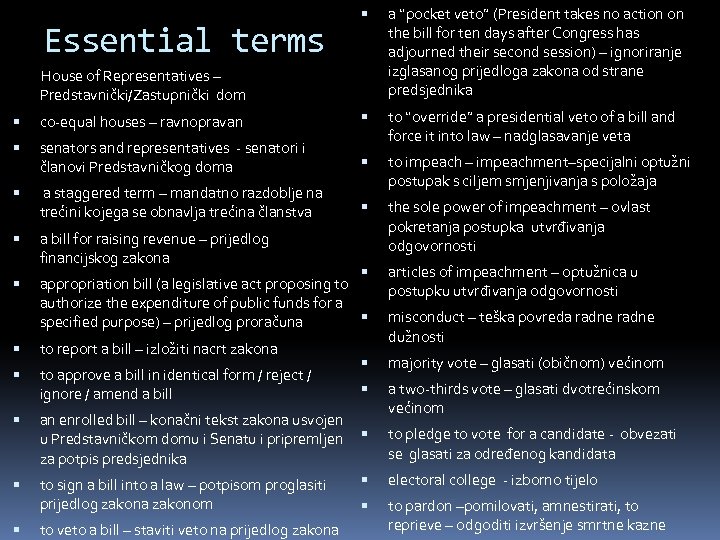 Essential terms a “pocket veto” (President takes no action on the bill for ten days after Congress has adjourned their second session) – ignoriranje izglasanog prijedloga zakona od strane predsjednika House of Representatives – Predstavnički/Zastupnički dom co-equal houses – ravnopravan senators and representatives - senatori i članovi Predstavničkog doma to “override” a presidential veto of a bill and force it into law – nadglasavanje veta a staggered term – mandatno razdoblje na trećini kojega se obnavlja trećina članstva to impeach – impeachment–specijalni optužni postupak s ciljem smjenjivanja s položaja a bill for raising revenue – prijedlog financijskog zakona the sole power of impeachment – ovlast pokretanja postupka utvrđivanja odgovornosti appropriation bill (a legislative act proposing to authorize the expenditure of public funds for a specified purpose) – prijedlog proračuna to report a bill – izložiti nacrt zakona to approve a bill in identical form / reject / ignore / amend a bill an enrolled bill – konačni tekst zakona usvojen u Predstavničkom domu i Senatu i pripremljen za potpis predsjednika to sign a bill into a law – potpisom proglasiti prijedlog zakona zakonom to veto a bill – staviti veto na prijedlog zakona articles of impeachment – optužnica u postupku utvrđivanja odgovornosti misconduct – teška povreda radne dužnosti majority vote – glasati (običnom) većinom a two-thirds vote – glasati dvotrećinskom većinom to pledge to vote for a candidate - obvezati se glasati za određenog kandidata electoral college - izborno tijelo to pardon –pomilovati, amnestirati, to reprieve – odgoditi izvršenje smrtne kazne
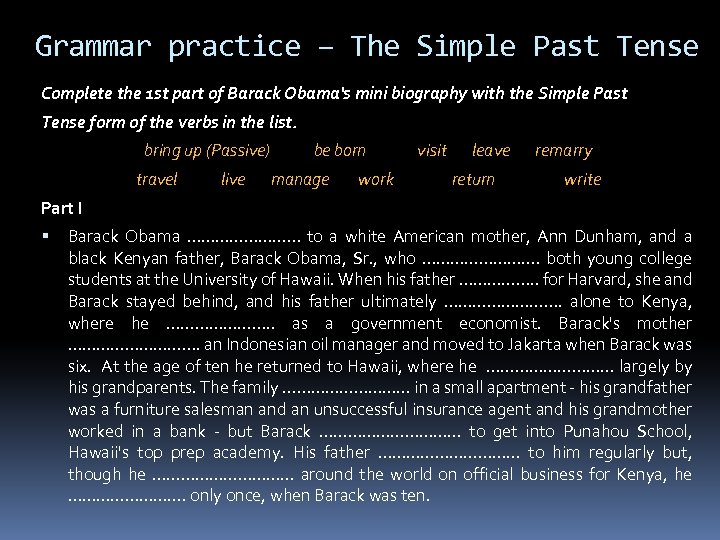 Grammar practice – The Simple Past Tense Complete the 1 st part of Barack Obama's mini biography with the Simple Past Tense form of the verbs in the list. bring up (Passive) travel live be born manage work visit leave return remarry write Part I Barack Obama ………… to a white American mother, Ann Dunham, and a black Kenyan father, Barack Obama, Sr. , who …………. both young college students at the University of Hawaii. When his father ……………. . for Harvard, she and Barack stayed behind, and his father ultimately …………. alone to Kenya, where he …………………. . as a government economist. Barack's mother ……………. an Indonesian oil manager and moved to Jakarta when Barack was six. At the age of ten he returned to Hawaii, where he …………… largely by his grandparents. The family …………… in a small apartment - his grandfather was a furniture salesman and an unsuccessful insurance agent and his grandmother worked in a bank - but Barack ……………. . . to get into Punahou School, Hawaii's top prep academy. His father …………… to him regularly but, though he …………… around the world on official business for Kenya, he …………. only once, when Barack was ten.
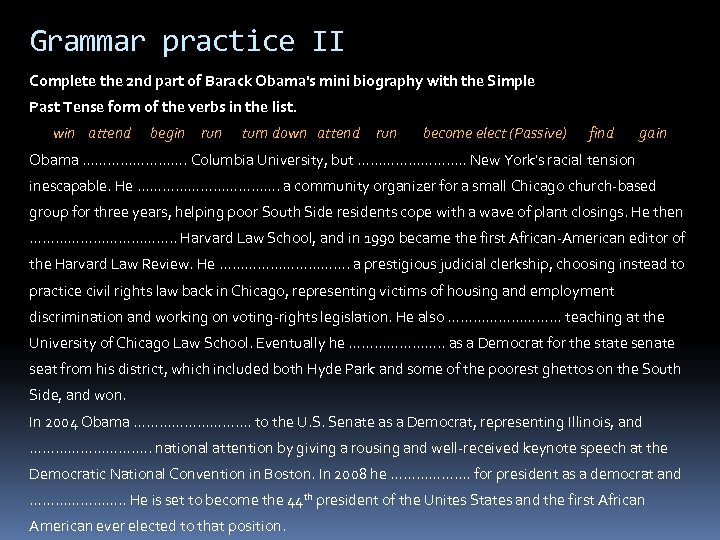 Grammar practice II Complete the 2 nd part of Barack Obama's mini biography with the Simple Past Tense form of the verbs in the list. win attend begin run turn down attend run become elect (Passive) find gain Obama …………. Columbia University, but …………. . New York's racial tension inescapable. He ………………. a community organizer for a small Chicago church-based group for three years, helping poor South Side residents cope with a wave of plant closings. He then ………………. . Harvard Law School, and in 1990 became the first African-American editor of the Harvard Law Review. He ……………. a prestigious judicial clerkship, choosing instead to practice civil rights law back in Chicago, representing victims of housing and employment discrimination and working on voting-rights legislation. He also …………… teaching at the University of Chicago Law School. Eventually he …………………. . as a Democrat for the state senate seat from his district, which included both Hyde Park and some of the poorest ghettos on the South Side, and won. In 2004 Obama ……………. to the U. S. Senate as a Democrat, representing Illinois, and ……………. . national attention by giving a rousing and well-received keynote speech at the Democratic National Convention in Boston. In 2008 he ………………. for president as a democrat and …………………. . He is set to become the 44 th president of the Unites States and the first African American ever elected to that position.