


 Скачать презентацию UNIT 15 THE NATURE AND SOURCES OF AMERICAN
7849a2756c62ae4d1612ea2ed60be382.ppt
- Количество слайдов: 26
 UNIT 15 THE NATURE AND SOURCES OF AMERICAN FEDERALISM
 Forms of government organization UNITARY STATE – a state whose three organs of state are governed as one single unit with one legislature and one parliament with local administrative branches FEDERATION – a union comprising a number of partially self-governing states or regions united by a central (“federal”) government – multiple levels of government CONFEDERATION – an association of sovereign states or communities, usually created by treaty by which they delegate certain powers to common institutions; often later adopt a common constitution (central issues usually – defense, foreign affairs, foreign trade, common currency)
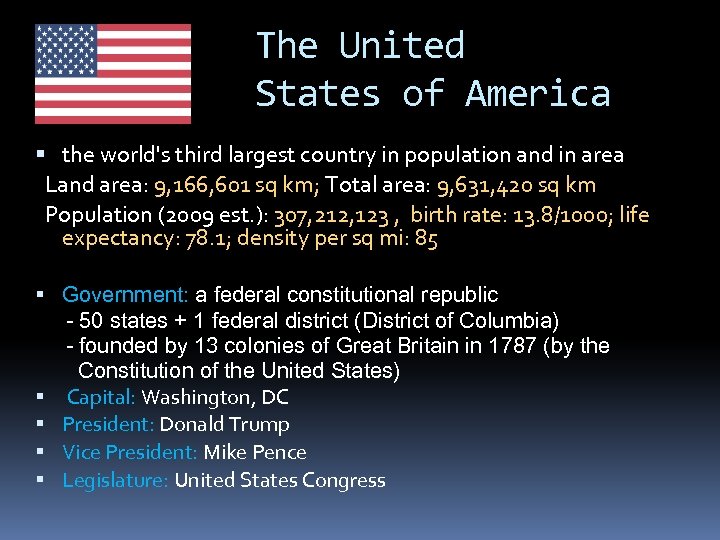 The United States of America the world's third largest country in population and in area Land area: 9, 166, 601 sq km; Total area: 9, 631, 420 sq km Population (2009 est. ): 307, 212, 123 , birth rate: 13. 8/1000; life expectancy: 78. 1; density per sq mi: 85 Government: a federal constitutional republic - 50 states + 1 federal district (District of Columbia) - founded by 13 colonies of Great Britain in 1787 (by the Constitution of the United States) Capital: Washington, DC President: Donald Trump Vice President: Mike Pence Legislature: United States Congress
 Use the reliable web sites and find the basic facts about the following events/people/documents in the early US history: 1. 2. 3. 4. 5. 6. 7. 8. The Boston Tea Party American Revolutionary War Declaration of Independence Articles of Confederation Constitutional Convention U. S. Constitution George Washington Bill of Rights
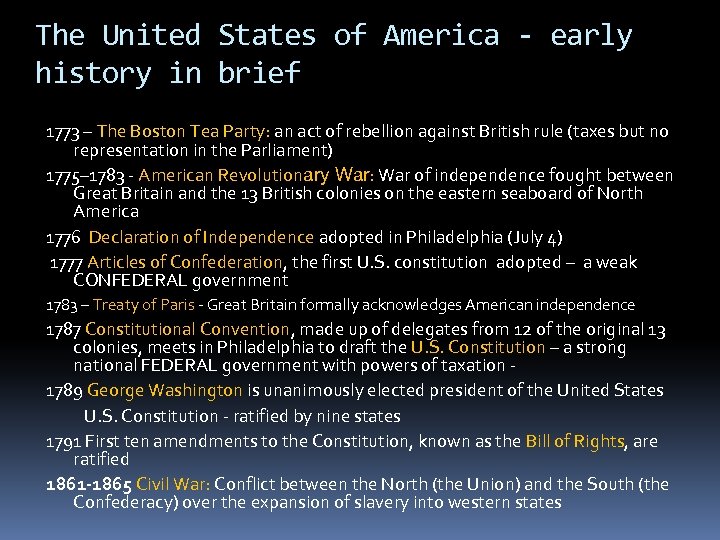 The United States of America - early history in brief 1773 – The Boston Tea Party: an act of rebellion against British rule (taxes but no representation in the Parliament) 1775– 1783 - American Revolutionary War: War of independence fought between Great Britain and the 13 British colonies on the eastern seaboard of North America 1776 Declaration of Independence adopted in Philadelphia (July 4) 1777 Articles of Confederation, the first U. S. constitution adopted – a weak CONFEDERAL government 1783 – Treaty of Paris - Great Britain formally acknowledges American independence 1787 Constitutional Convention, made up of delegates from 12 of the original 13 colonies, meets in Philadelphia to draft the U. S. Constitution – a strong national FEDERAL government with powers of taxation - 1789 George Washington is unanimously elected president of the United States U. S. Constitution - ratified by nine states 1791 First ten amendments to the Constitution, known as the Bill of Rights, are ratified 1861 -1865 Civil War: Conflict between the North (the Union) and the South (the Confederacy) over the expansion of slavery into western states
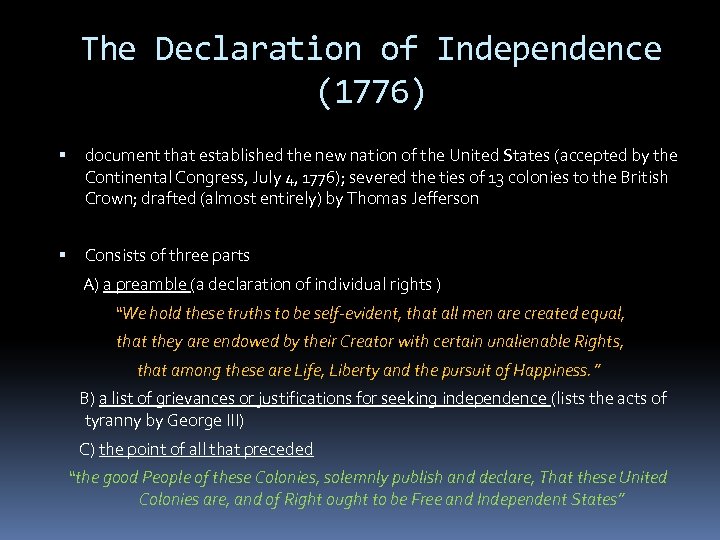 The Declaration of Independence (1776) document that established the new nation of the United States (accepted by the Continental Congress, July 4, 1776); severed the ties of 13 colonies to the British Crown; drafted (almost entirely) by Thomas Jefferson Consists of three parts A) a preamble (a declaration of individual rights ) “We hold these truths to be self-evident, that all men are created equal, that they are endowed by their Creator with certain unalienable Rights, that among these are Life, Liberty and the pursuit of Happiness. ” B) a list of grievances or justifications for seeking independence (lists the acts of tyranny by George III) C) the point of all that preceded “the good People of these Colonies, solemnly publish and declare, That these United Colonies are, and of Right ought to be Free and Independent States”
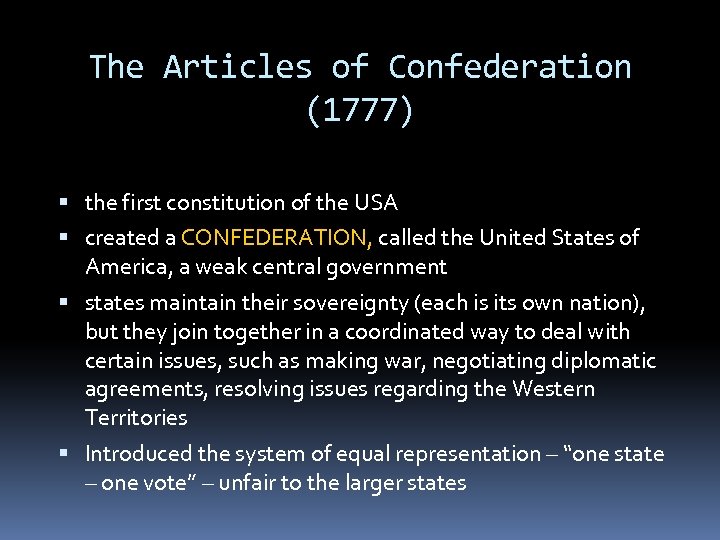 The Articles of Confederation (1777) the first constitution of the USA created a CONFEDERATION, called the United States of America, a weak central government states maintain their sovereignty (each is its own nation), but they join together in a coordinated way to deal with certain issues, such as making war, negotiating diplomatic agreements, resolving issues regarding the Western Territories Introduced the system of equal representation – “one state – one vote” – unfair to the larger states
 The Constitutional Convention (1787) also known as the Philadelphia Convention - one of the central events in the history of the United States took place in 1787 to address problems in the United States of America following independence from Great Britain intended only to revise the Articles of Confederation (primarily the division of powers between the states and the nation) but the intention of many of the Convention's proponents were to create a new government rather than "fix" the existing one George Washington elected to preside over the convention the result of the Convention - the United States Constitution Two plans for the improvement were proposed A) The Virginia Plan B) The New Jersey Plan
 The Virginia plan (The Large-State-Plan) James Madison – a new, entirely different conception of the United States government - a republican model - proposed a strong central government composed of 3 brances: legislative, executive, judicial diminished power of the states - people would elect their representatives to govern (in contrast to the Confederation model of the time, when the states appointed members of Congress)
 The Virginia Plan – main features a bicameral legislature (two houses) with PROPORTIONAL REPRESENTATION in both houses the legislature was very powerful an executive elected by congress a national judiciary, with life-terms of service the executive and some of the national judiciary would have the power to veto legislation, subject to override Federal laws were supreme over any state laws - favoured by larger states SIGNIFICANCE FOR THE HISTORY OF THE USA - - the first document which proposed separation of powers into legislative, executiv and judicial - created the idea of representation according to population (proportional representation)
 The New Jersey Plan (The Small-State Plan) William Paterson - feared that smaller states like his own would be overtaken by the larger ones without specific protections (in the current Confederation, each state was perfectly equal - all had one vote on all matters in Congress) – EQUAL REPRESENTATION - NEW YERSEY PLAN - unicameral legislature (one house) with EQUAL REPRESENTATION (each state had a single vote to prevent larger states from gaining too much power) Federal laws were supreme over state laws New Jersey plan – a rebuttal of Virginia Plan
 The New Jersey Plan – main features the current Congress was granted new powers (e. g. could set taxes and force their collection) an executive elected by Congress; served a single term and were subject to recall based on the request of state governors a judiciary appointed by the executives, with life-terms of service - instead of giving congress the nearly unlimited scope proposed in the Virginia plan, created a system of government less powerful at the national level than in the Virginia plan; protected the small states from the large ones by ensuring “one state - one vote”; ultimately rejected NEW YERSEY PLAN – rejected by the Constitutional Convention but used some of the ideas in the final draft of the Constitution (equal representation in the Senate)
 Conclusion – The Constitution of the United States of America CRUCIAL QUESTIONS How much power to allow the central government? How many representatives in Congress to allow each state? How the representatives should be elected-directly by the people or by the state legislators?
 Conclusion – the Constitution of the United States of America the final document of the Convention – established the government we are familiar with today - US BECAME A FEDERAL STATE - BICAMERAL LEGISLATURE - PROPORTIONAL REPRESENTATION IN THE HOUSE OF REPRESENTATIVES, EQUAL IN THE SENATE - REPRESENTATIVES ELECTED BY THE PEOPLE IN DIRECT (POPULAR) ELECTION, SENATORS BY STATE LEGISLATIONS IN INDIRECT ELECTIONS showed signs of its origins in the Virginian plan, but government less powerful at the national level the pattern of allocation of powers was worked out legislative veto (Virginia plan) discarded – judicial veto instead constitution + treaties – “the supreme law of the land, and the judges in every state shall be bound thereby” primary responsibility for the conduct of foreign affairs in the hands of the president – commander in chief of the armed forces electoral college to select the president – to ensure the executive independent of the national legislature The Making of the Constitution https: //www. youtube. com/watch? v=OSWl 5 ld. Ev 6 w
 The U. S. Bill of Rights (1791) the first 10 amendments to the Constitution written in response to calls from several states for greater constitutional protection for individual liberties - lists specific prohibitions on governmental power eg. the right to free speech and religion (1 st Amendment); the right to be free from unreasonable government intrusion in one’s home (4 th Amendment) etc. See full text: https: //www. billofrightsinstitute. org/founding-documents/billof-rights/
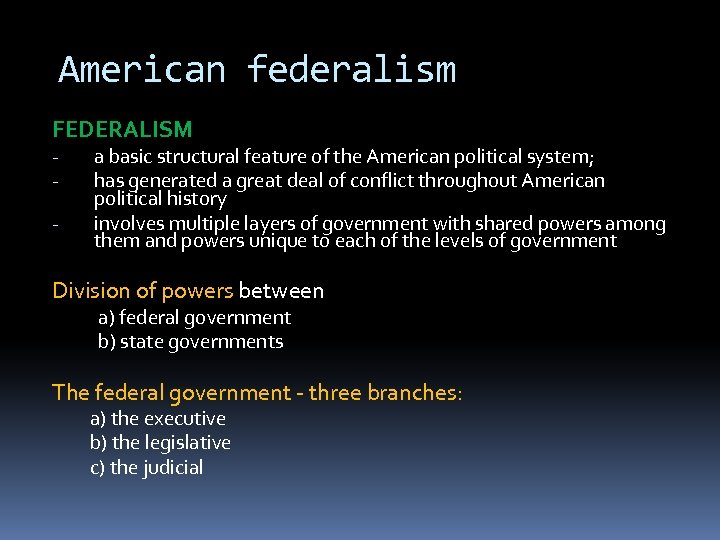 American federalism FEDERALISM - a basic structural feature of the American political system; has generated a great deal of conflict throughout American political history involves multiple layers of government with shared powers among them and powers unique to each of the levels of government Division of powers between a) federal government b) state governments The federal government - three branches: a) the executive b) the legislative c) the judicial
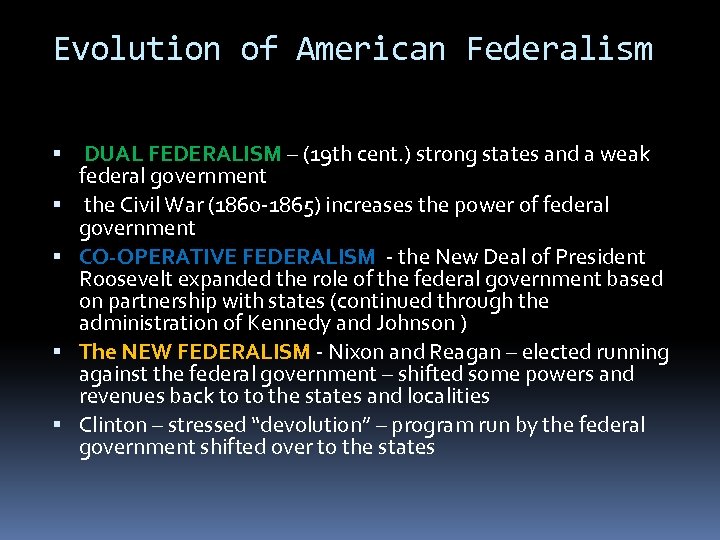 Evolution of American Federalism DUAL FEDERALISM – (19 th cent. ) strong states and a weak federal government the Civil War (1860 -1865) increases the power of federal government CO-OPERATIVE FEDERALISM - the New Deal of President Roosevelt expanded the role of the federal government based on partnership with states (continued through the administration of Kennedy and Johnson ) The NEW FEDERALISM - Nixon and Reagan – elected running against the federal government – shifted some powers and revenues back to to the states and localities Clinton – stressed “devolution” – program run by the federal government shifted over to the states
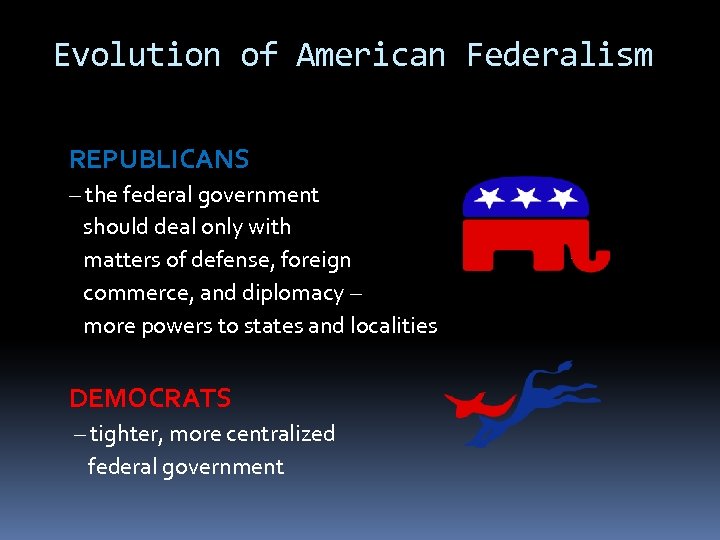 Evolution of American Federalism REPUBLICANS – the federal government should deal only with matters of defense, foreign commerce, and diplomacy – more powers to states and localities DEMOCRATS – tighter, more centralized federal government
 Sources of American Federalism The tenth amendment of the Constitution The fourteenth amendment The grant of unique powers of various levels of government under the Constitution numerous Supreme Court decisions
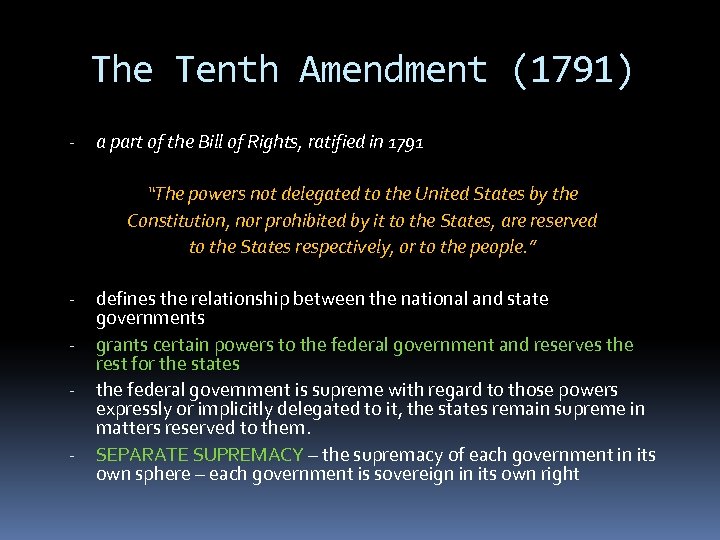 The Tenth Amendment (1791) - a part of the Bill of Rights, ratified in 1791 “The powers not delegated to the United States by the Constitution, nor prohibited by it to the States, are reserved to the States respectively, or to the people. ” - defines the relationship between the national and state governments grants certain powers to the federal government and reserves the rest for the states the federal government is supreme with regard to those powers expressly or implicitly delegated to it, the states remain supreme in matters reserved to them. SEPARATE SUPREMACY – the supremacy of each government in its own sphere – each government is sovereign in its own right
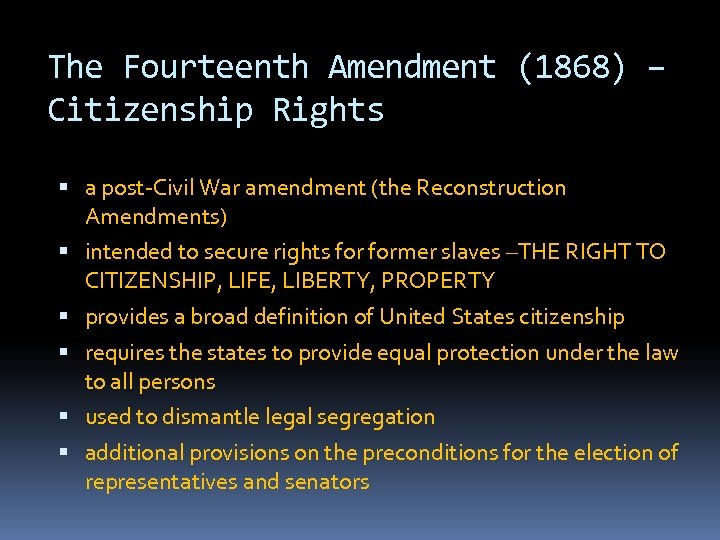 The Fourteenth Amendment (1868) – Citizenship Rights a post-Civil War amendment (the Reconstruction Amendments) intended to secure rights former slaves –THE RIGHT TO CITIZENSHIP, LIFE, LIBERTY, PROPERTY provides a broad definition of United States citizenship requires the states to provide equal protection under the law to all persons used to dismantle legal segregation additional provisions on the preconditions for the election of representatives and senators
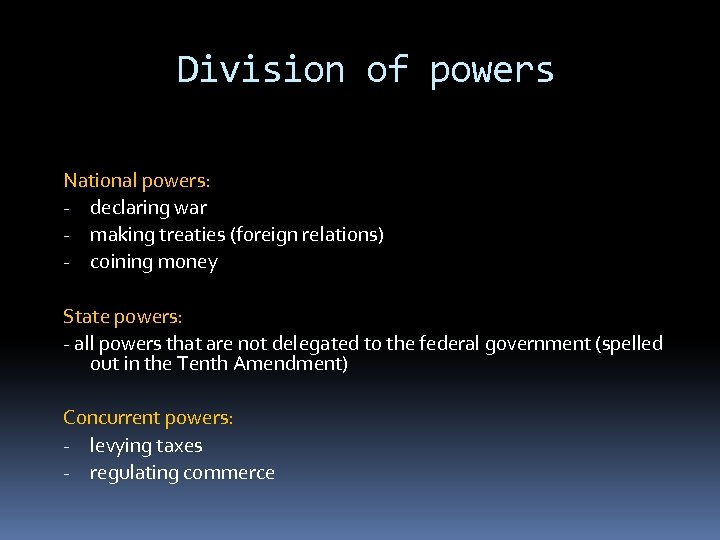 Division of powers National powers: - declaring war - making treaties (foreign relations) - coining money State powers: - all powers that are not delegated to the federal government (spelled out in the Tenth Amendment) Concurrent powers: - levying taxes - regulating commerce
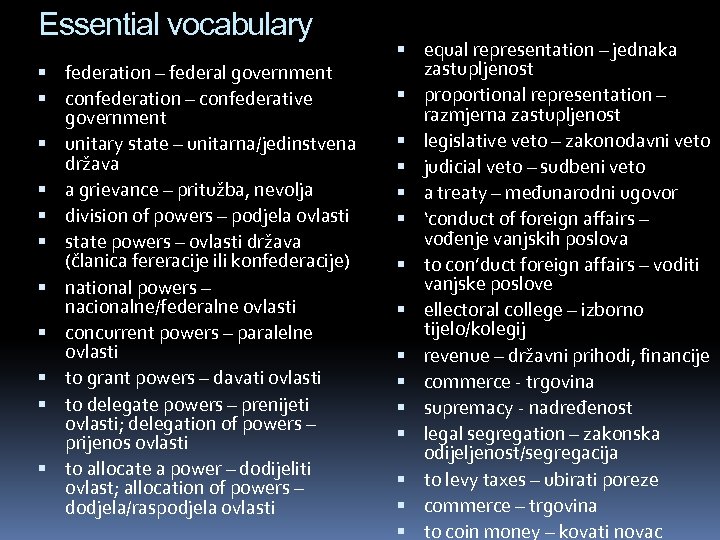 Essential vocabulary federation – federal government confederation – confederative government unitary state – unitarna/jedinstvena država a grievance – pritužba, nevolja division of powers – podjela ovlasti state powers – ovlasti država (članica fereracije ili konfederacije) national powers – nacionalne/federalne ovlasti concurrent powers – paralelne ovlasti to grant powers – davati ovlasti to delegate powers – prenijeti ovlasti; delegation of powers – prijenos ovlasti to allocate a power – dodijeliti ovlast; allocation of powers – dodjela/raspodjela ovlasti equal representation – jednaka zastupljenost proportional representation – razmjerna zastupljenost legislative veto – zakonodavni veto judicial veto – sudbeni veto a treaty – međunarodni ugovor ‘conduct of foreign affairs – vođenje vanjskih poslova to con’duct foreign affairs – voditi vanjske poslove ellectoral college – izborno tijelo/kolegij revenue – državni prihodi, financije commerce - trgovina supremacy - nadređenost legal segregation – zakonska odijeljenost/segregacija to levy taxes – ubirati poreze commerce – trgovina to coin money – kovati novac
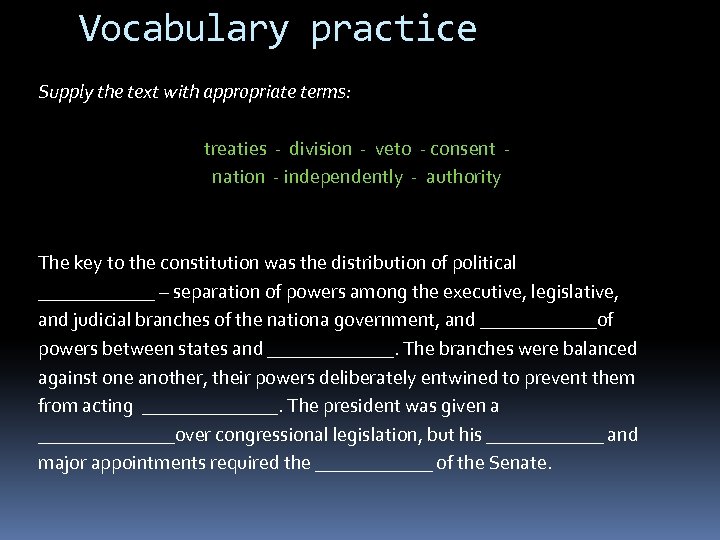 Vocabulary practice Supply the text with appropriate terms: treaties - division - veto - consent - nation - independently - authority The key to the constitution was the distribution of political ______ – separation of powers among the executive, legislative, and judicial branches of the nationa government, and ______of powers between states and _______. The branches were balanced against one another, their powers deliberately entwined to prevent them from acting _______. The president was given a _______over congressional legislation, but his ______ and major appointments required the ______ of the Senate.
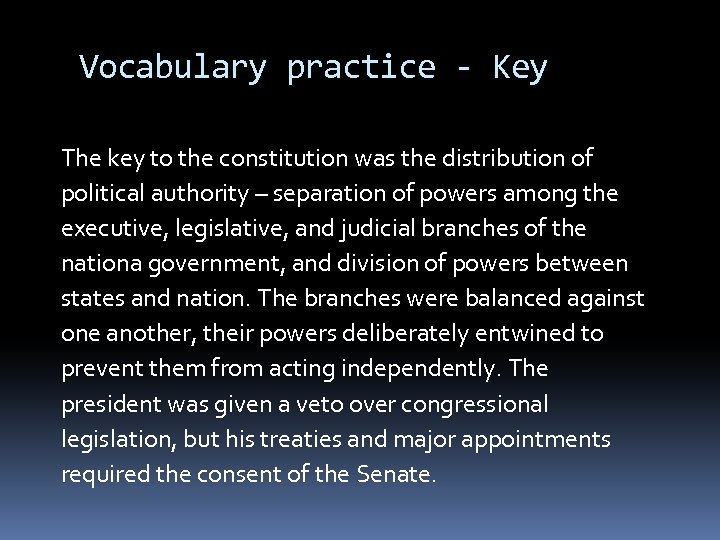 Vocabulary practice - Key The key to the constitution was the distribution of political authority – separation of powers among the executive, legislative, and judicial branches of the nationa government, and division of powers between states and nation. The branches were balanced against one another, their powers deliberately entwined to prevent them from acting independently. The president was given a veto over congressional legislation, but his treaties and major appointments required the consent of the Senate.