


 Скачать презентацию UNIT 11 Materials in Industrial design why do
c801c5b5e416d3c7349bc5a6119d67bc.ppt
- Количество слайдов: 32
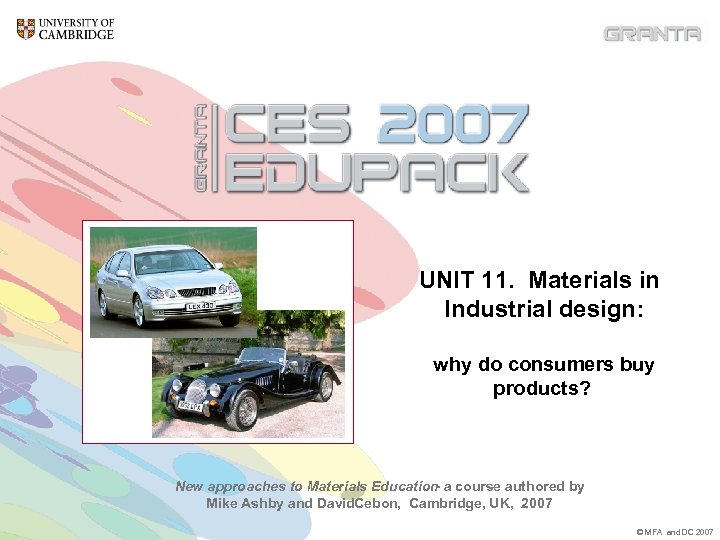 UNIT 11. Materials in Industrial design: why do consumers buy products? New approaches to Materials Education a course authored by Mike Ashby and David. Cebon, Cambridge, UK, 2007 © MFA and DC 2007
 Outline • Why is Industrial Design important? • What gives a product its character? • Making charts for sensory properties • Design: creating associations and perceptions Resources: • “Materials Selection in Mechanical Design”, 3 rd edition by M. F. Ashby, Butterworth Heinemann, Oxford UK, 2006, Chapter 17. • “Materials and Design, the Art and Acience of Materials Selection in Product Design”, by Mike Ashby and Kara Johnson Butterworth Heinemann, Oxford UK, 2002, ISBN 0 -7506 -5554 -2 © MFA and DC 2007
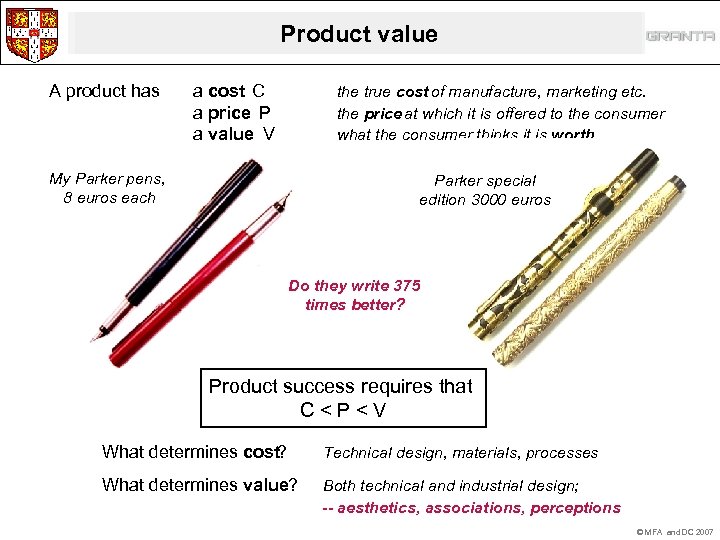 Product value A product has a cost C a price P a value V the true cost of manufacture, marketing etc. the price at which it is offered to the consumer what the consumer thinks it is worth My Parker pens, 8 euros each Parker special edition 3000 euros Do they write 375 times better? Product success requires that C
 Why is industrial design important ? Product maturity and market saturation • As products mature and markets saturate, the products of competing manufacturers converge technically -- hardly differ in performance or cost ID allows differentiation, enhanced value Corporate identity • Corporate and product identity are partly created and largely maintained through innovative industrial design ID creates corporate image The environment, in the broadest sense • Products are part of our environment. Products that give no sensual satisfaction damage the environment ID contributes to quality of life © MFA and DC 2007
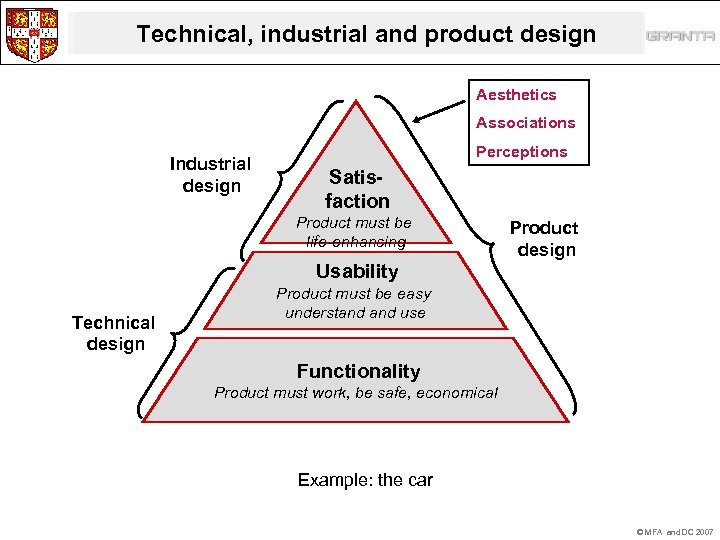 Technical, industrial and product design Aesthetics Associations Industrial design Perceptions Satisfaction Product must be life-enhancing Product design Usability Technical design Product must be easy understand use Functionality Product must work, be safe, economical Example: the car © MFA and DC 2007
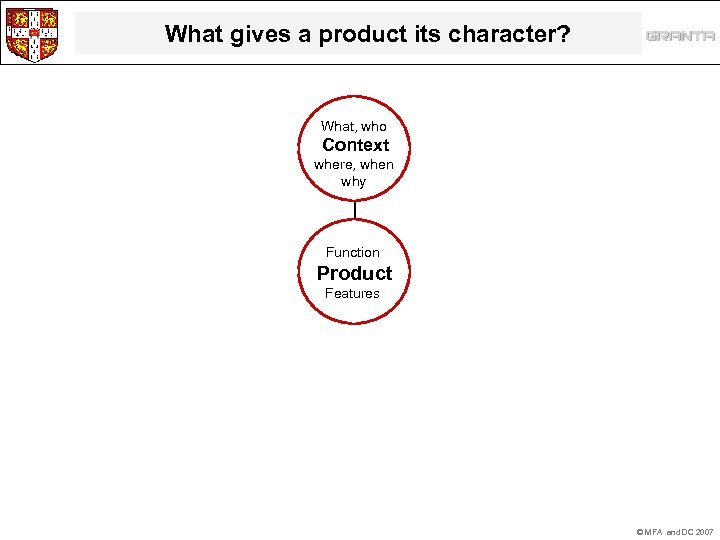 What gives a product its character? What, who Context where, when why Function Product Features © MFA and DC 2007
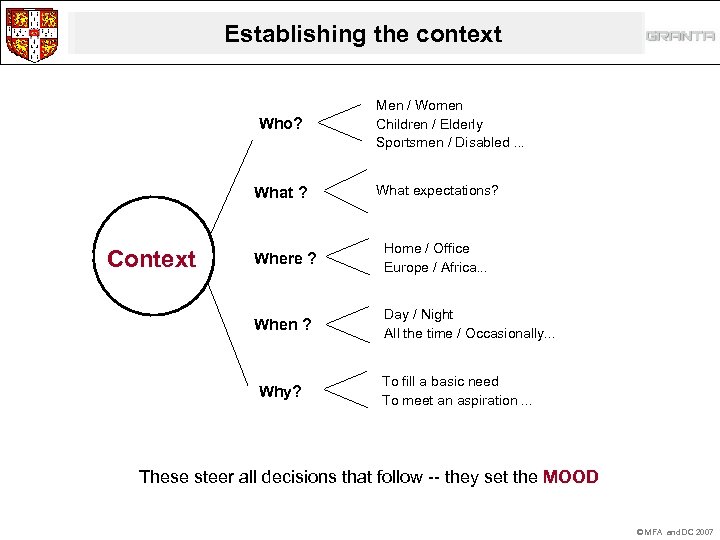 Establishing the context Who? What ? Men / Women Children / Elderly Sportsmen / Disabled. . . What expectations? Where ? Home / Office Europe / Africa. . . When ? Context Day / Night All the time / Occasionally. . . Why? To fill a basic need To meet an aspiration. . . These steer all decisions that follow -- they set the MOOD © MFA and DC 2007
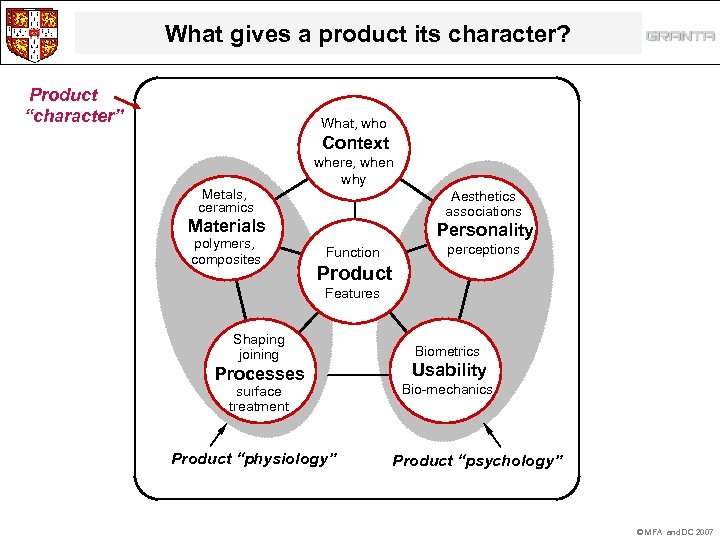 What gives a product its character? Product “character” What, who Context Metals, ceramics where, when why Aesthetics associations Materials polymers, composites Personality perceptions Function Product Features Shaping joining Processes surface treatment Product “physiology” Biometrics Usability Bio-mechanics Product “psychology” © MFA and DC 2007
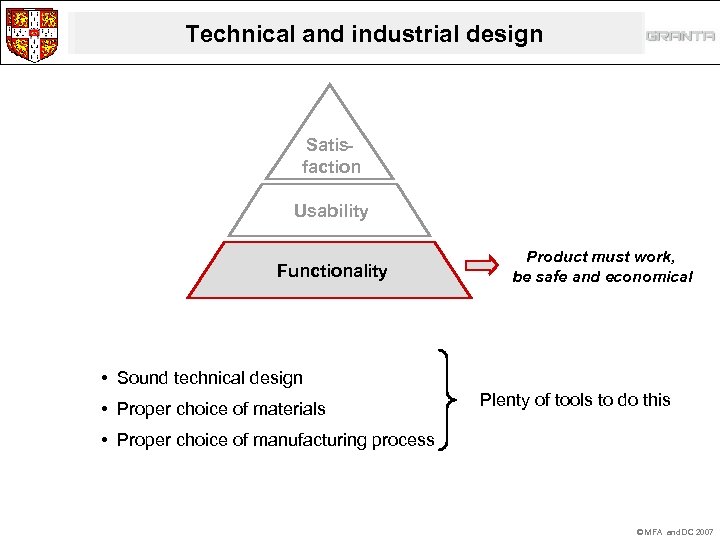 Technical and industrial design Satisfaction Usability Functionality Product must work, be safe and economical • Sound technical design • Proper choice of materials Plenty of tools to do this • Proper choice of manufacturing process © MFA and DC 2007
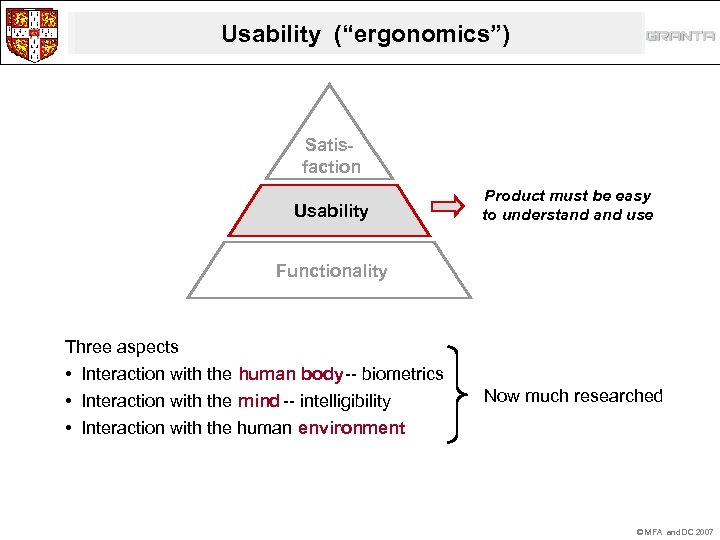 Usability (“ergonomics”) Satisfaction Usability Product must be easy to understand use Functionality Three aspects • Interaction with the human body-- biometrics • Interaction with the mind -- intelligibility • Interaction with the human environment Now much researched © MFA and DC 2007
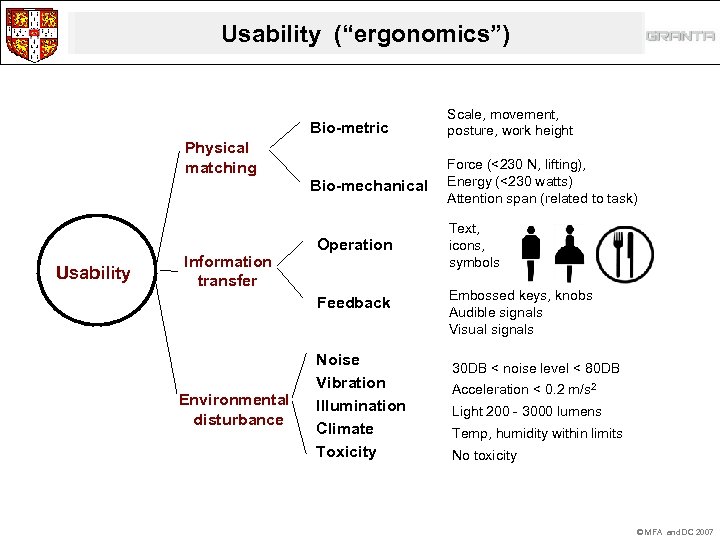 Usability (“ergonomics”) Bio-metric Scale, movement, posture, work height Bio-mechanical Force (<230 N, lifting), Energy (<230 watts) Attention span (related to task) Physical matching Usability Information transfer Operation Feedback Environmental disturbance Noise Vibration Illumination Climate Toxicity Text, icons, symbols Embossed keys, knobs Audible signals Visual signals 30 DB < noise level < 80 DB Acceleration < 0. 2 m/s 2 Light 200 - 3000 lumens Temp, humidity within limits No toxicity © MFA and DC 2007
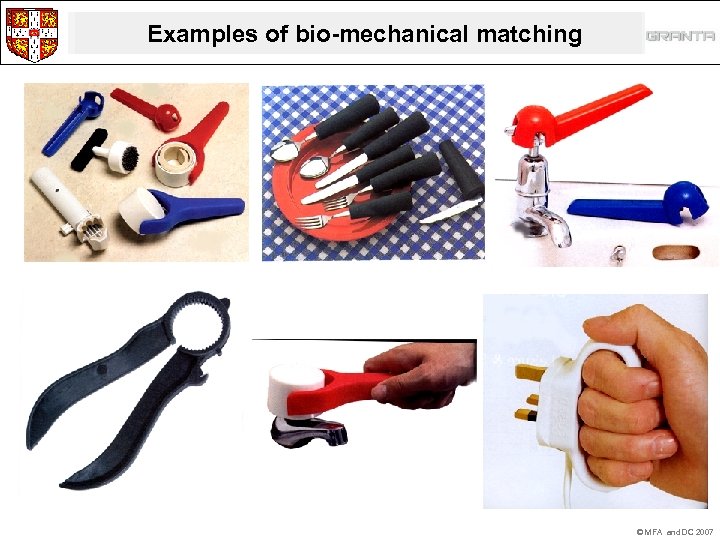 Examples of bio-mechanical matching © MFA and DC 2007
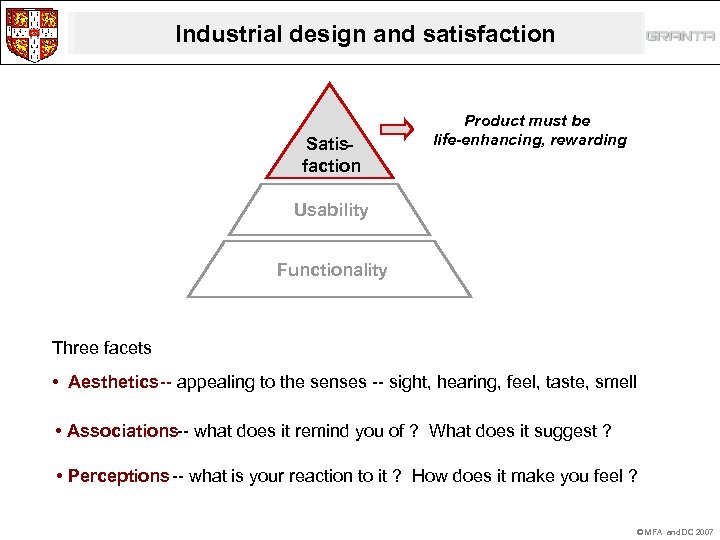 Industrial design and satisfaction Satisfaction Product must be life-enhancing, rewarding Usability Functionality Three facets • Aesthetics -- appealing to the senses -- sight, hearing, feel, taste, smell • Associations-- what does it remind you of ? What does it suggest ? • Perceptions -- what is your reaction to it ? How does it make you feel ? © MFA and DC 2007
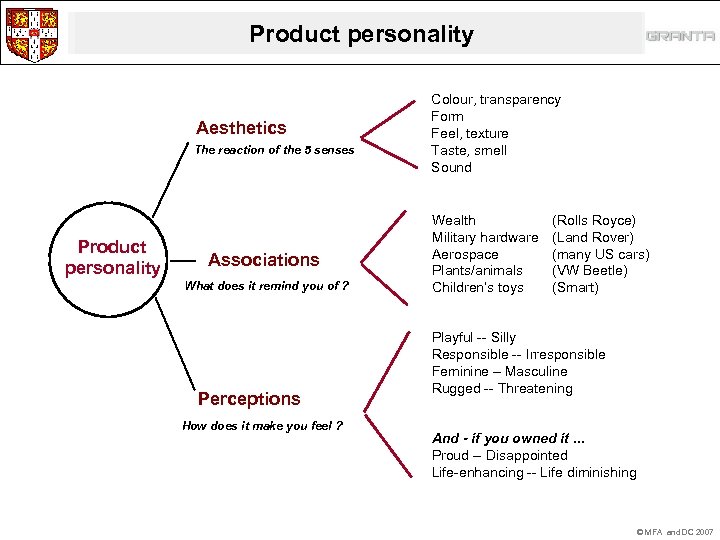 Product personality Aesthetics The reaction of the 5 senses Product personality Associations What does it remind you of ? Perceptions How does it make you feel ? Colour, transparency Form Feel, texture Taste, smell Sound Wealth Military hardware Aerospace Plants/animals Children’s toys (Rolls Royce) (Land Rover) (many US cars) (VW Beetle) (Smart) Playful -- Silly Responsible -- Irresponsible Feminine – Masculine Rugged -- Threatening And - if you owned it. . . Proud -- Disappointed Life-enhancing -- Life diminishing © MFA and DC 2007
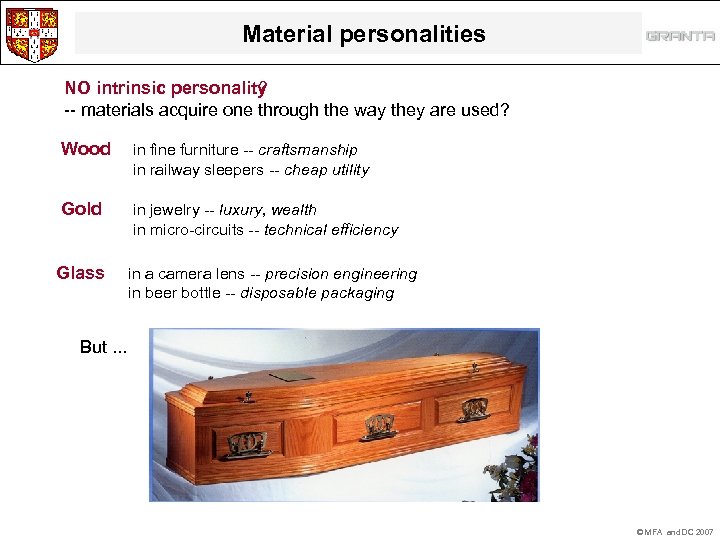 Material personalities NO intrinsic personality ? -- materials acquire one through the way they are used? Wood in fine furniture -- craftsmanship in railway sleepers -- cheap utility Gold in jewelry -- luxury, wealth in micro-circuits -- technical efficiency Glass in a camera lens -- precision engineering in beer bottle -- disposable packaging But. . . © MFA and DC 2007
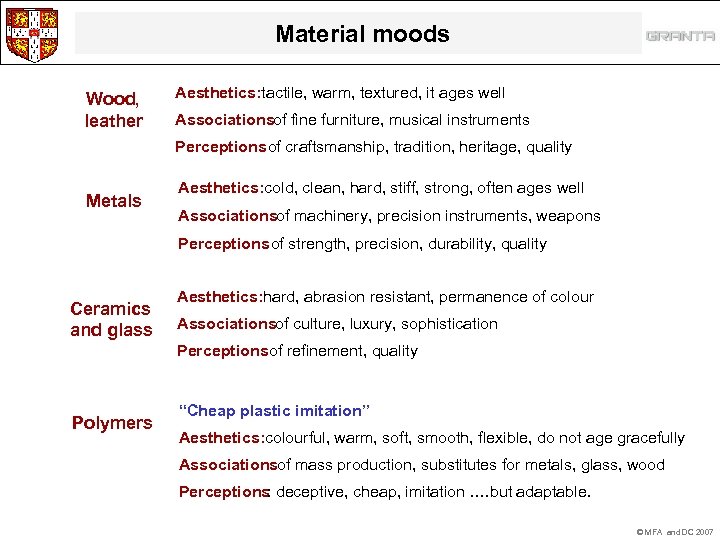 Material moods Wood, leather Aesthetics: tactile, warm, textured, it ages well Associationsof fine furniture, musical instruments Perceptions of craftsmanship, tradition, heritage, quality Metals Aesthetics: cold, clean, hard, stiff, strong, often ages well Associationsof machinery, precision instruments, weapons Perceptions of strength, precision, durability, quality Ceramics and glass Aesthetics: hard, abrasion resistant, permanence of colour Associationsof culture, luxury, sophistication Perceptions of refinement, quality Polymers “Cheap plastic imitation” Aesthetics: colourful, warm, soft, smooth, flexible, do not age gracefully Associationsof mass production, substitutes for metals, glass, wood Perceptions deceptive, cheap, imitation …. but adaptable. : © MFA and DC 2007
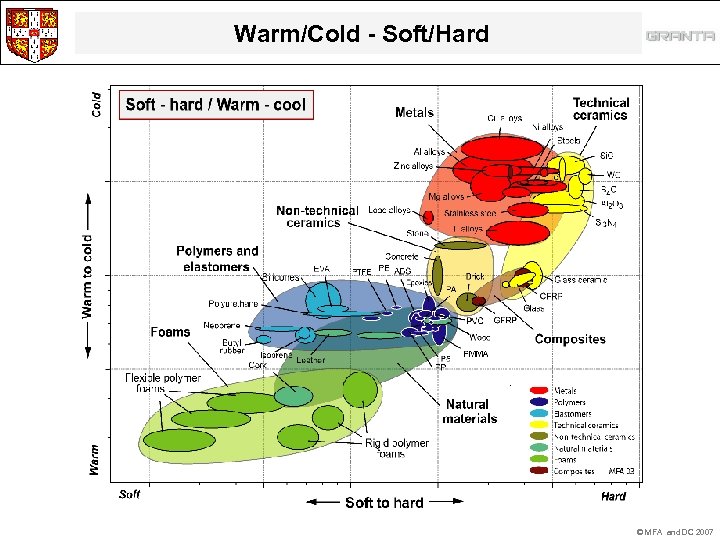 Warm/Cold - Soft/Hard © MFA and DC 2007
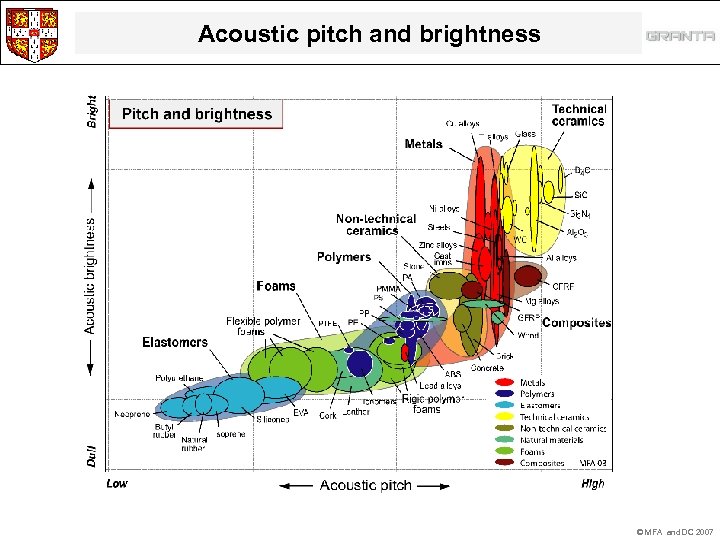 Acoustic pitch and brightness © MFA and DC 2007
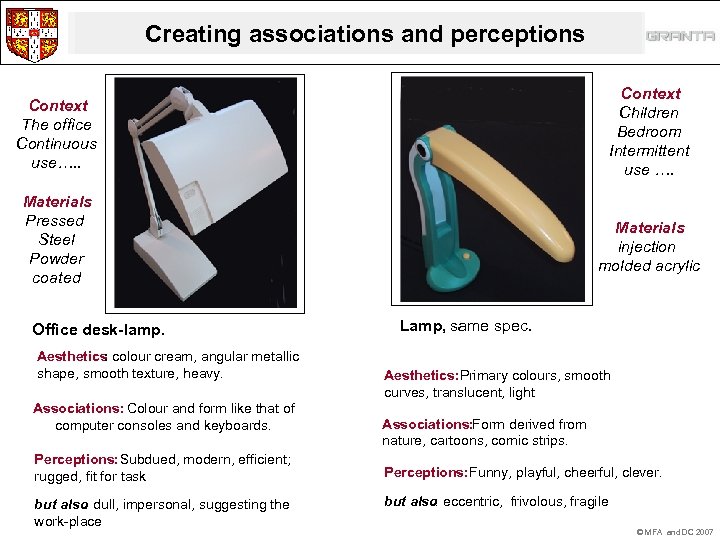 Creating associations and perceptions Context The office Continuous use…. . Context Children Bedroom Intermittent use …. Materials Pressed Steel Powder coated Materials injection molded acrylic Office desk-lamp. Aesthetics colour cream, angular metallic : shape, smooth texture, heavy. Associations: Colour and form like that of computer consoles and keyboards. Perceptions: Subdued, modern, efficient; rugged, fit for task but also: dull, impersonal, suggesting the work-place Lamp, same spec. Aesthetics: Primary colours, smooth curves, translucent, light Associations: Form derived from nature, cartoons, comic strips. Perceptions: Funny, playful, cheerful, clever. but also: eccentric, frivolous, fragile © MFA and DC 2007
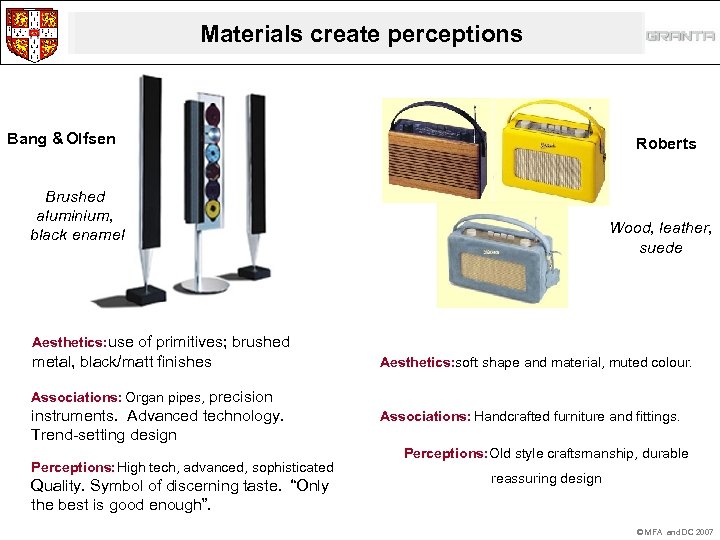 Materials create perceptions Bang & Olfsen Roberts Brushed aluminium, black enamel Wood, leather, suede Aesthetics: use of primitives; brushed metal, black/matt finishes Aesthetics: soft shape and material, muted colour. Associations: Organ pipes, precision instruments. Advanced technology. Trend-setting design Perceptions: High tech, advanced, sophisticated Quality. Symbol of discerning taste. “Only the best is good enough”. Associations: Handcrafted furniture and fittings. Perceptions: Old style craftsmanship, durable reassuring design © MFA and DC 2007
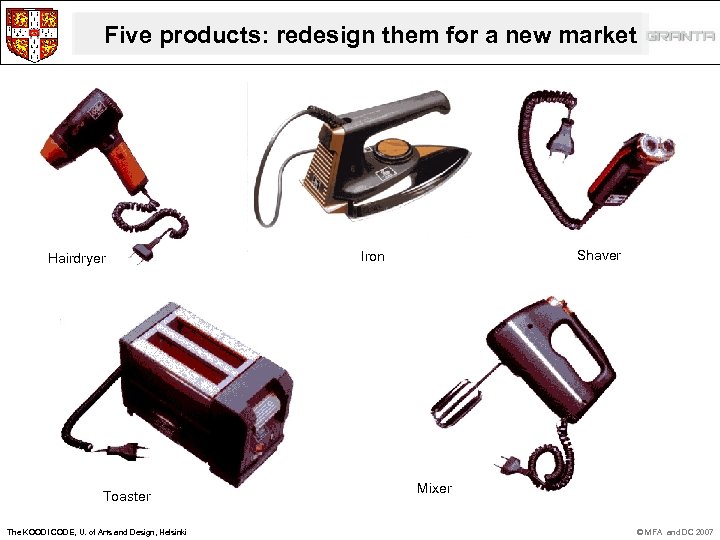 Five products: redesign them for a new market Hairdryer Toaster The KOODI CODE, U. of Arts and Design, Helsinki Shaver Iron Mixer © MFA and DC 2007
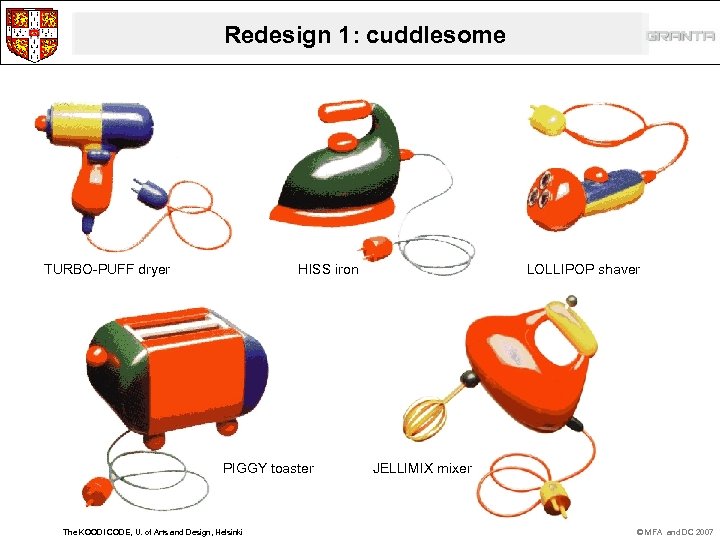 Redesign 1: cuddlesome TURBO-PUFF dryer HISS iron PIGGY toaster The KOODI CODE, U. of Arts and Design, Helsinki LOLLIPOP shaver JELLIMIX mixer © MFA and DC 2007
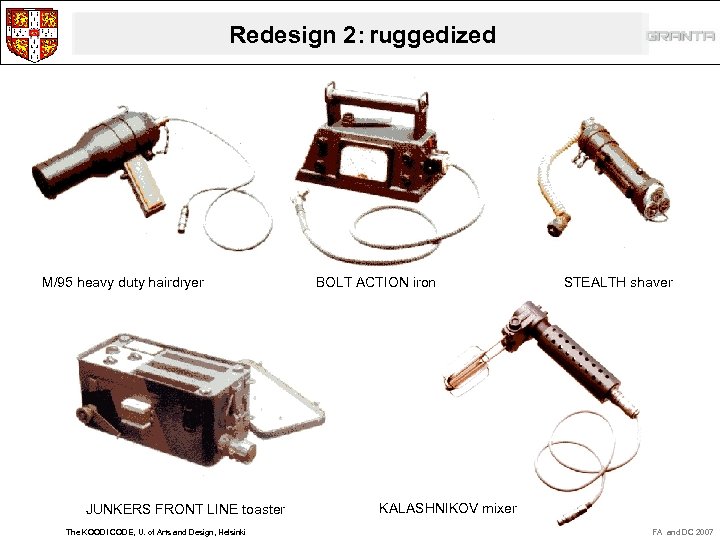 Redesign 2: ruggedized M/95 heavy duty hairdryer JUNKERS FRONT LINE toaster The KOODI CODE, U. of Arts and Design, Helsinki BOLT ACTION iron STEALTH shaver KALASHNIKOV mixer © MFA and DC 2007
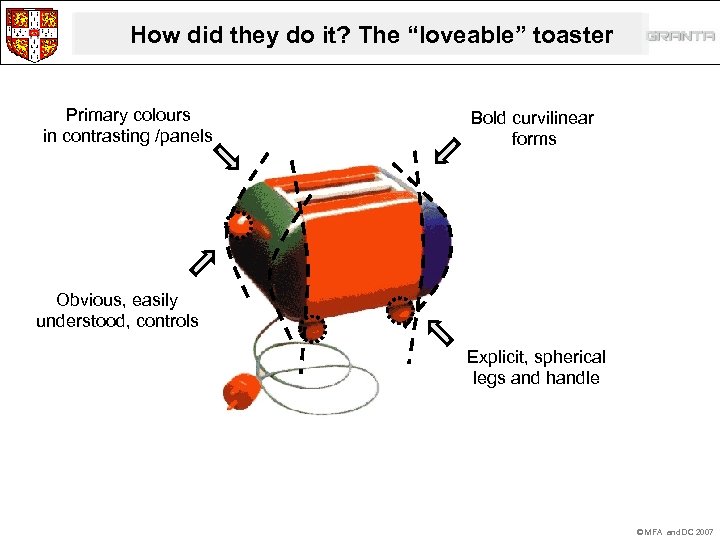 How did they do it? The “loveable” toaster Primary colours in contrasting /panels Bold curvilinear forms Obvious, easily understood, controls Explicit, spherical legs and handle © MFA and DC 2007
 Mood boards A mood board captures aspects of • Context What? Who? Why? Where? When? • Aesthetics • Associations • Perceptions • Materials © MFA and DC 2007
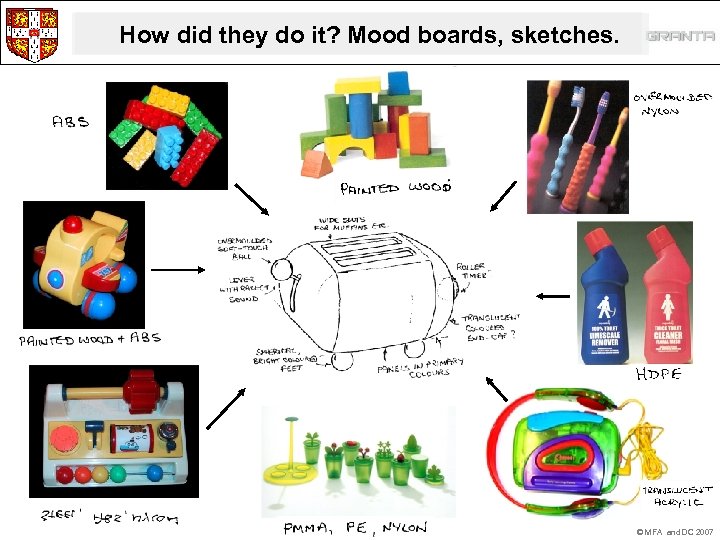 How did they do it? Mood boards, sketches. © MFA and DC 2007
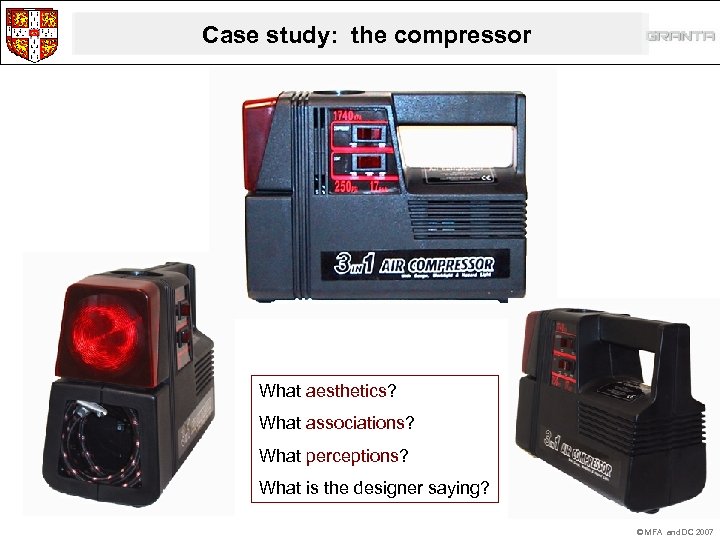 Case study: the compressor What aesthetics? What associations? What perceptions? What is the designer saying? © MFA and DC 2007
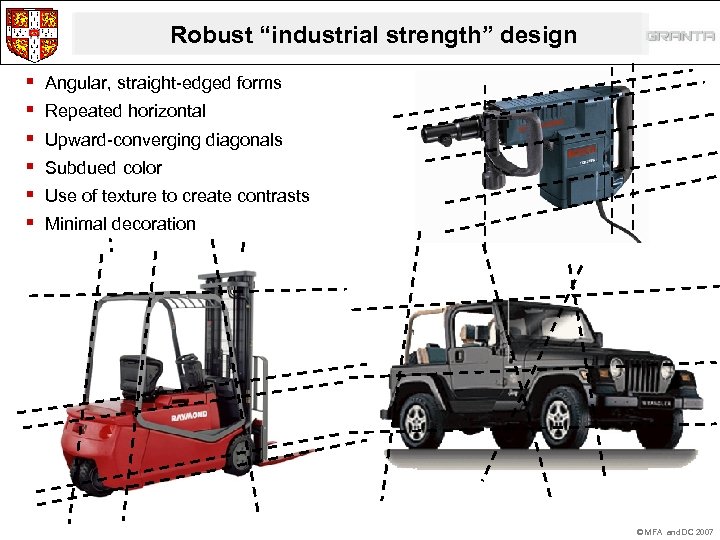 Robust “industrial strength” design § § § Angular, straight-edged forms Repeated horizontal Upward-converging diagonals Subdued color Use of texture to create contrasts Minimal decoration © MFA and DC 2007
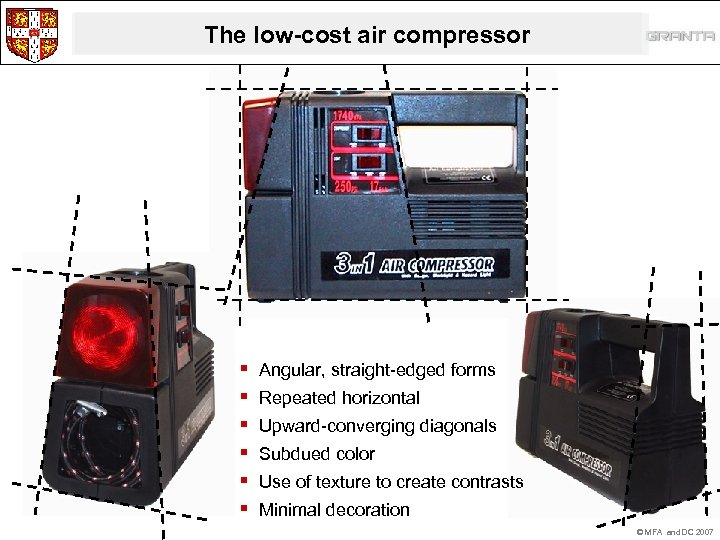 The low-cost air compressor § § § Angular, straight-edged forms Repeated horizontal Upward-converging diagonals Subdued color Use of texture to create contrasts Minimal decoration © MFA and DC 2007
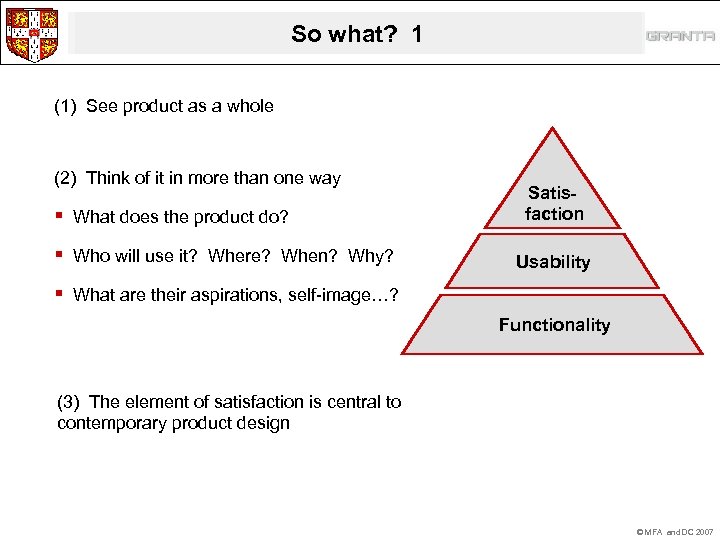 So what? 1 (1) See product as a whole (2) Think of it in more than one way § What does the product do? § Who will use it? Where? When? Why? Satisfaction Usability § What are their aspirations, self-image…? Functionality (3) The element of satisfaction is central to contemporary product design © MFA and DC 2007
 So what? 2 Train yourself - look at products and ask: § What aesthetics? Why? § What associations? How did the designer do it? Why? § What perceptions? What made you perceive it that way? How (intentionally or unintentionally) did the designer do it? § And finally: what was the designer trying to say? © MFA and DC 2007
 End of Unit 11 © MFA and DC 2007