


 Скачать презентацию Unit 10 FUNDING COMPANY ACTIVITIES Skills focus
2780fc0fc46966fabcf278516e9ca8eb.ppt
- Количество слайдов: 64
 Unit 10 FUNDING COMPANY ACTIVITIES
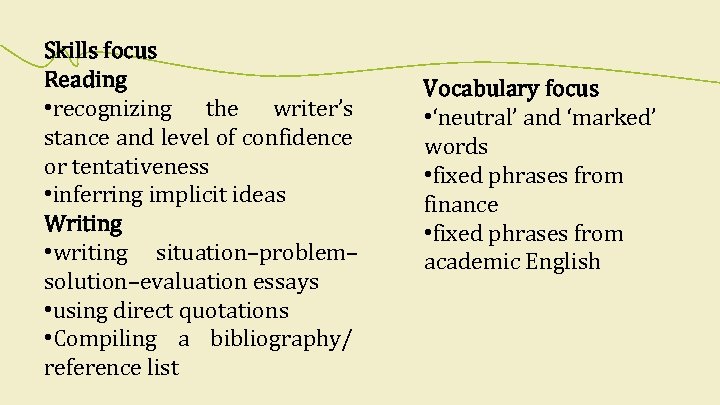 Skills focus Reading • recognizing the writer’s stance and level of confidence or tentativeness • inferring implicit ideas Writing • writing situation–problem– solution–evaluation essays • using direct quotations • Compiling a bibliography/ reference list Vocabulary focus • ‘neutral’ and ‘marked’ words • fixed phrases from finance • fixed phrases from academic English
 10. 1 Vocabulary 10. 2 Reading 10. 3 Extending skills 10. 4 Extending skills
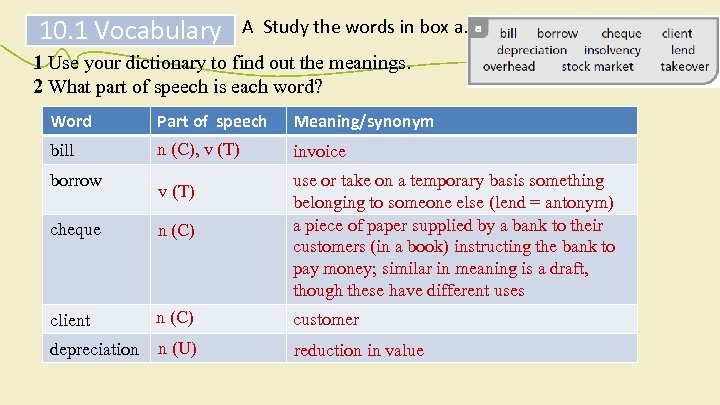 10. 1 Vocabulary A Study the words in box a. 1 Use your dictionary to find out the meanings. 2 What part of speech is each word? Word Part of speech Meaning/synonym bill n (C), v (T) invoice borrow cheque n (C) use or take on a temporary basis something belonging to someone else (lend = antonym) a piece of paper supplied by a bank to their customers (in a book) instructing the bank to pay money; similar in meaning is a draft, though these have different uses client n (C) customer depreciation n (U) reduction in value v (T)
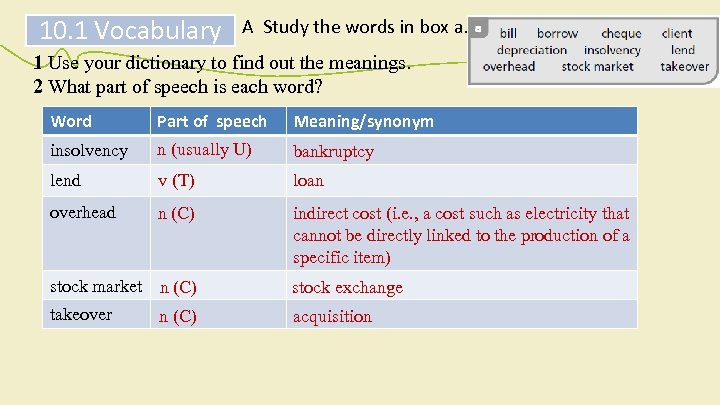 10. 1 Vocabulary A Study the words in box a. 1 Use your dictionary to find out the meanings. 2 What part of speech is each word? Word Part of speech Meaning/synonym insolvency n (usually U) bankruptcy lend v (T) loan overhead n (C) indirect cost (i. e. , a cost such as electricity that cannot be directly linked to the production of a specific item) stock market n (C) stock exchange takeover acquisition n (C)
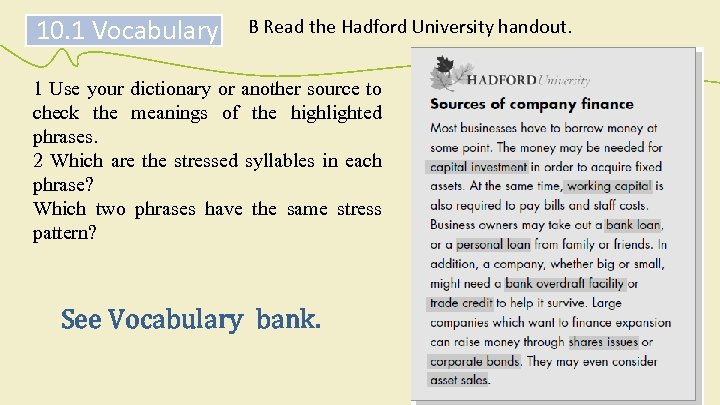 10. 1 Vocabulary B Read the Hadford University handout. 1 Use your dictionary or another source to check the meanings of the highlighted phrases. 2 Which are the stressed syllables in each phrase? Which two phrases have the same stress pattern? See Vocabulary bank.
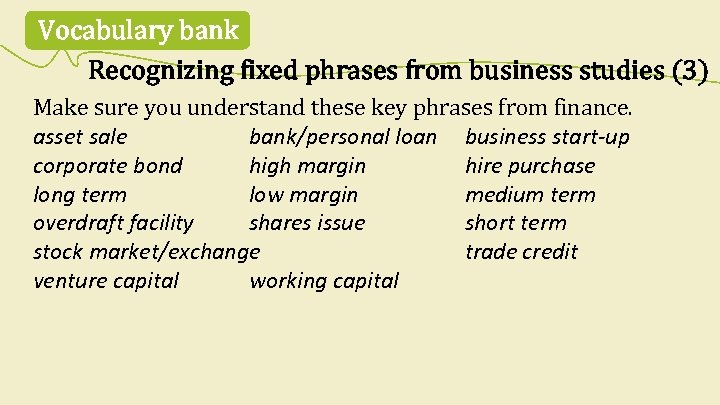 Vocabulary bank Recognizing fixed phrases from business studies (3) Make sure you understand these key phrases from finance. asset sale bank/personal loan business start-up corporate bond high margin hire purchase long term low margin medium term overdraft facility shares issue short term stock market/exchange trade credit venture capital working capital
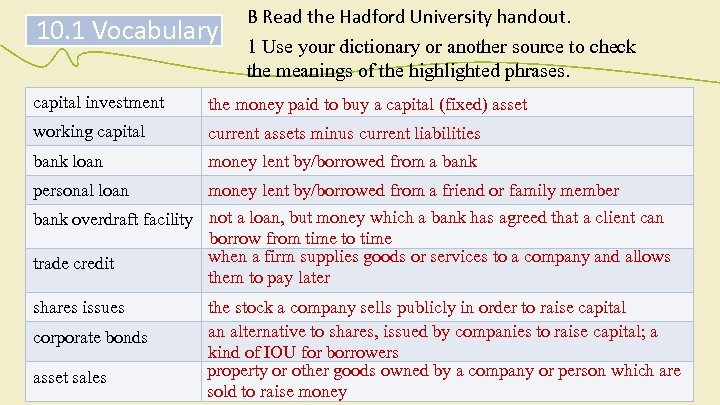 10. 1 Vocabulary B Read the Hadford University handout. 1 Use your dictionary or another source to check the meanings of the highlighted phrases. capital investment the money paid to buy a capital (fixed) asset working capital current assets minus current liabilities bank loan money lent by/borrowed from a bank money lent by/borrowed from a friend or family member bank overdraft facility not a loan, but money which a bank has agreed that a client can borrow from time to time when a firm supplies goods or services to a company and allows trade credit them to pay later personal loan shares issues corporate bonds asset sales the stock a company sells publicly in order to raise capital an alternative to shares, issued by companies to raise capital; a kind of IOU for borrowers property or other goods owned by a company or person which are sold to raise money
 10. 1 Vocabulary B Read the Hadford University handout. 2 Which are the stressed syllables in each phrase? Which two phrases have the same stress pattern? capital investment Ooo o. Oo working capital Oo Ooo bank loan OO personal loan Ooo O bank overdraft facility O Ooo o. Ooo trade credit O Oo shares issues O Oo corporate bonds Ooo O asset sales Oo O Shares issues and trade credit have the same stress pattern.
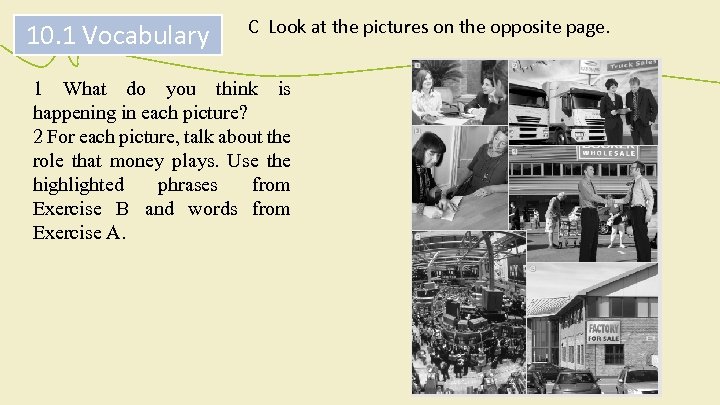 10. 1 Vocabulary C Look at the pictures on the opposite page. 1 What do you think is happening in each picture? 2 For each picture, talk about the role that money plays. Use the highlighted phrases from Exercise B and words from Exercise A.
 10. 1 Vocabulary C Look at the pictures on the opposite page. Possible answers: 1 Two business people are in a bank talking to the member of staff. Perhaps the clients want to borrow some money. In other words, they could be asking for either a bank loan or an overdraft facility. 2 A business person is looking at some new trucks/lorries. He will need some money to pay for the new lorries. In other words, he will need some money for capital investment. 3 A woman is writing a cheque – perhaps she is lending some money to a friend or family member – in other words, a personal loan. Or she could be paying a bill.
 10. 1 Vocabulary C Look at the pictures on the opposite page. Possible answers: 4 An owner of a small business is discussing/agreeing something with a supplier. Perhaps the supplier wants his/her money but the business person can’t pay the bill at the moment. The business person will need to negotiate trade credit. 5 This shows the inside of a stock exchange. This is where stocks, shares and bonds are bought and sold. It’s a stock market. 6 The company that owns this factory wants to sell it. In other words, this is an asset sale. Perhaps the company needs the money for something. Or possibly the factory is being sold as a result of insolvency.
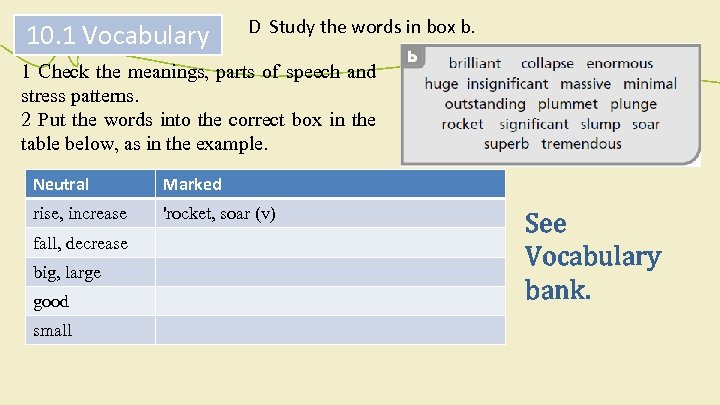 10. 1 Vocabulary D Study the words in box b. 1 Check the meanings, parts of speech and stress patterns. 2 Put the words into the correct box in the table below, as in the example. Neutral Marked rise, increase 'rocket, soar (v) fall, decrease big, large good small See Vocabulary bank.
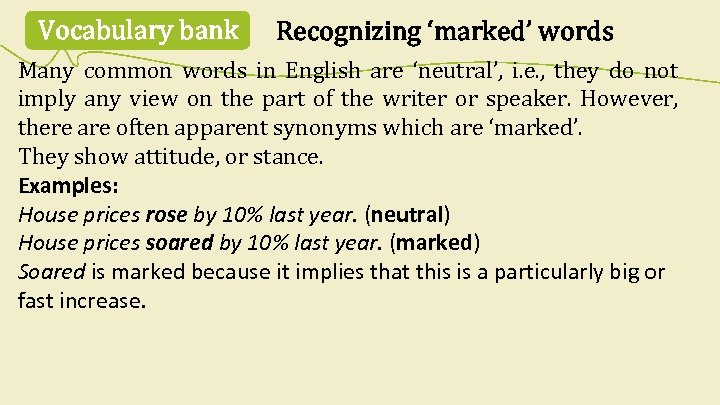 Vocabulary bank Recognizing ‘marked’ words Many common words in English are ‘neutral’, i. e. , they do not imply any view on the part of the writer or speaker. However, there are often apparent synonyms which are ‘marked’. They show attitude, or stance. Examples: House prices rose by 10% last year. (neutral) House prices soared by 10% last year. (marked) Soared is marked because it implies that this is a particularly big or fast increase.
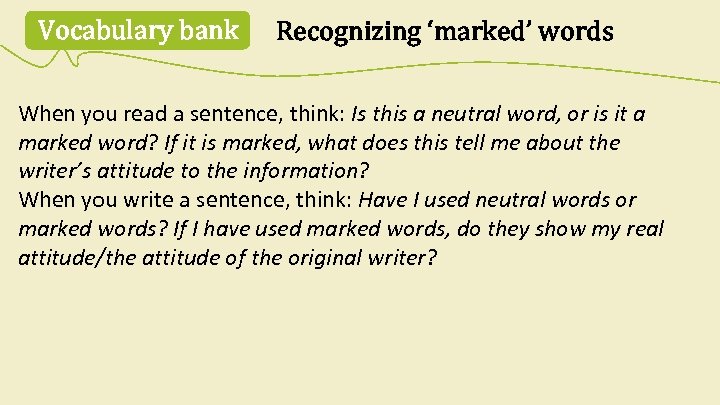 Vocabulary bank Recognizing ‘marked’ words When you read a sentence, think: Is this a neutral word, or is it a marked word? If it is marked, what does this tell me about the writer’s attitude to the information? When you write a sentence, think: Have I used neutral words or marked words? If I have used marked words, do they show my real attitude/the attitude of the original writer?
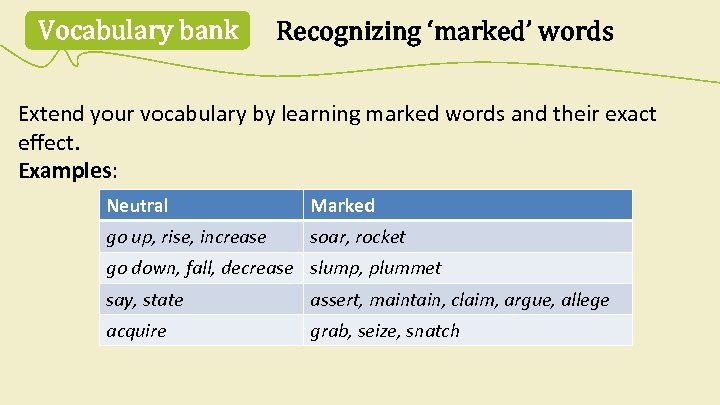 Vocabulary bank Recognizing ‘marked’ words Extend your vocabulary by learning marked words and their exact effect. Examples: Neutral Marked go up, rise, increase soar, rocket go down, fall, decrease slump, plummet say, state assert, maintain, claim, argue, allege acquire grab, seize, snatch
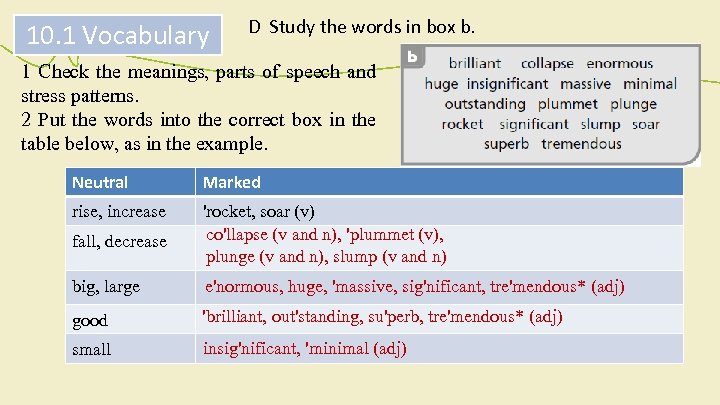 10. 1 Vocabulary D Study the words in box b. 1 Check the meanings, parts of speech and stress patterns. 2 Put the words into the correct box in the table below, as in the example. Neutral Marked rise, increase fall, decrease 'rocket, soar (v) co'llapse (v and n), 'plummet (v), plunge (v and n), slump (v and n) big, large e'normous, huge, 'massive, sig'nificant, tre'mendous* (adj) good 'brilliant, out'standing, su'perb, tre'mendous* (adj) small insig'nificant, 'minimal (adj)
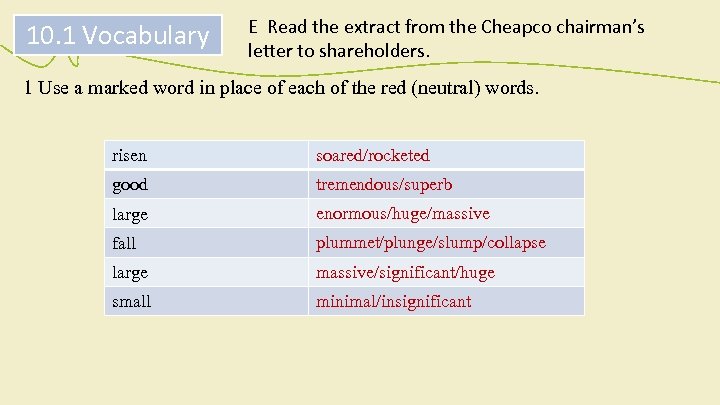 10. 1 Vocabulary E Read the extract from the Cheapco chairman’s letter to shareholders. 1 Use a marked word in place of each of the red (neutral) words. risen soared/rocketed good tremendous/superb large enormous/huge/massive fall plummet/plunge/slump/collapse large massive/significant/huge small minimal/insignificant
 10. 1 Vocabulary E Read the extract from the Cheapco chairman’s letter to shareholders. 2 Look at the bold phrases. How strong are they? See Skills bank.
 Vocabulary bank Recognizing levels of confidence in research or information In an academic context, writers will usually indicate the level of confidence in information they are giving. When you read a ‘fact’ in a text, look for qualifying words before it, which show the level of confidence. Examples: It appears to be the case that … /This suggests that … (tentative) The evidence shows that … /It is clear that … (definite /confident)
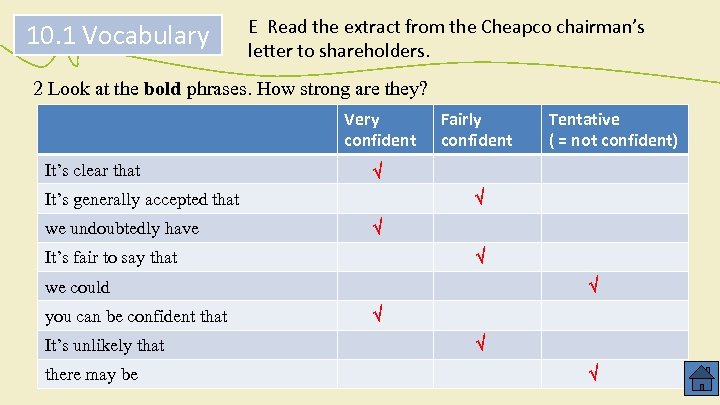 10. 1 Vocabulary E Read the extract from the Cheapco chairman’s letter to shareholders. 2 Look at the bold phrases. How strong are they? Very confident It’s clear that √ √ It’s fair to say that √ we could you can be confident that It’s unlikely that there may be Tentative ( = not confident) √ It’s generally accepted that we undoubtedly have Fairly confident √ √
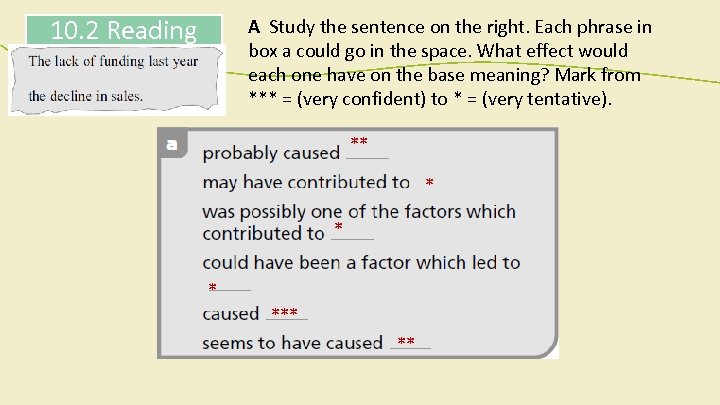 10. 2 Reading A Study the sentence on the right. Each phrase in box a could go in the space. What effect would each one have on the base meaning? Mark from *** = (very confident) to * = (very tentative). ** * *** **
 10. 2 Reading B Survey the text on the opposite page. 1 What will the text be about? 2 Write three research questions.
 10. 2 Reading C Read the text. Does it answer your questions?
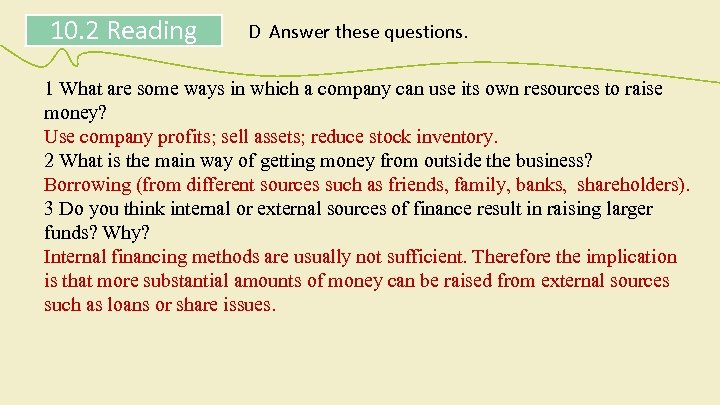 10. 2 Reading D Answer these questions. 1 What are some ways in which a company can use its own resources to raise money? Use company profits; sell assets; reduce stock inventory. 2 What is the main way of getting money from outside the business? Borrowing (from different sources such as friends, family, banks, shareholders). 3 Do you think internal or external sources of finance result in raising larger funds? Why? Internal financing methods are usually not sufficient. Therefore the implication is that more substantial amounts of money can be raised from external sources such as loans or share issues.
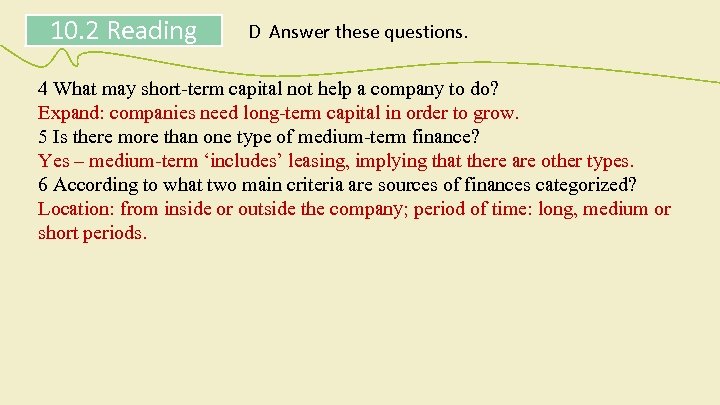 10. 2 Reading D Answer these questions. 4 What may short-term capital not help a company to do? Expand: companies need long-term capital in order to grow. 5 Is there more than one type of medium-term finance? Yes – medium-term ‘includes’ leasing, implying that there are other types. 6 According to what two main criteria are sources of finances categorized? Location: from inside or outside the company; period of time: long, medium or short periods.
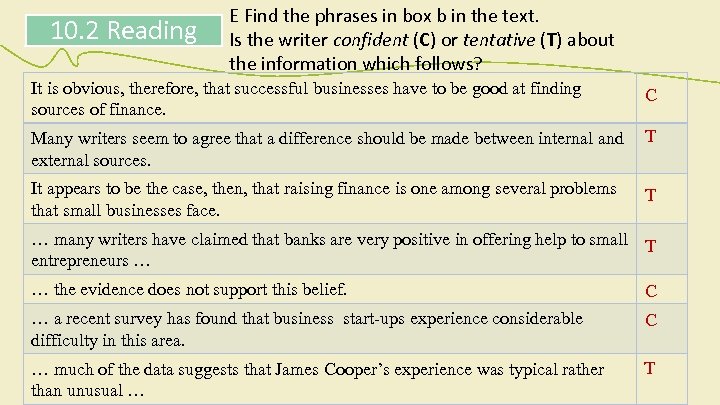 10. 2 Reading E Find the phrases in box b in the text. Is the writer confident (C) or tentative (T) about the information which follows? It is obvious, therefore, that successful businesses have to be good at finding sources of finance. C Many writers seem to agree that a difference should be made between internal and external sources. T It appears to be the case, then, that raising finance is one among several problems that small businesses face. T … many writers have claimed that banks are very positive in offering help to small T entrepreneurs … … the evidence does not support this belief. C … a recent survey has found that business start-ups experience considerable difficulty in this area. C … much of the data suggests that James Cooper’s experience was typical rather than unusual … T
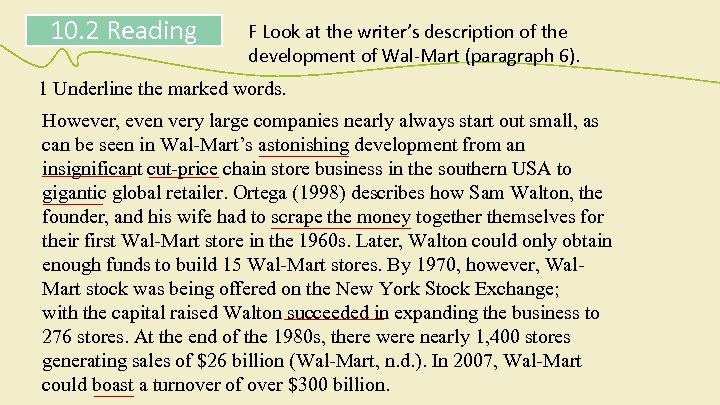 10. 2 Reading F Look at the writer’s description of the development of Wal-Mart (paragraph 6). 1 Underline the marked words. However, even very large companies nearly always start out small, as can be seen in Wal-Mart’s astonishing development from an _________ cut-price chain store business in the southern USA to insignificant _______ gigantic global retailer. Ortega (1998) describes how Sam Walton, the ______ founder, and his wife had to _______ together themselves for scrape the money their first Wal-Mart store in the 1960 s. Later, Walton could only obtain enough funds to build 15 Wal-Mart stores. By 1970, however, Wal. Mart stock was being offered on the New York Stock Exchange; with the capital raised Walton _____ expanding the business to succeeded in 276 stores. At the end of the 1980 s, there were nearly 1, 400 stores generating sales of $26 billion (Wal-Mart, n. d. ). In 2007, Wal-Mart could boast a turnover of over $300 billion. ____
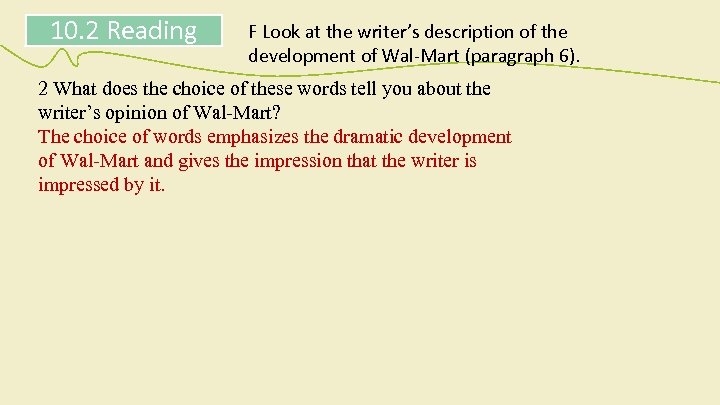 10. 2 Reading F Look at the writer’s description of the development of Wal-Mart (paragraph 6). 2 What does the choice of these words tell you about the writer’s opinion of Wal-Mart? The choice of words emphasizes the dramatic development of Wal-Mart and gives the impression that the writer is impressed by it.
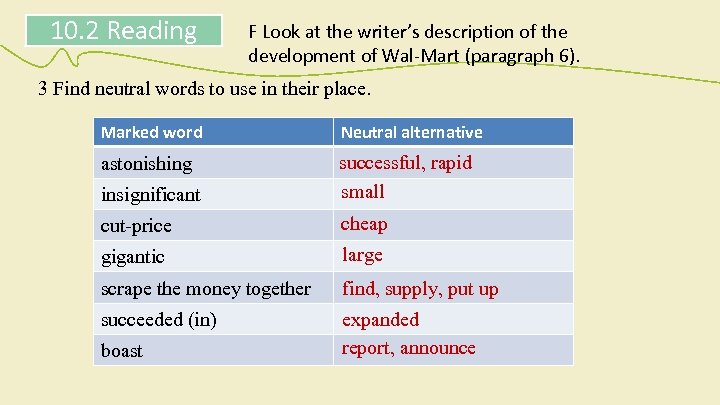 10. 2 Reading F Look at the writer’s description of the development of Wal-Mart (paragraph 6). 3 Find neutral words to use in their place. Marked word Neutral alternative astonishing insignificant successful, rapid small cut-price cheap gigantic large scrape the money together find, supply, put up succeeded (in) expanded report, announce boast
 10. 2 Reading G Study the example sentence on the right, and then sentences A and B. 1 Divide sentences A and B into small parts, as in the example sentence. 2 Underline any joining words (e. g. , conjunctions). See Skills bank.
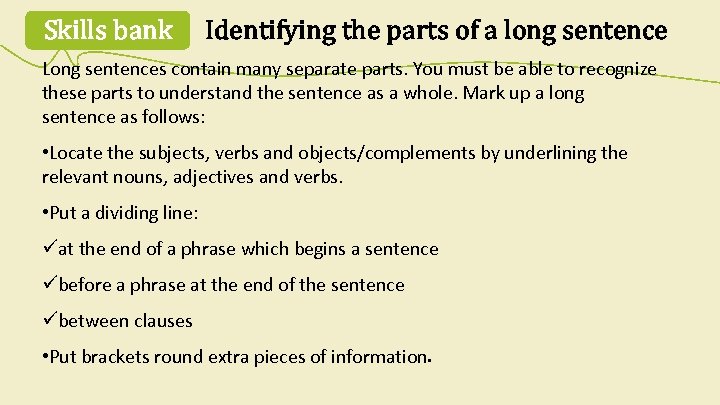 Skills bank Identifying the parts of a long sentence Long sentences contain many separate parts. You must be able to recognize these parts to understand the sentence as a whole. Mark up a long sentence as follows: • Locate the subjects, verbs and objects/complements by underlining the relevant nouns, adjectives and verbs. • Put a dividing line: üat the end of a phrase which begins a sentence übefore a phrase at the end of the sentence übetween clauses • Put brackets round extra pieces of information.
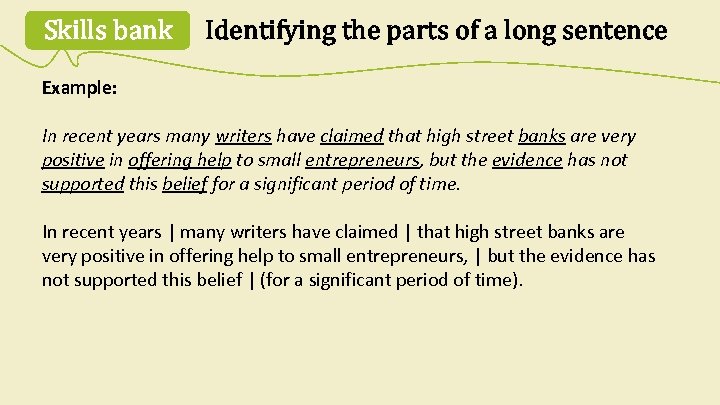 Skills bank Identifying the parts of a long sentence Example: In recent years many writers have claimed that high street banks are very positive in offering help to small entrepreneurs, but the evidence has not supported this belief for a significant period of time. In recent years | many writers have claimed | that high street banks are very positive in offering help to small entrepreneurs, | but the evidence has not supported this belief | (for a significant period of time).
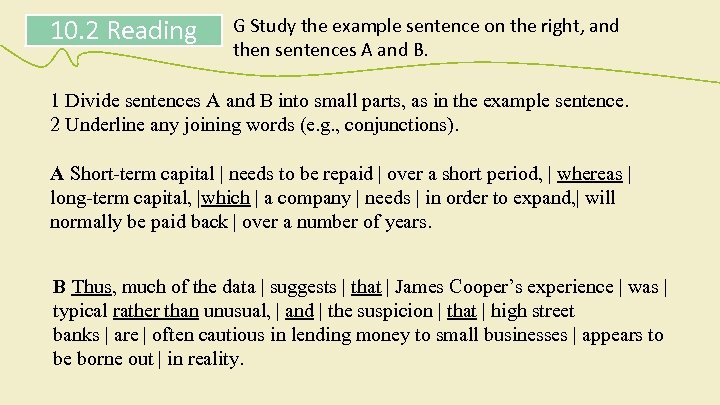 10. 2 Reading G Study the example sentence on the right, and then sentences A and B. 1 Divide sentences A and B into small parts, as in the example sentence. 2 Underline any joining words (e. g. , conjunctions). A Short-term capital | needs to be repaid | over a short period, | whereas | long-term capital, |which | a company | needs | in order to expand, | will normally be paid back | over a number of years. B Thus, much of the data | suggests | that | James Cooper’s experience | was | typical rather than unusual, | and | the suspicion | that | high street banks | are | often cautious in lending money to small businesses | appears to be borne out | in reality.
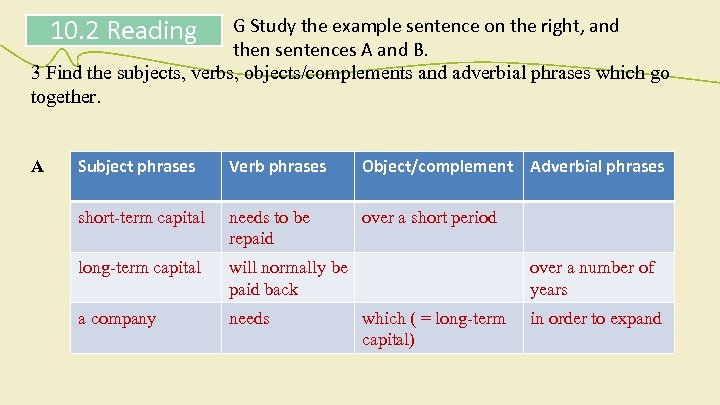 10. 2 Reading G Study the example sentence on the right, and then sentences A and B. 3 Find the subjects, verbs, objects/complements and adverbial phrases which go together. A Subject phrases Verb phrases Object/complement Adverbial phrases short-term capital needs to be repaid over a short period long-term capital will normally be paid back a company needs over a number of years which ( = long-term capital) in order to expand
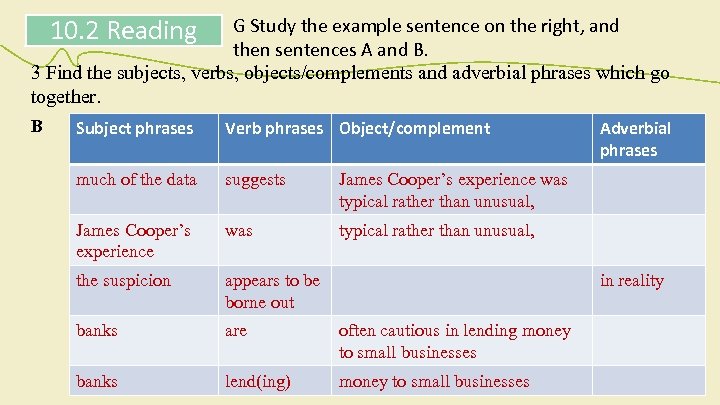 10. 2 Reading G Study the example sentence on the right, and then sentences A and B. 3 Find the subjects, verbs, objects/complements and adverbial phrases which go together. B Subject phrases Verb phrases Object/complement much of the data suggests James Cooper’s experience was typical rather than unusual, the suspicion appears to be borne out banks are often cautious in lending money to small businesses banks lend(ing) money to small businesses Adverbial phrases in reality
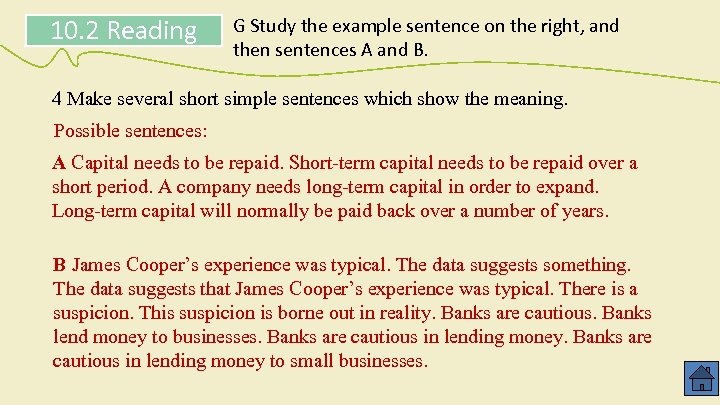 10. 2 Reading G Study the example sentence on the right, and then sentences A and B. 4 Make several short simple sentences which show the meaning. Possible sentences: A Capital needs to be repaid. Short-term capital needs to be repaid over a short period. A company needs long-term capital in order to expand. Long-term capital will normally be paid back over a number of years. B James Cooper’s experience was typical. The data suggests something. The data suggests that James Cooper’s experience was typical. There is a suspicion. This suspicion is borne out in reality. Banks are cautious. Banks lend money to businesses. Banks are cautious in lending money to small businesses.
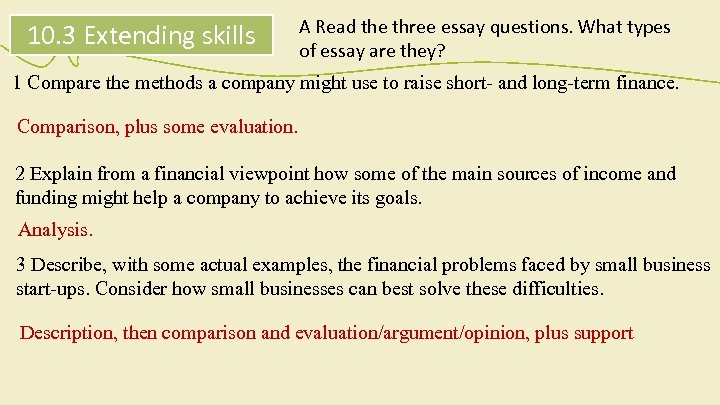 10. 3 Extending skills A Read the three essay questions. What types of essay are they? 1 Compare the methods a company might use to raise short- and long-term finance. Comparison, plus some evaluation. 2 Explain from a financial viewpoint how some of the main sources of income and funding might help a company to achieve its goals. Analysis. 3 Describe, with some actual examples, the financial problems faced by small business start-ups. Consider how small businesses can best solve these difficulties. Description, then comparison and evaluation/argument/opinion, plus support
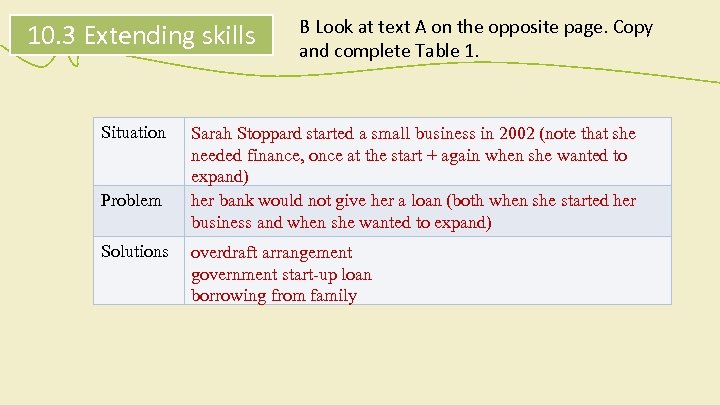 10. 3 Extending skills Situation Problem Solutions B Look at text A on the opposite page. Copy and complete Table 1. Sarah Stoppard started a small business in 2002 (note that she needed finance, once at the start + again when she wanted to expand) her bank would not give her a loan (both when she started her business and when she wanted to expand) overdraft arrangement government start-up loan borrowing from family
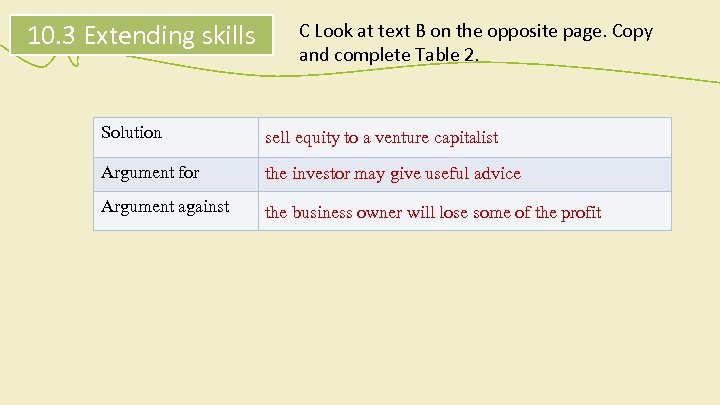 10. 3 Extending skills C Look at text B on the opposite page. Copy and complete Table 2. Solution sell equity to a venture capitalist Argument for the investor may give useful advice Argument against the business owner will lose some of the profit
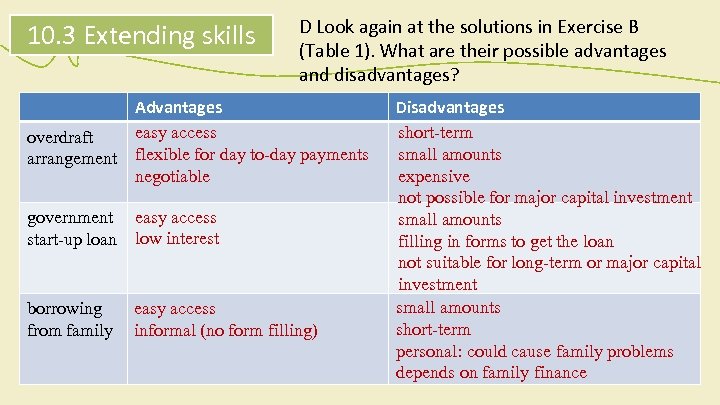 10. 3 Extending skills D Look again at the solutions in Exercise B (Table 1). What are their possible advantages and disadvantages? Advantages easy access overdraft arrangement flexible for day to-day payments negotiable government easy access start-up loan low interest borrowing from family easy access informal (no form filling) Disadvantages short-term small amounts expensive not possible for major capital investment small amounts filling in forms to get the loan not suitable for long-term or major capital investment small amounts short-term personal: could cause family problems depends on family finance
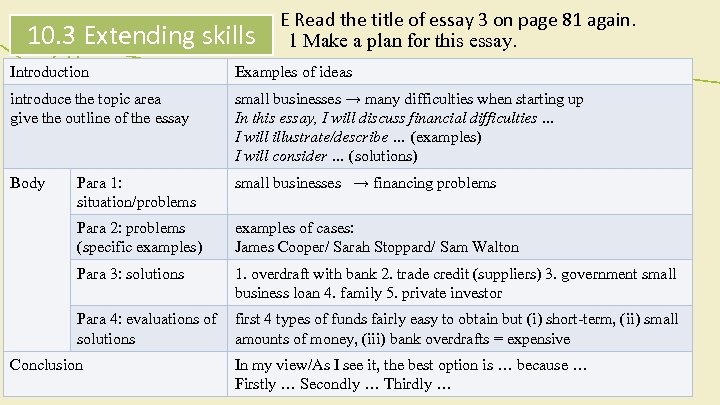 10. 3 Extending skills E Read the title of essay 3 on page 81 again. 1 Make a plan for this essay. Introduction Examples of ideas introduce the topic area give the outline of the essay small businesses → many difficulties when starting up In this essay, I will discuss financial difficulties … I will illustrate/describe … (examples) I will consider … (solutions) Body Para 1: situation/problems small businesses → financing problems Para 2: problems (specific examples) examples of cases: James Cooper/ Sarah Stoppard/ Sam Walton Para 3: solutions 1. overdraft with bank 2. trade credit (suppliers) 3. government small business loan 4. family 5. private investor Para 4: evaluations of solutions first 4 types of funds fairly easy to obtain but (i) short-term, (ii) small amounts of money, (iii) bank overdrafts = expensive Conclusion In my view/As I see it, the best option is … because … Firstly … Secondly … Thirdly …
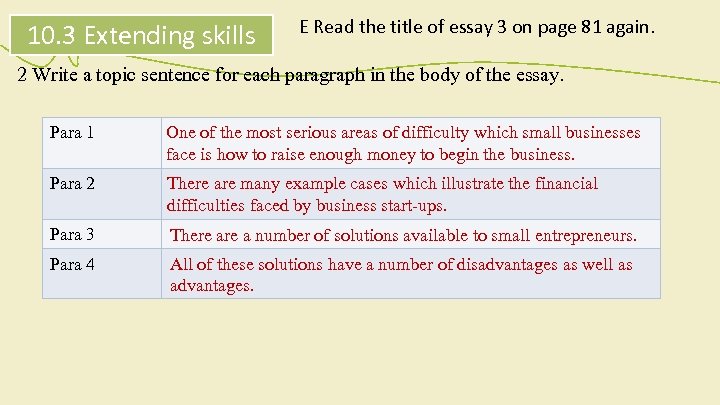 10. 3 Extending skills E Read the title of essay 3 on page 81 again. 2 Write a topic sentence for each paragraph in the body of the essay. Para 1 One of the most serious areas of difficulty which small businesses face is how to raise enough money to begin the business. Para 2 There are many example cases which illustrate the financial difficulties faced by business start-ups. Para 3 There a number of solutions available to small entrepreneurs. Para 4 All of these solutions have a number of disadvantages as well as advantages.
 10. 3 Extending skills E Read the title of essay 3 on page 81 again. 3 Write a concluding paragraph.
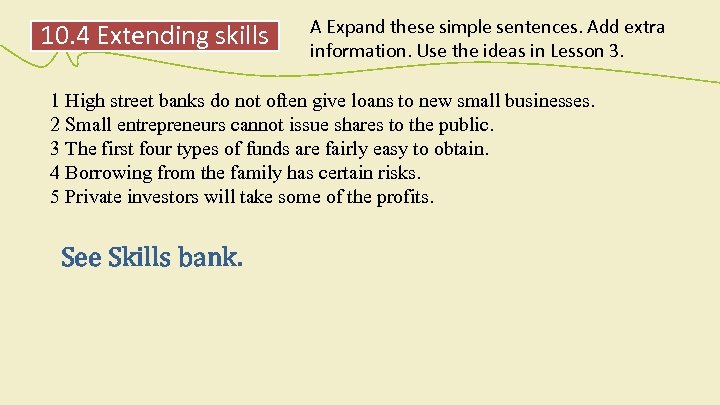 10. 4 Extending skills A Expand these simple sentences. Add extra information. Use the ideas in Lesson 3. 1 High street banks do not often give loans to new small businesses. 2 Small entrepreneurs cannot issue shares to the public. 3 The first four types of funds are fairly easy to obtain. 4 Borrowing from the family has certain risks. 5 Private investors will take some of the profits. See Skills bank.
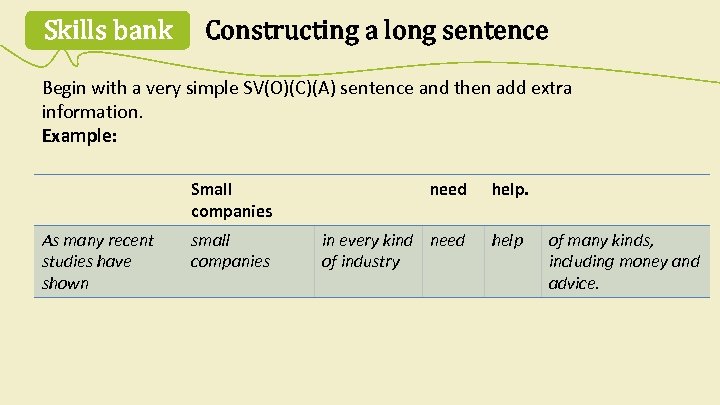 Skills bank Constructing a long sentence Begin with a very simple SV(O)(C)(A) sentence and then add extra information. Example: Small companies As many recent studies have shown need small companies in every kind need of industry help of many kinds, including money and advice.
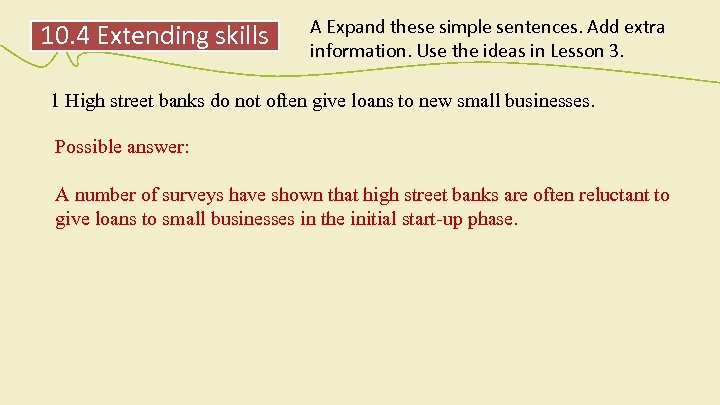 10. 4 Extending skills A Expand these simple sentences. Add extra information. Use the ideas in Lesson 3. 1 High street banks do not often give loans to new small businesses. Possible answer: A number of surveys have shown that high street banks are often reluctant to give loans to small businesses in the initial start-up phase.
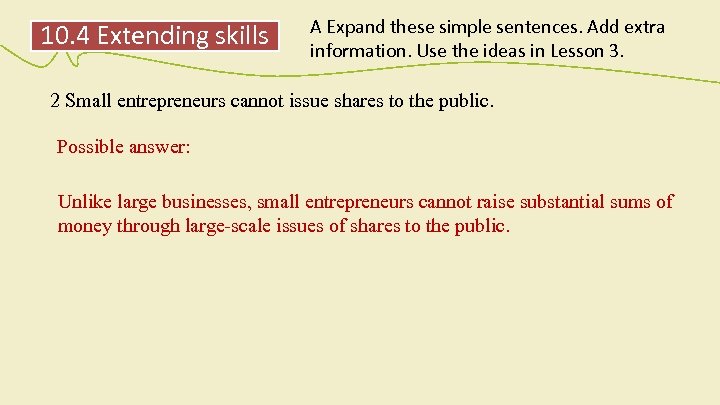 10. 4 Extending skills A Expand these simple sentences. Add extra information. Use the ideas in Lesson 3. 2 Small entrepreneurs cannot issue shares to the public. Possible answer: Unlike large businesses, small entrepreneurs cannot raise substantial sums of money through large-scale issues of shares to the public.
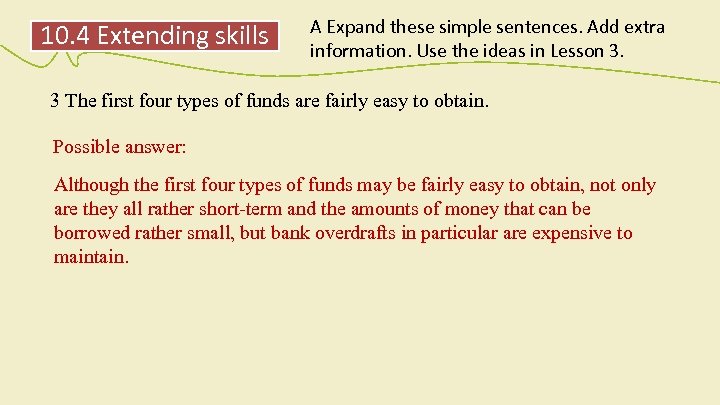 10. 4 Extending skills A Expand these simple sentences. Add extra information. Use the ideas in Lesson 3. 3 The first four types of funds are fairly easy to obtain. Possible answer: Although the first four types of funds may be fairly easy to obtain, not only are they all rather short-term and the amounts of money that can be borrowed rather small, but bank overdrafts in particular are expensive to maintain.
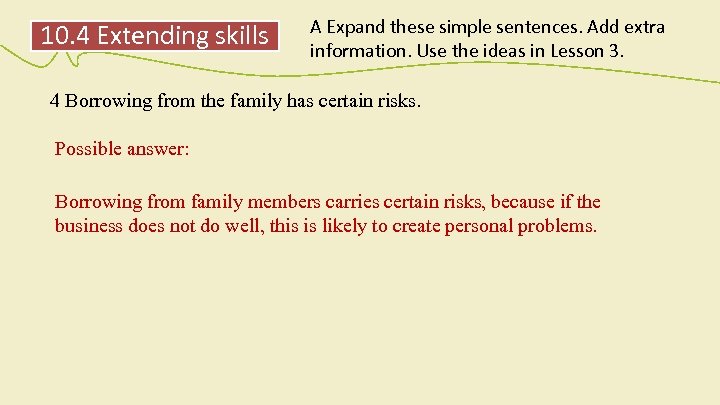 10. 4 Extending skills A Expand these simple sentences. Add extra information. Use the ideas in Lesson 3. 4 Borrowing from the family has certain risks. Possible answer: Borrowing from family members carries certain risks, because if the business does not do well, this is likely to create personal problems.
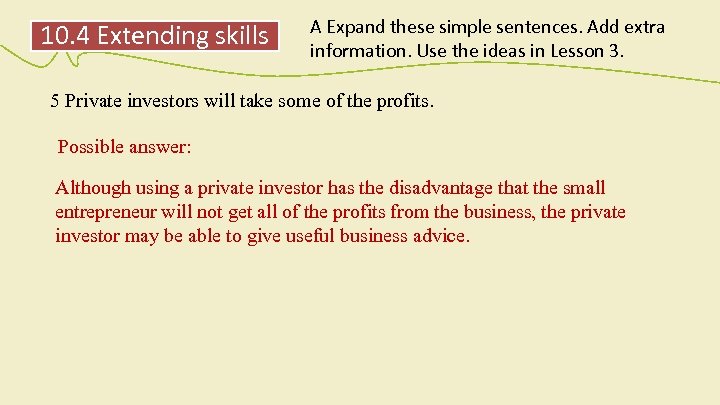 10. 4 Extending skills A Expand these simple sentences. Add extra information. Use the ideas in Lesson 3. 5 Private investors will take some of the profits. Possible answer: Although using a private investor has the disadvantage that the small entrepreneur will not get all of the profits from the business, the private investor may be able to give useful business advice.
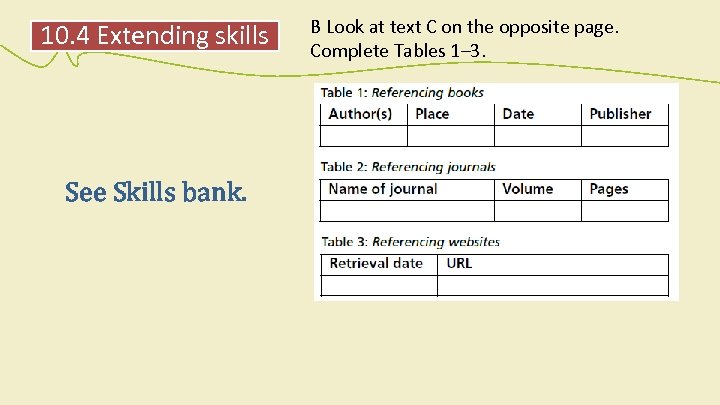 10. 4 Extending skills See Skills bank. B Look at text C on the opposite page. Complete Tables 1– 3.
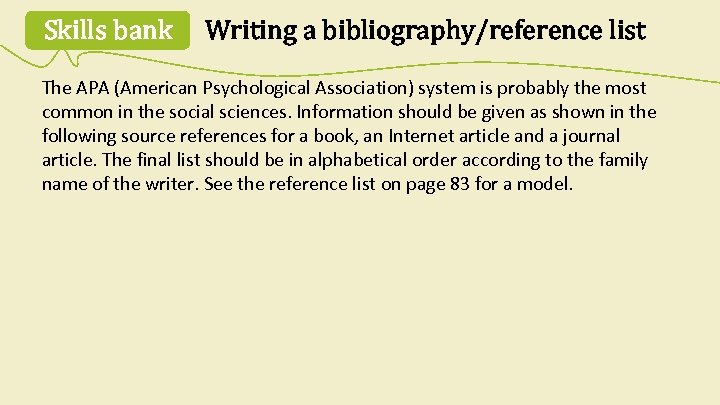 Skills bank Writing a bibliography/reference list The APA (American Psychological Association) system is probably the most common in the social sciences. Information should be given as shown in the following source references for a book, an Internet article and a journal article. The final list should be in alphabetical order according to the family name of the writer. See the reference list on page 83 for a model.
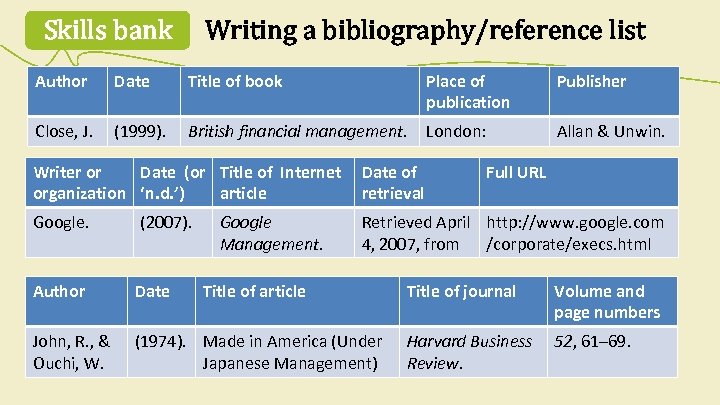 Skills bank Writing a bibliography/reference list Author Date Title of book Place of publication Publisher Close, J. (1999). British financial management. London: Allan & Unwin. Writer or Date (or Title of Internet organization ‘n. d. ’) article Date of retrieval Google. Retrieved April http: //www. google. com 4, 2007, from /corporate/execs. html (2007). Google Management. Author Date Title of article John, R. , & Ouchi, W. (1974). Made in America (Under Japanese Management) Full URL Title of journal Volume and page numbers Harvard Business Review. 52, 61– 69.
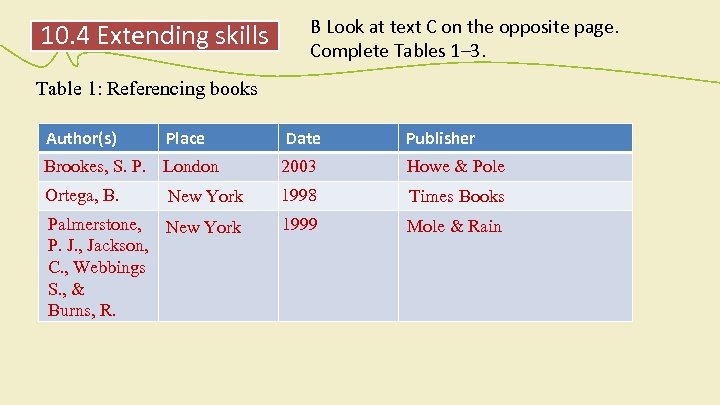 10. 4 Extending skills B Look at text C on the opposite page. Complete Tables 1– 3. Table 1: Referencing books Author(s) Place Date Publisher Brookes, S. P. London 2003 Howe & Pole Ortega, B. New York 1998 Times Books Palmerstone, New York P. J. , Jackson, C. , Webbings S. , & Burns, R. 1999 Mole & Rain
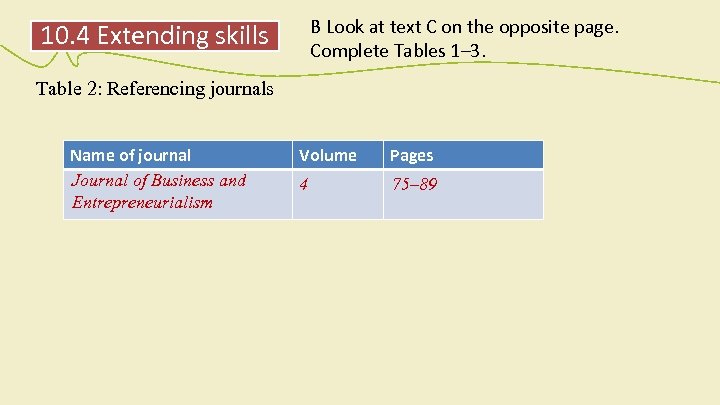 B Look at text C on the opposite page. Complete Tables 1– 3. 10. 4 Extending skills Table 2: Referencing journals Name of journal Journal of Business and Entrepreneurialism Volume Pages 4 75– 89
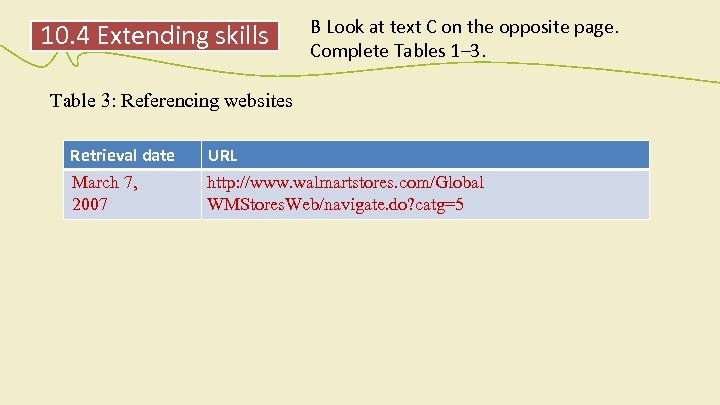 10. 4 Extending skills B Look at text C on the opposite page. Complete Tables 1– 3. Table 3: Referencing websites Retrieval date URL March 7, 2007 http: //www. walmartstores. com/Global WMStores. Web/navigate. do? catg=5
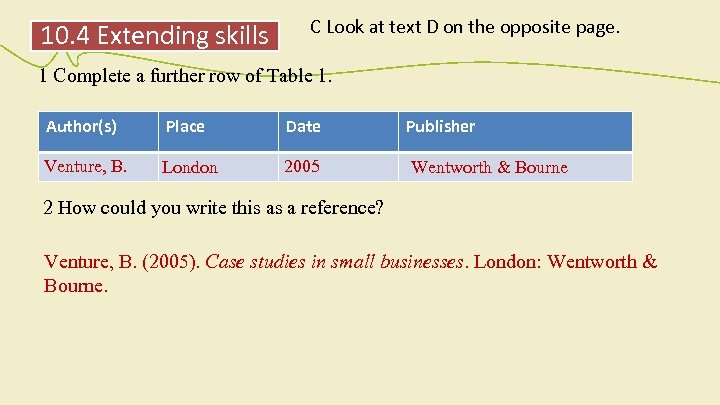 10. 4 Extending skills C Look at text D on the opposite page. 1 Complete a further row of Table 1. Author(s) Place Date Venture, B. London 2005 Publisher Wentworth & Bourne 2 How could you write this as a reference? Venture, B. (2005). Case studies in small businesses. London: Wentworth & Bourne.
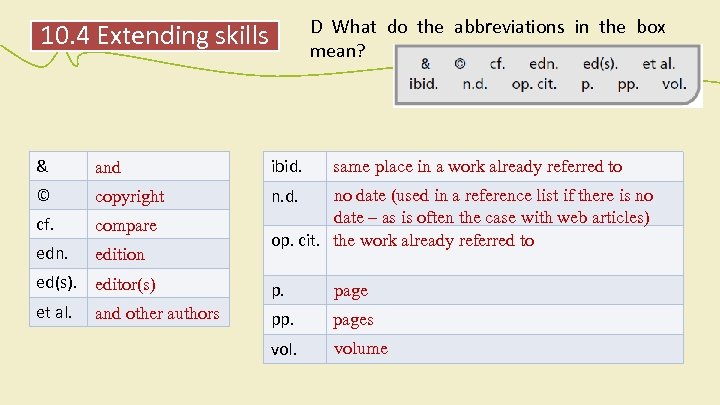 D What do the abbreviations in the box mean? 10. 4 Extending skills & and ibid. © copyright n. d. cf. compare edn. edition ed(s). editor(s) et al. and other authors same place in a work already referred to no date (used in a reference list if there is no date – as is often the case with web articles) op. cit. the work already referred to p. page pp. pages volume
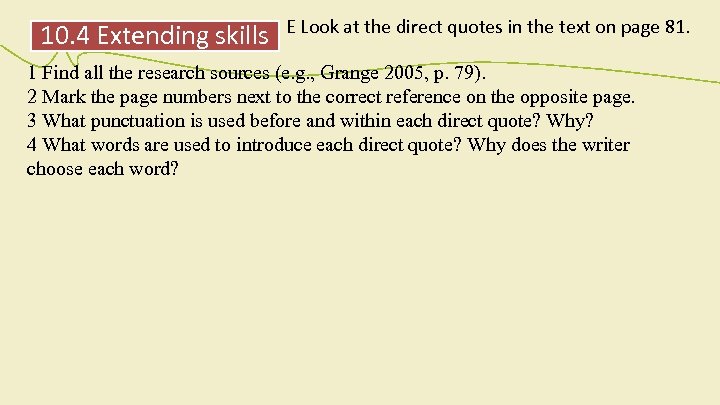 10. 4 Extending skills E Look at the direct quotes in the text on page 81. 1 Find all the research sources (e. g. , Grange 2005, p. 79). 2 Mark the page numbers next to the correct reference on the opposite page. 3 What punctuation is used before and within each direct quote? Why? 4 What words are used to introduce each direct quote? Why does the writer choose each word?
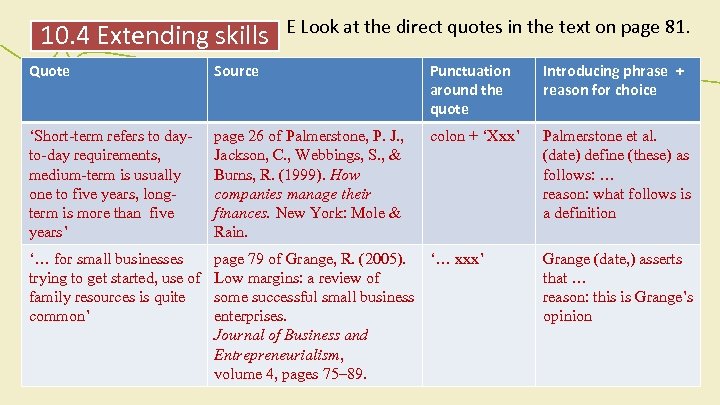 10. 4 Extending skills E Look at the direct quotes in the text on page 81. Quote Source Punctuation around the quote Introducing phrase + reason for choice ‘Short-term refers to dayto-day requirements, medium-term is usually one to five years, longterm is more than five years’ page 26 of Palmerstone, P. J. , Jackson, C. , Webbings, S. , & Burns, R. (1999). How companies manage their finances. New York: Mole & Rain. colon + ‘Xxx’ Palmerstone et al. (date) define (these) as follows: … reason: what follows is a definition ‘… for small businesses trying to get started, use of family resources is quite common’ page 79 of Grange, R. (2005). ‘… xxx’ Low margins: a review of some successful small business enterprises. Journal of Business and Entrepreneurialism, volume 4, pages 75– 89. Grange (date, ) asserts that … reason: this is Grange’s opinion
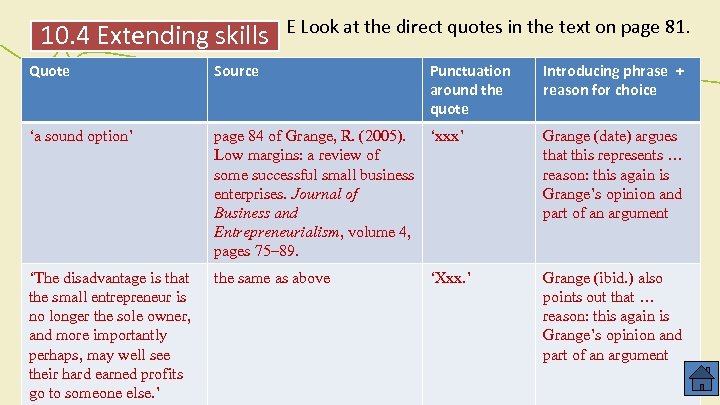 10. 4 Extending skills E Look at the direct quotes in the text on page 81. Quote Source Punctuation around the quote ‘a sound option’ page 84 of Grange, R. (2005). ‘xxx’ Low margins: a review of some successful small business enterprises. Journal of Business and Entrepreneurialism, volume 4, pages 75– 89. Grange (date) argues that this represents … reason: this again is Grange’s opinion and part of an argument ‘The disadvantage is that the small entrepreneur is no longer the sole owner, and more importantly perhaps, may well see their hard earned profits go to someone else. ’ the same as above Grange (ibid. ) also points out that … reason: this again is Grange’s opinion and part of an argument ‘Xxx. ’ Introducing phrase + reason for choice
 Tips for Reference 10. 1 Vocabulary部分,学生课前完成练习A、B,熟悉相关词汇和短语,课堂 上 完 成 练 习 C。 教 师 课 堂 讲 解 Vocabulary bank中 “Recognizing ‘marked’ words”和“Recognizing levels of confidence in research or information”技能, 完成练习D、E。 10. 2 Reading部分,课堂完成练习A、B、C、D、E;教师课堂讲解Skills bank 中的“Identifying the parts of a long sentence ”技能,完成练习G。 10. 3 Extending skills部分,课堂顺次完成练习A、B、C、D、E 。 10. 4 Extending skills部分,教师课堂讲解Skills bank中的“Constructing a long sentence”技 能 , 完 成 练 习 A。 讲 解 Skills bank中 的 “Writing a bibliography/reference list”技能,完成练习B、C、D、E。
 谢谢欣赏!
谢谢欣赏!