



 Unit 1
 Unit I Grammar • In this unit you will learn how to ask for information about a person, an object or a location by using the following: – – – the first three persons of the pronominal system sentence and question suffixes simple sentence (equational) construction the use of possessive pronouns negation
 Persons in Aymara • Aymara uses different person pronouns and verbal conjugations, depending on who the speaker is.
 Persons in Aymara • Aymara uses different person pronouns and verbal conjugations, depending on who the speaker is. • While English and Spanish use a three-person system and mark for singular and plural numbers (I ~ we, you ~ you all, she/he ~ they), Aymara uses a four-person system that does not mark for number.
 Persons in Aymara • Aymara uses different person pronouns and verbal conjugations, depending on who the speaker is. • While English and Spanish use a three-person system and mark for singular and plural numbers (I ~ we, you ~ you all, she/he ~ they), Aymara uses a four-person system that does not mark for number. • In this unit you are introduced to 1 st, 2 nd and 3 rd persons. – 1 = naya = first person, “I or we, but not you” – 2 = juma = second person, “you” – 3 = jup′a = third person, “she, they, he; neither you nor I, but human”
 Persons in Aymara • Aymara uses different person pronouns and verbal conjugations, depending on who the speaker is. • While English and Spanish use a three-person system and mark for singular and plural numbers (I ~ we, you ~ you all, she/he ~ they), Aymara uses a four-person system that does not mark for number. • In this unit you are introduced to 1 st, 2 nd and 3 rd persons. – 1 = naya = first person, “I or we, but not you” – 2 = juma = second person, “you” – 3 = jup′a = third person, “she, they, he; neither you nor I, but human” – The 4 th person (jiwasa) is presented in Unit III, and represents “we, both you and I”. See Gramática, VIII 1. 21; VII 3. 11. 1 for more information.
 Sentence suffixes • One of the interesting things about the Aymara language is that there are sentence suffixes.
 Sentence suffixes • One of the interesting things about the Aymara language is that there are sentence suffixes. • In English and in Spanish we most frequently indicate what kind of sentence we’re producing by the melody of our voice, or by the punctuation we use in writing.
 Sentence suffixes • One of the interesting things about the Aymara language is that there are sentence suffixes. • In English and in Spanish we most frequently indicate what kind of sentence we’re producing by the melody of our voice, or by the punctuation we use in writing. • For example, the simple series of words: I went downtown yesterday – Can be a declarative sentence, a statement of fact, by lowering your voice at the end, as in “I went downtown yesterday. ” – Can be a question by raising your voice at the end, as in “I went downtown yesterday? ” – Or can be a non-sentence, (a clause as part of a larger sentence), by keeping your voice level at the end in anticipation of further information, as in “I went downtown yesterday… and bought a shirt. ”
 Sentence suffixes • Aymara does not indicate sentence type with intonation as English and Spanish do.
 Sentence suffixes • Aymara does not indicate sentence type with intonation as English and Spanish do. • Instead, Aymara uses a series of suffixes that tell you what kind of a sentence you are listening to.
 Sentence suffixes • Aymara does not indicate sentence type with intonation as English and Spanish do. • Instead, Aymara uses a series of suffixes that tell you what kind of a sentence you are listening to. • Although intonational and melody changes exists in Aymara, they do not mark the grammar.
 Sentence suffixes • Aymara does not indicate sentence type with intonation as English and Spanish do. • Instead, Aymara uses a series of suffixes that tell you what kind of a sentence you are listening to. • Although intonational and melody changes exists in Aymara, they do not mark the grammar. • If you do not use the sentence suffixes in Aymara to mark your grammar, your Aymara is not grammatical. • Worse yet, you could be perceived as rude. – The one type of sentence that does not require sentence suffixes is the rude commands. In other words, using no sentence suffix means issuing a rude command. – Therefore, if you do not use sentence suffixes you will be perceived as perpetually shouting rude commands at everyone, even if your words are understood. – Remember, then, the importance of learning and knowing these sentence suffixes for your interactions with Aymara people.
 Sentence suffixes • Aymara does not indicate sentence type with intonation as English and Spanish do. • Instead, Aymara uses a series of suffixes that tell you what kind of a sentence you are listening to. • Although intonational and melody changes exists in Aymara, they do not mark the grammar. • If you do not use the sentence suffixes in Aymara to mark your grammar, your Aymara is not grammatical. • Worse yet, you could be perceived as rude. – The one type of sentence that does not require sentence suffixes is the rude commands. In other words, using no sentence suffix means issuing a rude command. – Therefore, if you do not use sentence suffixes you will be perceived as perpetually shouting rude commands at everyone, even if your words are understood. – Remember, then, the importance of learning and knowing these sentence suffixes for your interactions with Aymara people.
 Sentence suffix types • There are five sentence suffixes in Aymara.
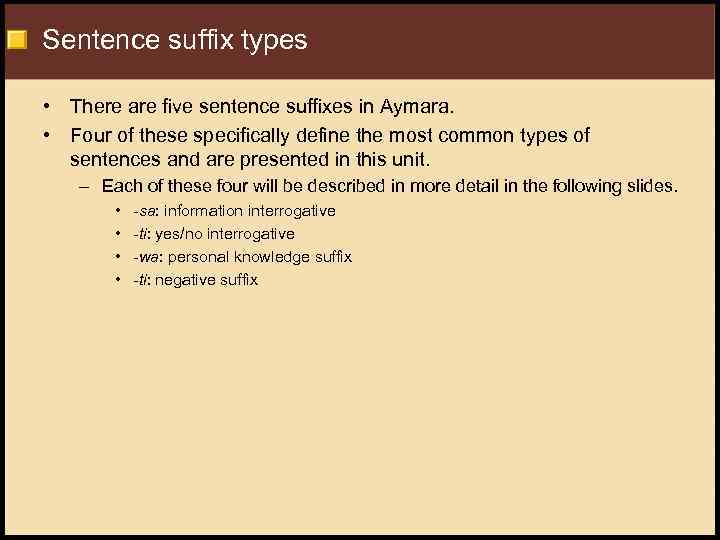 Sentence suffix types • There are five sentence suffixes in Aymara. • Four of these specifically define the most common types of sentences and are presented in this unit. – Each of these four will be described in more detail in the following slides. • • -sa: information interrogative -ti: yes/no interrogative -wa: personal knowledge suffix -ti: negative suffix
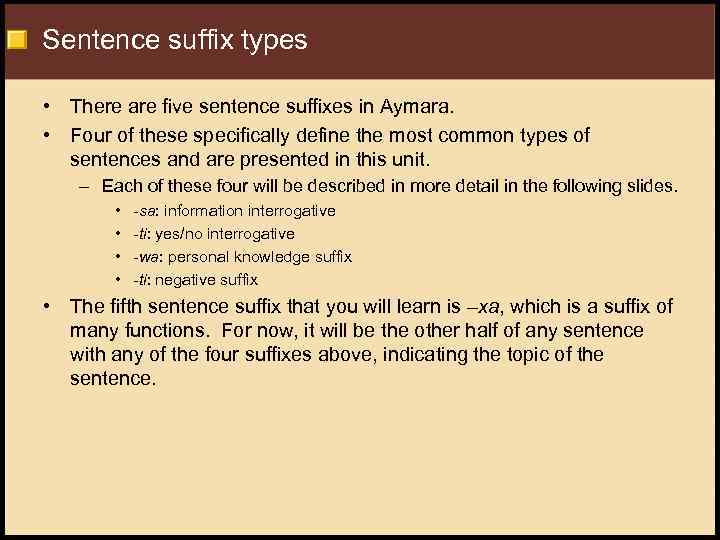 Sentence suffix types • There are five sentence suffixes in Aymara. • Four of these specifically define the most common types of sentences and are presented in this unit. – Each of these four will be described in more detail in the following slides. • • -sa: information interrogative -ti: yes/no interrogative -wa: personal knowledge suffix -ti: negative suffix • The fifth sentence suffix that you will learn is –xa, which is a suffix of many functions. For now, it will be the other half of any sentence with any of the four suffixes above, indicating the topic of the sentence.
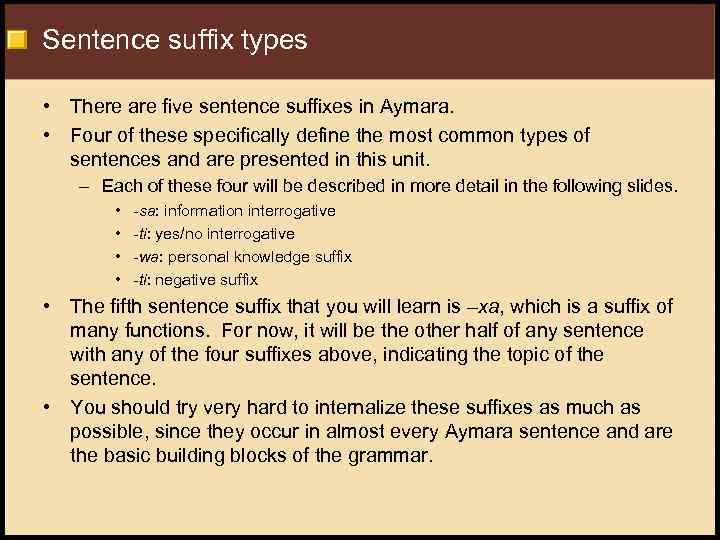 Sentence suffix types • There are five sentence suffixes in Aymara. • Four of these specifically define the most common types of sentences and are presented in this unit. – Each of these four will be described in more detail in the following slides. • • -sa: information interrogative -ti: yes/no interrogative -wa: personal knowledge suffix -ti: negative suffix • The fifth sentence suffix that you will learn is –xa, which is a suffix of many functions. For now, it will be the other half of any sentence with any of the four suffixes above, indicating the topic of the sentence. • You should try very hard to internalize these suffixes as much as possible, since they occur in almost every Aymara sentence and are the basic building blocks of the grammar.
 Information Interrogative –sa This suffix is used when asking an information question.
 Information Interrogative –sa This suffix is used when asking an information question. These questions are those that ask who, what, when, where, why, how, etc.
 Information Interrogative –sa This suffix is used when asking an information question. These questions are those that ask who, what, when, where, why, how, etc. Note though that the interrogative pronouns in Aymara to which –sa attach are not exact translations of the pronouns that we use for informational questions in English or Spanish.
 Information Interrogative –sa This suffix is used when asking an information question. These questions are those that ask who, what, when, where, why, how, etc. Note though that the interrogative pronouns in Aymara to which –sa attach are not exact translations of the pronouns that we use for informational questions in English or Spanish. You will learn these pronouns throughout the units. For now, however, just be able to recognize the –sa suffix in informational questions.
 Yes/No Interrogative –ti This suffix is used when asking a question to which you expect only a “yes” or “no” answer.
 Yes/No Interrogative –ti This suffix is used when asking a question to which you expect only a “yes” or “no” answer. In other words, all the other information relevant to this question is information the speaker already knows.
 Personal Knowledge Suffix –wa • “Data source” is a major category of the Aymara language. What this means is that you indicate in every sentence how you know what you are talking about.
 Personal Knowledge Suffix –wa • “Data source” is a major category of the Aymara language. What this means is that you indicate in every sentence how you know what you are talking about. • We will return to this in later units.
 Personal Knowledge Suffix –wa • “Data source” is a major category of the Aymara language. What this means is that you indicate in every sentence how you know what you are talking about. • We will return to this in later units. • For now, you need to know that the suffix –wa is used in answering question, both in the affirmative and the negative.
 Personal Knowledge Suffix –wa • “Data source” is a major category of the Aymara language. What this means is that you indicate in every sentence how you know what you are talking about. • We will return to this in later units. • For now, you need to know that the suffix –wa is used in answering question, both in the affirmative and the negative. • What this suffix also says is that you know what you are talking about because you have experienced it.
 Personal Knowledge Suffix –wa • “Data source” is a major category of the Aymara language. What this means is that you indicate in every sentence how you know what you are talking about. • We will return to this in later units. • For now, you need to know that the suffix –wa is used in answering question, both in the affirmative and the negative. • What this suffix also says is that you know what you are talking about because you have experienced it. • For pedagogical purpose, we pretend in these materials that you have experienced more that you have, so that you can participate fully in the exercises.
 Personal Knowledge Suffix –wa • “Data source” is a major category of the Aymara language. What this means is that you indicate in every sentence how you know what you are talking about. • We will return to this in later units. • For now, you need to know that the suffix –wa is used in answering question, both in the affirmative and the negative. • What this suffix also says is that you know what you are talking about because you have experienced it. • For pedagogical purpose, we pretend in these materials that you have experienced more that you have, so that you can participate fully in the exercises. • However, remember that this suffix –wa indicates personal knowledge. In later units you will learn what to say when you do not have personal experience.
 Personal Knowledge Suffix –wa • “Data source” is a major category of the Aymara language. What this means is that you indicate in every sentence how you know what you are talking about. • We will return to this in later units. • For now, you need to know that the suffix –wa is used in answering question, both in the affirmative and the negative. • What this suffix also says is that you know what you are talking about because you have experienced it. • For pedagogical purpose, we pretend in these materials that you have experienced more that you have, so that you can participate fully in the exercises. • However, remember that this suffix –wa indicates personal knowledge. In later units you will learn what to say when you do not have personal experience. • For now, pretend you already have some personal experience among the Aymara!
 Negative suffix –ti • This suffix is used when answering a question in the negative.
 Negative suffix –ti • This suffix is used when answering a question in the negative. • Note that although this suffix looks and sounds like the yes/no question suffix, it is in fact very different. – These are homophonous suffixes, which we’ll explain a bit more in the next slide.
 Negative suffix –ti • This suffix is used when answering a question in the negative. • Note that although this suffix looks and sounds like the yes/no question suffix, it is in fact very different. – These are homophonous suffixes, which we’ll explain a bit more in the next slide. • In a negative sentence the –ti occurs where the personal knowledge suffix –wa would have occurred, since you have the mark sentences as negative.
 Negative suffix –ti • This suffix is used when answering a question in the negative. • Note that although this suffix looks and sounds like the yes/no question suffix, it is in fact very different. – These are homophonous suffixes, which we’ll explain a bit more in the next slide. • In a negative sentence the –ti occurs where the personal knowledge suffix –wa would have occurred, since you have the mark sentences as negative. • At the same time though, a lot more happens in the rest of the sentence as well, because this negative suffix cannot be by itself. Aymara requires double negation, so somewhere in the sentence there also has to be a negative particle, another negative word. – Usually that word is jani, and usually the –wa sufffix goes on jani, to give janiw. – Of course, there are exceptions. The negative constructions are rather complicated in Aymara and you will learn how to use them in the exercises, bit by bit.
 A note on homophony • What is homophony? – Homophones are two or more segments of speech (words, suffixes, etc. ) that are pronounced alike but are different in meaning, derivation or spelling.
 A note on homophony • What is homophony? – Homophones are two or more segments of speech (words, suffixes, etc. ) that are pronounced alike but are different in meaning, derivation or spelling. – For example, the following three words are homophones in English: • too • two
 A note on homophony • What is homophony? – Homophones are two or more segments of speech (words, suffixes, etc. ) that are pronounced alike but are different in meaning, derivation or spelling. – For example, the following three words are homophones in English: • too • two – Their pronunciation is identical although they mean different things and are used in different contexts.
 Homophony in Aymara suffixes • Homophony can pose a real problem for you in learning Aymara because, as we have seen, some suffixes can have exactly the same pronunciation.
 Homophony in Aymara suffixes • • Homophony can pose a real problem for you in learning Aymara because, as we have seen, some suffixes can have exactly the same pronunciation. This happens in more cases than the -ti suffixes you’ve just seen, also.
 Homophony in Aymara suffixes • • • Homophony can pose a real problem for you in learning Aymara because, as we have seen, some suffixes can have exactly the same pronunciation. This happens in more cases than the -ti suffixes you’ve just seen, also. Sometimes these homophonous suffixes have the same effect on the roots and suffixes around them, so they will cause the vowels to elide (be deleted) or not in the same way.
 Homophony in Aymara suffixes • • Homophony can pose a real problem for you in learning Aymara because, as we have seen, some suffixes can have exactly the same pronunciation. This happens in more cases than the -ti suffixes you’ve just seen, also. Sometimes these homophonous suffixes have the same effect on the roots and suffixes around them, so they will cause the vowels to elide (be deleted) or not in the same way. But sometimes (as in the case of the –ta suffix we’ll see in a minute), they can have different effects on the roots and suffixes around them, so you can tell them apart that way.
 Homophony in Aymara suffixes • • • Homophony can pose a real problem for you in learning Aymara because, as we have seen, some suffixes can have exactly the same pronunciation. This happens in more cases than the -ti suffixes you’ve just seen, also. Sometimes these homophonous suffixes have the same effect on the roots and suffixes around them, so they will cause the vowels to elide (be deleted) or not in the same way. But sometimes (as in the case of the –ta suffix we’ll see in a minute), they can have different effects on the roots and suffixes around them, so you can tell them apart that way. Sometimes, because vowels can elide, you can end up with a a single consonant (such as /t/) that could have come from any number of different suffixes – an interrogative or negative sentence suffix or a verb conjugation for two different grammatical persons, etc. In these cases, you’ll need the context to tell you where that /t/ came from originally.
 Homophony in Aymara suffixes • • Homophony can pose a real problem for you in learning Aymara because, as we have seen, some suffixes can have exactly the same pronunciation. This happens in more cases than the -ti suffixes you’ve just seen, also. Sometimes these homophonous suffixes have the same effect on the roots and suffixes around them, so they will cause the vowels to elide (be deleted) or not in the same way. But sometimes (as in the case of the –ta suffix we’ll see in a minute), they can have different effects on the roots and suffixes around them, so you can tell them apart that way. Sometimes, because vowels can elide, you can end up with a a single consonant (such as /t/) that could have come from any number of different suffixes – an interrogative or negative sentence suffix or a verb conjugation for two different grammatical persons, etc. In these cases, you’ll need the context to tell you where that /t/ came from originally. These are problems we will discuss as we proceed through the grammar presentations of the various units. For a chart of the homophonous suffixes, click here.
 Equational sentences and suffixes • What is an equational sentence? • Essentially, it is a sentence with a subject and a use of the "to be” verb.
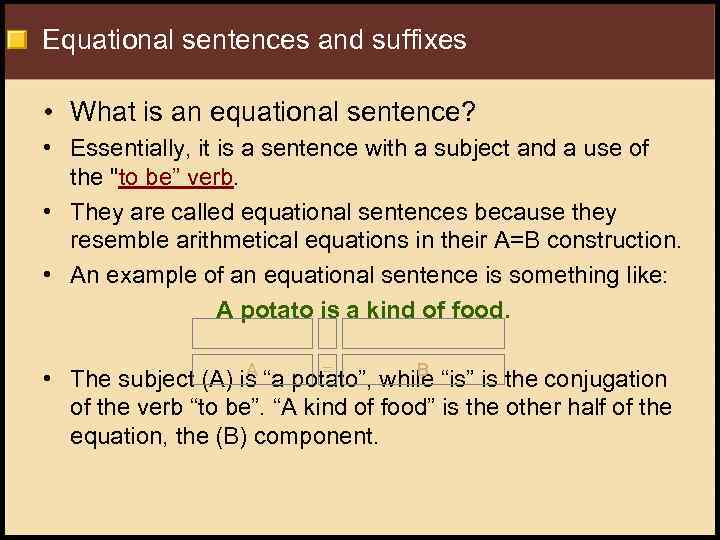
 Equational sentences and suffixes • What is an equational sentence? • Essentially, it is a sentence with a subject and a use of the "to be” verb. • They are called equational sentences because they resemble arithmetical equations in their A=B construction.
 Equational sentences and suffixes • What is an equational sentence? • Essentially, it is a sentence with a subject and a use of the "to be” verb. • They are called equational sentences because they resemble arithmetical equations in their A=B construction. • An example of an equational sentence is something like: A potato is a kind of food.
 Equational sentences and suffixes • What is an equational sentence? • Essentially, it is a sentence with a subject and a use of the "to be” verb. • They are called equational sentences because they resemble arithmetical equations in their A=B construction. • An example of an equational sentence is something like: A potato is a kind of food. • The subject (A) is “a potato”, while “is” is the conjugation of the verb “to be”. “A kind of food” is the other half of the equation, the (B) component.
 Equational sentences and suffixes • What is an equational sentence? • Essentially, it is a sentence with a subject and a use of the "to be” verb. • They are called equational sentences because they resemble arithmetical equations in their A=B construction. • An example of an equational sentence is something like: A potato is a kind of food. A = B • The subject (A) is “a potato”, while “is” is the conjugation of the verb “to be”. “A kind of food” is the other half of the equation, the (B) component.
 Equational sentences and suffixes • In the equational sentences you will see in this unit, you will learn how to talk about origin, about where you and other people are from.
 Equational sentences and suffixes • In the equational sentences you will see in this unit, you will learn how to talk about origin, about where you and other people are from. • There a number of different aspects of the sentence that you will need to be aware of. The following slides present examples of what is discussed here.
 Equational sentences and suffixes • In the equational sentences you will see in this unit, you will learn how to talk about origin, about where you and other people are from. • There a number of different aspects of the sentence that you will need to be aware of. The following slides present examples of what is discussed here. • Aymara equational sentences are marked with the –xa suffix on one half and the –wa (personal knowledge) suffix on the other half.
 Equational sentences and suffixes • In the equational sentences you will see in this unit, you will learn how to talk about origin, about where you and other people are from. • There a number of different aspects of the sentence that you will need to be aware of. The following slides present examples of what is discussed here. • Aymara equational sentences are marked with the –xa suffix on one half and the –wa (personal knowledge) suffix on the other half. – Remember that the –xa sentence suffix is the 5 th suffix type, which we will study late. In this case, –xa marks the person whose origin you are discussing.
 Sentence construction: origin • In addition to the –xa and –wa suffixes, there are some other changes you have to be aware of in sentences construction.
 Sentence construction: origin • In addition to the –xa and –wa suffixes, there are some other changes you have to be aware of in sentences construction. • In the verbalized noun –kiri– is inserted to mark the place of origin.
 Sentence construction: origin • In addition to the –xa and –wa suffixes, there are some other changes you have to be aware of in sentences construction. • In the verbalized noun –kiri– is inserted to mark the place of origin. • –k– verbalizes the preceding noun, which consists of the word for the place of origin plus the suffix –na, which means “in” or “from”.
 Sentence construction: origin • In addition to the –xa and –wa suffixes, there are some other changes you have to be aware of in sentences construction. • In the verbalized noun –kiri– is inserted to mark the place of origin. • –k– verbalizes the preceding noun, which consists of the word for the place of origin plus the suffix –na, which means “in” or “from”. • This -k- causes the preceding vowel to be deleted, but – iri– then renominalizes the form. Thus the vowel remains when adding the person suffixes.
 Sentence construction: origin • In addition to the –xa and –wa suffixes, there are some other changes you have to be aware of in sentences construction. • In the verbalized noun –kiri– is inserted to mark the place of origin. • –k– verbalizes the preceding noun, which consists of the word for the place of origin plus the suffix –na, which means “in” or “from”. • This -k- causes the preceding vowel to be deleted, but – iri– then renominalizes the form. Thus the vowel remains when adding the person suffixes. – Note that the person suffixes, when affixed to full verbs, normally oblige the vowel to delete, but that is prevented here because of –k–iri–. See Gramática, IX; VIII for further information.
 Sentence construction: origin • Let’s say, for example, that we want to talk about where someone is from, such as “She is from here”.
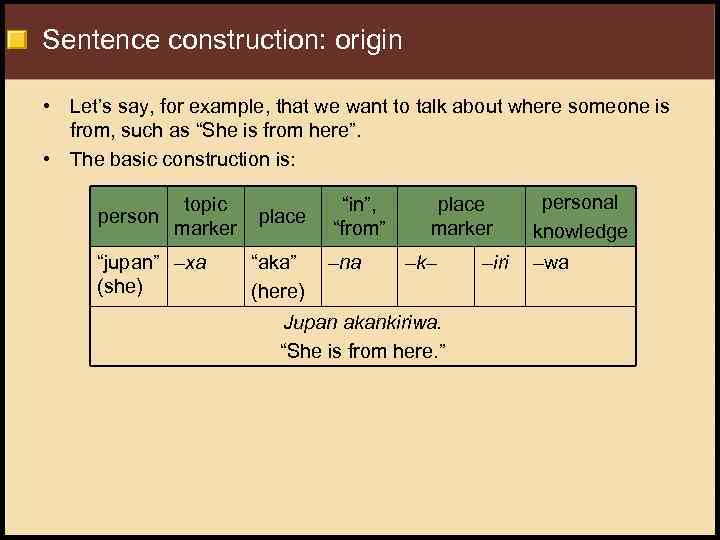 Sentence construction: origin • Let’s say, for example, that we want to talk about where someone is from, such as “She is from here”. • The basic construction is: person topic marker “jupan” –xa (she) place “aka” (here) “in”, “from” –na place marker –k– Jupan akankiriwa. “She is from here. ” –iri personal knowledge –wa
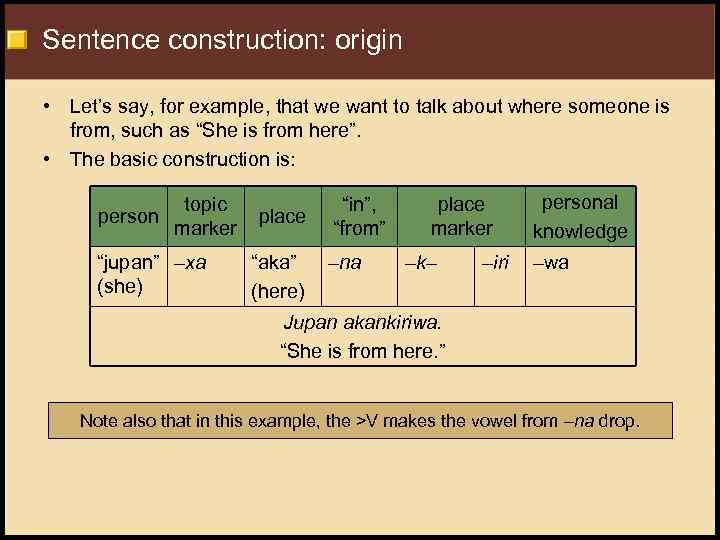 Sentence construction: origin • Let’s say, for example, that we want to talk about where someone is from, such as “She is from here”. • The basic construction is: person topic marker “jupan” –xa (she) place “aka” (here) “in”, “from” –na place marker –k– –iri personal knowledge –wa Jupan akankiriwa. “She is from here. ” Note also that in this example, the >V makes the vowel from –na drop.
 Sentence construction: origin • To vary this sentence to talk, for example, about yourself or someone else, you can change the pronouns, but the basic construction remains the same.
 Sentence construction: origin • To vary this sentence to talk, for example, about yourself or someone else, you can change the pronouns, but the basic construction remains the same. • To talk about you (2 nd person) or I (1 st person), you need an additional suffix: -ta is used as to indicate “one who”.
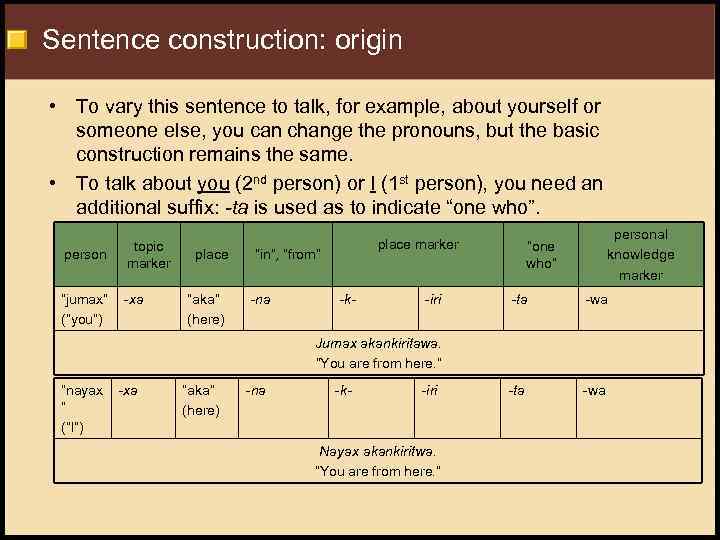 Sentence construction: origin • To vary this sentence to talk, for example, about yourself or someone else, you can change the pronouns, but the basic construction remains the same. • To talk about you (2 nd person) or I (1 st person), you need an additional suffix: -ta is used as to indicate “one who”. person “jumax” (“you”) topic marker -xa place “aka” (here) place marker “in”, “from” -na -k- -iri personal knowledge marker “one who” -ta -wa Jumax akankiritawa. “You are from here. ” “nayax ” (“I”) -xa “aka” (here) -na -k- -iri Nayax akankiritwa. “You are from here. ”
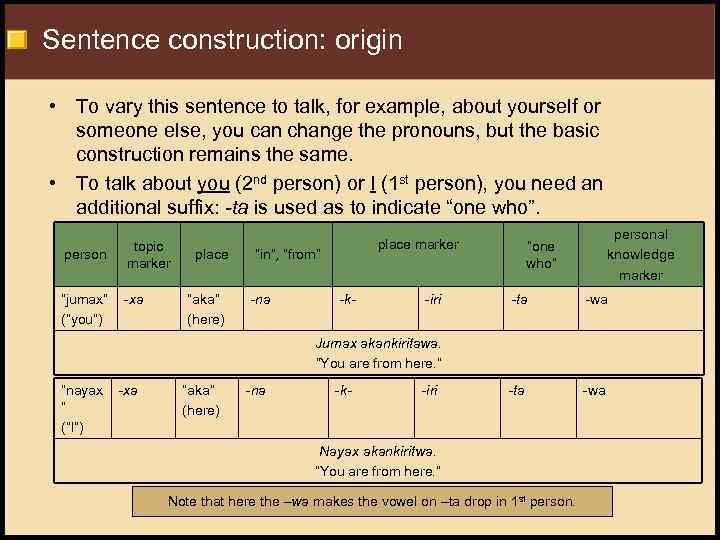 Sentence construction: origin • To vary this sentence to talk, for example, about yourself or someone else, you can change the pronouns, but the basic construction remains the same. • To talk about you (2 nd person) or I (1 st person), you need an additional suffix: -ta is used as to indicate “one who”. person “jumax” (“you”) topic marker -xa place “aka” (here) place marker “in”, “from” -na -k- -iri personal knowledge marker “one who” -ta -wa Jumax akankiritawa. “You are from here. ” “nayax ” (“I”) -xa “aka” (here) -na -k- -iri Nayax akankiritwa. “You are from here. ” Note that here the –wa makes the vowel on –ta drop in 1 st person.
 Question formation • There are many types of Aymara questions.
 Question formation • There are many types of Aymara questions. • Here you are introduced to the Aymara information question which is marked with the suffix –sa.
 Question formation • There are many types of Aymara questions. • Here you are introduced to the Aymara information question which is marked with the suffix –sa. • The information that is given in answer to the question is marked with the –wa suffix.
 Question formation • There are many types of Aymara questions. • Here you are introduced to the Aymara information question which is marked with the suffix –sa. • The information that is given in answer to the question is marked with the –wa suffix. • Notice that in each question you have a first part marked with –xa and a second part marked with –sa.
 Question formation • There are many types of Aymara questions. • Here you are introduced to the Aymara information question which is marked with the suffix –sa. • The information that is given in answer to the question is marked with the –wa suffix. • Notice that in each question you have a first part marked with –xa and a second part marked with –sa. • In the following question-answer pairs, note the occurrence of the suffix markers. They are marked in a different color so you can spot them more easily.
 Question formation • There are many types of Aymara questions. • Here you are introduced to the Aymara information question which is marked with the suffix –sa. • The information that is given in answer to the question is marked with the –wa suffix. • Notice that in each question you have a first part marked with –xa and a second part marked with –sa. • In the following question-answer pairs, note the occurrence of the suffix markers. They are marked in a different color so you can spot them more easily. • Remember that in some cases the vowels can be dropped, so you might only be able to observe the original consonant of the suffix.
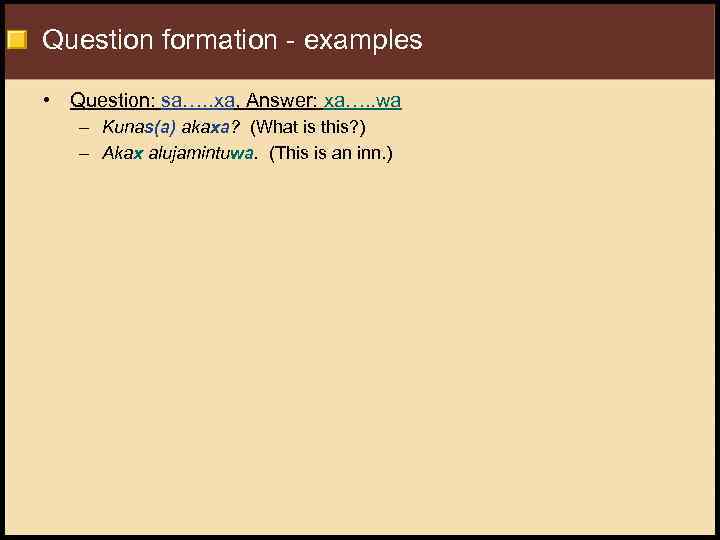 Question formation - examples • Question: sa…. . xa, Answer: xa…. . wa – Kunas(a) akaxa? (What is this? ) – Akax alujamintuwa. (This is an inn. )
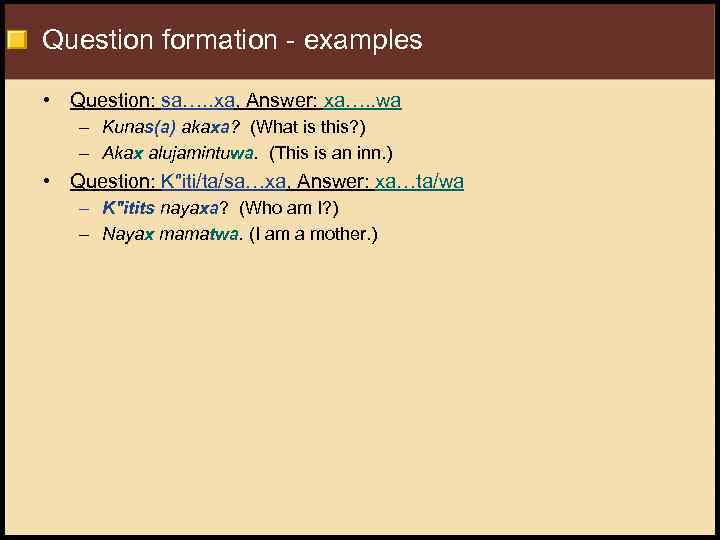 Question formation - examples • Question: sa…. . xa, Answer: xa…. . wa – Kunas(a) akaxa? (What is this? ) – Akax alujamintuwa. (This is an inn. ) • Question: K″iti/ta/sa…xa, Answer: xa…ta/wa – K″itits nayaxa? (Who am I? ) – Nayax mamatwa. (I am a mother. )
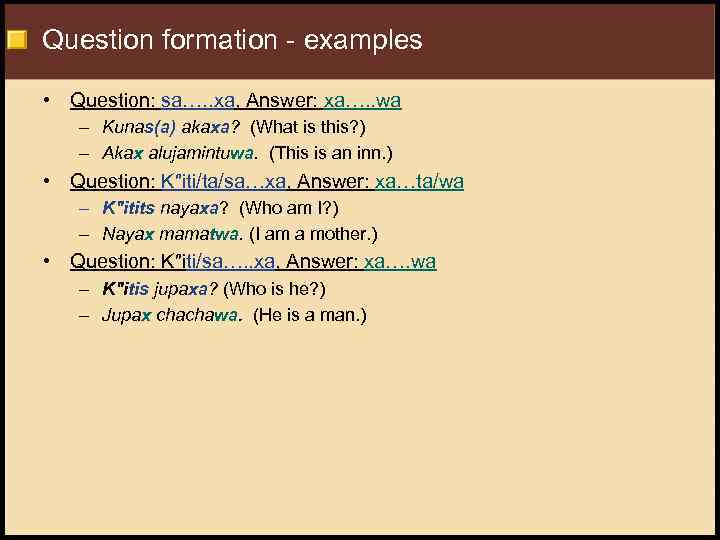 Question formation - examples • Question: sa…. . xa, Answer: xa…. . wa – Kunas(a) akaxa? (What is this? ) – Akax alujamintuwa. (This is an inn. ) • Question: K″iti/ta/sa…xa, Answer: xa…ta/wa – K″itits nayaxa? (Who am I? ) – Nayax mamatwa. (I am a mother. ) • Question: K″iti/sa…. . xa, Answer: xa…. wa – K"itis jupaxa? (Who is he? ) – Jupax chachawa. (He is a man. )
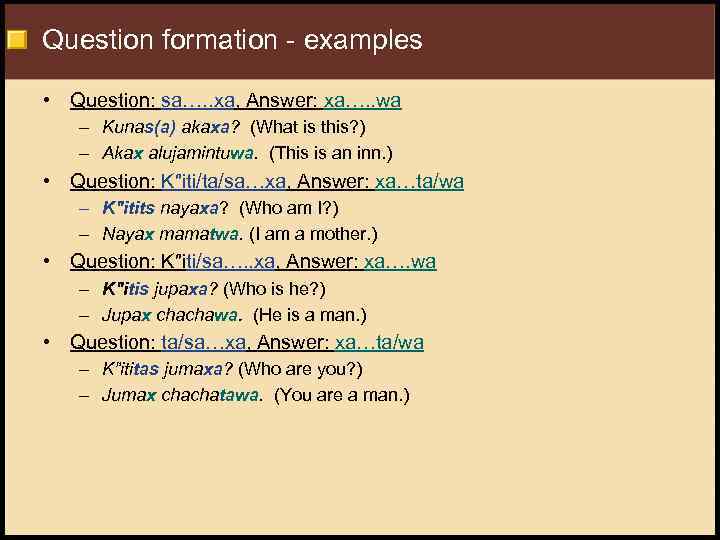 Question formation - examples • Question: sa…. . xa, Answer: xa…. . wa – Kunas(a) akaxa? (What is this? ) – Akax alujamintuwa. (This is an inn. ) • Question: K″iti/ta/sa…xa, Answer: xa…ta/wa – K″itits nayaxa? (Who am I? ) – Nayax mamatwa. (I am a mother. ) • Question: K″iti/sa…. . xa, Answer: xa…. wa – K"itis jupaxa? (Who is he? ) – Jupax chachawa. (He is a man. ) • Question: ta/sa…xa, Answer: xa…ta/wa – K”ititas jumaxa? (Who are you? ) – Jumax chachatawa. (You are a man. )
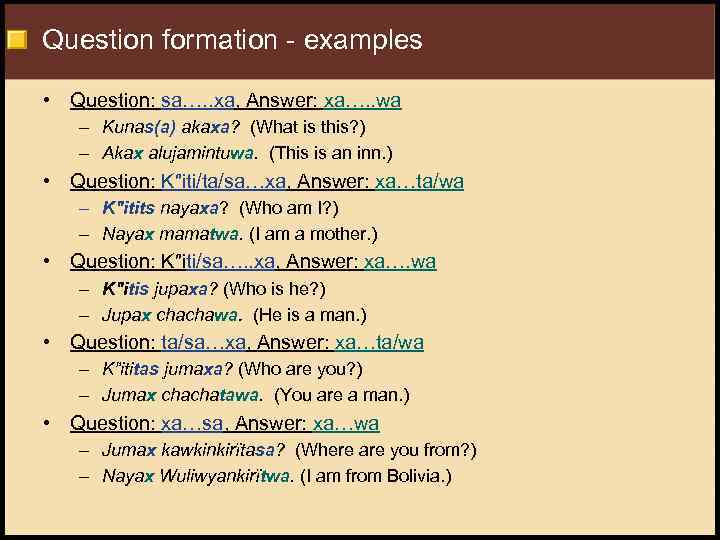 Question formation - examples • Question: sa…. . xa, Answer: xa…. . wa – Kunas(a) akaxa? (What is this? ) – Akax alujamintuwa. (This is an inn. ) • Question: K″iti/ta/sa…xa, Answer: xa…ta/wa – K″itits nayaxa? (Who am I? ) – Nayax mamatwa. (I am a mother. ) • Question: K″iti/sa…. . xa, Answer: xa…. wa – K"itis jupaxa? (Who is he? ) – Jupax chachawa. (He is a man. ) • Question: ta/sa…xa, Answer: xa…ta/wa – K”ititas jumaxa? (Who are you? ) – Jumax chachatawa. (You are a man. ) • Question: xa…sa, Answer: xa…wa – Jumax kawkinkirïtasa? (Where are you from? ) – Nayax Wuliwyankirïtwa. (I am from Bolivia. )
 Possessives • A possessive phrase is used to talk about things or item that belong to you or others, such as “my pencil” or “your house. ”
 Possessives • A possessive phrase is used to talk about things or item that belong to you or others, such as “my pencil” or “your house. ” • In Aymara, possessive phrases consist of four elements, although recall as well that the sentence suffixes you have just studied occur on these sentences or questions as well.
 Possessives • A possessive phrase is used to talk about things or item that belong to you or others, such as “my pencil” or “your house. ” • In Aymara, possessive phrases consist of four elements, although recall as well that the sentence suffixes you have just studied occur on these sentences or questions as well. • Elements of a possessive phrase: – – the possessor (the person who owns something) + the –na suffix + the possessed thing (the object that is owned) + the possessive suffix » See next slide for list of possessive suffixes
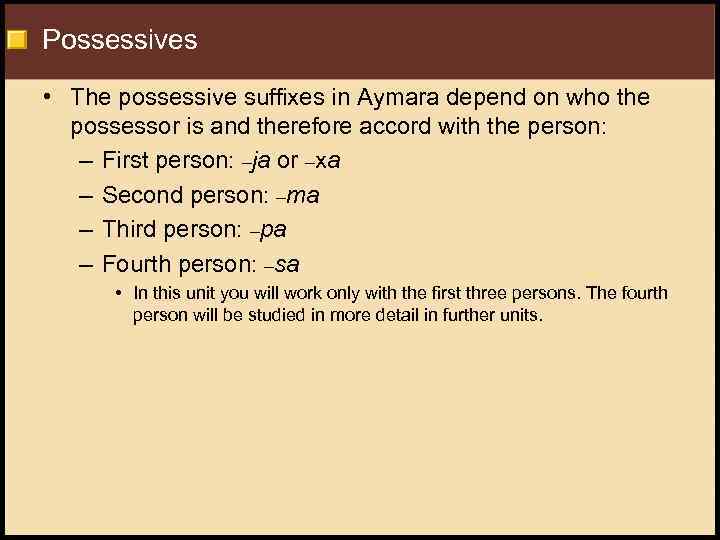
 Possessives • The possessive suffixes in Aymara depend on who the possessor is and therefore accord with the person: – First person: –ja or –xa – Second person: –ma – Third person: –pa – Fourth person: –sa
 Possessives • The possessive suffixes in Aymara depend on who the possessor is and therefore accord with the person: – First person: –ja or –xa – Second person: –ma – Third person: –pa – Fourth person: –sa • In this unit you will work only with the first three persons. The fourth person will be studied in more detail in further units.
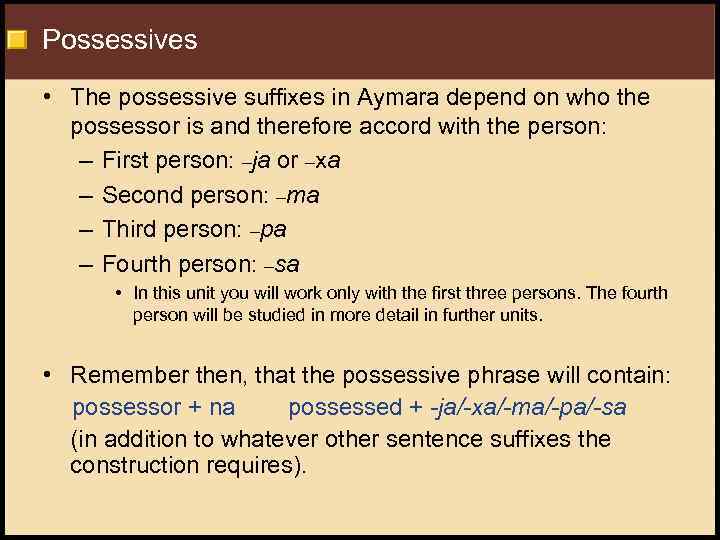 Possessives • The possessive suffixes in Aymara depend on who the possessor is and therefore accord with the person: – First person: –ja or –xa – Second person: –ma – Third person: –pa – Fourth person: –sa • In this unit you will work only with the first three persons. The fourth person will be studied in more detail in further units. • Remember then, that the possessive phrase will contain: possessor + na possessed + -ja/-xa/-ma/-pa/-sa (in addition to whatever other sentence suffixes the construction requires).
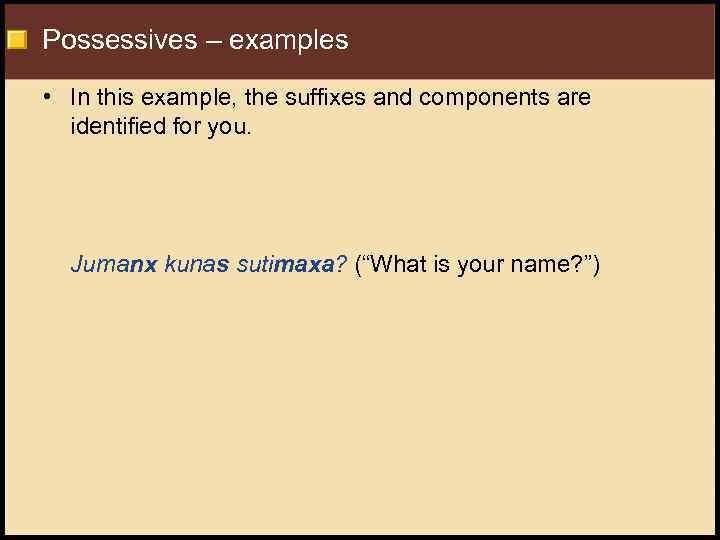 Possessives – examples • In this example, the suffixes and components are identified for you. Jumanx kunas sutimaxa? (“What is your name? ”)
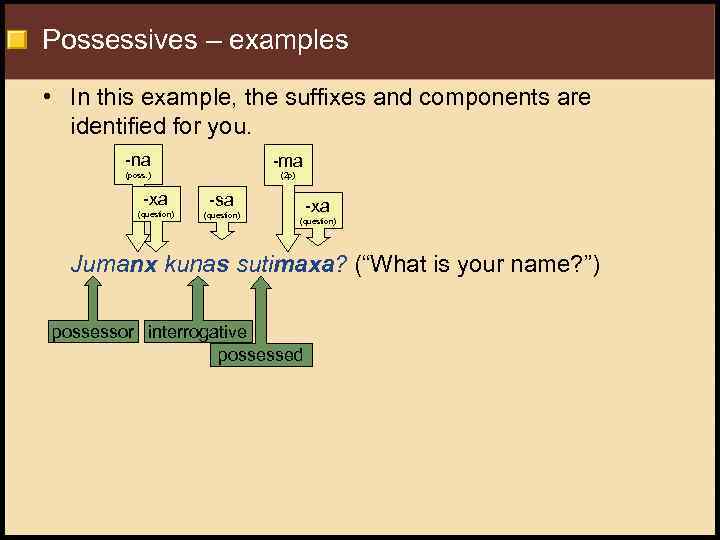 Possessives – examples • In this example, the suffixes and components are identified for you. -na -ma (poss. ) (2 p) -xa -sa (question) -xa (question) Jumanx kunas sutimaxa? (“What is your name? ”) possessor interrogative possessed
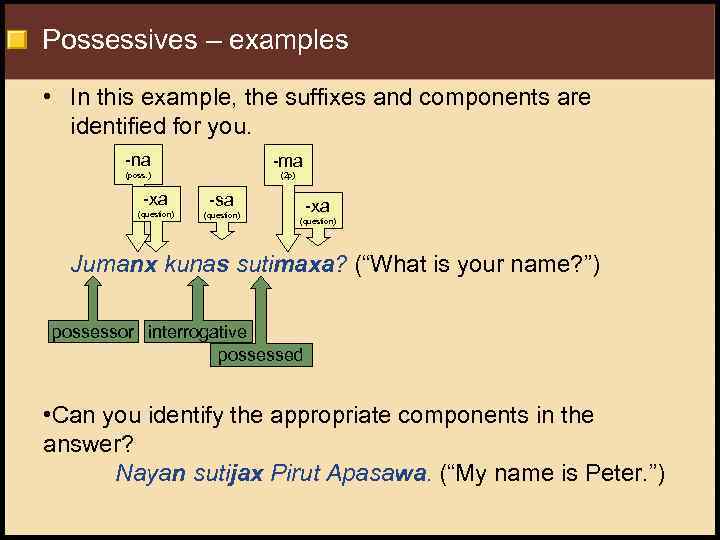 Possessives – examples • In this example, the suffixes and components are identified for you. -na -ma (poss. ) (2 p) -xa -sa (question) -xa (question) Jumanx kunas sutimaxa? (“What is your name? ”) possessor interrogative possessed • Can you identify the appropriate components in the answer? Nayan sutijax Pirut Apasawa. (“My name is Peter. ”)
 Possessives – examples • Compare these questions and answers that refer to “you” and to “him”.
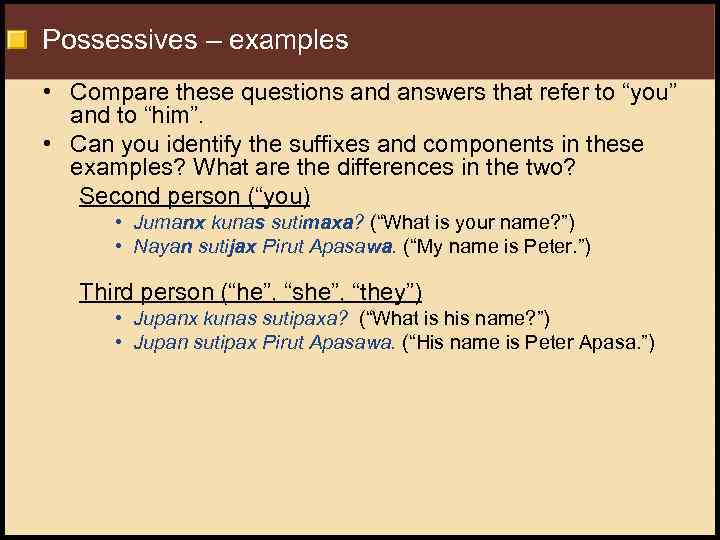 Possessives – examples • Compare these questions and answers that refer to “you” and to “him”. • Can you identify the suffixes and components in these examples? What are the differences in the two? Second person (“you) • Jumanx kunas sutimaxa? (“What is your name? ”) • Nayan sutijax Pirut Apasawa. (“My name is Peter. ”) Third person (“he”, “she”, “they”) • Jupanx kunas sutipaxa? (“What is his name? ”) • Jupan sutipax Pirut Apasawa. (“His name is Peter Apasa. ”)
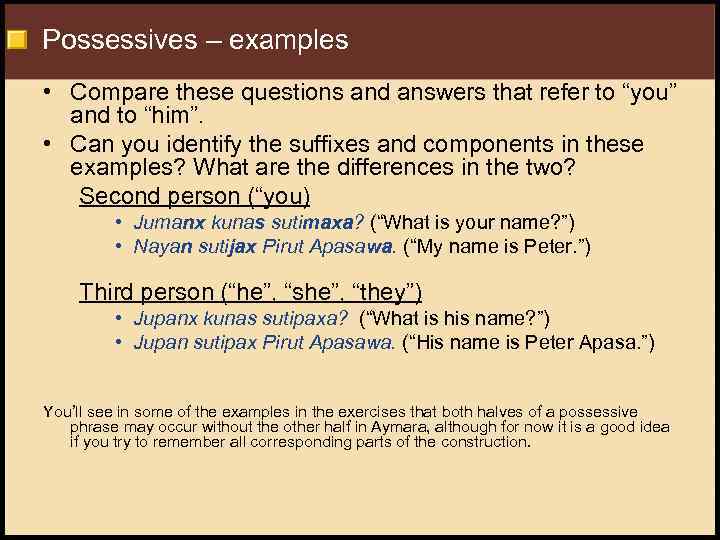 Possessives – examples • Compare these questions and answers that refer to “you” and to “him”. • Can you identify the suffixes and components in these examples? What are the differences in the two? Second person (“you) • Jumanx kunas sutimaxa? (“What is your name? ”) • Nayan sutijax Pirut Apasawa. (“My name is Peter. ”) Third person (“he”, “she”, “they”) • Jupanx kunas sutipaxa? (“What is his name? ”) • Jupan sutipax Pirut Apasawa. (“His name is Peter Apasa. ”) You’ll see in some of the examples in the exercises that both halves of a possessive phrase may occur without the other half in Aymara, although for now it is a good idea if you try to remember all corresponding parts of the construction.
 Negation • Up to this point, the questions you have seen have all been answered in the affirmative, i. e. , “yes”.
 Negation • Up to this point, the questions you have seen have all been answered in the affirmative, i. e. , “yes”. • Learning how to say “no” to questions is important as well, and in Aymara has its own specific construction.
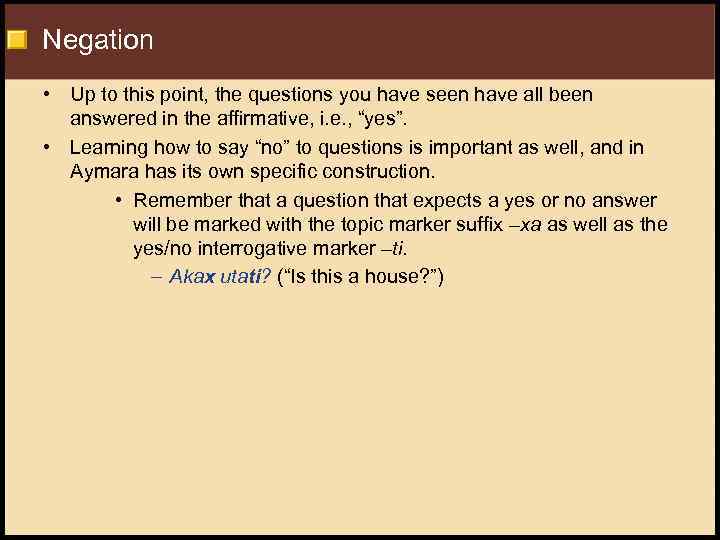 Negation • Up to this point, the questions you have seen have all been answered in the affirmative, i. e. , “yes”. • Learning how to say “no” to questions is important as well, and in Aymara has its own specific construction. • Remember that a question that expects a yes or no answer will be marked with the topic marker suffix –xa as well as the yes/no interrogative marker –ti. – Akax utati? (“Is this a house? ”)
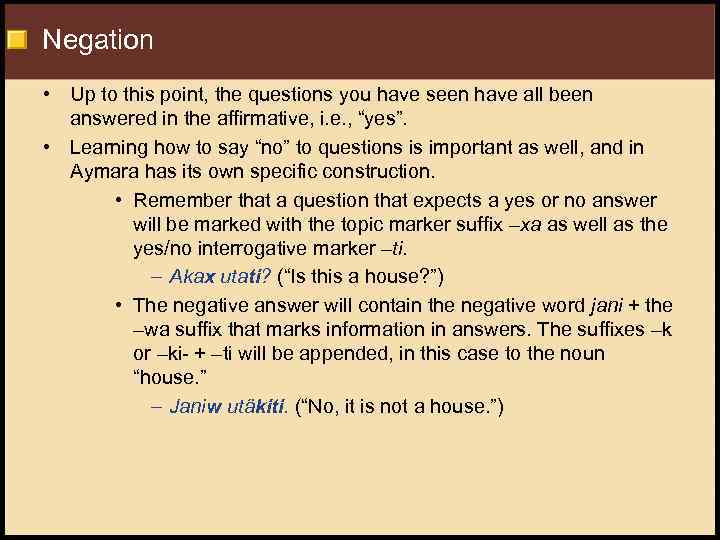 Negation • Up to this point, the questions you have seen have all been answered in the affirmative, i. e. , “yes”. • Learning how to say “no” to questions is important as well, and in Aymara has its own specific construction. • Remember that a question that expects a yes or no answer will be marked with the topic marker suffix –xa as well as the yes/no interrogative marker –ti. – Akax utati? (“Is this a house? ”) • The negative answer will contain the negative word jani + the –wa suffix that marks information in answers. The suffixes –k or –ki- + –ti will be appended, in this case to the noun “house. ” – Janiw utäkiti. (“No, it is not a house. ”)
 Review of important suffixes • As you have no doubt come to realize by now, the suffixes for persons (“I”, “you, ” etc. ) are very important in Aymara, as they occur on every utterance you will make.
 Review of important suffixes • As you have no doubt come to realize by now, the suffixes for persons (“I”, “you, ” etc. ) are very important in Aymara, as they occur on every utterance you will make. • Therefore, in the final portion of this unit’s presentation we present a list of all the suffixes you will need to know. Look over these and study them, because you will come across them in the exercises for this unit as well as future units.
 Review of important suffixes • As you have no doubt come to realize by now, the suffixes for persons (“I”, “you, ” etc. ) are very important in Aymara, as they occur on every utterance you will make. • Therefore, in the final portion of this unit’s presentation we present a list of all the suffixes you will need to know. Look over these and study them, because you will come across them in the exercises for this unit as well as future units. • In the Unit Resources, you’ll find a. pdf version of this chart that you can print out and keep for your reference, if you like.
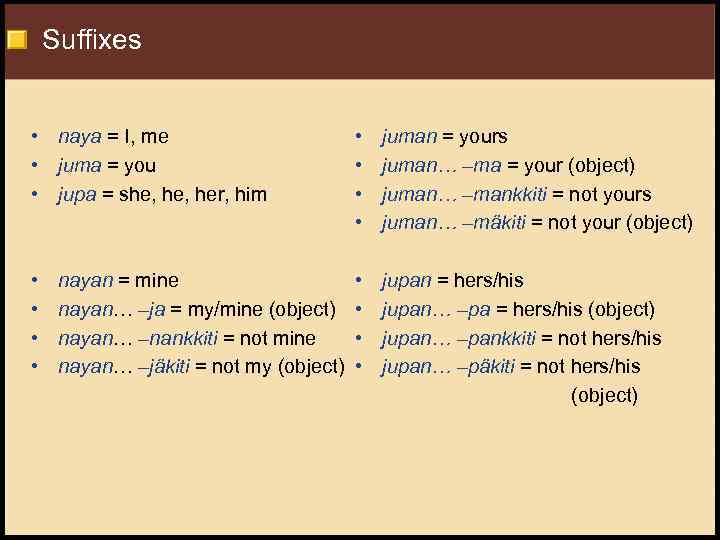 Suffixes • naya = I, me • juma = you • jupa = she, her, him • • juman = yours juman… –ma = your (object) juman… –mankkiti = not yours juman… –mäkiti = not your (object) • • jupan = hers/his jupan… –pa = hers/his (object) jupan… –pankkiti = not hers/his jupan… –päkiti = not hers/his (object) nayan = mine nayan… –ja = my/mine (object) nayan… –nankkiti = not mine nayan… –jäkiti = not my (object)
 Conclusion • In this first unit, you have learned some of the basic elements of Aymara language.
 Conclusion • In this first unit, you have learned some of the basic elements of Aymara language. • Most importantly, you have seen how to form simple questions asking about people, places and things, as well as how to provide answers.
 Conclusion • In this first unit, you have learned some of the basic elements of Aymara language. • Most importantly, you have seen how to form simple questions asking about people, places and things, as well as how to provide answers. • The structures you have seen are: – the first three persons of the pronominal system and their suffixes – sentence and question suffixes – the use of possessive pronouns – negation
 Conclusion • In this first unit, you have learned some of the basic elements of Aymara language. • Most importantly, you have seen how to form simple questions asking about people, places and things, as well as how to provide answers. • The structures you have seen are: – the first three persons of the pronominal system and their suffixes – sentence and question suffixes – the use of possessive pronouns – negation • When you feel comfortable with these structures, go on to the Unit I Exercises, which will practice each element you have seen here in context.