 Скачать презентацию UNIRAILINFRA Committee meeting 10 February 2011 Brussels
579614a02af3d931eefa412970300cc5.ppt
- Количество слайдов: 84



UNIRAILINFRA Committee meeting 10 February 2011, Brussels
Agenda 1. Welcome; Approval of the Minutes from the last meeting 2. Public Affairs n n n Rail Investments in Central and Eastern Europe Maintenance Other EU Topics 3. Guest Speaker – Jaroslav Straka (DG Regio – Poland) 4. Business Roundtable 5. Standardisation and Regulation Activities n n 6. R&D Activities (part 1): n n 7. Update and debate on the rail JTI R&D Activities (part 3): n 9. Innotrack Implementation (I 2 G) Workshop on Rail grade selection in Vienna R&D Activities (part 2): n 8. Promoting European rail standards in the United States Infrastructure standardisation and Chinese initiatives Tec. Rec on steel grades Infrastructure TSI Scope Extension Other ongoing R&D projects Events and Next Meetings
Agenda 1. Welcome; Approval of the Minutes from the last meeting 2. Public Affairs n n n Rail Investments in Central and Eastern Europe Maintenance Other EU Topics 3. Guest Speaker – Jaroslav Straka (DG Regio – Poland) 4. Business Roundtable 5. Standardisation and Regulation Activities n n 6. R&D Activities (part 1): n n 7. Update and debate on the rail JTI R&D Activities (part 3): n 9. Innotrack Implementation (I 2 G) Workshop on Rail grade selection in Vienna R&D Activities (part 2): n 8. Promoting European rail standards in the United States Infrastructure standardisation and Chinese initiatives Tec. Rec on steel grades Infrastructure TSI Scope Extension Other ongoing R&D projects Events and Next Meetings
Rail investments in Central and Eastern Europe 4
Romania n Meeting with European Commission, DG REGIO, Unit for Romania n Dramatic situation: absorption rate of 1% for current programming period. Even more serious because 10% of programming period is brought upfront in RO to avoid issues with co-financing. n Rail Masterplan approved in 2004 is not implemented by RO authorities n « Project directorate » inside Ministry of Transport does not deliver the support expected by DG REGIO for projects’ selection and setup n UNIFE actions n Facilitate exchange on best practices between ADIF, Polish Masterplan’s team and CFR n Organise workshop on Rail Infrastructure Investments (target date: end of June 2011, Sofia)
Bulgaria (1/2) n Various meetings with European Commission, DG REGIO, Unit for Bulgaria n BG is the worst case within the EU-12 and the Operational Program (OP) for Transport is the most difficult to implement n OP Transport contains 580 mn € for rail, out of which € 464 mn from Cohesion Funds. The latter will be reduced by 90 mn € because funds are not used. This € 90 mn will be transferred to Sofia Metro (more capable in managing investments) n Too thin project pipeline: not enough projects ready for tendering and implementation. n Transport Master Plan commissioned by the Transport ministry and developed by AECOM consultants has been completed but not adopted yet as both parties cannot agree on the final terms. DG region has not been involved in the development of that plan. n Legal procedure for planning, land acquisition and resolving disputes in tendering are very time consuming. n Decision structures in projects are extremely hierarchical and nobody wants to take decision with the result that infrastructure investment projects are poorly managed, necessary decisions for contract alterations are not taken and projects fail.
Bulgaria (2/2) n UNIFE actions n Close cooperation with Unit in charge of Bulgaria, DG REGIO n Meetings in Bulgaria (23 November 2010) with: Transport Minister, National Rail Infrastructure Manager, Bulgarian Parliament’s Transport Committee n Letters sent to Minister of Transport, Minister of Finance, Minister of Regional Development, National Rail Infrastructure Manager, where UNIFE asks for: n Establishment of a rail project implementation task force & board with delegates from the Ministries of Transport, Finance, Regional Development and NRIC - empowered to jointly decide on contract alterations where necessary, n Establishment of adequate project management structures within NRIC or within an Infrastructure Investment Agency, n Decide on how the strategies for the rail sector in the General Transport Master Plan can be put into action, n Focus on the project pipeline, develop and publish a project tendering calendar and agree with NRIC and the planning consultants on the necessary timeline for the finalization of concrete projects. n Organise workshop on Rail Infrastructure Investments (target date: end of June 2011, Sofia)
Revision of the Cohesion Policy n Debate is starting now n Proposals to be issued between July and September 2011 n It is time to think about our own priorities and suggestions! What are your ideas: n To improve funds absorption? n To increase the share of/priority to rail project? n To increase projects’ size in call for tenders?
Maintenance action plan 9
Context n UNIFE achievements: n gathered information about the situation of maintenance markets in a number of EU Member States n drafted a document with arguments in favour of market opening n raised the issue of maintenance at its meeting with Commissioner Kallas on 25 June 2010 and sent a paper with the key challenges to the rail sector, including the question of maintenance on 29 July 2010 n drafted a strategy paper on maintenance market opening n created a maintenance task force that held its first meeting on 24 November n included a section on maintenance in its position paper on the 1 st railway package recast and presented the paper to MEPs n The Strategy Committee held a debate on maintenance on 3 December 2011 and asked UNIFE to further develop its strategy on maintenance markets opening. n The Strategy Committee and the Presiding Board discuss the UNIFE Strategy Proposal on 9 February. 10
Maintenance in the Recast of the First Railway Package n Recast Proposal by the EC The proposal addresses the question of maintenance only with the objective of improving the access to rail-related services (RRS), infrastructure maintenance is not included n Access to service facilities should be provided in a non-discriminatory manner n When a service facility belongs to a body or a firm that holds a dominant position in at least one service market, the service provider shall be organised in such a way that it is independent, in legal, organisational and decision-making terms of this body or firm n Makes it difficult for the providers of RRS to reject RUs n Newly built maintenance and other technical facilities developed for specific new rolling stock may be reserved to the use of one railway undertaking for a period of five years n Use-it-or-lose-it provision 11
Maintenance in the Recast of the First Railway Package n Ideas of the rapporteur (Debora Serracchiani) Ms Serracchiani also regards the question of maintenance primarily as a matter of access to RRS for new entrants. Infrastructure is not included. n For high speed rail: every RU should have exclusive contracts with maintenance providers. International operators would be required to build up maintenance workshops along their international lines (Quote: “they also do it at home”) n Different rules could apply for freight (Quote: “time is not of the essence for freight operators”) n Stronger use-it-or-lose-it provision 12
Maintenance in the Recast of the First Railway Package n UNIFE’s proposal The structure of the maintenance market is the focus of UNIFE. The structure needs to change to the benefit of a more competitive market and better access to RRS. Infrastructure maintenance must also be outsourced 13
Proposal for a market model n Scope: Both preventive and corrective maintenance must be outsourced, as there is a strong interdependence between the two activities n Key features: A. Division of responsibilities in the field of maintenance n Safety responsibility: must be kept in the hands of the infrastructure manager and the railway undertakings n Maintenance functions: distinction between the maintenance management function and maintenance development and delivery functions that can be outsourced n Asset knowledge: infrastructure manager must carry the responsibility; the maintainer must be granted a permanent and complete access to data 14
Proposal for a market model B. Obligation to tender n Regulation should impose transparent contracting between infrastructure managers and maintainers and non-discriminatory tendering n A transition period should be organised to open the market progressively: no more than 10 years and at least 10% of maintenance volume tendered two years after the entry into force of the new regulation. C. Contract duration n The minimum contract duration shall not be less than 5 years D. Basis for payments n Payments must be based on performance (i. e. on a series of key performance indicators). 15
Proposal for a market model E. Separation of accounts between the core tasks of the infrastructure manager and maintenance n Guarantees fair and transparent competition between maintenance providers n Helps avoiding cross-financing and delivering fairer prices. n This separation should rely on the same principles as the separation between infrastructure management and transport operations: n Profit and loss accounts and balance sheets must be separated. n A distinct division within the infrastructure manager or a separate entity should be established to carry maintenance works n No public funds granted for the purpose of infrastructure management shall be transferred to the maintenance production division of an infrastructure manager 16
Proposal for a market model F. On-track machines n On-track machines are very costly assets that contractors can purchase only in a limited number. On the other hand, some infrastructure managers possess a number of such machines. It is necessary to maximise the use of existing machines. n Therefore, two major issues must be addressed in regulation to ensure an optimal use of on-track machines in an open maintenance market: n Access to the machines of the infrastructure managers shall be granted in a transparent and non-discriminatory way n Circulation of OTMs between the EU Member States should be made easier 17
Possible lobbying strategies 1. Best practice strategy: informing the infrastructure managers and the operators about the benefits of maintenance outsourcing n UNIFE would raise awareness among infrastructure managers and railway undertakings about the benefits of maintenance outsourcing. In parallel, maintenance services offered by the industry need to be popularised. n The members could complement UNIFE’s actions by launching a joint marketing campaign towards operators and infrastructure managers. n It would also be important to raise the awareness of the governments on this issue. 18
2. Awareness-raising strategy: informing the EU institutions and creating a debate on maintenance markets opening n Step 1: Awareness raising of the European Commission Inform the Commission about the benefits of market opening and the current status of maintenance markets. n Step 2: Request for a study on the benefit of market opening in the framework of the 1 st Railway Package n Foster the debate on maintenance market opening, by asking the Commission to assess the possibilities of further opening the market n Suggestion: Art. 13, § 6 (new), Proposal for a directive of the European Parliament and of the Council establishing a single European railway area “The European Commission shall undertake a study by 2012 to evaluate whether access to services could be further facilitated by the opening of maintenance services to competition. The study should also examine whether competitive tendering of maintenance services would be more economically efficient. ” 19
3. Regulatory strategy: lobbying towards the EU institutions for a regulation on the opening of infrastructure and rolling stock maintenance markets n Given the vast potential for efficiency gains and cost reductions through a complete opening of the market for rail related services, the Commission should propose regulation in this area. n It is indeed unlikely that maintenance outsourcing will develop without regulation, as outsourcing is so far depending only on the willingness of railway undertakings and infrastructure managers and it cannot develop by itself. n This regulation could be part of a new recast of the railway packages or be an independent proposal based on a different legal basis. 20
Outcomes of the Presiding Board meeting, 9 February 2011 n The UNIFE Presiding Board considers that UNIFE activities should focus on promoting best practices with our customers. 21
Other EU Topics
1. Transport White Paper 23
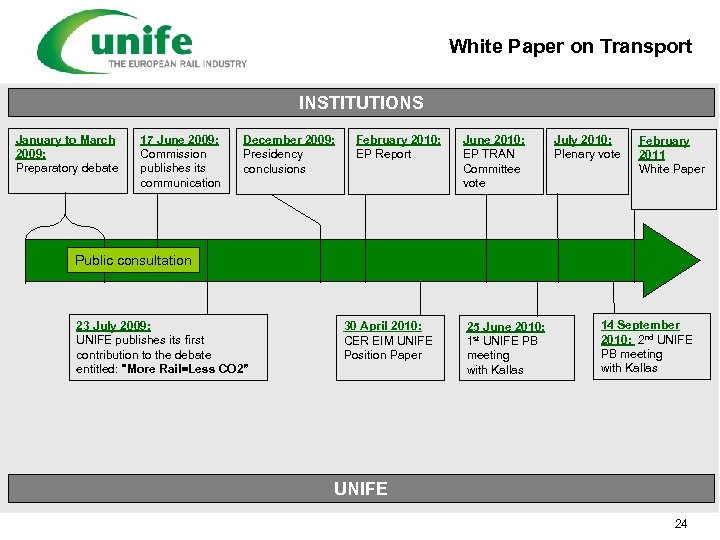
White Paper on Transport INSTITUTIONS January to March 2009: Preparatory debate 17 June 2009: Commission publishes its communication December 2009: Presidency conclusions February 2010: EP Report June 2010: EP TRAN Committee vote July 2010: Plenary vote February 2011 White Paper Public consultation 23 July 2009: UNIFE publishes its first contribution to the debate entitled: "More Rail=Less CO 2” 30 April 2010: CER EIM UNIFE Position Paper 25 June 2010: 1 st UNIFE PB meeting with Kallas 14 September 2010: 2 nd UNIFE PB meeting with Kallas UNIFE 24
White Paper on Transport – What does UNIFE want? a) Enhance global competitiveness of the European rail industry through accelerated market development in Europe - Modal shift to sustainable modes of transport such as rail - One single CO 2 emission’s reduction objective - Implementation of market opening’s regulation - Increase TEN-T funding for more European infrastructure b) Remove bottlenecks that hamper rail market development - Development of the European high-speed rail network - Extension of the scope of TSIs and remove red tape from rail products’ certification - Level-playing field between the transport modes
White Paper – Position of Commissioner Siim Kallas Commissioner Kallas’ position on Transport White Paper: n The vision is to bring down barriers to growth n On a single CO 2 emission reduction objective, Kallas says «we need to carefully evaluate how to draft such goals. The last Commission was very active with drafting goals but not so good with following up on them» n Rail needs more flexibility; less political involvement and more market opening n Rail needs more private capital as public budget deficits are threatening rail investments in the long-run n Implementation of ERTMS is important Commission published a “conceptual paper” addressed to EP TRAN Committee in December 2010
27
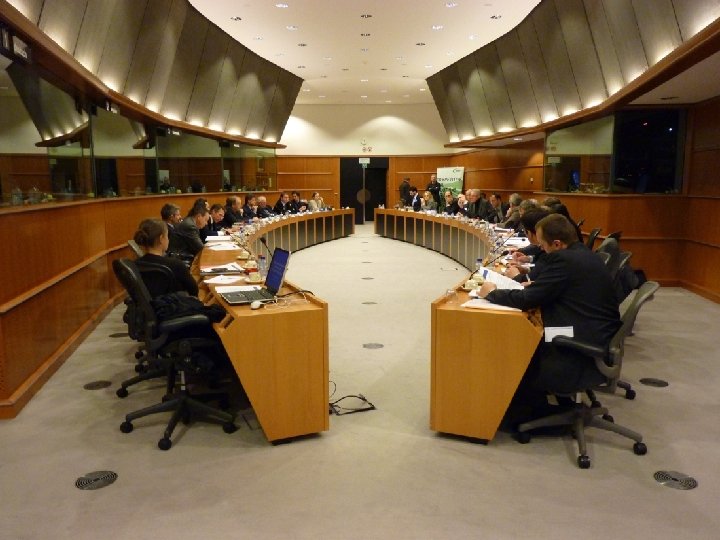
EP Round table on Transport White Paper organised by UNIFE (29/11) n Multi-stakeholder exchange (Commission, Parliament, EEA, industry, railway operators) focussing on current concerns for the rail sector: decarbonisation, market opening, pricing and regulation policies, integration and multimodality n Participation: Matthias Ruete, Jacqueline Mc. Glade, MEPs (Grosch, Meissner, Cramer, Sterckx, Simpson), CER, EIM and UNIFE members’ representatives n Key statements: n White Paper will propose measures to improve competitiveness and cohesion of the European transport network (a true European high speed rail network is needed) n Investments in alternative and sustainable modes of transport will be strongly supported n Pricing and regulation policies are at the heart of a level playing field between the transport modes n Decarbonisation of transport: M. Ruete mentions that some “targets” will be part of the White Paper
Next steps n UNIFE-CER-EIM meeting with VP Kallas (4 February) n Discussion based on Conceptual Paper A Roadmap to 2050 – New routes ahead n No mention of single or common binding target for greenhouse gas emissions from transportation n Doubts concerning declaration on reduction of transport sector emissions by 50 - 70% by 2050 n By 2050 rail could be the dominant mode of transport for inter-city passenger travel over intermediate distances, as well as for long-distance freight n For rail, “need to develop the concepts of corridors, mobilize and focus infrastructure investment, strengthen the ERA and ensure effective and rapid convergence of technical standards, reinforce the network of rail regulators and further pursue the opening of markets” n UNIFE-CER-EIM to request concrete actions regarding: n High Speed Rail n Rail Investments in the New Member States n Multimodality 29
2. 1 st Railway Package Recast 30
Recast of the First Railway Package n Proposal n Published on 17 September 2010 n Official title: Directive “establishing a single European railway area (Recast)” (COM(2010) 475) n Addresses three problem areas: Competition, Regulation and Financing n Objectives n n n Legal simplification: consolidation of existing directives in one document Create better environment for competition among operators Ensure sustainable and predictable financing Better regulatory oversight promote a high degree of competitiveness and revive rail transport in Europe 31
Recast of the First Railway Package n Time line n EP n First exchange of views TRAN 25 January n Adoption in TRAN in May n Adoption in plenary on 22 June 2011 n Council n Policy Debate on 31 March n Political Agreement 16 June n Adoption at the earliest in late 2011 n Rapporteurs n Debora Serracchiani (S&D, IT) n n Werner Kuhn (shadow EPP, DE) Michael Cramer (shadow Greens, DE) Ramon Tremosa (shadow ALDE, ES) Robert Zile (shadow ECR) 32
Recast of the First Railway Package n UNIFE position paper n Liberalisation leads to growth of rail and can increase modal share of rail n Intra-modal competition leads to inter-modal competitiveness n Need for strong regulator n Liberalisation of domestic services n ERTMS track access charge reduction n ERTMS is a successful and mature system, exported globally n Market penetration too slow in Europe n 5% track access charge reduction must be maintained n Will lead to virtuous circle 33
Recast of the First Railway Package n Rail Infrastructure Development Strategies n Master plan covering a period of at least five years on the basis of which the IM’s develop their business strategies. n Useful tool, long advocated by UNIFE n Current system of annual budgets is inefficient n Better life cycle costs due to better planning n Maintenance n Independent maintainers will help new entrant operators n Industry maintenance can deliver better service and availability at a better price (e. g. SE and UK) n Amendments advocated by UNIFE n Study impact and possibility of maintenance market opening n Guarantee parallel introduction of noise charging for road and rail. 34
3. Trade 35
Revision of Agreement on Government Procurement (GPA) n DG MARKT made an offer to revise GPA with Japan: n No changes in what EU can sell in Japan: EU can sell to JAP operators in the field of metro, trams and buses but no railway equipment or railway construction as a consequence of the Operational safety clause. n A change in what JAP can sell to EU: JAP can no longer sell any railway equipment and railway construction to EU, but it can sell any non-railway equipment or non-railway construction to EU operators in the field of metro, trams and buses operators (but not urban railways like S-Bahn and RER ). n The EU proposes a fully symmetric situation and will negotiate reciprocal opening of sales of railway equipment and railway construction to operators in the urban transport sector on a goods to goods basis. 36
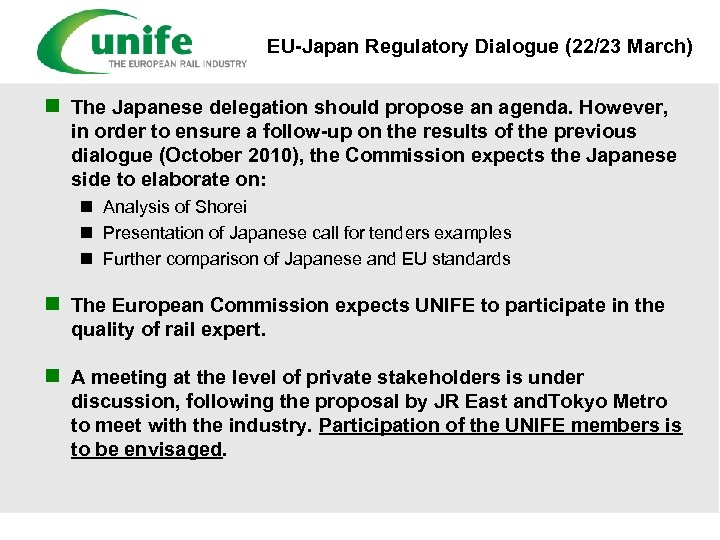
EU-Japan Regulatory Dialogue (22/23 March) n The Japanese delegation should propose an agenda. However, in order to ensure a follow-up on the results of the previous dialogue (October 2010), the Commission expects the Japanese side to elaborate on: n Analysis of Shorei n Presentation of Japanese call for tenders examples n Further comparison of Japanese and EU standards n The European Commission expects UNIFE to participate in the quality of rail expert. n A meeting at the level of private stakeholders is under discussion, following the proposal by JR East and. Tokyo Metro to meet with the industry. Participation of the UNIFE members is to be envisaged.
Agenda 1. Welcome; Approval of the Minutes from the last meeting 2. Public Affairs n n n Rail Investments in Central and Eastern Europe Maintenance Other EU Topics 3. Guest Speaker – Jaroslav Straka (DG Regio – Poland) 4. Business Roundtable 5. Standardisation and Regulation Activities n n 6. R&D Activities (part 1): n n 7. Update and debate on the rail JTI R&D Activities (part 3): n 9. Innotrack Implementation (I 2 G) Workshop on Rail grade selection in Vienna R&D Activities (part 2): n 8. Promoting European rail standards in the United States Infrastructure standardisation and Chinese initiatives Tec. Rec on steel grades Infrastructure TSI Scope Extension Other ongoing R&D projects Events and Next Meetings
Guest Speaker – Jaroslav Straka DG Regio (Poland) 39
Agenda 1. Welcome; Approval of the Minutes from the last meeting 2. Public Affairs n n n Rail Investments in Central and Eastern Europe Maintenance Other EU Topics 3. Guest Speaker – Jaroslav Straka (DG Regio – Poland) 4. Business Roundtable 5. Standardisation and Regulation Activities n n 6. R&D Activities (part 1): n n 7. Update and debate on the rail JTI R&D Activities (part 3): n 9. Innotrack Implementation (I 2 G) Workshop on Rail grade selection in Vienna R&D Activities (part 2): n 8. Promoting European rail standards in the United States Infrastructure standardisation and Chinese initiatives Tec. Rec on steel grades Infrastructure TSI Scope Extension Other ongoing R&D projects Events and Next Meetings
Business Roundtable 41
Agenda 1. Welcome; Approval of the Minutes from the last meeting 2. Public Affairs n n n Rail Investments in Central and Eastern Europe Maintenance Other EU Topics 3. Guest Speaker – Jaroslav Straka (DG Regio – Poland) 4. Business Roundtable 5. Standardisation and Regulation Activities n n 6. R&D Activities (part 1): n n 7. Update and debate on the rail JTI R&D Activities (part 3): n 9. Innotrack Implementation (I 2 G) Workshop on Rail grade selection in Vienna R&D Activities (part 2): n 8. Promoting European rail standards in the United States Infrastructure standardisation and Chinese initiatives Tec. Rec on steel grades Infrastructure TSI Scope Extension Other ongoing R&D projects Events and Next Meetings
Standardisation and Regulation Activities 43
Promoting European rail standards in the United States Next steps for the USA based on UNIFE mission 26 th -28 th January 2011 44
Assessment of the current situation in the development of High Speed Rail in the USA n Despite strong commitment from the Obama administration to develop High-speed rail, a number of issues, both political and technical/regulatory, are hampering the development of HS rail n There is a high likelihood that the first set of HS rail projects (California, Desert Express CA/NV + Florida) will develop in a rather uncoordinated manner. This will give birth to incompatible projects, hampering the business case for HS rail and all suppliers n The regulator (Federal Railroad Administration - FRA) is acutely aware of this situation, yet is ‘only’ mandated to ensure safety, and not to regulate basic interfaces for technical compatibility n UNIFE members have no structured platform where to meet and to discuss these matters of joint interest
Observations n Supported by FRA, UNIFE believes that the concept of Interoperability has advantages for HS rail particularly in terms of: n Standardised basic interface specifications n Open competition on the market (enabling the creation of a market at the beginning) n Thus enabling the notion of ‘mixed’ traffic (HS rolling stock to be able to feed into existing infrastructure in urban areas – like in Europe) n For the moment, the FRA is only able to organise consensus building meetings to deal with a limited number of safety standards (RSAC process) n On the one hand, European TSIs get a chance to be used as a reference if the Californian project becomes the leading one, but the association with pre-existing US safety regulation would create a catastrophic situation n UNIFE received encouragement by UNIFE members, FRA and ASHRA (American High Speed Rail Alliance) to play a role in helping to set up the technical/regulatory boundary conditions for an open ‘EU style’ approach
What needs to be done? n UNIFE members need support in setting up a ‘joint working methodology’ How? : n Set up of ‘ad-hoc’ working group of UNIFE members in the US n And strengthened participation of UNIFE members in the « RSAC » process, with a better and coordinated support from European mother companies n FRA wants to maintain a close collaboration with ERA (associated with UNIFE) as independent actors n UNIFE can help in facilitating this, by also lobbying the Commission so as to give a dedicated budget to ERA to do so How? : n ERA to participate in the « RSAC » process and to develop a partnership with the FRA, with the support of UNIFE n UNIFE to become ‘temporary’ member of the ASHRA ‘Standards, Regulatory & Interoperability’ committee so as to kick start the process n In the medium term, better coordinated US based UNIFE companies should take over this role
Decision by the Presiding Board n The Presiding Board decided that UNIFE involvement should focus on developing a package of standards to be transferred to FRA and promoted in the United States n Lobbying should primarily be done by UNIFE (not necessarily by UNIFE members in the US)
Infrastructure standardisation and Chinese initiatives
Tec. Recs
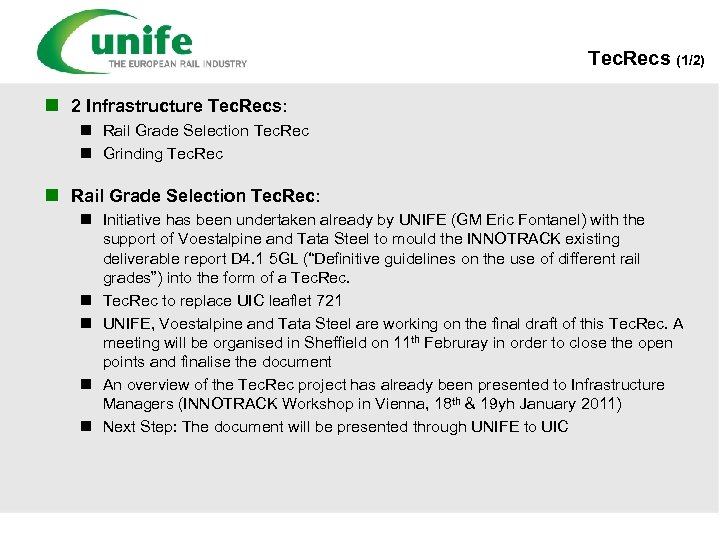
Tec. Recs (1/2) n 2 Infrastructure Tec. Recs: n Rail Grade Selection Tec. Rec n Grinding Tec. Rec n Rail Grade Selection Tec. Rec: n Initiative has been undertaken already by UNIFE (GM Eric Fontanel) with the support of Voestalpine and Tata Steel to mould the INNOTRACK existing deliverable report D 4. 1 5 GL (“Definitive guidelines on the use of different rail grades”) into the form of a Tec. Rec. n Tec. Rec to replace UIC leaflet 721 n UNIFE, Voestalpine and Tata Steel are working on the final draft of this Tec. Rec. A meeting will be organised in Sheffield on 11 th Februray in order to close the open points and finalise the document n An overview of the Tec. Rec project has already been presented to Infrastructure Managers (INNOTRACK Workshop in Vienna, 18 th & 19 yh January 2011) n Next Step: The document will be presented through UNIFE to UIC
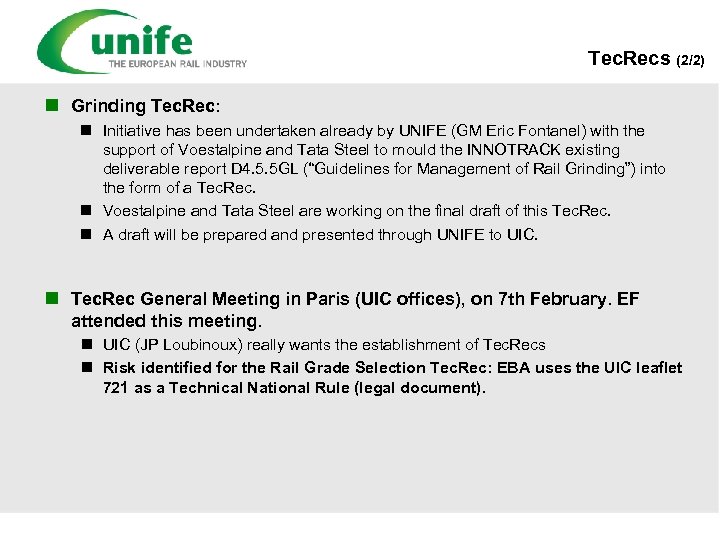
Tec. Recs (2/2) n Grinding Tec. Rec: n Initiative has been undertaken already by UNIFE (GM Eric Fontanel) with the support of Voestalpine and Tata Steel to mould the INNOTRACK existing deliverable report D 4. 5. 5 GL (“Guidelines for Management of Rail Grinding”) into the form of a Tec. Rec. n Voestalpine and Tata Steel are working on the final draft of this Tec. Rec. n A draft will be prepared and presented through UNIFE to UIC. n Tec. Rec General Meeting in Paris (UIC offices), on 7 th February. EF attended this meeting. n UIC (JP Loubinoux) really wants the establishment of Tec. Recs n Risk identified for the Rail Grade Selection Tec. Rec: EBA uses the UIC leaflet 721 as a Technical National Rule (legal document).
Infrastructure TSI Scope Extension
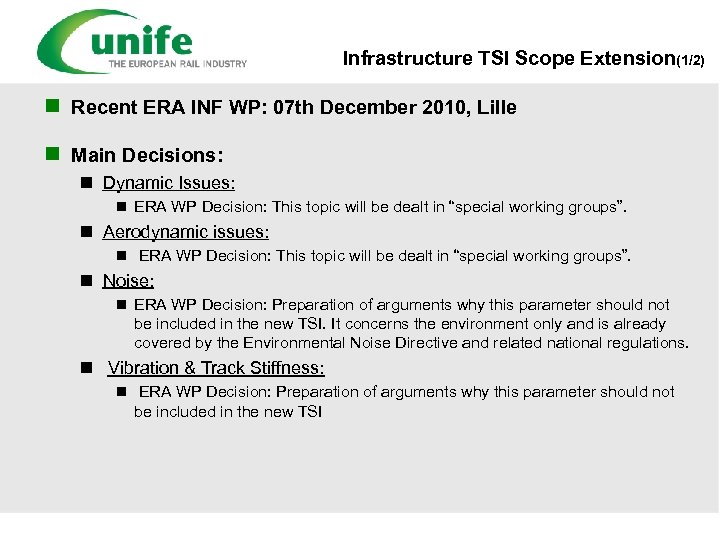
Infrastructure TSI Scope Extension(1/2) n Recent ERA INF WP: 07 th December 2010, Lille n Main Decisions: n Dynamic Issues: n ERA WP Decision: This topic will be dealt in “special working groups”. n Aerodynamic issues: n ERA WP Decision: This topic will be dealt in “special working groups”. n Noise: n ERA WP Decision: Preparation of arguments why this parameter should not be included in the new TSI. It concerns the environment only and is already covered by the Environmental Noise Directive and related national regulations. n Vibration & Track Stiffness: n ERA WP Decision: Preparation of arguments why this parameter should not be included in the new TSI
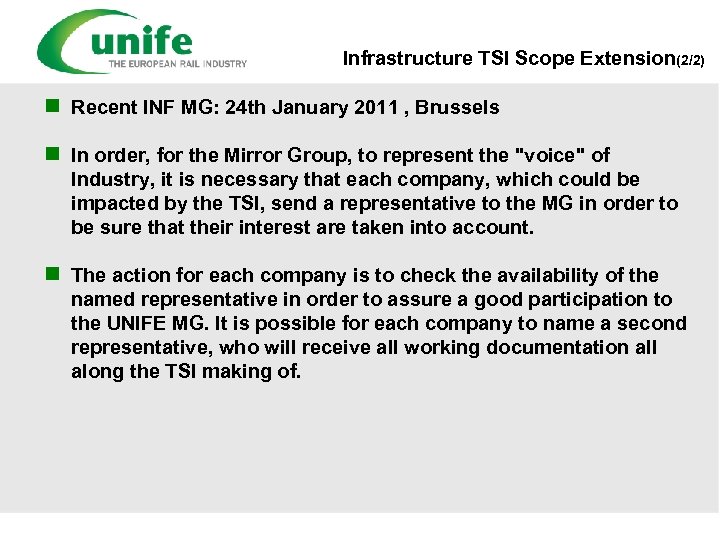
Infrastructure TSI Scope Extension(2/2) n Recent INF MG: 24 th January 2011 , Brussels n In order, for the Mirror Group, to represent the "voice" of Industry, it is necessary that each company, which could be impacted by the TSI, send a representative to the MG in order to be sure that their interest are taken into account. n The action for each company is to check the availability of the named representative in order to assure a good participation to the UNIFE MG. It is possible for each company to name a second representative, who will receive all working documentation all along the TSI making of.
Agenda 1. Welcome; Approval of the Minutes from the last meeting 2. Public Affairs n n n Rail Investments in Central and Eastern Europe Maintenance Other EU Topics 3. Guest Speaker – Jaroslav Straka (DG Regio – Poland) 4. Business Roundtable 5. Standardisation and Regulation Activities n n 6. R&D Activities (part 1): n n 7. Update and debate on the rail JTI R&D Activities (part 3): n 9. Innotrack Implementation (I 2 G) Workshop on Rail grade selection in Vienna R&D Activities (part 2): n 8. Promoting European rail standards in the United States Infrastructure standardisation and Chinese initiatives Tec. Rec on steel grades Infrastructure TSI Scope Extension Other ongoing R&D projects Events and Next Meetings
INNOTRACK Implementation (I 2 G) & Workshop on Rail Grade Selection in Vienna
INNOTRACK Implementation (I 2 G) & Workshop on Rail Grade Selection in Vienna (1/2) n Workshop on Rail Grade Selection in Vienna, 18 th – 19 th January 2011 n n n Participation of several IMs Presentation of Innotrack’s Results & Guidelines Presentation of Tec. Rec Concept IMs are interested in INNOTRACK results Risk identified: DB is reluctant to the establishment of a Tec. Rec. n UIC – TEG will discuss about the usefulness of the Tec. Rec in February 2011
INNOTRACK Implementation (I 2 G) & Workshop on Rail Grade Selection in Vienna (2/2) n Recent I 2 G meeting: 25 January 2011, in Brussels n Confirmation of Group members n A Mission Statement has been proposed for further I 2 G work n Discussion on the establishment of the Tec. Recs n Rail Grade Selection Tec. Rec n Grinding Tec. Rec n To improve Dissemination Activities and Implementation activities (Benefits of INNOTRACK) n Next I 2 G meeting: 9 th june 2011, Paris (UIC offices)
Agenda 1. Welcome; Approval of the Minutes from the last meeting 2. Public Affairs n n n Rail Investments in Central and Eastern Europe Maintenance Other EU Topics 3. Guest Speaker – Jaroslav Straka (DG Regio – Poland) 4. Business Roundtable 5. Standardisation and Regulation Activities n n 6. R&D Activities (part 1): n n 7. Update and debate on the rail JTI R&D Activities (part 3): n 9. Innotrack Implementation (I 2 G) Workshop on Rail grade selection in Vienna R&D Activities (part 2): n 8. Promoting European rail standards in the United States Infrastructure standardisation and Chinese initiatives Tec. Rec on steel grades Infrastructure TSI Scope Extension Other ongoing R&D projects Events and Next Meetings
Update and debate on the rail JTI
JTI update n UNIFE updated in November the JTI preliminary paper (for initial lobbying) n UNIFE produced in December a draft Term of Reference for the rail JTI, summaring all Task Force agreements and findings n A System Integrators CTO meeting (14/01/11) paved the way to structure the JTI (starting from Rolling Stock): 1. Company interest for product or topic to reach high level objectives (competition vs Asia and modal shift): 2. Identify from each product (or topic) the phase to which each company is ready to work together (target level of standardisation). 3. Specify quantitative targets for reaching the high level objectives 4. Identify: a) the associated root technologies b) the standards specification c) the demonstrator(s).
JTI update n UNIFE raised awareness to: n Directly concerned DGs and Cabinets + Permanent Representations Attachés (with Belgian Presidency) n General information to UIC (Secretary General) + UITP (Secretary General) of our JTI initiative n UNIFE rail JTI presentation at ERRAC ESG meeting on 17/02/11 n DG RTD news: n New Head of UNIT H : Mr. Liam BRESLIN – previously Clean. Sky interim Executive Director! n Meeting date with UNIFE to be agreed n Mr. Strohmeier (Deputy director at DG RTD) and M. Smith (Director General at DG RTD) messages : n Smith: "I look forward to continue our cooperation in 2011” n Strohmeier: “I encourage you to explore the possibility of proposing existing instruments to support research for competitiveness of rail equipment suppliers. ERRAC can make proposals in this respect with the context of its strategy and consultative role. ”
JTI update n DG ENTR news: n Communication on Industrial policy n Published on 28 October and launched by Commissioner Tajani n […]undertake a feasibility study on demonstration projects on rail energy storage and the hybridisation of diesel traction, enabling demonstration and further research projects to increase energy efficiency and strengthen competitiveness (call for proposals in 2012/13); […] n 8. 6 An enhanced sectoral approach […] In addition, the Commission will in 2011 consult with stakeholder on the best way to use and strengthen the industrial dimension of Joint Technology Initiatives and European Innovation Partnerships as announced in the Innovation Union Initiative, and on priorities in this respect. […] n The System Integrators CTO did not find a subject for a pilot initiative the above communication, therefore UNIFE met the DG ENTR and a study on the supply industry competitiveness will replace the on hybridisation: the study analysis will most probably favour the creation of the rail JTI.
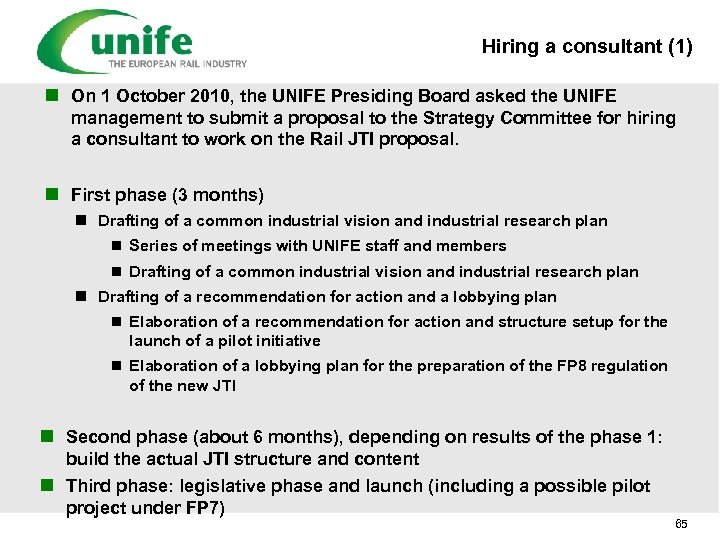
Hiring a consultant (1) n On 1 October 2010, the UNIFE Presiding Board asked the UNIFE management to submit a proposal to the Strategy Committee for hiring a consultant to work on the Rail JTI proposal. n First phase (3 months) n Drafting of a common industrial vision and industrial research plan n Series of meetings with UNIFE staff and members n Drafting of a common industrial vision and industrial research plan n Drafting of a recommendation for action and a lobbying plan n Elaboration of a recommendation for action and structure setup for the launch of a pilot initiative n Elaboration of a lobbying plan for the preparation of the FP 8 regulation of the new JTI n Second phase (about 6 months), depending on results of the phase 1: build the actual JTI structure and content n Third phase: legislative phase and launch (including a possible pilot project under FP 7) 65
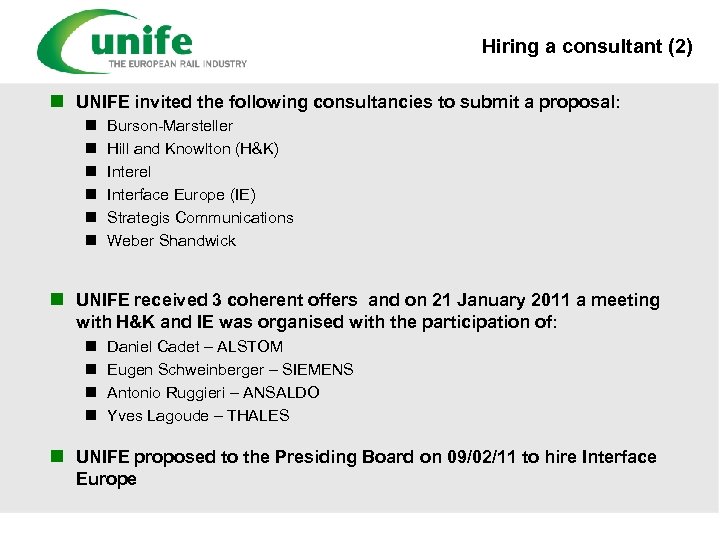
Hiring a consultant (2) n UNIFE invited the following consultancies to submit a proposal: n n n Burson-Marsteller Hill and Knowlton (H&K) Interel Interface Europe (IE) Strategis Communications Weber Shandwick n UNIFE received 3 coherent offers and on 21 January 2011 a meeting with H&K and IE was organised with the participation of: n n Daniel Cadet – ALSTOM Eugen Schweinberger – SIEMENS Antonio Ruggieri – ANSALDO Yves Lagoude – THALES n UNIFE proposed to the Presiding Board on 09/02/11 to hire Interface Europe
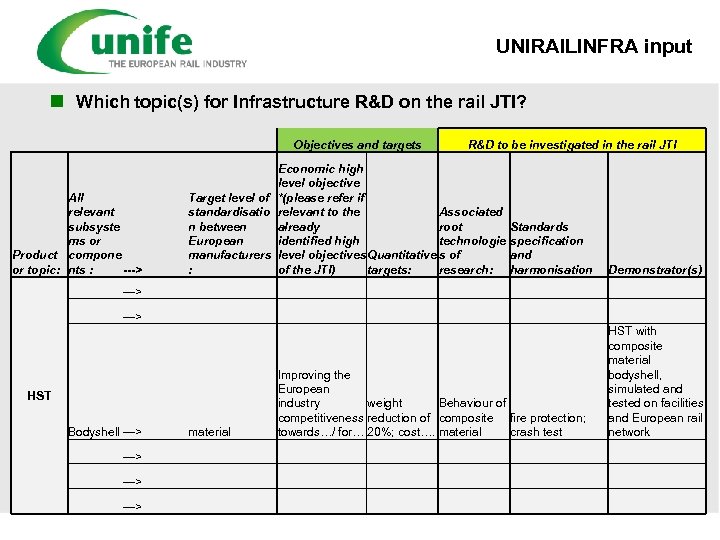
UNIRAILINFRA input n Which topic(s) for Infrastructure R&D on the rail JTI? Objectives and targets All relevant subsyste ms or Product compone or topic: nts : ---> R&D to be investigated in the rail JTI Economic high level objective Target level of *(please refer if standardisatio relevant to the Associated n between already root European identified high technologie manufacturers level objectives Quantitative s of targets: : of the JTI) research: Standards specification and harmonisation Demonstrator(s) ---> HST with composite material bodyshell, simulated and tested on facilities and European rail network HST Improving the European industry weight Behaviour of competitiveness reduction of composite fire protection; towards…/ for… 20%; cost…. material crash test Bodyshell ---> material --->
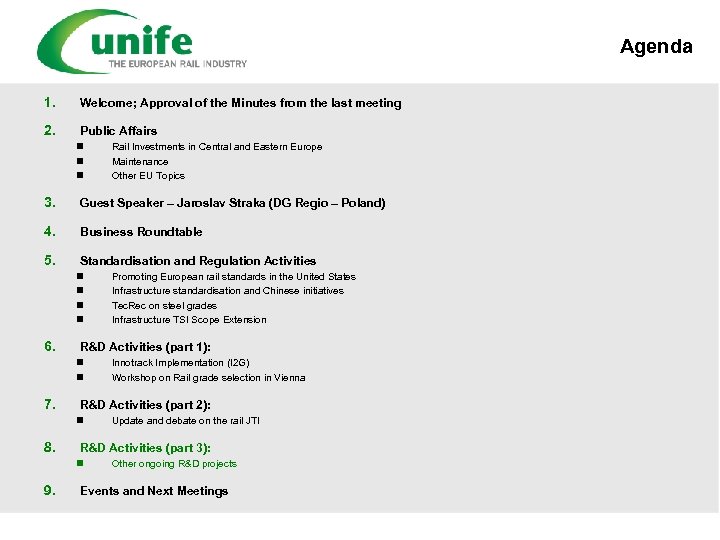
Agenda 1. Welcome; Approval of the Minutes from the last meeting 2. Public Affairs n n n Rail Investments in Central and Eastern Europe Maintenance Other EU Topics 3. Guest Speaker – Jaroslav Straka (DG Regio – Poland) 4. Business Roundtable 5. Standardisation and Regulation Activities n n 6. R&D Activities (part 1): n n 7. Update and debate on the rail JTI R&D Activities (part 3): n 9. Innotrack Implementation (I 2 G) Workshop on Rail grade selection in Vienna R&D Activities (part 2): n 8. Promoting European rail standards in the United States Infrastructure standardisation and Chinese initiatives Tec. Rec on steel grades Infrastructure TSI Scope Extension Other ongoing R&D projects Events and Next Meetings
Other ongoing R&D projects
1. PM’n’IDEA project
PM’n’IDEA status (1/4) n PM’n’IDEA – Predictive Maintenance employing Non-intrusive Inspection & Data Analysis n n UNIFE is the coordinator Development of novel inspection and sensor technologies for track infrastructure 3 years duration (commenced 1 June 2009); 4. 9 m € budget; 16 partners Industry Partners: Tata Steel, Alstom Transport, Mer Mec Group, TSTG, D 2 S International, Bytronic n Mid-term (18 months) reporting n Final reports (including financials) submitted to EC by end Jan 2010 n Upcoming events and meetings n EC review meeting 22 February 2011 n Steering Board-TMT: 10 & 11 March 2011, Stockholm
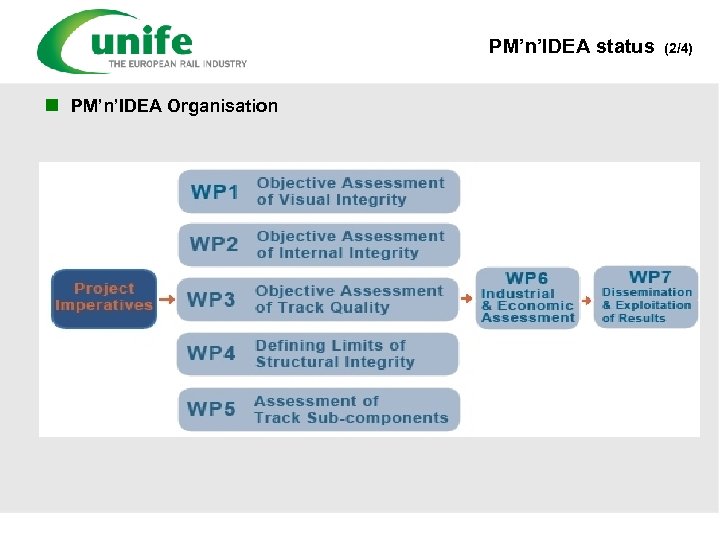
PM’n’IDEA status (2/4) n PM’n’IDEA Organisation
PM’n’IDEA status (3/4) n Main Expected Final Results n WP 1 – Objective Assessment of Visual Integrity n To deliver a novel image inspection system for the automatic inspection of tramway tracks. n To provide a methodology for assessing the degradation of rail profile (3 -D laser profile system for grooved rails). n WP 2 – Objective Assessment of Internal Integrity n To provide a critical and practical evaluation of a novel prototype inspection technique (for assessing the internal integrity of embedded grooved rails). n WP 3 – Objective Assessment of Track Quality n To define methodologies for interpretation and analysis of multiple signals from different trains
PM’n’IDEA status (4/4) n WP 4 – Structural Integrity of Grooved Rail n To provide a methodology for establishing wear limits for different rail sections under defined loading conditions. n To recommend permissible wear limits for a selected range of grooved and flat bottom rail sections n WP 5 – Assessment of Track Components n Installation and practical validation of prototype versions of selected key track components that have the capability to monitor degradation. n WP 6 – Industrial & Economic Assessment n Industrial and economic assessments of all innovative products developed within the project with particular focus on both first installed and life cycle costs (LCC).
2. AUTOMAIN project
AUTOMAIN status (1/2) n AUTOMAIN – Augmented Usage of Track by Optimisation of Maintenance, Allocation and Inspection of railway Networks n Budget: 4 M EUR (EC funding request: 3 M EUR) n Length: 3 years n Kick-off meeting: 2 -3 -4 February 2011, Utrecht n Partners: 18 n Coordinator PRO RAIL n UNIFE Members: MER MEC Group, VOSSLOH COGIFER, EFRTC Name, Company 76
AUTOMAIN status (2/2) n Project objectives n Objective 1: To adopt best practice from other industries in inspection and maintenance optimisation (e. g. , highways, aerospace…). n Objective 2: To develop novel track inspection approaches for freight and mixed traffic routes. n Objective 3: To improve the effectiveness and efficiency of maintenance processes (e. g. , grinding and tamping). n Objective 4: To develop further key technologies that will drive the development of infrastructure design. n Objective 5: To develop a new maintenance planning and scheduling tool that is able to optimise the programme of required maintenance activities Name, Company 77
3. RIVAS project
RIVAS status (1/3) n RIVAS – Railway Induced Vibration Abatement Solutions n n Budget: 8. 2 M EUR (EC funding request: 5 M EUR) Length: 3 years Kick-off meeting: 2 -3 February 2011, Paris Partners: 27 n Coordinator UIC n UNIFE Members: ALSTOM, BT, Lucchini RS, Rail. One Name, Company 79
RIVAS status (2/3) n General objectives n To focus primarily on freight lines n To be applicable to other rail sector operations (local (suburban), n n regional and high-speed networks) To increase attractiveness of rail traffic To increase acceptability of railways to Europe’s residents To strengthen competitiveness of railway transport To strengthen Europe’s railway industry also in the market place outside Europe Name, Company 80
RIVAS status (3/3) n Main technical objectives n The development of technologies to reduce vibration ‘at source’. The focus will be on measures that can be applicable to: n rail vehicle design n rolling stock maintenance n track design n track maintenance n sub-grade engineering n the transmission path within the railway infrastructure n The development of cost effective test procedures including a measurement protocol to monitor and control the performance of vibration reduction measures, hence making results comparable throughout Europe n A ‘technology assessment’ in terms of cost-effectiveness, safety issues, operation, potential impact on rolling noise emission, social aspects
Agenda 1. Welcome; Approval of the Minutes from the last meeting 2. Public Affairs n n n Rail Investments in Central and Eastern Europe Maintenance Other EU Topics 3. Guest Speaker – Jaroslav Straka (DG Regio – Poland) 4. Business Roundtable 5. Standardisation and Regulation Activities n n 6. R&D Activities (part 1): n n 7. Update and debate on the rail JTI R&D Activities (part 3): n 9. Innotrack Implementation (I 2 G) Workshop on Rail grade selection in Vienna R&D Activities (part 2): n 8. Promoting European rail standards in the United States Infrastructure standardisation and Chinese initiatives Tec. Rec on steel grades Infrastructure TSI Scope Extension Other ongoing R&D projects Events and Next Meetings
n Next meetings: n 15 th June 2011, Rome (UNIFE General Assembly)
Promote rail market growth for sustainable mobility. www. unife. org
Скачать презентацию UNIRAILINFRA Committee meeting 10 February 2011 Brussels
579614a02af3d931eefa412970300cc5.ppt