 Скачать презентацию Unique Australian Essential Oils Rob Santich BHSc Fellow
ea2f3a7c02ceac6008f31770b2e2ca89.ppt
- Количество слайдов: 38



Unique Australian Essential Oils Rob Santich BHSc, Fellow ANTA Unit Coordinator UNE Technical Consultant Medi. Herb
What Are Essential Oils? • Essential oils (EOs) are secondary metabolites of plant photosynthesis & are stored in oil ducts in bark, roots, leaves & stems • They are responsible for the distinctive odour of plants. • They are soluble in alcohol & fat & evaporate in heat & light • Essential oils are extracted using a variety of methods & are used in health care, self-care, & in the food, cosmetic & perfume industries Dunning T. Essential Oils in Therapeutic Care. Australian Scholarly Publications, Melbourne, 2007
Key Points • Essential oils have a long history of safe use in almost all cultures • The internal use of essential oils is controversial in many parts of the world • Were it is accepted specific training is required • Essential oils have specific functions in plants that enable the plant to survive & thrive • Modern aromatherapeutic practice is an evolving modality Dunning T. Essential Oils in Therapeutic Care. Australian Scholarly Publications, Melbourne, 2007
Key Points • Medicine, perfume & herbalism existed as one until the late 1800 s • The rise of modern chemistry processes, laboratory techniques, modern medicines, & scientific principles saw them separate, even though herbs were the basis of many medicines Dunning T. Essential Oils in Therapeutic Care. Australian Scholarly Publications, Melbourne, 2007
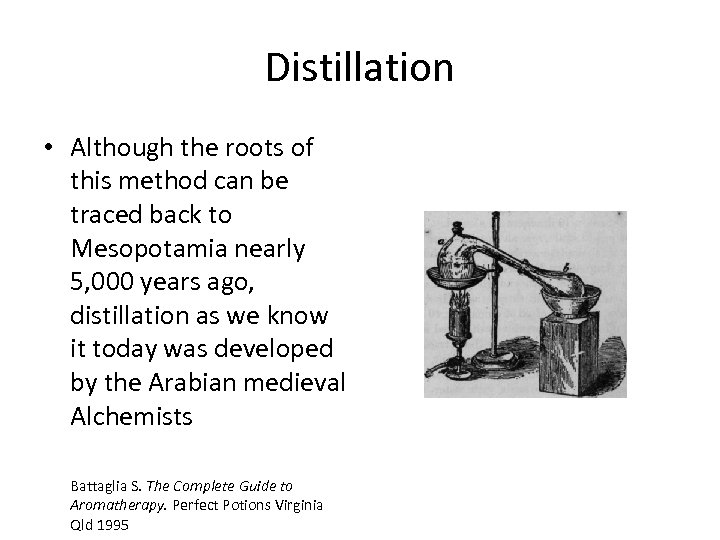
Distillation • Although the roots of this method can be traced back to Mesopotamia nearly 5, 000 years ago, distillation as we know it today was developed by the Arabian medieval Alchemists Battaglia S. The Complete Guide to Aromatherapy. Perfect Potions Virginia Qld 1995
Distillation • These techniques were then further developed in Grasse, in the south of France, the home of the perfume industry • In terms of the Australian experience, it is apparent that Original Australians were well aware of the medicinal virtues of the many essential oil bearing local plant species • These plants where mostly used as infusions, poultices & burnt as smudge Dunning T. Essential Oils in Therapeutic Care. Australian Scholarly Publications, Melbourne, 2007
Local Industry • Soon after the English invasion, efforts were made to examine therapeutic effects of the native plants • Denis Considen, the assistant Surgeon General of the First Fleet, is accredited with the distillation & shipment to England of a sample of Eucalyptus oil for evaluation Boland DJ, Brophy JJ, House APN. Eucalyptus Leaf Oils. Inkata Press. Melbourne, 1991
Local Industry • It took quite some time for the local industry to develop • The first Government botanist for Victoria, Baron Ferdinand von Mueller, is credited with convincing his pharmacist friend, Joseph Bosisto, of the medicinal virtues of Eucalyptus oil and the potential for a local industry • Bosisto built the first commercial still near Dandenong Vic in 1854 • The first Eucalytus tree to be worked for its oil was E. radiata or narrow leafed peppermint Boland DJ, Brophy JJ, House APN. Eucalyptus Leaf Oils. Inkata Press. Melbourne, 1991
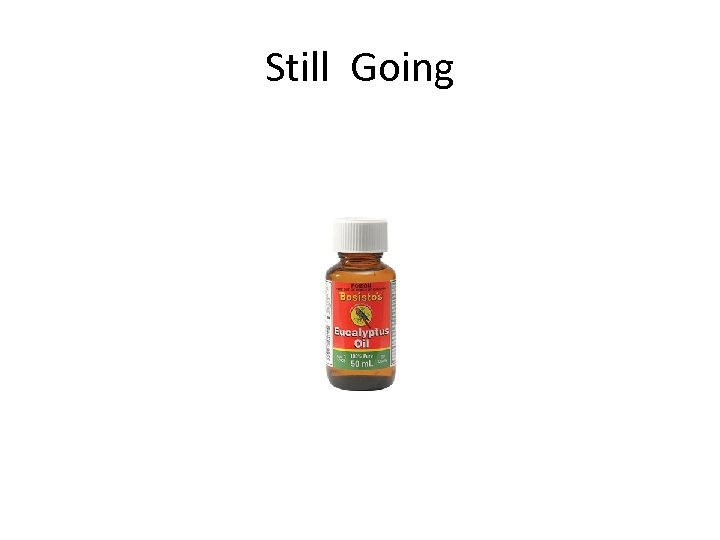
Still Going
Scientific Interest • Scientific interest in the antibacterial activity of extracts from Australian plants started in the 1940 s and 1950 s • Information about traditional Aboriginal & early European use, led to a major research effort by the CSIRO with a subsequent phytochemical surveys identifying a large number plants with biological activity • Impetus for this research, however, dwindled & contemporary research on medical uses of Australian indigenous plants has, to a large extent, focused on one or two selected species Pearn J. J Paediatr Child Health 2005; 41(5 -6): 284 -290 Wilkinson JM, Cavanagh H. Phytother Res 2005; 19: 643 -646
Scientific Interest • Perhaps the most extensively studied of all the Australian plants is Melaleuca alternifolia (tea tree) • The medical potential of this essential oil was noted in the scientific literature as early as 1930 • More recently at least 100 studies on this plant were published between 2000 & 2004 Wilkinson JM, Cavanagh H. Phytother Res 2005; 19: 643 -646
Today's Oils • Melaleuca ericifolia, Swamp tea tree, Rosalina, Lavender tea tree, Lavaleuca • Prostanthera mellisifolia & rotundifolia, Balm mint bush • Agonis fragrans, Fragonia • Leptospermum petersonii, Lemon scented tea tree • Eucalyptus citriodora, Lemon scented gum • Santalum spicatum, WA Sandalwood
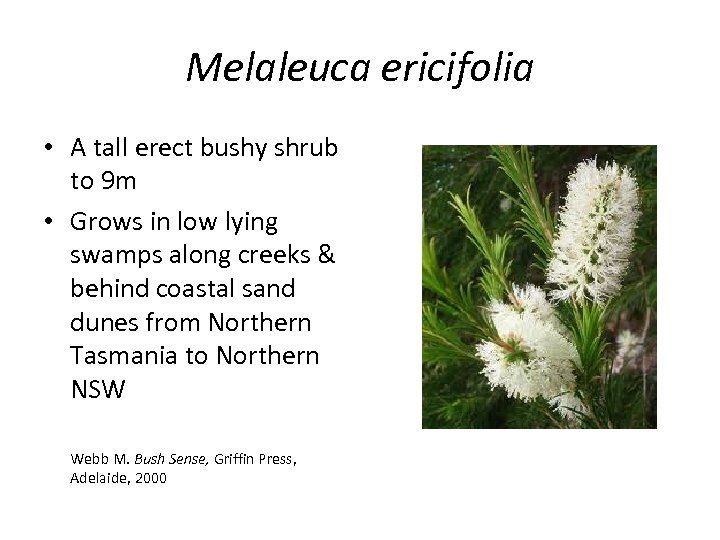
Melaleuca ericifolia • A tall erect bushy shrub to 9 m • Grows in low lying swamps along creeks & behind coastal sand dunes from Northern Tasmania to Northern NSW Webb M. Bush Sense, Griffin Press, Adelaide, 2000
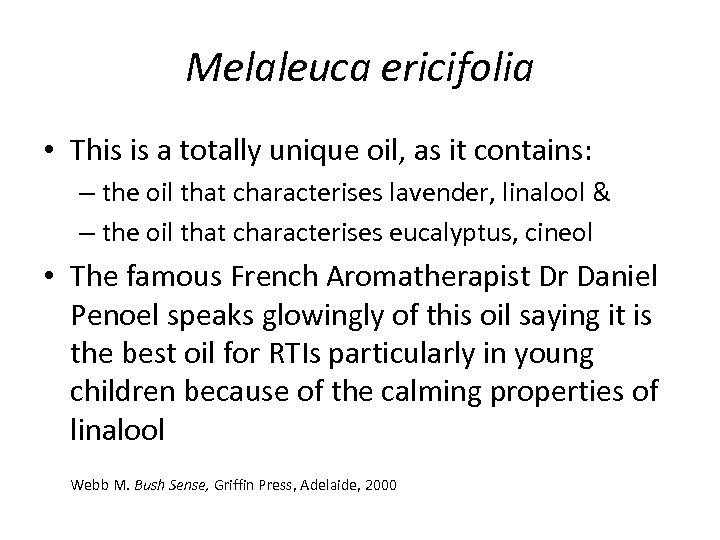
Melaleuca ericifolia • This is a totally unique oil, as it contains: – the oil that characterises lavender, linalool & – the oil that characterises eucalyptus, cineol • The famous French Aromatherapist Dr Daniel Penoel speaks glowingly of this oil saying it is the best oil for RTIs particularly in young children because of the calming properties of linalool Webb M. Bush Sense, Griffin Press, Adelaide, 2000
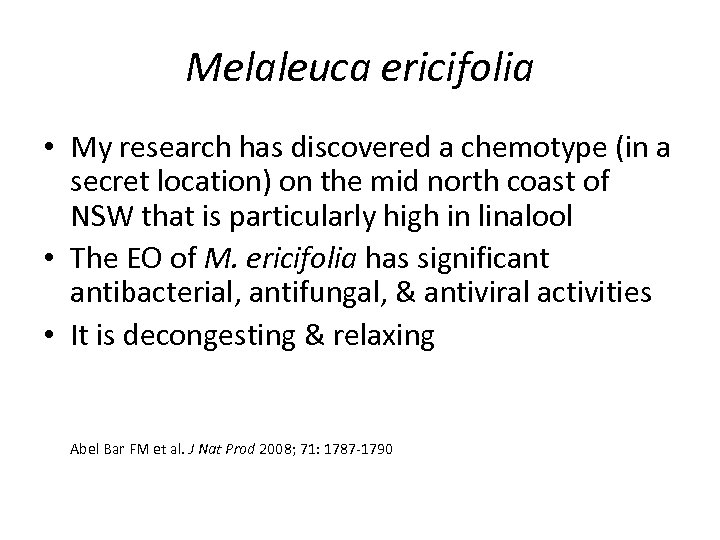
Melaleuca ericifolia • My research has discovered a chemotype (in a secret location) on the mid north coast of NSW that is particularly high in linalool • The EO of M. ericifolia has significant antibacterial, antifungal, & antiviral activities • It is decongesting & relaxing Abel Bar FM et al. J Nat Prod 2008; 71: 1787 -1790
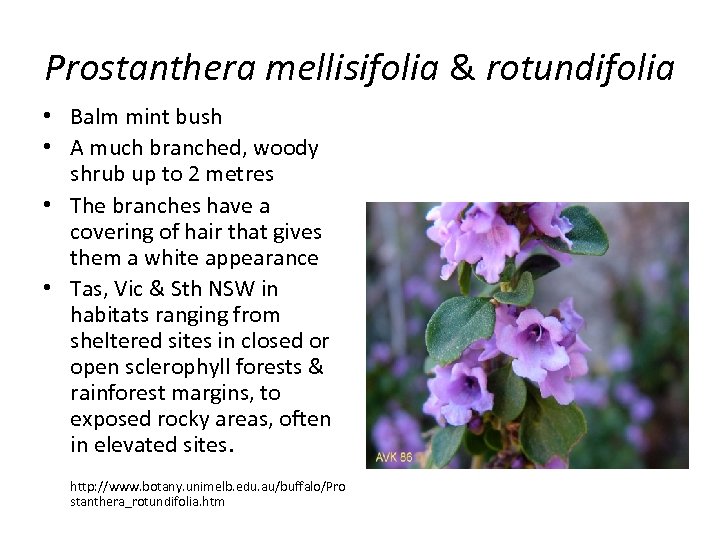
Prostanthera mellisifolia & rotundifolia • Balm mint bush • A much branched, woody shrub up to 2 metres • The branches have a covering of hair that gives them a white appearance • Tas, Vic & Sth NSW in habitats ranging from sheltered sites in closed or open sclerophyll forests & rainforest margins, to exposed rocky areas, often in elevated sites. http: //www. botany. unimelb. edu. au/buffalo/Pro stanthera_rotundifolia. htm
Prostanthera mellisifolia & rotundifolia • One feature of the mints is their clean, strongly minty eucalyptus like fragrance • The essential oil contains cineole (the smell of eucalyptus) & alpha & beta pinene • Used for the treatment of colds & headaches • Its fresh scent is reminiscent of the Australian bush • It is energising & uplifting https: //rirdc. infoservices. com. au/downloads/00 -038. pdf
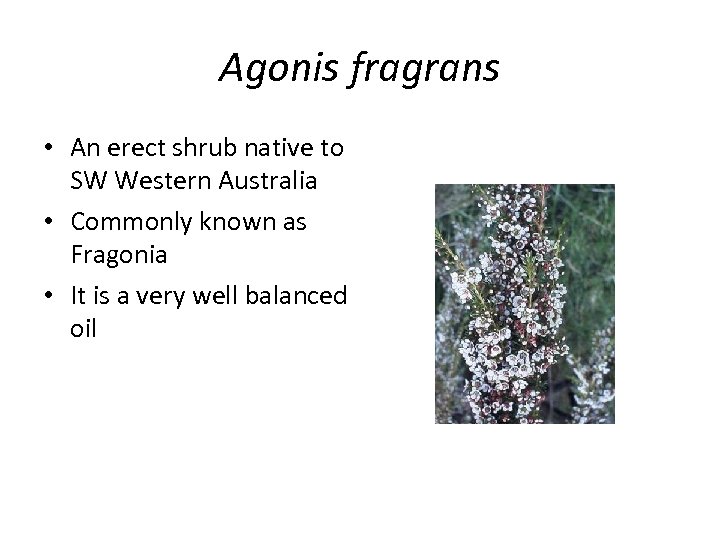
Agonis fragrans • An erect shrub native to SW Western Australia • Commonly known as Fragonia • It is a very well balanced oil
Agonis fragrans • Fragonia oil has significant anti-microbial activity • Primary constituents of the oil are cineole, alpha-pinene & linalool • The odour is described as "a pleasant fresh cineolic odour with a hint of a citrus note mixed with a slight spicy cinnamon tonality & sweet balsamic undertones” http: //www. paperbarkoils. com. au/essential-oils. html#oil_agnois
Agonis fragrans • Researchers have never come across on essential oil before that has this amazing power of harmonisation & rebalancing • Fragonia is currently used for the following; relief from muscle pain & aches, RTIs, digestive disorders & allergies due to yeast infection & as an immune tonic in all cases of infectious diseases http: //www. healingartsandsciences. com
Agonis fragrans • It also has application in stress-related problems & mental illness because of its effect of creating balance in the body & mind • Also, chronic tonsillitis & bronchial conditions http: //www. healingartsandsciences. com
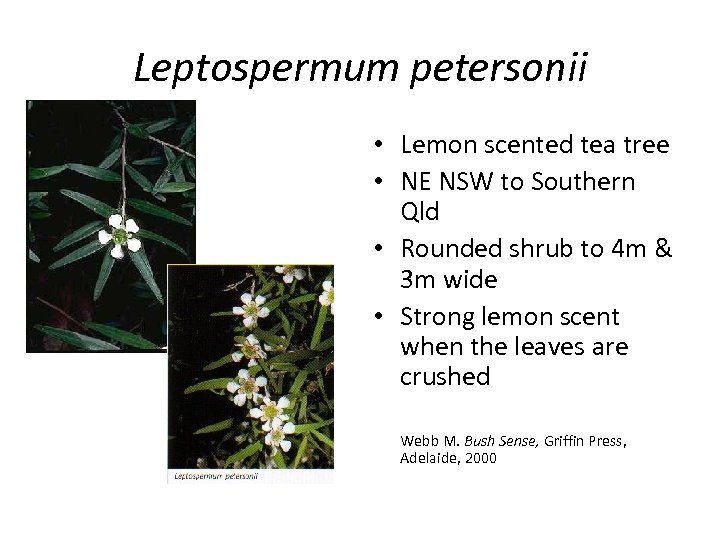
Leptospermum petersonii • Lemon scented tea tree • NE NSW to Southern Qld • Rounded shrub to 4 m & 3 m wide • Strong lemon scent when the leaves are crushed Webb M. Bush Sense, Griffin Press, Adelaide, 2000
Leptospermum petersonii • The major constituents are geranial & neral • These are aldehydes which are sometimes skin irritants in sensitive individuals • L. petersonii oil volatiles were found to be potent inhibitors of fungal growth in vitro • No significant cell toxicity was found to be associated with the volatiles • Synergises with Tea tree oil to improve it’s antifungal activity http: //search. proquest. com. ezproxy. une. edu. au/docview/209864311
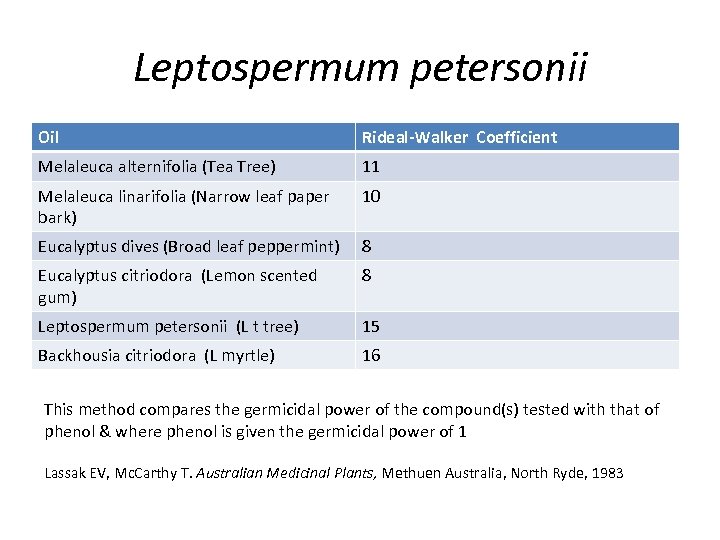
Leptospermum petersonii Oil Rideal-Walker Coefficient Melaleuca alternifolia (Tea Tree) 11 Melaleuca linarifolia (Narrow leaf paper bark) 10 Eucalyptus dives (Broad leaf peppermint) 8 Eucalyptus citriodora (Lemon scented gum) 8 Leptospermum petersonii (L t tree) 15 Backhousia citriodora (L myrtle) 16 This method compares the germicidal power of the compound(s) tested with that of phenol & where phenol is given the germicidal power of 1 Lassak EV, Mc. Carthy T. Australian Medicinal Plants, Methuen Australia, North Ryde, 1983
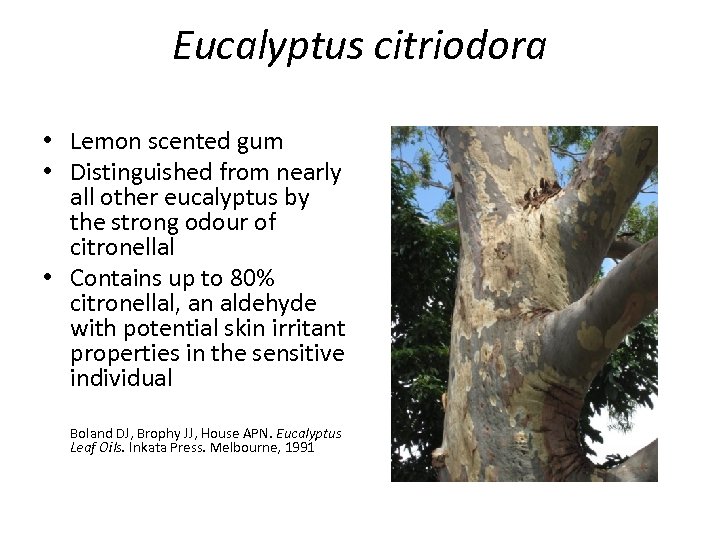
Eucalyptus citriodora • Lemon scented gum • Distinguished from nearly all other eucalyptus by the strong odour of citronellal • Contains up to 80% citronellal, an aldehyde with potential skin irritant properties in the sensitive individual Boland DJ, Brophy JJ, House APN. Eucalyptus Leaf Oils. Inkata Press. Melbourne, 1991
Eucalyptus citriodora • Medium to tall tree with a sparse crown • Deciduous bark with pink (northern form) or spotted (southern form) bark • Occurs naturally is several disjunct locations – Around Cairns – From Maryborough to Mackay • Often planted as an exotic Boland DJ, Brophy JJ, House APN. Eucalyptus Leaf Oils. Inkata Press. Melbourne, 1991
Eucalyptus citriodora • The EO is antiseptic, antiviral, bactericidal, antifungal, insecticide & decongestant • In fact all the lemon scented oils are insecticidal & repellent • The aroma of the lemon scented oils is uplifting, yet relaxing & decongesting, ideal in the treatment of RTIs Webb M. Bush Sense, Griffin Press, Adelaide, 2000
Protection from Tick Bites § Lemon eucalyptus essential oil reduces tick bites by 50% § A volunteer sample of 111 individuals was recruited among healthy, outdoor active adults living in two highly infested tick areas § They were randomly divided into two groups: one group applied the spray daily for 2 wk to the lower extremities, whereas the other group was instructed not to use any type of repellent on any part of the body
Protection from Tick Bites § After 2 weeks, the scheme was reversed § The number of reported attached ticks noted below the waist was 31% during the period when the spray was used & 65% when no spray was used (P < 0. 001) § No evident redistribution of attached ticks from protected areas to unprotected areas was seen Gardulf A, Wohlfart I, Gustafson R. J Med Entomol 2004; 41(6): 1064 -1067
Personal Insect Repellent • Easily prepared from the hydrosols of either L. tea tree, L. scented eucalyptus or L. myrtle to which approximately 5% of the EO is added • Place in a food grade spray bottle • Shake before use & spray liberally but not around the eyes
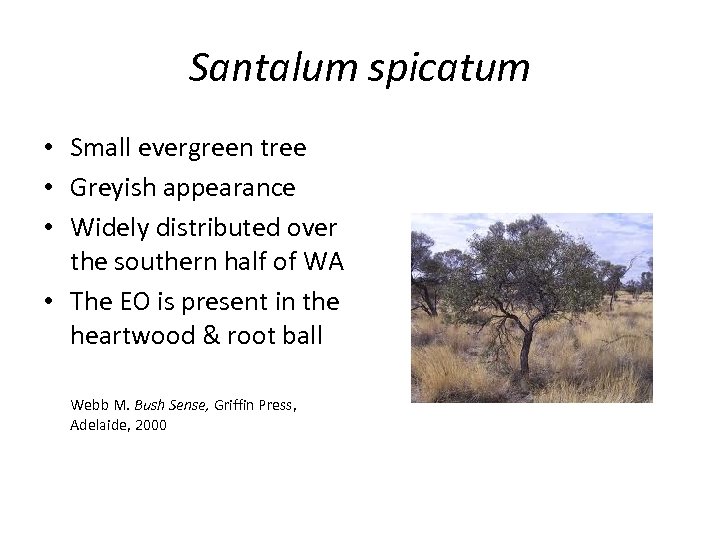
Santalum spicatum • Small evergreen tree • Greyish appearance • Widely distributed over the southern half of WA • The EO is present in the heartwood & root ball Webb M. Bush Sense, Griffin Press, Adelaide, 2000
Santalum spicatum • The endemic species of sandalwood, was a significant part of the local economy in the 19 th & early 20 th centuries • The trees were harvested in the wild & exported to Asia & the Dutch East Indies & an oil distilled • Overexploitation & land clearing soon threatened the viability of the industry, & the government stepped in to protect the highvalue crop with harvest & export controls Sabto M. Ecos 2010; 158: 26 -29
Santalum spicatum • By the 1990 s, farmers in WA were beginning to experiment with plantings of S. spicatum • Larger agribusiness players soon entered the fray in the Kimberley region, with irrigated plantations of Santalum album, an exotic species native to India • By 2010, the Kimberley region was home to the largest sandalwood plantation in the world: approximately 3700 ha of S. album
Santalum spicatum • Sandalwood is a root 'hemi-parasite', which attaches its roots to nitrogen-fixing host species (such as acacias & casuarinas) & extracts water & nutrients from them Sabto M. Ecos 2010; 158: 26 -29
Santalum spicatum • A recent study demonstrated strong activity against: – Candida albicans – Gram positive bacterium Staphylococcus aureus – Gram negative bacteria Escherichia coli – Pseudomonas aeruginosa – Klebsiella pneumoniae Jirovetz L et al. Flavour Fragr J 2006; 21: 465– 468
Santalum spicatum • Indian Sandalwood & WA Sandalwood are chemically similar • Both contain alpha & beta santalol, the components that give the scent to Sandalwood • WA Sandalwood contains higher levels of farnesol & alpha bisabolol which add to the anti-inflammatory & antimicrobial effects Webb M. Bush Sense, Griffin Press, Adelaide, 2000
Santalum spicatum Uses: • Topical application for any skin infection, whether bacterial, viral or fungal • Inhalation for RTIs • Internally for gut infections, cystitis • It is a powerful urinary antiseptic • A fixative for other higher note oils
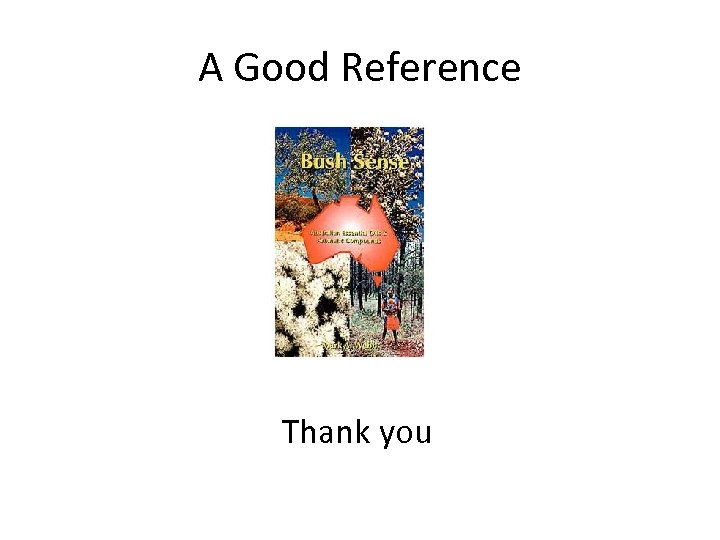
A Good Reference Thank you
Скачать презентацию Unique Australian Essential Oils Rob Santich BHSc Fellow
ea2f3a7c02ceac6008f31770b2e2ca89.ppt