 Скачать презентацию Union principally financed by the EU A joint
d1547864d315b4fcc640abcee21e15f9.ppt
- Количество слайдов: 43




Union, principally financed by the EU. A joint initiative of the OECD and the European CONFERENCE on Regulatory Impact Assessment Ankara - 19, 20 and 21 April, 2006 PART II : 19 April pm Good RIA practices in selected EU member states 2. RIA practices in ITALY Mario Martelli [m. martelli@agora 2000. it] © OECD
Contents Ø Ø Ø Ø Background and context When to undertake a RIA? What are the main steps to be taken when undertaking a RIA? Who should be consulted and at what stages of the process? What data is needed and what are the best sources for compiling relevant data? What can be done to avoid RIA delaying the policy making process? How to assure the quality of RIA? How to use RIA post facto or ex ante?
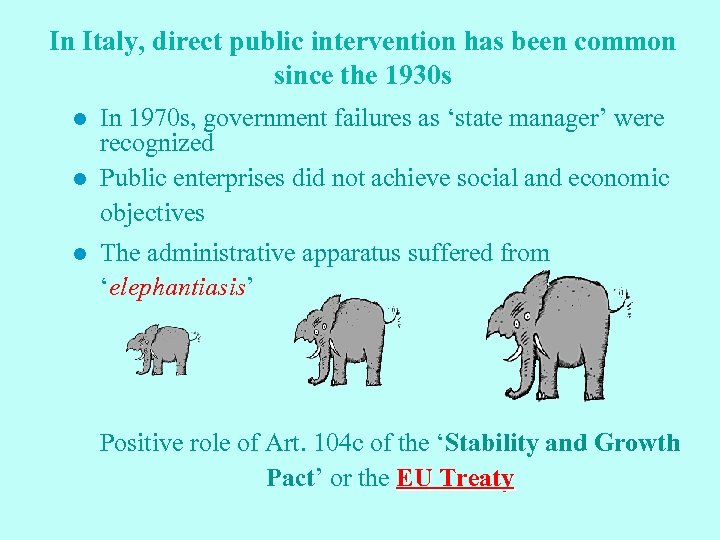
In Italy, direct public intervention has been common since the 1930 s l l l In 1970 s, government failures as ‘state manager’ were recognized Public enterprises did not achieve social and economic objectives The administrative apparatus suffered from ‘elephantiasis’ Positive role of Art. 104 c of the ‘Stability and Growth Pact’ or the EU Treaty Pact
The elements of the Italian RIA Introduced in Italy as a part of the “Semplificazione” Law Art. 5, L. 50/99 Operational with 2 Specific Rules of the Presidency of the Council of Ministers 3/2000 e 9/2001 A set of activities supposed to be carried out by Public entities and administrations while they are planning regulations, in order to assess, on a ex-ante basis their effects on citizens, enterprises and PA
The purpose of the Italian RIA The Italian RIA establishes if a regulatory intervention is really necessary, and it directs the regulator toward the less onerous solutions for the beneficiary. It allows to consider different relevant options, and to assess them on the base of their cost and benefits (or, better, on relevant Pros and Contra), providing for the consultation of the interested beneficiary
A major objective: improving ‘competitive advantage’ The Italian RIA – improving ‘competitive advantage’ l Poor performance of one sector has negative effects as inputs for productive sectors (June 2003 Report - Italian Antitrust Authority) l Costs for enterprises connected to “bad regulation” represent a competitive disadvantage factor l As part of the public administration reforms, RIA is a “modern instrument” for the administration to improve its decision processes without slowing them down
What RIA was in the 2001 -2004 experimentation A “modern instrument” for the administration to improve its own decisional processes without making heavier and slowing down the action The new regulatory provisions have been evaluated not only vis-à-vis their abstract coherence with values considered worthed to be carried out, but as well, and especially, with regards to the pros and contra for citizens, enterprises, and the public sector, in the light of the economic programming objectives (agenda) agenda
Italian RIA – overview § § § 2001 to 2005 5 RIAs carried out at national level 18 RIAs carried out at regional level (out of 21 regions) Establishment of RIA permanent offices/project in Tuscany, Piedmont, Friuli V. G.
![RIA: who [the Italian experience]? - It is essential to create a balance between](https://present5.com/presentation/d1547864d315b4fcc640abcee21e15f9/image-9.jpg "RIA: who [the Italian experience]? - It is essential to create a balance between")
RIA: who [the Italian experience]? - It is essential to create a balance between centralization and decentralization - The role of sectoral Ministries: Ministries - they have the relevant expertise and know the problem better. . . - . . . but they tend to use RIA to justify rather than to assess their regulatory proposals - The role of the “Center of the Government”: Government - need of an “external” review of the work of the sectoral Ministries - can facilitate the dialogue among different Ministries on the same proposal - the “Center” should not expropriate the regulatory functions of sectoral Ministries, but should rather integrate the RIAs into the regulatory process - International experience shows that only a later stage in the developement of a RIA system may consist in moving from a top-down approach to a decentralized one
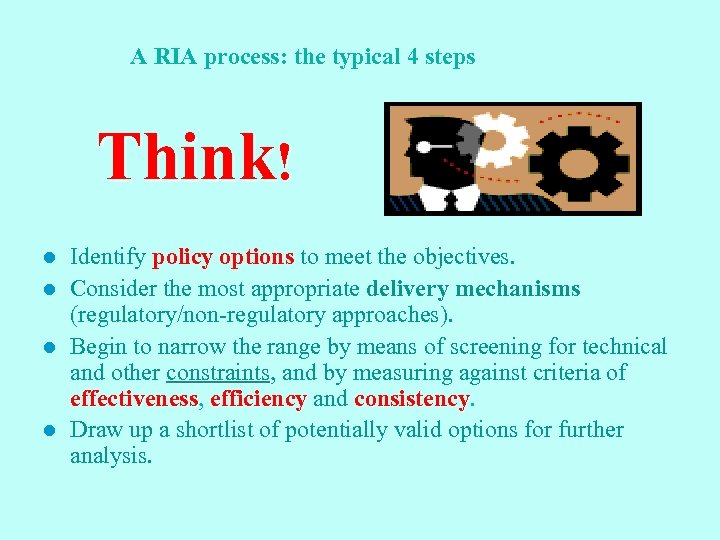
A RIA process: the typical 4 steps Think! l l Identify policy options to meet the objectives. Consider the most appropriate delivery mechanisms (regulatory/non-regulatory approaches). Begin to narrow the range by means of screening for technical and other constraints, and by measuring against criteria of constraints effectiveness, efficiency and consistency. effectiveness consistency Draw up a shortlist of potentially valid options for further analysis.
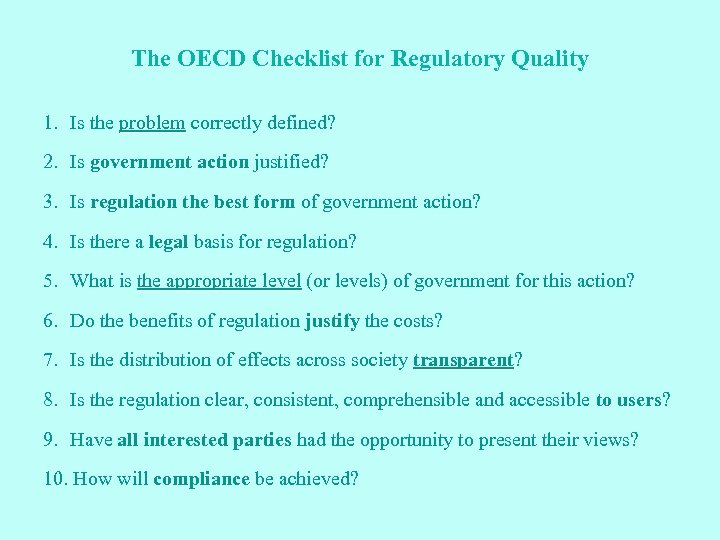
The OECD Checklist for Regulatory Quality 1. Is the problem correctly defined? 2. Is government action justified? 3. Is regulation the best form of government action? 4. Is there a legal basis for regulation? 5. What is the appropriate level (or levels) of government for this action? 6. Do the benefits of regulation justify the costs? 7. Is the distribution of effects across society transparent? transparent 8. Is the regulation clear, consistent, comprehensible and accessible to users? users 9. Have all interested parties had the opportunity to present their views? 10. How will compliance be achieved?
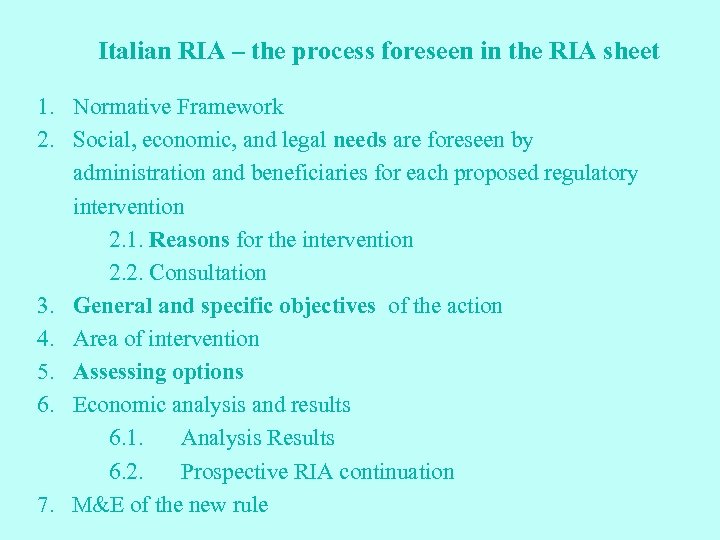
Italian RIA – the process foreseen in the RIA sheet 1. Normative Framework 2. Social, economic, and legal needs are foreseen by administration and beneficiaries for each proposed regulatory intervention 2. 1. Reasons for the intervention 2. 2. Consultation 3. General and specific objectives of the action 4. Area of intervention 5. Assessing options 6. Economic analysis and results 6. 1. Analysis Results 6. 2. Prospective RIA continuation 7. M&E of the new rule
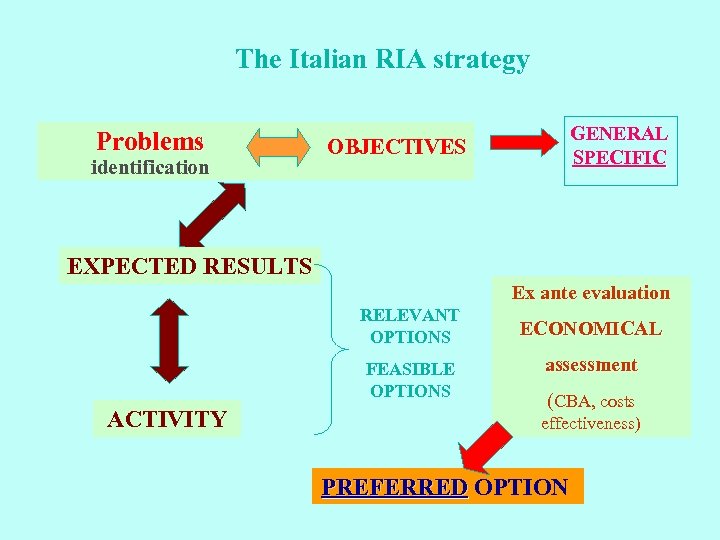
The Italian RIA strategy Problems identification GENERAL SPECIFIC OBJECTIVES EXPECTED RESULTS Ex ante evaluation RELEVANT OPTIONS FEASIBLE OPTIONS ACTIVITY ECONOMICAL assessment (CBA, costs effectiveness) PREFERRED OPTION
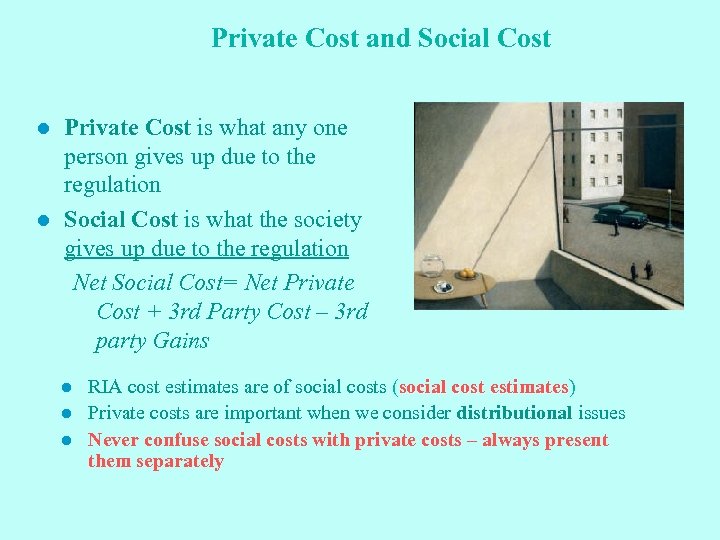
Private Cost and Social Cost l l Private Cost is what any one person gives up due to the regulation Social Cost is what the society gives up due to the regulation Net Social Cost= Net Private Cost + 3 rd Party Cost – 3 rd party Gains l l l Public and Private Sunlight, 2002 RIA cost estimates are of social costs (social cost estimates) estimates Private costs are important when we consider distributional issues Never confuse social costs with private costs – always present them separately
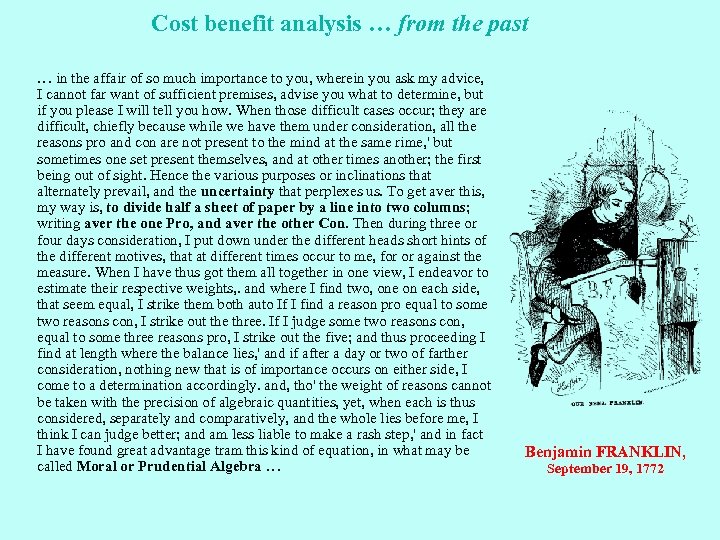
Cost benefit analysis … from the past … in the affair of so much importance to you, wherein you ask my advice, I cannot far want of sufficient premises, advise you what to determine, but if you please I will tell you how. When those difficult cases occur; they are difficult, chiefly because while we have them under consideration, all the reasons pro and con are not present to the mind at the same rime, ' but sometimes one set present themselves, and at other times another; the first being out of sight. Hence the various purposes or inclinations that alternately prevail, and the uncertainty that perplexes us. To get aver this, my way is, to divide half a sheet of paper by a line into two columns; writing aver the one Pro, and aver the other Con. Then during three or four days consideration, I put down under the different heads short hints of the different motives, that at different times occur to me, for or against the measure. When I have thus got them all together in one view, I endeavor to estimate their respective weights, . and where I find two, one on each side, that seem equal, I strike them both auto If I find a reason pro equal to some two reasons con, I strike out the three. If I judge some two reasons con, equal to some three reasons pro, I strike out the five; and thus proceeding I find at length where the balance lies, ' and if after a day or two of farther consideration, nothing new that is of importance occurs on either side, I come to a determination accordingly. and, tho' the weight of reasons cannot be taken with the precision of algebraic quantities, yet, when each is thus considered, separately and comparatively, and the whole lies before me, I think I can judge better; and am less liable to make a rash step, ' and in fact I have found great advantage tram this kind of equation, in what may be called Moral or Prudential Algebra … Benjamin FRANKLIN, September 19, 1772
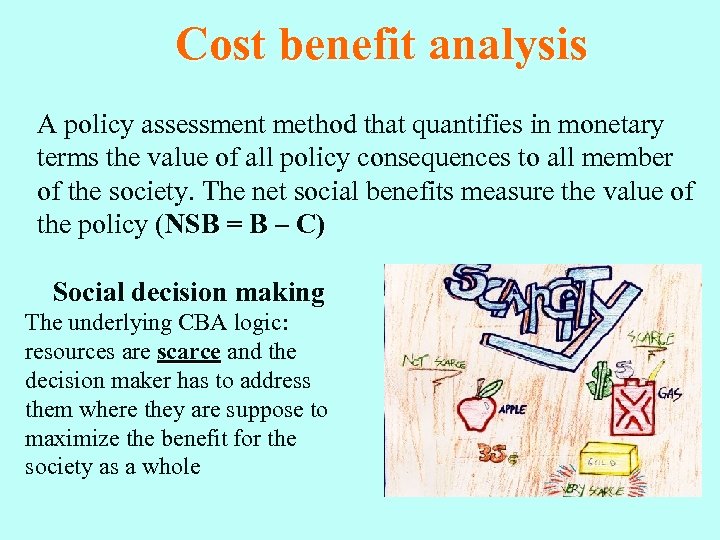
Cost benefit analysis A policy assessment method that quantifies in monetary terms the value of all policy consequences to all member of the society. The net social benefits measure the value of the policy (NSB = B – C) Social decision making The underlying CBA logic: resources are scarce and the decision maker has to address them where they are suppose to maximize the benefit for the society as a whole
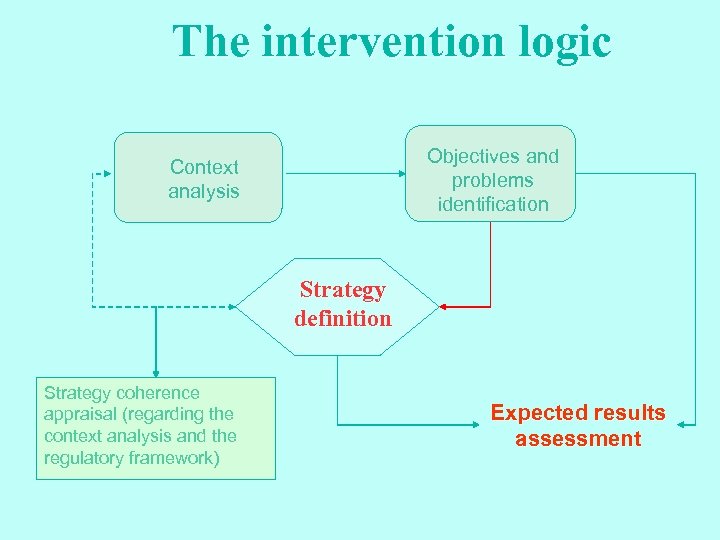
The intervention logic Objectives and problems identification Context analysis Strategy definition Strategy coherence appraisal (regarding the context analysis and the regulatory framework) Expected results assessment
l l l The importance of defining the problem/need correctly No analysis can compensate for poor problem definition Incorrect problem definition will result in regulatory failure or even perverse results The OECD Recommendation starts with the most important question: Is the problem correctly defined? The problem to be solved should be precisely stated, giving clear evidence of its nature and magnitude, and explaining why it has arisen (identifying the incentives of affected entities)
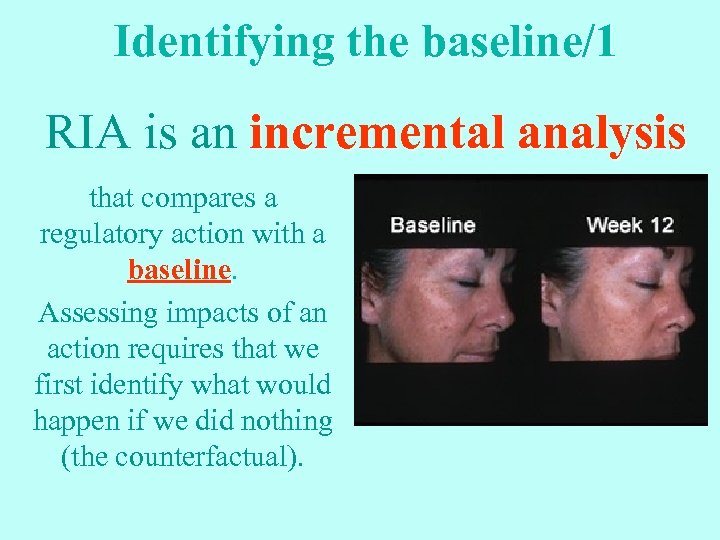
Identifying the baseline/1 RIA is an incremental analysis that compares a regulatory action with a baseline Assessing impacts of an action requires that we first identify what would happen if we did nothing (the counterfactual).
Identifying the baseline/2 l. A RIA must be based on a clear statement of the baseline: What will happen in future if no action is taken? l This is often not easy, because the consequences of the current situation are not often not clear (consider the problem of global warming)
Choosing a Baseline Choice of a baseline may require consideration of many factors, including: factors • evolution of the market, • changes in external factors affecting benefits and costs, • changes in regulations. The baseline should reflect the future effect of current programs and policies (the importance of the Agenda). Agenda Pro’s and con’s should be assessed against the same baseline
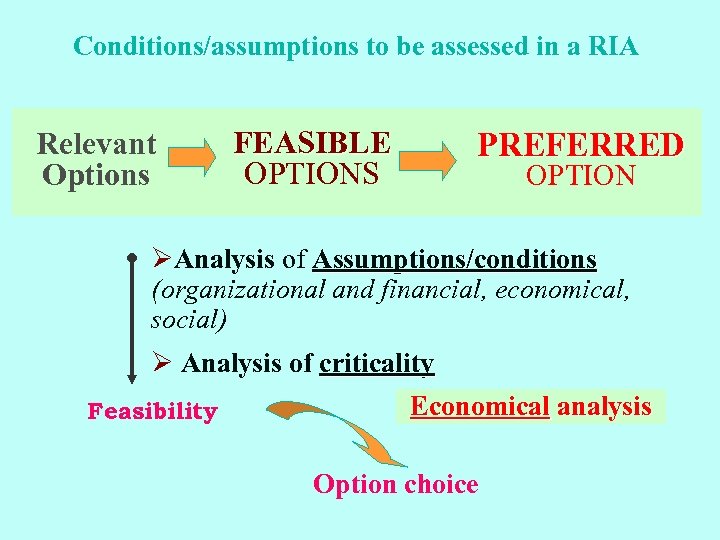
Conditions/assumptions to be assessed in a RIA Relevant Options FEASIBLE OPTIONS PREFERRED OPTION ØAnalysis of Assumptions/conditions (organizational and financial, economical, social) Ø Analysis of criticality Feasibility Economical analysis Option choice
Alternatives Be brave! Don’t be scared: seek alternatives Remember that …. . you don’t need to be brave to do something you are obliged to do in any case… The Grapes of Wrath (1940) - H. Fonda
Mixed options and differential regulation There are few “pure” solutions. The best solution is usually a mix of alternatives and traditional regulation. Why having only Providing for different obligations according to the sector involved, … if you can have a “mixed fried” the firm’s dimension or the social class avoid to impose the same costs indifferently. In this case we have differential regulation (for example, less stringent obligations for SMEs, cheaper tickets for young people, etc. ).
What is “public consultation” consultation in a broad sense?
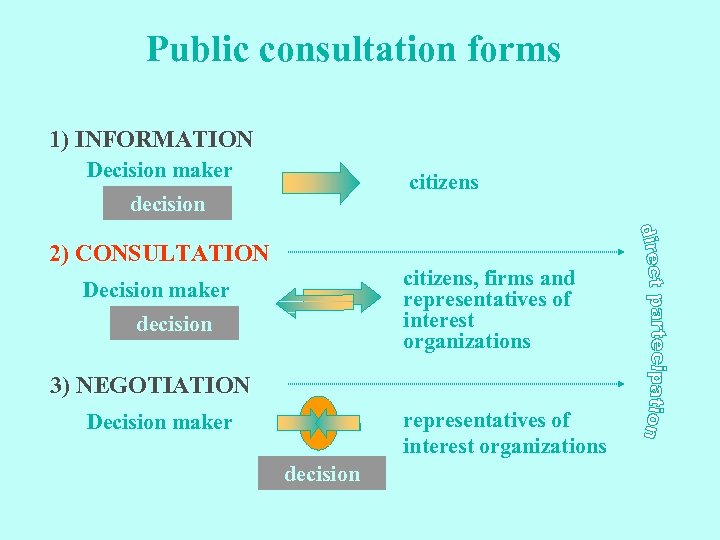
Public consultation forms 1) INFORMATION Decision maker citizens decision 2) CONSULTATION citizens, firms and representatives of interest organizations Decision maker decision 3) NEGOTIATION representatives of interest organizations Decision maker decision
Consultation and RIA Consultation as a research method to gather quantitative data and opinions and to promote and simplify transparency and public participation. Ø Cognitive role (reducing asymmetric information between regulator and society) Ø Its main goal is not negotiation with interest groups, but the enrichment of the empirical basis for decision-making. A good regulation should always take into account different points of view
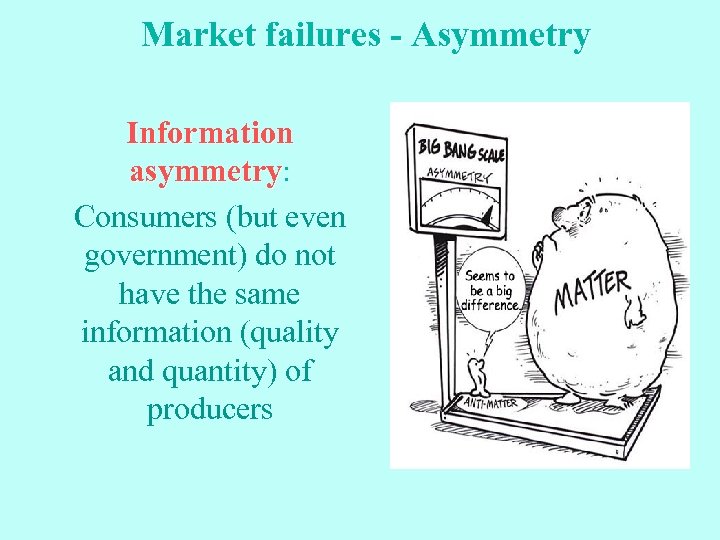
Market failures - Asymmetry Information asymmetry: asymmetry Consumers (but even government) do not have the same information (quality and quantity) of producers
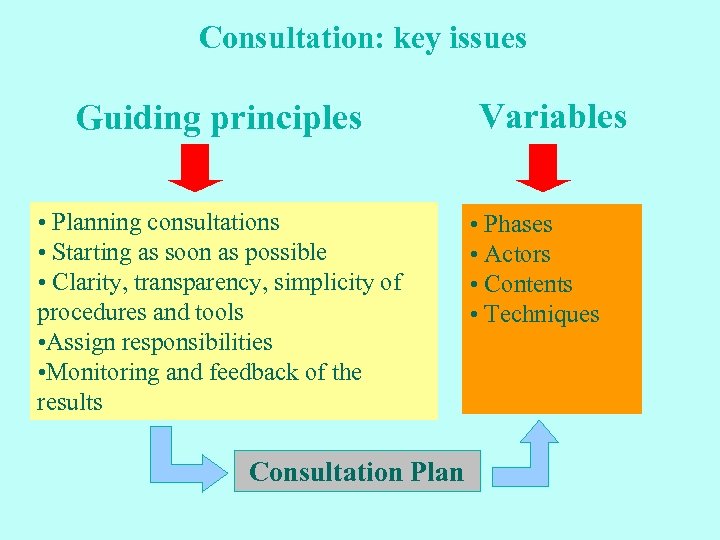
Consultation: key issues Guiding principles • Planning consultations • Starting as soon as possible • Clarity, transparency, simplicity of procedures and tools • Assign responsibilities • Monitoring and feedback of the results Consultation Plan Variables • Phases • Actors • Contents • Techniques
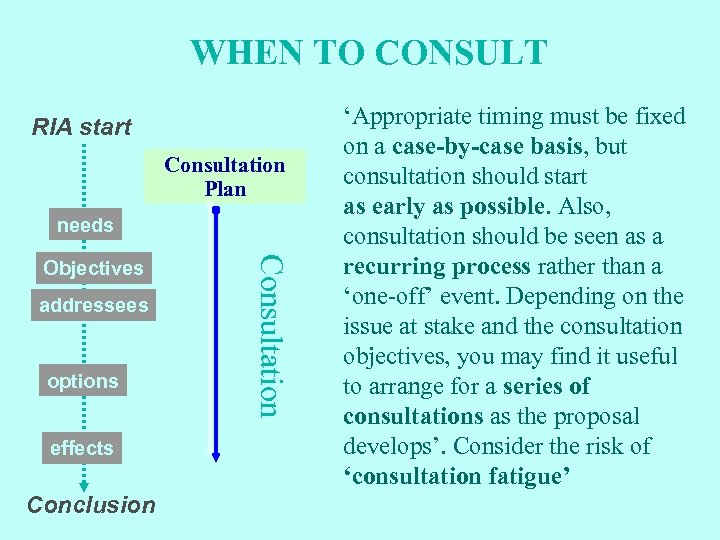
WHEN TO CONSULT RIA start Consultation Plan needs addressees options effects Conclusion Consultation Objectives ‘Appropriate timing must be fixed on a case-by-case basis, but consultation should start as early as possible. Also, possible consultation should be seen as a recurring process rather than a ‘one-off’ event. Depending on the issue at stake and the consultation objectives, you may find it useful to arrange for a series of consultations as the proposal develops’. Consider the risk of ‘consultation fatigue’
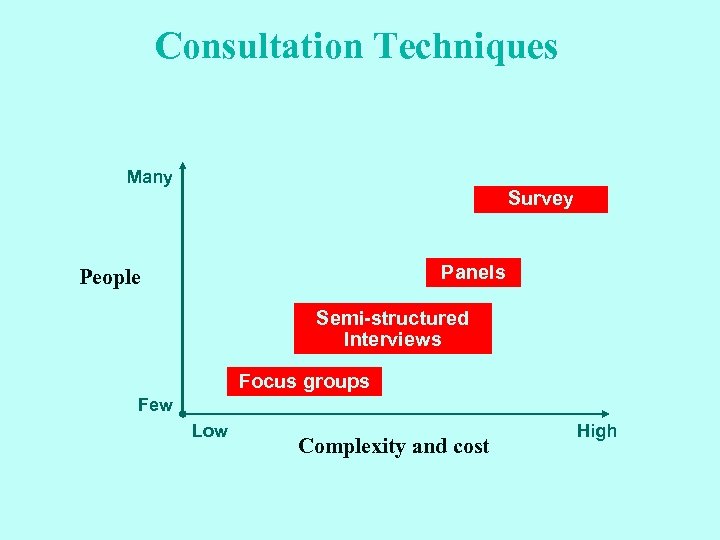
Consultation Techniques Many Survey Panels People Semi-structured Interviews Focus groups Few Low Complexity and cost High
The Italian regional experience about RIA/1 Consultation contributions l For the administrations • Clearer problem definition, better identification of objective and expected results, expansion of the info available • Use of innovative techniques with promising resuts • Higher communication flows among different administrations , better use of different competencies, visibility l For those consulted • Greater participation in the decisional process; higher awareness of the participation l For RIA • Gathering of info and opinions about: options, unexpected problems, costs and benefits
The Italian regional experience about RIA/2 Consultation limits l Difficulties in planning and conducting consultation as soon as possible l Difficulties in coordinating different administrations each owning a piece of relevant info l Majority of informal contacts l Data gathered not exhaustible (both qualitatively and quantitatively)
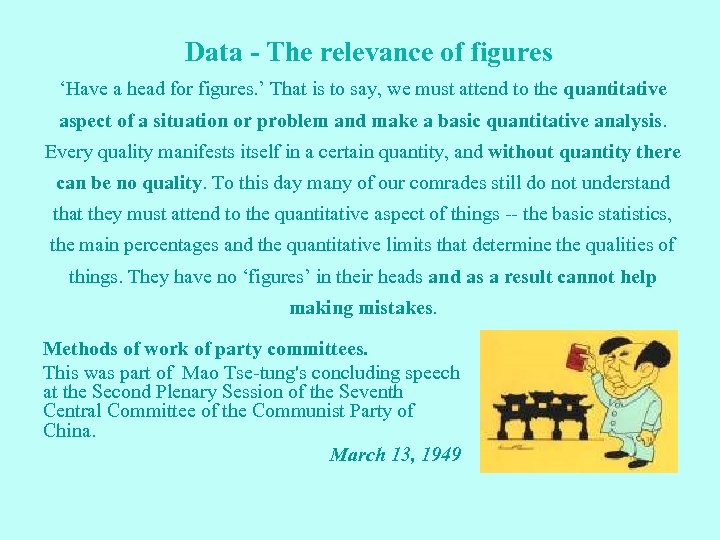
Data - The relevance of figures ‘Have a head for figures. ’ That is to say, we must attend to the quantitative aspect of a situation or problem and make a basic quantitative analysis Every quality manifests itself in a certain quantity, and without quantity there can be no quality. To this day many of our comrades still do not understand quality that they must attend to the quantitative aspect of things -- the basic statistics, the main percentages and the quantitative limits that determine the qualities of things. They have no ‘figures’ in their heads and as a result cannot help making mistakes Methods of work of party committees. This was part of Mao Tse-tung's concluding speech at the Second Plenary Session of the Seventh Central Committee of the Communist Party of China. March 13, 1949
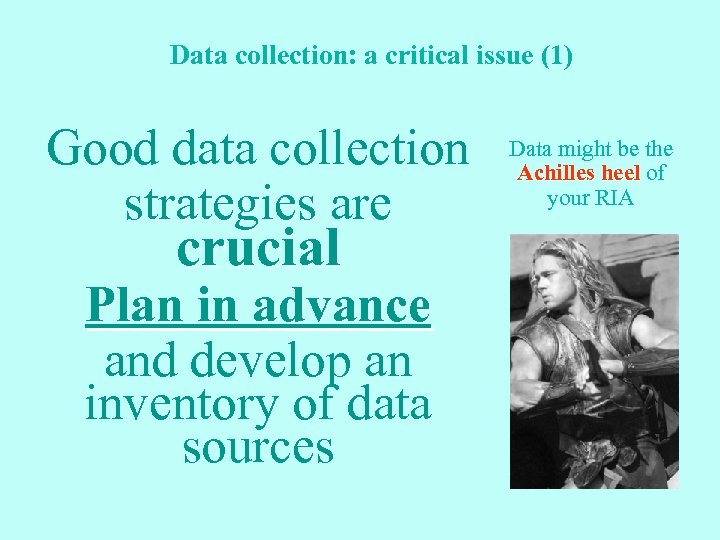
Data collection: a critical issue (1) Good data collection strategies are crucial Plan in advance and develop an inventory of data sources Data might be the Achilles heel of your RIA
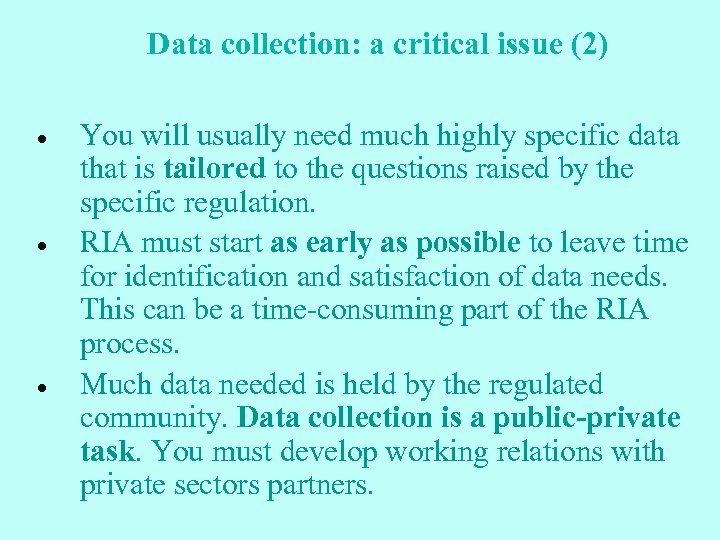
Data collection: a critical issue (2) · · · You will usually need much highly specific data that is tailored to the questions raised by the specific regulation. RIA must start as early as possible to leave time for identification and satisfaction of data needs. This can be a time-consuming part of the RIA process. Much data needed is held by the regulated community. Data collection is a public-private task. You must develop working relations with private sectors partners.
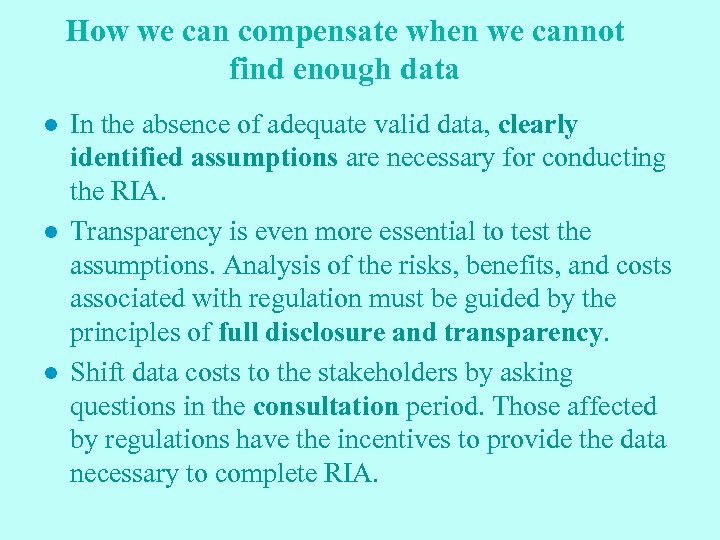
How we can compensate when we cannot find enough data l l l In the absence of adequate valid data, clearly identified assumptions are necessary for conducting the RIA. Transparency is even more essential to test the assumptions. Analysis of the risks, benefits, and costs associated with regulation must be guided by the principles of full disclosure and transparency. Shift data costs to the stakeholders by asking questions in the consultation period. Those affected by regulations have the incentives to provide the data necessary to complete RIA.
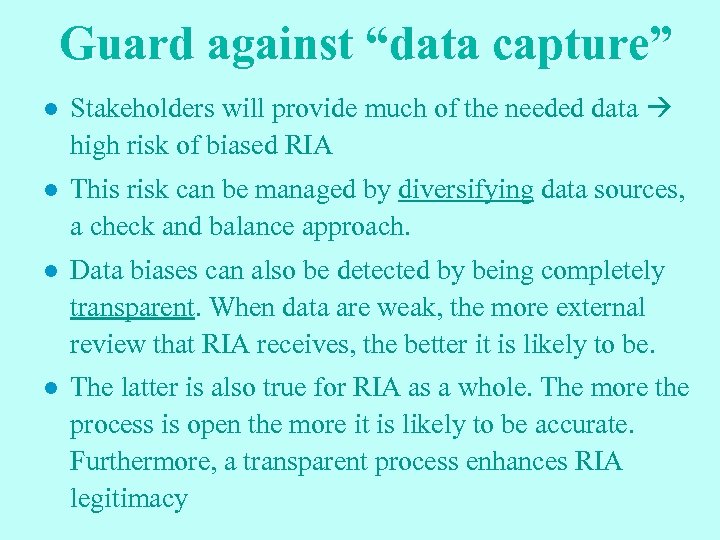
Guard against “data capture” l Stakeholders will provide much of the needed data high risk of biased RIA l This risk can be managed by diversifying data sources, a check and balance approach. l Data biases can also be detected by being completely transparent. When data are weak, the more external review that RIA receives, the better it is likely to be. l The latter is also true for RIA as a whole. The more the process is open the more it is likely to be accurate. Furthermore, a transparent process enhances RIA legitimacy
Two important points to take into account l Stakeholders are probably not accustomed to support their requests with data and figures It is necessary to define as soon as possible clear rule of the game. l The analysis of data influences the composition of the RIA team: the role of statisticians is essential in finding, selecting, and validating data and data sources. This could require organizational consequences (the role of the statistical office during RIA is fundamental)
Planning key points l Starting early and with proper resourcing l Planning ahead every phase (deadline, consultation, etc…) l Setting clear objectives l Identify options, including alternatives
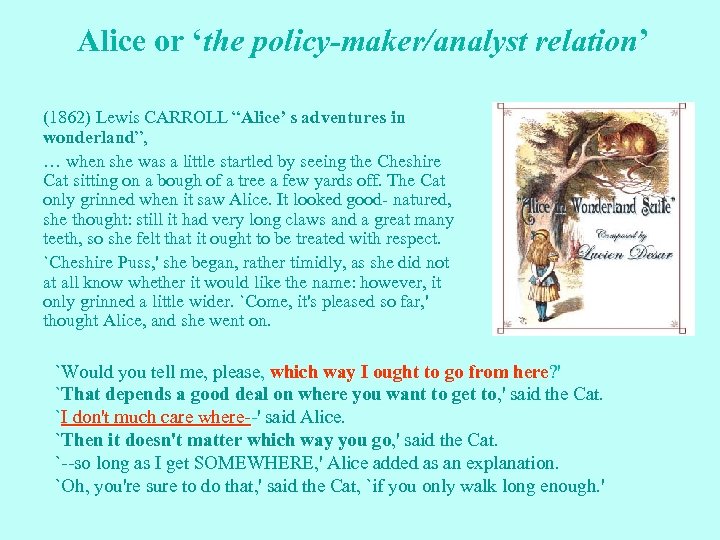
Alice or ‘the policy-maker/analyst relation’ (1862) Lewis CARROLL “Alice’ s adventures in wonderland”, wonderland … when she was a little startled by seeing the Cheshire Cat sitting on a bough of a tree a few yards off. The Cat only grinned when it saw Alice. It looked good- natured, she thought: still it had very long claws and a great many teeth, so she felt that it ought to be treated with respect. `Cheshire Puss, ' she began, rather timidly, as she did not at all know whether it would like the name: however, it only grinned a little wider. `Come, it's pleased so far, ' thought Alice, and she went on. `Would you tell me, please, which way I ought to go from here? ' here `That depends a good deal on where you want to get to, ' said the Cat. to `I don't much care where--' said Alice. where`Then it doesn't matter which way you go, ' said the Cat. go `--so long as I get SOMEWHERE, ' Alice added as an explanation. `Oh, you're sure to do that, ' said the Cat, `if you only walk long enough. '
Planning pitfalls l Starting when policy decision already taken l Fuzzy objectives (reduces options) l Inadequate time or planning l Failure fully to assess impacts on market/stakeholders In any case, at least l Use appropriate expertise to assess all relevant impacts l Quantify where possible l Acknowledge and reflect uncertainties in results
Improving RIA with RIE (Regulatory Impact ex post Evaluation) l The “next step” of a developed RIA system is to extend the approach from an ex ante assessment to an ex post evaluation, evaluation using similar methods l An ex post monitoring can relate to a “compliance analysis” system, which evaluates the level of “complance” of a regulation system l The role of failures (and of poor RIAs): learning from poor RIAs can be very useful. However, self-evaluations are not sufficient useful and often may not be objective enough. A more formal, independent and objective check should therefore be provided
Скачать презентацию Union principally financed by the EU A joint
d1547864d315b4fcc640abcee21e15f9.ppt