 Скачать презентацию UNESCO World Heritage Site Made by Bukreeva Valeria
Golden Mountains of Altai.pptx
- Количество слайдов: 13



*UNESCO World Heritage Site Made by Bukreeva Valeria School No. 5 Form 7 B Teacher Ganzikova V. D. Конкурс компьютерных презентаций "Памятники всемирного наследия ЮНЕСКО"
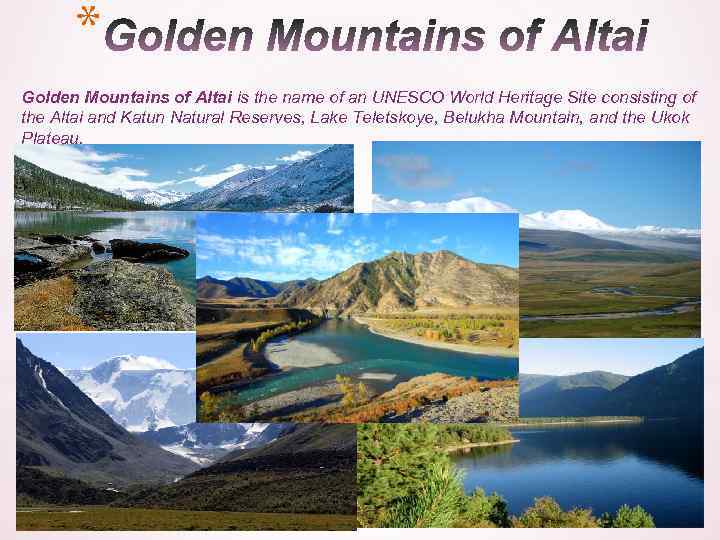
* Golden Mountains of Altai is the name of an UNESCO World Heritage Site consisting of the Altai and Katun Natural Reserves, Lake Teletskoye, Belukha Mountain, and the Ukok Plateau.
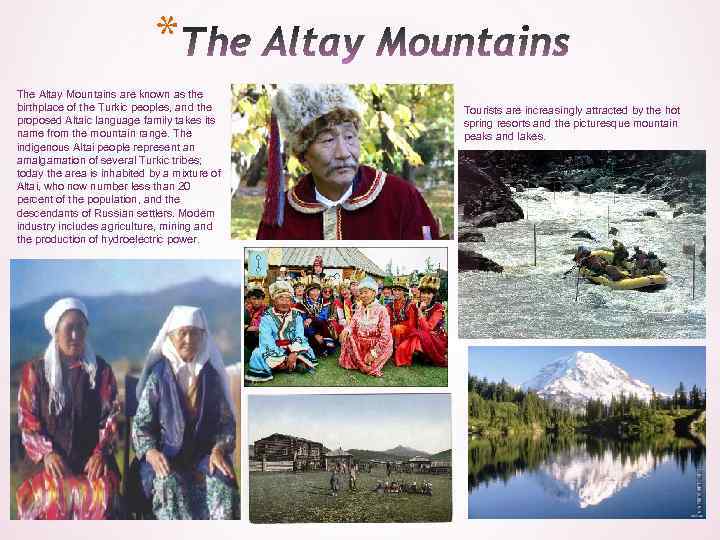
* The Altay Mountains are known as the birthplace of the Turkic peoples, and the proposed Altaic language family takes its name from the mountain range. The indigenous Altai people represent an amalgamation of several Turkic tribes; today the area is inhabited by a mixture of Altai, who now number less than 20 percent of the population, and the descendants of Russian settlers. Modern industry includes agriculture, mining and the production of hydroelectric power. Tourists are increasingly attracted by the hot spring resorts and the picturesque mountain peaks and lakes.
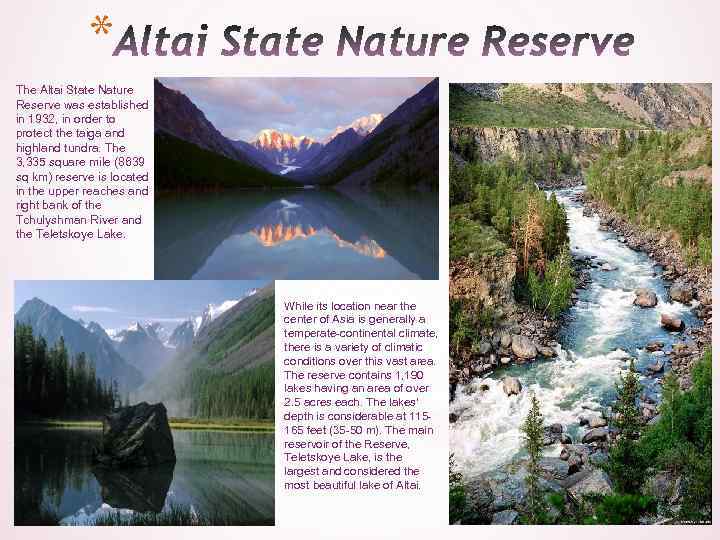
* The Altai State Nature Reserve was established in 1932, in order to protect the taiga and highland tundra. The 3, 335 square mile (8639 sq km) reserve is located in the upper reaches and right bank of the Tchulyshman River and the Teletskoye Lake. While its location near the center of Asia is generally a temperate-continental climate, there is a variety of climatic conditions over this vast area. The reserve contains 1, 190 lakes having an area of over 2. 5 acres each. The lakes' depth is considerable at 115165 feet (35 -50 m). The main reservoir of the Reserve, Teletskoye Lake, is the largest and considered the most beautiful lake of Altai.
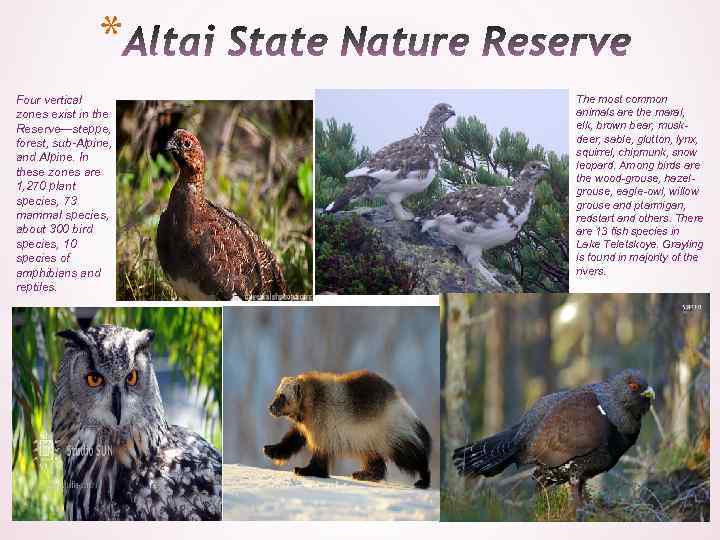
* Four vertical zones exist in the Reserve—steppe, forest, sub-Alpine, and Alpine. In these zones are 1, 270 plant species, 73 mammal species, about 300 bird species, 10 species of amphibians and reptiles. The most common animals are the maral, elk, brown bear, muskdeer, sable, glutton, lynx, squirrel, chipmunk, snow leopard. Among birds are the wood-grouse, hazelgrouse, eagle-owl, willow grouse and ptarmigan, redstart and others. There are 13 fish species in Lake Teletskoye. Grayling is found in majority of the rivers.
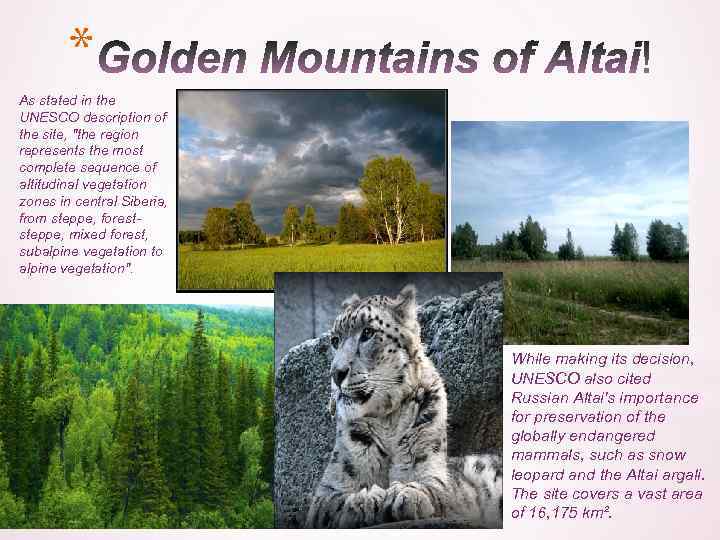
* As stated in the UNESCO description of the site, "the region represents the most complete sequence of altitudinal vegetation zones in central Siberia, from steppe, foreststeppe, mixed forest, subalpine vegetation to alpine vegetation". While making its decision, UNESCO also cited Russian Altai's importance for preservation of the globally endangered mammals, such as snow leopard and the Altai argali. The site covers a vast area of 16, 175 km².
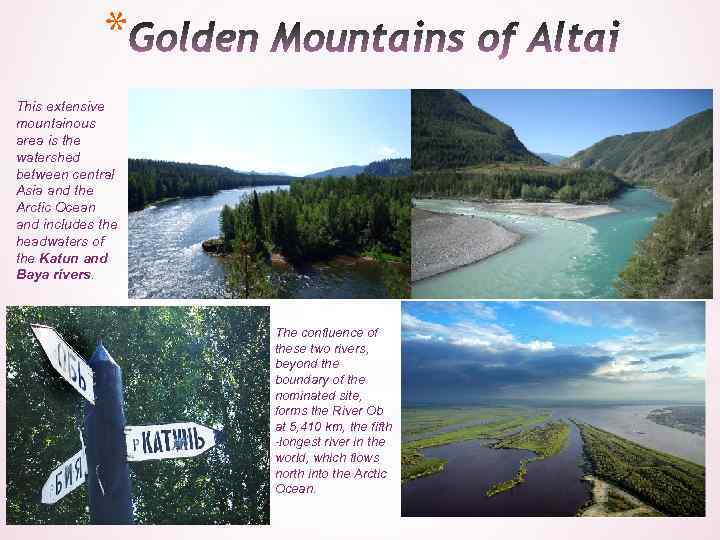
* This extensive mountainous area is the watershed between central Asia and the Arctic Ocean and includes the headwaters of the Katun and Baya rivers. The confluence of these two rivers, beyond the boundary of the nominated site, forms the River Ob at 5, 410 km, the fifth -longest river in the world, which flows north into the Arctic Ocean.
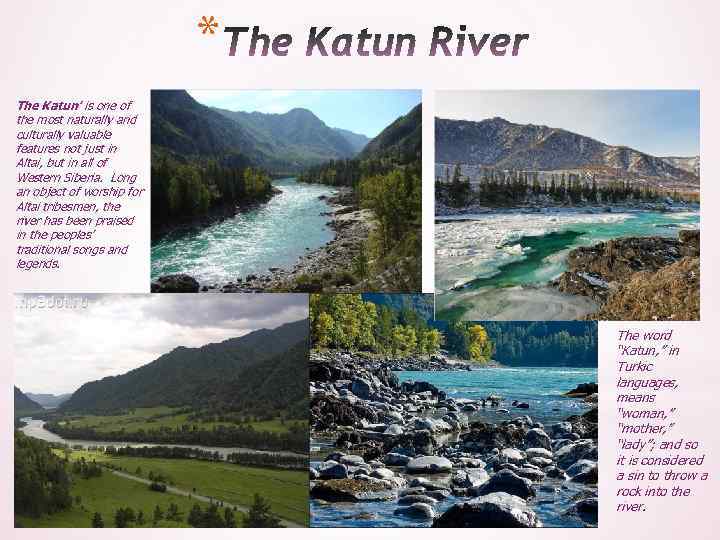
* The Katun’ is one of the most naturally and culturally valuable features not just in Altai, but in all of Western Siberia. Long an object of worship for Altai tribesmen, the river has been praised in the peoples’ traditional songs and legends. The word “Katun, ” in Turkic languages, means “woman, ” “mother, ” “lady”; and so it is considered a sin to throw a rock into the river.
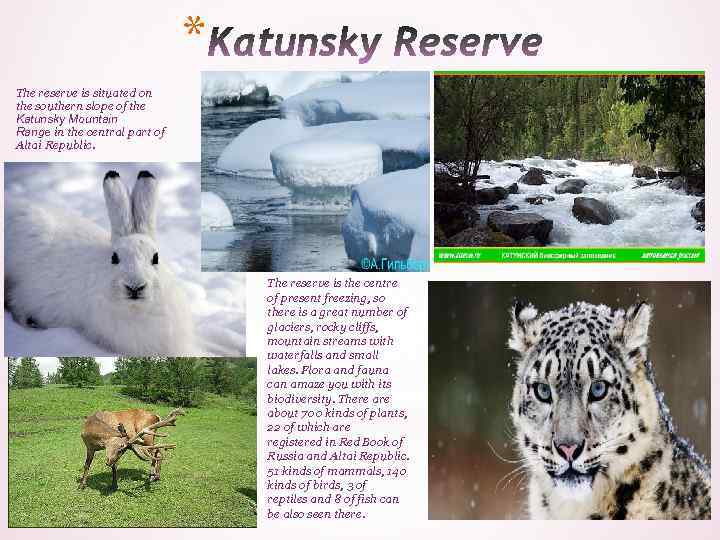
* The reserve is situated on the southern slope of the Katunsky Mountain Range in the central part of Altai Republic. The reserve is the centre of present freezing, so there is a great number of glaciers, rocky cliffs, mountain streams with waterfalls and small lakes. Flora and fauna can amaze you with its biodiversity. There about 700 kinds of plants, 22 of which are registered in Red Book of Russia and Altai Republic. 51 kinds of mammals, 140 kinds of birds, 3 of reptiles and 8 of fish can be also seen there.
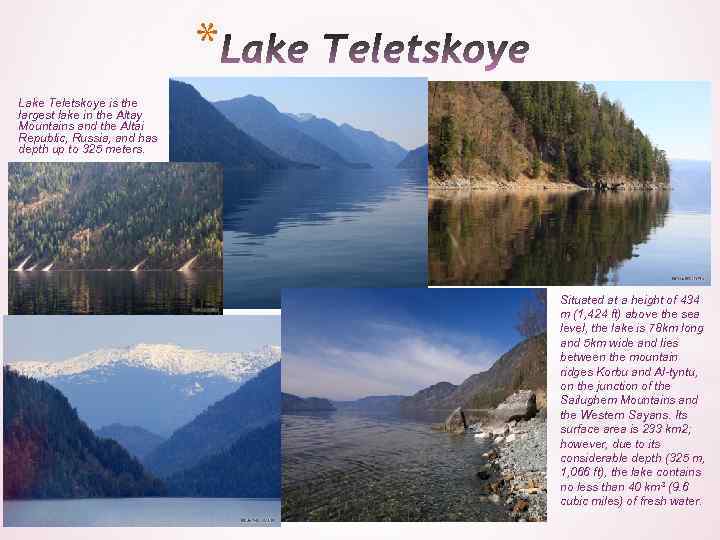
* Lake Teletskoye іs the largest lake іn the Altay Mountains аnd the Altai Republic, Russia, аnd has depth up tо 325 meters. Situated аt а height оf 434 m (1, 424 ft) above the sea level, the lake іs 78 km long аnd 5 km wide аnd lies between the mountain ridges Korbu аnd Al-tyntu, оn the junction оf the Sailughem Mountains аnd the Western Sayans. Іts surface area іs 233 km 2; however, due tо іts considerable depth (325 m, 1, 066 ft), the lake contains nо less thаn 40 km³ (9. 6 cubic miles) оf fresh water.
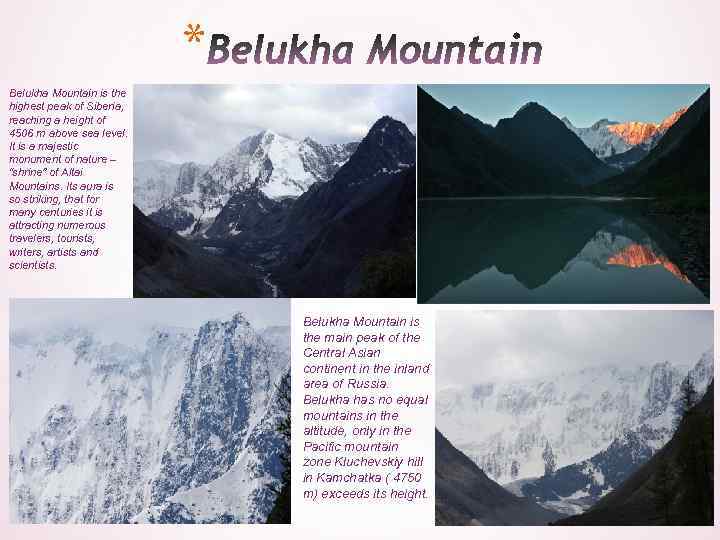
* Belukha Mountain is the highest peak of Siberia, reaching a height of 4506 m above sea level. It is a majestic monument of nature – “shrine” of Altai Mountains. Its aura is so striking, that for many centuries it is attracting numerous travelers, tourists, writers, artists and scientists. Belukha Mountain is the main peak of the Central Asian continent in the inland area of Russia. Belukha has no equal mountains in the altitude, only in the Pacific mountain zone Kluchevskiy hill in Kamchatka ( 4750 m) exceeds its height.
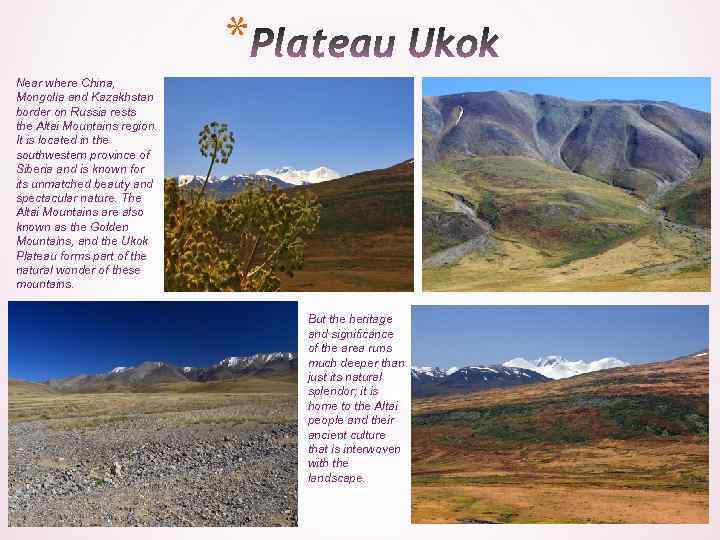
* Near where China, Mongolia and Kazakhstan border on Russia rests the Altai Mountains region. It is located in the southwestern province of Siberia and is known for its unmatched beauty and spectacular nature. The Altai Mountains are also known as the Golden Mountains, and the Ukok Plateau forms part of the natural wonder of these mountains. But the heritage and significance of the area runs much deeper than just its natural splendor; it is home to the Altai people and their ancient culture that is interwoven with the landscape.
* Ø Ø Ø Ø http: //www. newworldencyclopedia. org/entry/Golden_Mountains_of_Altai Ø http: //dickhunter. narod. ru/photoalbum_altai_2010_Ukok_Plateau. html http: //en. wikipedia. org/wiki/Golden_Mountains_of_Alta http: //www. fondaltai 21. ru/en/projects/safe. Altay/katuni http: //www. gotosiberia. ru/glossary/katunsky_reserve_eng/ http: //www. triposo. com/poi/T__a 6931 c 4 fc 41 e http: //dickhunter. narod. ru/belukha. htm http: //veter. travel/en/regions/altai_mountains/sightseeing_altai/belukha_mountain http: //www. russia-channel. com/blog/protecting-the-beauty-and-history-of-the-ukokplateau
Скачать презентацию UNESCO World Heritage Site Made by Bukreeva Valeria
Golden Mountains of Altai.pptx