


 Скачать презентацию Understanding the Principles of Counseling and Psychotherapy Chapter
4ef9afcb8fe5c09445d1459bd88fe748.ppt
- Количество слайдов: 24
 Understanding the Principles of Counseling and Psychotherapy Chapter 9
 Chapter 9 Overview Non-Linear Listening and Core Schemas Assessment and Schema Dynamics Therapeutic Alliance and Core Schema Dynamics Early Childhood Recollections The Formulations Working with Client Schemas
 Schema Dynamics and Psychological Disorders Cognitive Distortions –CBT practitioners look for these in clients thinking –Reflect rigid and unrealistic schema dynamics –Understanding the schema dynamics can help address the distorted thinking
 Cognitive Distortions Selective Abstraction Overgeneralization Magnification Minimization Personalization Dichotomous Thinking Please turn to p. 204, “Information Box: Common Methods of Distorting Cognitions”
 Schema Dynamics and Axis I Disorders When cognitive distortions become problematic üSchema dynamics may be unrealistic üIndividuals aware that there is a problem üOld patterns not useful anymore üNon-linear thinking starts here
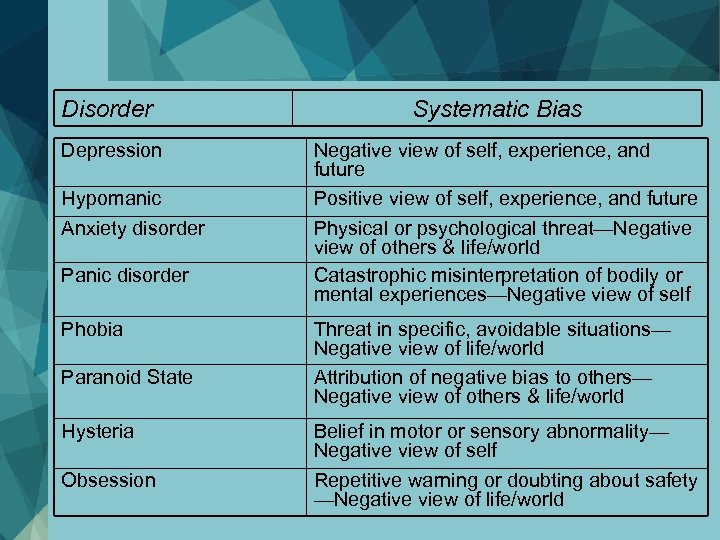 Disorder Depression Hypomanic Anxiety disorder Panic disorder Phobia Paranoid State Systematic Bias Negative view of self, experience, and future Positive view of self, experience, and future Physical or psychological threat—Negative view of others & life/world Catastrophic misinterpretation of bodily or mental experiences—Negative view of self Threat in specific, avoidable situations— Negative view of life/world Attribution of negative bias to others— Negative view of others & life/world Hysteria Belief in motor or sensory abnormality— Negative view of self Obsession Repetitive warning or doubting about safety —Negative view of life/world
 Please turn to p. 204“Clinical Case Example: A Drinker with “Bumps” in His Childhood”
 Schema Dynamics and Personality Disorders Definition –An enduring pattern –deviates markedly from the expectations of the culture –is inflexible and pervasive across a broad range of personal and social situations –lead to clinically significant distress or impairment In other words, personality disorders are simply disorders that arise from one’s schemas.
 Schema Dynamics and Personality Disorders Coded on Axis II Half of all Clients have a Personality Disorder Majority of Manuals focus on Axis II goes undiagnosed or “deferred” Why? Because practitioners are not taught the nonlinear thinking necessary to understand them!
 Please turn to p. 207 “Clinical Case Exercise: Anxious and Dependent”
 The “Narrative” of Client Schema Understanding “What makes a client tick. ” –Listen to client’s story and define the “plot” • Both Linear and Non-Linear Listening –Who are the main characters? • Hero and Villain –Contains recurring patterns • Themes provide meaning for client and help therapist make sense of behavior.
 Linear Listening and Client Schemas Linear Listening for Content What is the client saying about view of self, others, world Listen for “injunctions” Linear Listening for Feelings Shading and punctuating story Please turn to p. 185, Exercise 9. 1: Linear Listening for Schema
 Non-Linear Listening and Schemas “What if…” –Personal “domino theory” –Attempt to control and predict “If…, then…” –Logic behind the behavior –Non-linear listening provides clues –All flows to schema dynamics
 Formal Assessment and Schema Dynamics Readiness for Change Client Resources
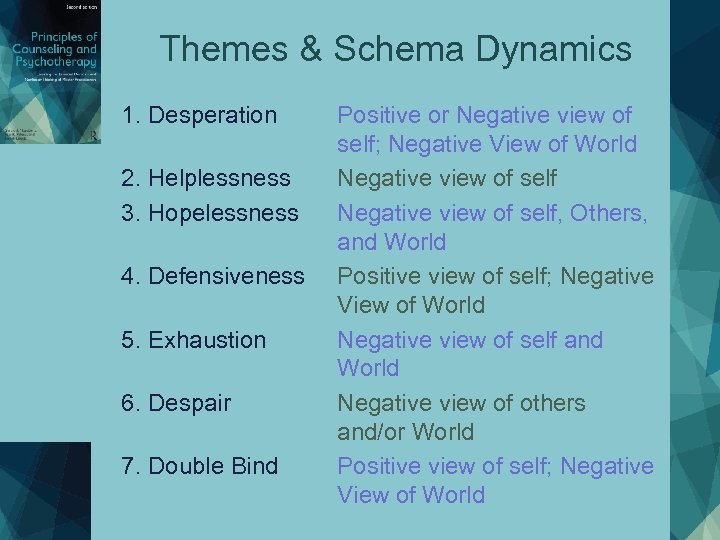 Themes & Schema Dynamics 1. Desperation 2. Helplessness 3. Hopelessness 4. Defensiveness 5. Exhaustion 6. Despair 7. Double Bind Positive or Negative view of self; Negative View of World Negative view of self, Others, and World Positive view of self; Negative View of World Negative view of self and World Negative view of others and/or World Positive view of self; Negative View of World
 Therapeutic Alliance and Schemas 1. Alliance is strengthened by therapist recognition of schema dynamics 2. Ruptures can bee deepened or repaired more quickly based on schema dynamics.
 Family-of-Origin and Schema Dynamics (View of Self/Others/World) all originate from Family-of-origin interactions. Sibling position (and relationships) play important roles. Please turn to p. 193, Clinical Exercise 9. 2
 Please turn to p. 216, and review “Clinical Case Example: An Unhappy Couple in Crisis”
 Early Childhood Memories Method for collecting data on schema dynamics Circumvents defensiveness by asking about childhood memories Obtaining several recollections will allow for patterns to be evident regarding view of self, others, and world
 The Formulation Puts the client’s story together 1. The Plot 2. The Characters 3. Their Motivation 4. The Narrative All by understanding schema dynamics See p. 219, Clinical Exercise: Working with ECRs to Determine Schema Dynamics
 Working with Client’s Schema Where does change fit in? Assimilation new experiences are interpreted in terms of a current framework or schema Accommodation psychological process of adjusting schema Remember Sherlock’s warning!!! Go back to Susan and Bob (p. 216)
 Non-Linear Methods of Working with Client Schema Please turn to p. 224, Clinical Case Example: Overly Sensitive
 Working with Client’s Schema Metaphor Non-Linear Describe complex issues with simple stories Helps clients see their schema dynamics differently Facilitate accommodation e. g. , House, M. D. Turn to p. 226, “Clinical Exercise: Imagination and Metaphor”
 THANK YOU. Any Questions?