


 Скачать презентацию Understanding reducing the resort to custody Evidence
4a3ac2affcf60b59eefb5b1c5be585fb.ppt
- Количество слайдов: 15
 Understanding & reducing the resort to custody: Evidence from 10 countries Dr Jessica Jacobson Catherine Heard Institute for Criminal Policy Research Sentencing & Penal Decision-Making European Group, Edinburgh conference 8 -9 June 2017
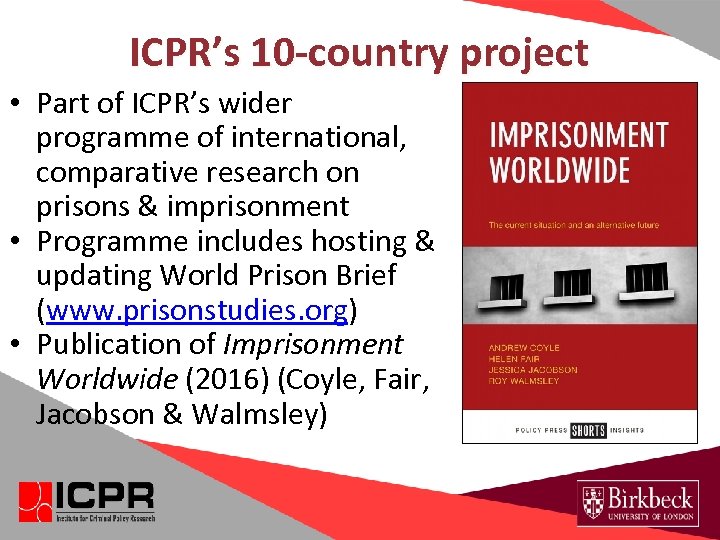 ICPR’s 10 -country project • Part of ICPR’s wider programme of international, comparative research on prisons & imprisonment • Programme includes hosting & updating World Prison Brief (www. prisonstudies. org) • Publication of Imprisonment Worldwide (2016) (Coyle, Fair, Jacobson & Walmsley)
 ICPR’s 10 -country project • Research & policy project • Focus on 10 contrasting jurisdictions • Entails: – Research & analysis: examine what drives use of imprisonment in the 10 jurisdictions – Policy development: devise & disseminate measures for reducing the resort to imprisonment (in the 10 jurisdictions & beyond) • Currently at early stages of research
 Global context of 10 -country project • 11 m+ prisoners worldwide • About 3 m of whom are in pretrial detention/remand. • About 2. 2 m are in US prisons • Vast disparities in prison pop. rates & trends • But rapid, unrelenting growth in imprisonment in much of the world in recent decades.
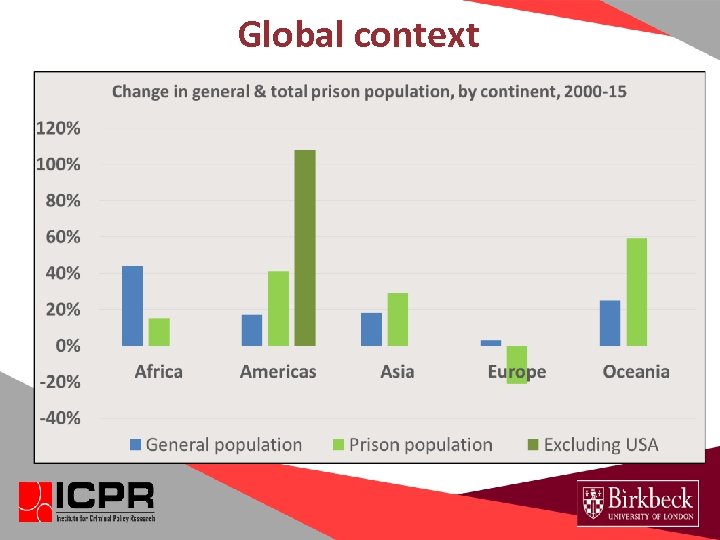 Global context
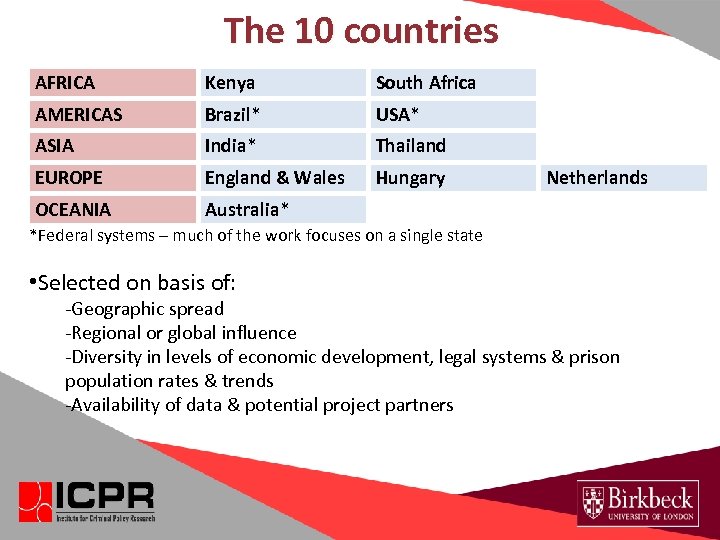 The 10 countries AFRICA Kenya South Africa AMERICAS Brazil* USA* ASIA India* Thailand EUROPE England & Wales Hungary OCEANIA Australia* Netherlands *Federal systems – much of the work focuses on a single state • Selected on basis of: -Geographic spread -Regional or global influence -Diversity in levels of economic development, legal systems & prison population rates & trends -Availability of data & potential project partners
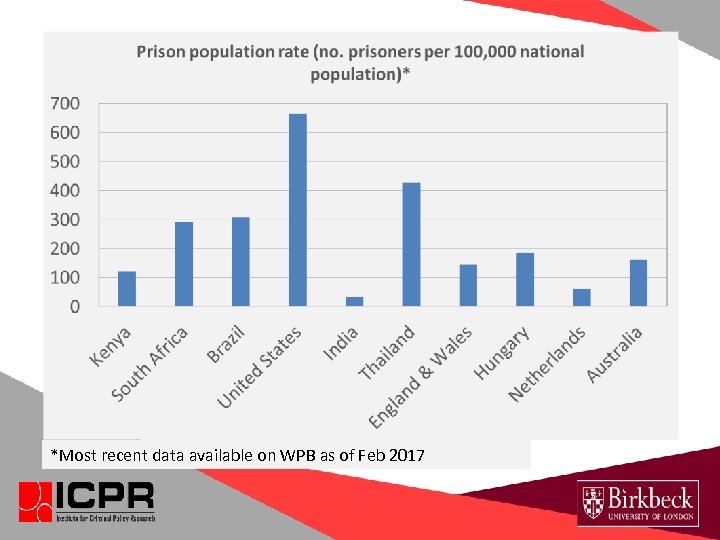 *Most recent data available on WPB as of Feb 2017
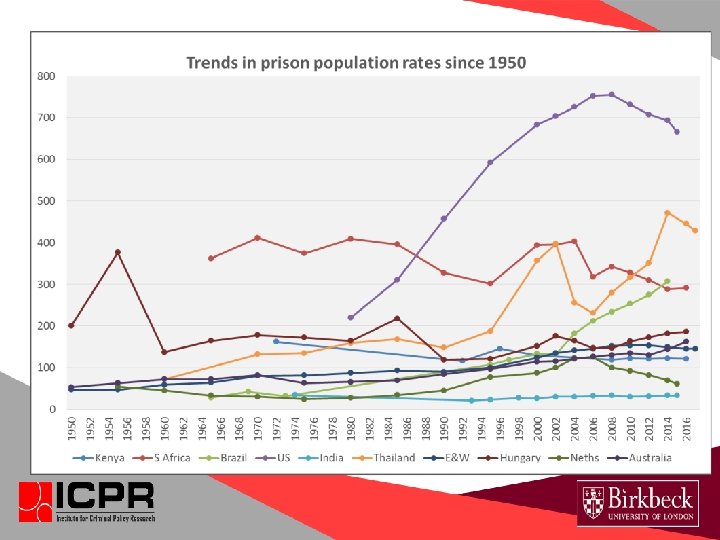
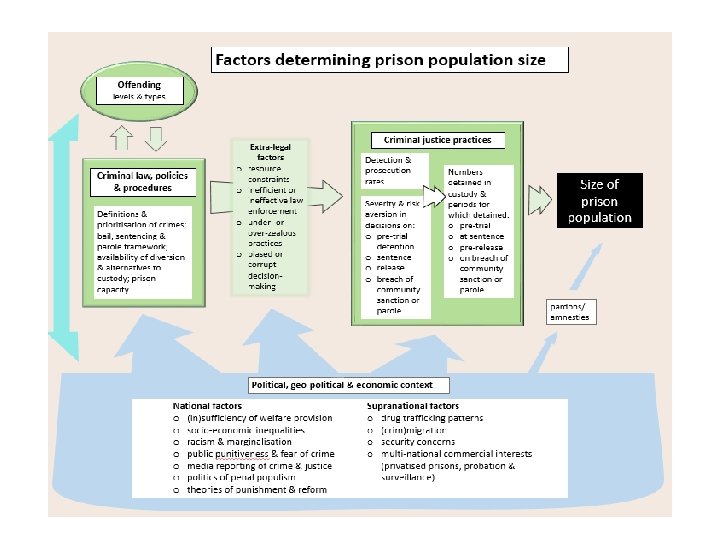
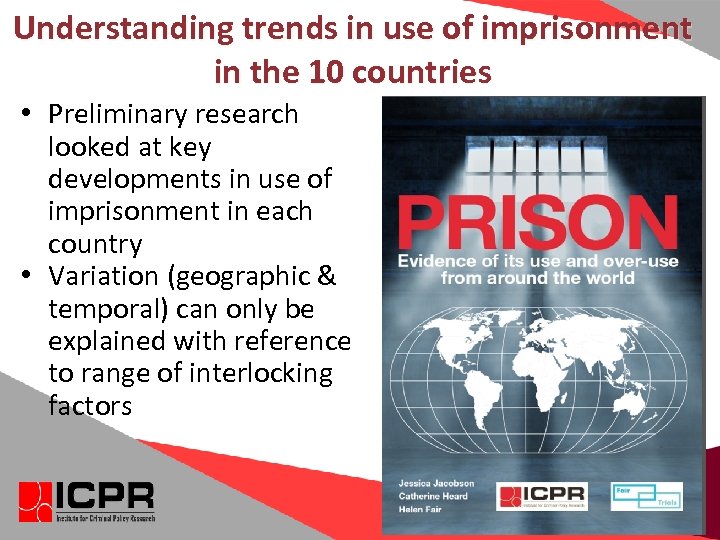 Understanding trends in use of imprisonment in the 10 countries • Preliminary research looked at key developments in use of imprisonment in each country • Variation (geographic & temporal) can only be explained with reference to range of interlocking factors
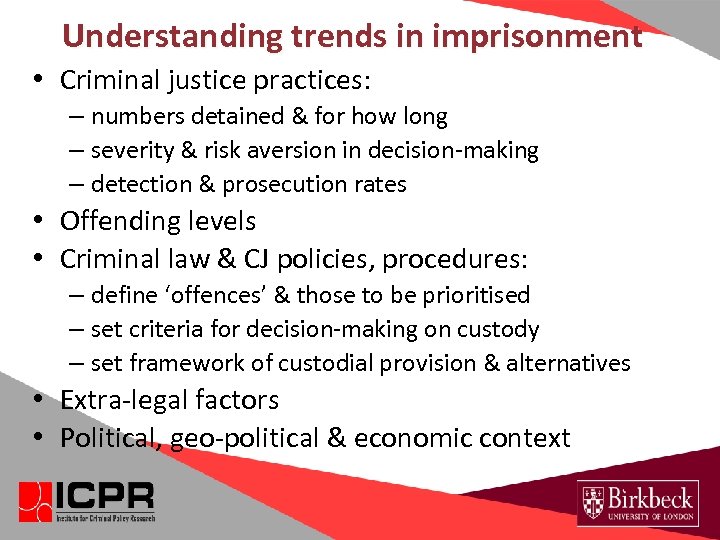 Understanding trends in imprisonment • Criminal justice practices: – numbers detained & for how long – severity & risk aversion in decision-making – detection & prosecution rates • Offending levels • Criminal law & CJ policies, procedures: – define ‘offences’ & those to be prioritised – set criteria for decision-making on custody – set framework of custodial provision & alternatives • Extra-legal factors • Political, geo-political & economic context
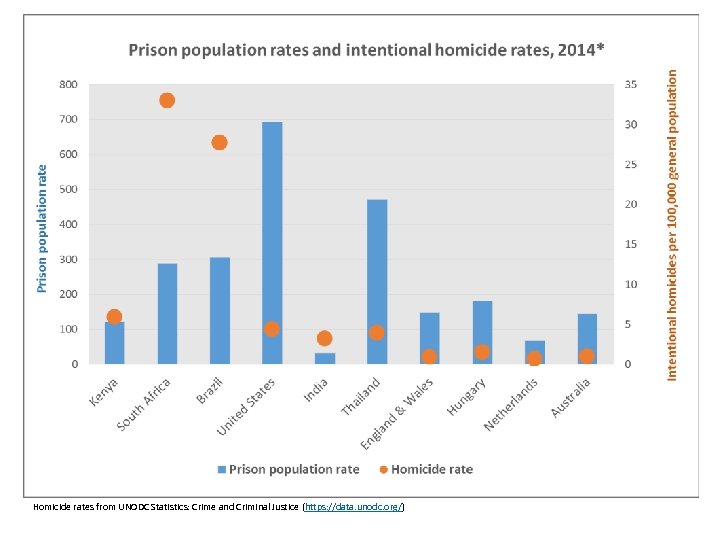 Homicide rates from UNODC Statistics: Crime and Criminal Justice (https: //data. unodc. org/)
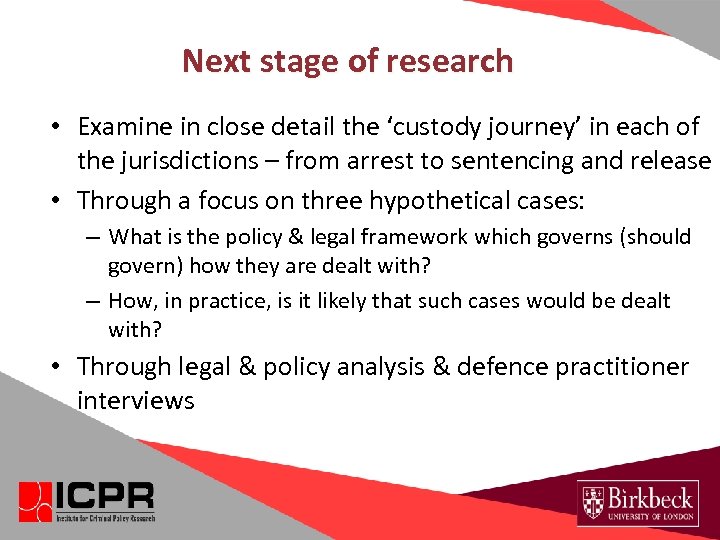 Next stage of research • Examine in close detail the ‘custody journey’ in each of the jurisdictions – from arrest to sentencing and release • Through a focus on three hypothetical cases: – What is the policy & legal framework which governs (should govern) how they are dealt with? – How, in practice, is it likely that such cases would be dealt with? • Through legal & policy analysis & defence practitioner interviews
 Three vignettes • A 32 -year-old man broke into a house in when the residents were at work, accessing the rear of the house via a back alley and breaking a window to gain entry. He stole jewellery and cash belonging to one of the residents, worth a total of approximately [x]. The offender has several prior convictions for the same type of offence, and other acquisitive offences. • A 26 -year-old woman was recruited in her home country of [x] to transport heroin in return for a cash payment. She had flown to [x] from her home country carrying the heroin in a hidden compartment in a money belt. The quantity of heroin was 400 grams, or a little under 1 lb. She had no prior convictions. • Two 23 -year-old friends, L and J, got into an argument while drinking together in a bar. Both left the scene, and L texted a mutual friend to say that he was going to kill J. The next morning, on leaving his home for work, J was confronted by L who had been waiting for him outside his property. L was armed with a knife, which he used to stab J fatally in the chest. He had no prior convictions.
 Catherine Heard c. heard@bbk. ac. uk Helen Fair h. fair@bbk. ac. uk Jessica Jacobson j. Jacobson@bbk. ac. uk Institute for Criminal Policy Research, Birkbeck, University of London http: //icpr. org. uk/ http: //www. prisonstudies. org/