 Скачать презентацию Understanding Poverty and Socio-economic Differences based on A
ab8809d549a9b36caa630ab212c03c6c.ppt
- Количество слайдов: 49



Understanding Poverty and Socio-economic Differences based on A Framework of Understanding Poverty by Dr. Ruby Payne Christ Presbyterian Church February 3 rd, 10 th, 17 th, 24 th, 2013
Introductions…. . Please tell us your name and share one of the following… Your occupation Where you grew up Something about your family Your New Year’s Resolution Or Something that probably no one in the room knows about you (except maybe your spouse)
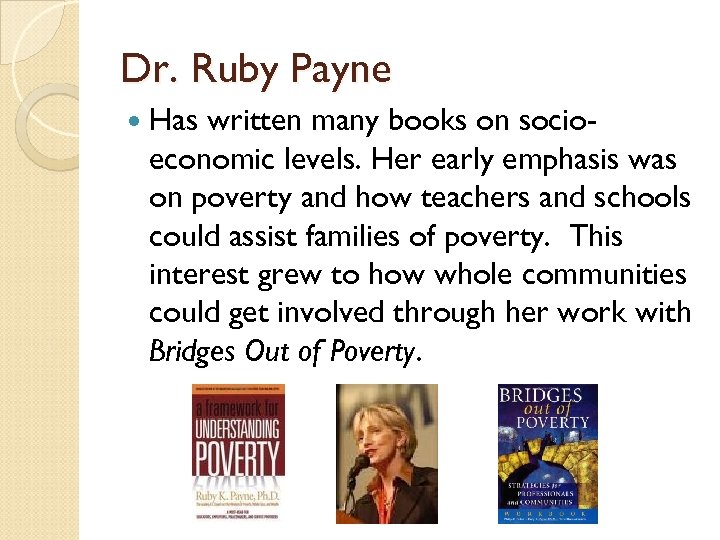
Dr. Ruby Payne Has written many books on socioeconomic levels. Her early emphasis was on poverty and how teachers and schools could assist families of poverty. This interest grew to how whole communities could get involved through her work with Bridges Out of Poverty.
Scripture tells us…. Deuteronomy 15: 7 -8 If there is a poor man among your brothers in any of the towns of the land that the LORD your God is giving you, do not be hardhearted or tightfisted toward your poor brother. Rather be openhanded and freely lend him whatever he needs. Proverbs 11: 24 -25 One man gives freely, yet gains even more; another withholds unduly, but comes to poverty. A generous man will prosper; he who refreshes others will himself be refreshed.
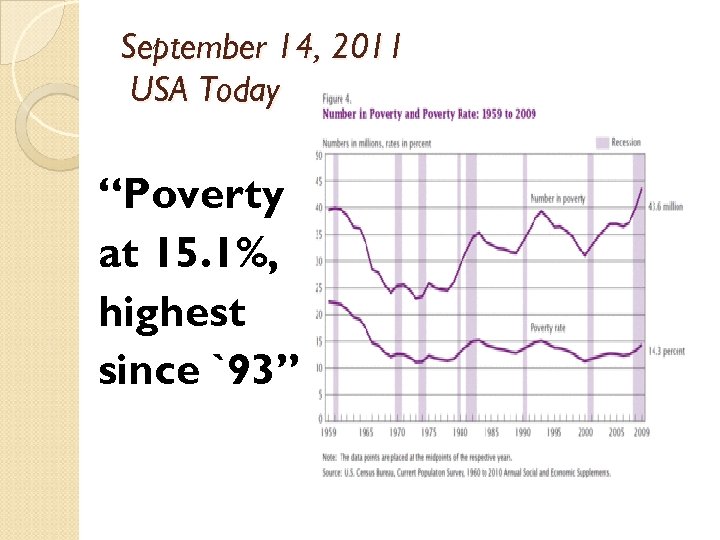
September 14, 2011 USA Today “Poverty at 15. 1%, highest since `93”
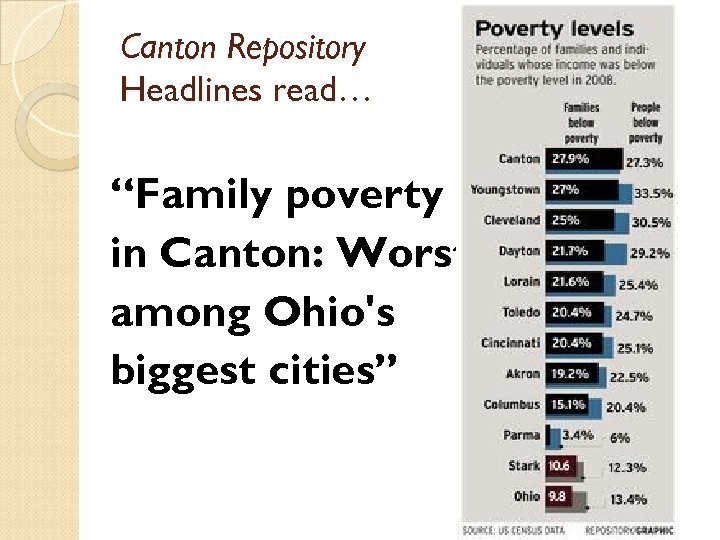
Canton Repository Headlines read… “Family poverty in Canton: Worst among Ohio's biggest cities”
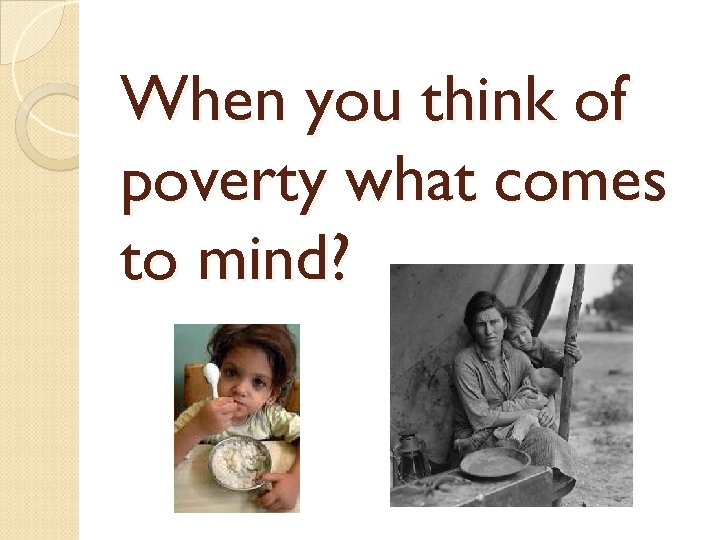
When you think of poverty what comes to mind?
Let’s brainstorm what poverty can lead to…think of words that begin with the letter “D”…
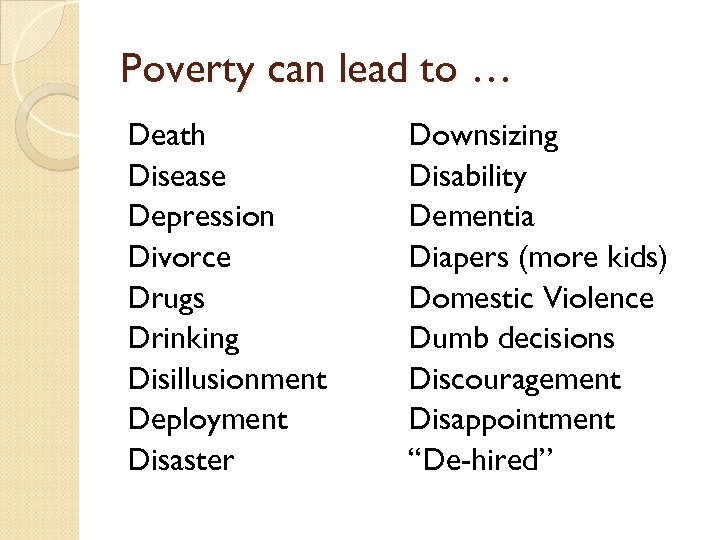
Poverty can lead to … Death Disease Depression Divorce Drugs Drinking Disillusionment Deployment Disaster Downsizing Disability Dementia Diapers (more kids) Domestic Violence Dumb decisions Discouragement Disappointment “De-hired”
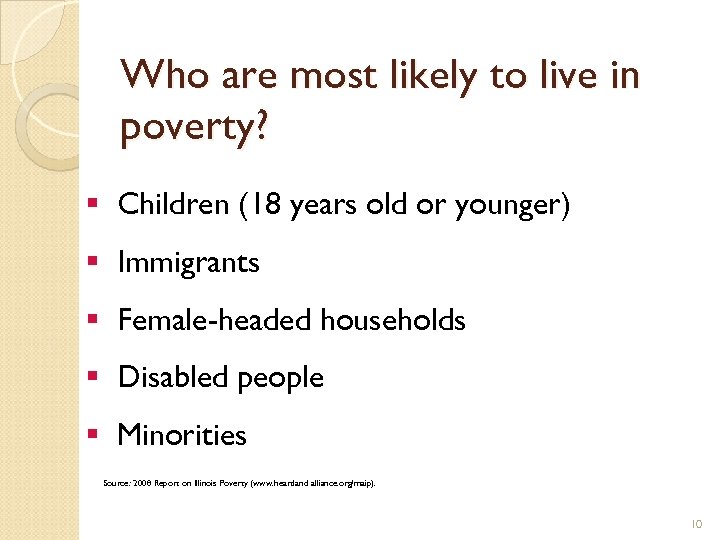
Who are most likely to live in poverty? § Children (18 years old or younger) § Immigrants § Female-headed households § Disabled people § Minorities Source: 2008 Report on Illinois Poverty (www. heartland alliance. org/maip). 10
To survive in poverty, one must rely upon non-verbal, sensory, and reactive skills. To survive in business and the school setting, one must use verbal, abstract, and proactive skills.
KEY POINTS Poverty is relative Poverty occurs in all races and ethnicities Generational and situational poverty are different Schools operate from middle class norms and values Individuals bring with them the hidden rules of class in which they are raised …Let’s find out of you’d survive in the different classes…
Can you survive…. . In Poverty? In Middle Class? In Wealth?
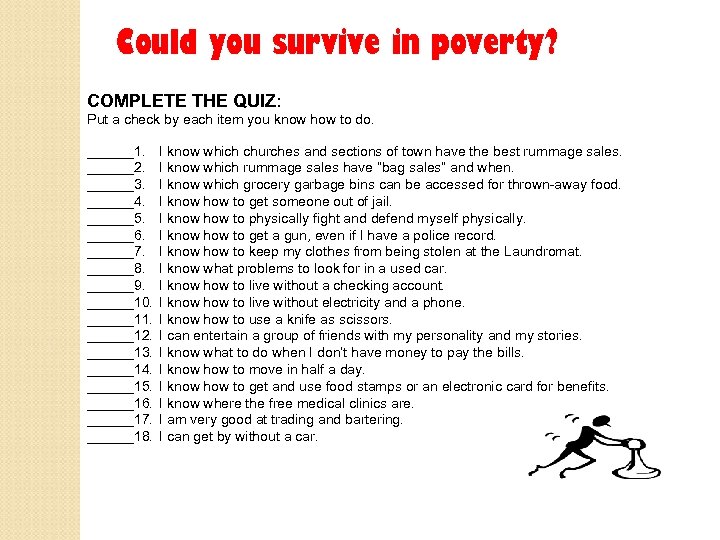
Could you survive in poverty? COMPLETE THE QUIZ: Put a check by each item you know how to do. ______1. ______2. ______3. ______4. ______5. ______6. ______7. ______8. ______9. ______10. ______11. ______12. ______13. ______14. ______15. ______16. ______17. ______18. I know which churches and sections of town have the best rummage sales. I know which rummage sales have “bag sales” and when. I know which grocery garbage bins can be accessed for thrown-away food. I know how to get someone out of jail. I know how to physically fight and defend myself physically. I know how to get a gun, even if I have a police record. I know how to keep my clothes from being stolen at the Laundromat. I know what problems to look for in a used car. I know how to live without a checking account. I know how to live without electricity and a phone. I know how to use a knife as scissors. I can entertain a group of friends with my personality and my stories. I know what to do when I don’t have money to pay the bills. I know how to move in half a day. I know how to get and use food stamps or an electronic card for benefits. I know where the free medical clinics are. I am very good at trading and bartering. I can get by without a car.
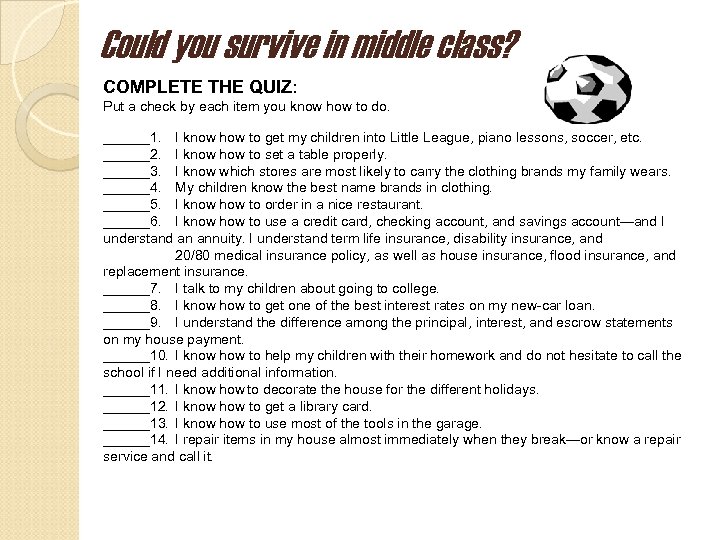
Could you survive in middle class? COMPLETE THE QUIZ: Put a check by each item you know how to do. ______1. I know how to get my children into Little League, piano lessons, soccer, etc. ______2. I know how to set a table properly. ______3. I know which stores are most likely to carry the clothing brands my family wears. ______4. My children know the best name brands in clothing. ______5. I know how to order in a nice restaurant. ______6. I know how to use a credit card, checking account, and savings account—and I understand an annuity. I understand term life insurance, disability insurance, and 20/80 medical insurance policy, as well as house insurance, flood insurance, and replacement insurance. ______7. I talk to my children about going to college. ______8. I know how to get one of the best interest rates on my new-car loan. ______9. I understand the difference among the principal, interest, and escrow statements on my house payment. ______10. I know how to help my children with their homework and do not hesitate to call the school if I need additional information. ______11. I know how to decorate the house for the different holidays. ______12. I know how to get a library card. ______13. I know how to use most of the tools in the garage. ______14. I repair items in my house almost immediately when they break—or know a repair service and call it.
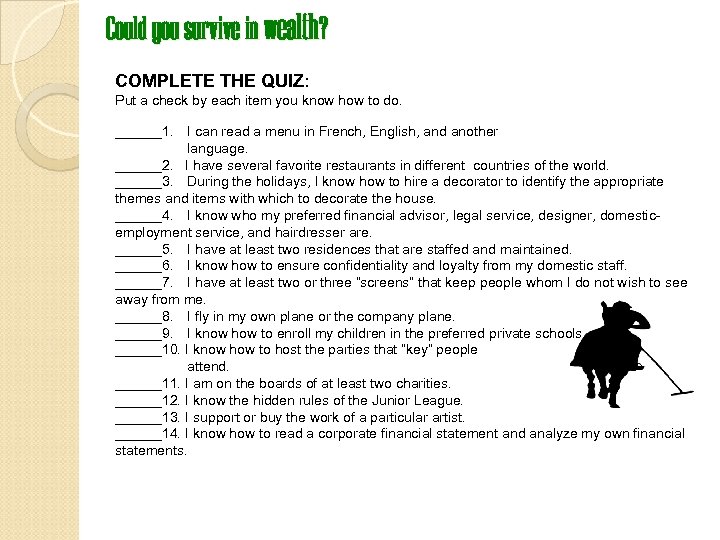
Could you survive in wealth? COMPLETE THE QUIZ: Put a check by each item you know how to do. ______1. I can read a menu in French, English, and another language. ______2. I have several favorite restaurants in different countries of the world. ______3. During the holidays, I know how to hire a decorator to identify the appropriate themes and items with which to decorate the house. ______4. I know who my preferred financial advisor, legal service, designer, domesticemployment service, and hairdresser are. ______5. I have at least two residences that are staffed and maintained. ______6. I know how to ensure confidentiality and loyalty from my domestic staff. ______7. I have at least two or three “screens” that keep people whom I do not wish to see away from me. ______8. I fly in my own plane or the company plane. ______9. I know how to enroll my children in the preferred private schools. ______10. I know how to host the parties that “key” people attend. ______11. I am on the boards of at least two charities. ______12. I know the hidden rules of the Junior League. ______13. I support or buy the work of a particular artist. ______14. I know how to read a corporate financial statement and analyze my own financial statements.
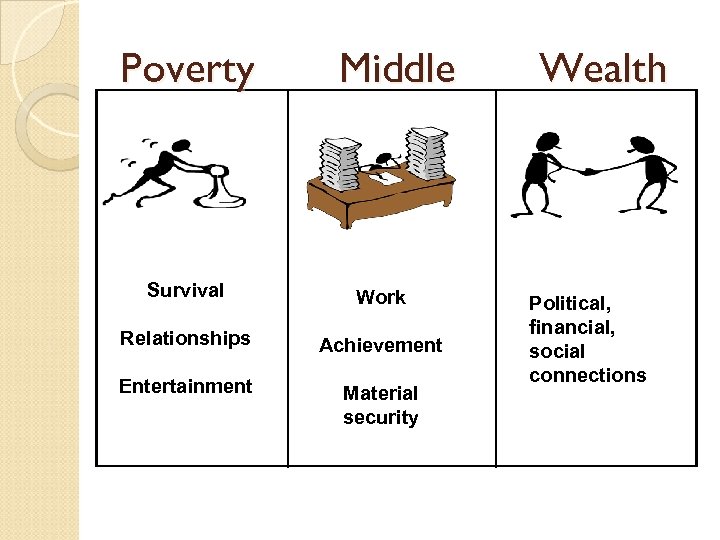
Poverty Middle Survival Work Relationships Achievement Entertainment Material security Wealth Political, financial, social connections
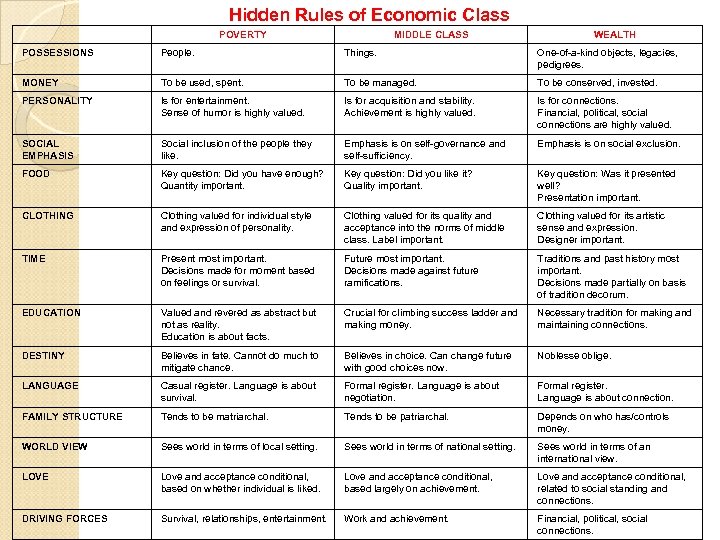
Hidden Rules of Economic Class POVERTY MIDDLE CLASS WEALTH POSSESSIONS People. Things. One-of-a-kind objects, legacies, pedigrees. MONEY To be used, spent. To be managed. To be conserved, invested. PERSONALITY Is for entertainment. Sense of humor is highly valued. Is for acquisition and stability. Achievement is highly valued. Is for connections. Financial, political, social connections are highly valued. SOCIAL EMPHASIS Social inclusion of the people they like. Emphasis is on self-governance and self-sufficiency. Emphasis is on social exclusion. FOOD Key question: Did you have enough? Quantity important. Key question: Did you like it? Quality important. Key question: Was it presented well? Presentation important. CLOTHING Clothing valued for individual style and expression of personality. Clothing valued for its quality and acceptance into the norms of middle class. Label important. Clothing valued for its artistic sense and expression. Designer important. TIME Present most important. Decisions made for moment based on feelings or survival. Future most important. Decisions made against future ramifications. Traditions and past history most important. Decisions made partially on basis of tradition decorum. EDUCATION Valued and revered as abstract but not as reality. Education is about facts. Crucial for climbing success ladder and making money. Necessary tradition for making and maintaining connections. DESTINY Believes in fate. Cannot do much to mitigate chance. Believes in choice. Can change future with good choices now. Noblesse oblige. LANGUAGE Casual register. Language is about survival. Formal register. Language is about negotiation. Formal register. Language is about connection. FAMILY STRUCTURE Tends to be matriarchal. Tends to be patriarchal. Depends on who has/controls money. WORLD VIEW Sees world in terms of local setting. Sees world in terms of national setting. Sees world in terms of an international view. LOVE Love and acceptance conditional, based on whether individual is liked. Love and acceptance conditional, based largely on achievement. Love and acceptance conditional, related to social standing and connections. DRIVING FORCES Survival, relationships, entertainment. Work and achievement. Financial, political, social connections.
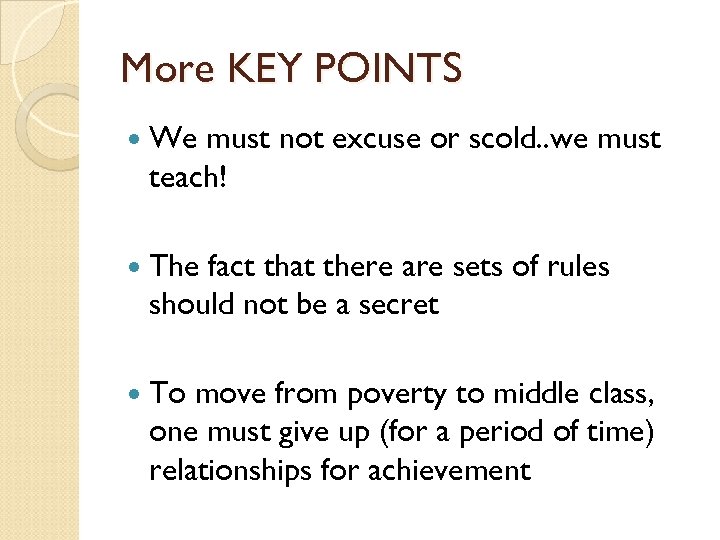
More KEY POINTS We must not excuse or scold. . we must teach! The fact that there are sets of rules should not be a secret To move from poverty to middle class, one must give up (for a period of time) relationships for achievement
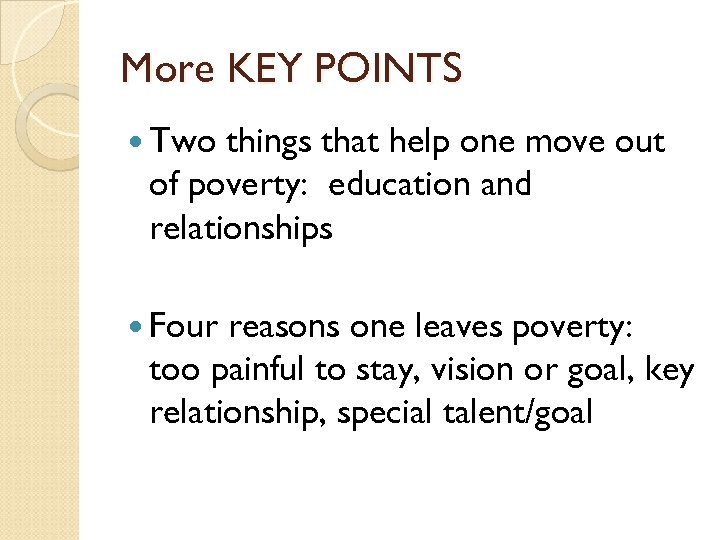
More KEY POINTS Two things that help one move out of poverty: education and relationships Four reasons one leaves poverty: too painful to stay, vision or goal, key relationship, special talent/goal
No significant learning occurs without a significant relationship. " " –Dr. James Comer
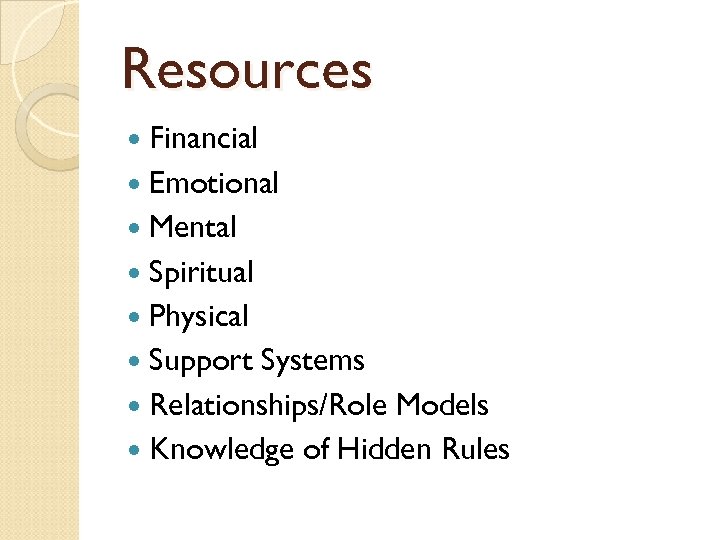
Resources Financial Emotional Mental Spiritual Physical Support Systems Relationships/Role Models Knowledge of Hidden Rules
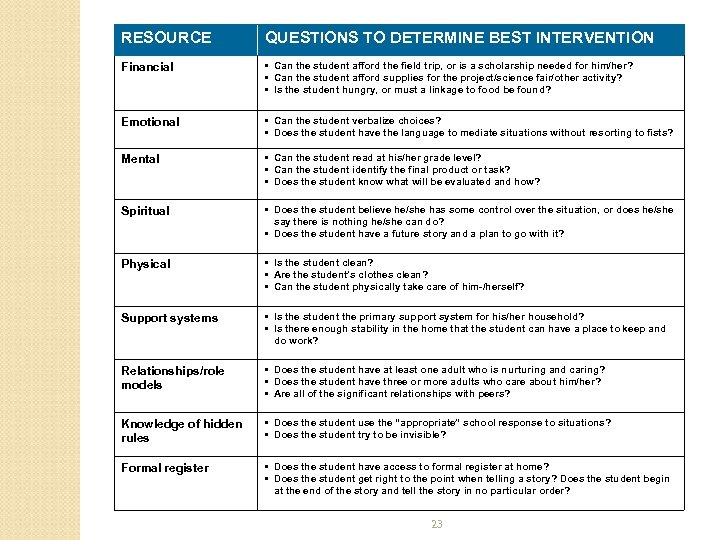
RESOURCE QUESTIONS TO DETERMINE BEST INTERVENTION Financial • Can the student afford the field trip, or is a scholarship needed for him/her? • Can the student afford supplies for the project/science fair/other activity? • Is the student hungry, or must a linkage to food be found? Emotional • Can the student verbalize choices? • Does the student have the language to mediate situations without resorting to fists? Mental • Can the student read at his/her grade level? • Can the student identify the final product or task? • Does the student know what will be evaluated and how? Spiritual • Does the student believe he/she has some control over the situation, or does he/she say there is nothing he/she can do? • Does the student have a future story and a plan to go with it? Physical • Is the student clean? • Are the student’s clothes clean? • Can the student physically take care of him-/herself? Support systems • Is the student the primary support system for his/her household? • Is there enough stability in the home that the student can have a place to keep and do work? Relationships/role models • Does the student have at least one adult who is nurturing and caring? • Does the student have three or more adults who care about him/her? • Are all of the significant relationships with peers? Knowledge of hidden rules • Does the student use the “appropriate” school response to situations? • Does the student try to be invisible? Formal register • Does the student have access to formal register at home? • Does the student get right to the point when telling a story? Does the student begin at the end of the story and tell the story in no particular order? 23
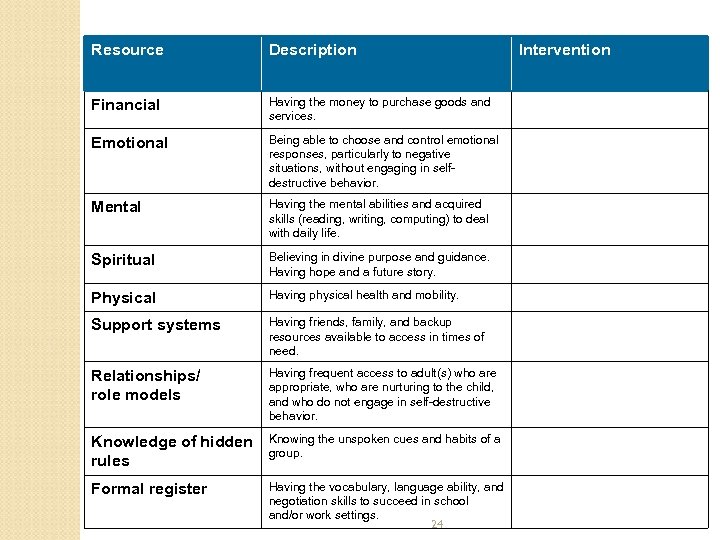
Resource Description Financial Having the money to purchase goods and services. Emotional Being able to choose and control emotional responses, particularly to negative situations, without engaging in selfdestructive behavior. Mental Having the mental abilities and acquired skills (reading, writing, computing) to deal with daily life. Spiritual Believing in divine purpose and guidance. Having hope and a future story. Physical Having physical health and mobility. Support systems Having friends, family, and backup resources available to access in times of need. Relationships/ role models Having frequent access to adult(s) who are appropriate, who are nurturing to the child, and who do not engage in self-destructive behavior. Knowledge of hidden rules Knowing the unspoken cues and habits of a group. Formal register Having the vocabulary, language ability, and negotiation skills to succeed in school and/or work settings. 24 Intervention
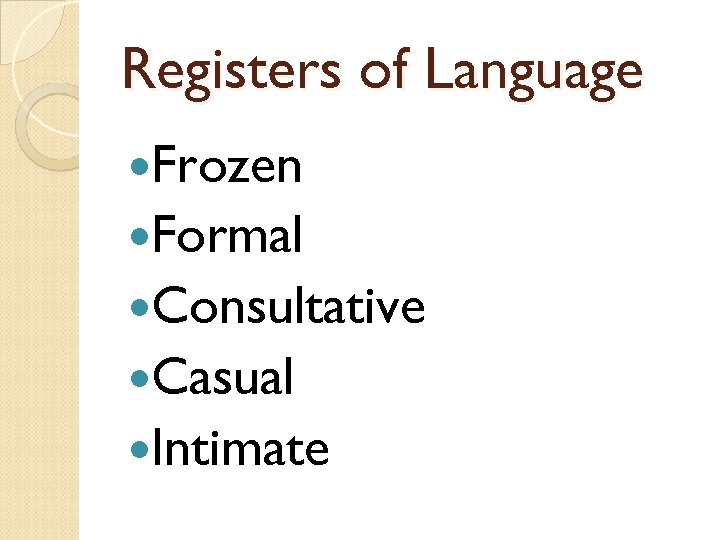
Registers of Language Frozen Formal Consultative Casual Intimate
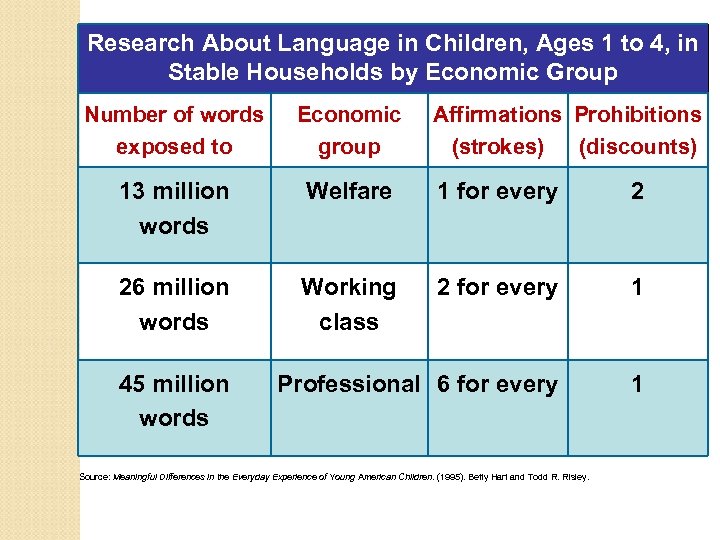
Research About Language in Children, Ages 1 to 4, in Stable Households by Economic Group Number of words exposed to Economic group 13 million words Welfare 1 for every 2 26 million words Working class 2 for every 1 Professional 6 for every 1 45 million words Affirmations Prohibitions (strokes) (discounts) Source: Meaningful Differences in the Everyday Experience of Young American Children. (1995). Betty Hart and Todd R. Risley. 26
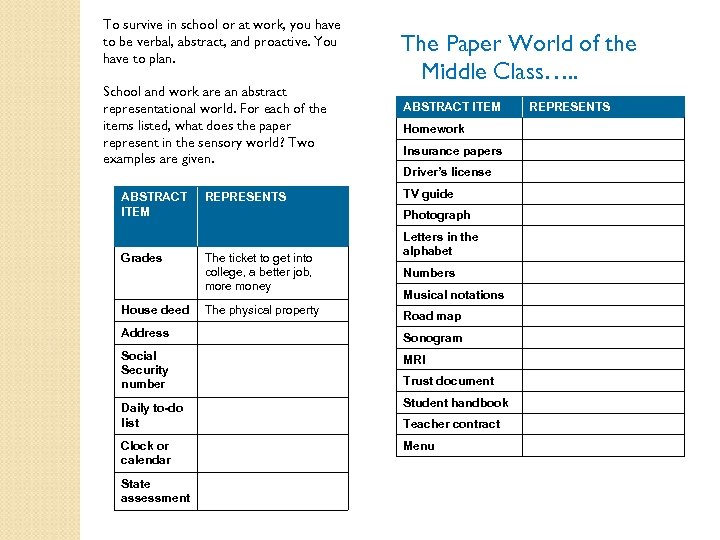
To survive in school or at work, you have to be verbal, abstract, and proactive. You have to plan. School and work are an abstract representational world. For each of the items listed, what does the paper represent in the sensory world? Two examples are given. ABSTRACT ITEM Grades House deed REPRESENTS The Paper World of the Middle Class…. . The Paper ITEM REPRESENTS ABSTRACTWorld of Middle Homework Class Insurance papers Driver’s license TV guide Photograph The ticket to get into college, a better job, more money The physical property Letters in the alphabet Numbers Musical notations Road map Address Sonogram Social Security number MRI Daily to-do list Student handbook Clock or calendar Menu Trust document Teacher contract State assessment 27
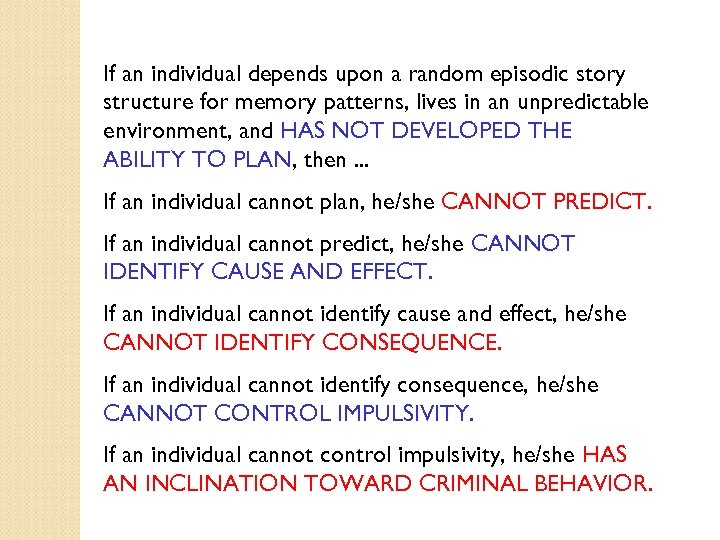
If an individual depends upon a random episodic story structure for memory patterns, lives in an unpredictable environment, and HAS NOT DEVELOPED THE ABILITY TO PLAN, then. . . If an individual cannot plan, he/she CANNOT PREDICT. If an individual cannot predict, he/she CANNOT IDENTIFY CAUSE AND EFFECT. If an individual cannot identify cause and effect, he/she CANNOT IDENTIFY CONSEQUENCE. If an individual cannot identify consequence, he/she CANNOT CONTROL IMPULSIVITY. If an individual cannot control impulsivity, he/she HAS AN INCLINATION TOWARD CRIMINAL BEHAVIOR. 28
§ Poverty is a concrete, sensory, reactive world. § School is verbal, abstract representational, and proactive. § Without language, one lacks the tools necessary to negotiate and manipulate his/her position in the world. 29
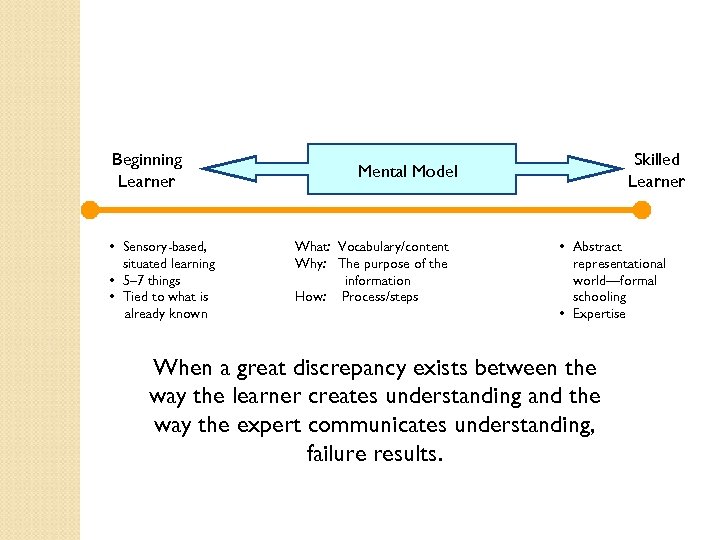
What Are Mental Models? Beginning Learner • Sensory-based, situated learning • 5– 7 things • Tied to what is already known Skilled Learner Mental Model What: Vocabulary/content Why: The purpose of the information How: Process/steps • Abstract representational world—formal schooling • Expertise When a great discrepancy exists between the way the learner creates understanding and the way the expert communicates understanding, failure results. 30
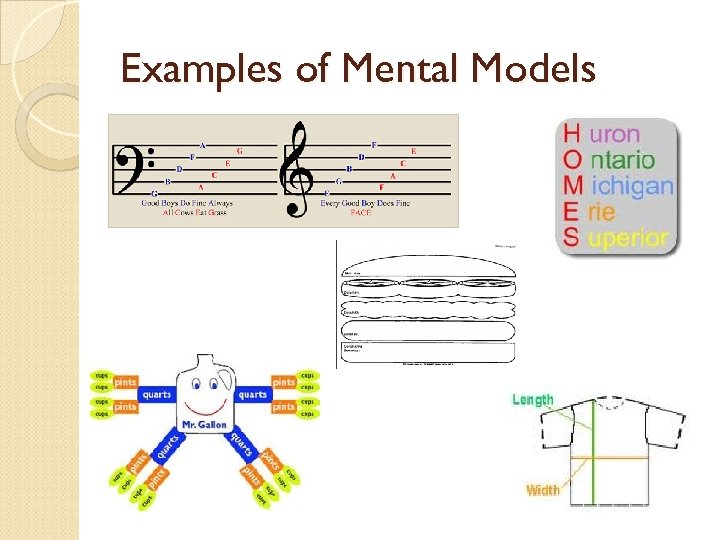
Examples of Mental Models
Tammy’s Story As you watch this clip think of the hidden rules of poverty, the resources that Tammy and her family have or don’t have, the registers of language, and the local resources from which they might benefit.
Debriefing…. What was your overall “feeling” about what you saw? Did Tammy want for her family what others in “middle class” want for theirs? What did Matt want for his life? What resources did Tammy and her family have? What resources did they not have? What can you take away from this?
Stark County, Ohio has… 6 Universities 17 Malone University of Mount Union Walsh University Kent State/Stark Ashland University/Branch Stark State (2 year Tech) School districts (60, 017 students) 12 locals 5 cities Numerous private and charter schools
Community Resources Countless local resources with the number of universities Strong business and organizational interest in the education of our youth Dedicated foundational support (Stark Community Foundation, Deuble Foundation, David Foundation, Timken Foundation, Hoover Foundation, Sisters of Charity) Concentrated geographic area
Community Needs Networking – knowing what different agencies and institutions are doing and what their goals are Connectivity – finding ways to collaborate as not to duplicate services Capitalizing on the culture of the whole community… knowing strengths of different areas and how to utilize them Educate the community on understanding the issues of poverty
Teacher preparation program partnerships – college and local school districts Student teaching Field experience College/university visits by high school students Local tutoring Volunteerism
Grants…federal, state, and local…. Improving Teacher Quality Grant National Professional Development Grant State Department Grants Locally funded Grants - ARTSin. STARK
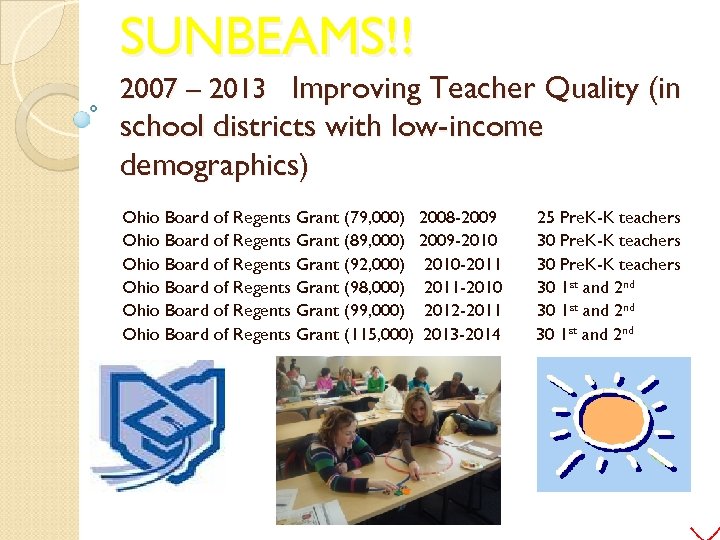
SUNBEAMS!! 2007 – 2013 Improving Teacher Quality (in school districts with low-income demographics) Ohio Board of Regents Grant (79, 000) Ohio Board of Regents Grant (89, 000) Ohio Board of Regents Grant (92, 000) Ohio Board of Regents Grant (98, 000) Ohio Board of Regents Grant (99, 000) Ohio Board of Regents Grant (115, 000) 2008 -2009 -2010 -2011 -2010 2012 -2011 2013 -2014 25 Pre. K-K teachers 30 1 st and 2 nd 30 1 st and 2 nd
National Professional Development Grant – Project ACHIEVE Partnership of two area universities and six city and county school districts Two million dollar, five year project Project ACHIEVE Access to Curriculum and High Quality Instruction for Educators Valuing English Language Learners
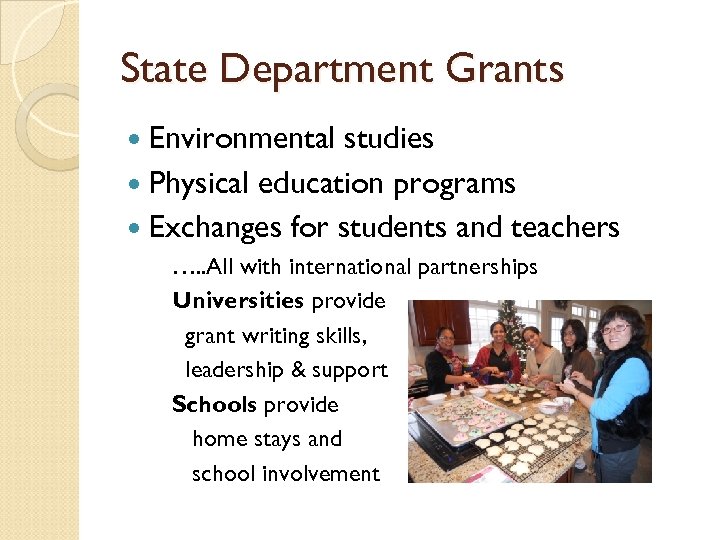
State Department Grants Environmental studies Physical education programs Exchanges for students and teachers …. . All with international partnerships Universities provide grant writing skills, leadership & support Schools provide home stays and school involvement
Local grant support and professional development combined… Literacy Celebrations from 2006 to 2013 * Bring in children’s book authors and/or illustrators to share their work * Invite area educators (teachers, librarians, art teachers, etc. ) to participate * Get local grant support to sponsor local school activities based on the work of the guest presenter
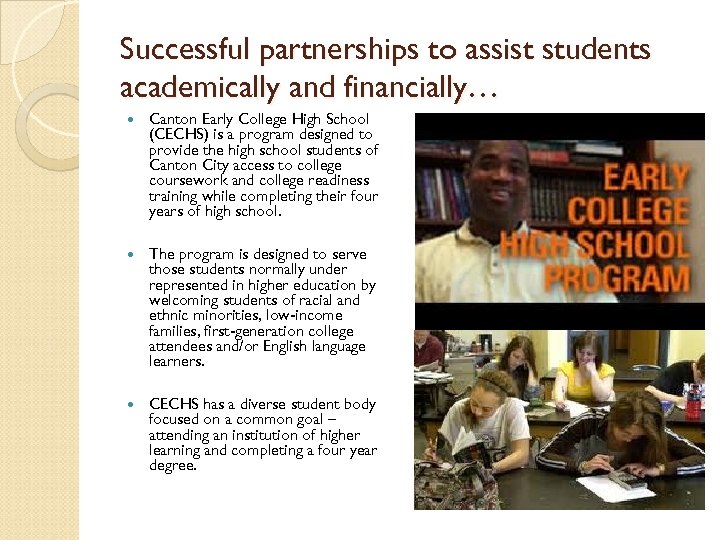
Successful partnerships to assist students academically and financially… Canton Early College High School (CECHS) is a program designed to provide the high school students of Canton City access to college coursework and college readiness training while completing their four years of high school. The program is designed to serve those students normally under represented in higher education by welcoming students of racial and ethnic minorities, low-income families, first-generation college attendees and/or English language learners. CECHS has a diverse student body focused on a common goal – attending an institution of higher learning and completing a four year degree.
Successful partnerships to assist students academically and financially… College Opportunity Credits / Dual Credit Stark County school districts have embarked on a bold, broadly-focused effort to provide College Opportunity Credits—opportunities for students to earn both high school and college credit while attending high school—in ever increasing numbers. This effort involves a series of distinct programs and approaches.
HELP GUIDE Community Harvest Stark Community Foundation Habitat for Humanity/Restore The Refuge of Hope Good Will United Way Church programs – food, clothing, household needs
What can we do as educators to assist students and their families? *Understand the “hidden rules” and culture of all socio-economic groups *Know the area resources *Share resources with others *Participate on boards and committees *Volunteer for special programs/events *Contribute to w/agencies/programs
Proverbs 3: 27 -28 Do not withhold good from those who deserve it, when it is in your power to act. Do not say to your neighbor, "Come back later; I'll give it tomorrow" — when you now have it with you.
“We think sometimes that poverty is only being hungry, naked and homeless. The poverty of being unwanted, unloved and uncared for is the greatest poverty…” Mother Teresa
Thank You… Questions or comments?
Скачать презентацию Understanding Poverty and Socio-economic Differences based on A
ab8809d549a9b36caa630ab212c03c6c.ppt