


 Скачать презентацию Understanding of the specific type of the commercial
b5ec5929ffa68dae5e771ff8111e9a67.ppt
- Количество слайдов: 25
 Understanding of the specific type of the commercial communication PRODUCT PLACEMENT Conference on media and copyright - Prague 18/20 March 2009
 PP is as old as TV and film industry l PP is not a new phenomenon: it's been around since moving pictures exist (they're called "soap operas" for a reason). l In the 2004 -05 US season, broadcast networks alone (ABC, CBS, NBC, FOX, UPN, WB) displayed a staggering 100 000 product placements (source: PQ Media). ¡ Entire shows, like The Restaurant, have been financed by product placement only. On Fox, the American Idol judges seem to really love Coke. l On the US market, PP has invaded sitcoms, soap operas, and even local morning shows. In short, advertising on TV has exploded beyond the boundaries of the traditional commercial communication. l Is a new era for content financing opening now in the EU? ¡ The French and Italian situation ¡ Some questions regarding the future forms of advertising
 The French situation: from surreptitious advertising to product placement l Principle: Commercial communications shall be inserted in specific spots otherwise it is considered to be surreptitious advertising hence forbidden (1992 French Decree) l Since there was no specific legislation on Product Placement in France (meaning that it is not an issue!!), the CSA made a distinction between the inclusion of PP in cinematographic works and audiovisual works.
 2 regimes for Cinema and TV l CINEMA: The CSA’s position is not to intervene towards broadcasters programming a film containing PP, even though the broadcaster itself would have contributed to the financing of the film (as a coproducer) as the film’s first vocation is to be released in theatres.
 TELEVISION: l The CSA estimates that PP shall be ruled when included in AV works as the aim is to be exclusively broadcasted on TV, no matter if they were pre financed by the broadcaster or purchased after being produced. l Broadcasters shall make sure that the works they broadcast do not contain any excessive visual or verbal prominence of goods, services or brands and that the products are naturally inserted in the scenario and their inclusion justified, otherwise such a placement is considered to be surreptitious ad hence prohibited. Conclusion: ¡ When justified by the works requirements, PP is authorised without any blurring. ¡ Undue prominence of any product or service is forbidden when meant to abuse the audience and not respecting the principle of the separation between commercial communication spots and programmes
 The new Commercial Communications Law and PP l The Commercial Communications Law has been adopted on 3. 02. 2009 and gives the CSA the task to fix the conditions in which programmes can benefit from PP and requirements to ensure that viewers will be clearly informed of the existence of PP l The date of entry into force of this legislation is not mentioned yet. l Thus, PP will remain prohibited until the CSA has determined its conditions and outline. l The PP business model is left to the operators.
 The Italian situation l Cinema: PP is legalised by the 2004 « Decreto Urbani » that regulates for the first time PP in cinematographic works (PP shall be identified in the ending credits of the films). ¡ « L’ultimo Crodino » to be released on 20. 03. 09 is an example of naming placement (crodino being the brand’s name of a famous alcoholic beverage and the name of the film’s protagonist)
 Italy and product placement l Television: PP is neither defined nor regulated hence not formally prohibited as long as it is not considered to be surreptitious advertising. It is controlled by 2 authorities: ¡Autorità Garante della Concorrenza e del Mercato ¡Autorità per le Garanzie nelle Communicazioni.
 The transposition of the AMS Directive in Italy l The Senate is currently discussing the legal framework to be set up for PP on TV. ¡The majority wants its authorisation while the opposition claim for its prohibition.
 Will the AMS directive bring market maturity? l The French PP market is quite young (100 million €) in comparison to the US market where PP represents > 3 billions $ - a film being a pure media product for advertisers. l PP value can reach 25 % of a film budget in the US (from 5 to 6 PP per film) but only 1 to 5 % of a French film budget l PP amount is anecdotic and is mainly dedicated to the promotion campaign.
 The French market on PP l Cost of PP in France: an average amount going from 5 000 to 30 000 € l Around 70 % of the French film contain PP : ¡ 1/3 are direct payments ¡ 2/3 are exchanges of products or services ¡ Few - rare - are free of charge. l The big deal is “to whom belong this money which comes after the production stage during the broadcasting?
 How do Product Placement companies work? l They are intermediaries between studios and advertisers: “Film hunters” l Role: ¡Assess scenarii’s potential for PP ¡Look for brands and products ¡Prepare PP strategy for studios ¡Offer a contractual relation between studios and brands
 The limits of the European Cinema l The European cinema being rather « art house » does not constitute per se a project for PP. l European directors claim their freedom of creation l European producers will not communicate on the presence of PP in their film - being an artistic work and not a market product.
 Brands interests for PP in Europe l PP is still a niche for European brands (not always provisioned in their media budget) l PP is not expensive and even if the film is not a success, there are still the DVD release and TV broadcast (public, private and rebroadcasts) to promote the brand product. . l Yet, no reliable study or indicators can measure the ROI of PP for brands in Europe when research in that matter is booming in USA (Nielsen AIG and others)
 Why PP seems so attractive for advertisers and broadcasters (source Les Broude Restich South Africa) l 90 % of DVR are using PP to skip commercials (source ITVX) l Only 16 % of the viewers are watching ads when viewing live. l Impossibility to loose control on viewers that are no more able to skip ads. l According to Mirri. Ad London recent estimates: ¼ of the 88 billion $ spend in the US is wasted. l PP is a ascendancy technique while interstitial ad is the descendancy in US and EU
 PP: Another financial source? l PP is not a strong enough financial relay compared to national and regional funds and other supports a European film can benefit from. l Being of a limited amount, PP is mostly dedicated to the promotion campaign of the film. l PP is an advantage for producers as it goes directly right into their hands (50% at the contract signature, 50% at the film release)
 PP: An advantage for new support? l PP and TV Channels: ¡ Prohibited in France but still do exist in different ways: the brand will not be mentioned but recognisable. ¡ In the US, a viewer can see a brand as many as 1 000 times a show (American shopper Discovery channel) ¡ The TV media department deals with the brand for the exchange of service/good. l New contents for PP: Video games and Internet
 PP and Content online l Films: Internet has intensified the communication around films release hence brands visibility. l Webseries: Advertising Agencies have concluded agreements with studios to develop webseries where PP is possible. l Online distribution of TV series: catch up TV or VOD enables the insertion of PP after TV broadcasting l The famous French sitcom broadcasted on France 3 “Plus Belle La Vie” once accessible online has PP integrated: viewers can click on the actors’ branded clothes and buy them online. l Mobile TV: Screen not appropriate.
 What is the future of PP? l Possibility to reach niche consumers ¡ e. g. ethnics consumers who are most influenced by PP (BIG Research USA 2008). l PP have the most influence on grocery purchase (food/cleaning/beauty). l The best PP performers are those which are purchased for social validation (beauty, apparel and small electronics). l PP will grow 5 times faster than traditional ads over the next 3 years (ITVX news 2008)
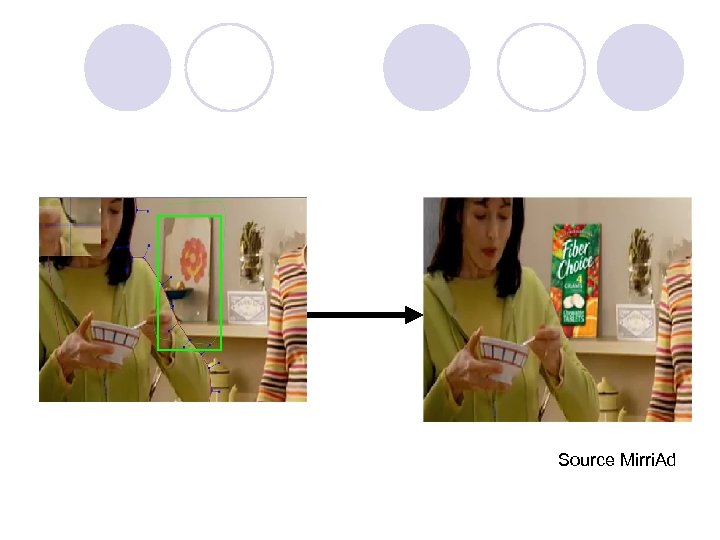
 New forms of PP with digital l The advertising industry is looking for new shows to reach new audience (e. g. young women audience for Herbal essence and try to integrate the product or service “organically” into a programme) (source: P&G) l ICT are offering today the technology to do so (Embedded Ad Video)
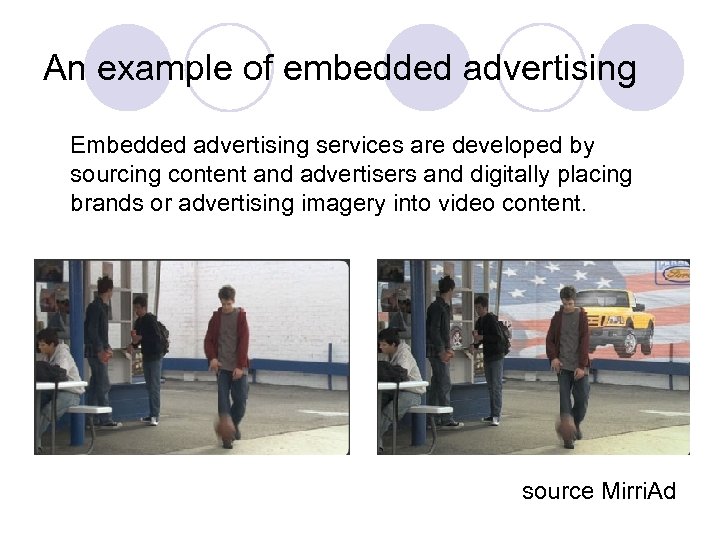 An example of embedded advertising Embedded advertising services are developed by sourcing content and advertisers and digitally placing brands or advertising imagery into video content. source Mirri. Ad
 Source Mirri. Ad
 ITC for PP: Embedded Advertising in Video. l Big issues: inability to tune out, seamless and “organic integration” to the content, synergy with ad campaigns on other medias. l But…. in the US, the FCC has started an investigation in July 2008 on PP with embedded advertising (FCC refers to PP and product integration into the dialog and/or plot of a programme which has been exposing the public to commercial messages without their knowledge).
 ……and new areas for monitoring, control and vigilance l such as the FCC that estimates that it is too difficult to discern when PP occurs. The FCC would consider new rules to better inform viewers when brands appear on shows in exchange for money. Such disclosures run during the credits, but the agency plans to examine whether PP notices should be written in bigger print and displayed for a longer period. l The PP is now possible at the production stage (post prod) and “organically integrated” in the show whatever the show is (fiction, film, magazine documentary and so on). l New areas of conflicts for value between producers, broadcasters advertisers and……… content creators.
 l Alain MODOT - Vice President l am@mediacg. tv l l l 18 rue Séguier - 75006 PARIS France - +33 1 55 42 73 01 Rue de la Pépinière, 12 - 1000 BRUSSELS, Belgium - + 32 2 521 80 16 Via C. Colombo 454 - 00145 ROMA - Italy