 Скачать презентацию Understanding in reading De Boeck 1996 and 2008
8bc2518350ed1e2235c9fb16daf8479a.ppt
- Количество слайдов: 16



Understanding in reading De Boeck, 1996 and 2008. By Jocelyne GIASSON Ch. 1 : A model of understanding in reading
Evolution of the concept of understanding in reading : a model • Traditional concept : 1. Reading activity = sequential list of skills to be taught hierarchically mastering each skill separately = mastering reading Reading = mosaic of isolated skills. • More contemporary model : 1. More global model directed towards the integration of skills : Reading = holistic and unit based process ; interaction between skills is assumed (a reading skill separated from its context loses part of its meaning) Metaphors (p. 5) - bicycle - symphonic orchestra
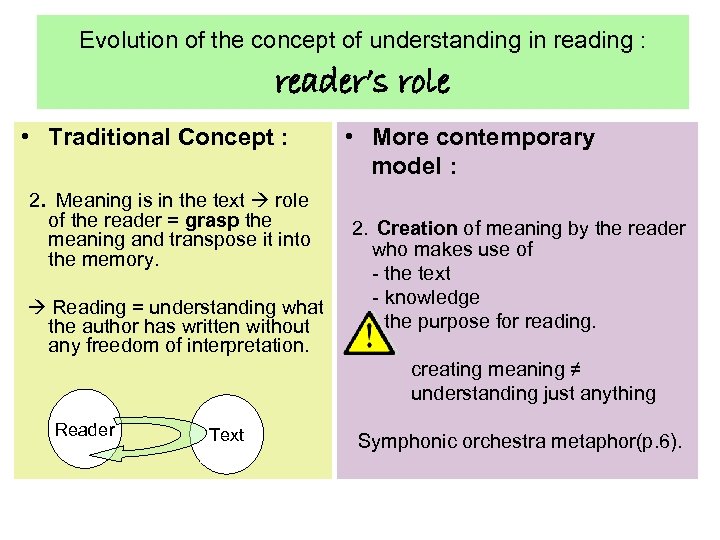
Evolution of the concept of understanding in reading : reader’s role • Traditional Concept : 2. Meaning is in the text role of the reader = grasp the meaning and transpose it into the memory. Reading = understanding what the author has written without any freedom of interpretation. • More contemporary model : 2. Creation of meaning by the reader who makes use of - the text - knowledge - the purpose for reading. creating meaning ≠ understanding just anything Reader Text Symphonic orchestra metaphor(p. 6).
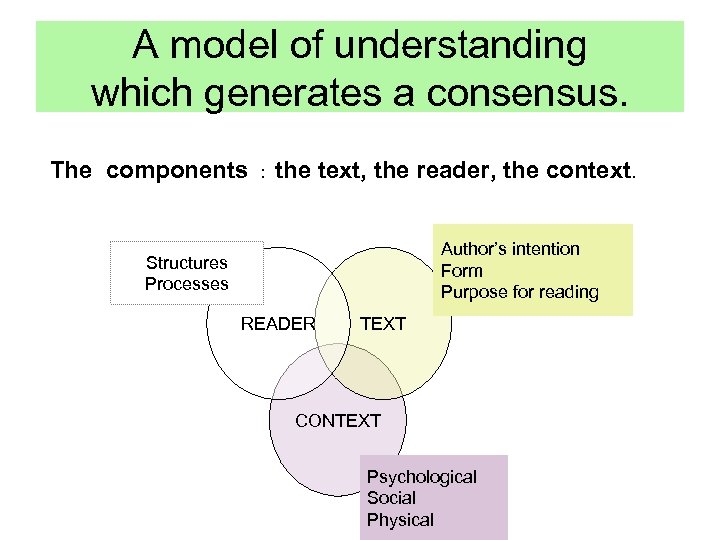
A model of understanding which generates a consensus. The components : the text, the reader, the context. Author’s intention Form Purpose for reading Structures Processes READER TEXT CONTEXT Psychological Social Physical
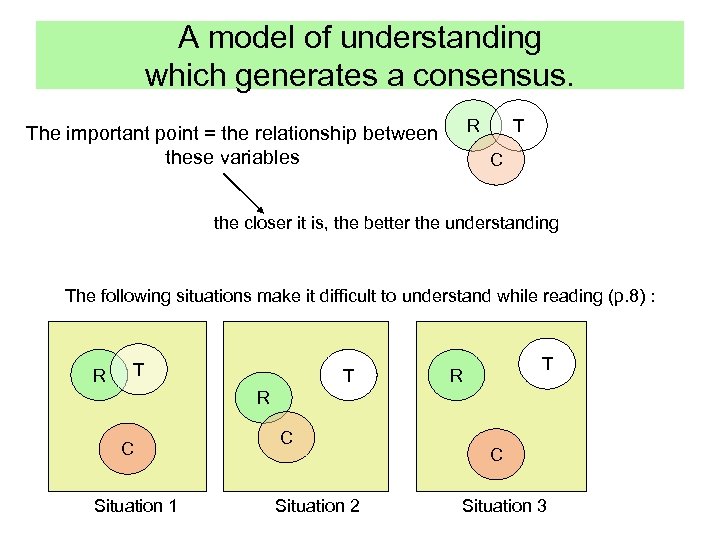
A model of understanding which generates a consensus. R The important point = the relationship between these variables T C the closer it is, the better the understanding The following situations make it difficult to understand while reading (p. 8) : R T T T R R C Situation 1 C Situation 2 C Situation 3
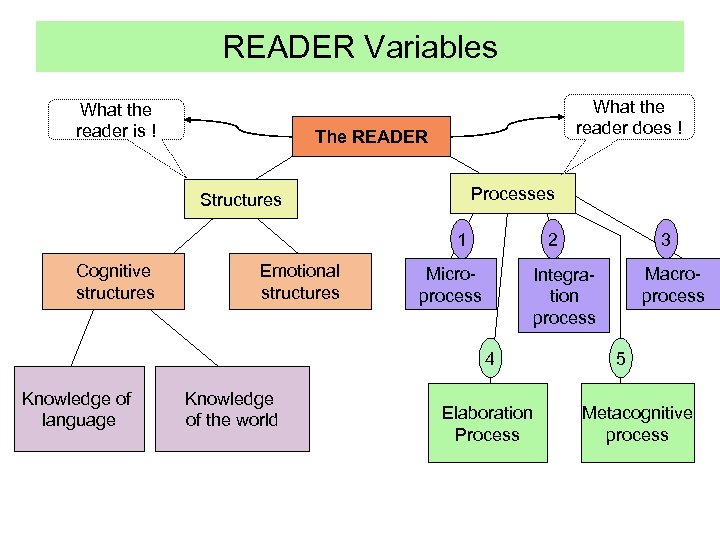
READER Variables What the reader is ! What the reader does ! The READER Processes Structures 1 Cognitive structures Emotional structures 2 Microprocess Knowledge of the world Macroprocess Integration process 4 Knowledge of language 3 Elaboration Process 5 Metacognitive process
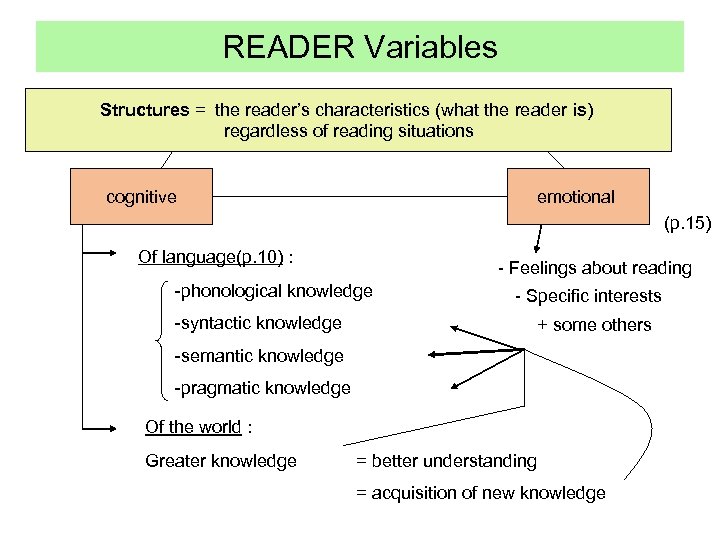
READER Variables Structures = the reader’s characteristics (what the reader is) regardless of reading situations cognitive emotional (p. 15) Of language(p. 10) : - Feelings about reading -phonological knowledge - Specific interests -syntactic knowledge + some others -semantic knowledge -pragmatic knowledge Of the world : Greater knowledge = better understanding = acquisition of new knowledge
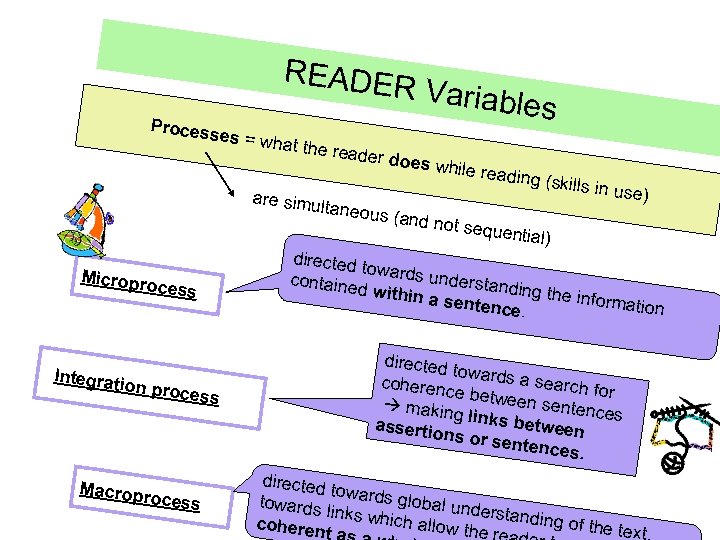
READER Process e s = what the read e r does w are simu ltaneous Micropr ocess Integrat ion proc ess Macropr ocess Variable s hile read in (and not g (skills in use) sequenti al ) directed towards un containe d within derstanding the i nformati a senten on ce. directed towards as coheren ce betwe earch for en s makin g links b entences etween assertio ns or se ntences. directed towards global un towards derstand links whi ing of the ch allow coheren text the t
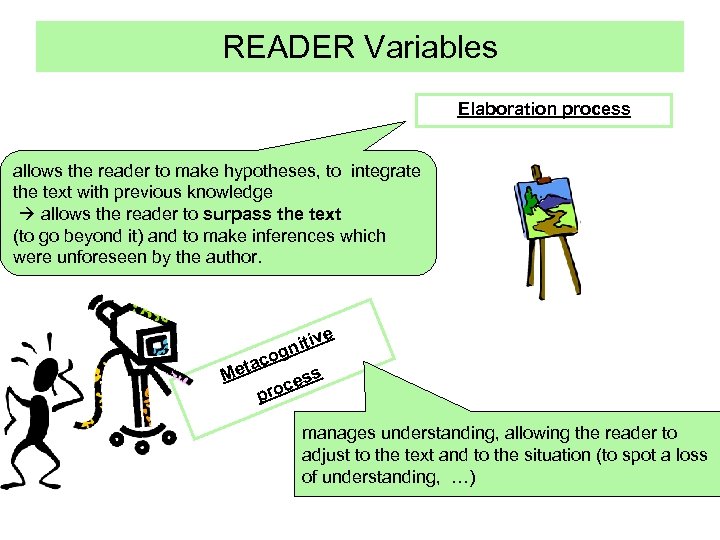
READER Variables Elaboration process allows the reader to make hypotheses, to integrate the text with previous knowledge allows the reader to surpass the text (to go beyond it) and to make inferences which were unforeseen by the author. ve niti g aco t Me ss oce pr manages understanding, allowing the reader to adjust to the text and to the situation (to spot a loss of understanding, …)
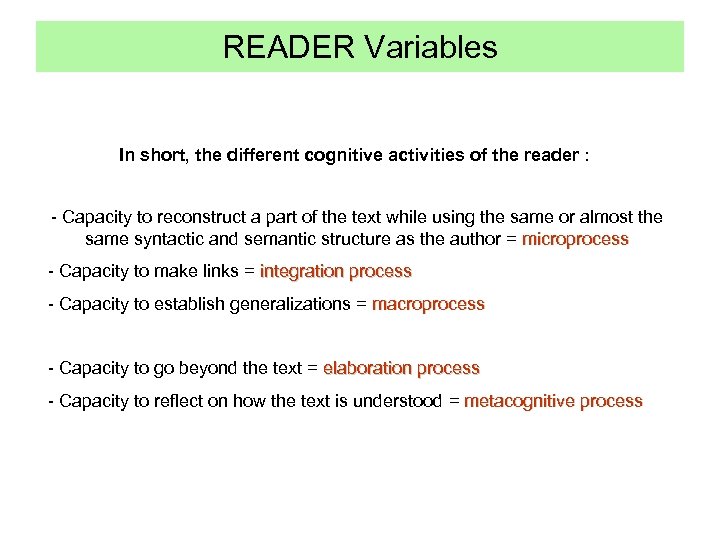
READER Variables In short, the different cognitive activities of the reader : - Capacity to reconstruct a part of the text while using the same or almost the same syntactic and semantic structure as the author = microprocess - Capacity to make links = integration process - Capacity to establish generalizations = macroprocess - Capacity to go beyond the text = elaboration process - Capacity to reflect on how the text is understood = metacognitive process
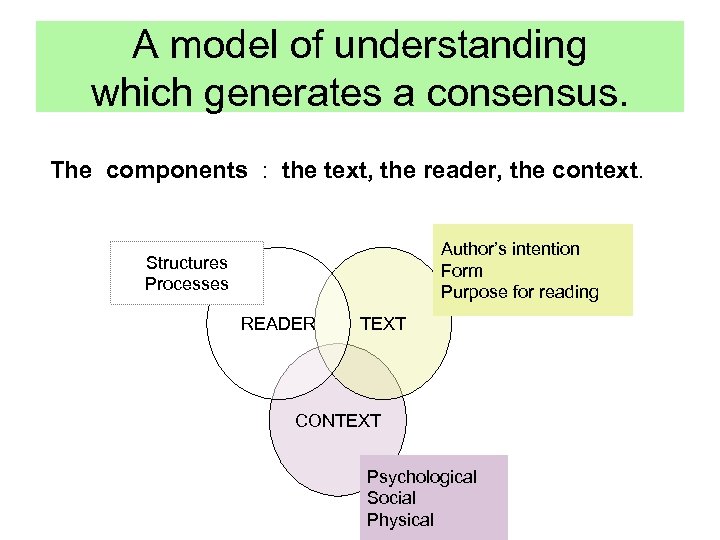
A model of understanding which generates a consensus. The components : the text, the reader, the context. Author’s intention Form Purpose for reading Structures Processes READER TEXT CONTEXT Psychological Social Physical
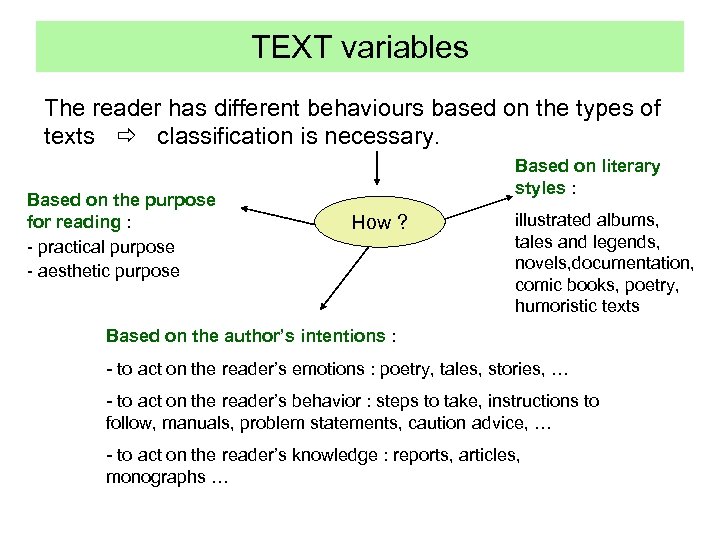
TEXT variables The reader has different behaviours based on the types of texts classification is necessary. Based on the purpose for reading : - practical purpose - aesthetic purpose Based on literary styles : How ? illustrated albums, tales and legends, novels, documentation, comic books, poetry, humoristic texts Based on the author’s intentions : - to act on the reader’s emotions : poetry, tales, stories, … - to act on the reader’s behavior : steps to take, instructions to follow, manuals, problem statements, caution advice, … - to act on the reader’s knowledge : reports, articles, monographs …
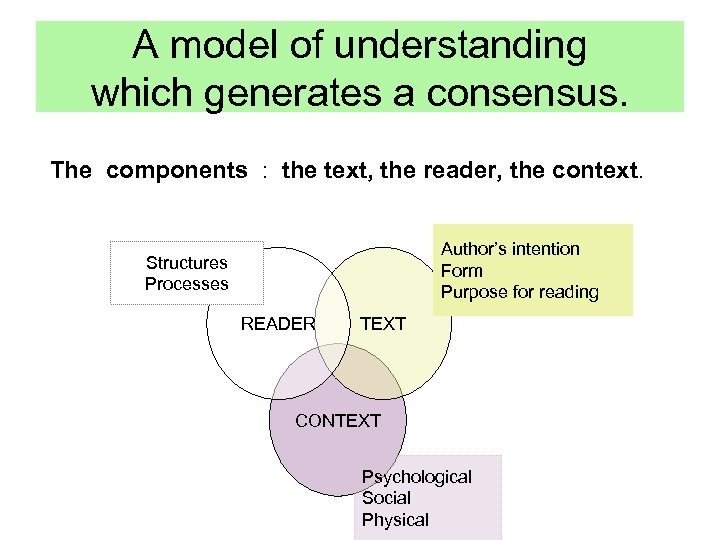
A model of understanding which generates a consensus. The components : the text, the reader, the context. Author’s intention Form Purpose for reading Structures Processes READER TEXT CONTEXT Psychological Social Physical
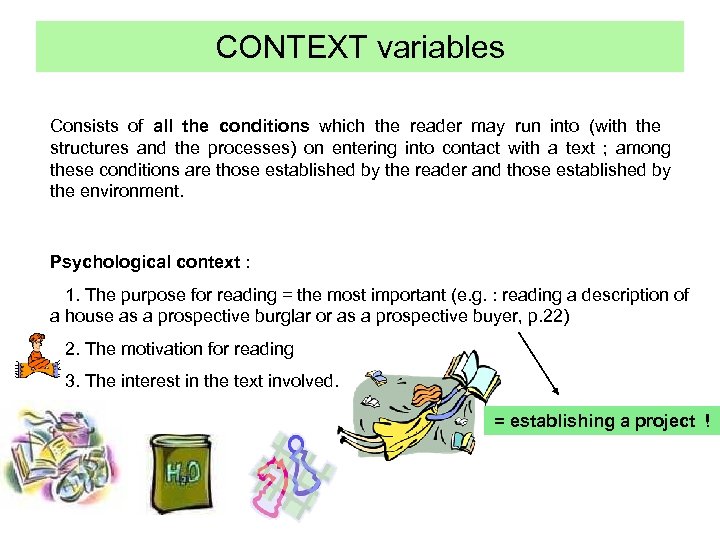
CONTEXT variables Consists of all the conditions which the reader may run into (with the structures and the processes) on entering into contact with a text ; among these conditions are those established by the reader and those established by the environment. Psychological context : 1. The purpose for reading = the most important (e. g. : reading a description of a house as a prospective burglar or as a prospective buyer, p. 22) 2. The motivation for reading 3. The interest in the text involved. = establishing a project !
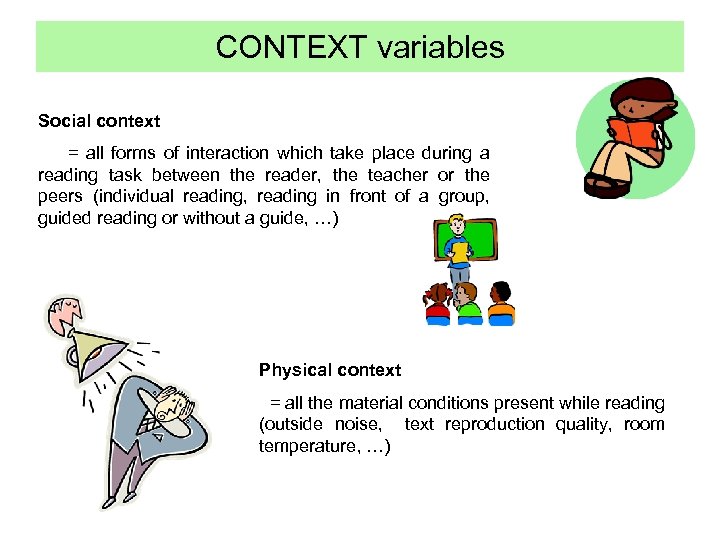
CONTEXT variables Social context = all forms of interaction which take place during a reading task between the reader, the teacher or the peers (individual reading, reading in front of a group, guided reading or without a guide, …) Physical context = all the material conditions present while reading (outside noise, text reproduction quality, room temperature, …)
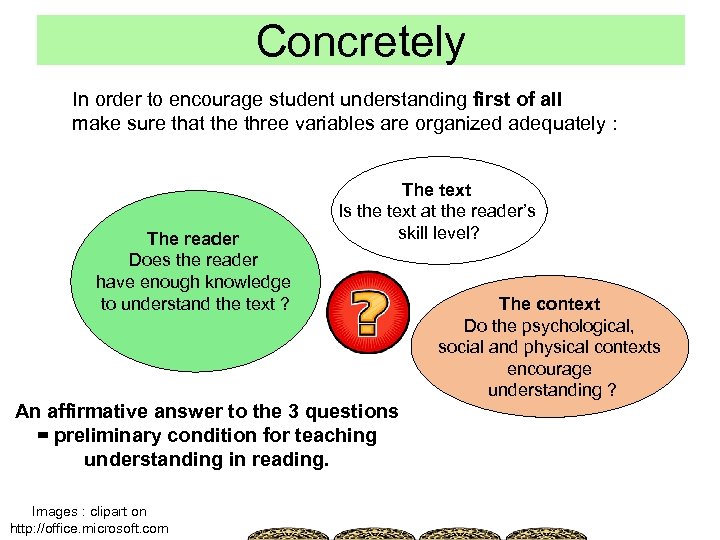
Concretely In order to encourage student understanding first of all make sure that the three variables are organized adequately : The reader Does the reader have enough knowledge to understand the text ? The text Is the text at the reader’s skill level? An affirmative answer to the 3 questions = preliminary condition for teaching understanding in reading. Images : clipart on http: //office. microsoft. com The context Do the psychological, social and physical contexts encourage understanding ?
Скачать презентацию Understanding in reading De Boeck 1996 and 2008
8bc2518350ed1e2235c9fb16daf8479a.ppt