 Скачать презентацию Understanding Human Behavior from Sensor Data Henry Kautz
cb97a3a9330713adc43192573e33c5d1.ppt
- Количество слайдов: 59



Understanding Human Behavior from Sensor Data Henry Kautz University of Washington
A Dream of AI § Systems that can understand ordinary human experience § Work in KR, NLP, vision, IUI, planning… o Plan recognition o Behavior recognition o Activity tracking § Goals o Intelligent user interfaces o Step toward true AI
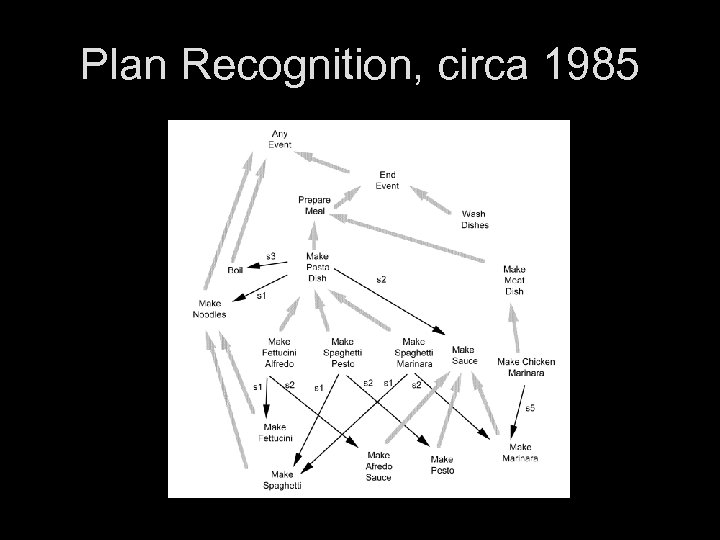
Plan Recognition, circa 1985
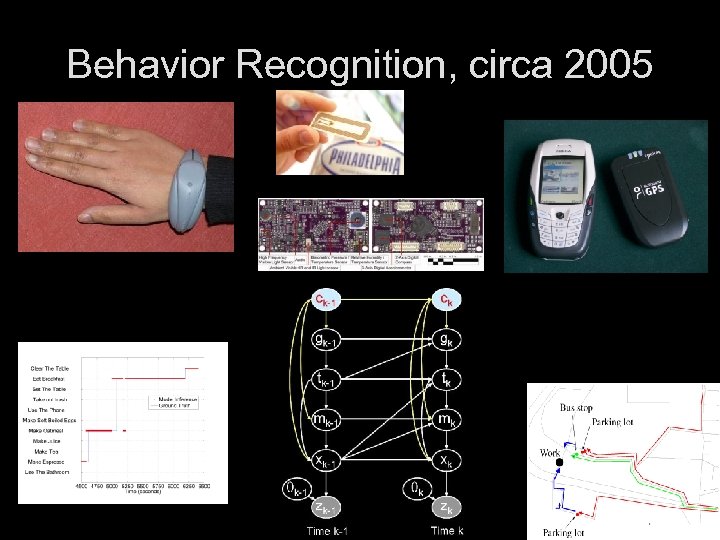
Behavior Recognition, circa 2005
Punch Line § Resurgence of work in behavior understanding, fueled by o Advances in probabilistic inference · Graphical models · Scalable inference · KR U Bayes o Ubiquitous sensing devices · RFID, GPS, motes, … · Ground recognition in sensor data o Healthcare applications · Aging boomers – fastest growing demographic
This Talk § Activity tracking from RFID tag data o ADL Monitoring § Learning patterns of transportation use from GPS data o Activity Compass § Learning to label activities and places o Life Capture § Other recent research
This Talk § Activity tracking from RFID tag data o ADL Monitoring § Learning patterns of transportation use from GPS data o Activity Compass § Learning to label activities and places o Life Capture § Other recent research
Object-Based Activity Recognition § Activities of daily living involve the manipulation of many physical objects o Kitchen: stove, pans, dishes, … o Bathroom: toothbrush, shampoo, towel, … o Bedroom: linen, dresser, clock, clothing, … § We can recognize activities from a timesequence of object touches
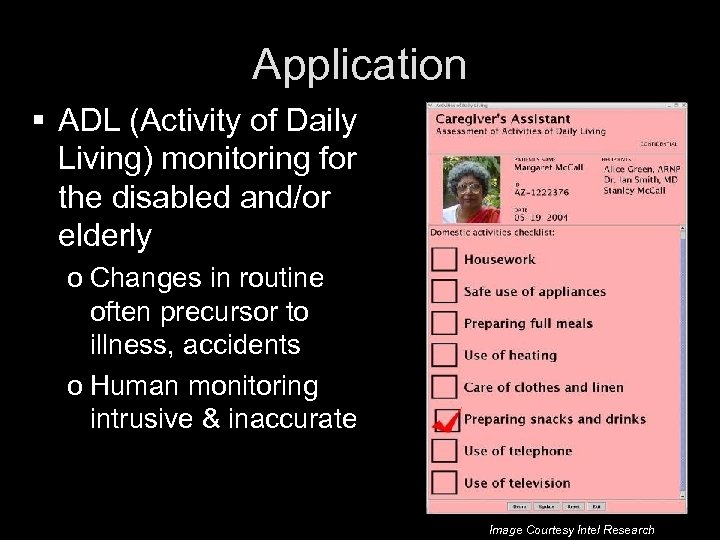
Application § ADL (Activity of Daily Living) monitoring for the disabled and/or elderly o Changes in routine often precursor to illness, accidents o Human monitoring intrusive & inaccurate Image Courtesy Intel Research
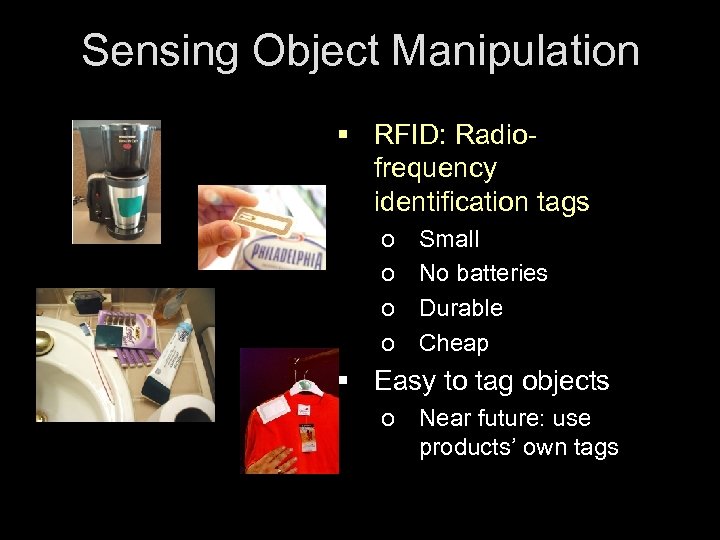
Sensing Object Manipulation § RFID: Radiofrequency identification tags o o Small No batteries Durable Cheap § Easy to tag objects o Near future: use products’ own tags
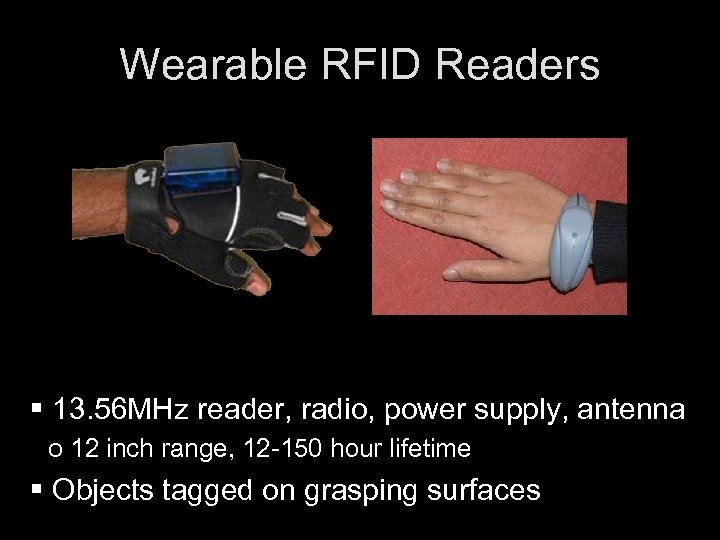
Wearable RFID Readers § 13. 56 MHz reader, radio, power supply, antenna o 12 inch range, 12 -150 hour lifetime § Objects tagged on grasping surfaces
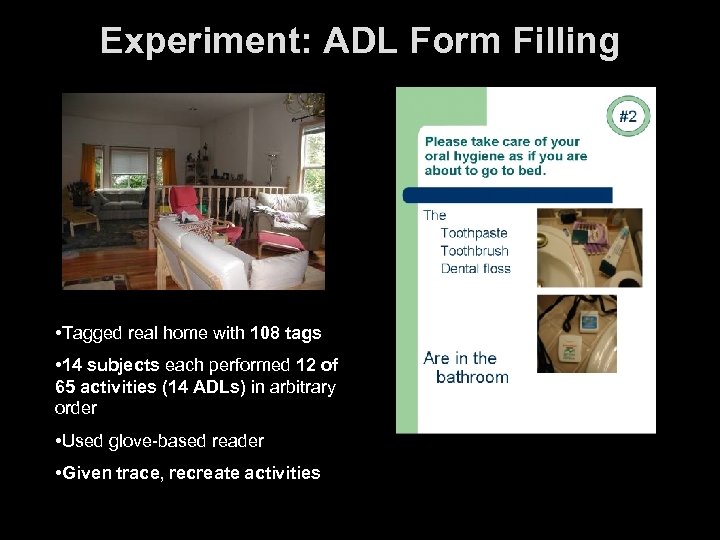
Experiment: ADL Form Filling • Tagged real home with 108 tags • 14 subjects each performed 12 of 65 activities (14 ADLs) in arbitrary order • Used glove-based reader • Given trace, recreate activities
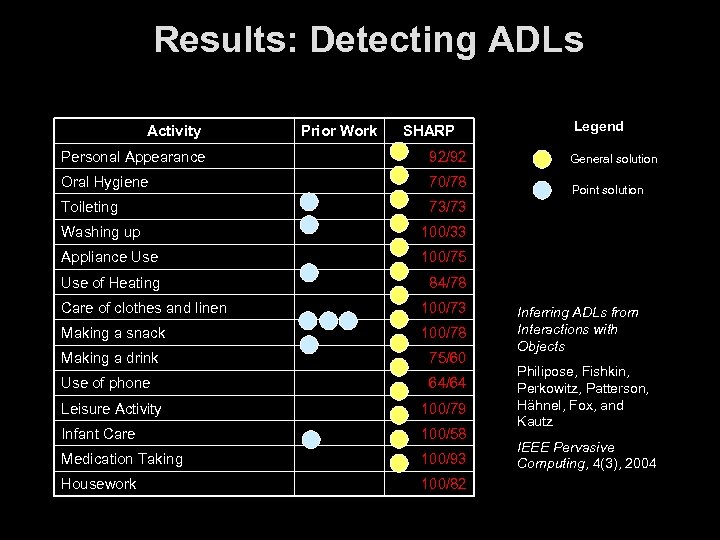
Results: Detecting ADLs Activity Prior Work SHARP Personal Appearance 92/92 Oral Hygiene 70/78 Toileting Legend 73/73 Washing up 100/75 Use of Heating Point solution 100/33 Appliance Use General solution 84/78 Care of clothes and linen 100/73 Making a snack 100/78 Making a drink 75/60 Use of phone 64/64 Leisure Activity 100/79 Infant Care 100/58 Medication Taking 100/93 Housework 100/82 Inferring ADLs from Interactions with Objects Philipose, Fishkin, Perkowitz, Patterson, Hähnel, Fox, and Kautz IEEE Pervasive Computing, 4(3), 2004
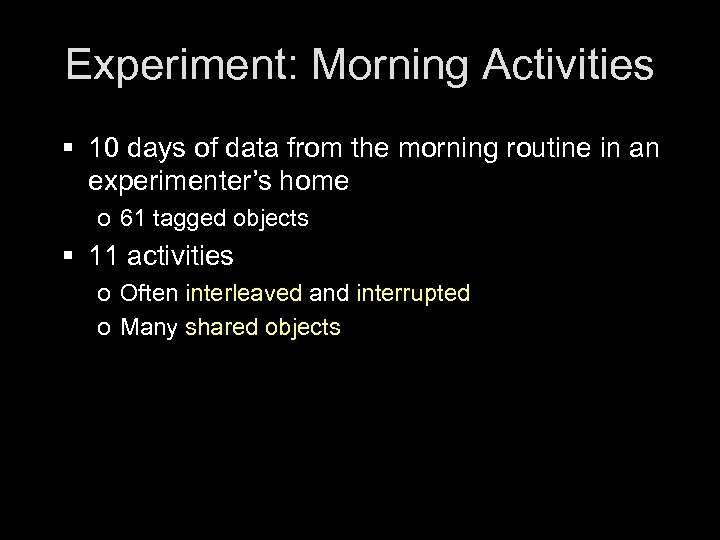
Experiment: Morning Activities § 10 days of data from the morning routine in an experimenter’s home o 61 tagged objects § 11 activities o Often interleaved and interrupted o Many shared objects Use bathroom Make coffee Set table Make oatmeal Make tea Eat breakfast Make eggs Use telephone Clear table Prepare OJ Take out trash
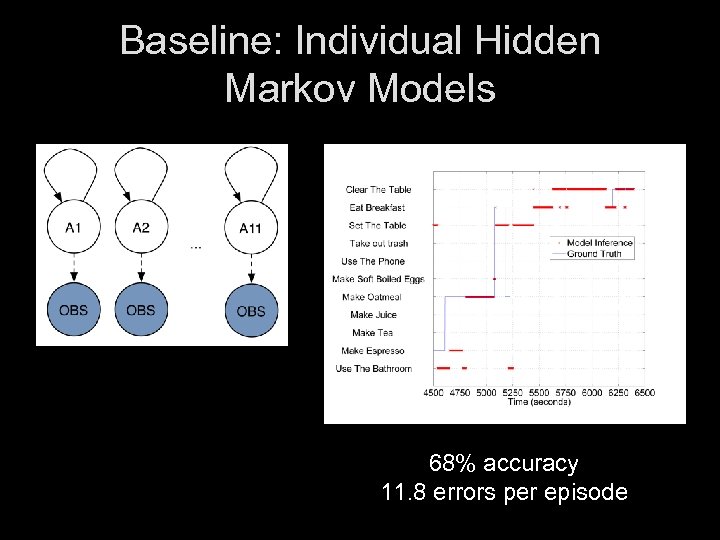
Baseline: Individual Hidden Markov Models 68% accuracy 11. 8 errors per episode
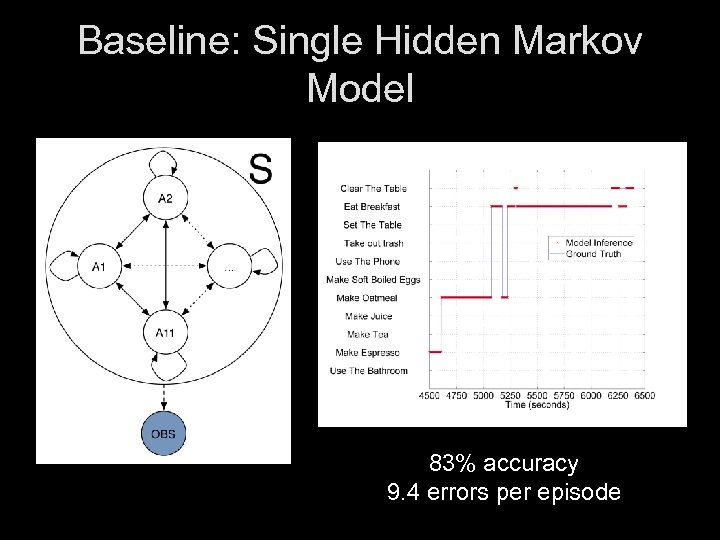
Baseline: Single Hidden Markov Model 83% accuracy 9. 4 errors per episode
Cause of Errors § Observations were types of objects o Spoon, plate, fork … § Typical errors: confusion between activities o Using one object repeatedly o Using different objects of same type § Critical distinction in many ADL’s o Eating versus setting table o Dressing versus putting away laundry
Aggregate Features § HMM with individual object observations fails o No generalization! § Solution: add aggregation features o Number of objects of each type used o Requires history of current activity performance o DBN encoding avoids explosion of HMM
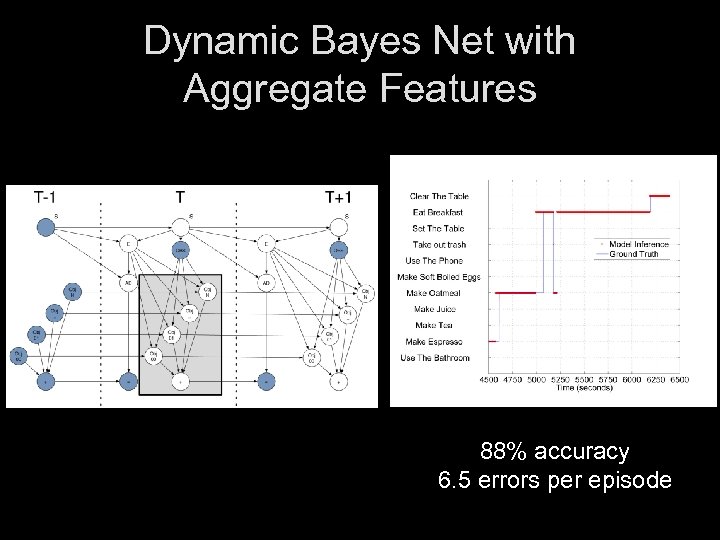
Dynamic Bayes Net with Aggregate Features 88% accuracy 6. 5 errors per episode
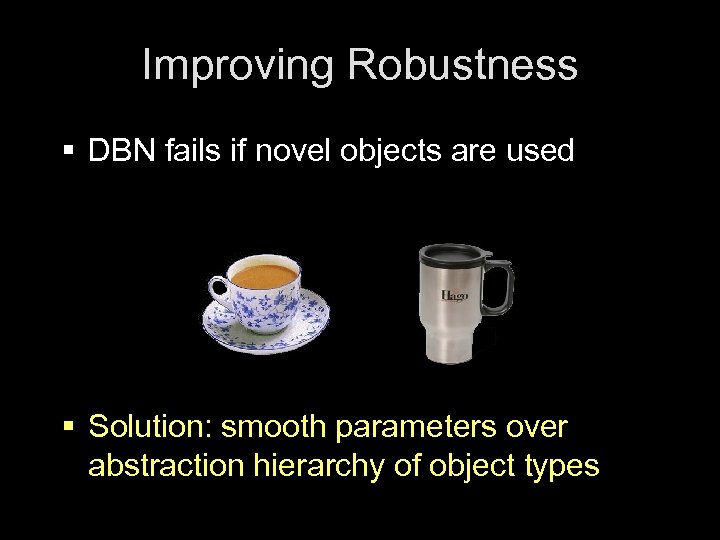
Improving Robustness § DBN fails if novel objects are used § Solution: smooth parameters over abstraction hierarchy of object types
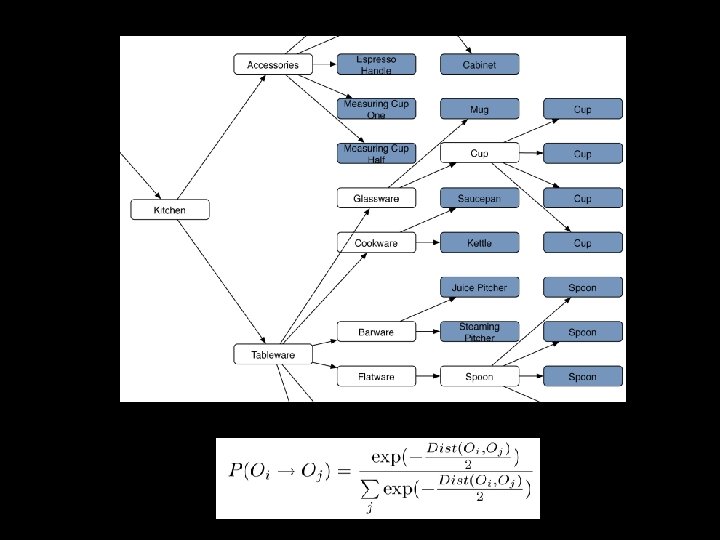
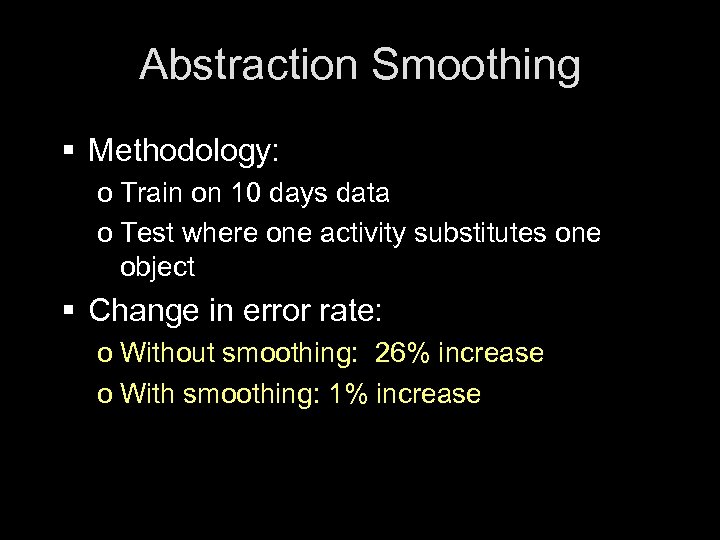
Abstraction Smoothing § Methodology: o Train on 10 days data o Test where one activity substitutes one object § Change in error rate: o Without smoothing: 26% increase o With smoothing: 1% increase
Summary § Activities of daily living can be robustly tracked using RFID data o Simple, direct sensors can often replace (or augment) general machine vision o Accurate probabilistic inference requires sequencing, aggregation, and abstraction o Works for essentially all ADLs defined in healthcare literature D. Patterson, H. Kautz, & D. Fox, ISWC 2005 best paper award
This Talk § Activity tracking from RFID tag data o ADL Monitoring § Learning patterns of transportation use from GPS data o Activity Compass § Learning to label activities and places o Life Capture § Other recent research
Motivation: Community Access for the Cognitively Disabled
The Problem § Using public transit cognitively challenging o Learning bus routes and numbers o Transfers o Recovering from mistakes § Point to point shuttle service impractical o Slow o Expensive § Current GPS units hard to use o Require extensive user input o Error-prone near buildings, inside buses o No help with transfers, timing
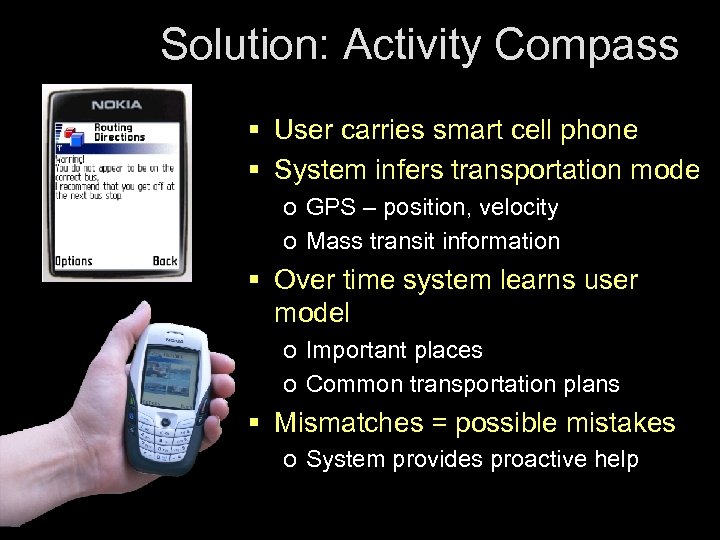
Solution: Activity Compass § User carries smart cell phone § System infers transportation mode o GPS – position, velocity o Mass transit information § Over time system learns user model o Important places o Common transportation plans § Mismatches = possible mistakes o System provides proactive help
Technical Challenge § Given a data stream from a GPS unit. . . o Infer the user’s mode of transportation, and places where the mode changes · Foot, car, bus, bike, … · Bus stops, parking lots, enter buildings, … o Learn the user’s daily pattern of movement o Predict the user’s future actions o Detect user errors
Technical Approach § Map is a directed graph G=(V, E) § Location: o Edge e o Distance d from start of edge o Actual (displaced) GPS reading § Movement: o Mode { foot, car, bus } determines velocity range o Change mode near bus stops & parking places § Tracking (filtering): Given some prior estimate, o Update position & mode according to motion model o Correct according to next GPS reading
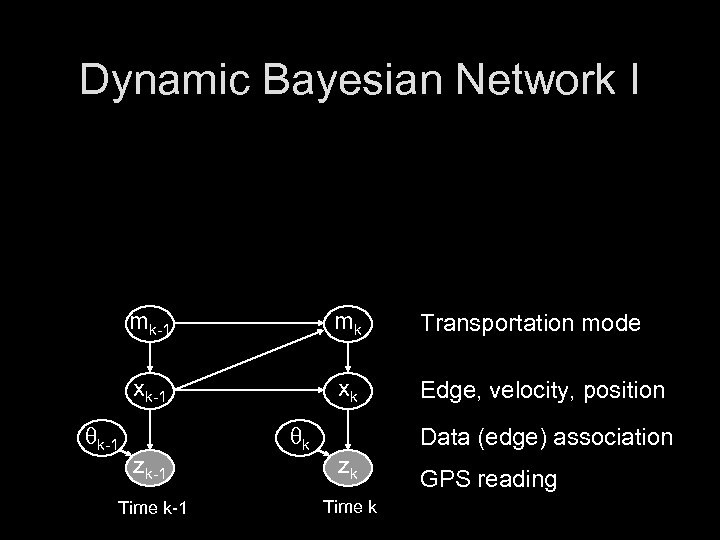
Dynamic Bayesian Network I mk-1 Transportation mode xk-1 qk-1 mk xk Edge, velocity, position zk-1 Time k-1 qk Data (edge) association zk Time k GPS reading
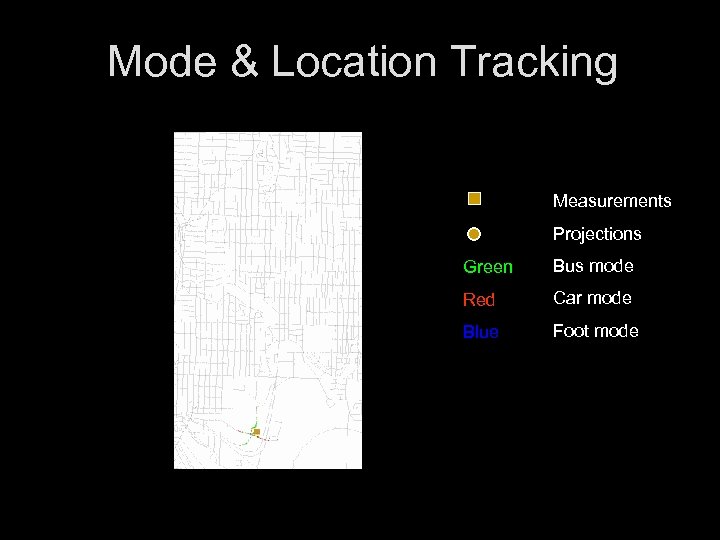
Mode & Location Tracking Measurements Projections Green Bus mode Red Car mode Blue Foot mode
Learning § Prior knowledge – general constraints on transportation use o Vehicle speed range o Bus stops § Learning – specialize model to particular user o 30 days GPS readings o Unlabeled data o Learn edge transition parameters using expectation-maximization (EM)
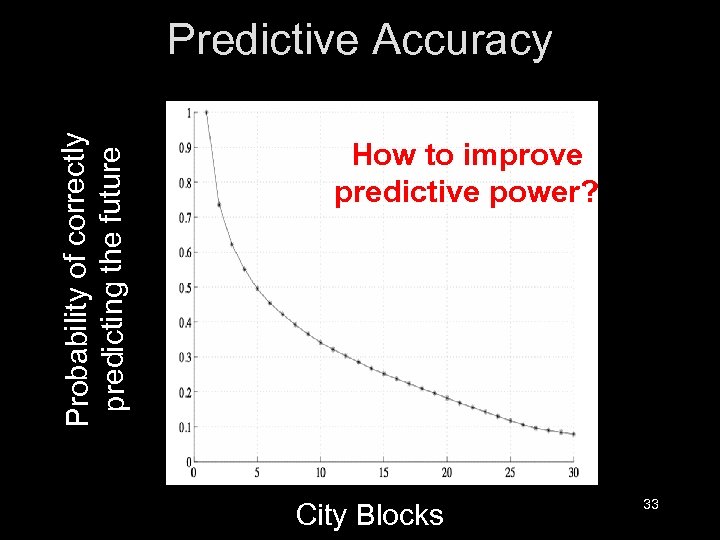
Probability of correctly predicting the future Predictive Accuracy How to improve predictive power? City Blocks 33
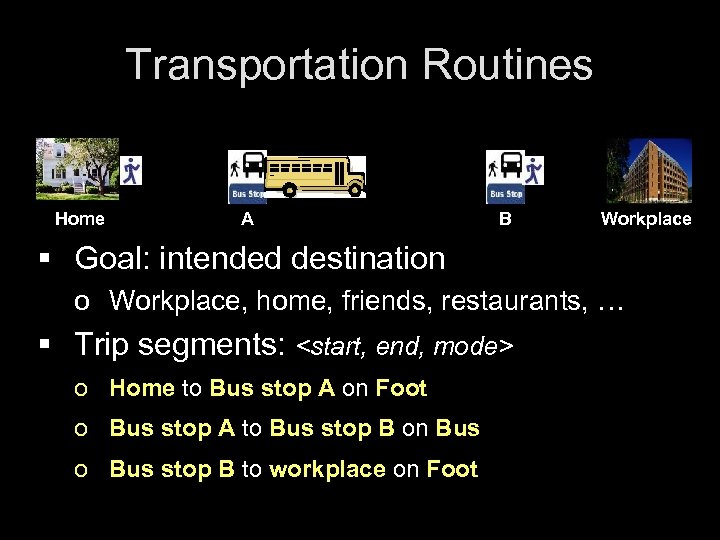
Transportation Routines Home A B Workplace § Goal: intended destination o Workplace, home, friends, restaurants, … § Trip segments: <start, end, mode> o Home to Bus stop A on Foot o Bus stop A to Bus stop B on Bus o Bus stop B to workplace on Foot
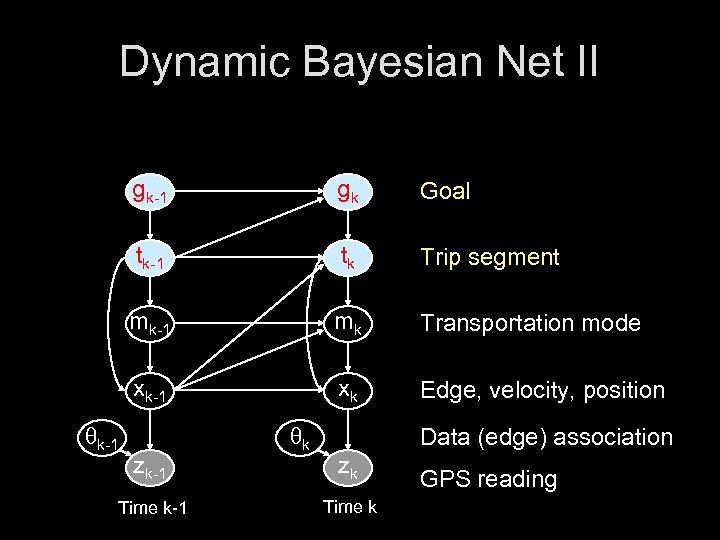
Dynamic Bayesian Net II gk-1 Goal tk-1 tk Trip segment mk-1 mk Transportation mode xk-1 qk-1 gk xk Edge, velocity, position zk-1 Time k-1 qk Data (edge) association zk Time k GPS reading
Unsupervised Hierarchical Learning § Use previous model to infer: o Goals · locations where user stays for a long time o Transition points · locations with high mode transition probability o Trip segments · paths connecting transition points or goals § Learn transition probabilities o Lower levels conditioned on higher levels o Expectation-Maximization
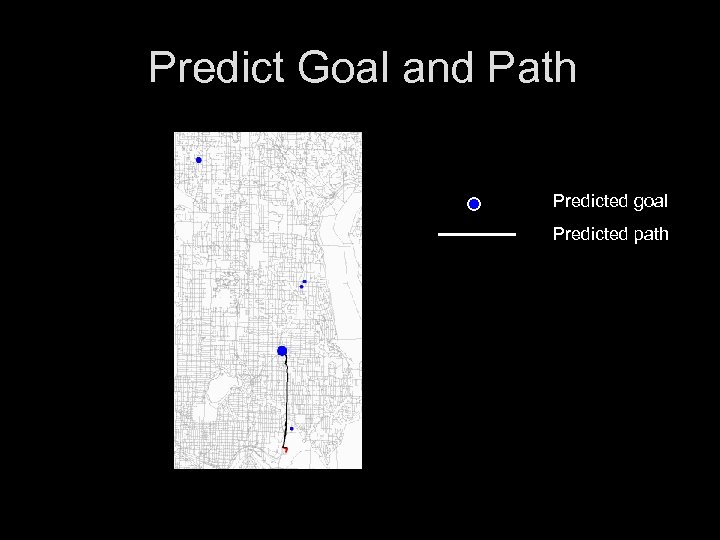
Predict Goal and Path Predicted goal Predicted path
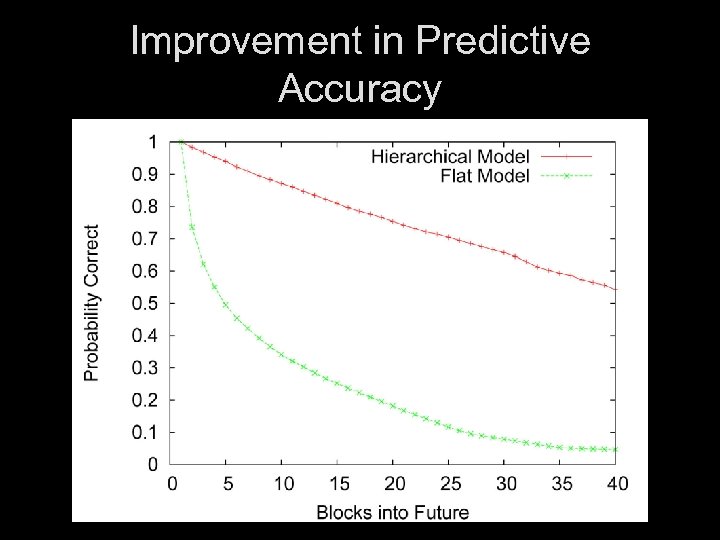
Improvement in Predictive Accuracy
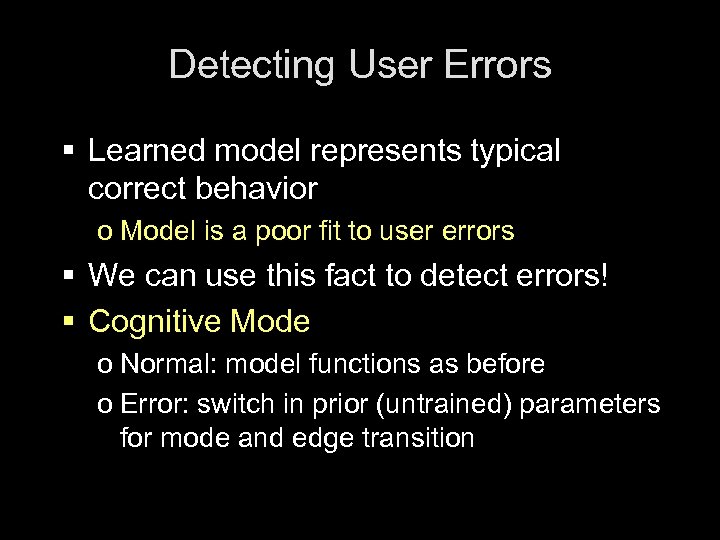
Detecting User Errors § Learned model represents typical correct behavior o Model is a poor fit to user errors § We can use this fact to detect errors! § Cognitive Mode o Normal: model functions as before o Error: switch in prior (untrained) parameters for mode and edge transition
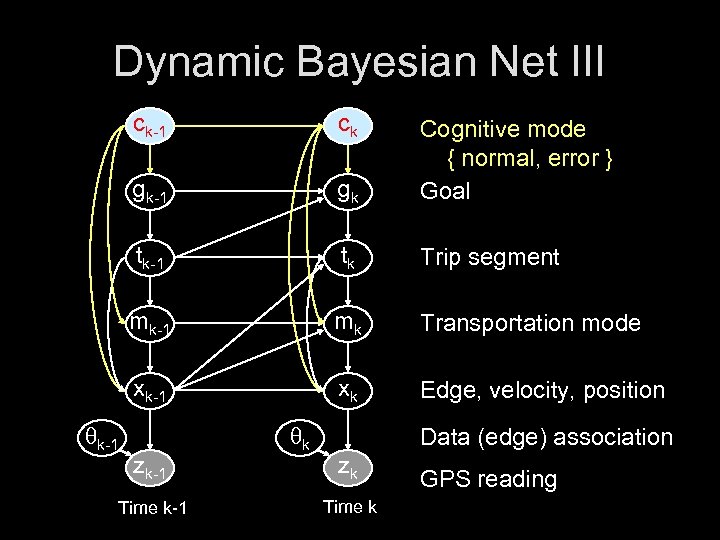
Dynamic Bayesian Net III ck-1 gk Cognitive mode { normal, error } Goal tk-1 tk Trip segment mk-1 mk Transportation mode xk-1 qk-1 ck xk Edge, velocity, position zk-1 Time k-1 qk Data (edge) association zk Time k GPS reading
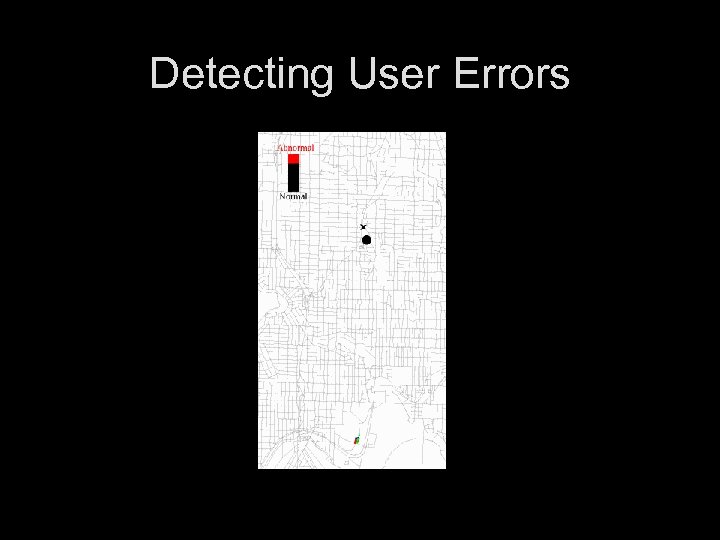
Detecting User Errors
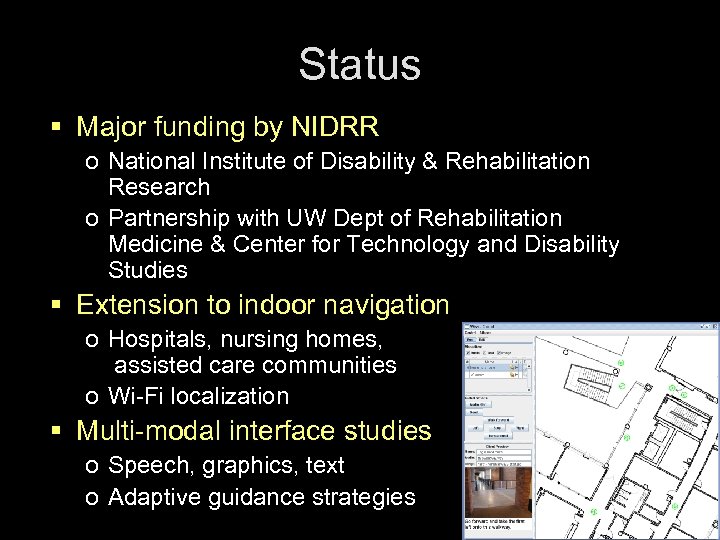
Status § Major funding by NIDRR o National Institute of Disability & Rehabilitation Research o Partnership with UW Dept of Rehabilitation Medicine & Center for Technology and Disability Studies § Extension to indoor navigation o Hospitals, nursing homes, assisted care communities o Wi-Fi localization § Multi-modal interface studies o Speech, graphics, text o Adaptive guidance strategies
Papers Patterson, Liao, Fox, & Kautz, UBICOMP 2003 Inferring High Level Behavior from Low Level Sensors Patterson et al, UBICOMP-2004 Opportunity Knocks: a System to Provide Cognitive Assistance with Transportation Services Liao, Fox, & Kautz, AAAI 2004 (Best Paper) Learning and Inferring Transportation Routines
This Talk § Activity tracking from RFID tag data o ADL Monitoring § Learning patterns of transportation use from GPS data o Activity Compass § Learning to label activities and places o Life Capture § Other recent research
Task § Learn to label a person’s o Daily activities · working, visiting friends, traveling, … o Significant places · work place, friend’s house, usual bus stop, … § Given o Training set of labeled examples o Wearable sensor data stream · GPS, acceleration, ambient noise level, …
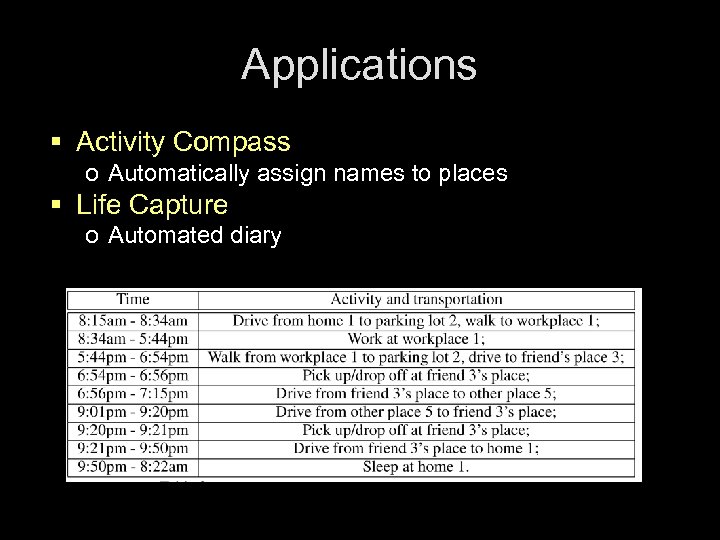
Applications § Activity Compass o Automatically assign names to places § Life Capture o Automated diary
Conditional Models § HMMs and DBNs are generative models o Describe complete joint probability space § For labeling tasks, conditional models are often simpler and more accurate o Learn only P( label | observations ) o Fewer parameters than corresponding generative model
Things to be Modeled § § § Raw GPS reading (observed) Actual user location Activities (time dependent) Significant places (time independent) Soft constraints between all of the above (learned)
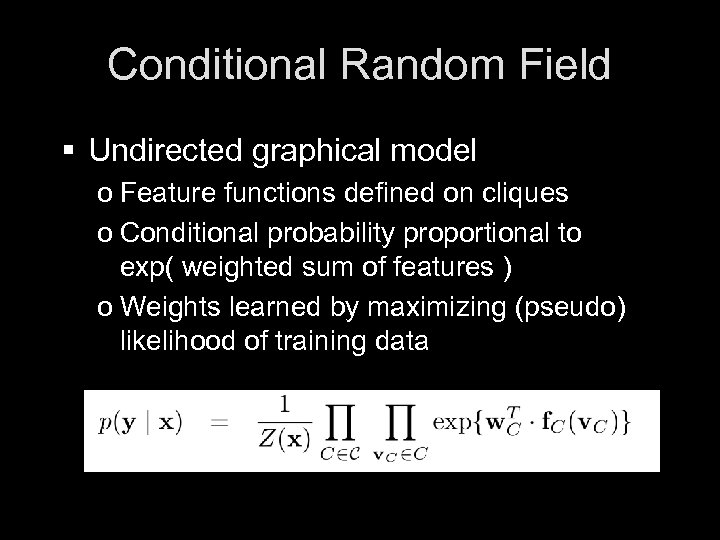
Conditional Random Field § Undirected graphical model o Feature functions defined on cliques o Conditional probability proportional to exp( weighted sum of features ) o Weights learned by maximizing (pseudo) likelihood of training data
Relational Markov Network § First-order version of conditional random field § Features defined by feature templates o All instances of a template have same weight § Examples: o o o Time of day an activity occurs Place an activity occurs Number of places labeled “Home” Distance between adjacent user locations Distance between GPS reading & nearest street
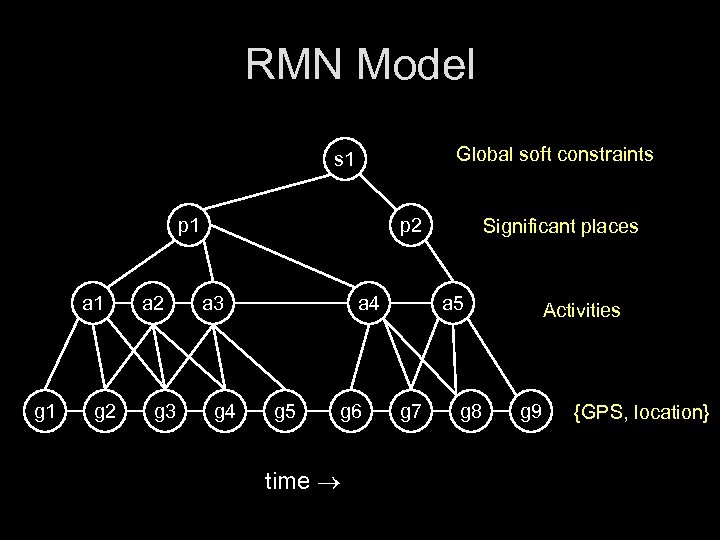
RMN Model Global soft constraints s 1 p 1 a 1 g 2 a 2 g 3 p 2 a 3 g 4 a 4 g 5 g 6 time Significant places a 5 g 7 g 8 Activities g 9 {GPS, location}
Significant Places § Previous work decoupled identifying significant places from rest of inference o Simple temporal threshold o Misses places with brief activities § RMN model integrates o Identifying significant place o Labeling significant places o Labeling activities
Efficient Inference § Some features are expensive to handle by general inference algorithms o E. g. belief propagation, MCMC § Can dramatically speed up inference by associating inference procedures with feature templates o Fast Fourier transform (FFT) to compute “counting” features o O(n log 2 n) versus O(2 n)
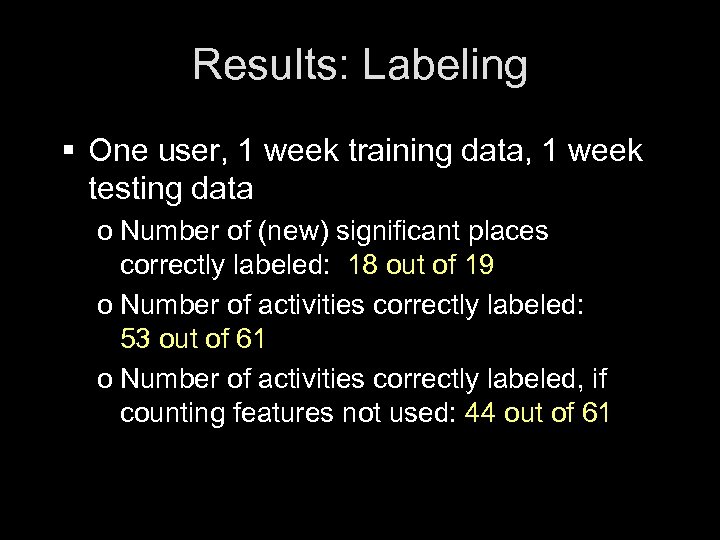
Results: Labeling § One user, 1 week training data, 1 week testing data o Number of (new) significant places correctly labeled: 18 out of 19 o Number of activities correctly labeled: 53 out of 61 o Number of activities correctly labeled, if counting features not used: 44 out of 61
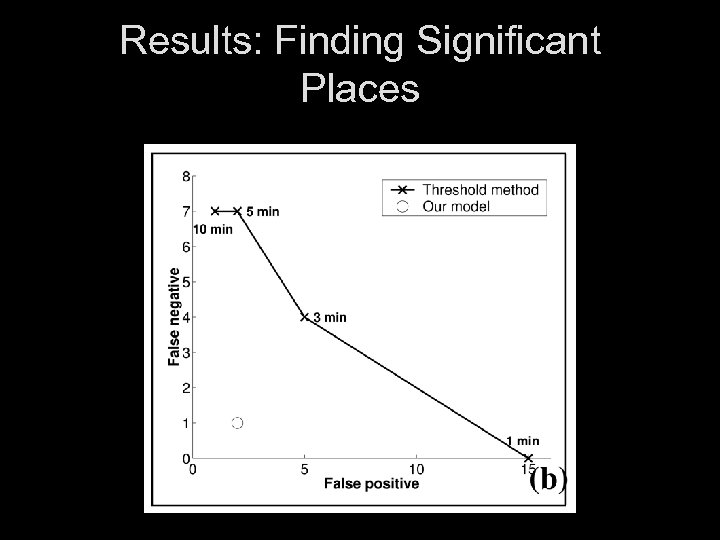
Results: Finding Significant Places
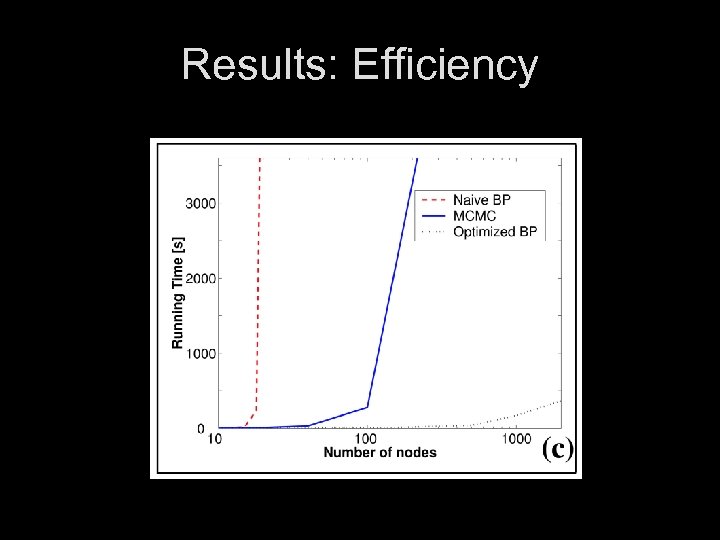
Results: Efficiency
Summary § We can learn to label a user’s activities and meaningful locations using sensor data & state of the art relational statistical models (Liao, Fox, & Kautz, IJCAI 2005, NIPS 2006) § Many avenues to explore: o o Transfer learning Finer grained activities Structured activities Social groups
Conclusion: Why Now? § An early goal of AI was to create programs that could understand ordinary human experience § This goal proved elusive o Missing probabilistic tools o Systems not grounded in real world o Lacked compelling purpose § Today we have the mathematical tools, the sensors, and the motivation
Credits § Graduate students: o Don Patterson, Lin Liao, Ashish Sabharwal, Yongshao Ruan, Tian Sang, Harlan Hile, Alan Liu, Bill Pentney, Brian Ferris § Colleagues: o Dieter Fox, Gaetano Borriello, Dan Weld, Matthai Philipose § Funders: o NIDRR, Intel, NSF, DARPA
Скачать презентацию Understanding Human Behavior from Sensor Data Henry Kautz
cb97a3a9330713adc43192573e33c5d1.ppt