 Скачать презентацию UNDERSTANDING HOARDING BEHAVIORS IN OLDER ADULTS Linda Shumaker
80006fb16554f6cd980d65624d4627b8.ppt
- Количество слайдов: 59



UNDERSTANDING HOARDING BEHAVIORS IN OLDER ADULTS Linda Shumaker, RN-BC, M. A. PA Behavioral Health and Aging Coalition
Watson has described Sherlock Holmes as having a “horror of destroying documents” resulting in stacks of papers in every corner of the room.
HOARDING (COMPULSIVE HOARDING, COMPULSIVE HOARDING SYNDROME) Compulsive hoarding was originally defined as “acquisition of/ or failure to discard possessions that appear to be useless or of limited value”… It has been expanded to include “significant clutter in the home and behavior that causes impairment”. (Behavioral Research and Therapy, 1996; 34: 341 -350)
CHARACTERISTICS OF CUMPULSIVE HOARDING BEHAVIORS o Excessive acquisition and retention of “apparently” useless things and animals. o Cluttered living spaces that limit activities for which these spaces were designed. o Significant distress or impairment is caused by the hoarding behaviors. Frost and Hartl (1996)
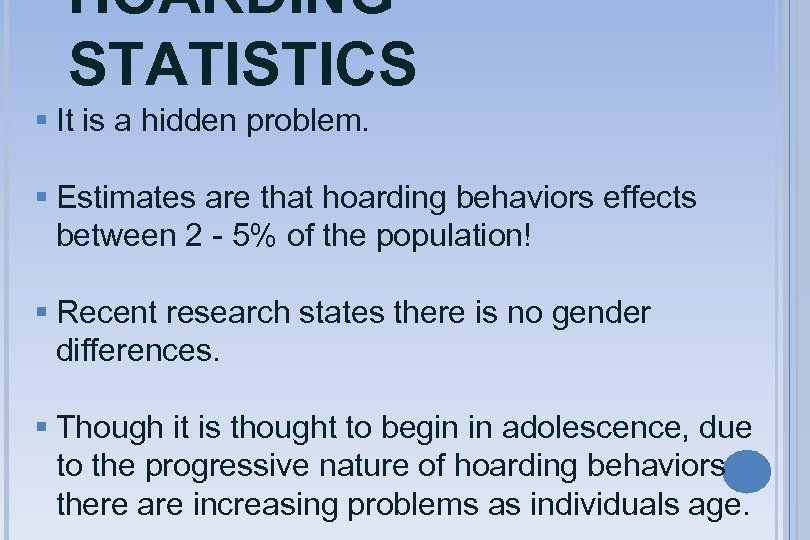
HOARDING STATISTICS § It is a hidden problem. § Estimates are that hoarding behaviors effects between 2 - 5% of the population! § Recent research states there is no gender differences. § Though it is thought to begin in adolescence, due to the progressive nature of hoarding behaviors there are increasing problems as individuals age.
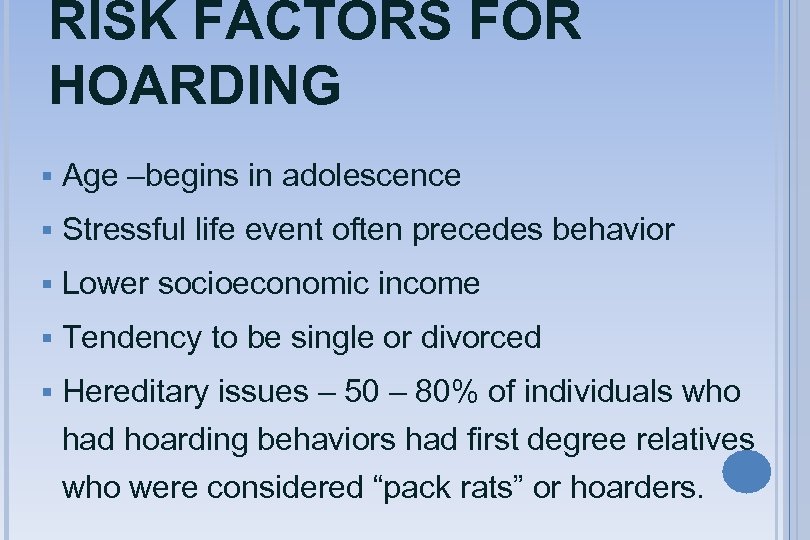
RISK FACTORS FOR HOARDING § Age –begins in adolescence § Stressful life event often precedes behavior § Lower socioeconomic income § Tendency to be single or divorced § Hereditary issues – 50 – 80% of individuals who had hoarding behaviors had first degree relatives who were considered “pack rats” or hoarders.

RISK FACTORS FOR HOARDING o Stressful Life Events – • Some individuals develop hoarding behaviors after experiencing a stressful life event such as a motor vehicle accident, death of a love one, sexual abuse, rape or witness to a crime. § Behavioral Research Therapy 1996; 34: 341 -350. § Behavioral Research Therapy 2005; 43: 269 -276. § Journal of Anxiety Disorders January 2005; 675 -686. § Clinical Psychiatry News, June 2006.
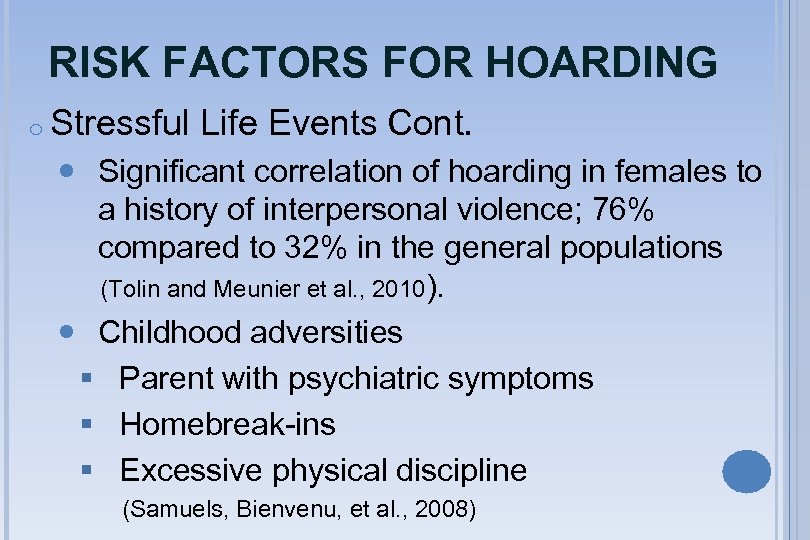
RISK FACTORS FOR HOARDING o Stressful Life Events Cont. Significant correlation of hoarding in females to a history of interpersonal violence; 76% compared to 32% in the general populations (Tolin and Meunier et al. , 2010). Childhood adversities § Parent with psychiatric symptoms § Homebreak-ins § Excessive physical discipline (Samuels, Bienvenu, et al. , 2008)
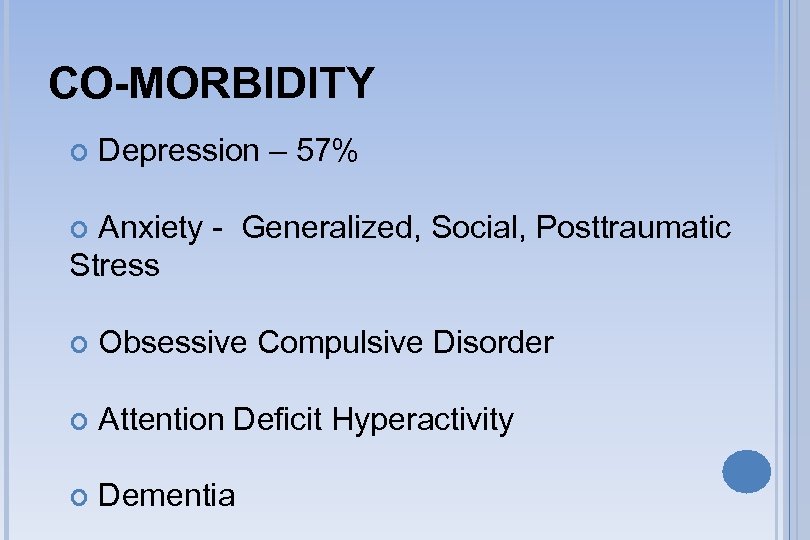
CO-MORBIDITY Depression – 57% Anxiety - Generalized, Social, Posttraumatic Stress Obsessive Compulsive Disorder Attention Deficit Hyperactivity Dementia
SYMPTOMS (WHAT WE SEE!): Cluttered living spaces Inability to discard items Keeping stacks of newspapers, magazines or junk mail Moving items from one pile to another without discarding anything – “churning” Difficulty managing daily activities, including difficulty making decisions
INDIVIDUALS WHO HAVE “HOARDING BEHAVIORS”: May have a significant emotional attachment to items. Feel the items they collect will be needed or will have value in the future. Feel safer when surrounded by the things they collect!
INDIVIDUALS WHO HAVE “HOARDING BEHAVIORS” HAVE: § Personalities that may also be indecisive and avoidant § Most individuals who hoard are socially withdrawn and isolated/ or hoarding behaviors may lead to social isolation § People who compulsively hoard are often perfectionists
INDIVIDUALS WHO HAVE “HOARDING BEHAVIORS” HAVE: § The need to acquire unneeded or seemingly useless items, including trash § Excessive attachment to possessions and have discomfort letting others touch or borrow possessions § A sense of responsibility § Difficulty organizing items
KEY WORDS FOR HOARDING Indecisiveness Procrastination Avoidance Perfectionism
DIAGNOSING HOARDING: Primary reasons for Hoarding are “biologically-based” rather than “psychological”. Studies have shown that no definitive cause that has been determined. Randy Frost, Ph. D, Israel Professor of Psychology, Smith College, Northampton, Mass.
HOARDING RESEARCH Functional imaging suggests the medial prefrontal area of the brain plays an important role. PET Scans show lower than normal activity in the anterior cingulate gyrus. This area is associated with such tasks as focused attention and decision making.
HOARDING AND THE DSM 5 §Now considered a distinct disorder §Previously was a Subtype or symptom of Obsessive Compulsive Disorder §Hoarding behaviors may also seen in individuals with Generalized Anxiety Disorder, Social Phobias, Schizophrenia, Dementia, Eating disorders and Mental Retardation §Those with significant hoarding symptoms are more likely to suffer from co-morbid depression
HOARDING Why the relationship with Obsessive Compulsive Disorder? Hoarding and “saving” behaviors are found in 18 – 42% of individuals with OCD Most individuals who hoard will also exhibit symptoms of OCD
HOARDING RESEARCH Compulsive Hoarding has a different pattern of genetic inheritance than OCD symptoms. Studies suggest the compulsive hoarding syndrome is a genetically distinct subgroup or variant of OCD with a characteristic pattern of associated symptoms and functional disability. Saxena, S. , Brody, A, et al “Cerebral Glucose Metabolism in Obsessive-Compulsive Hoarding, ” American Journal of Psychiatry, 161: 6, June 2004
DSM 5 HOARDING: Persistent difficulty discarding or parting with possessions, regardless of their actual value. This difficulty is due to a perceived need to save the items and distress associated with discarding them. The symptoms result in the accumulation of possessions that congest and clutter active living areas, and substantially compromise their intended uses. If living areas are uncluttered, it is only because of the interventions of third parties.
DSM 5 CONT. The hoarding causes clinically significant distress or impairment in social, occupational, or other important areas of functioning (including maintaining a safe environment for self and others). The hoarding is not attributable to another medical condition (e. g. : brain injury, cerebrovascular disease, etc. ).
DSM 5 CONT. The hoarding is not better accounted for by the symptoms of another DSM 5 disorder (e. g. : hoarding due to obsessions in Obsessive Compulsive Disorder, decreased energy in Major Depressive Disorder, delusions in Schizophrenia, restricted interests in Autism Spectrum Disorder, etc. ).
COMPLICATIONS OF HOARDING: Unsanitary conditions that pose a health risk - 81% of cases Inability to perform daily tasks, such as bathing or cooking Poor work performance Loneliness and social isolation Fire hazard - 45% of cases Falls usually expose the situation!

ANIMAL HOARDING IS ALSO AN INCREASING CONCERN!
DEFINED BY FOUR CHARACTERISTICS Obsessive attempts to accumulate or maintain a collection of animals in the face of progressively deteriorating conditions; Failure to provide minimal standards of sanitation, space, nutrition, and veterinary care for animals; “Animal Hoarding: Structuring Interdisciplinary Responses to help People, Animals and Communities at Risk, ” 2004, Hoarding of Animal Research Consortium(HARC).
DEFINED BY FOUR CHARACTERISTICS Inability to recognize the effects of this failure on the welfare of the animals, human members of the household, and the environment and Denial or minimization of problems and living conditions for people and animals. “Animal Hoarding: Structuring Interdisciplinary Responses to help People, Animals and Communities at Risk, ” 2004, Hoarding of Animal Research Consortium(HARC).
Hoarding is a “symptom” that is known to be difficult to treat, even more so if the client is unwilling!
DIAGNOSING HOARDING: Acquisition of a large number of possessions Having an overly cluttered home or living spaces Having significant distress over the hoarding behavior
ASSESSMENT Saving Inventory-Revised tool (Frost) Saving Cognition Inventory (Frost, Steketee) Hoarding Rating Scale Assessment Tool (Frost) Clutter Image Rating Scale (Frost) Activities of Daily Living (ADL)

TREATMENT Treatment is challenging and has “mixed success” Cross system collaboration helpful Medication Psychotherapy

TREATMENT MEDICATION Antidepressants – (SSRI’s) Selective Serotonin Reuptake Inhibitors
TREATMENT -THERAPY Behavioral Therapy Cognitive remediation Focus on building concrete skills
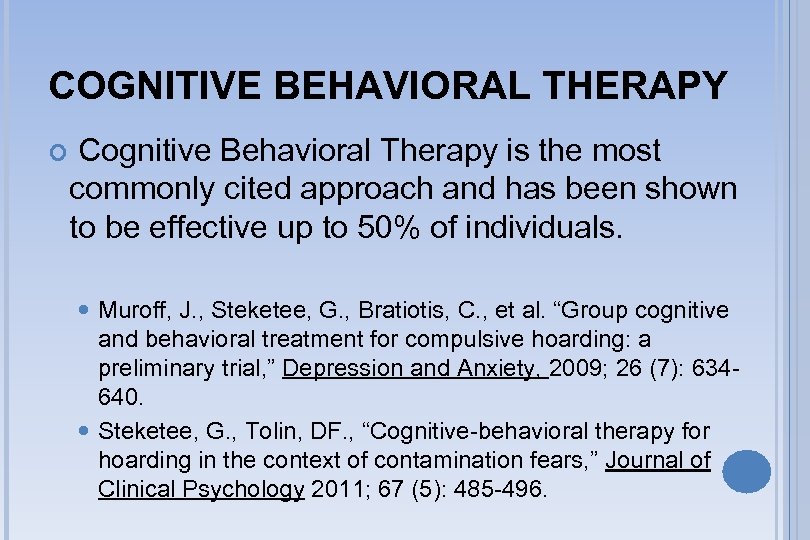
COGNITIVE BEHAVIORAL THERAPY Cognitive Behavioral Therapy is the most commonly cited approach and has been shown to be effective up to 50% of individuals. Muroff, J. , Steketee, G. , Bratiotis, C. , et al. “Group cognitive and behavioral treatment for compulsive hoarding: a preliminary trial, ” Depression and Anxiety, 2009; 26 (7): 634640. Steketee, G. , Tolin, DF. , “Cognitive-behavioral therapy for hoarding in the context of contamination fears, ” Journal of Clinical Psychology 2011; 67 (5): 485 -496.
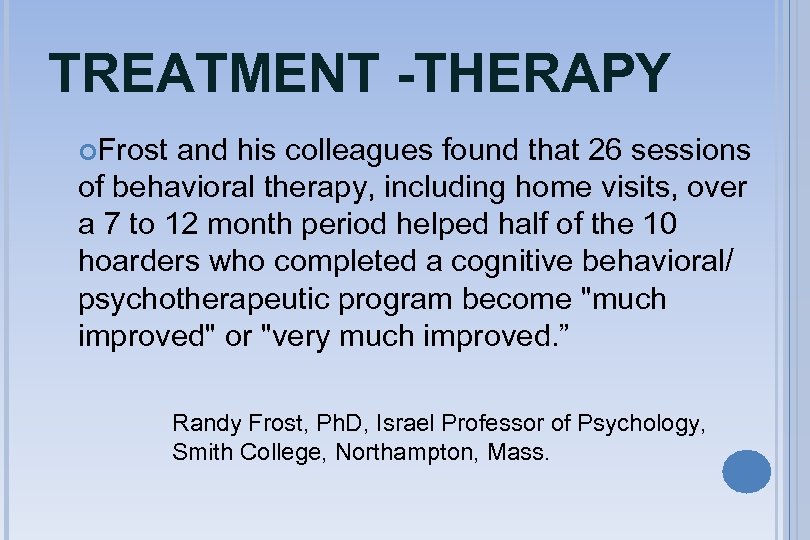
TREATMENT -THERAPY Frost and his colleagues found that 26 sessions of behavioral therapy, including home visits, over a 7 to 12 month period helped half of the 10 hoarders who completed a cognitive behavioral/ psychotherapeutic program become "much improved" or "very much improved. ” Randy Frost, Ph. D, Israel Professor of Psychology, Smith College, Northampton, Mass.
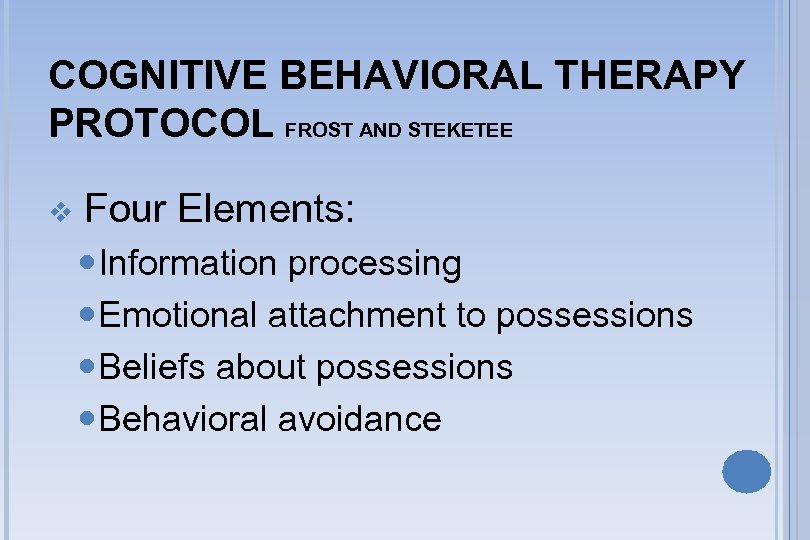
COGNITIVE BEHAVIORAL THERAPY PROTOCOL FROST AND STEKETEE v Four Elements: Information processing Emotional attachment to possessions Beliefs about possessions Behavioral avoidance
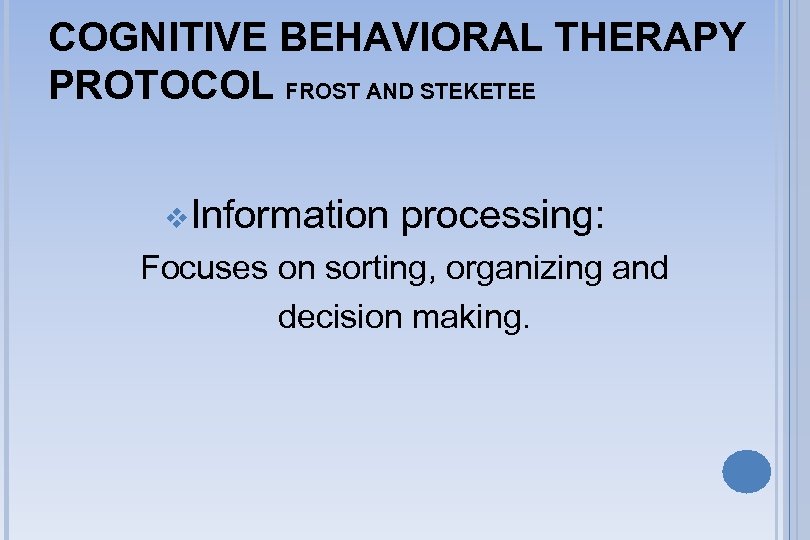
COGNITIVE BEHAVIORAL THERAPY PROTOCOL FROST AND STEKETEE v. Information processing: Focuses on sorting, organizing and decision making.
COGNITIVE BEHAVIORAL THERAPY PROTOCOL FROST AND STEKETEE v. Emotional attachment to possessions: Cognitive restructuring and exposure techniques are used to challenge beliefs around objects and explores consequences of discarding.
COGNITIVE BEHAVIORAL THERAPY PROTOCOL FROST AND STEKETEE v. Beliefs about possessions: Focuses on cognitive restructuring and exposure to examine beliefs around possessions.
COGNITIVE BEHAVIORAL THERAPY PROTOCOL FROST AND STEKETEE v. Behavioral Avoidance: This protocol focuses on creating experiences that allow the individual to face situations that generate anxiety, while replacing avoidance with “adaptive coping strategies”.
COGNITIVE BEHAVIORAL THERAPY § “Declutter” the home by in-home visits with therapist or “professional organizer”. § Learn “relaxation” skills. § Family or group therapy. § Hospitalization if needed. § Periodic visits / ongoing treatment to keep up “healthy” habits.
COGNITIVE BEHAVIORAL THERAPY Explore potential issues behind hoarding behaviors. Learn to organize and categorize possessions. (Practical Approaches – Four Key Actions). Improve decision-making skills

PRACTICAL APPROACHES – FOUR KEY ACTIONS Throw away (TA) Recycle (R) Give Away (GA) Keep and Put Away (KAPA) These actions should be the basis of everything you do! http: //understanding_ocd. tripod. com/hoarding. html
CLUTTERGONE APPROACH HTTP: //WWW. CLUTTERGONE. CO. UK/ Clutter – easily shifted, part of a disorganized life § Clots – collection of clutter not moved for 6 months or more § Clogs – when “clots” become stuck together § Goat paths – between clots § Define “rubbish” § During “first pass” get rid of rubbish §
PRACTICAL APPROACHES §Be direct and talk face to face with the client §Use a soft, gentle approach §Let the individual tell their story §Treat the person with respect and dignity §Remain calm and factual, but caring and supportive Associated Counselors and Therapists, Hermosa Beach California - http: //www. beachpsych. com/pages/cc 80. html
PRACTICAL APPROACHES § Respect the meaning and attachment to the “possessions”– they may have strong attachments to seemingly unimportant objects § Evaluate for safety § Refer for medical and mental health evaluation § Go slowly and expect gradual changes Associated Counselors and Therapists, Hermosa Beach California - www. beachpsych. com/pages/cc 80. html

PRACTICAL APPROACHES § Reassure the client that you are there to work with them! § Involve the older adult in finding solutions § Work with medical, mental health, public health and other agencies to maximize resources Associated Counselors and Therapists, Hermosa Beach California - http: //www. beachpsych. com/pages/cc 80. html

COMMUNITY-BASED INTERVENTIONS üCross system collaborative approach § Multiagency Hoarding Teams – (MAHT) – coordination of public sector approaches § “Hoarding Task Forces”
HOARDING TASK FORCES KEY ISSUES § A comprehensive, multi-agency approach best serves the interests of the owner/ occupant. § Each agency must have an understanding of services and capabilities of other agencies. § Hoarding behaviors can create unsafe living conditions; action must be taken to protect life, health, and safety. Task Fairfax County, Virginia Hoarding Force, Annual Report, 2009
HOARDING TASK FORCES KEY ISSUES § Significant staff resources may be required. Enforcement, follow-up, remediation, and court action may require many hours and there is no guarantee that the behavior will not reoccur. § A compassionate, professional, and coordinated approach must be developed to provide a chance of recovery for the owner/ occupant and the community. Fairfax County, Virginia Hoarding Task Force, Annual Report, 2009

CROSS SYSTEM COLLABORATIVE APPROACH § Area Agency on Aging § Mental Health Centers/ Providers § Crisis Intervention/ emergency services § Inpatient Psychiatric Services § Department of Health § Humane Society § Private consultants – “professional organizers”
RESOURCES FOR HOARDING TASK FORCES International Exchange on Hoarding (Mental Health Association of Orange County) - http: //www. hoardingtaskforce. org/ Fairfax County Hoarding Task Force - http: //www. fairfaxcounty. gov/code/hoarding/hoardin g-annual-report. pdf Orange County Task Force on Hoarding - http: //ochealthinfo. com/bhs/about/amhs/hoarding
RESOURCES FOR HOARDING TASK FORCES Koenig, T. , Chapin R. , and Spano, R. “ Using Multidisciplinary Teams to Address Ethical Dilemmas with Older Adults Who Hoard, ” Journal of Gerontological Social Work, 53: 137 -147. 2010. Whitfield, K. , Daniels, J. , Flesaker, K. , and Simmons, D. “Older Adults with Hoarding Behavior Aging in Place: Looking to a Collaborative Community-Based Planning Approach for Solutions, ” Journal of Aging Research, Volume 2012, Article ID 205425.
RESOURCES Buried in Treasure: Help for Compulsive Acquiring, Saving and Hoarding, Randy Frost and Gail Steketee, Boston: Houghton Mifflin Harcourt Press, (2010). Compulsive Hoarding and Acquiring: Treatment that Works, Workbook by – Randy Frost and Gail Steketee, Boston: Houghton Mifflin Harcourt Press, (2010).
RESOURCES Digging Out: Helping Your Loved One Manage Clutter, Hoarding and Compulsive Acquiring, Michael A. Tompkins and Tamara L. Hartl. Oakland, Calif. : New Harbinger Publications, (2009). Stuff: Compulsive Hoarding and the Meaning of Things, Randy Frost and Gail Steketee. Boston: Houghton Mifflin Harcourt, (2010). The Hoarding Handbook: A Guide for Human Service Professionals. Bratiotis, C. , Schmalisch, C. , & Steketee, G. . New York: Oxford University, (2011).
RESOURCES Cluttergone - http: //www. compulsivehoarding. org/index. html Help for Hoarders http: //www. helpforhoarders. co. uk/

RESOURCES Mayo Clinic – http: //www. mayoclinic. org/diseasesconditions/hoarding/basics/definition/CON 20031337 Web MD - http: //www. webmd. com/mentalhealth/features/harmless-pack-rat-orcompulsive-hoarder?

RESOURCES Hoarding Fact Sheet – http: //www. beachpsych. com/pages/cc 80. html Understanding OCD/ Hoarding – http: //understanding_ocd. tripod. com/hoarding. html Orange County Hoarding Intervention “Resource Guide” - http: //ochealthinfo. com/civicax/filebank/blobdload. aspx? Bl ob. ID=11039 AARP Caregiving Checklist - http: //assets. aarp. org/external_sites/caregiving/checklists/ checklist_home. Safety. html
RESOURCES Tufts University Veterinary School - http: //www. tufts. edu/vet/hoarding/ “Animal Hoarding: Structuring interdisciplinary responses to help people, animals and communities at risk, ” 2006, Hoarding of Animal Research Consortium, (HARC) Edited by Gary Patronek, Lynn Loar, and Jane N. Nathanson.

QUESTIONS?
Скачать презентацию UNDERSTANDING HOARDING BEHAVIORS IN OLDER ADULTS Linda Shumaker
80006fb16554f6cd980d65624d4627b8.ppt