


 Скачать презентацию Understanding American Classroom Culture Classroom
e245e5166c5666506456180d08cf1d89.ppt
- Количество слайдов: 16
 Understanding American Classroom Culture
 • Classroom culture and public space • Talking with your Professor • Syllabus overview • Class discussions • Group Work • Email • Plagiarism • Seeking Help • Writing & Communications Center • Questions?
 Classroom Culture • Professors and teaching styles vary. • Read your syllabus carefully. Example • Students are expected to ask questions andphoto layout participate in class discussions. • Personal hygiene is important in public spaces. • Students are expected to be on time for class. • Become friends with native English speakers.
 Talking with your Professor • Speak directly and simply in person and in e-mails. It is not considered rude to make a request or ask for information. • Your professors understand that you may have questions or need letters of recommendation, and they consider it to be part of their job. Of course, some ways of asking are more polite than others. • Be sure to project your voice when you talk.
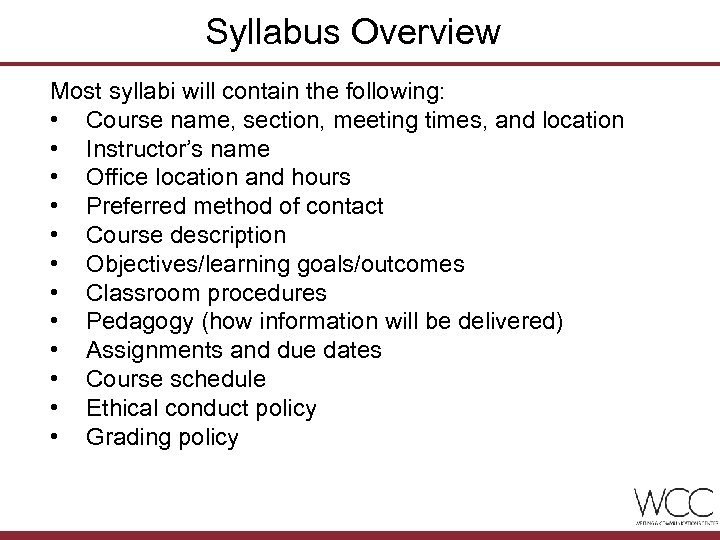 Syllabus Overview Most syllabi will contain the following: • Course name, section, meeting times, and location • Instructor’s name • Office location and hours • Preferred method of contact • Course description • Objectives/learning goals/outcomes • Classroom procedures • Pedagogy (how information will be delivered) • Assignments and due dates • Course schedule • Ethical conduct policy • Grading policy
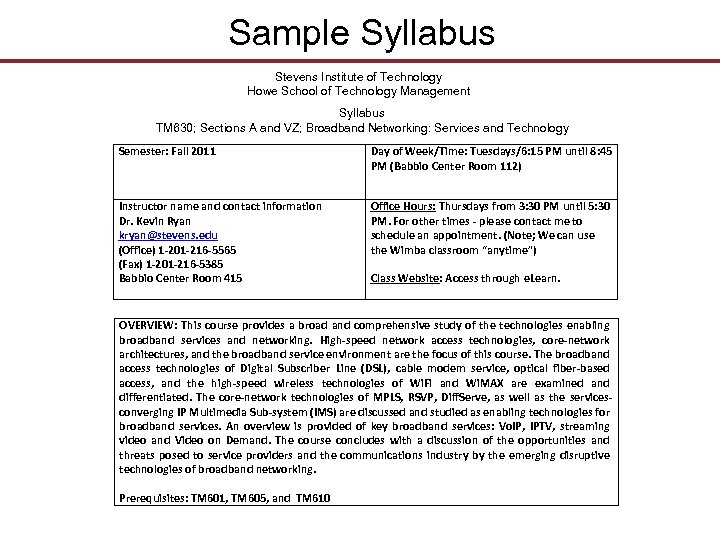 Sample Syllabus Stevens Institute of Technology Howe School of Technology Management Syllabus TM 630; Sections A and VZ; Broadband Networking: Services and Technology Semester: Fall 2011 Day of Week/Time: Tuesdays/6: 15 PM until 8: 45 PM (Babbio Center Room 112) Instructor name and contact information Dr. Kevin Ryan kryan@stevens. edu (Office) 1 -201 -216 -5565 (Fax) 1 -201 -216 -5385 Babbio Center Room 415 Office Hours: Thursdays from 3: 30 PM until 5: 30 PM. For other times - please contact me to schedule an appointment. (Note; We can use the Wimba classroom “anytime”) Class Website: Access through e. Learn. OVERVIEW: This course provides a broad and comprehensive study of the technologies enabling broadband services and networking. High-speed network access technologies, core-network architectures, and the broadband service environment are the focus of this course. The broadband access technologies of Digital Subscriber Line (DSL), cable modem service, optical fiber-based access, and the high-speed wireless technologies of Wi. Fi and Wi. MAX are examined and differentiated. The core-network technologies of MPLS, RSVP, Diff. Serve, as well as the servicesconverging IP Multimedia Sub-system (IMS) are discussed and studied as enabling technologies for broadband services. An overview is provided of key broadband services: Vo. IP, IPTV, streaming video and Video on Demand. The course concludes with a discussion of the opportunities and threats posed to service providers and the communications industry by the emerging disruptive technologies of broadband networking. Prerequisites: TM 601, TM 605, and TM 610
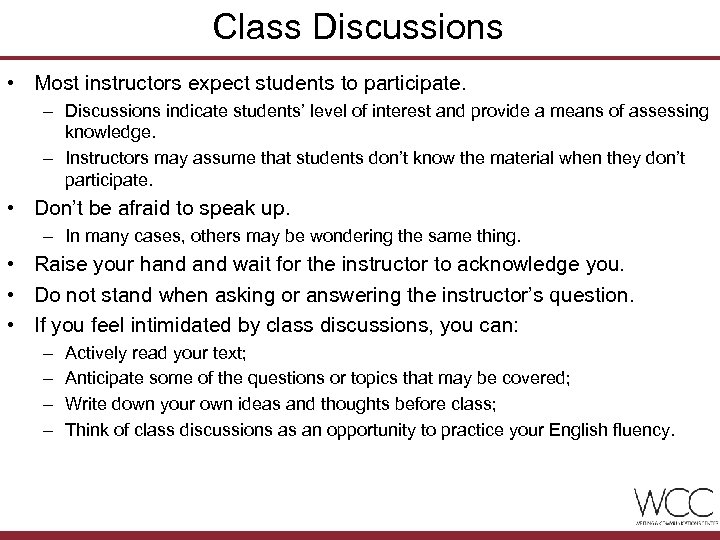 Class Discussions • Most instructors expect students to participate. – Discussions indicate students’ level of interest and provide a means of assessing knowledge. – Instructors may assume that students don’t know the material when they don’t Example participate. photo layout • Don’t be afraid to speak up. – In many cases, others may be wondering the same thing. • Raise your hand wait for the instructor to acknowledge you. • Do not stand when asking or answering the instructor’s question. • If you feel intimidated by class discussions, you can: – – Actively read your text; Anticipate some of the questions or topics that may be covered; Write down your own ideas and thoughts before class; Think of class discussions as an opportunity to practice your English fluency.
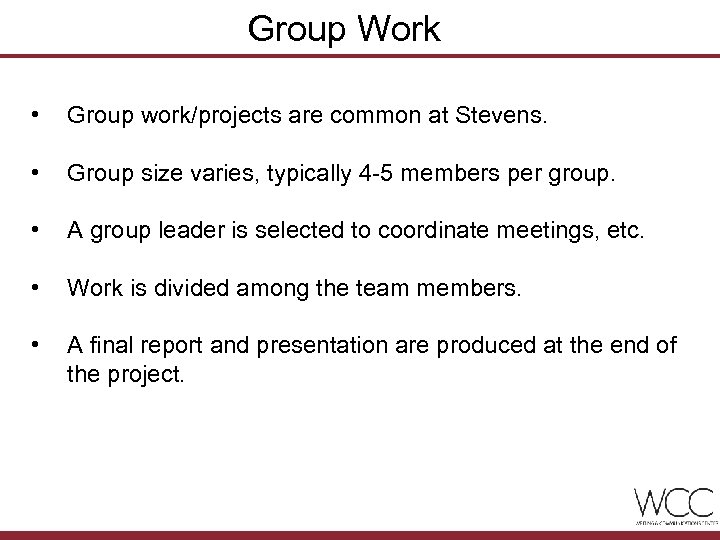 Group Work • Group work/projects are common at Stevens. • Group size varies, typically 4 -5 members per group. • A group leader is selected to coordinate meetings, etc. • Work is divided among the team members. • A final report and presentation are produced at the end of the project.
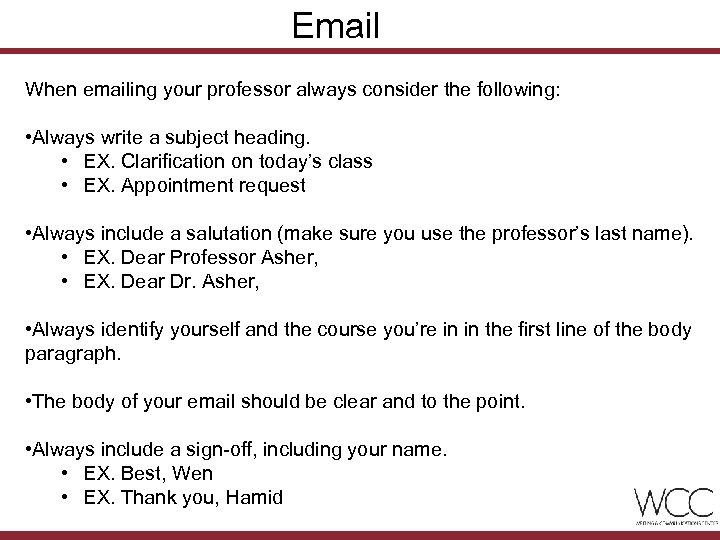 Email When emailing your professor always consider the following: • Always write a subject heading. • EX. Clarification on today’s class • EX. Appointment request • Always include a salutation (make sure you use the professor’s last name). • EX. Dear Professor Asher, • EX. Dear Dr. Asher, • Always identify yourself and the course you’re in in the first line of the body paragraph. • The body of your email should be clear and to the point. • Always include a sign-off, including your name. • EX. Best, Wen • EX. Thank you, Hamid
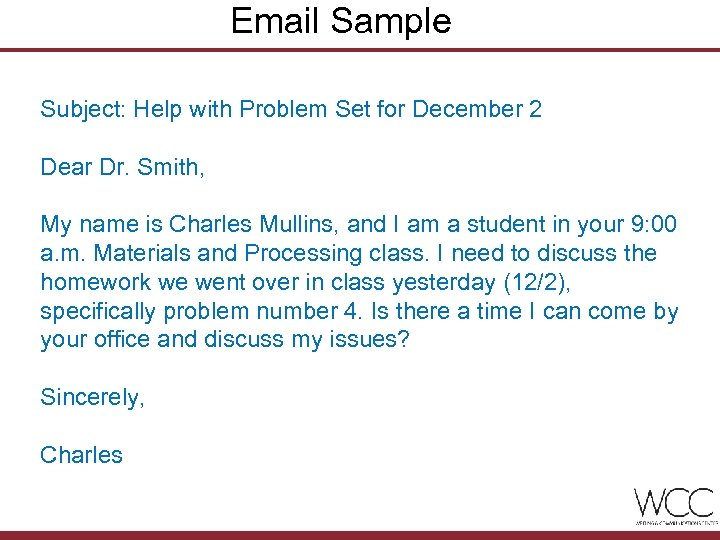 Email Sample Subject: Help with Problem Set for December 2 Dear Dr. Smith, My name is Charles Mullins, and I am a student in your 9: 00 a. m. Materials and Processing class. I need to discuss the homework we went over in class yesterday (12/2), specifically problem number 4. Is there a time I can come by your office and discuss my issues? Sincerely, Charles
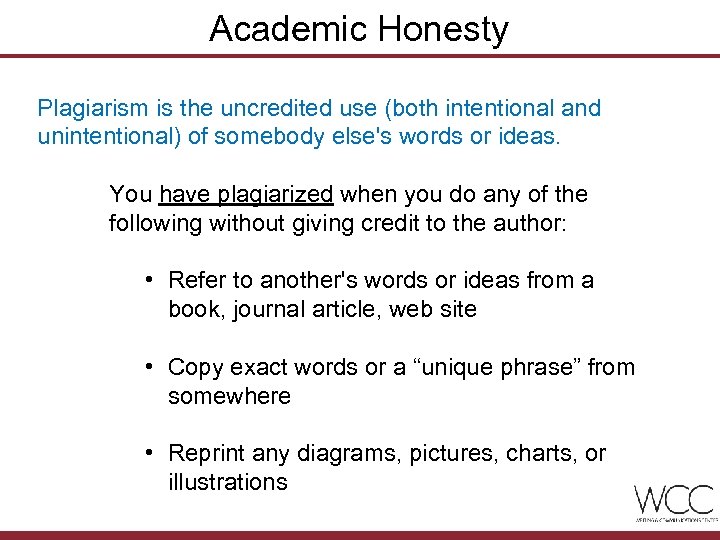 Academic Honesty Plagiarism is the uncredited use (both intentional and unintentional) of somebody else's words or ideas. Example photo layout You have plagiarized when you do any of the following without giving credit to the author: • Refer to another's words or ideas from a book, journal article, web site • Copy exact words or a “unique phrase” from somewhere • Reprint any diagrams, pictures, charts, or illustrations
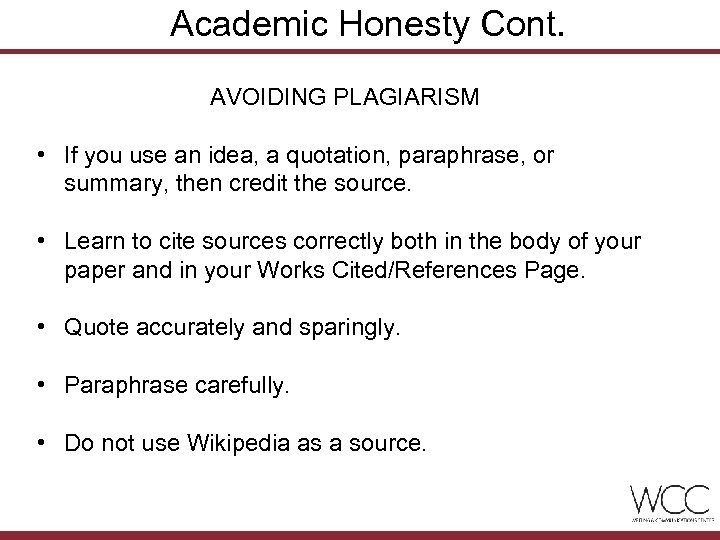 Academic Honesty Cont. AVOIDING PLAGIARISM • If you use an idea, a quotation, paraphrase, or summary, then credit the source. • Learn to cite sources correctly both in the body of your paper and in your Works Cited/References Page. • Quote accurately and sparingly. • Paraphrase carefully. • Do not use Wikipedia as a source.
 Seeking Help § Ask your professor, T. A. , or classmate(s) for assistance. § Write down any questions you may have during the lecture. Example photo layout § Raise your hand to ask a question during class, or ask your questions after class while they are fresh in your mind. § Make friends or acquaintances in your classes and form study groups. § Email your professor or classmates for assistance.
 Writing & Communications Center For free help with • writing • Located in Morton 210 • public speaking • Open to all students at Stevens • presentations • Find current hours and make an appointment at http: //www. stevens. edu/cal/wcc • English conversation • and more
 Other resources English Conversation Group every Friday from 12: 00 -1: 00 PM, beginning January 17 rd. Conversation group is relaxed and informal, nothing to prepare, no appointments necessary. Come to Morton 210 and meet your fellow grad students. The CAL Language Lab, in Peirce 107, features an excellent pronunciation workshop video series and Stevens’ own Online Writing Tutorial. The Purdue OWL is a great resource for a variety of writing; it has useful guidance and exercises for non-native speakers (and writers) of English. You can find it at http: //owl. english. purdue. edu/
 References Eberly Center for Teaching Excellence and Intercultural Communications. (n. d. ) Recognizing and addressing cultural variation in the classroom. Retrieved from http: //www. cmu. edu/teaching/resources/ Publications. Archives/Internal. Reports/culturalvariations. pdf Van Horn, M. C. (2011). Resources for multilingual writers and ESL. In D. Hacker & N. Sommers, A writer’s reference (7 th ed. ) (E 1 a-E 1 c). Boston, MA: Bedford/Saint Martin. Gebhard, J. G. (2013). International students’ adjustment problems and behaviors. Journal of international students, 2, 184 -193.