


 Скачать презентацию Undergraduate Involvement in Space-Related Research Presentation to the
82e05a4f3f4689248a40686006ded373.ppt
- Количество слайдов: 19
 Undergraduate Involvement in Space-Related Research Presentation to the Committee of 100 Board of Advisors October 15, 1999 Chris Hall Aerospace and Ocean Engineering (540) 231 -2314 chall@aoe. vt. edu http: //www. aoe. vt. edu/~chall
 Overview • Aerospace and Ocean Engineering • Undergraduate research involvement in AOE • Space-related research and education • Undergraduate involvement in space-related research
 Aerospace and Ocean Engineering • 19 Faculty in – – aerodynamics and hydrodynamics structural mechanics dynamics and control design of aircraft, spacecraft, and ships • Yearly graduation rate of approximately – 60 Bachelors of Science – 25 Masters of Science – 15 Doctor of Philosophy • $3. 5 million annual research funding • Ranked 10 th in Aerospace Engineering departments in the United States (US News & World Report)
 Undergraduate Projects in AOE • Recently received University Exemplary Department Award in recognition of undergraduate research opportunities • Research involves students at all levels • World-class research facilities are used in lab courses – Stability Wind Tunnel – Flight Simulation Laboratory • Research incorporated into Senior Capstone Design Courses • Design projects include collaborations – France, England Thailand for aircraft projects – Georgia Tech and Technical University of Vienna for spacecraft projects • Design projects regularly win in competitions – Space design took First Prize in 1998 – Aircraft design took Second and Third Prizes in 1998
 Innovation in Design Education • Vertical integration of freshmen through seniors – Now a standard feature in several of our projects • Horizontal integration of engineering majors – Aerospace vehicle design teams typically include students from several departments • Multi-university collaborations – Design teams use internet, teleconferences, and international travel – Last year’s 1 st prize-winning Space Design team included students from VT and Georgia Tech – Last year’s 3 rd prize-winning Aircraft Design team included students from VT and Loughborough University • Practical experience of faculty contributes to design education – Example: Nathan Kirschbaum, retired Grumman engineer
 Other Departmental Recognition • Grants from The Boeing Company and Lockheed Martin Aerospace – support undergraduate research and multidisciplinary design • Professor Lutze received AIAA’s National Outstanding Faculty Advisor Award • Professor Schetz received AIAA’s Contribution to Society Award • Professors Cliff, Durham, and Marchman received College of Engineering recognition for their education and research programs
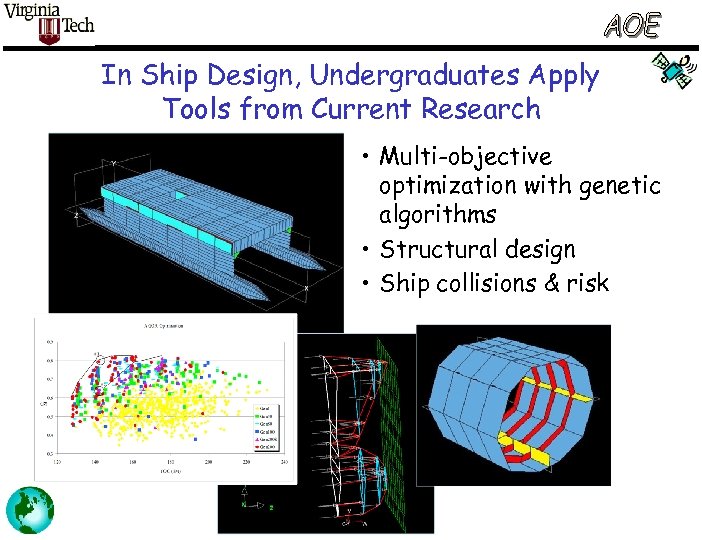 In Ship Design, Undergraduates Apply Tools from Current Research • Multi-objective optimization with genetic algorithms • Structural design • Ship collisions & risk
 My Background • 20 years in the USAF – technician, satellite systems engineer, and professor • 5½ years at the Air Force Institute of Technology – Taught space systems engineering, nonlinear dynamics and control – 27 M. S. students and 3 Ph. D. students in space-related research • 2+ years at Virginia Tech – Teaching space design and spacecraft dynamics and control – 1 M. S. graduate, currently advising 3 M. S. and 1 Ph. D. as well as several undergrads – Research supported by NASA, NSF, and USAF
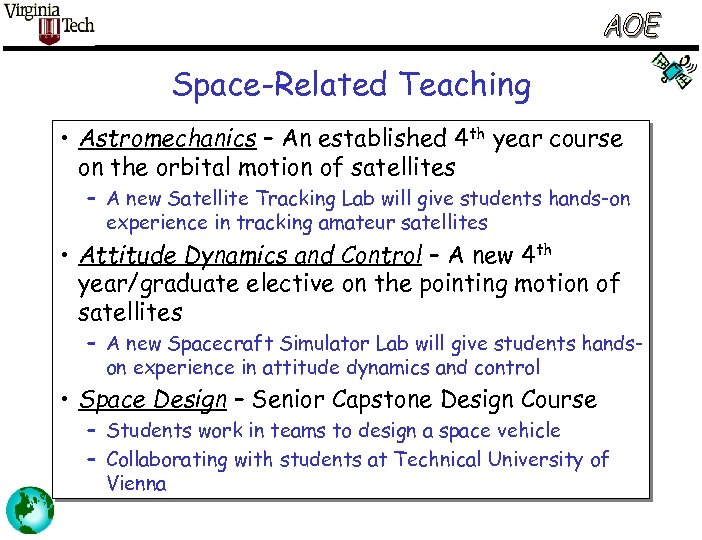 Space-Related Teaching • Astromechanics – An established 4 th year course on the orbital motion of satellites – A new Satellite Tracking Lab will give students hands-on experience in tracking amateur satellites • Attitude Dynamics and Control – A new 4 th year/graduate elective on the pointing motion of satellites – A new Spacecraft Simulator Lab will give students handson experience in attitude dynamics and control • Space Design – Senior Capstone Design Course – Students work in teams to design a space vehicle – Collaborating with students at Technical University of Vienna
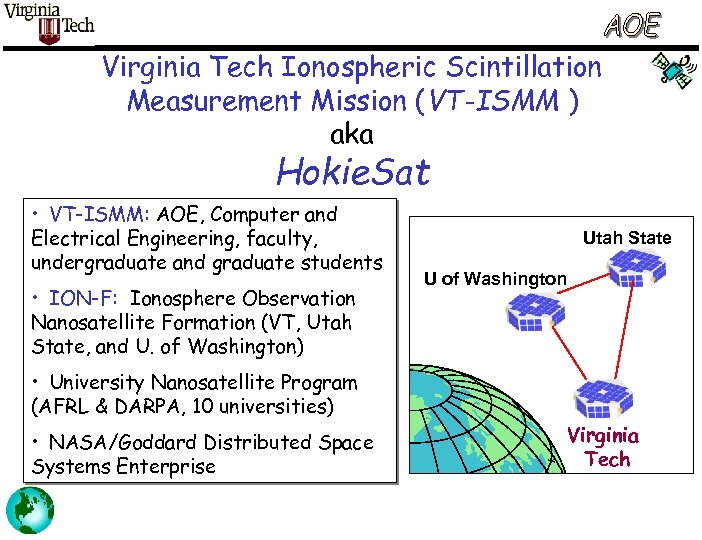 Virginia Tech Ionospheric Scintillation Measurement Mission (VT-ISMM ) aka Hokie. Sat • VT-ISMM: AOE, Computer and Electrical Engineering, faculty, undergraduate and graduate students • ION-F: Ionosphere Observation Nanosatellite Formation (VT, Utah State, and U. of Washington) Utah State U of Washington • University Nanosatellite Program (AFRL & DARPA, 10 universities) X • NASA/Goddard Distributed Space Systems Enterprise Virginia Tech
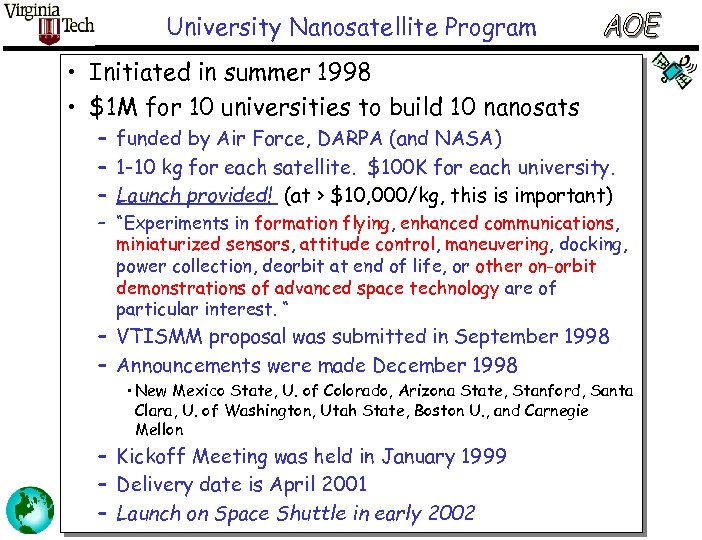 University Nanosatellite Program • Initiated in summer 1998 • $1 M for 10 universities to build 10 nanosats – funded by Air Force, DARPA (and NASA) – 1 -10 kg for each satellite. $100 K for each university. – Launch provided! (at > $10, 000/kg, this is important) – “Experiments in formation flying, enhanced communications, miniaturized sensors, attitude control, maneuvering, docking, power collection, deorbit at end of life, or other on-orbit demonstrations of advanced space technology are of particular interest. “ – VTISMM proposal was submitted in September 1998 – Announcements were made December 1998 • New Mexico State, U. of Colorado, Arizona State, Stanford, Santa Clara, U. of Washington, Utah State, Boston U. , and Carnegie Mellon – Kickoff Meeting was held in January 1999 – Delivery date is April 2001 – Launch on Space Shuttle in early 2002
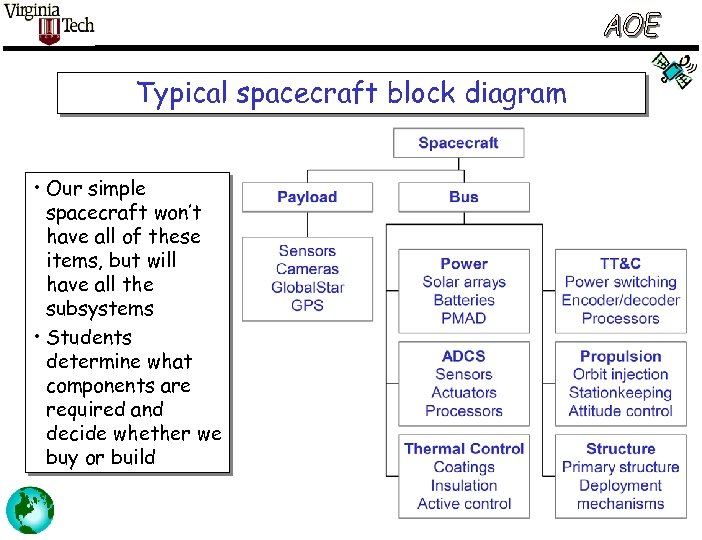 Typical spacecraft block diagram • Our simple spacecraft won’t have all of these items, but will have all the subsystems • Students determine what components are required and decide whether we buy or build
 Hokie. Sat Mission Objectives • Educational – maximize student involvement – enhance space design experience – improve space-related courses • Technological – – “formation flying” GPS orbit determination microsensor attitude determination Telemetry, Tracking & Commanding (TT&C) using Global. Star – near-autonomous mission operations over the internet • Scientific – contribute to ionospheric scintillation research
 Student Research Involvement • More than 20 AOE undergraduates have contributed to the project – Tether dynamics analysis and design – Modeling and simulation – Structural analysis and design • A similar number of ECp. E undergraduates have contributed – Flight computer design – Communications analysis and design – Power system analysis and design • At least 5 related M. S. theses as undergraduates stay for graduate school
 Faculty Involvement • Nat Davis, Computer Engineering – Flight computer selection, design, fabrication • Jason Lai, Electrical Engineering – Power system, batteries, solar cells • Chris Hall, Aerospace Engineering – System configuration, structure, flight dynamics • Wayne Scales, Electrical Engineering – GPS, ionospheric scintillation science mission • Warren Stutzman, Electrical Engineering – Communications
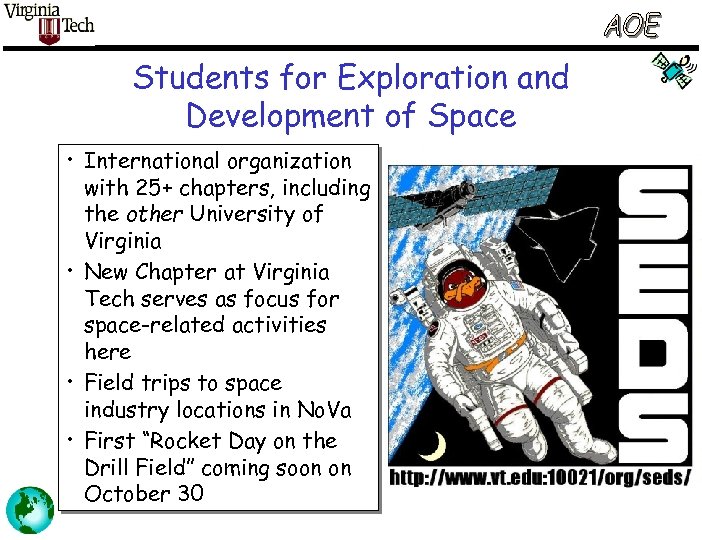 Students for Exploration and Development of Space • International organization with 25+ chapters, including the other University of Virginia • New Chapter at Virginia Tech serves as focus for space-related activities here • Field trips to space industry locations in No. Va • First “Rocket Day on the Drill Field” coming soon on October 30
 Summary • The Department of Aerospace and Ocean Engineering recognizes and fosters the synergy between research and undergraduate education • Space-related activities are on the cutting edge of a field that is exciting to many students in and out of the Aerospace Engineering curriculum
 Ionosphere Observation Nanosatellite Formation (ION-F) • Three-satellite formation – Hokie. Sat (Virginia Tech) – Dawg. Star (U. of Washington) – USUSat (Utah State) • Integrated science mission for measuring properties and effects of the ionosphere • Formation flying demonstration mission – control relative position in “same orbit” and “same ground track” formations
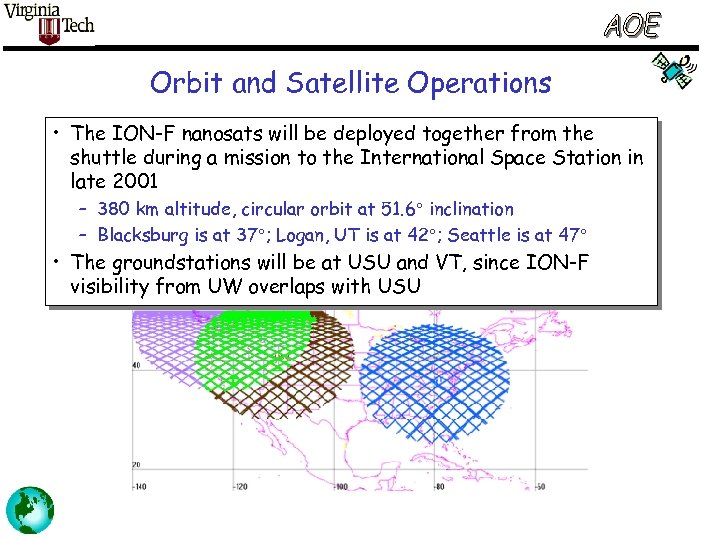 Orbit and Satellite Operations • The ION-F nanosats will be deployed together from the shuttle during a mission to the International Space Station in late 2001 – 380 km altitude, circular orbit at 51. 6 inclination – Blacksburg is at 37 ; Logan, UT is at 42 ; Seattle is at 47 • The groundstations will be at USU and VT, since ION-F visibility from UW overlaps with USU