


 Скачать презентацию Undergraduate Creativity at a Chinese University A U
ee4991c00cc899d38df51cd115ef041b.ppt
- Количество слайдов: 25
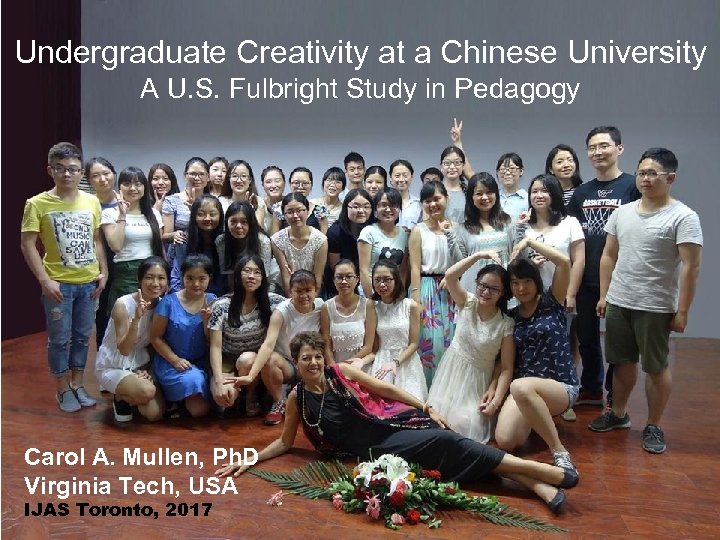 Undergraduate Creativity at a Chinese University A U. S. Fulbright Study in Pedagogy Carol A. Mullen, Ph. D Virginia Tech, USA IJAS Toronto, 2017
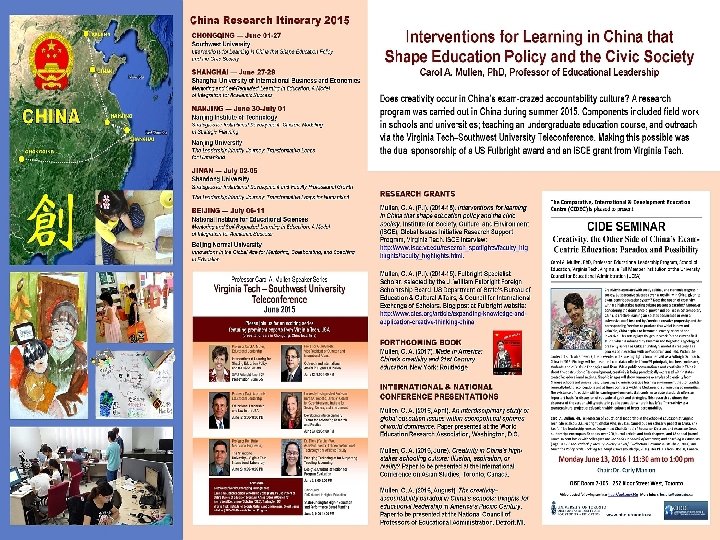
 Sponsors & Research Grants Mullen, C. A. (P. I). (2014 -15). Interventions for Learning in China that Shape Education Policy and the Civic Society. Fulbright Specialist Scholar, selected by the J. William Fulbright Foreign Scholarship Board, US Department of State’s Bureau of Education & Cultural Affairs, & Council for International Exchange of Scholars. Mullen, C. A. (P. I). (2014 -15). Interventions for learning in China that shape education policy and the civic society. Institute for Society, Culture, and Environment (ISCE), Global Issues Initiative Research Support Program, Virginia Tech.
 Influencing Pedagogy: Economics and Education in the Asia–Pacific Century
 Global Environmental Trends Asia is the new world center: “The future of geopolitics will be decided in Asia, not Afghanistan or Iraq, and the U. S. should be right at the center of the action” (H. Clinton, Former Secretary of State, 2011, p. 56) America is capitalizing on trade during this economic boom (Foreign Policy Initiative Forum, 2011) will be the “A special aspect of any Asian system relationship between the United States and China. It is often described as one between a rising power and an established power. Two successive American and Chinese presidents have announced their joint aim to deal with this matter on the basis of cooperation. Significant spokesmen in both countries have stressed the adversarial aspect. The direction taken will play a defining role in our period. ” (H. Kissinger, 2015, Former Secretary of State, p. 2)
 Educational Environmental Trends ● global education (peace, social justice, creative education) ● global-mindedness=capacity to create across cultures ● education reforms: Programme for International Student Assessment (PISA) (reading, math, & science): competitive global free-market economy ● mutual aping (China & US): creativity & testing
 Creativity in China: Paradox & Possibility Purpose To displace one-dimensional thinking in study of creativity in China Primary Research Question Does creativity occur in China’s exam-crazed accountability culture? Specific Questions Does China, at the forefront of enforced test-centric schooling, display any creativity in education? Is it even plausible that creativity in education could thrive in a communist regime? With this country’s commitment to lead the international ratings for tested subjects in education, is creative learning merely an aspiration? If it does occur, is creativity an isolated occurrence or even a subversive act, a counterforce within the normative
 Creativity Defined Making something, seeing differently, and solving problems; relating unrelated things makes the ordinary extraordinary Moving disciplines & societies (Kaufman & Beghetto, 2009) “Mysterious process of coming up with new ideas and new things, bringing into existence something genuinely new that is valued enough to be added to the culture” (Csikszentmihalyi, 1996, pp. 6– 25) Unstructured decision making; beyond problemsolving, “question posing” (Eisner, 2001/2004)
 Creativity Blends Creativity, innovation, and invention are interchanged: “Creativity implies some measure of invention” (Schwab, 1969/2004, p. 114) Versus Creativity Differentiated “Creativity: Capability/act of conceiving something original or unusual” “Innovation: Implementation of something new” “Invention: Creation of something that has never been made before” (Hunter, 2013, p. 9) My study: Creativity and the other terms as they fit + question-posing, meaning-making, problem solving,
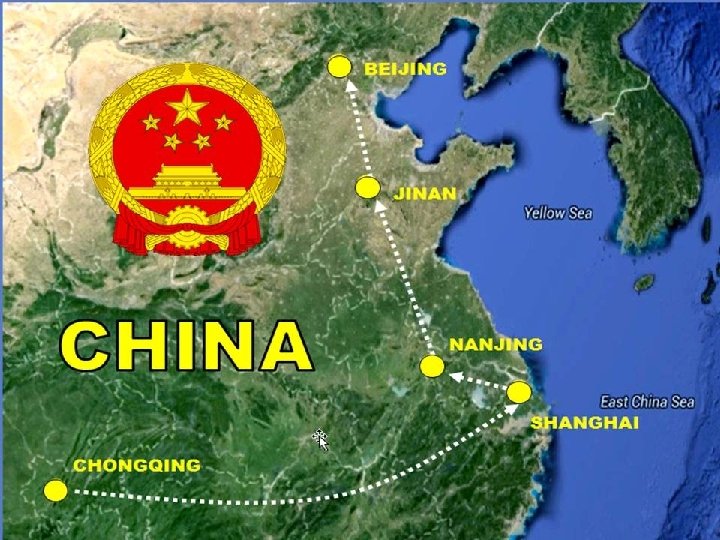
 Eclectic Methods for Creativity Study ● field work in schools and universities (2015– 2016) ● undergraduate preservice education course (2015) ● outreach via the VT–Southwest University Teleconference ● data collection on creative education: conversations, interviews, & reflective activities ● 110 study participants at 9 educational places-- 6 schooling sites: 3 universities: public kindergarten school Southwest University, Chongqing, C public rural elementary school Shandong University, Jinan, China public special education school Virginia Tech, Blacksburg, USA private pre. K– 12 Montessori school public high school teaching training institute (slide 1 of 2)
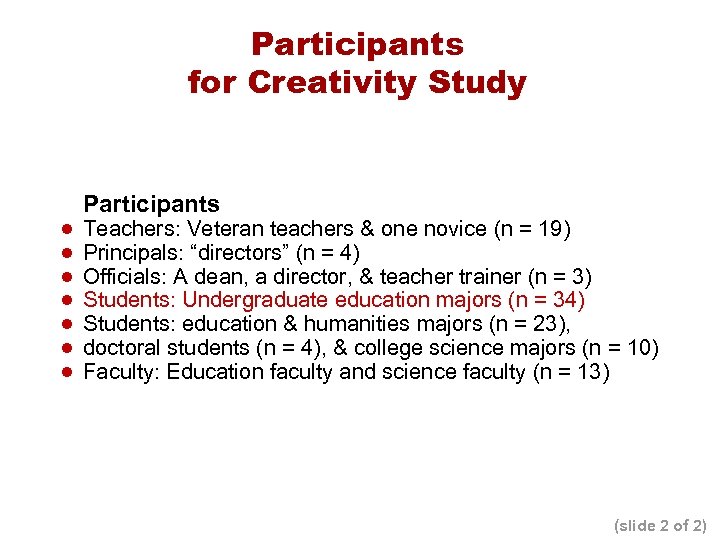 Participants for Creativity Study ● ● ● ● Participants Teachers: Veteran teachers & one novice (n = 19) Principals: “directors” (n = 4) Officials: A dean, a director, & teacher trainer (n = 3) Students: Undergraduate education majors (n = 34) Students: education & humanities majors (n = 23), doctoral students (n = 4), & college science majors (n = 10) Faculty: Education faculty and science faculty (n = 13) (slide 2 of 2)
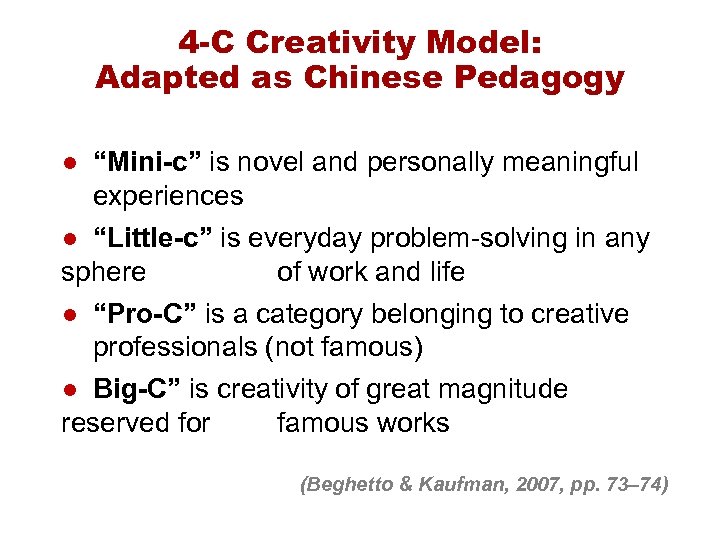 4 -C Creativity Model: Adapted as Chinese Pedagogy ● “Mini-c” is novel and personally meaningful experiences ● “Little-c” is everyday problem-solving in any sphere of work and life ● “Pro-C” is a category belonging to creative professionals (not famous) ● Big-C” is creativity of great magnitude reserved for famous works (Beghetto & Kaufman, 2007, pp. 73– 74)
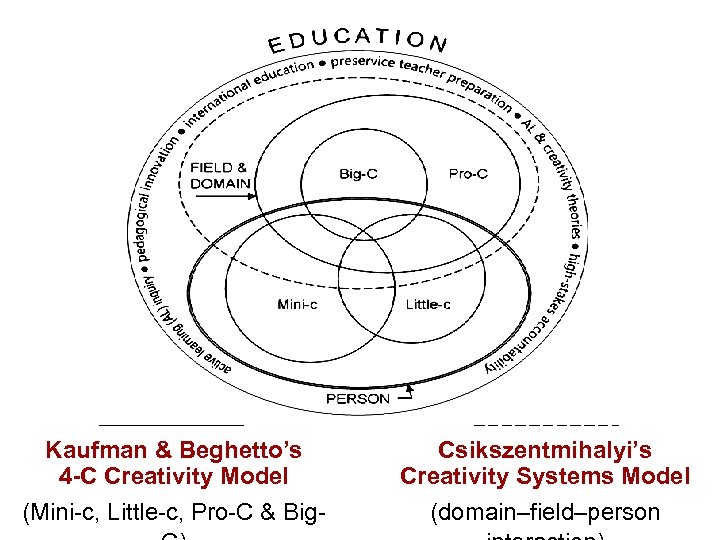 Kaufman & Beghetto’s 4 -C Creativity Model Csikszentmihalyi’s Creativity Systems Model (Mini-c, Little-c, Pro-C & Big- (domain–field–person
 Larva—Creativity in Undergraduate Education: Case Study
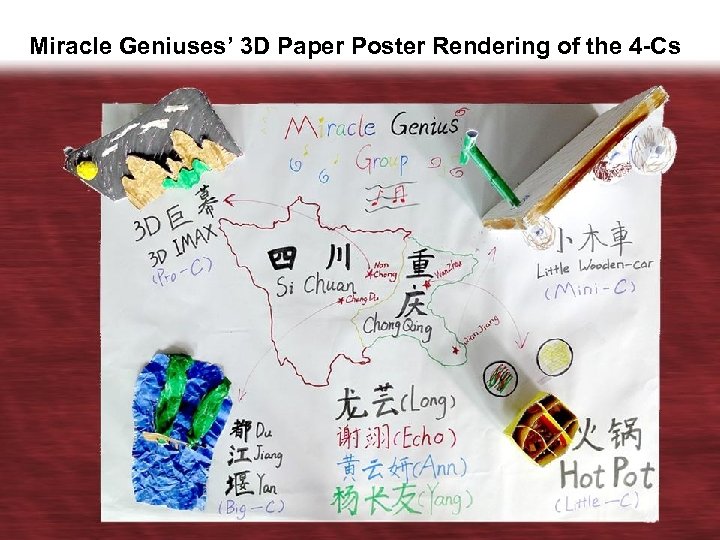 Miracle Geniuses’ 3 D Paper Poster Rendering of the 4 -Cs
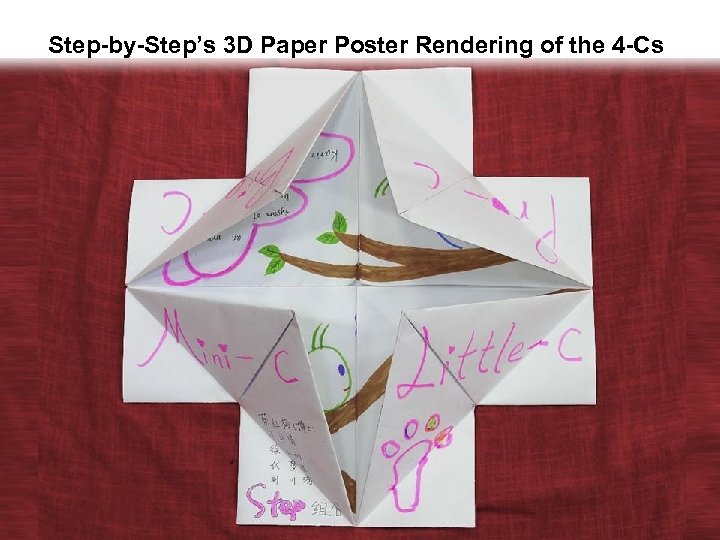 Step-by-Step’s 3 D Paper Poster Rendering of the 4 -Cs
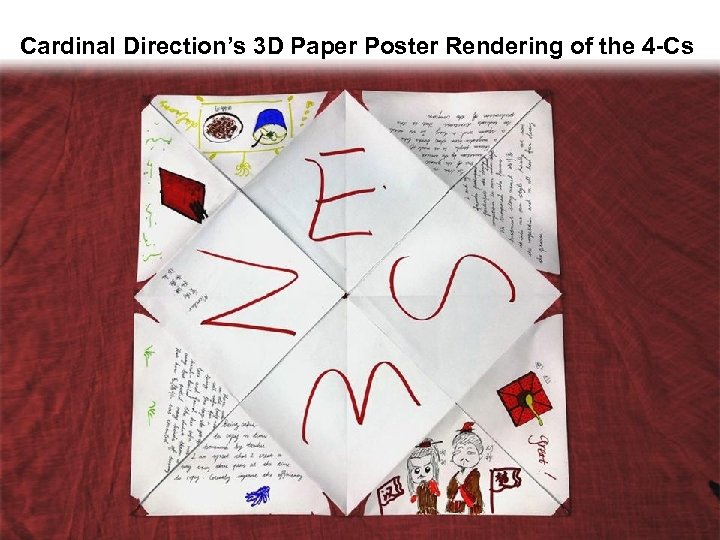 Cardinal Direction’s 3 D Paper Poster Rendering of the 4 -Cs
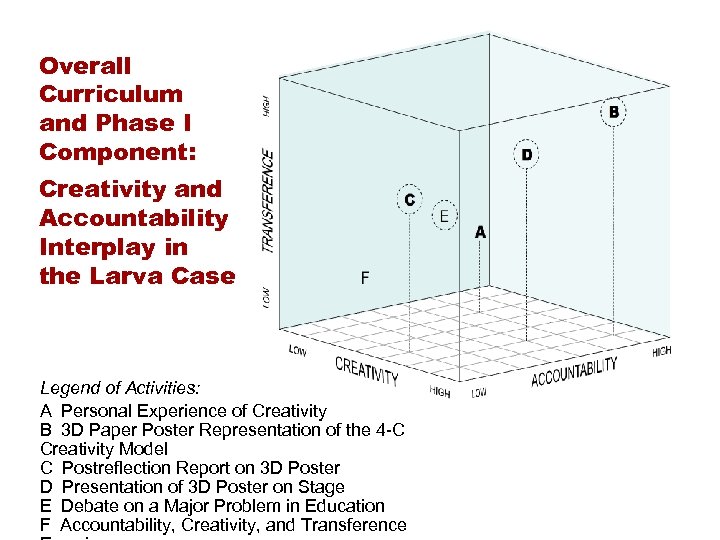 Overall Curriculum and Phase I Component: Creativity and Accountability Interplay in the Larva Case Legend of Activities: A Personal Experience of Creativity B 3 D Paper Poster Representation of the 4 -C Creativity Model C Postreflection Report on 3 D Poster D Presentation of 3 D Poster on Stage E Debate on a Major Problem in Education F Accountability, Creativity, and Transference
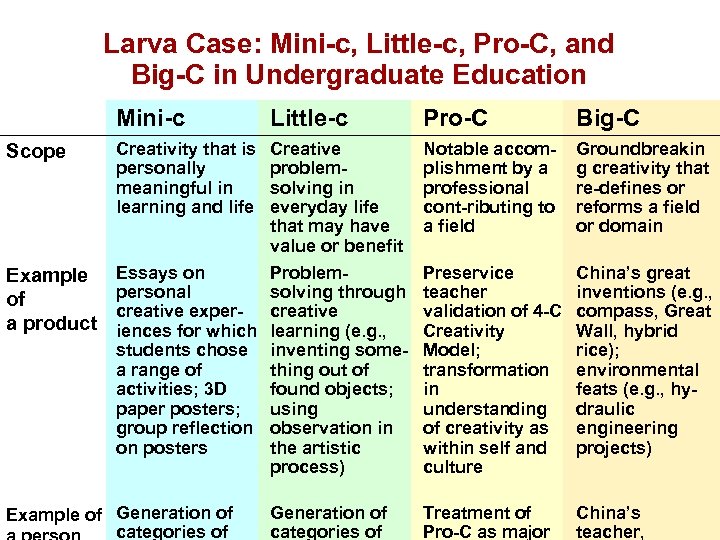 Larva Case: Mini-c, Little-c, Pro-C, and Big-C in Undergraduate Education Mini-c Scope Example of a product Little-c Creativity that is personally meaningful in learning and life Creative problemsolving in everyday life that may have value or benefit Essays on Problempersonal solving through creative expercreative iences for which learning (e. g. , students chose inventing somea range of thing out of activities; 3 D found objects; paper posters; using group reflection observation in on posters the artistic process) Example of Generation of categories of Pro-C Big-C Notable accomplishment by a professional cont-ributing to a field Groundbreakin g creativity that re-defines or reforms a field or domain Preservice teacher validation of 4 -C Creativity Model; transformation in understanding of creativity as within self and culture China’s great inventions (e. g. , compass, Great Wall, hybrid rice); environmental feats (e. g. , hydraulic engineering projects) Treatment of Pro-C as major China’s teacher,
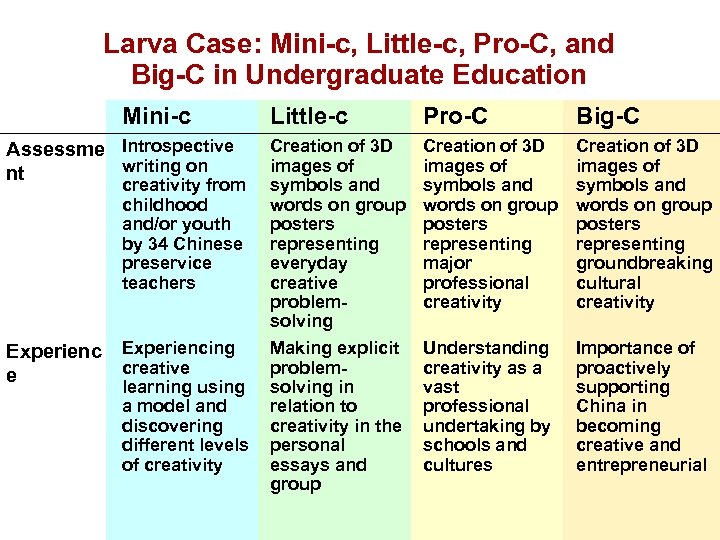 Larva Case: Mini-c, Little-c, Pro-C, and Big-C in Undergraduate Education Mini-c Assessme Introspective writing on nt creativity from childhood and/or youth by 34 Chinese preservice teachers Experienc e Experiencing creative learning using a model and discovering different levels of creativity Little-c Pro-C Big-C Creation of 3 D images of symbols and words on group posters representing everyday creative problemsolving Making explicit problemsolving in relation to creativity in the personal essays and group Creation of 3 D images of symbols and words on group posters representing major professional creativity Creation of 3 D images of symbols and words on group posters representing groundbreaking cultural creativity Understanding creativity as a vast professional undertaking by schools and cultures Importance of proactively supporting China in becoming creative and entrepreneurial
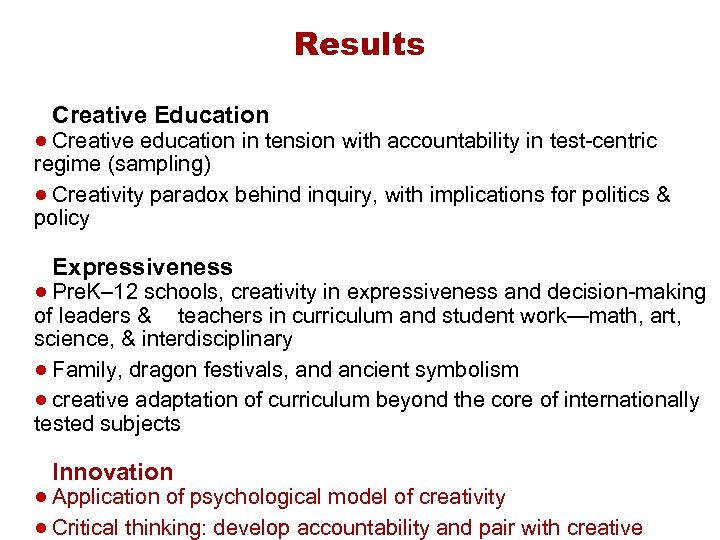 Results Creative Education ● Creative education in tension with accountability in test-centric regime (sampling) ● Creativity paradox behind inquiry, with implications for politics & policy Expressiveness ● Pre. K– 12 schools, creativity in expressiveness and decision-making of leaders & teachers in curriculum and student work—math, art, science, & interdisciplinary ● Family, dragon festivals, and ancient symbolism ● creative adaptation of curriculum beyond the core of internationally tested subjects Innovation ● Application of psychological model of creativity ● Critical thinking: develop accountability and pair with creative
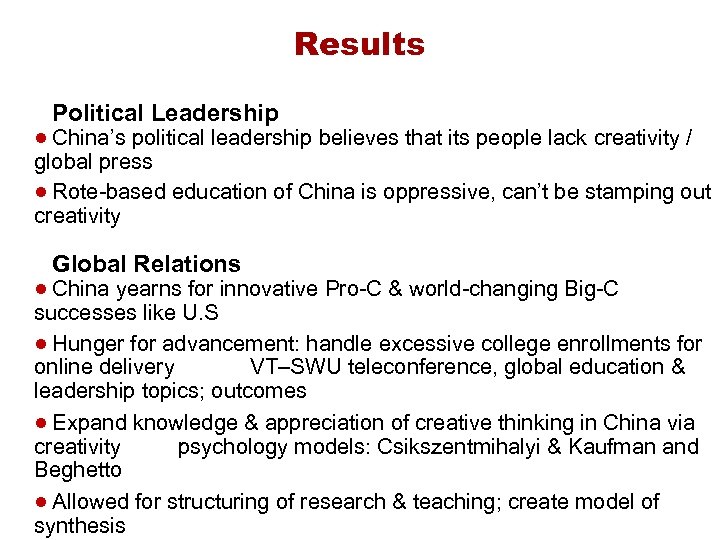 Results Political Leadership ● China’s political leadership believes that its people lack creativity / global press ● Rote-based education of China is oppressive, can’t be stamping out creativity Global Relations ● China yearns for innovative Pro-C & world-changing Big-C successes like U. S ● Hunger for advancement: handle excessive college enrollments for online delivery VT–SWU teleconference, global education & leadership topics; outcomes ● Expand knowledge & appreciation of creative thinking in China via creativity psychology models: Csikszentmihalyi & Kaufman and Beghetto ● Allowed for structuring of research & teaching; create model of synthesis
 Select References Beghetto, R. A. , & Kaufman, J. C. (2007). Toward a broader conception of creativity: A case for “mini-c” creativity. Psychology of Aesthetics, Creativity, and the Arts, 1(2), 73– 79. Clinton, H. R. (2011). America’s Pacific century. Foreign Policy, 189, 56– 63. Csikszentmihalyi, M. (1996). Creativity: The psychology of discovery and invention. London: Harper. Perennial. Eisner, E. W. (2001/2004). What does it mean to say that a school is doing well? In D. J. Flinders & S. J. Thornton (Eds. ), The curriculum studies reader (2 nd ed. ) (pp. 297– 305). New York: Routledge. Foreign Policy Initiative Forum. (2011, December 13). The Obama Administration's Pivot to Asia: A Conversation with Assistant Secretary Kurt Campbell. Session at the Foreign Policy Initiative Forum. [transcript. ] Retrieved from http: //www. foreignpolicyi. org/files/uploads/images/Asia%20 Pivot. pdf Hunter, G. S. (2013). Out think: How innovative leaders drive exceptional outcomes. Mississauga, ON: John Wiley & Sons Canada. Kaufman, J. C. , & Beghetto, R. A. (2009). Beyond big and little: The Four C Model of creativity. Review of General Psychology, 13(1), 1– 12. Kissinger, H. (2015, January 29). Opening Statement by Dr. Henry A. Kissinger before the United States Senate Committee on Armed Services at a hearing convened to discuss “Global Challenges and U. S. National Security Strategy” (pp. 1– 3) [Speeches and Public Statements]. Retrieved from http: //www. henryakissinger. com/speeches/012915. html Mullen, C. A. (2017, in press). Creativity and education in China: Paradox and possibilities for an era of accountability. New York: Routledge & Kappa Delta Pi. Schwab, J. (1969/2004). The practical: A language for curriculum. In D. J. Flinders & S. J.