 Скачать презентацию Underage Drinking A South Carolina Priority November 16
90ba3d890cecb0c19039a6a700139fcb.ppt
- Количество слайдов: 96



Underage Drinking: A South Carolina Priority November 16, 2010 CAST Training
State Epidemiological Outcomes Workgroup (SEOW) SEOW is a subcommittee of Gov. Council n Began meeting in 2006 n Determined four state priorities, approved by GC in 2008 n Underage Drinking n Alcohol-Related Traffic Crashes n Youth Tobacco Use (including smokeless tobacco) n Substance Use During Pregnancy n
Strategic Prevention Framework Consequences Consumption Causal Factors
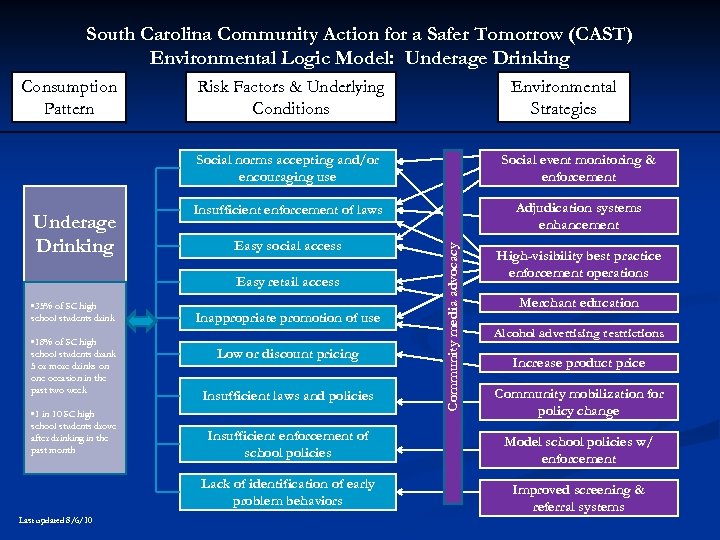
South Carolina Community Action for a Safer Tomorrow (CAST) Environmental Logic Model: Underage Drinking Consumption Pattern Risk Factors & Underlying Conditions Environmental Strategies Underage Drinking Social event monitoring & enforcement Insufficient enforcement of laws Adjudication systems enhancement Easy social access Easy retail access • 35% of SC high school students drink • 18% of SC high school students drank 5 or more drinks on one occasion in the past two week • 1 in 10 SC high school students drove after drinking in the past month Inappropriate promotion of use Low or discount pricing Insufficient laws and policies Community media advocacy Social norms accepting and/or encouraging use High-visibility best practice enforcement operations Merchant education Alcohol advertising restrictions Increase product price Community mobilization for policy change Model school policies w/ enforcement Lack of identification of early problem behaviors Last updated 8/6/10 Insufficient enforcement of school policies Improved screening & referral systems
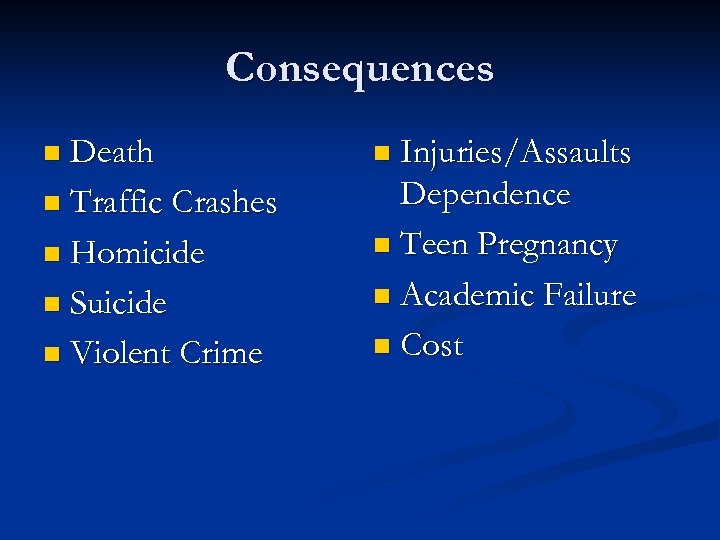
Consequences n Death n Injuries/Assaults n Traffic Crashes Dependence n Teen Pregnancy n Academic Failure n Cost n Homicide n Suicide n Violent Crime
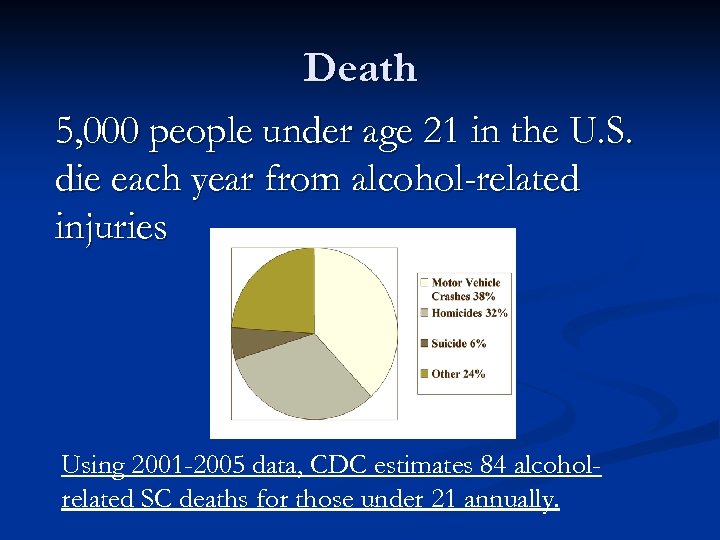
Death 5, 000 people under age 21 in the U. S. die each year from alcohol-related injuries Using 2001 -2005 data, CDC estimates 84 alcoholrelated SC deaths for those under 21 annually.
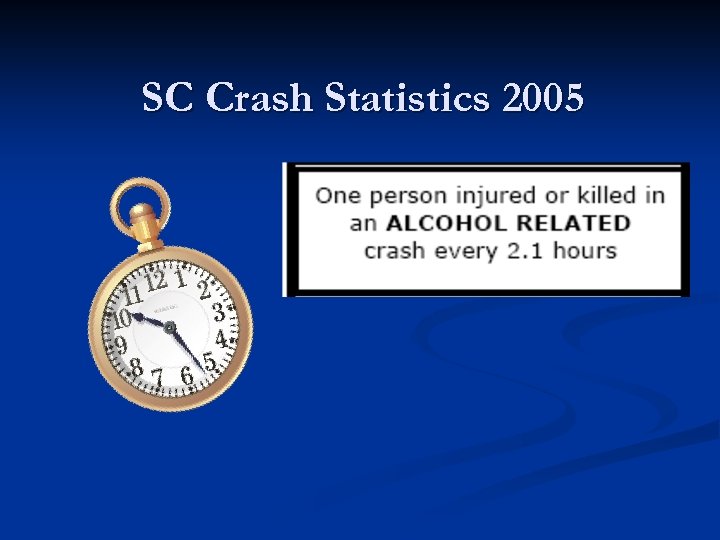
SC Crash Statistics 2005
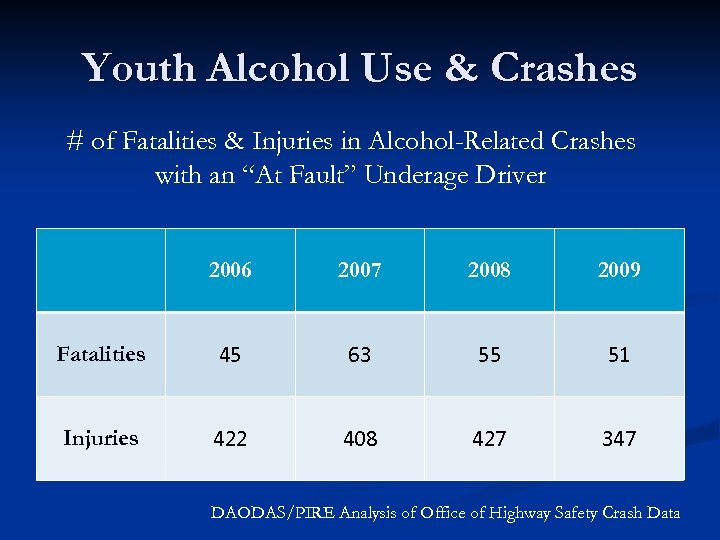
Youth Alcohol Use & Crashes # of Fatalities & Injuries in Alcohol-Related Crashes with an “At Fault” Underage Driver 2006 2007 2008 2009 Fatalities 45 63 55 51 Injuries 422 408 427 347 DAODAS/PIRE Analysis of Office of Highway Safety Crash Data
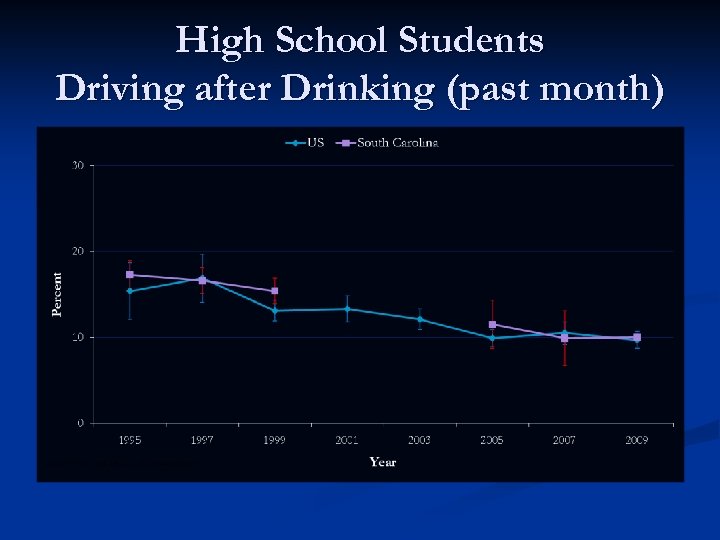
High School Students Driving after Drinking (past month)
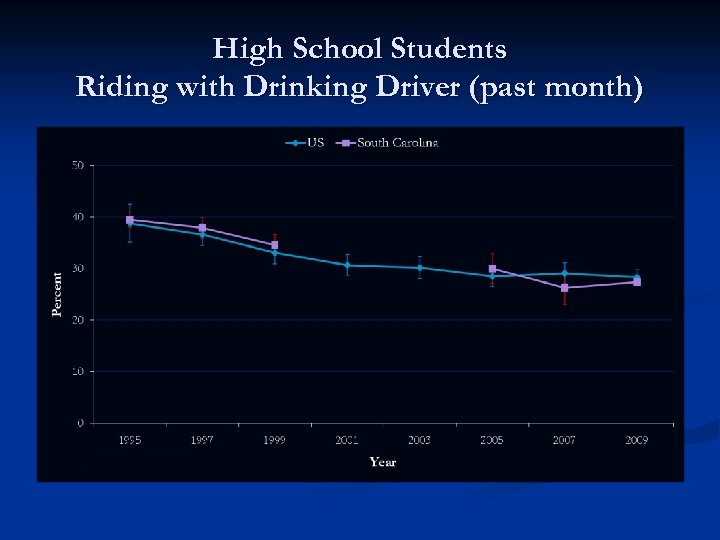
High School Students Riding with Drinking Driver (past month)
Homicide n Estimated 47% of homicides are alcohol-related (all ages) n SC: 7. 7 deaths per 100, 000 n 31% higher than US
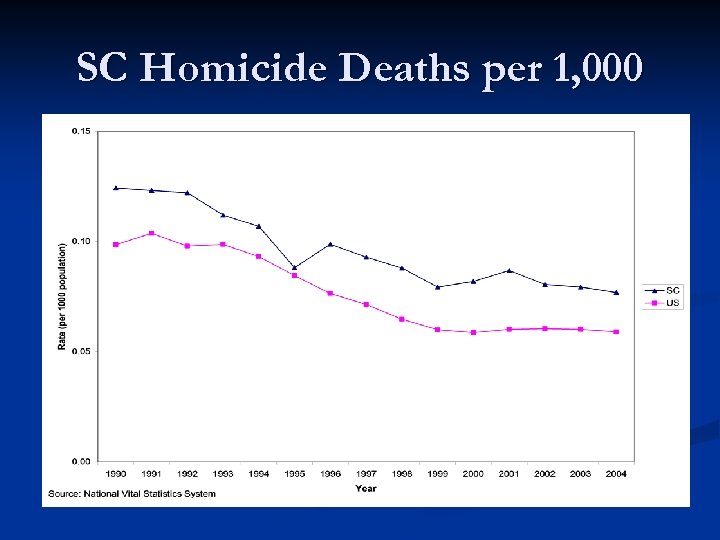
SC Homicide Deaths per 1, 000
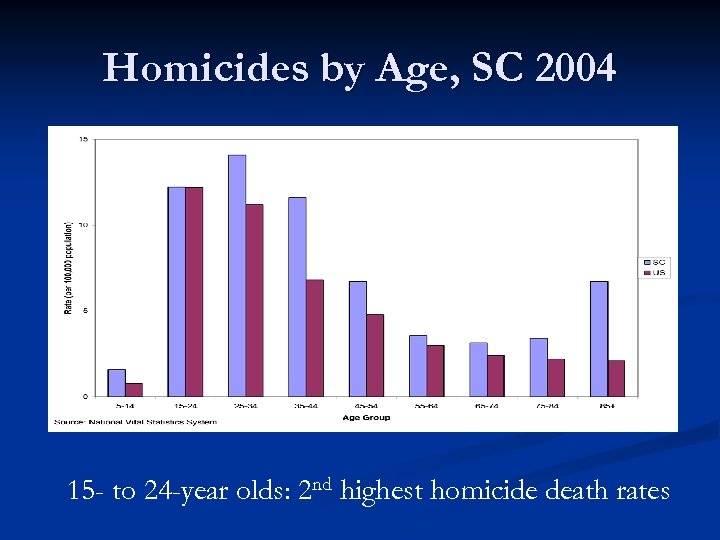
Homicides by Age, SC 2004 15 - to 24 -year olds: 2 nd highest homicide death rates
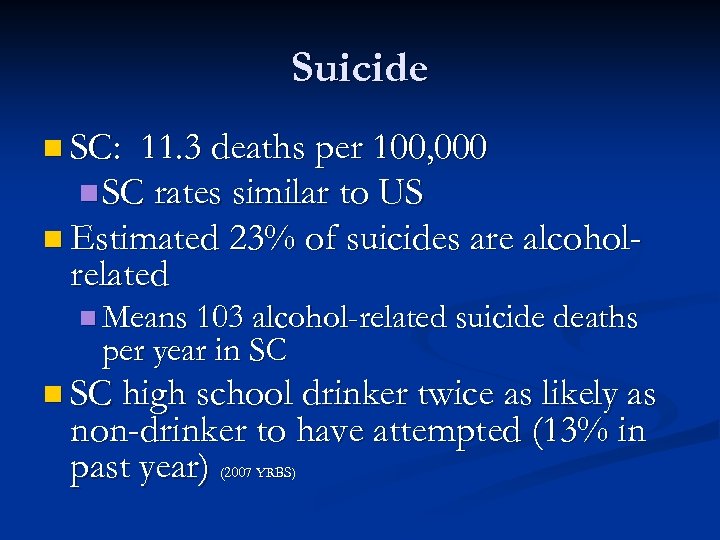
Suicide n SC: 11. 3 deaths per 100, 000 n SC rates similar to US n Estimated 23% of suicides are alcoholrelated n Means 103 alcohol-related suicide deaths per year in SC high school drinker twice as likely as non-drinker to have attempted (13% in past year) (2007 YRBS)
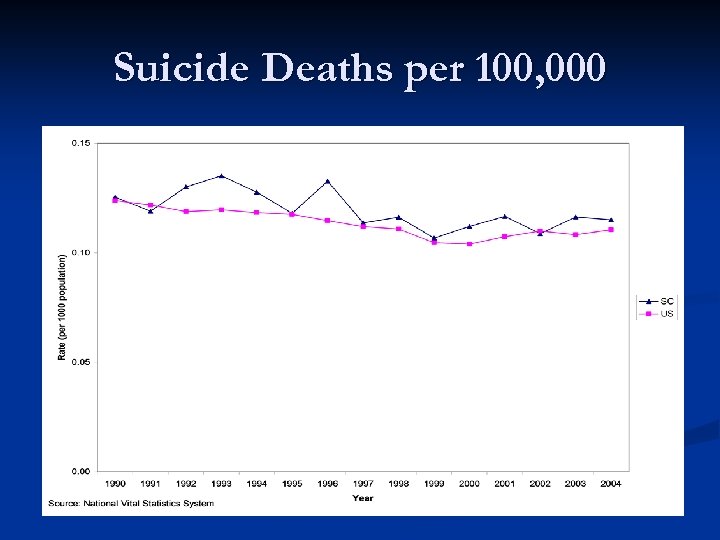
Suicide Deaths per 100, 000
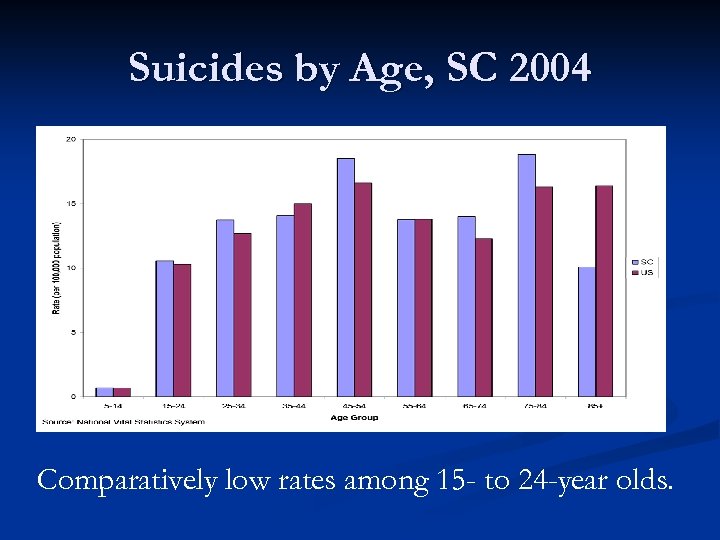
Suicides by Age, SC 2004 Comparatively low rates among 15 - to 24 -year olds.
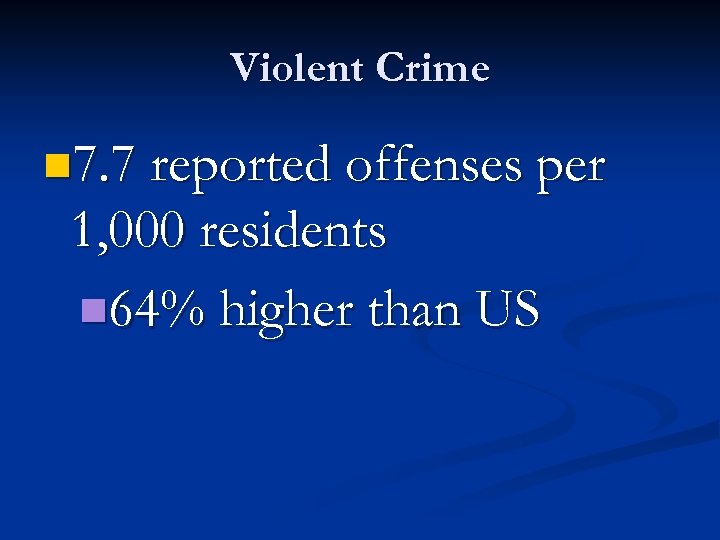
Violent Crime n 7. 7 reported offenses per 1, 000 residents n 64% higher than US
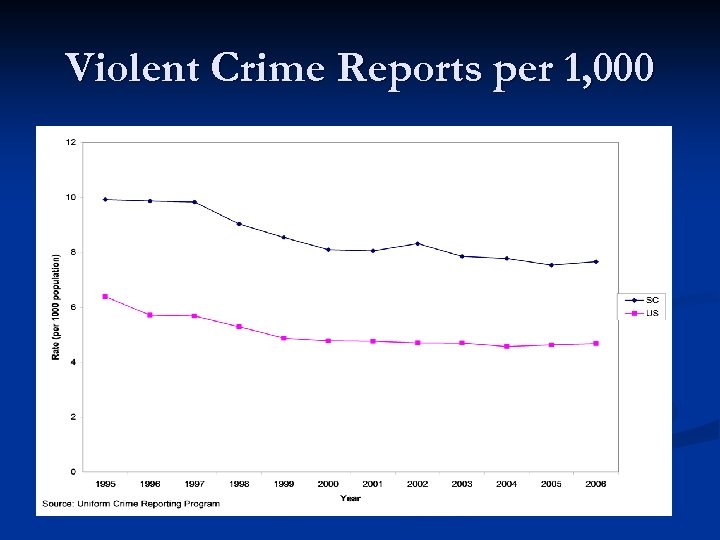
Violent Crime Reports per 1, 000
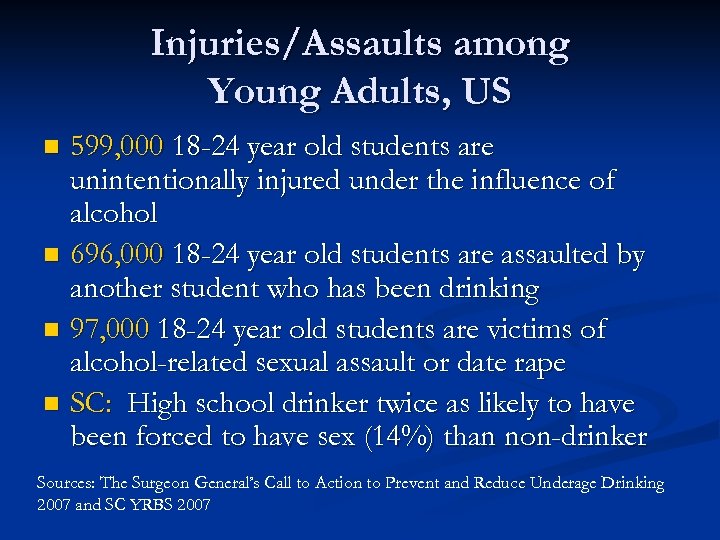
Injuries/Assaults among Young Adults, US n n 599, 000 18 -24 year old students are unintentionally injured under the influence of alcohol 696, 000 18 -24 year old students are assaulted by another student who has been drinking 97, 000 18 -24 year old students are victims of alcohol-related sexual assault or date rape SC: High school drinker twice as likely to have been forced to have sex (14%) than non-drinker Sources: The Surgeon General’s Call to Action to Prevent and Reduce Underage Drinking 2007 and SC YRBS 2007
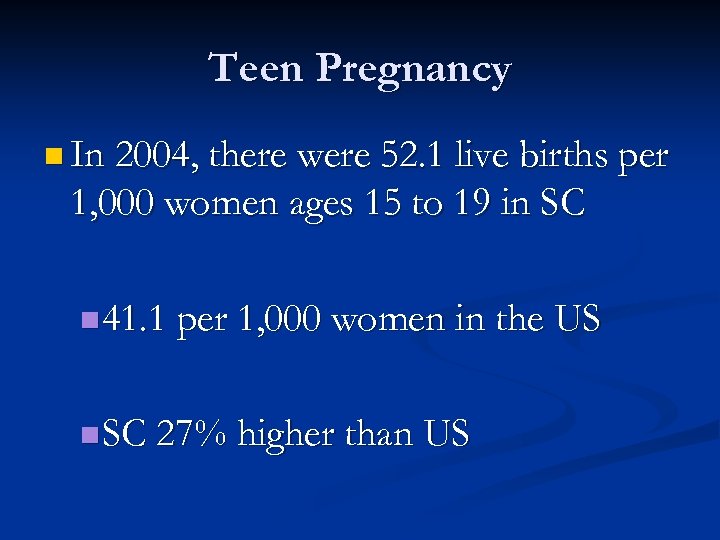
Teen Pregnancy n In 2004, there were 52. 1 live births per 1, 000 women ages 15 to 19 in SC n 41. 1 per 1, 000 women in the US n SC 27% higher than US
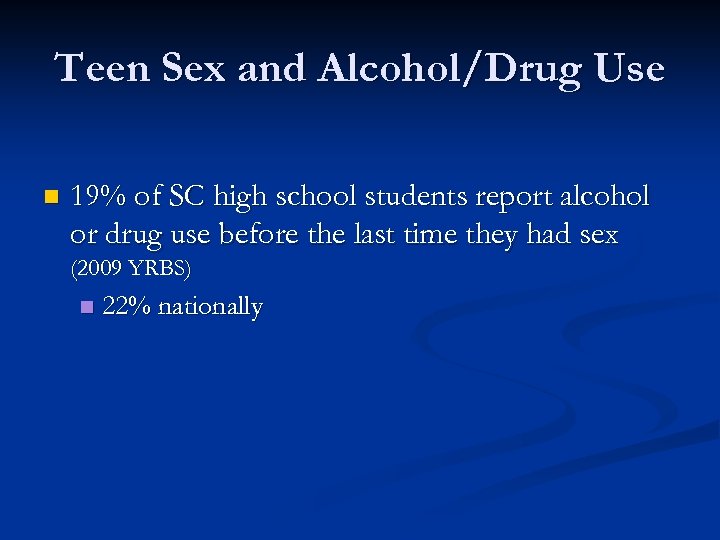
Teen Sex and Alcohol/Drug Use n 19% of SC high school students report alcohol or drug use before the last time they had sex (2009 YRBS) n 22% nationally
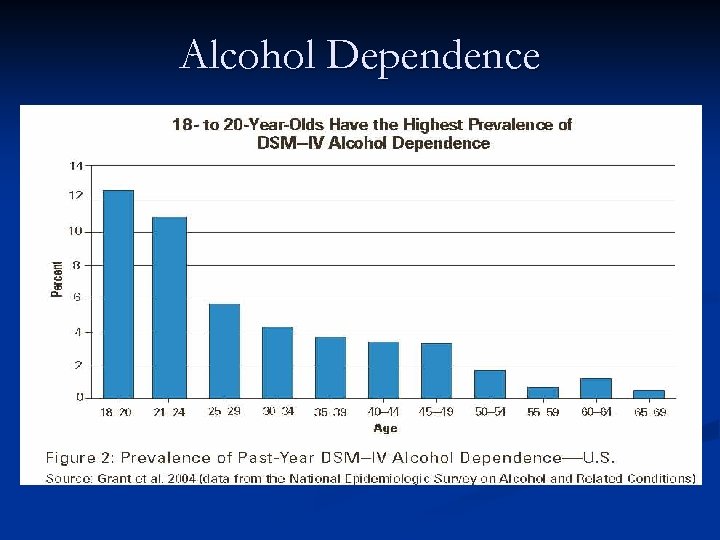
Alcohol Dependence
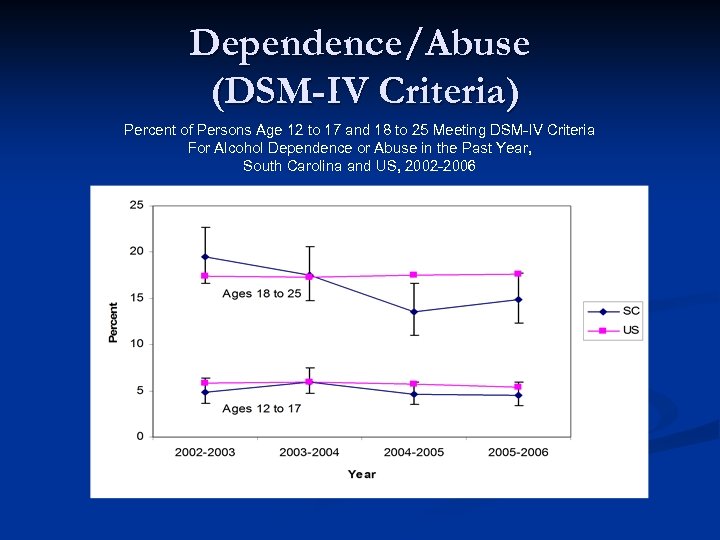
Dependence/Abuse (DSM-IV Criteria) Percent of Persons Age 12 to 17 and 18 to 25 Meeting DSM-IV Criteria For Alcohol Dependence or Abuse in the Past Year, South Carolina and US, 2002 -2006
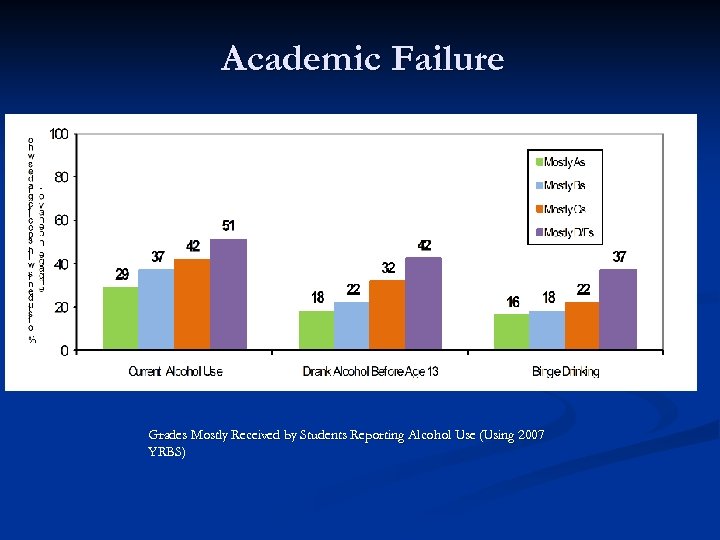
Academic Failure Grades Mostly Received by Students Reporting Alcohol Use (Using 2007 YRBS)
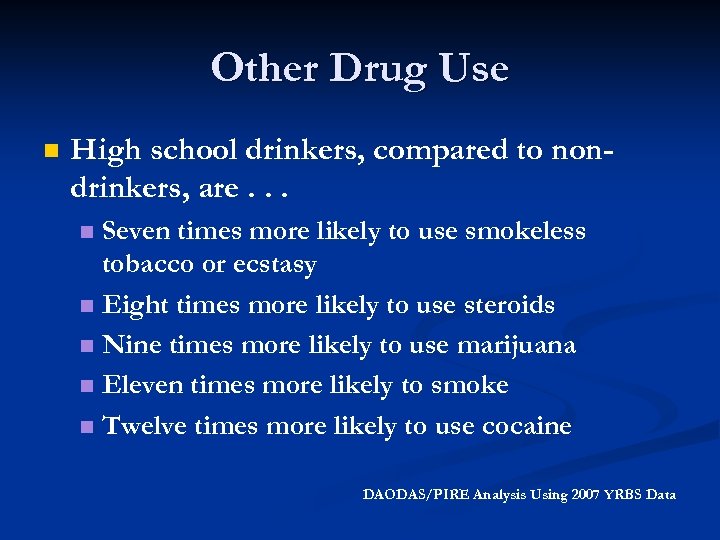
Other Drug Use n High school drinkers, compared to nondrinkers, are. . . Seven times more likely to use smokeless tobacco or ecstasy n Eight times more likely to use steroids n Nine times more likely to use marijuana n Eleven times more likely to smoke n Twelve times more likely to use cocaine n DAODAS/PIRE Analysis Using 2007 YRBS Data
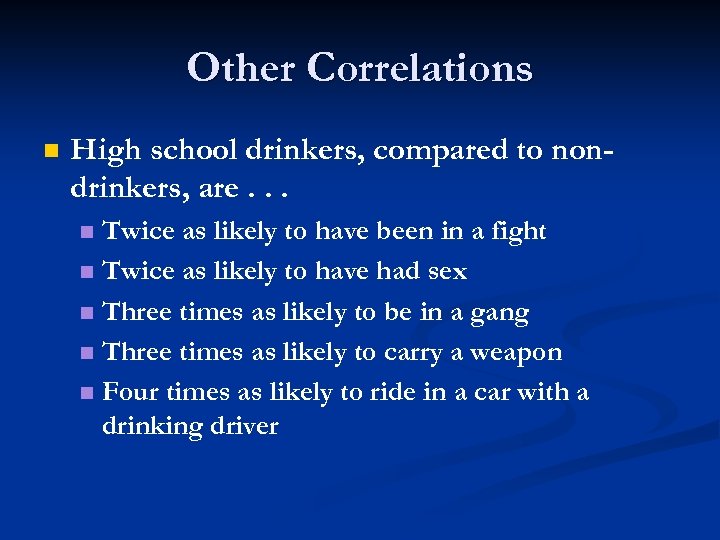
Other Correlations n High school drinkers, compared to nondrinkers, are. . . Twice as likely to have been in a fight n Twice as likely to have had sex n Three times as likely to be in a gang n Three times as likely to carry a weapon n Four times as likely to ride in a car with a drinking driver n
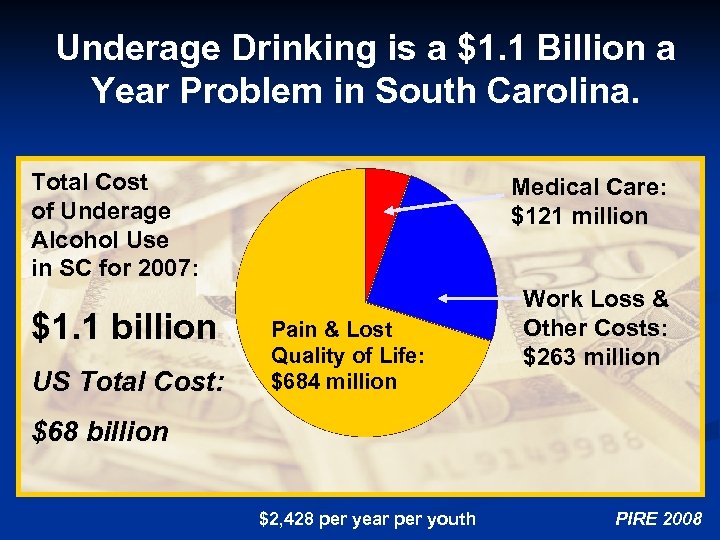
Underage Drinking is a $1. 1 Billion a Year Problem in South Carolina. Total Cost of Underage Alcohol Use in SC for 2007: $1. 1 billion US Total Cost: Medical Care: $121 million Pain & Lost Quality of Life: $684 million Work Loss & Other Costs: $263 million $68 billion $2, 428 per year per youth PIRE 2008
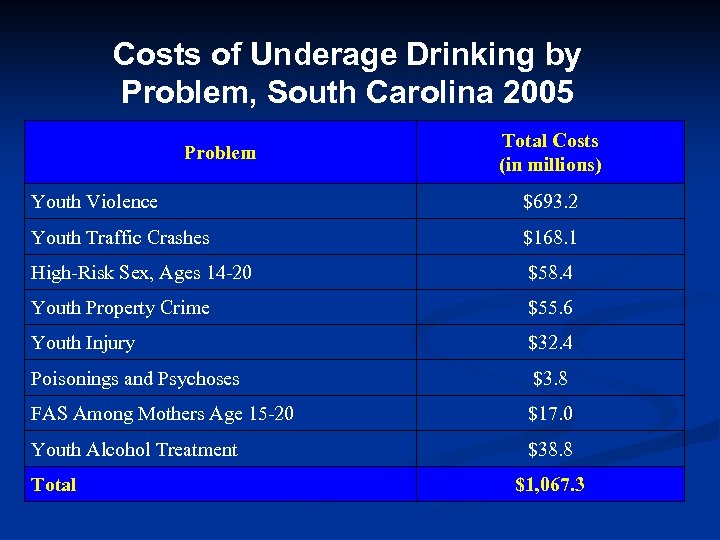
Costs of Underage Drinking by Problem, South Carolina 2005 Problem Total Costs (in millions) Youth Violence $693. 2 Youth Traffic Crashes $168. 1 High-Risk Sex, Ages 14 -20 $58. 4 Youth Property Crime $55. 6 Youth Injury $32. 4 Poisonings and Psychoses $3. 8 FAS Among Mothers Age 15 -20 $17. 0 Youth Alcohol Treatment $38. 8 Total $1, 067. 3
Consumption Patterns n SC Middle School Use n SC Adult Use n SC College Use n Age of First Use n SC High School Use n How much they drink n What they drink n Where they drink
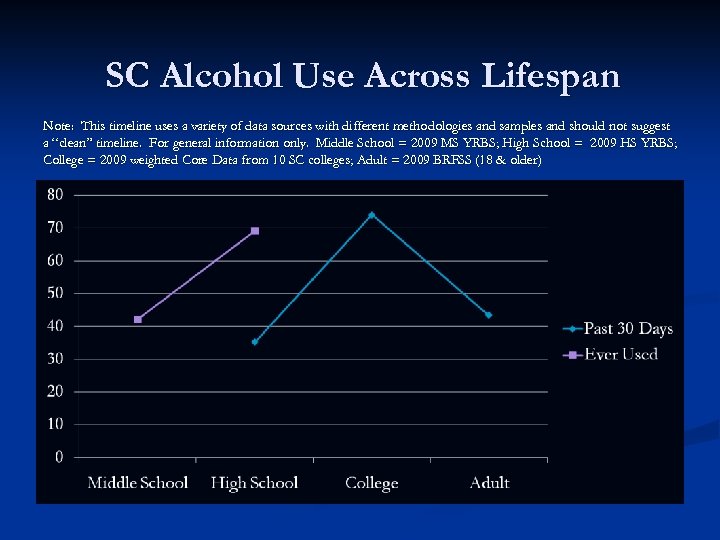
SC Alcohol Use Across Lifespan Note: This timeline uses a variety of data sources with different methodologies and samples and should not suggest a “clean” timeline. For general information only. Middle School = 2009 MS YRBS; High School = 2009 HS YRBS; College = 2009 weighted Core Data from 10 SC colleges; Adult = 2009 BRFSS (18 & older)
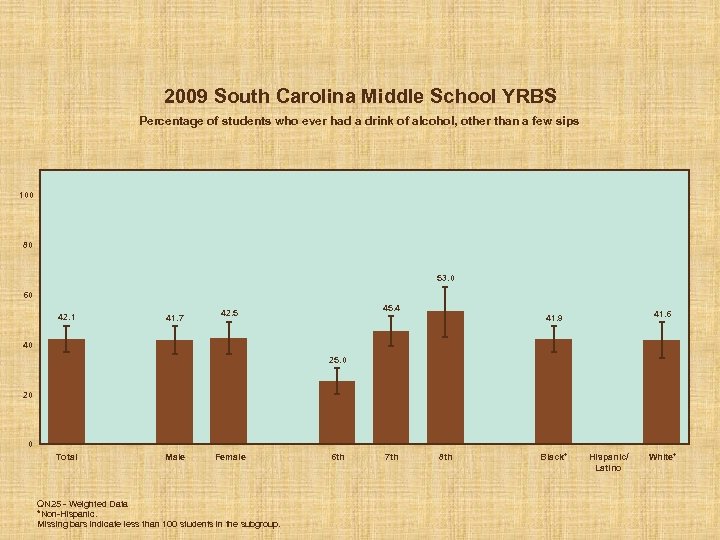
2009 South Carolina Middle School YRBS Percentage of students who ever had a drink of alcohol, other than a few sips 100 80 53. 0 60 42. 1 41. 7 45. 4 42. 5 41. 6 41. 9 40 25. 0 20 0 Total Male Female QN 25 - Weighted Data *Non-Hispanic. Missing bars indicate less than 100 students in the subgroup. 6 th 7 th 8 th Black* Hispanic/ Latino White*
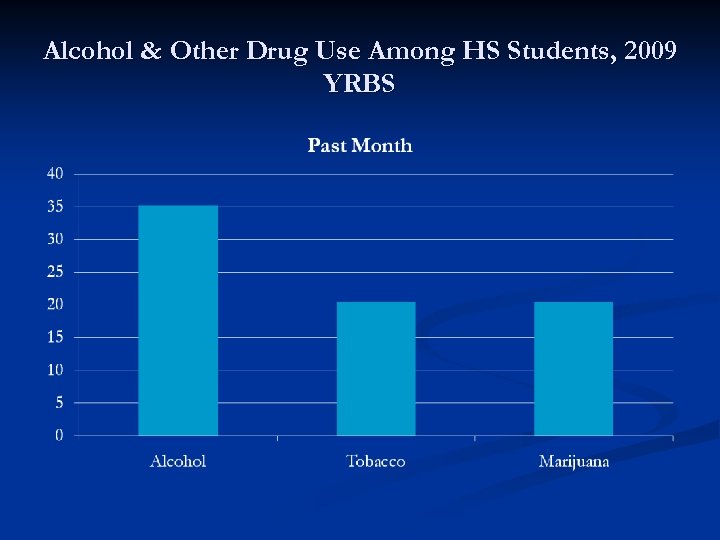
Alcohol & Other Drug Use Among HS Students, 2009 YRBS
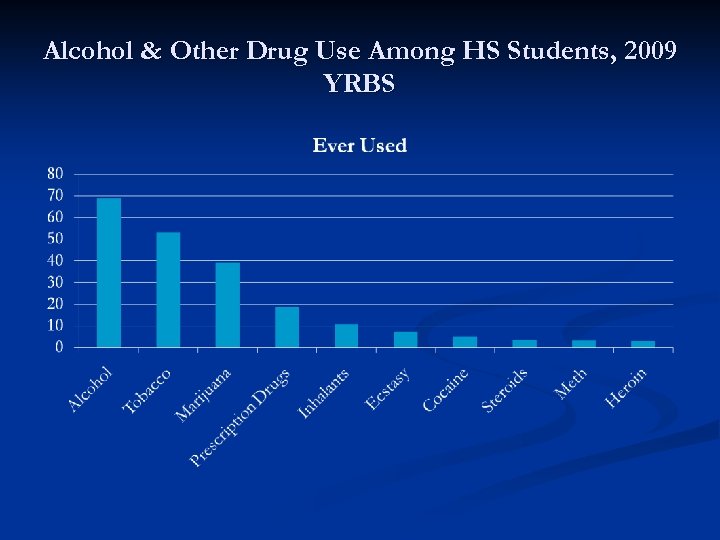
Alcohol & Other Drug Use Among HS Students, 2009 YRBS
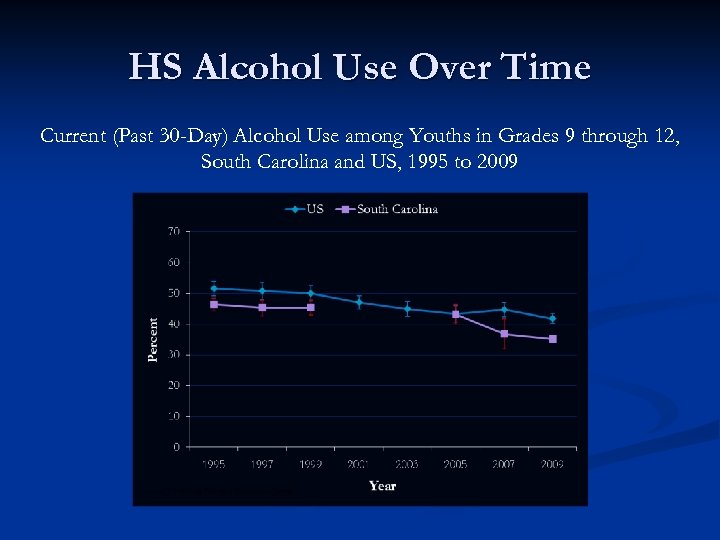
HS Alcohol Use Over Time Current (Past 30 -Day) Alcohol Use among Youths in Grades 9 through 12, South Carolina and US, 1995 to 2009
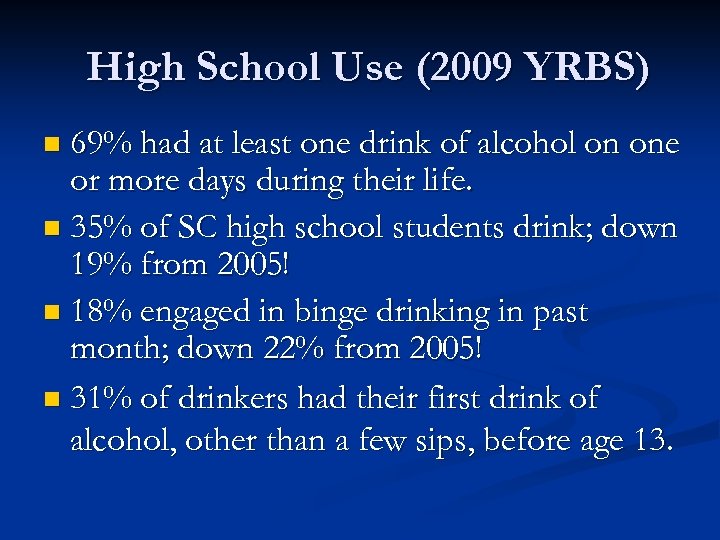
High School Use (2009 YRBS) n 69% had at least one drink of alcohol on one or more days during their life. n 35% of SC high school students drink; down 19% from 2005! n 18% engaged in binge drinking in past month; down 22% from 2005! n 31% of drinkers had their first drink of alcohol, other than a few sips, before age 13.
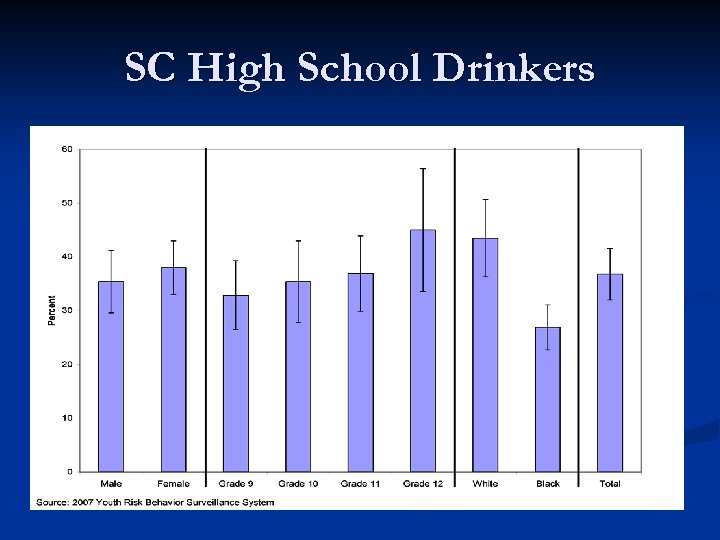
SC High School Drinkers
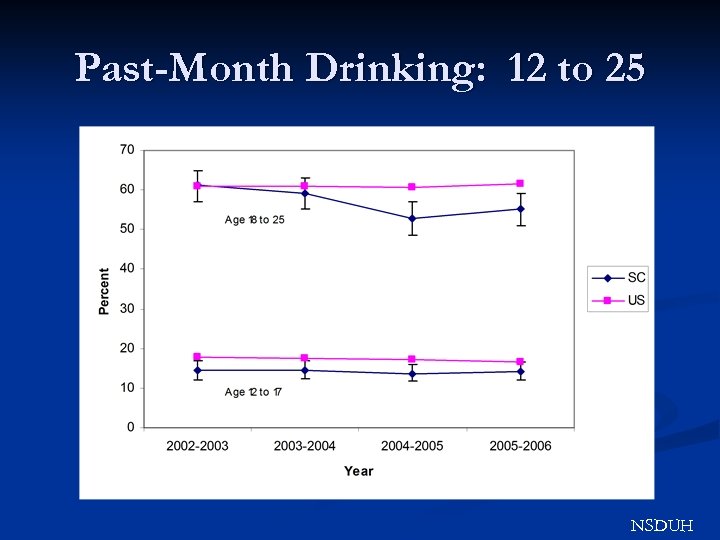
Past-Month Drinking: 12 to 25 NSDUH
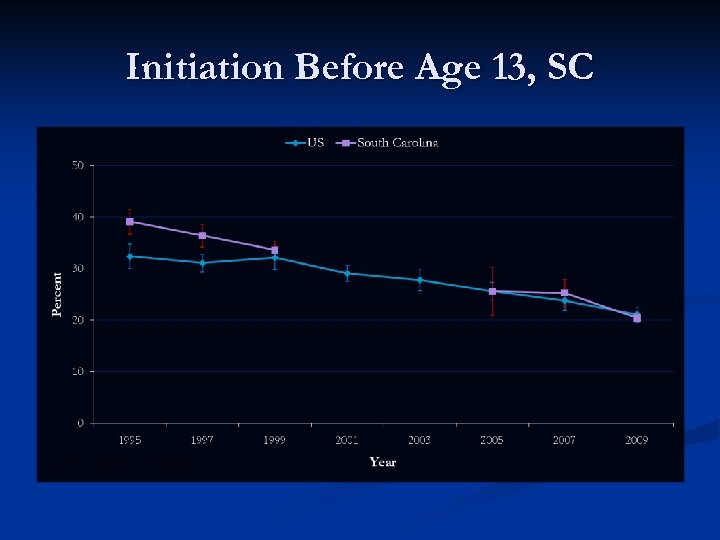
Initiation Before Age 13, SC
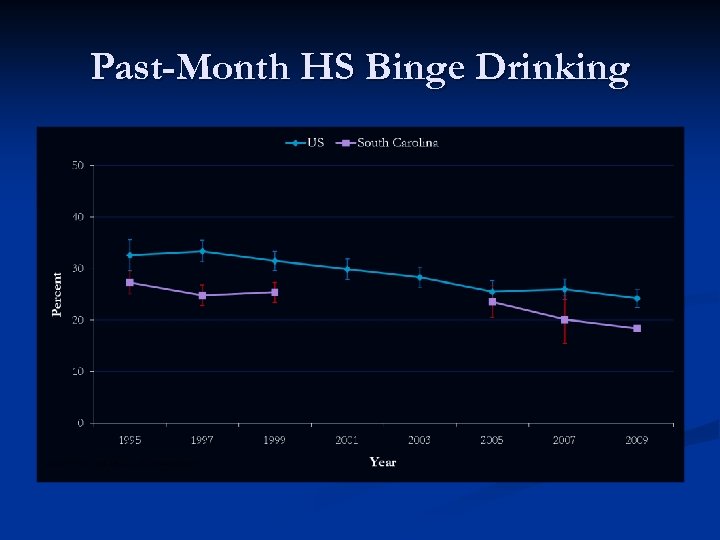
Past-Month HS Binge Drinking
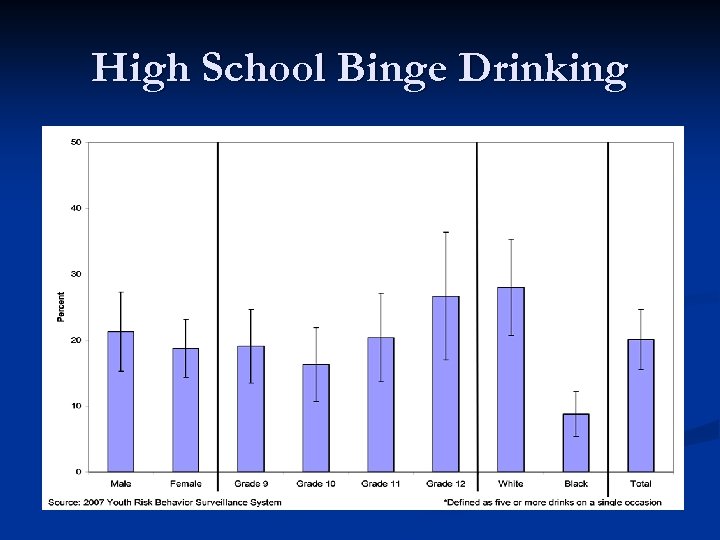
High School Binge Drinking
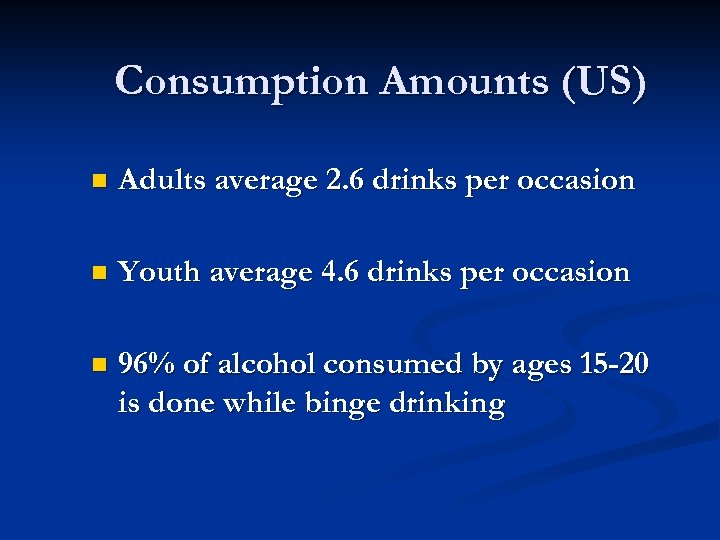
Consumption Amounts (US) n Adults average 2. 6 drinks per occasion n Youth average 4. 6 drinks per occasion n 96% of alcohol consumed by ages 15 -20 is done while binge drinking
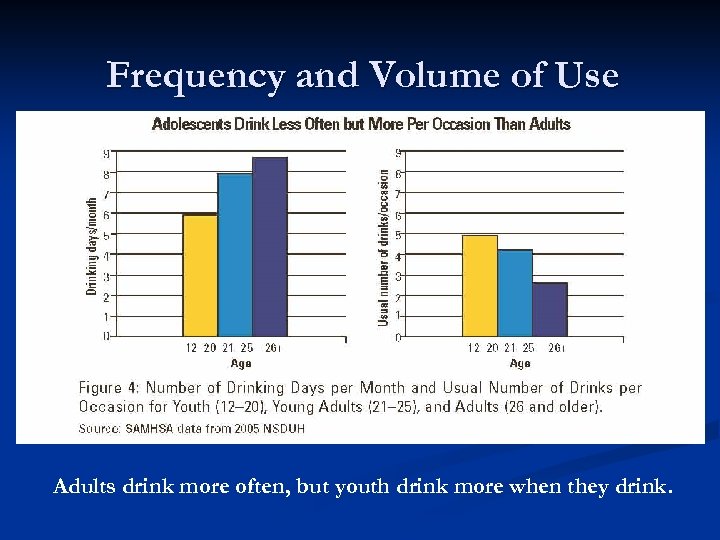
Frequency and Volume of Use Adults drink more often, but youth drink more when they drink.
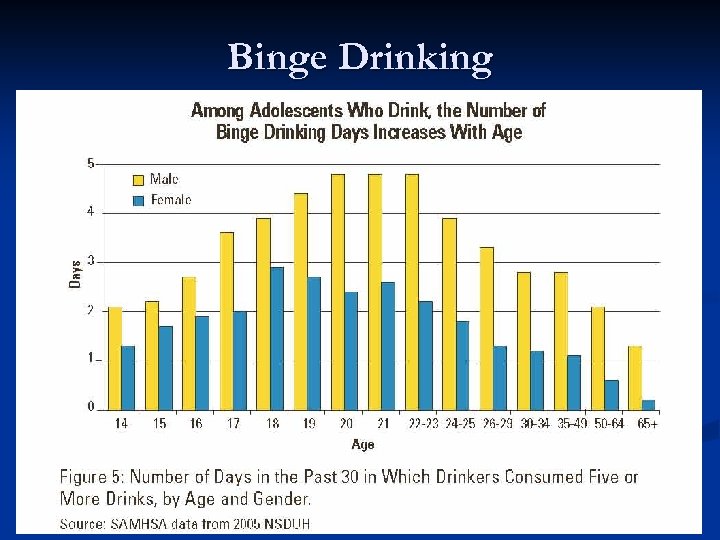
Binge Drinking
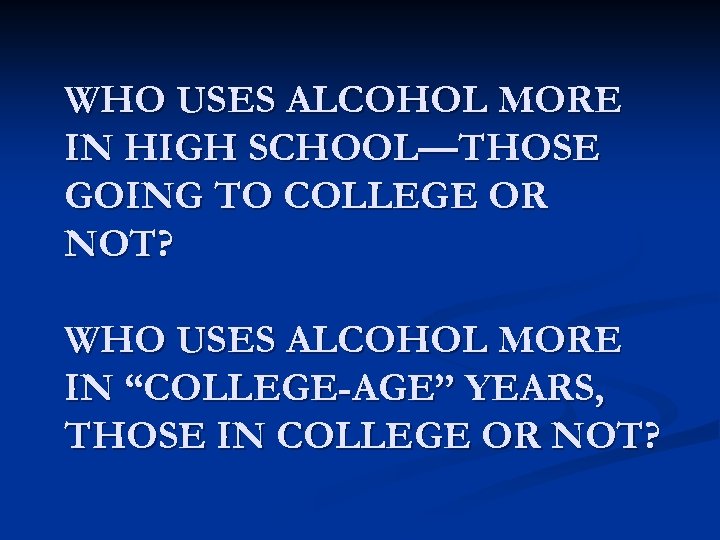
WHO USES ALCOHOL MORE IN HIGH SCHOOL—THOSE GOING TO COLLEGE OR NOT? WHO USES ALCOHOL MORE IN “COLLEGE-AGE” YEARS, THOSE IN COLLEGE OR NOT?
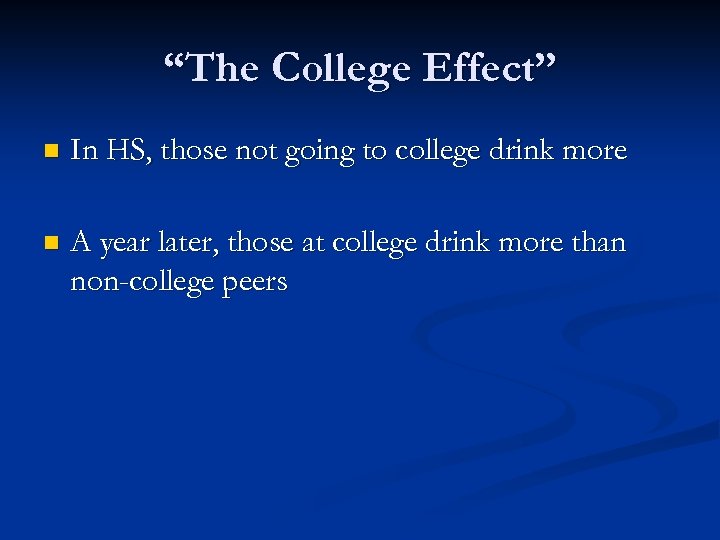
“The College Effect” n In HS, those not going to college drink more n A year later, those at college drink more than non-college peers
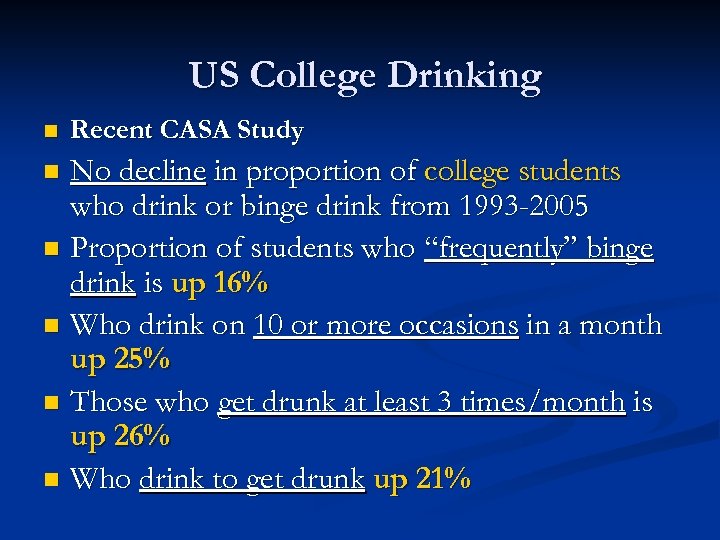
US College Drinking n Recent CASA Study No decline in proportion of college students who drink or binge drink from 1993 -2005 n Proportion of students who “frequently” binge drink is up 16% n Who drink on 10 or more occasions in a month up 25% n Those who get drunk at least 3 times/month is up 26% n Who drink to get drunk up 21% n
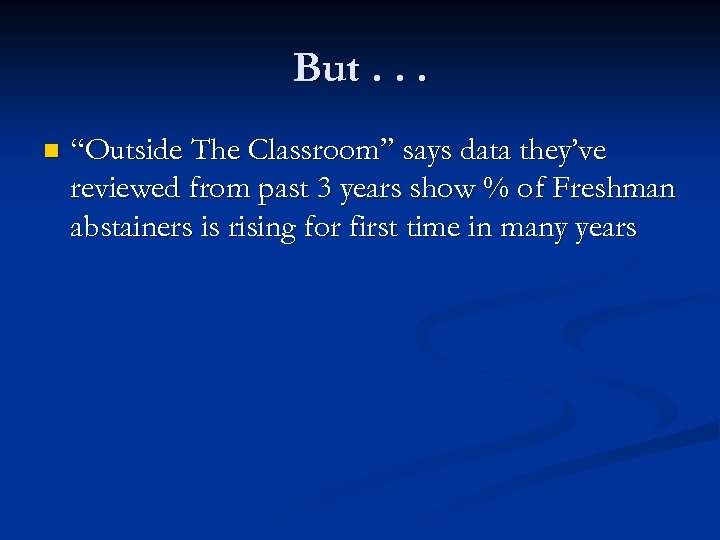
But. . . n “Outside The Classroom” says data they’ve reviewed from past 3 years show % of Freshman abstainers is rising for first time in many years
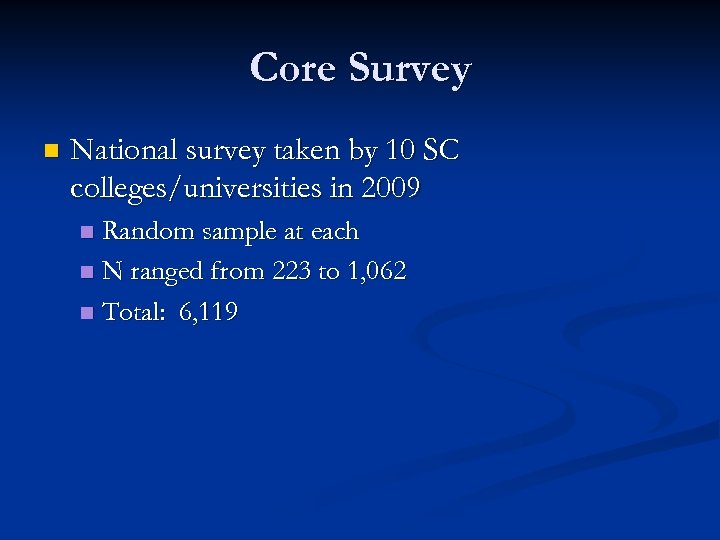
Core Survey n National survey taken by 10 SC colleges/universities in 2009 Random sample at each n N ranged from 223 to 1, 062 n Total: 6, 119 n
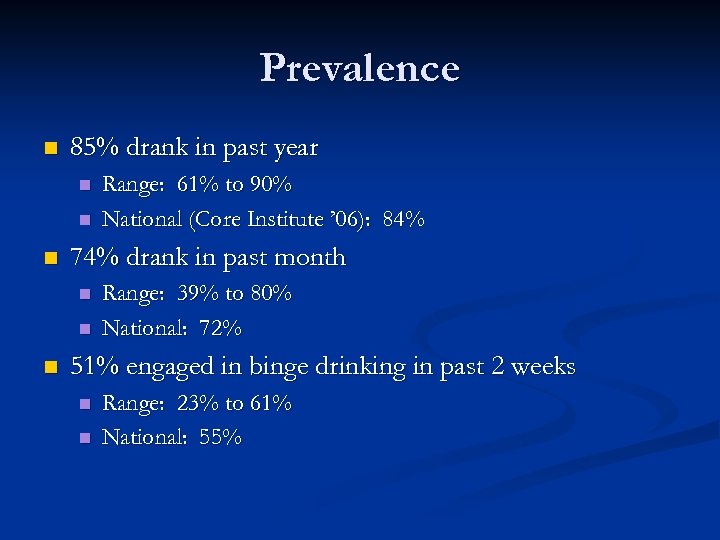
Prevalence n 85% drank in past year n n n 74% drank in past month n n n Range: 61% to 90% National (Core Institute ’ 06): 84% Range: 39% to 80% National: 72% 51% engaged in binge drinking in past 2 weeks n n Range: 23% to 61% National: 55%
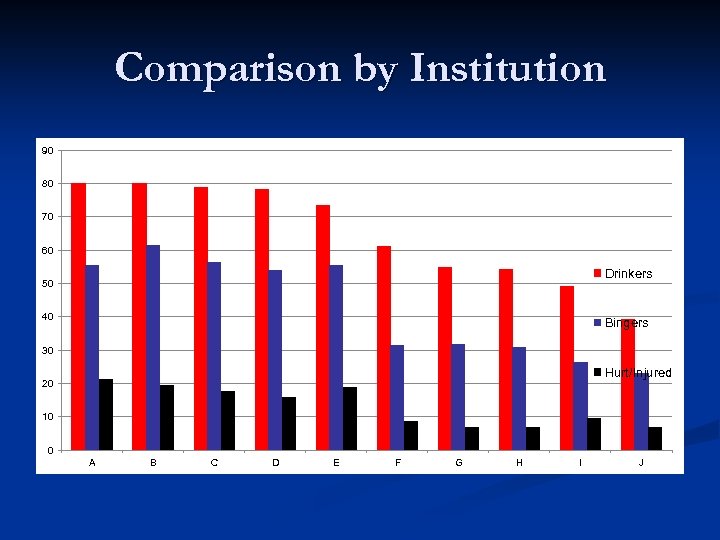
Comparison by Institution 90 80 70 60 Drinkers 50 40 Bingers 30 Hurt/Injured 20 10 0 A B C D E F G H I J SC Core Survey Data, 2009
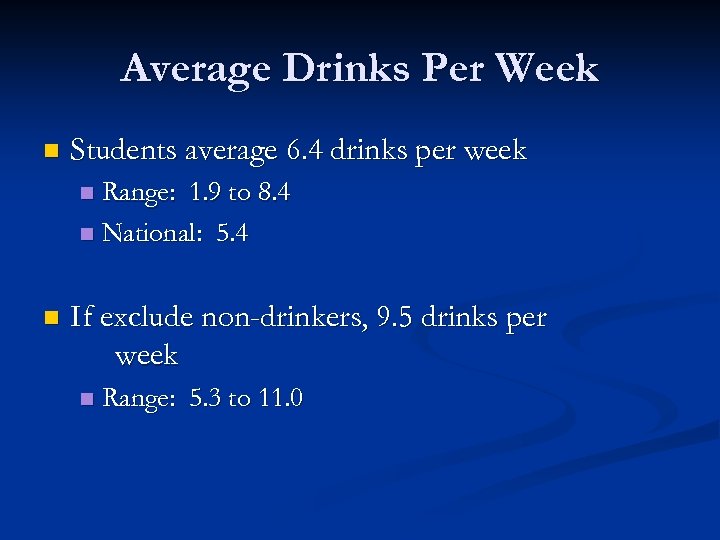
Average Drinks Per Week n Students average 6. 4 drinks per week Range: 1. 9 to 8. 4 n National: 5. 4 n n If exclude non-drinkers, 9. 5 drinks per week n Range: 5. 3 to 11. 0
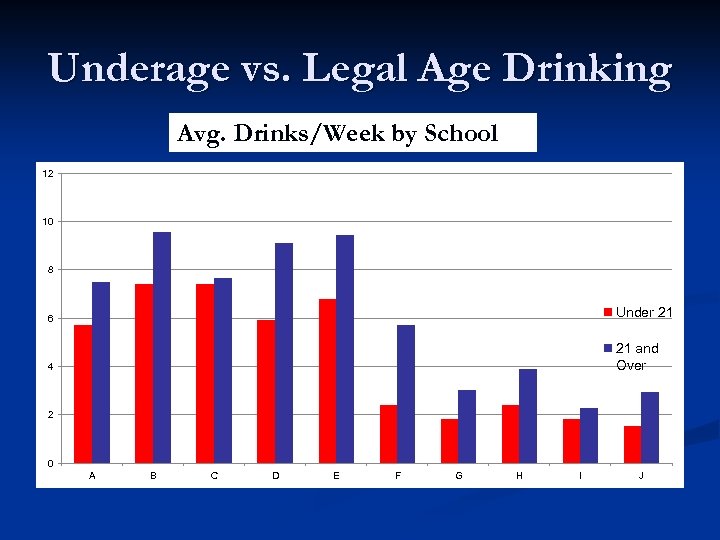
Underage vs. Legal Age Drinking Avg. Drinks/Week by School 12 10 8 6 Under 21 4 21 and Over 2 0 A B C D E F G H I J SC Core Survey Data, 2009
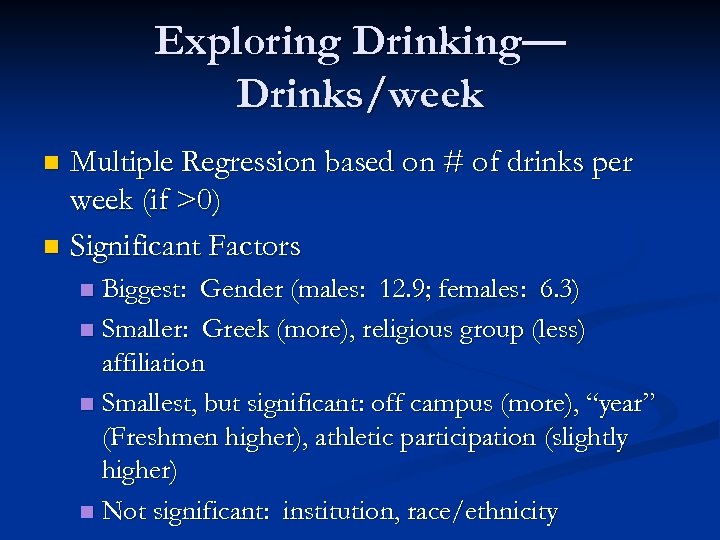
Exploring Drinking— Drinks/week Multiple Regression based on # of drinks per week (if >0) n Significant Factors n Biggest: Gender (males: 12. 9; females: 6. 3) n Smaller: Greek (more), religious group (less) affiliation n Smallest, but significant: off campus (more), “year” (Freshmen higher), athletic participation (slightly higher) n Not significant: institution, race/ethnicity n
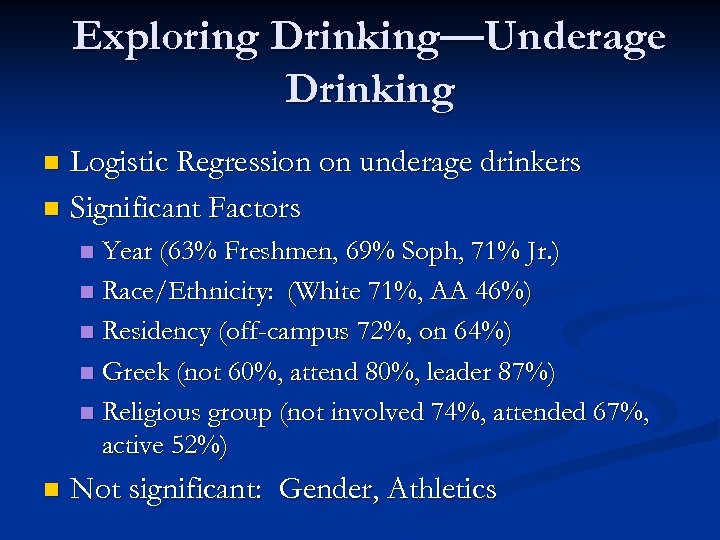
Exploring Drinking—Underage Drinking Logistic Regression on underage drinkers n Significant Factors n Year (63% Freshmen, 69% Soph, 71% Jr. ) n Race/Ethnicity: (White 71%, AA 46%) n Residency (off-campus 72%, on 64%) n Greek (not 60%, attend 80%, leader 87%) n Religious group (not involved 74%, attended 67%, active 52%) n n Not significant: Gender, Athletics
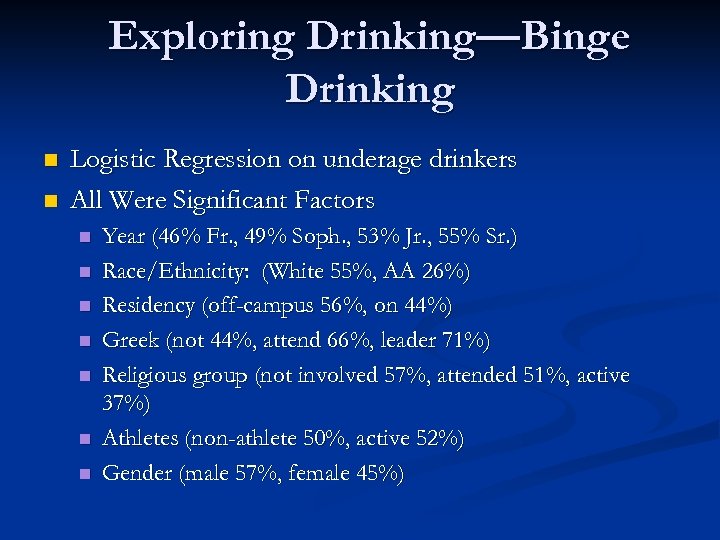
Exploring Drinking—Binge Drinking n n Logistic Regression on underage drinkers All Were Significant Factors n n n n Year (46% Fr. , 49% Soph. , 53% Jr. , 55% Sr. ) Race/Ethnicity: (White 55%, AA 26%) Residency (off-campus 56%, on 44%) Greek (not 44%, attend 66%, leader 71%) Religious group (not involved 57%, attended 51%, active 37%) Athletes (non-athlete 50%, active 52%) Gender (male 57%, female 45%)
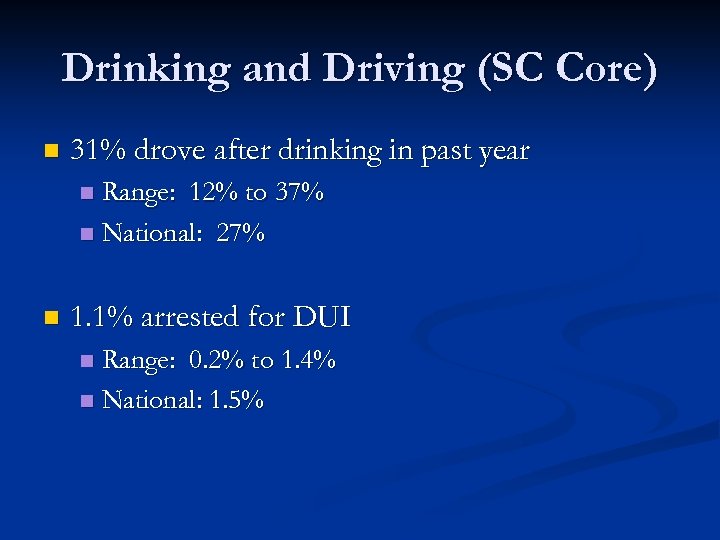
Drinking and Driving (SC Core) n 31% drove after drinking in past year Range: 12% to 37% n National: 27% n n 1. 1% arrested for DUI Range: 0. 2% to 1. 4% n National: 1. 5% n
Academic Impact (SC Core) Average Number of Drinks Per Week by GPA (Drinkers Only) SC Core Survey Data, 2009
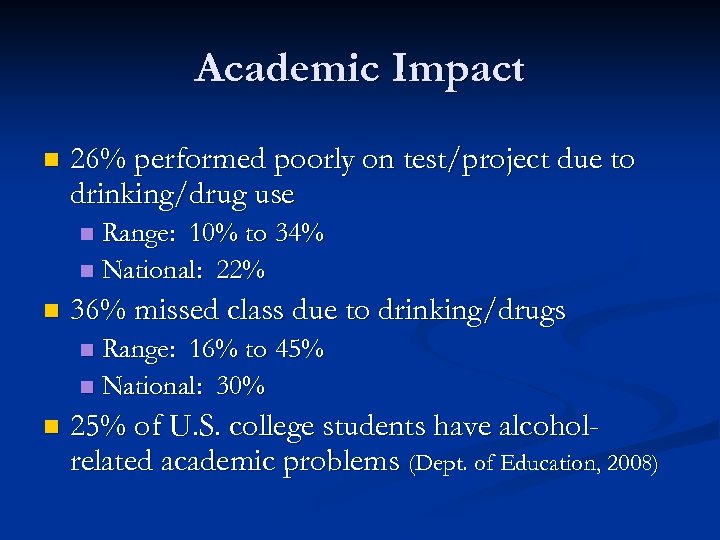
Academic Impact n 26% performed poorly on test/project due to drinking/drug use Range: 10% to 34% n National: 22% n n 36% missed class due to drinking/drugs Range: 16% to 45% n National: 30% n n 25% of U. S. college students have alcoholrelated academic problems (Dept. of Education, 2008)
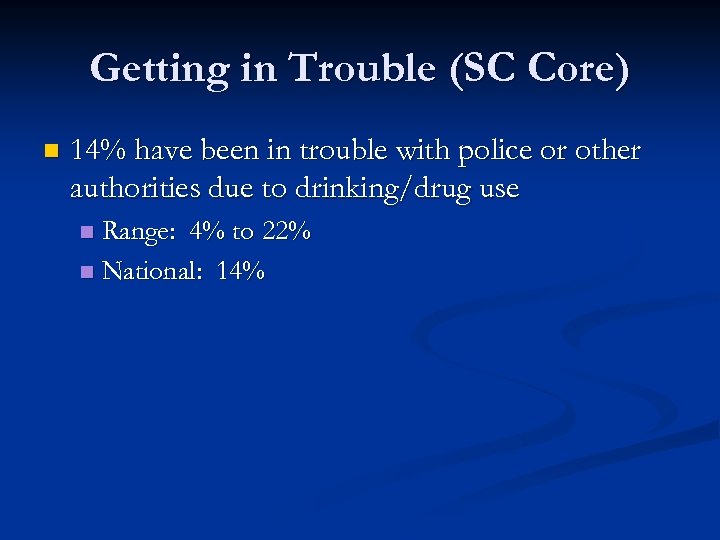
Getting in Trouble (SC Core) n 14% have been in trouble with police or other authorities due to drinking/drug use Range: 4% to 22% n National: 14% n
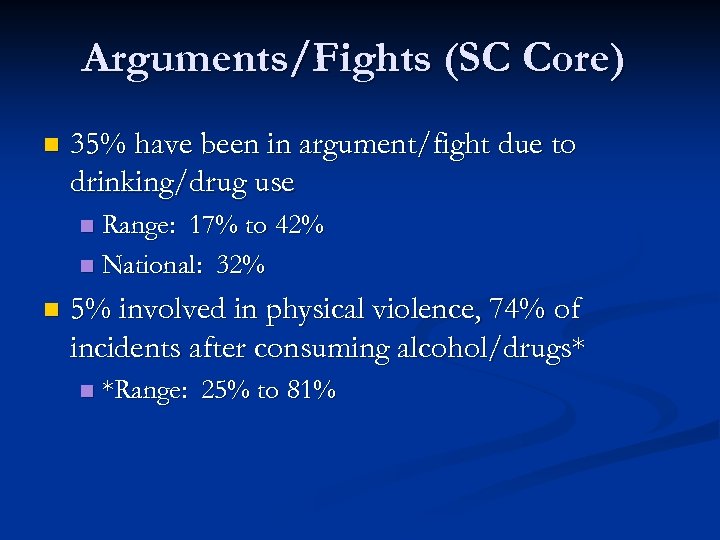
Arguments/Fights (SC Core) n 35% have been in argument/fight due to drinking/drug use Range: 17% to 42% n National: 32% n n 5% involved in physical violence, 74% of incidents after consuming alcohol/drugs* n *Range: 25% to 81%
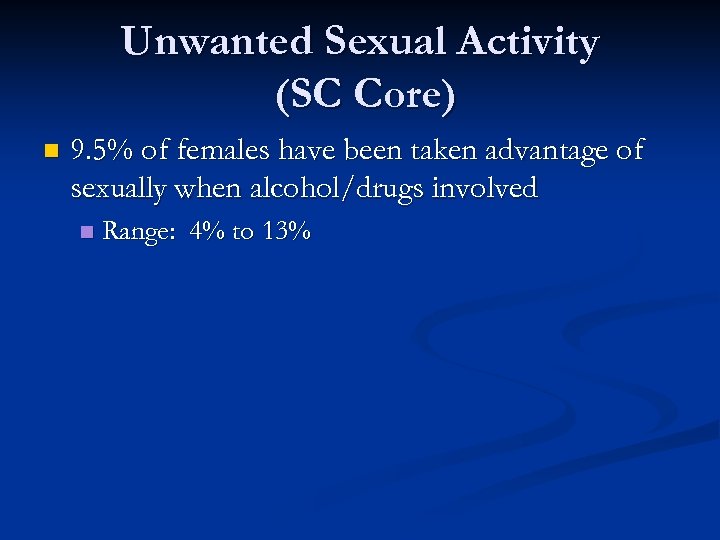
Unwanted Sexual Activity (SC Core) n 9. 5% of females have been taken advantage of sexually when alcohol/drugs involved n Range: 4% to 13%
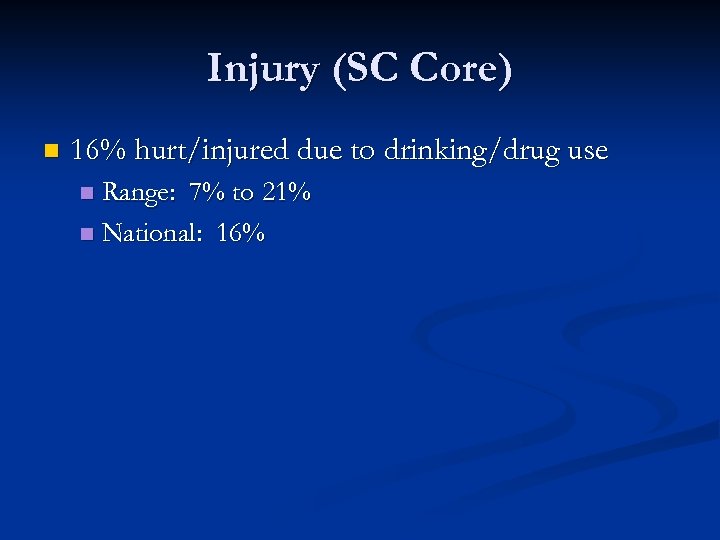
Injury (SC Core) n 16% hurt/injured due to drinking/drug use Range: 7% to 21% n National: 16% n
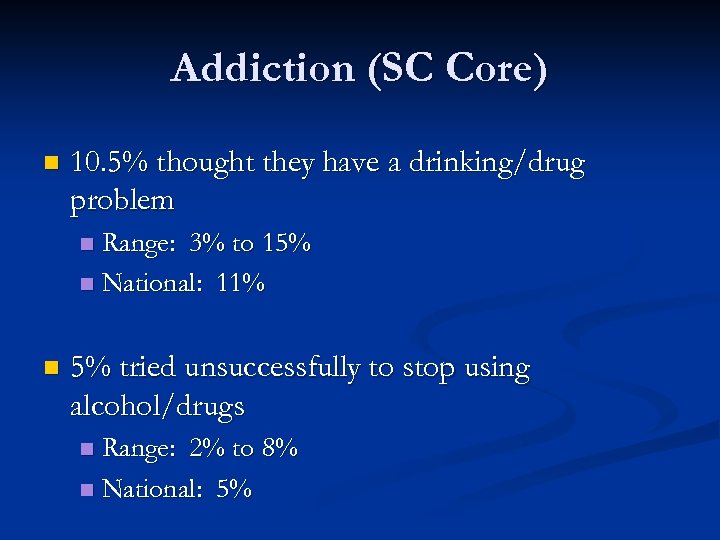
Addiction (SC Core) n 10. 5% thought they have a drinking/drug problem Range: 3% to 15% n National: 11% n n 5% tried unsuccessfully to stop using alcohol/drugs Range: 2% to 8% n National: 5% n
What is the drink of choice for SC high school students?
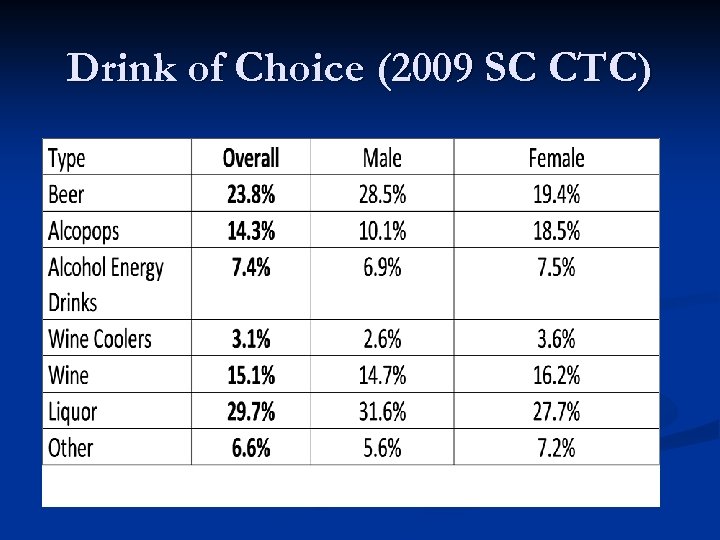
Drink of Choice (2009 SC CTC)
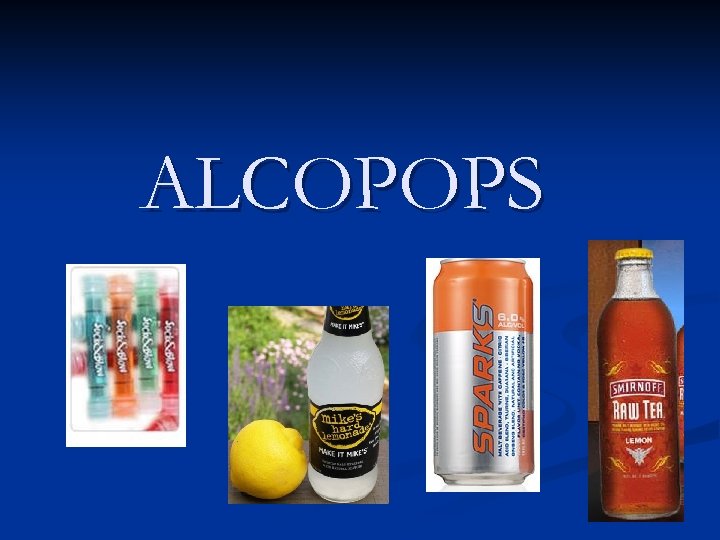
ALCOPOPS
Production of Alcopops A liquid is derived from malt n It is filtered to remove most or all taste, odor and alcohol n “Flavoring” is added to the liquid, which includes distilled alcohol n Product distributed as malt beverage (most or all brewed alcohol is removed – distilled alcohol only) n Beer classification n
Why the Classification? n Advantages – Beer is: n Advertised on electronic media n Taxed at substantially lower tax rates n Available in a greater # of retail locations, particularly those likely to be frequented by underage drinkers
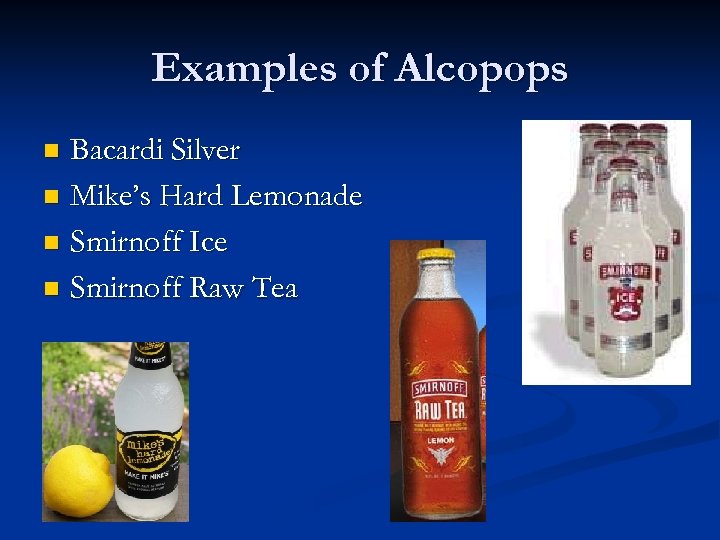
Examples of Alcopops Bacardi Silver n Mike’s Hard Lemonade n Smirnoff Ice n Smirnoff Raw Tea n
The “New” Kid on the Block Alcoholic Energy Drinks
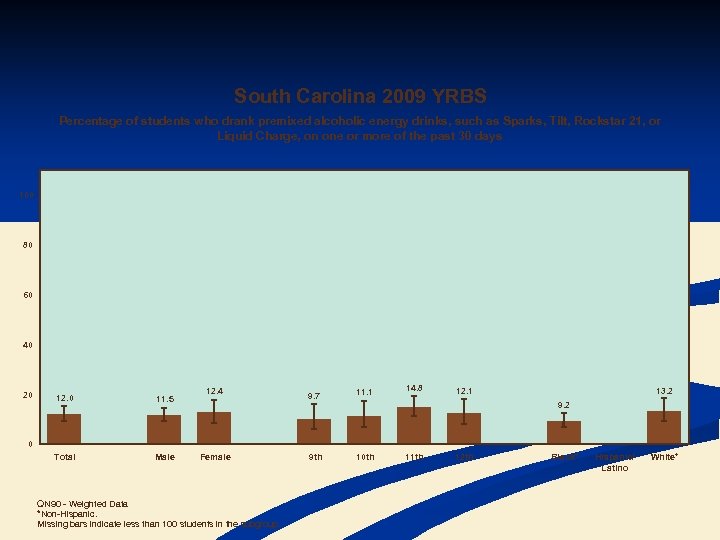
South Carolina 2009 YRBS Percentage of students who drank premixed alcoholic energy drinks, such as Sparks, Tilt, Rockstar 21, or Liquid Charge, on one or more of the past 30 days 100 80 60 40 20 12. 0 11. 5 Total Male 12. 4 9. 7 11. 1 14. 8 13. 2 12. 1 9. 2 0 Female QN 90 - Weighted Data *Non-Hispanic. Missing bars indicate less than 100 students in the subgroup. 9 th 10 th 11 th 12 th Black* Hispanic/ Latino White*
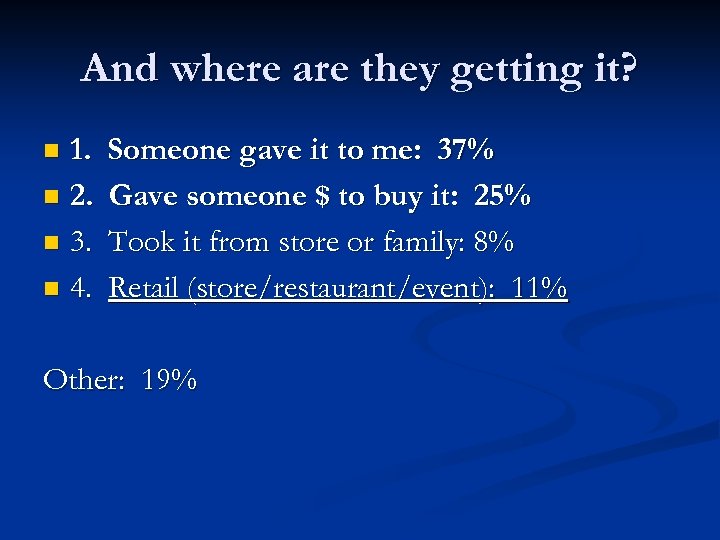
And where are they getting it? 1. n 2. n 3. n 4. n Someone gave it to me: 37% Gave someone $ to buy it: 25% Took it from store or family: 8% Retail (store/restaurant/event): 11% Other: 19%
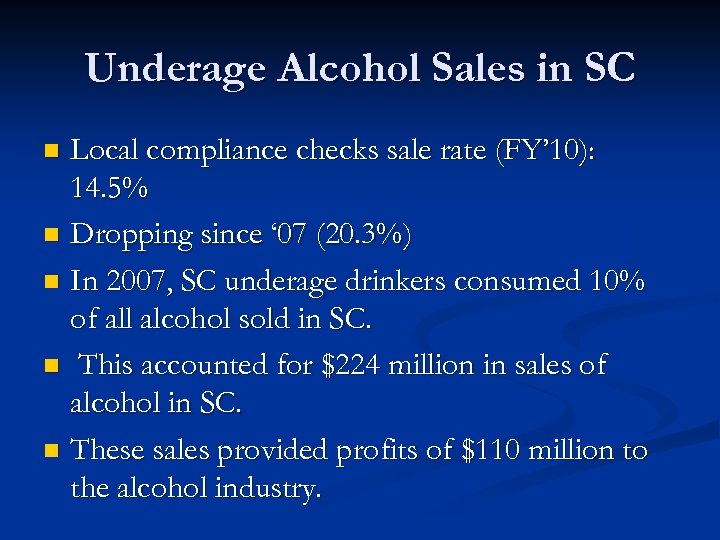
Underage Alcohol Sales in SC Local compliance checks sale rate (FY’ 10): 14. 5% n Dropping since ‘ 07 (20. 3%) n In 2007, SC underage drinkers consumed 10% of all alcohol sold in SC. n This accounted for $224 million in sales of alcohol in SC. n These sales provided profits of $110 million to the alcohol industry. n
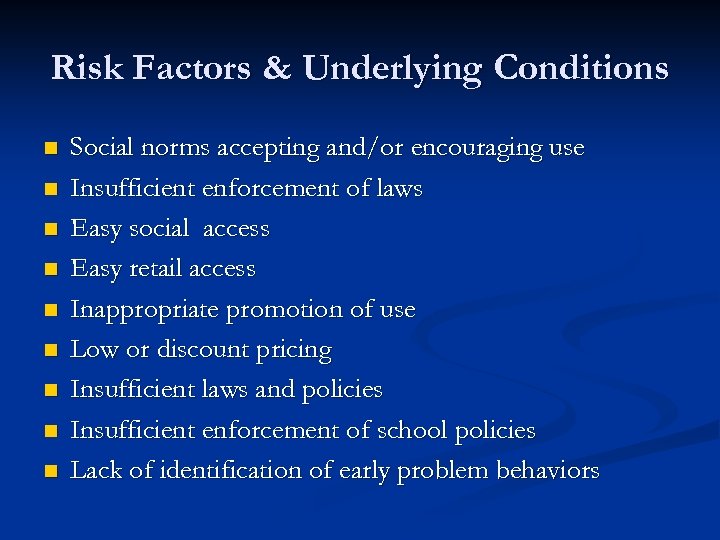
Risk Factors & Underlying Conditions n n n n n Social norms accepting and/or encouraging use Insufficient enforcement of laws Easy social access Easy retail access Inappropriate promotion of use Low or discount pricing Insufficient laws and policies Insufficient enforcement of school policies Lack of identification of early problem behaviors
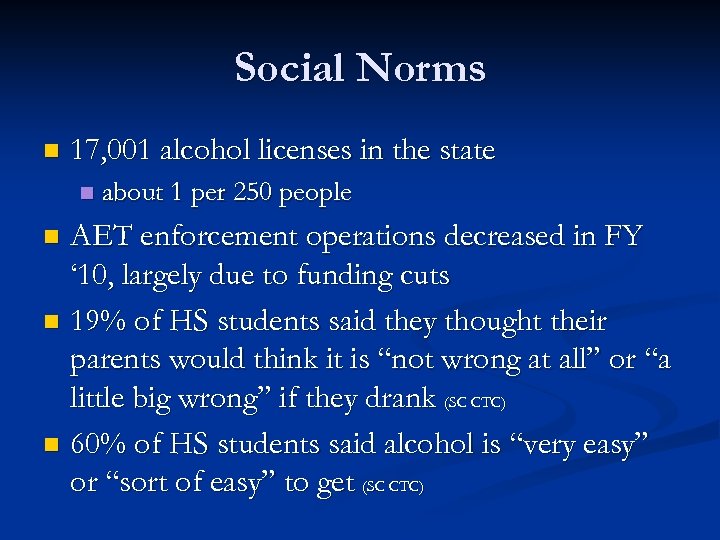
Social Norms n 17, 001 alcohol licenses in the state n about 1 per 250 people AET enforcement operations decreased in FY ‘ 10, largely due to funding cuts n 19% of HS students said they thought their parents would think it is “not wrong at all” or “a little big wrong” if they drank (SC CTC) n 60% of HS students said alcohol is “very easy” or “sort of easy” to get (SC CTC) n
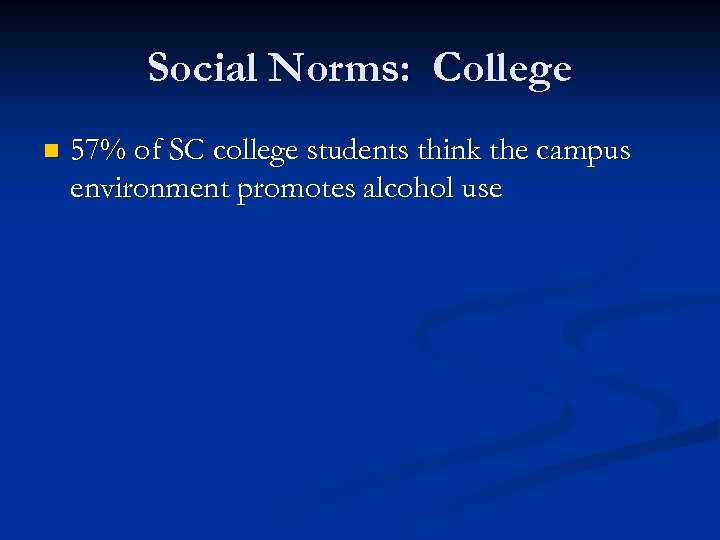
Social Norms: College n 57% of SC college students think the campus environment promotes alcohol use
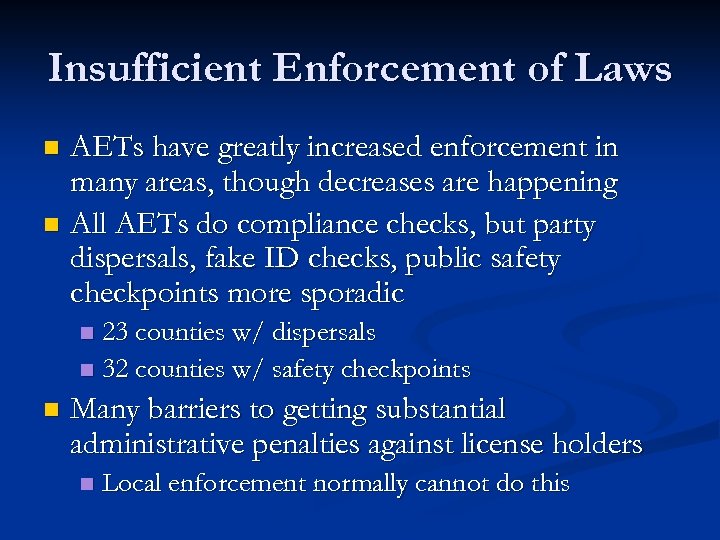
Insufficient Enforcement of Laws AETs have greatly increased enforcement in many areas, though decreases are happening n All AETs do compliance checks, but party dispersals, fake ID checks, public safety checkpoints more sporadic n 23 counties w/ dispersals n 32 counties w/ safety checkpoints n n Many barriers to getting substantial administrative penalties against license holders n Local enforcement normally cannot do this
Social Access n SC YRBS: Almost 2/3 of the time, alcohol provided by adult (non-retail)
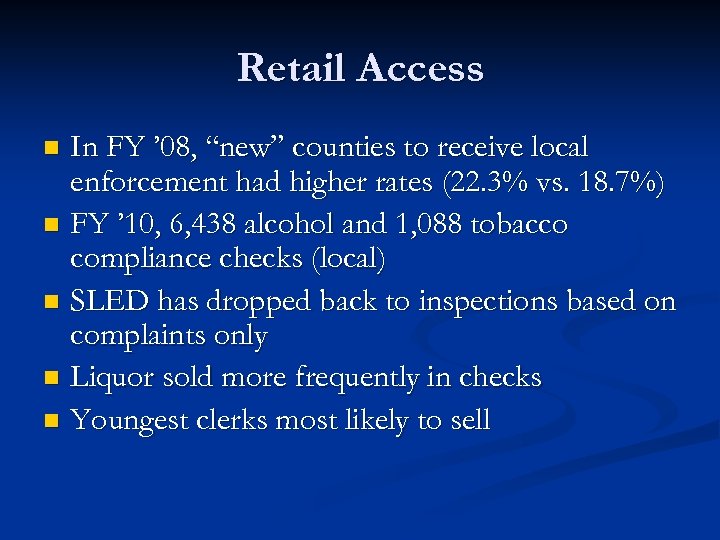
Retail Access In FY ’ 08, “new” counties to receive local enforcement had higher rates (22. 3% vs. 18. 7%) n FY ’ 10, 6, 438 alcohol and 1, 088 tobacco compliance checks (local) n SLED has dropped back to inspections based on complaints only n Liquor sold more frequently in checks n Youngest clerks most likely to sell n
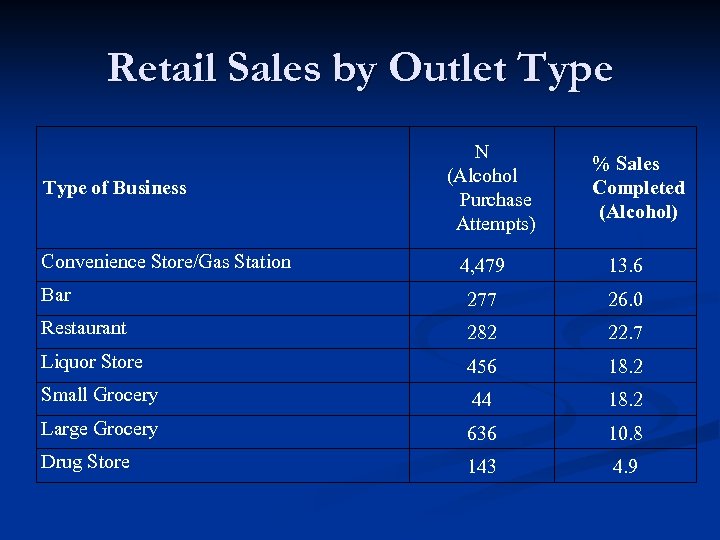
Retail Sales by Outlet Type of Business Convenience Store/Gas Station N (Alcohol Purchase Attempts) % Sales Completed (Alcohol) 4, 479 13. 6 Bar 277 26. 0 Restaurant 282 22. 7 Liquor Store 456 18. 2 Small Grocery 44 18. 2 Large Grocery 636 10. 8 Drug Store 143 4. 9
Inappropriate Promotion Income from underage drinking = $22 Billion/year (mostly from beer) (IOM, 2003). n Total spent on alcohol advertising = $4. 8 billion n Many ads work to “normalize” drinking alcohol n Happy Hour laws reported to be confusing to law enforcement and retailers n Rarely enforced n
Low or Discount Pricing n SC alcohol sales tax rates: spirits tax = $4. 97; n table wine tax = $1. 08; n beer tax = $. 77. n SC ranked 21 st, 11 th, and 3 rd in the nation for sales tax rates, respectively, n Meaning: SC has close to an average sales tax on spirits, a high tax on wine, and a very high tax on beer. n
Pricing Alcopops taxed as beer n Beer tax unchanged for 30+ years but is still one of highest in US n Happy Hour laws reported to be confusing to law enforcement and retailers n n Rarely enforced
Insufficient Laws & Policies Underage drinking laws greatly strengthened in 2007 (PUDAAA) n Communities have very little ability to regulate alcohol sale issues (power lies with state) n Department of Revenue and SLED alcohol sections not staffed as they once were n
Insufficient Enforcement of School Policies n Many school policies address penalties but not referral protocol or responsibility to provide prevention efforts
Lack of Identification of Early Problem Behaviors n Many systems that could identify problematic early alcohol use are not taking full opportunity to do so: Schools n Physicians n People working with youth n Parents n Prevention specialists n
Action Steps Presented by Risk Factor/Underlying Condition n Items listed as “Being Done” and “Could be Done” are simply examples n Strengths/Weaknesses can be debated n Not suggesting any planned or future courses of action or advocacy by DAODAS, CAST, or any other group n
Social Norms Being Done n n Some areas using social norms campaigns Active AET enforcement Media advocacy (getting better) Parents Who Host, Lose the Most Could Be Done n n Working on community event alcohol sale policies Develop local advocacy groups (youth/adults)
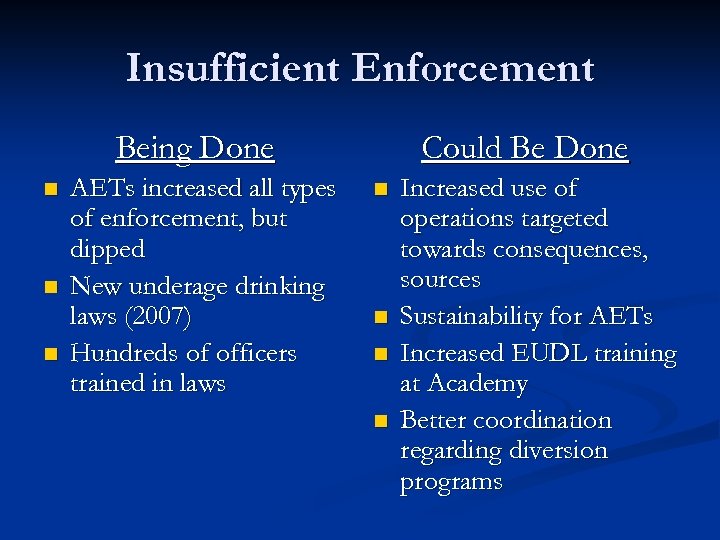
Insufficient Enforcement Being Done n n n AETs increased all types of enforcement, but dipped New underage drinking laws (2007) Hundreds of officers trained in laws Could Be Done n n Increased use of operations targeted towards consequences, sources Sustainability for AETs Increased EUDL training at Academy Better coordination regarding diversion programs
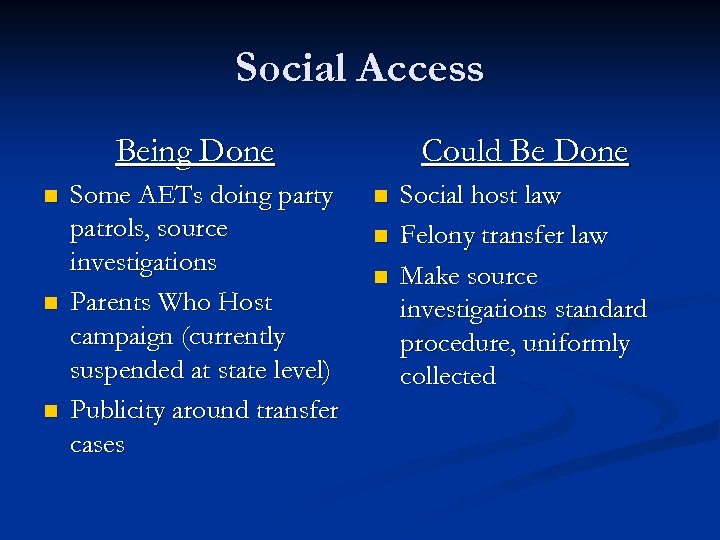
Social Access Being Done n n n Some AETs doing party patrols, source investigations Parents Who Host campaign (currently suspended at state level) Publicity around transfer cases Could Be Done n n n Social host law Felony transfer law Make source investigations standard procedure, uniformly collected
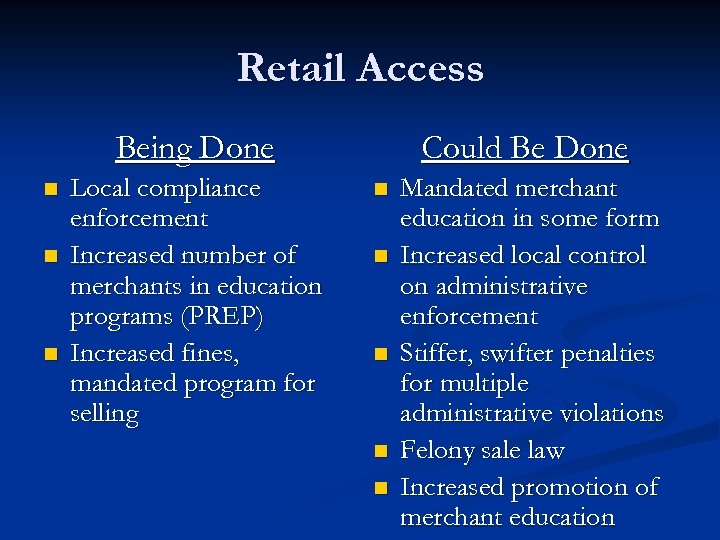
Retail Access Being Done n n n Local compliance enforcement Increased number of merchants in education programs (PREP) Increased fines, mandated program for selling Could Be Done n n n Mandated merchant education in some form Increased local control on administrative enforcement Stiffer, swifter penalties for multiple administrative violations Felony sale law Increased promotion of merchant education
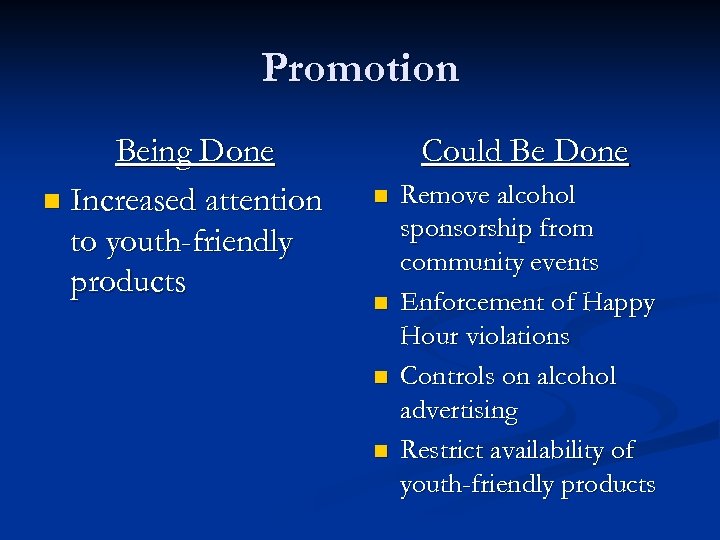
Promotion Being Done n Increased attention to youth-friendly products Could Be Done n n Remove alcohol sponsorship from community events Enforcement of Happy Hour violations Controls on alcohol advertising Restrict availability of youth-friendly products
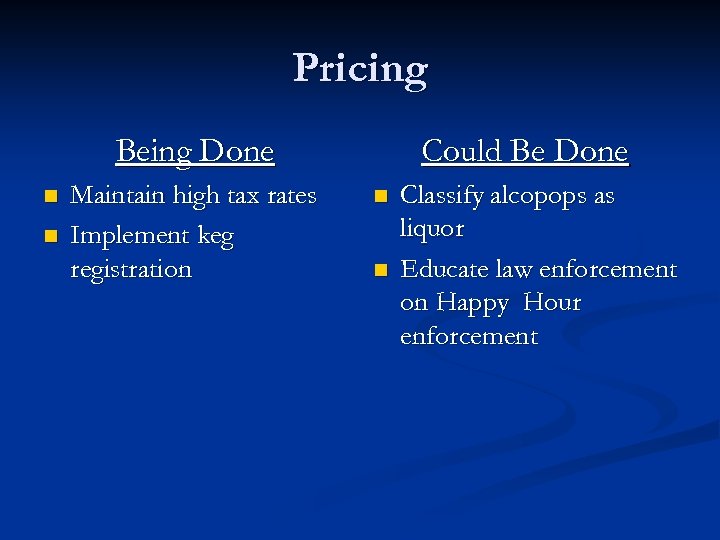
Pricing Being Done n n Maintain high tax rates Implement keg registration Could Be Done n n Classify alcopops as liquor Educate law enforcement on Happy Hour enforcement
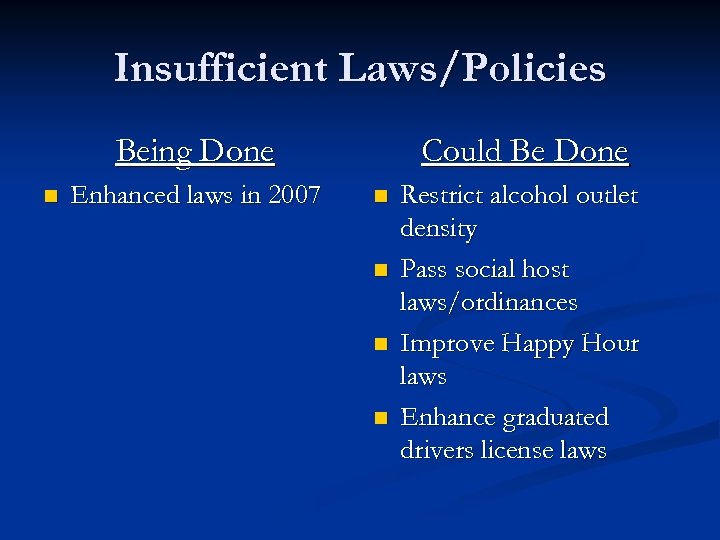
Insufficient Laws/Policies Being Done n Enhanced laws in 2007 Could Be Done n n Restrict alcohol outlet density Pass social host laws/ordinances Improve Happy Hour laws Enhance graduated drivers license laws
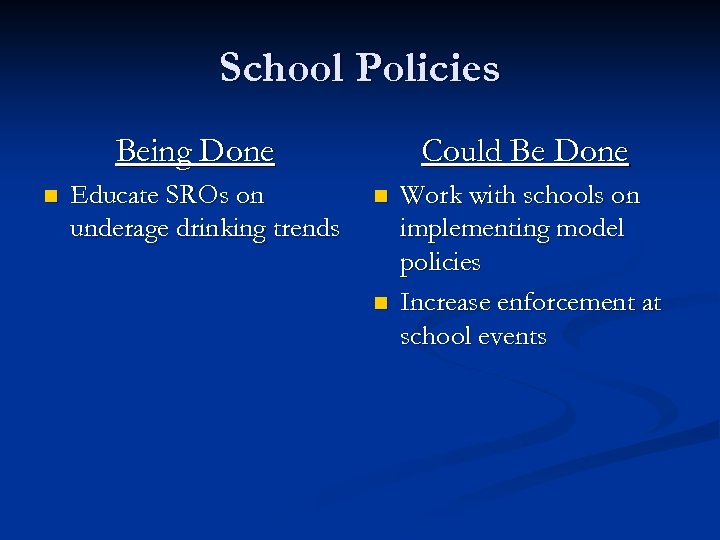
School Policies Being Done n Educate SROs on underage drinking trends Could Be Done n n Work with schools on implementing model policies Increase enforcement at school events
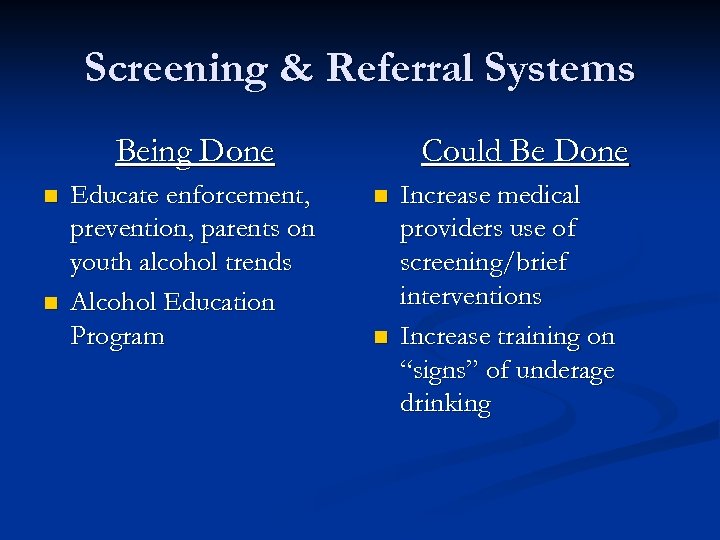
Screening & Referral Systems Being Done n n Educate enforcement, prevention, parents on youth alcohol trends Alcohol Education Program Could Be Done n n Increase medical providers use of screening/brief interventions Increase training on “signs” of underage drinking
Скачать презентацию Underage Drinking A South Carolina Priority November 16
90ba3d890cecb0c19039a6a700139fcb.ppt