


 Скачать презентацию UNCLASSIFIED DODCAS 2012 DON Cost Community Update of
5b3226a99ed9f8e98227c16dcd1b4032.ppt
- Количество слайдов: 22
 UNCLASSIFIED DODCAS 2012: DON Cost Community Update of the Probability of Program Success (Po. PS) Version 2. 3, Cost SME Inputs February 2012 POC: Mr. Jim Baratta Deputy Director Naval Center for Cost Analysis james. baratta@navy. mil
 Po. PS 2. 3 Update Intentions • ASN(RD&A) Sys Eng office was tasked to incorporate 200+ updates submitted by Po. PS users/stakeholders (e. g. PEO, PM, SYSCOM) • Updates cut across all Po. PS criteria/metrics, not just “TOC” (our area) • Updates were in the following five categories: – Change wording to “Service-generic” • OSD and Army desire to adopt the Naval Po. PS framework – Separate ACAT I criteria from lower ACATs • Clarify requirements for those programs below the ACAT I level – Incorporate SECNAV’s focus on Energy • Affected TOC criteria with FBCE wording/metrics – Include acquisition community focus on “Should Cost” • Add metric(s) that reflected such focus – Collapse “verbose/extended” criteria statements (“decompose”) • Break into smaller measurable chunks, or re-word • Adding-to or modifying existing criteria outside of this list was restricted!! 2
 Po. PS 2. 3 Cost SME Team • • Mr. Jim Baratta Mr. Don Burlingham Mr. Joe Cardarelli Mr. Scott Clark Mr. Chris Mushrush Mr. Nidak Sumrean Ms. Susan Wileman Mr. Mourad Yacoub Deputy Director, DASN (Cost & Economics) (NCCA) Director, MARCORSYSCOM Cost and Analysis Branch NAVAIR 4. 2 NAVSEA 05 C Deputy Director, NAVAIR Cost Department (AIR 4. 2) Director, NAVSEA Cost Engineering Dept (SEA 05 C) MARCORSYSCOM Cost and Analysis Branch Director, SPAWAR Cost Est Div (SPAWAR 1. 6) (listed alphabetically) • • • 43 of the 206 change submissions were in the TOC criteria (most of any) Most of the submissions spanned multiple Gates The Cost SME team was allowed to “revise” or “reword” the inputs that were submitted to our team by ASN(RD&A). 3
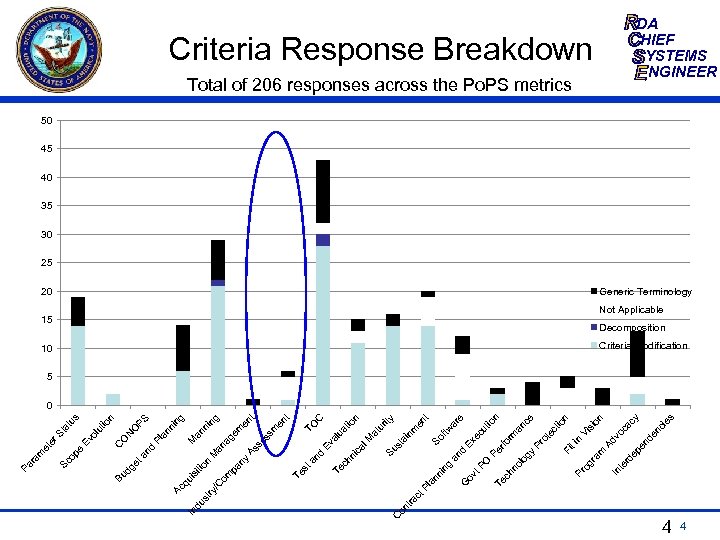 ni an d ch Te st Te C TO ua al Ev en t m se ss As em ng ni M an ng PS ni an Pl an ag M ny pa n tio si om /C qu i nd N O n io ut at us St ol C O Ev er tio n ca l. M at ur ity Su C st on ai nm tra ct en Pl t an So ni ftw ng ar an e d G Ex ov ec t. P ut O io Pe n Te rfo ch rm no an lo ce gy Pr ot ec tio n Fi ti n Pr Vi og si ra on m Ad In vo te ca rd cy ep en de nc ie s try du s In Ac op e et a dg Bu Sc m et ra Pa Criteria Response Breakdown Total of 206 responses across the Po. PS metrics 20 15 10 DA HIEF YSTEMS NGINEER 50 45 40 35 30 25 Generic Terminology Not Applicable Decomposition Criteria Modification 5 0 4 4
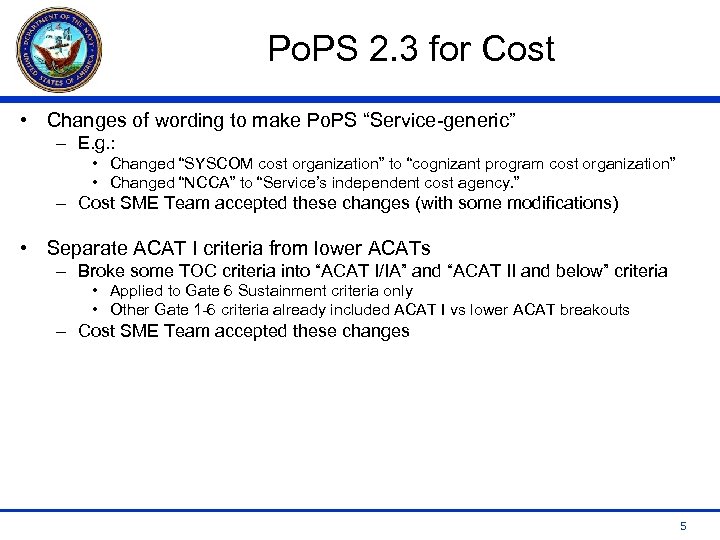 Po. PS 2. 3 for Cost • Changes of wording to make Po. PS “Service-generic” – E. g. : • Changed “SYSCOM cost organization” to “cognizant program cost organization” • Changed “NCCA” to “Service’s independent cost agency. ” – Cost SME Team accepted these changes (with some modifications) • Separate ACAT I criteria from lower ACATs – Broke some TOC criteria into “ACAT I/IA” and “ACAT II and below” criteria • Applied to Gate 6 Sustainment criteria only • Other Gate 1 -6 criteria already included ACAT I vs lower ACAT breakouts – Cost SME Team accepted these changes 5
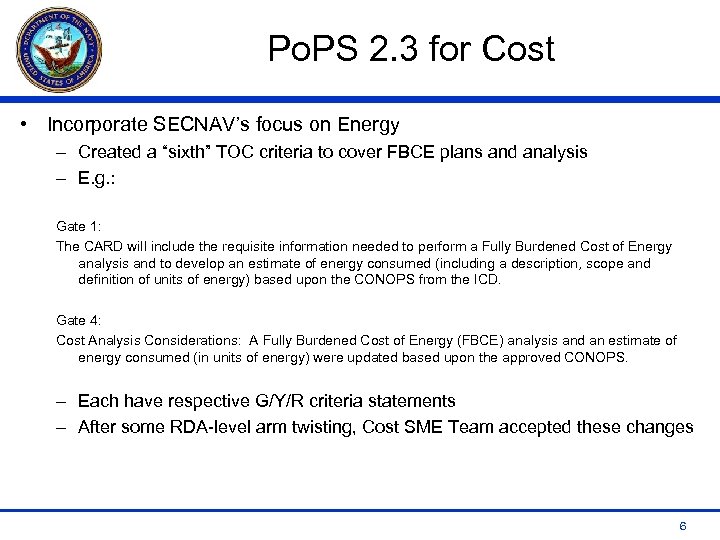 Po. PS 2. 3 for Cost • Incorporate SECNAV’s focus on Energy – Created a “sixth” TOC criteria to cover FBCE plans and analysis – E. g. : Gate 1: The CARD will include the requisite information needed to perform a Fully Burdened Cost of Energy analysis and to develop an estimate of energy consumed (including a description, scope and definition of units of energy) based upon the CONOPS from the ICD. Gate 4: Cost Analysis Considerations: A Fully Burdened Cost of Energy (FBCE) analysis and an estimate of energy consumed (in units of energy) were updated based upon the approved CONOPS. – Each have respective G/Y/R criteria statements – After some RDA-level arm twisting, Cost SME Team accepted these changes 6
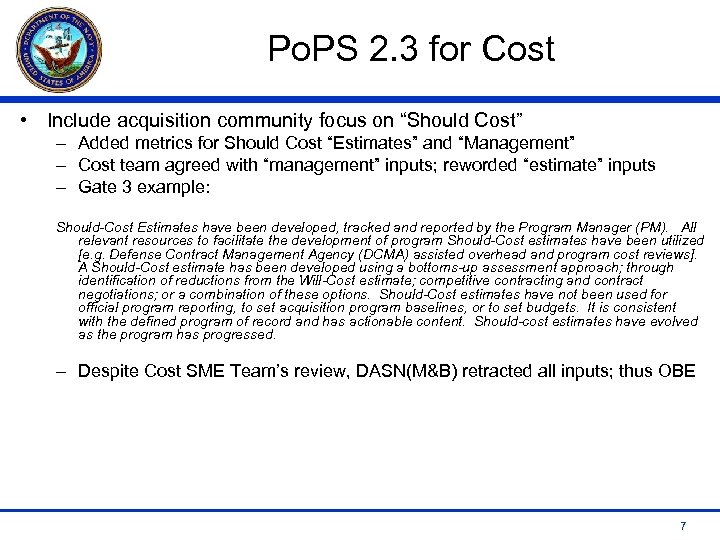 Po. PS 2. 3 for Cost • Include acquisition community focus on “Should Cost” – Added metrics for Should Cost “Estimates” and “Management” – Cost team agreed with “management” inputs; reworded “estimate” inputs – Gate 3 example: Should-Cost Estimates have been developed, tracked and reported by the Program Manager (PM). All relevant resources to facilitate the development of program Should-Cost estimates have been utilized [e. g. Defense Contract Management Agency (DCMA) assisted overhead and program cost reviews]. A Should-Cost estimate has been developed using a bottoms-up assessment approach; through identification of reductions from the Will-Cost estimate; competitive contracting and contract negotiations; or a combination of these options. Should-Cost estimates have not been used for official program reporting, to set acquisition program baselines, or to set budgets. It is consistent with the defined program of record and has actionable content. Should-cost estimates have evolved as the program has progressed. – Despite Cost SME Team’s review, DASN(M&B) retracted all inputs; thus OBE 7
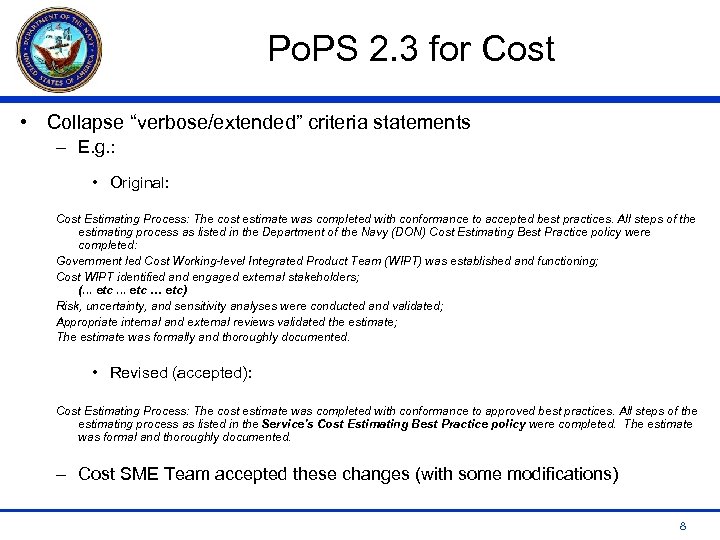 Po. PS 2. 3 for Cost • Collapse “verbose/extended” criteria statements – E. g. : • Original: Cost Estimating Process: The cost estimate was completed with conformance to accepted best practices. All steps of the estimating process as listed in the Department of the Navy (DON) Cost Estimating Best Practice policy were completed: Government led Cost Working-level Integrated Product Team (WIPT) was established and functioning; Cost WIPT identified and engaged external stakeholders; (. . . etc … etc) Risk, uncertainty, and sensitivity analyses were conducted and validated; Appropriate internal and external reviews validated the estimate; The estimate was formally and thoroughly documented. • Revised (accepted): Cost Estimating Process: The cost estimate was completed with conformance to approved best practices. All steps of the estimating process as listed in the Service's Cost Estimating Best Practice policy were completed. The estimate was formal and thoroughly documented. – Cost SME Team accepted these changes (with some modifications) 8
 Po. PS 2. 3 – Path Ahead • Adding-to or modifying existing criteria outside of this list was restricted – Cost SME team’s desire to revise/edit some criteria was out of scope – Things like “S-Curve CVs” and other metrics will be addressed in next round • The full update also incorporate AMMS (Acquisition Management Metrics System), which was accredited in Dec 2011 – AMMS is a “summary level” comparison metrics tool, across portfolios • Not simply a “Gate-specific snapshot” of a single program • ASN(RD&A) Sys Eng team is compiling and forwarding the whole package to ASN(RD&A) for chop – Expect the revised update to be in the tasker system in the coming month – Don’t hold your breath 9
 Questions? Resource Sponsor Program Manager 10
 Backups IS ALYS COST AN s, ourse fc y Gol. . . Bu nkers Ta lease Fly Air Force! 11
 slides” g Briefin AT I =“ AC = “M etrics All A and R CATs /Y /G” 12
 13
13
 3. Completed CRB 3. Approve APB and Full Funding Cert for MS-B. 7. SCP, assumptions, cost risks, S-Curves 8. Cost drivers by phase and by KPP/KSA; cost reduction strategies. DASN (C&E) SYSCOM Cost Dir 14
 15
15
 16
16
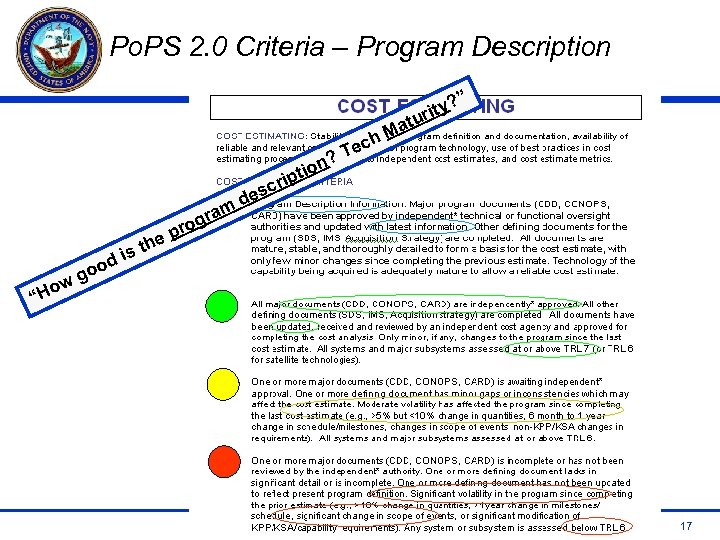 Po. PS 2. 0 Criteria – Program Description ” r io ipt c des m e s th di n? t Ma h Tec ? rity u ra og pr o go w o “H 17
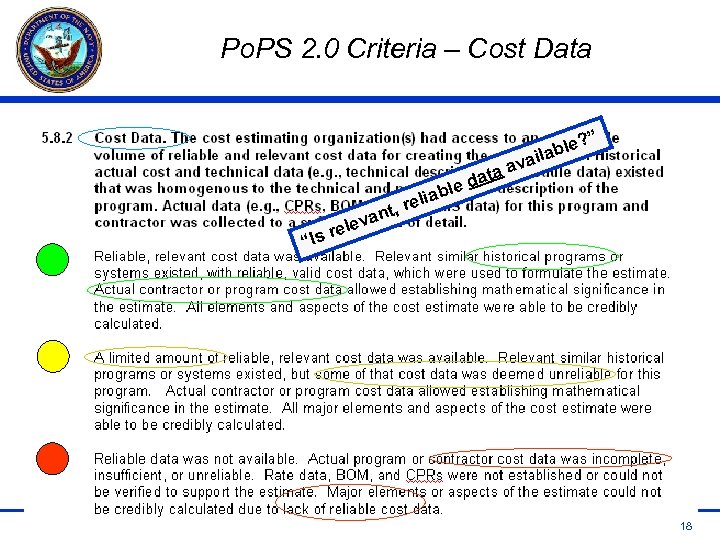 Po. PS 2. 0 Criteria – Cost Data le? ” b aila v aa dat e iabl l t, re van le e Is r “ 18
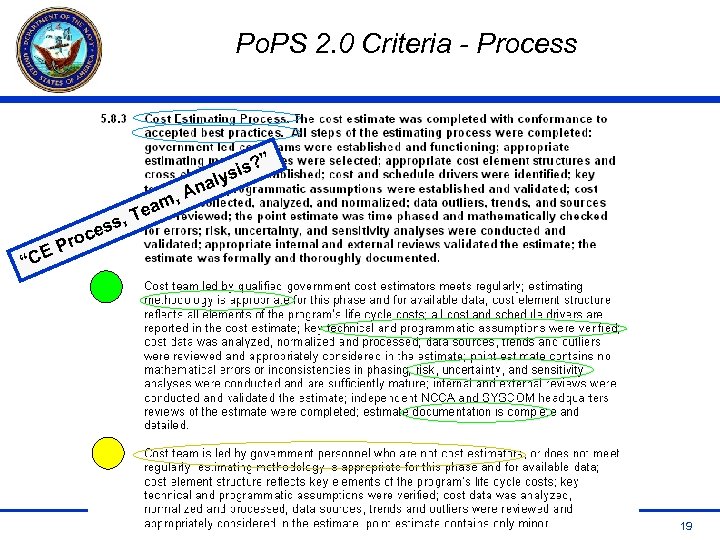 Po. PS 2. 0 Criteria - Process ” is? lys a , An m a e s, T s oce r P CE “ 19
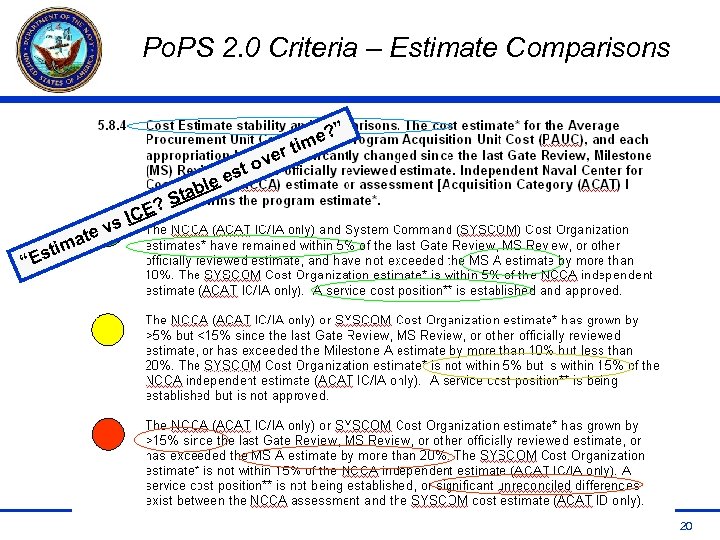 Po. PS 2. 0 Criteria – Estimate Comparisons r ove t e? ” im t s e ble a t s te v S E? IC a stim E “ 20
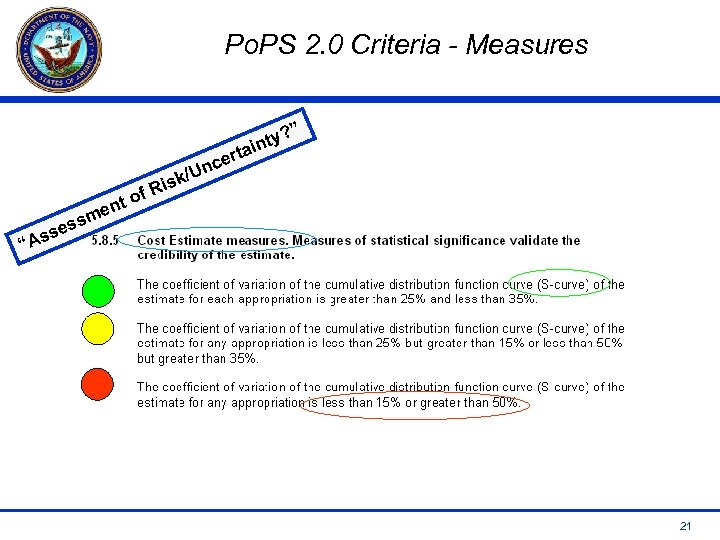 Po. PS 2. 0 Criteria - Measures f s ses As o ent m ” ta r nce /U isk R ? inty “ 21
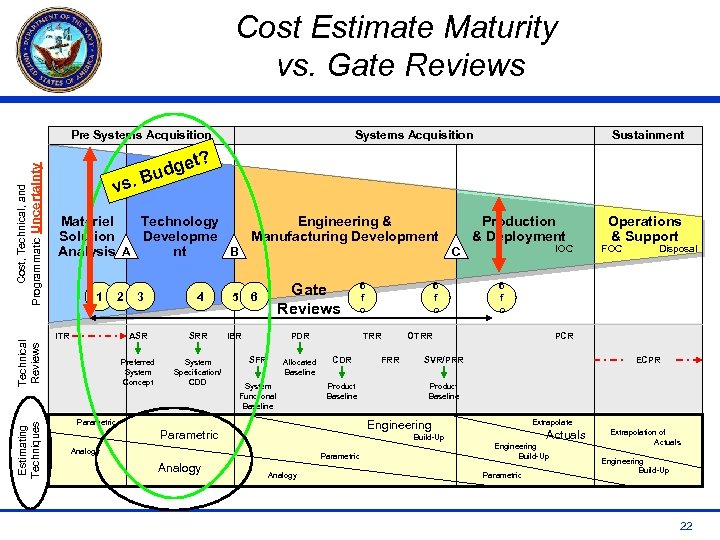 Cost Estimate Maturity vs. Gate Reviews Estimating Techniques Technical Reviews Cost, Technical, and Programmatic Uncertainty Pre Systems Acquisition Sustainment t? ge Bud. vs Materiel Technology Engineering & Production Solution Developme Manufacturing Development & Deployment IOC Analysis A nt B C 1 3 4 5 ASR SRR System Specification/ CDD Gate Reviews IBR Preferred System Concept ITR 2 6 6 f o PDR SFR Allocated Baseline System Functional Baseline TRR CDR Product Baseline Parametric FRR OTRR Parametric Analogy Disposal PCR SVR/PRR ECPR Product Baseline Extrapolate Actuals Build-Up Analogy FOC 6 f o Engineering Parametric Analogy 6 f o Operations & Support Engineering Build-Up Parametric Extrapolation of Actuals Engineering Build-Up 22