


 Скачать презентацию UNCLASSIFIED Alternative Futures Approach to Nuclear Deterrence Planning
722aa65f957c7310cec63947faf774df.ppt
- Количество слайдов: 37
 UNCLASSIFIED Alternative Futures Approach to Nuclear Deterrence Planning Capabilities Based Planning for the New Triad 15 July 2002 8725 John J. Kingman Road, MSC 6201 Fort Belvoir, VA. 22060 -6201 UNCLASSIFIED
 UNCLASSIFIED Table of Contents Executive Summary Introduction Worlds and Operational Situations Requirements Generation Adaptive Options Database Force Structure Guidelines Conclusions and Recommendations Attachments Appendices Acronyms 2 UNCLASSIFIED
 UNCLASSIFIED Purpose • Provide a report detailing a “proof of concept” capabilitiesbased approach for developing integrated strategic strike planning recommendations – Context – Study Method • • Worlds and Operational Situations (OPSITs) Requirements Generation Adaptive Options Database Force Structure Guidelines • Provide recommendations for use of the method developed in this study 3 UNCLASSIFIED
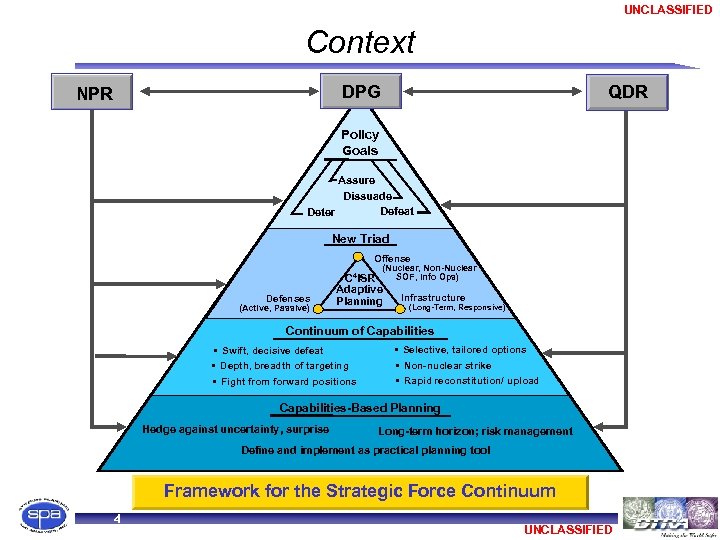 UNCLASSIFIED Context DPG NPR QDR Policy Goals Assure Dissuade Defeat Deter New Triad Offense (Nuclear, Non-Nuclear SOF, Info Ops) Defenses (Active, Passive) C 4 ISR Adaptive Planning Infrastructure (Long-Term, Responsive) Continuum of Capabilities • Swift, decisive defeat • Depth, breadth of targeting • Fight from forward positions • Selective, tailored options • Non-nuclear strike • Rapid reconstitution/ upload Capabilities-Based Planning Hedge against uncertainty, surprise Long-term horizon; risk management Define and implement as practical planning tool Framework for the Strategic Force Continuum 4 UNCLASSIFIED
 UNCLASSIFIED Capabilities-Based Planning • Planning is driven by uncertainty of threat and certainty of surprise – Focus on range of capability needs vice specific threat • Diverse set of capabilities is needed to deal with plausible adversaries – Not country specific but… – Multiple contingencies and real geographies • Capability includes both content and capacity – Content-performance at the individual platform level – Capacity-performance across force structure • Study focus is strategic strike capability • Analysis captures strike targets through the lens of a range of possible adversaries – Types of targets lead to content – Numbers of targets lead to capacity 5 UNCLASSIFIED
 Scenario-Based Planning: UNCLASSIFIED Alternative Future Worlds Approach Worlds • Top-down independent approach I • Proven and credible method • Accounts for uncertainty III Today II • Plausibly bounds the spectrum of challenges and possibilities • Scenarios tied to worlds • Integrated focus on the future to help today’s decision making ~ 20 -30 years hence “A tool for ordering one’s perceptions about alternative future environments in which one’s decisions might be played out. ” Peter Schwartz, Art of the Long View 6 UNCLASSIFIED
 UNCLASSIFIED Study Methodology 2020 Alternative Worlds Operational Situations Capabilities Threat + Target Base R E Q U I R E M E N T S T R A D E O F F A N A L Y S Inputs Assume NPR Offensive Force Adaptive Options Database Options for Modernizing and Augmenting U. S. Offensive Forces 2020 Force Structure Recommendations 7 UNCLASSIFIED
 UNCLASSIFIED Worlds and OPSITs 2020 Alternative Worlds Operational Situations Capabilities Threat + Target Base R E Q U I R E M E N T S T R A D E O F F A N A L Y S Inputs Assume NPR Offensive Force Adaptive Options Database Options for Modernizing and Augmenting U. S. Offensive Forces 2020 Force Structure Recommendations 8 UNCLASSIFIED
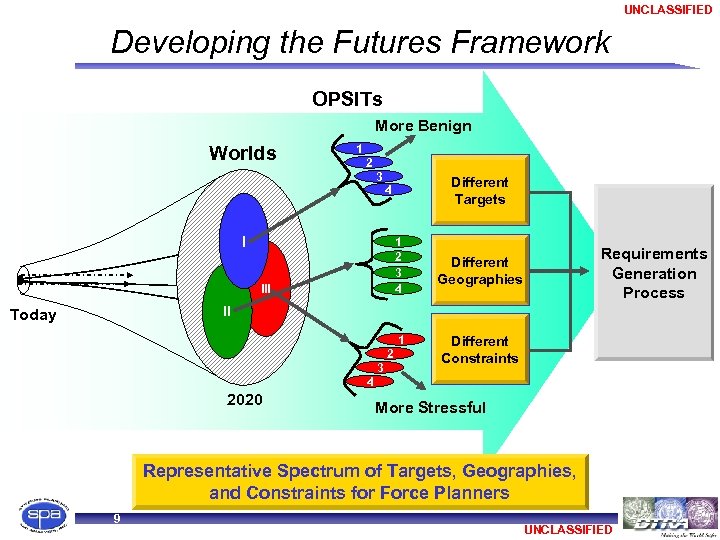 UNCLASSIFIED Developing the Futures Framework OPSITs More Benign Worlds 1 2 3 Different Targets 4 I 1 2 3 4 III Requirements Generation Process Different Geographies II Today 1 2 3 Different Constraints 4 2020 More Stressful Representative Spectrum of Targets, Geographies, and Constraints for Force Planners 9 UNCLASSIFIED
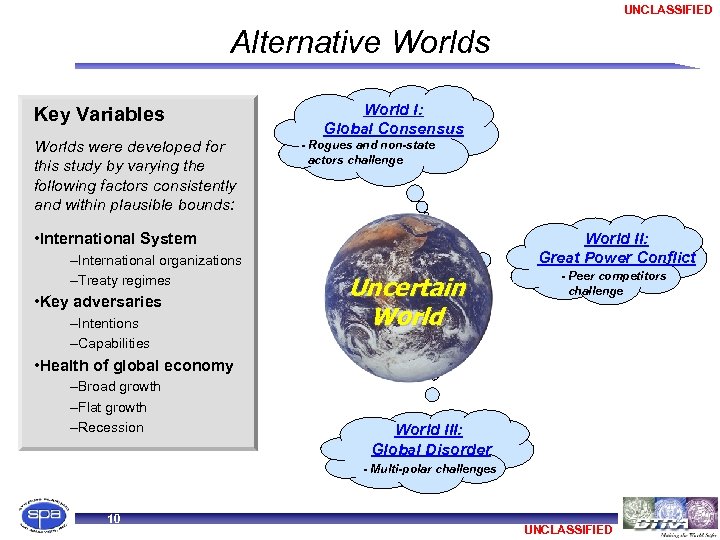 UNCLASSIFIED Alternative Worlds Key Variables Worlds were developed for this study by varying the following factors consistently and within plausible bounds: World I: Global Consensus - Rogues and non-state actors challenge • International System –International organizations –Treaty regimes • Key adversaries –Intentions –Capabilities World II: Great Power Conflict Uncertain World - Peer competitors challenge • Health of global economy –Broad growth –Flat growth –Recession World III: Global Disorder - Multi-polar challenges 10 UNCLASSIFIED
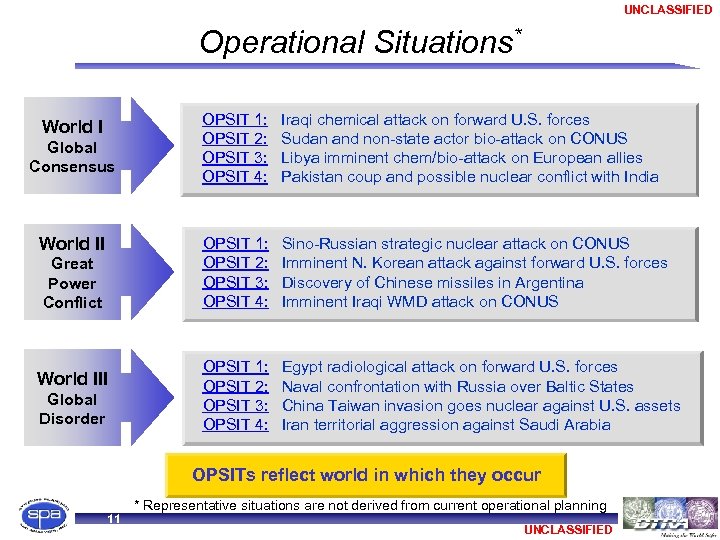 UNCLASSIFIED Operational Situations* Global Consensus World II Great Power Conflict World III Global Disorder OPSIT 1: OPSIT 2: OPSIT 3: OPSIT 4: Iraqi chemical attack on forward U. S. forces Sudan and non-state actor bio-attack on CONUS Libya imminent chem/bio-attack on European allies Pakistan coup and possible nuclear conflict with India OPSIT 1: OPSIT 2: OPSIT 3: OPSIT 4: World I Sino-Russian strategic nuclear attack on CONUS Imminent N. Korean attack against forward U. S. forces Discovery of Chinese missiles in Argentina Imminent Iraqi WMD attack on CONUS OPSIT 1: OPSIT 2: OPSIT 3: OPSIT 4: Egypt radiological attack on forward U. S. forces Naval confrontation with Russia over Baltic States China Taiwan invasion goes nuclear against U. S. assets Iran territorial aggression against Saudi Arabia OPSITs reflect world in which they occur 11 * Representative situations are not derived from current operational planning UNCLASSIFIED
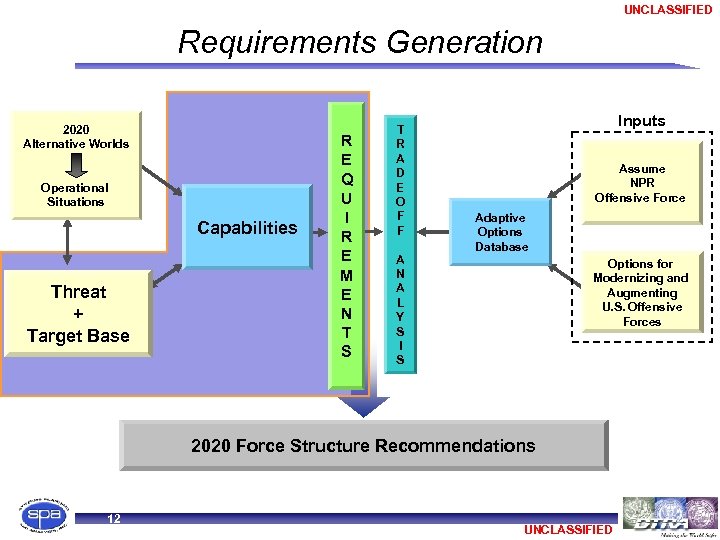 UNCLASSIFIED Requirements Generation 2020 Alternative Worlds Operational Situations Capabilities Threat + Target Base R E Q U I R E M E N T S T R A D E O F F A N A L Y S Inputs Assume NPR Offensive Force Adaptive Options Database Options for Modernizing and Augmenting U. S. Offensive Forces 2020 Force Structure Recommendations 12 UNCLASSIFIED
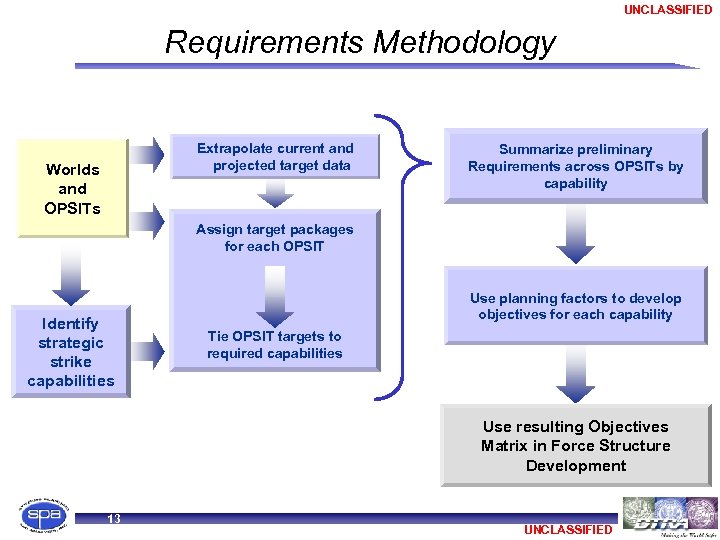 UNCLASSIFIED Requirements Methodology Extrapolate current and projected target data Worlds and OPSITs Summarize preliminary Requirements across OPSITs by capability Assign target packages for each OPSIT Identify strategic strike capabilities Use planning factors to develop objectives for each capability Tie OPSIT targets to required capabilities Use resulting Objectives Matrix in Force Structure Development 13 UNCLASSIFIED
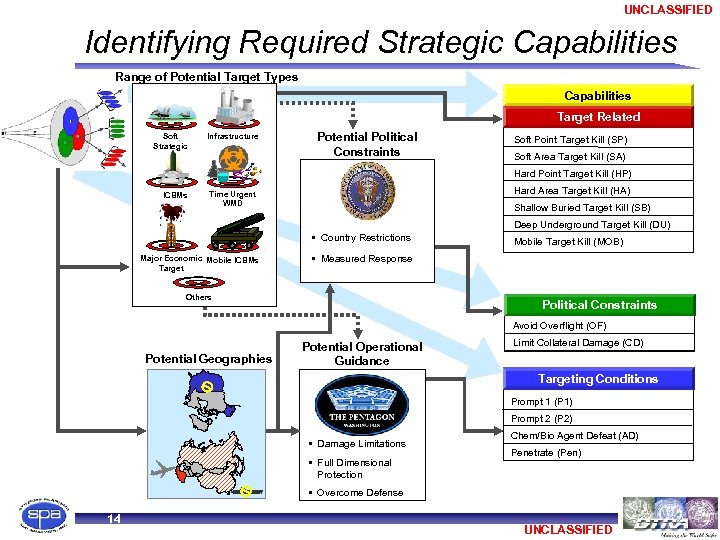 UNCLASSIFIED Identifying Required Strategic Capabilities Range of Potential Target Types Capabilities Target Related Soft Strategic Infrastructure Potential Political Constraints Soft Point Target Kill (SP) Soft Area Target Kill (SA) Hard Point Target Kill (HP) ICBMs Hard Area Target Kill (HA) Time Urgent WMD Shallow Buried Target Kill (SB) Deep Underground Target Kill (DU) • Country Restrictions Major Economic Mobile ICBMs Target Mobile Target Kill (MOB) • Measured Response Others Political Constraints Avoid Overflight (OF) Potential Geographies Potential Operational Guidance Limit Collateral Damage (CD) Targeting Conditions Prompt 1 (P 1) Prompt 2 (P 2) • Damage Limitations • Full Dimensional Protection Chem/Bio Agent Defeat (AD) Penetrate (Pen) • Overcome Defense 14 UNCLASSIFIED
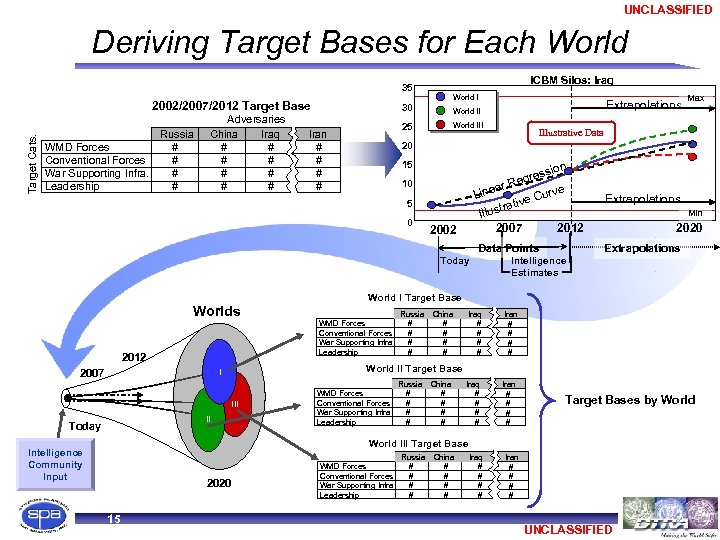 UNCLASSIFIED Deriving Target Bases for Each World ICBM Silos: Iraq 35 Target Cats. 2002/2007/2012 Target Base Russia WMD Forces # Conventional Forces # War Supporting Infra. # Leadership # Adversaries China Iraq # # # # World I 30 25 Iran # # Extrapolations World III Max Illustrative Data 20 15 sion gres e ar R e Line Curv tive tra Illus 2007 2012 10 5 0 2002 Data Points Today Extrapolations Min 2020 Extrapolations Intelligence Estimates World I Target Base Worlds 2012 2007 III II Russia # # China # # # # Iraq # # # # Iran # # World II Target Base I Today WMD Forces Conventional Forces War Supporting Infra. Leadership Russia # # China # # Target Bases by World III Target Base Intelligence Community Input 2020 15 WMD Forces Conventional Forces War Supporting Infra. Leadership Russia # # China # # Iraq # # Iran # # UNCLASSIFIED
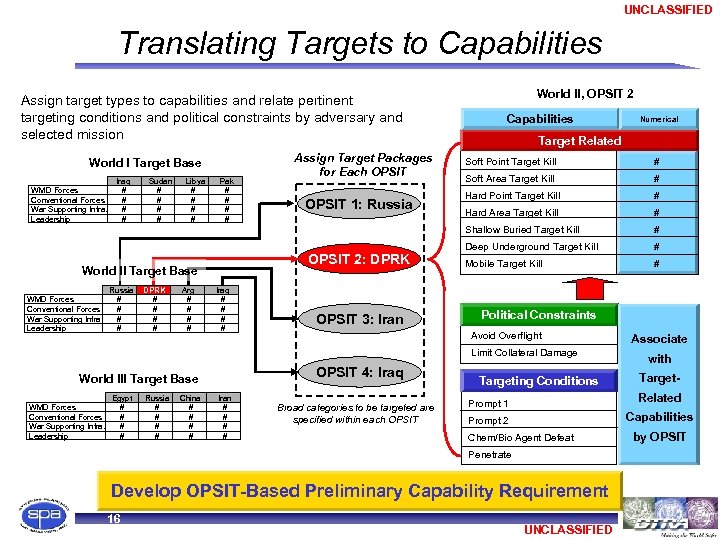 UNCLASSIFIED Translating Targets to Capabilities Assign target types to capabilities and relate pertinent targeting conditions and political constraints by adversary and selected mission World I Target Base Assign Target Packages for Each OPSIT World II, OPSIT 2 Capabilities Numerical Target Related Iraq # # Sudan # # Libya # # Pak # # OPSIT 2: DPRK World II Target Base WMD Forces Conventional Forces War Supporting Infra. Leadership Russia # # DPRK # # Arg # # OPSIT 1: Russia Iraq # # OPSIT 3: Iran # Soft Area Target Kill # Hard Point Target Kill # Hard Area Target Kill # Shallow Buried Target Kill WMD Forces Conventional Forces War Supporting Infra. Leadership Soft Point Target Kill # Deep Underground Target Kill # Mobile Target Kill # Political Constraints Avoid Overflight Limit Collateral Damage OPSIT 4: Iraq World III Target Base WMD Forces Conventional Forces War Supporting Infra. Leadership Egypt # # Russia # # China # # Iran # # Broad categories to be targeted are specified within each OPSIT Targeting Conditions with Target- Prompt 1 Related Prompt 2 Capabilities Chem/Bio Agent Defeat Penetrate Develop OPSIT-Based Preliminary Capability Requirement 16 Associate UNCLASSIFIED by OPSIT
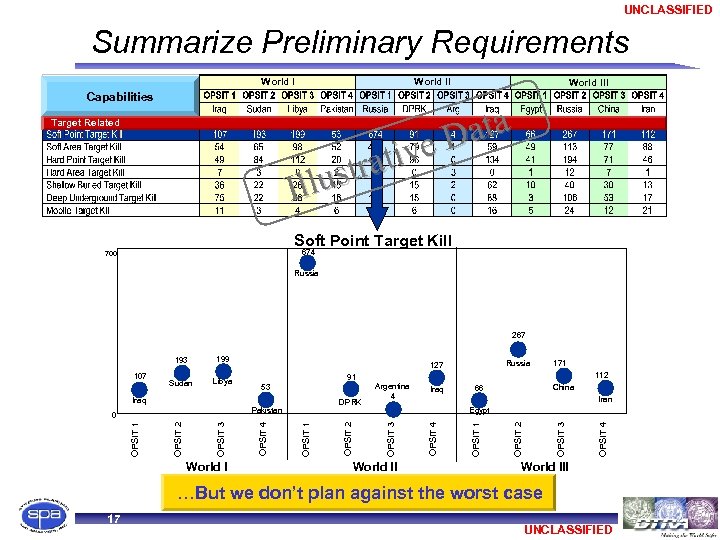 UNCLASSIFIED Summarize Preliminary Requirements World I Capabilities World III ata ve D rati lust Il Target Related Soft Point Target Kill 674 700 Russia 267 World I OPSIT 1 OPSIT 3 OPSIT 2 OPSIT 1 0 OPSIT 4 Pakistan Iraq Iran Egypt World II OPSIT 4 DPRK China 66 OPSIT 3 Iraq 171 112 Argentina 4 OPSIT 2 91 53 OPSIT 1 Libya OPSIT 4 Sudan Russia 127 OPSIT 3 107 199 OPSIT 2 193 World III …But we don’t plan against the worst case 17 UNCLASSIFIED
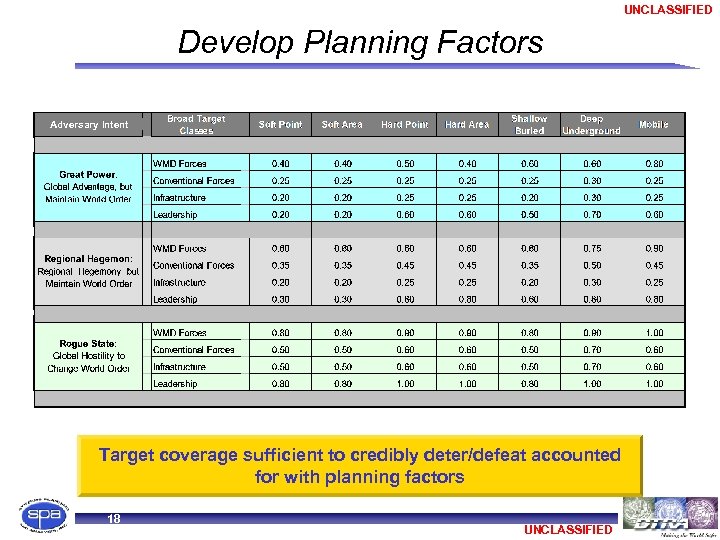 UNCLASSIFIED Develop Planning Factors Adversary Intent Target coverage sufficient to credibly deter/defeat accounted for with planning factors 18 UNCLASSIFIED
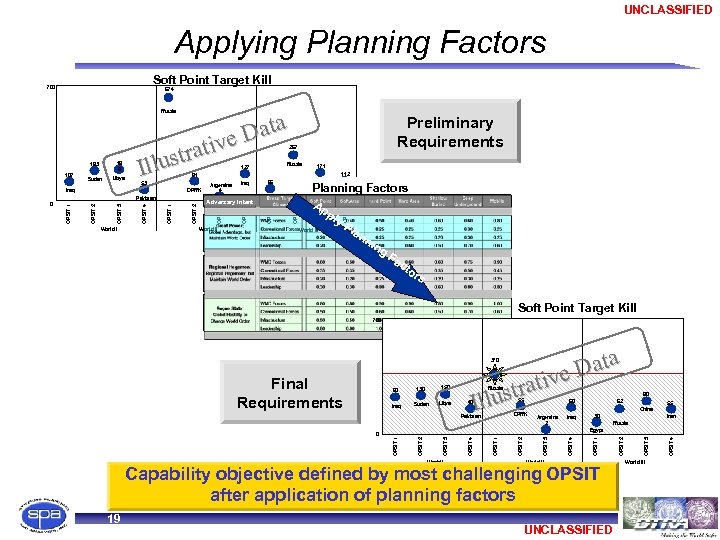 UNCLASSIFIED Applying Planning Factors Soft Point Target Kill 700 674 Russia Adversary Intent OPSIT 3 OPSIT 2 OPSIT 1 OPSIT 4 112 World II China 66 Egypt Iran Planning Factors Ap pl y. P World III lan ni ng Fa ct o rs Soft Point Target Kill 700 Data e rativ t Illus 370 90 Iraq 150 130 Sudan Libya Russia 55 40 60 DPRK Pakistan Argentina 2 Iraq 55 China 30 Iran Russia World II UNCLASSIFIED World III OPSIT 4 OPSIT 3 OPSIT 2 OPSIT 1 OPSIT 4 OPSIT 3 OPSIT 2 World I Capability objective defined by most challenging OPSIT after application of planning factors OPSIT 2 Egypt 0 19 90 62 OPSIT 1 Final Requirements OPSIT 1 OPSIT 2 OPSIT 1 OPSIT 3 World I Iraq OPSIT 4 DPRK Pakistan Argentina 4 171 OPSIT 3 53 Iraq 0 Russia 127 OPSIT 2 Sudan Preliminary Requirements 267 91 OPSIT 1 19 9 Libya OPSIT 4 193 107 Data ative tr Illus
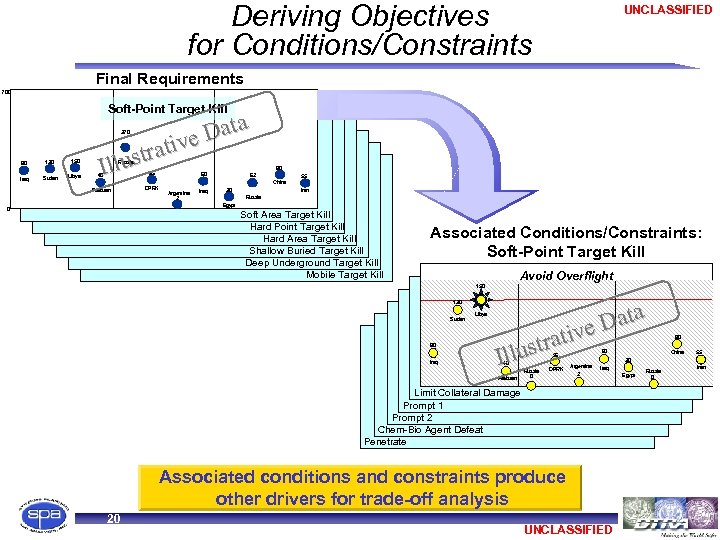 Deriving Objectives for Conditions/Constraints UNCLASSIFIED Final Requirements 700 Soft-Point Target Kill Data ative tr Illus 370 90 130 150 Iraq Sudan Libya Russia 40 55 Pakistan DPRK 60 Argentina 2 Iraq 90 62 30 55 China Iran Russia Egypt 0 Soft Area Target Kill Hard Point Target Kill Hard Area Target Kill Shallow Buried Target Kill Deep Underground Target Kill Mobile Target Kill Associated Conditions/Constraints: Soft-Point Target Kill: Avoid Overflight 150 250 199 130 250 Sudan 250 193 Libya Sudan 250 Iraq Data e trativ Illus 193 Libya Sudan 107 Iraq Soft-Point Target Kill: Avoid Overflight 199 193 Libya Sudan 250 90 Soft-Point Target Kill: Avoid Overflight 199 107 Iraq 107 193 Libya Soft-Point Target Kill: Avoid Overflight 199 127 Soft-Point Target Kill: Avoid Overflight 90 China 199 55 60 Iraq 40 193 Libya Argentina Sudan DPRK 91 91 91 Iraq Sudan Russia DPRK 2 DPRK 53 53 0 Pakistan Argentina 91 Limit Collateral Damage Prompt 1 Prompt 2 Chem-Bio Agent Defeat Penetrate Associated conditions and constraints produce other drivers for trade-off analysis 20 UNCLASSIFIED 127 China 30 127 Iraq 66 Russia Egypt 66 127 0 Iraq Russia 66 171 55 China Iran
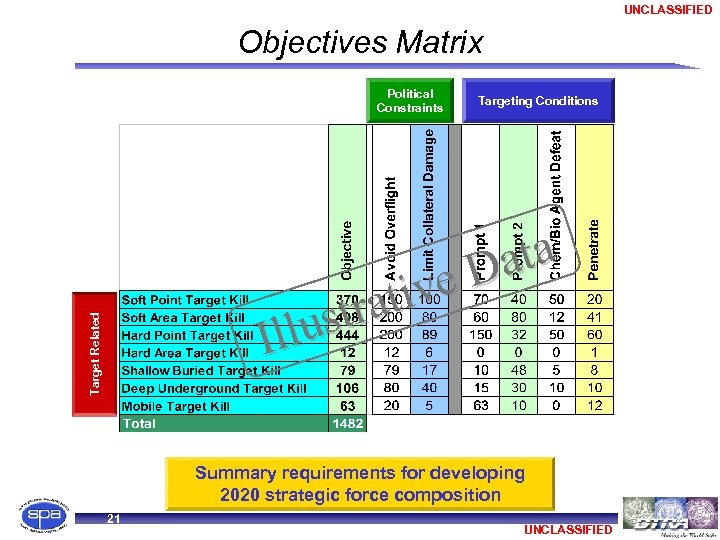 UNCLASSIFIED Objectives Matrix Political Constraints Targeting Conditions Target Related ata e. D ativ str Illu Summary requirements for developing 2020 strategic force composition 21 UNCLASSIFIED
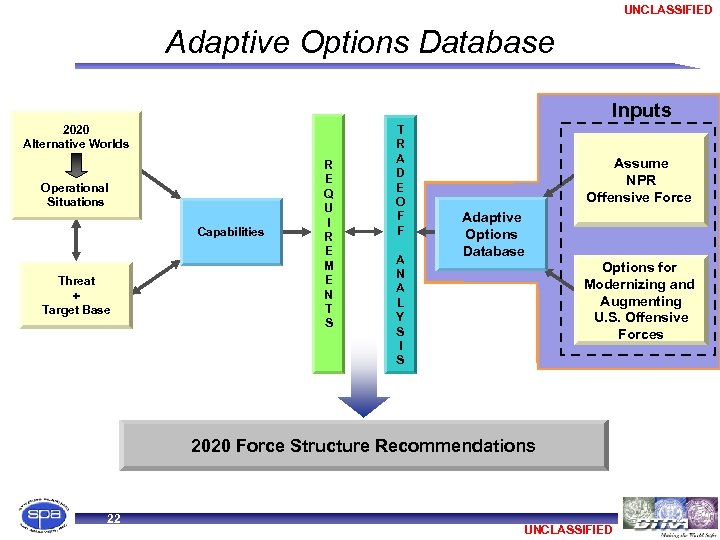 UNCLASSIFIED Adaptive Options Database Inputs 2020 Alternative Worlds Operational Situations Capabilities Threat + Target Base R E Q U I R E M E N T S T R A D E O F F A N A L Y S I S Assume NPR Offensive Force Adaptive Options Database Options for Modernizing and Augmenting U. S. Offensive Forces 2020 Force Structure Recommendations 22 UNCLASSIFIED
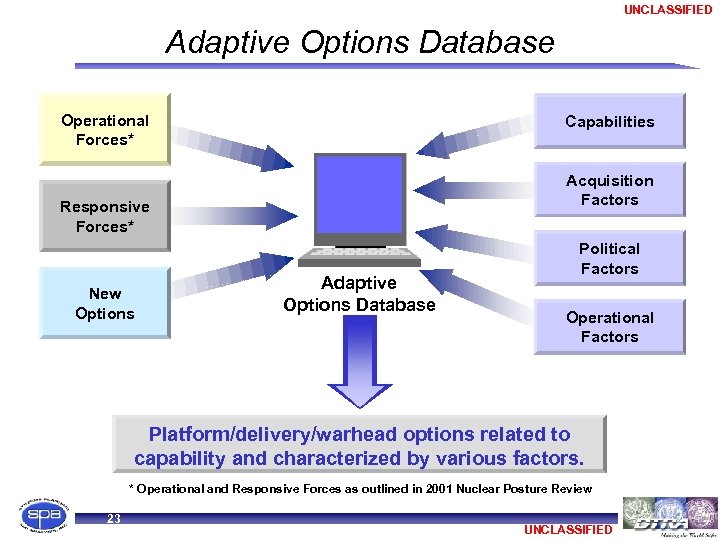 UNCLASSIFIED Adaptive Options Database Operational Forces* Capabilities Acquisition Factors Responsive Forces* New Options Adaptive Options Database Political Factors Operational Factors Platform/delivery/warhead options related to capability and characterized by various factors. * Operational and Responsive Forces as outlined in 2001 Nuclear Posture Review 23 UNCLASSIFIED
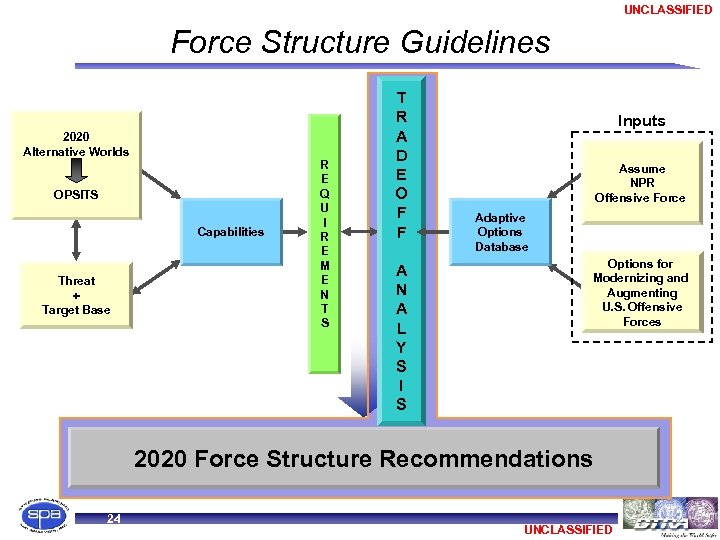 UNCLASSIFIED Force Structure Guidelines 2020 Alternative Worlds OPSITS Capabilities Threat + Target Base R E Q U I R E M E N T S T R A D E O F F A N A L Y S Inputs Assume NPR Offensive Force Adaptive Options Database Options for Modernizing and Augmenting U. S. Offensive Forces 2020 Force Structure Recommendations 24 UNCLASSIFIED
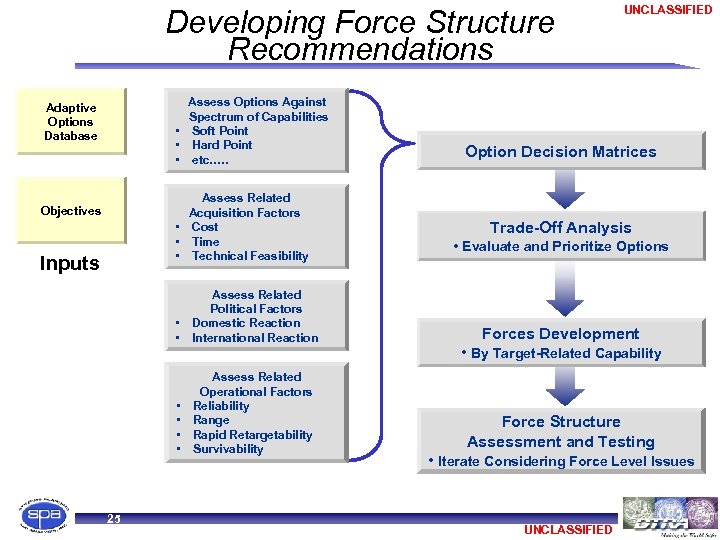 Developing Force Structure Recommendations Assess Options Against Spectrum of Capabilities • Soft Point • Hard Point • etc…. . Adaptive Options Database Assess Related Acquisition Factors • Cost • Time • Technical Feasibility Objectives Inputs • • • 25 Assess Related Political Factors Domestic Reaction International Reaction Assess Related Operational Factors Reliability Range Rapid Retargetability Survivability UNCLASSIFIED Option Decision Matrices Trade-Off Analysis • Evaluate and Prioritize Options Forces Development • By Target-Related Capability Force Structure Assessment and Testing • Iterate Considering Force Level Issues UNCLASSIFIED
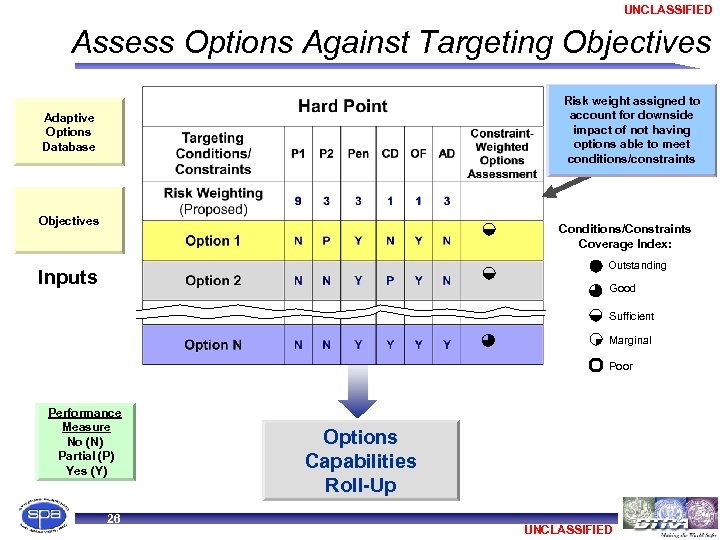 UNCLASSIFIED Assess Options Against Targeting Objectives Risk weight assigned to account for downside impact of not having options able to meet conditions/constraints Adaptive Options Database Objectives Conditions/Constraints Coverage Index: Outstanding Inputs Good Sufficient Marginal Poor Performance Measure No (N) Partial (P) Yes (Y) 26 Options Capabilities Roll-Up UNCLASSIFIED
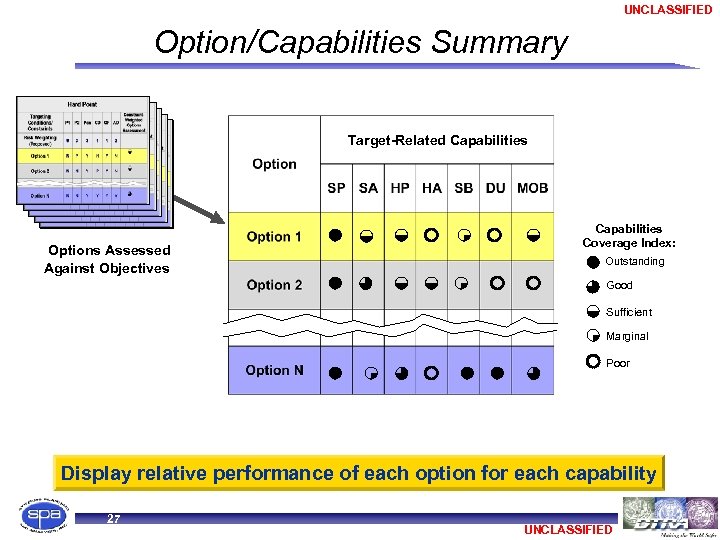 UNCLASSIFIED Option/Capabilities Summary Target-Related Capabilities Options Assessed Against Objectives Capabilities Coverage Index: Outstanding Good Sufficient Marginal Poor Display relative performance of each option for each capability 27 UNCLASSIFIED
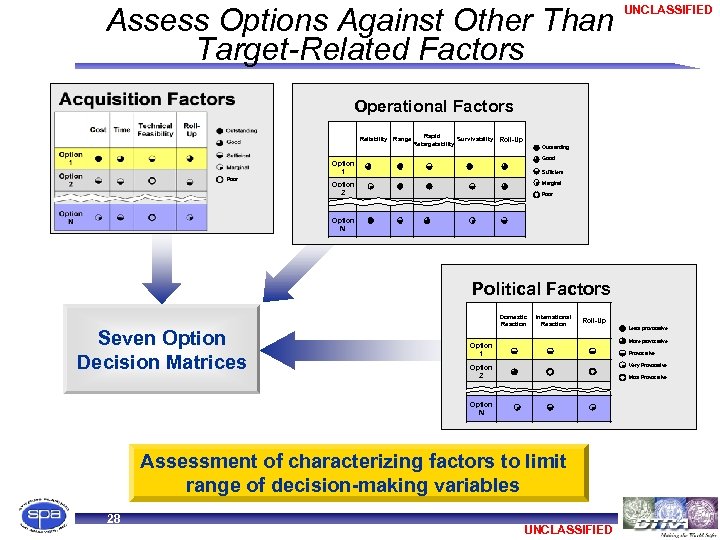 Assess Options Against Other Than Target-Related Factors UNCLASSIFIED Operational Factors Reliability Range Rapid Survivability Roll-Up Retargetability Outstanding Good Option 1 Poor Sufficient Marginal Option 2 Poor Unacceptable Option N Political Factors Seven Option Decision Matrices Domestic Reaction International Reaction Roll-Up More provocative Option 1 Provocative Very Provocative Option 2 Most Provocative Option N Assessment of characterizing factors to limit range of decision-making variables 28 Least provocative UNCLASSIFIED
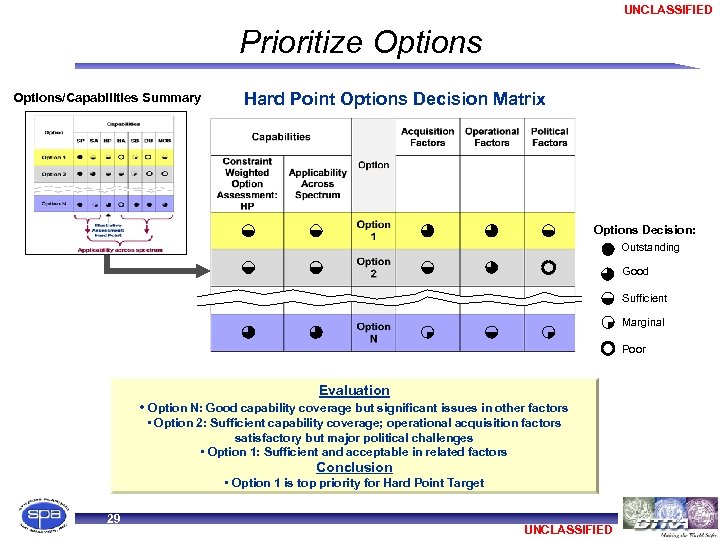 UNCLASSIFIED Prioritize Options/Capabilities Summary Hard Point Options Decision Matrix Options Decision: Outstanding Good Sufficient Marginal Poor Evaluation • Option N: Good capability coverage but significant issues in other factors • Option 2: Sufficient capability coverage; operational acquisition factors satisfactory but major political challenges • Option 1: Sufficient and acceptable in related factors Conclusion • Option 1 is top priority for Hard Point Target 29 UNCLASSIFIED
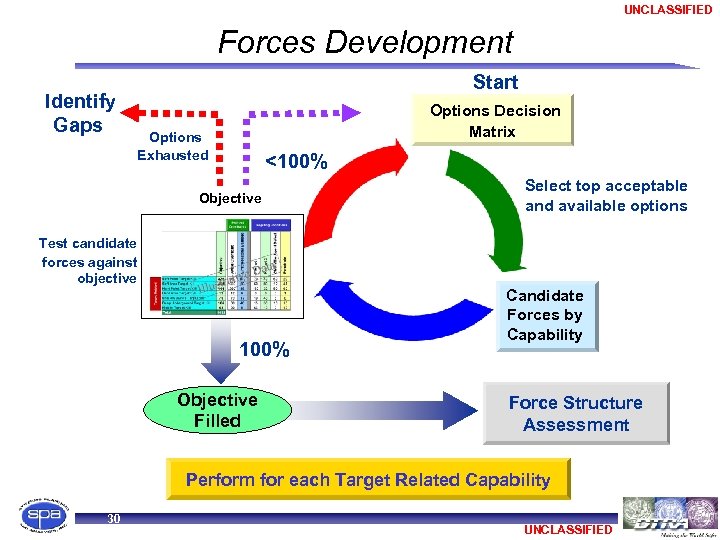 UNCLASSIFIED Forces Development Identify Gaps Start Options Decision Matrix Options Exhausted <100% Objective Select top acceptable and available options Test candidate forces against objective 100% Objective Filled Candidate Forces by Capability Force Structure Assessment Perform for each Target Related Capability 30 UNCLASSIFIED
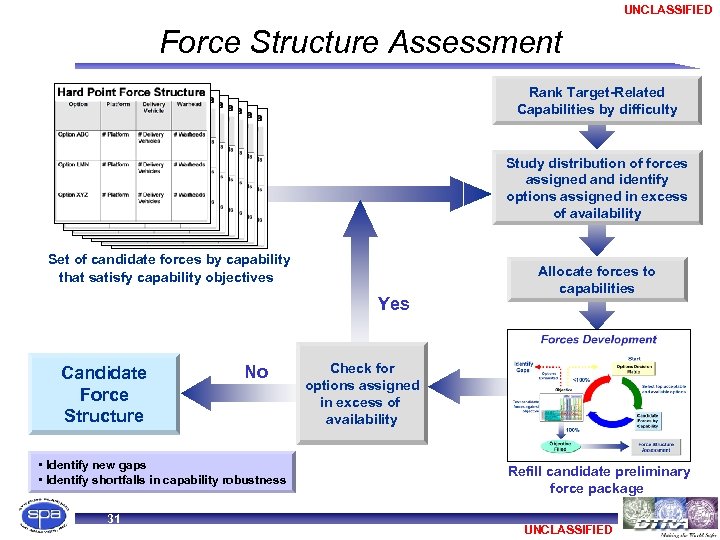 UNCLASSIFIED Force Structure Assessment Rank Target-Related Capabilities by difficulty Study distribution of forces assigned and identify options assigned in excess of availability Set of candidate forces by capability that satisfy capability objectives Yes Candidate Force Structure No • Identify new gaps • Identify shortfalls in capability robustness 31 Allocate forces to capabilities Check for options assigned in excess of availability Refill candidate preliminary force package UNCLASSIFIED
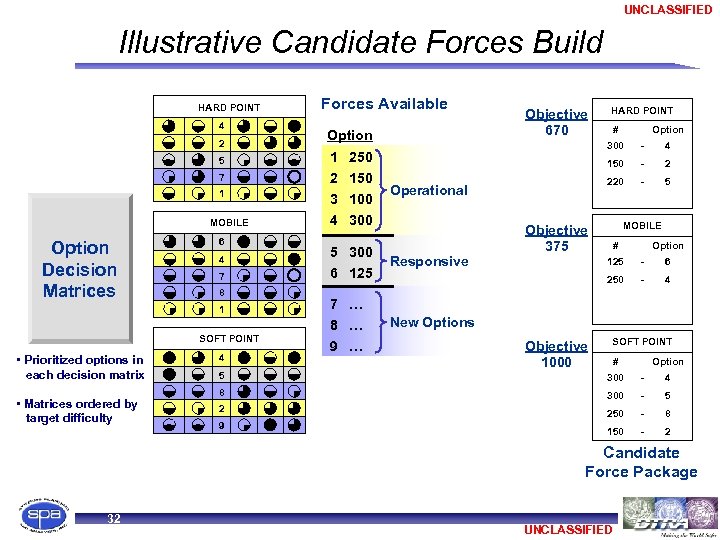 UNCLASSIFIED Illustrative Candidate Forces Build HARD POINT 4 2 Forces Available Option 5 2 150 1 3 100 4 300 MOBILE Option Decision Matrices 6 4 5 300 7 6 125 8 1 • Prioritized options in each decision matrix • Matrices ordered by target difficulty 4 5 # Option Responsive 4 150 - 2 220 Operational - 5 MOBILE Objective 375 # Option 125 - 6 250 - 4 7 … 8 … SOFT POINT HARD POINT 300 1 250 7 Objective 670 9 … New Options Objective 1000 SOFT POINT # Option 300 - 4 8 300 - 5 2 250 - 8 150 - 2 9 Candidate Force Package 32 UNCLASSIFIED
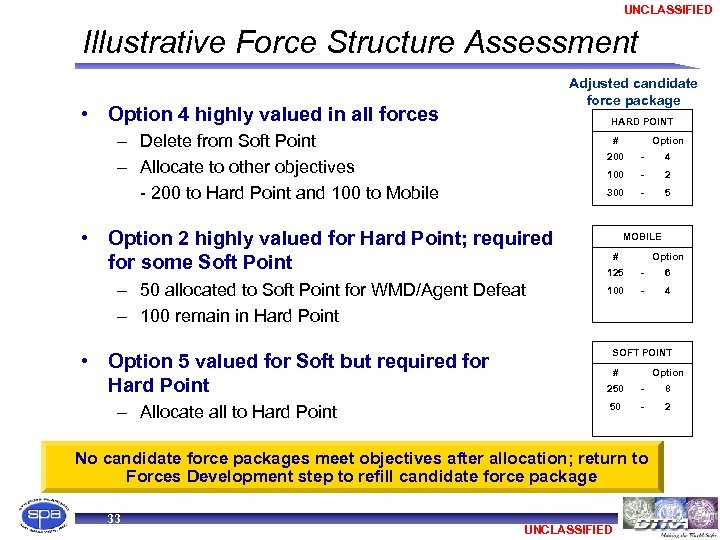 UNCLASSIFIED Illustrative Force Structure Assessment Adjusted candidate force package • Option 4 highly valued in all forces HARD POINT – Delete from Soft Point – Allocate to other objectives - 200 to Hard Point and 100 to Mobile # 200 – Allocate all to Hard Point 4 - 2 300 – 50 allocated to Soft Point for WMD/Agent Defeat – 100 remain in Hard Point - 100 • Option 2 highly valued for Hard Point; required for some Soft Point • Option 5 valued for Soft but required for Hard Point Option - 5 MOBILE # Option 125 - 6 100 - 4 SOFT POINT # Option 250 - 8 50 - 2 No candidate force packages meet objectives after allocation; return to Forces Development step to refill candidate force package 33 UNCLASSIFIED
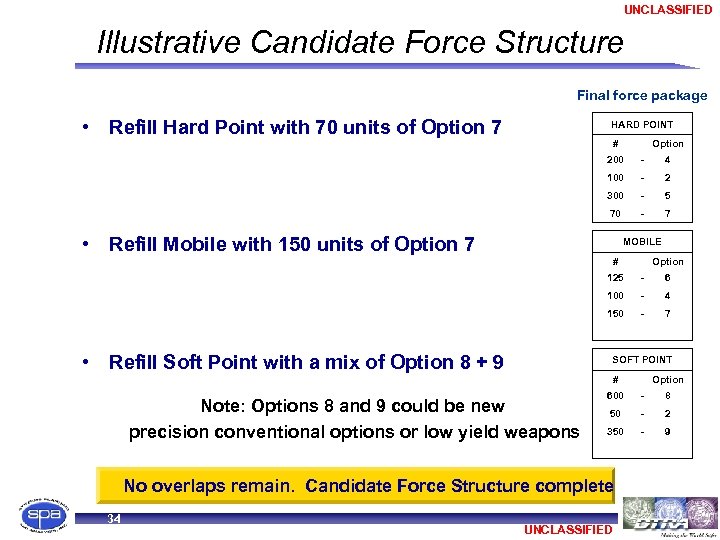 UNCLASSIFIED Illustrative Candidate Force Structure Final force package • Refill Hard Point with 70 units of Option 7 HARD POINT # Option 200 - 4 100 - 2 300 - 5 70 - 7 • Refill Mobile with 150 units of Option 7 MOBILE # Option 125 6 100 - 4 150 • Refill Soft Point with a mix of Option 8 + 9 - 7 SOFT POINT # Note: Options 8 and 9 could be new precision conventional options or low yield weapons 600 - 8 50 - 2 350 - 9 No overlaps remain. Candidate Force Structure complete 34 Option UNCLASSIFIED
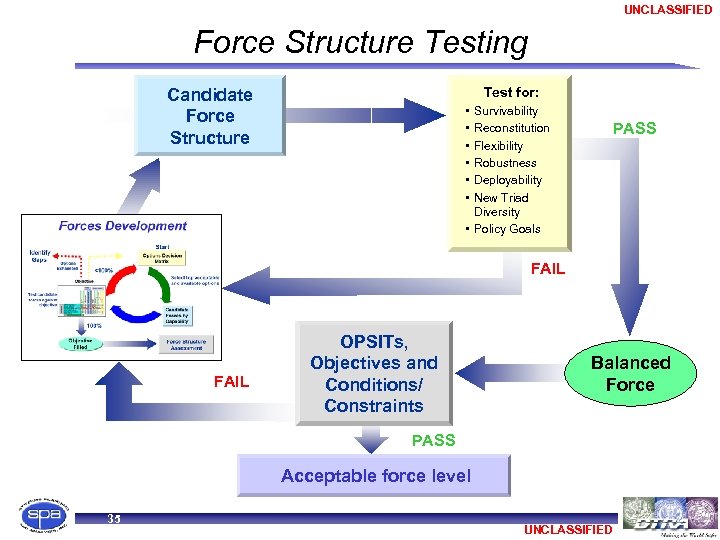 UNCLASSIFIED Force Structure Testing Candidate Force Structure Test for: • • • Survivability Reconstitution Flexibility Robustness Deployability New Triad Diversity • Policy Goals PASS FAIL OPSITs, Objectives and Conditions/ Constraints Balanced Force PASS Acceptable force level 35 UNCLASSIFIED
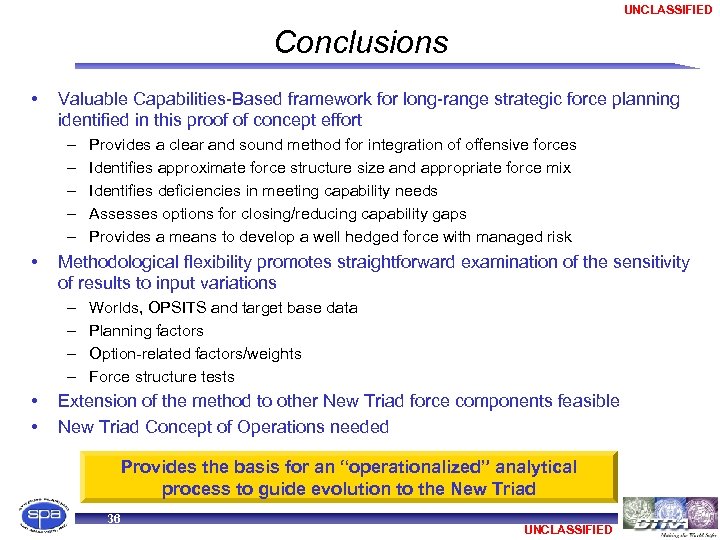 UNCLASSIFIED Conclusions • Valuable Capabilities-Based framework for long-range strategic force planning identified in this proof of concept effort – – – • Methodological flexibility promotes straightforward examination of the sensitivity of results to input variations – – • • Provides a clear and sound method for integration of offensive forces Identifies approximate force structure size and appropriate force mix Identifies deficiencies in meeting capability needs Assesses options for closing/reducing capability gaps Provides a means to develop a well hedged force with managed risk Worlds, OPSITS and target base data Planning factors Option-related factors/weights Force structure tests Extension of the method to other New Triad force components feasible New Triad Concept of Operations needed Provides the basis for an “operationalized” analytical process to guide evolution to the New Triad 36 UNCLASSIFIED
 UNCLASSIFIED Recommendations • Implement and improve this process to aid in planning strike forces for the New Triad – Comprehensive treatment of strategic force options – Develop New Triad CONOPs – Intelligence Community validation of target data • Broaden the process to allow periodic assessment of the implications of the evolution to reduced levels of operational nuclear weapons • Integrate remaining strategic force elements in the method to produce a unifying framework for New Triad planning – – Other offensive options (SOF and IO) Strategic defense options C 4 ISR and Adaptive Planning affect capability needs Impact of infrastructure on capability needs • Provide this brief to the strategic community and Joint Staff Strategic community provide inputs to ASCO/CSN regarding requirements for follow-on efforts using this approach to Capabilities-Based Planning 37 UNCLASSIFIED