


 Скачать презентацию UNCLAS Executive Lecture Forum Radvanyi Chair in International
ec8f09c8b5072a48bf0947ef9573116f.ppt
- Количество слайдов: 27
 UNCLAS Executive Lecture Forum Radvanyi Chair in International Security Studies Mississippi State University “Fighting the Long War-Military Strategy for the War on Terrorism” Rear Admiral Bill Sullivan Vice Director for Strategic Plans & Policy The Joint Staff 1 UNCLAS
 UNCLAS Why America Wants: a “Short War” • A short war means lower costs in lives and national treasure. • A short war reflects the enormous talent and power of our nation. • To the average American, the threat to the U. S. is difficult to comprehend. • War is alien to the peaceful nature and desires of our nation. 2 UNCLAS
 UNCLAS Why the Global War on Terrorism is a “Long War” • The enemy is committed to his cause. He is prepared to fight to the death for what he believes is a defense of his religion. • The enemy has a strategy with global aspirations. He estimates it will take him decades to accomplish his strategic objectives. • It requires change within the Islamic world. Historically, such changes have taken centuries to occur. • It requires increased partner nation capacity – armed forces, police, economic development, and good governance – to combat the violent extremist threat. Such growth takes decades to achieve. The enemy has committed to a long war and publicly articulated his goals for decades 3 UNCLAS
 UNCLAS Violent Extremism is not a new phenomenon “Those who study jihad will understand why Islam wants to conquer the whole world. All the countries conquered by Islam or to be conquered in the future will be marked for everlasting salvation. Islam says: Kill all the unbelievers just as they would kill you all!” Ayatollah Ruhollah Khomeini, 1942 “[The defense of the homeland] is not the ultimate objective of the Islamic movement of jihad, but it is a means of establishing the Divine authority within it so that it becomes the headquarters for the movement of Islam, which is then to be carries throughout the earth to the whole of mankind, as the object of this religion is all humanity and its sphere of action is the whole earth. ” Sayyid Qutb, 1955 How are these objectives related to the history of the Muslim empire? 4 UNCLAS
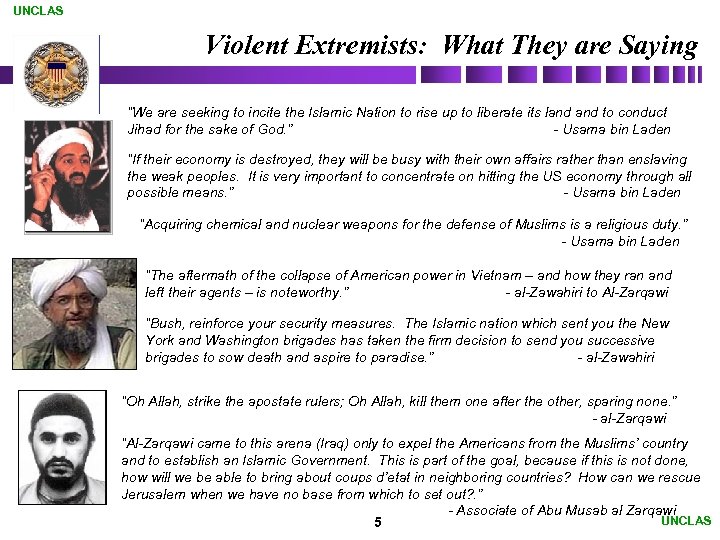 UNCLAS Violent Extremists: What They are Saying “We are seeking to incite the Islamic Nation to rise up to liberate its land to conduct Jihad for the sake of God. ” - Usama bin Laden “If their economy is destroyed, they will be busy with their own affairs rather than enslaving the weak peoples. It is very important to concentrate on hitting the US economy through all possible means. ” - Usama bin Laden “Acquiring chemical and nuclear weapons for the defense of Muslims is a religious duty. ” - Usama bin Laden “The aftermath of the collapse of American power in Vietnam – and how they ran and left their agents – is noteworthy. ” - al-Zawahiri to Al-Zarqawi “Bush, reinforce your security measures. The Islamic nation which sent you the New York and Washington brigades has taken the firm decision to send you successive brigades to sow death and aspire to paradise. ” - al-Zawahiri “Oh Allah, strike the apostate rulers; Oh Allah, kill them one after the other, sparing none. ” - al-Zarqawi “Al-Zarqawi came to this arena (Iraq) only to expel the Americans from the Muslims’ country and to establish an Islamic Government. This is part of the goal, because if this is not done, how will we be able to bring about coups d’etat in neighboring countries? How can we rescue Jerusalem when we have no base from which to set out? . ” - Associate of Abu Musab al Zarqawi UNCLAS 5
 UNCLAS Global War on Terrorism--Who is the enemy? • The enemy consists of various extremist Islamic groups that espouse the use of violence to achieve their ideological aims – al Qa’ida being the most dangerous. Characteristics are: – No state, no uniform, lives among the population – Believes religion is under attack and calls upon Muslims to defend Islam – Even support by 1% of the Muslim population would equate to over 12 million “enemies” • While we may view his beliefs as dangerously misguided…. – He is absolutely committed to his cause – His religious ideology successfully attracts recruits – He has a sufficient population base from which to protract the conflict How has the enemy become so dangerous? 6 UNCLAS
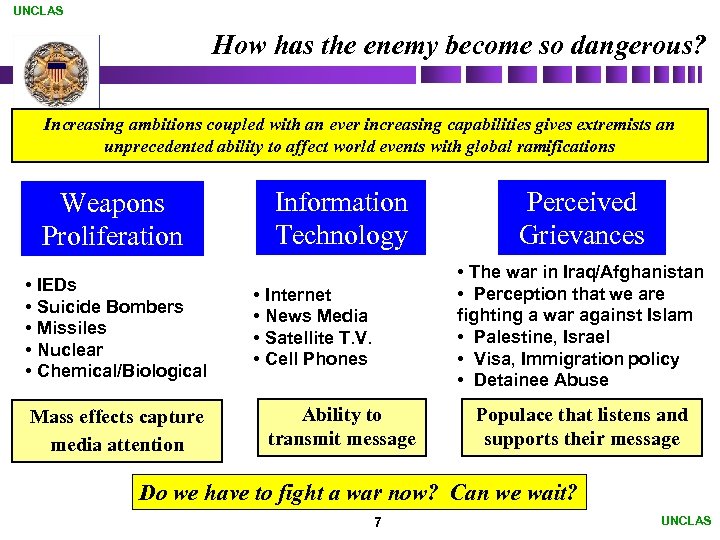 UNCLAS How has the enemy become so dangerous? Increasing ambitions coupled with an ever increasing capabilities gives extremists an unprecedented ability to affect world events with global ramifications Weapons Proliferation • IEDs • Suicide Bombers • Missiles • Nuclear • Chemical/Biological Mass effects capture media attention Information Technology Perceived Grievances • The war in Iraq/Afghanistan • Perception that we are fighting a war against Islam • Palestine, Israel • Visa, Immigration policy • Detainee Abuse • Internet • News Media • Satellite T. V. • Cell Phones Ability to transmit message Populace that listens and supports their message Do we have to fight a war now? Can we wait? 7 UNCLAS
 UNCLAS World War II: A Historical Perspective • Despite threat, France, Britain and the United States did nothing to stop the rise of Nazi Germany. • Achieve “Peace in our Time” through appeasement. • The consequences of inaction: – Germany invades France and attacks Great Britain; invades North Africa, Russia and the Balkans; occupies Italy. – United States enters the war in 1941 after Pearl Harbor. – World War II costs: • Lives lost: 300, 000 US; 70 million worldwide (1937 -45) • US war expenditures: $3. 114 Trillion (2005 dollars); 38% of GDP per year • US reconstruction expenditures: $90 Billion over 4 years (2005 dollars); 1% of GDP per year (1948 -1952) Is the Global War on Terrorism a precursor to a larger conflict? What’s the enemies plan? What might this conflict look like? 8 UNCLAS
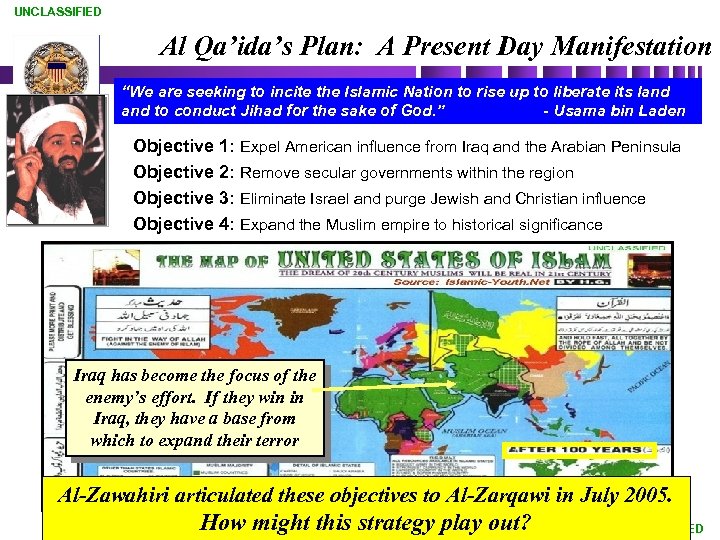 UNCLASSIFIED Al Qa’ida’s Plan: A Present Day Manifestation “We are seeking to incite the Islamic Nation to rise up to liberate its land to conduct Jihad for the sake of God. ” - Usama bin Laden Objective 1: Expel American influence from Iraq and the Arabian Peninsula Objective 2: Remove secular governments within the region Objective 3: Eliminate Israel and purge Jewish and Christian influence Objective 4: Expand the Muslim empire to historical significance Iraq has become the focus of the enemy’s effort. If they win in Iraq, they have a base from which to expand their terror Al-Zawahiri articulated these objectives to Al-Zarqawi in July 2005. How might this strategy play out? UNCLASSIFIED
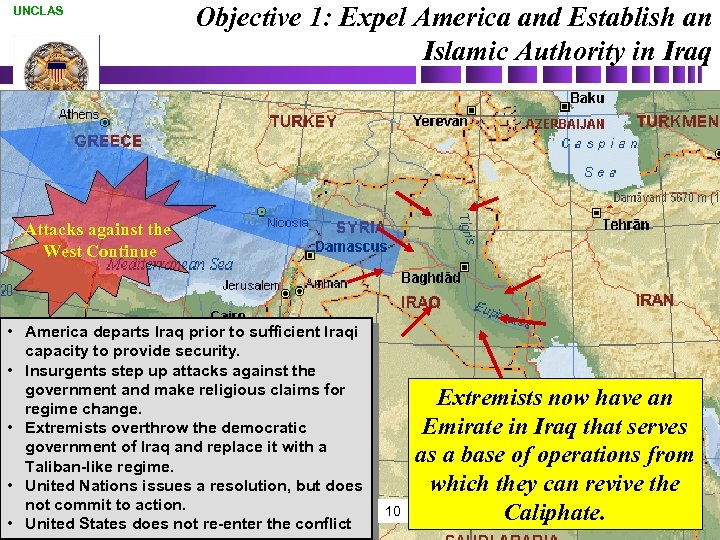 UNCLAS Objective 1: Expel America and Establish an Islamic Authority in Iraq Attacks against the West Continue • America departs Iraq prior to sufficient Iraqi capacity to provide security. • Insurgents step up attacks against the government and make religious claims for regime change. • Extremists overthrow the democratic government of Iraq and replace it with a Taliban-like regime. • United Nations issues a resolution, but does not commit to action. 10 • United States does not re-enter the conflict 10 Extremists now have an Emirate in Iraq that serves as a base of operations from which they can revive the Caliphate. UNCLAS
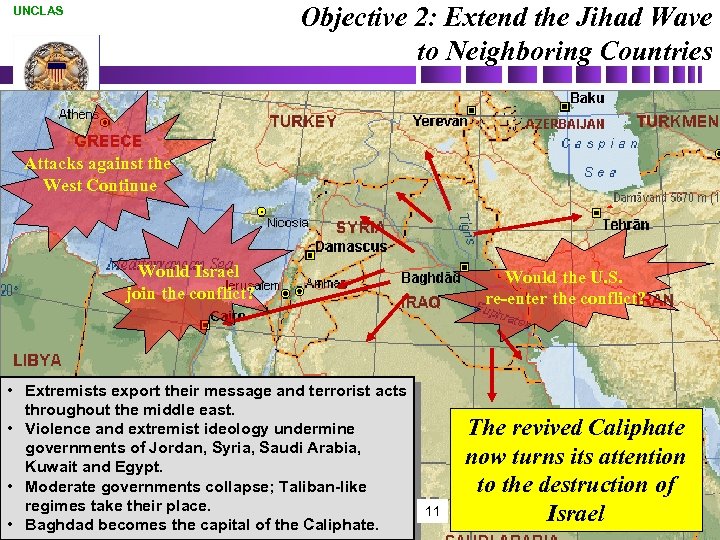 Objective 2: Extend the Jihad Wave to Neighboring Countries UNCLAS Attacks against the West Continue Would Israel join the conflict? • Extremists export their message and terrorist acts throughout the middle east. • Violence and extremist ideology undermine governments of Jordan, Syria, Saudi Arabia, Kuwait and Egypt. • Moderate governments collapse; Taliban-like regimes take their place. 11 • Baghdad becomes the capital of the Caliphate. Would the U. S. re-enter the conflict? 11 The revived Caliphate now turns its attention to the destruction of Israel UNCLAS
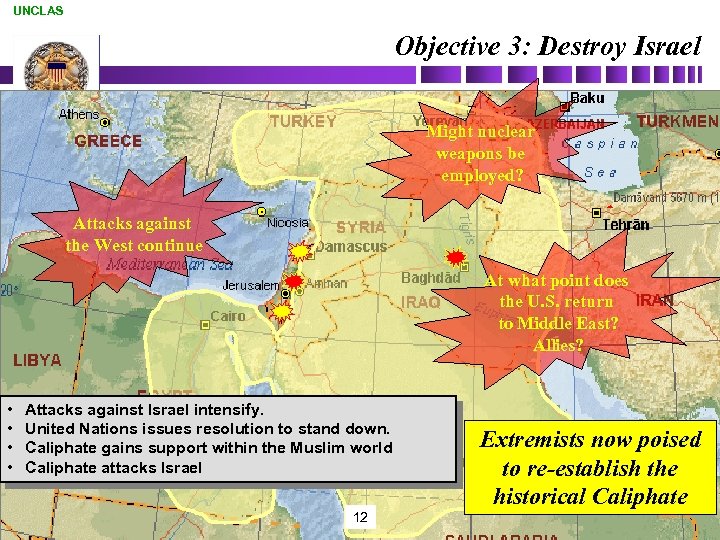 UNCLAS Objective 3: Destroy Israel Might nuclear weapons be employed? Attacks against the West continue At what point does the U. S. return to Middle East? Allies? • • Attacks against Israel intensify. United Nations issues resolution to stand down. Caliphate gains support within the Muslim world Caliphate attacks Israel 12 12 Extremists now poised to re-establish the historical Caliphate UNCLAS
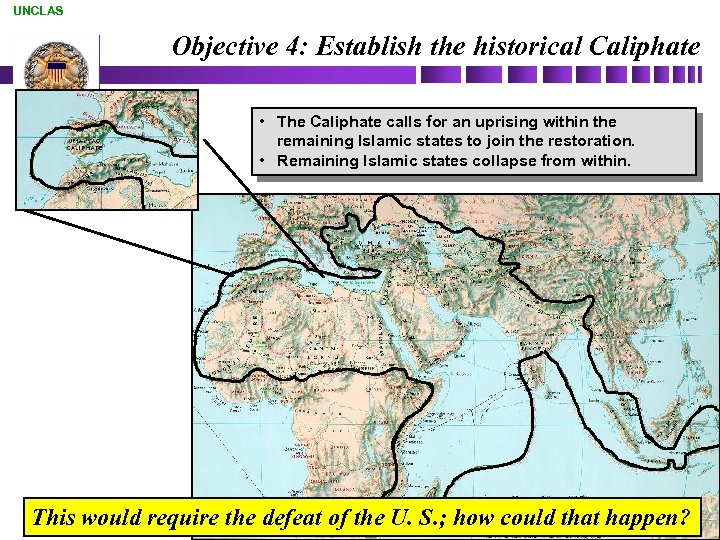 UNCLAS Objective 4: Establish the historical Caliphate • The Caliphate calls for an uprising within the remaining Islamic states to join the restoration. • Remaining Islamic states collapse from within. This would require the defeat of the U. S. ; how could that happen? UNCLAS 13
 UNCLAS Consider How the U. S. can be Defeated… The United States cannot be defeated militarily. The enemy knows this. But consider: • The world’s most dangerous people possess the world’s most dangerous weapons – nuclear, chemical, or biological weapons… • Terror attacks weaken the world economy • Continued casualties weaken national resolve • Traditional allies prefer accommodation Would it expand the conflict into a “clash of civilizations? ” Or… – – Force our economy into a recession? Depression? Create political pressure for isolationism? Deter us from necessary action? Force us to reach accommodation – “Peace in our Time? ” To win, the US must exploit the vulnerabilities of the enemy. What are they? 14 UNCLAS
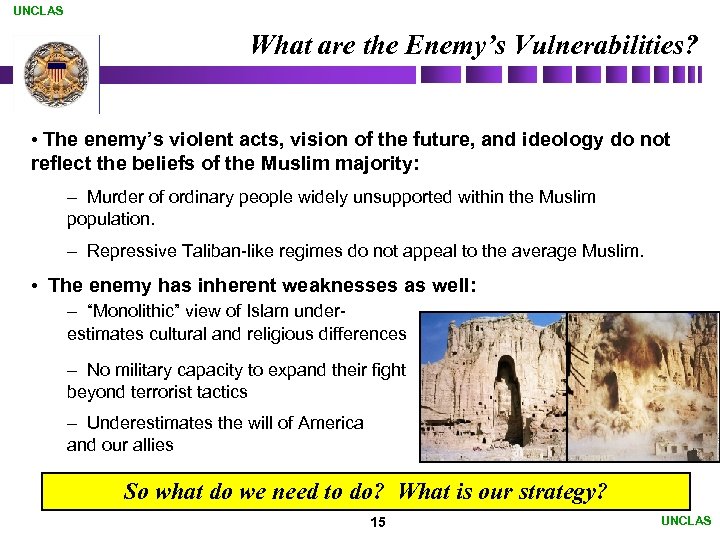 UNCLAS What are the Enemy’s Vulnerabilities? • The enemy’s violent acts, vision of the future, and ideology do not reflect the beliefs of the Muslim majority: – Murder of ordinary people widely unsupported within the Muslim population. – Repressive Taliban-like regimes do not appeal to the average Muslim. • The enemy has inherent weaknesses as well: – “Monolithic” view of Islam underestimates cultural and religious differences – No military capacity to expand their fight beyond terrorist tactics – Underestimates the will of America and our allies So what do we need to do? What is our strategy? 15 UNCLAS
 UNCLAS US Strategy The three key elements to win this war are: –Protect and defend the Homeland –Attack terrorists and their capacity to operate effectively at home and abroad –Support mainstream Muslim efforts to reject violent extremism In addition to the strategic elements, there are three critical crosscutting enablers: – Expanding foreign partnerships and partnership capacity – Strengthening our capacity to prevent terrorist acquisition and use of WMD – Institutionalizing domestically and internationally the strategy against violent extremists This war goes far beyond the borders of Iraq, Afghanistan and the Greater Middle East 16 UNCLAS
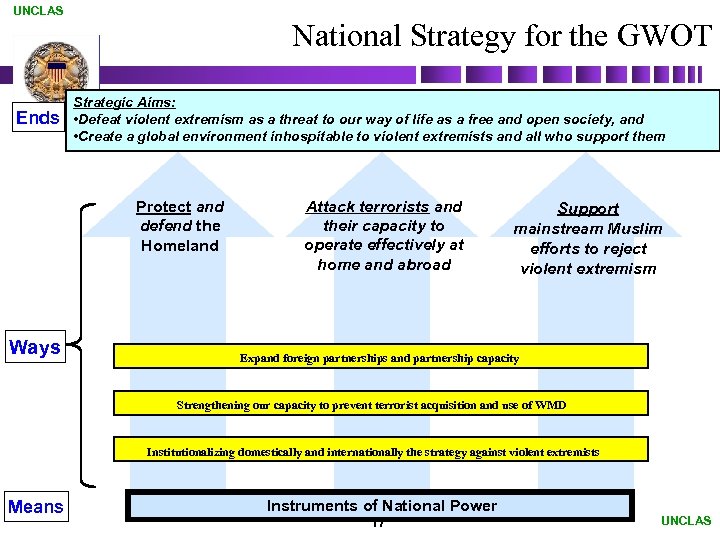 UNCLAS Ends National Strategy for the GWOT Strategic Aims: • Defeat violent extremism as a threat to our way of life as a free and open society, and • Create a global environment inhospitable to violent extremists and all who support them Protect and defend the Homeland Ways Attack terrorists and their capacity to operate effectively at home and abroad Support mainstream Muslim efforts to reject violent extremism Expand foreign partnerships and partnership capacity Strengthening our capacity to prevent terrorist acquisition and use of WMD Institutionalizing domestically and internationally the strategy against violent extremists Means Instruments of National Power 17 UNCLAS
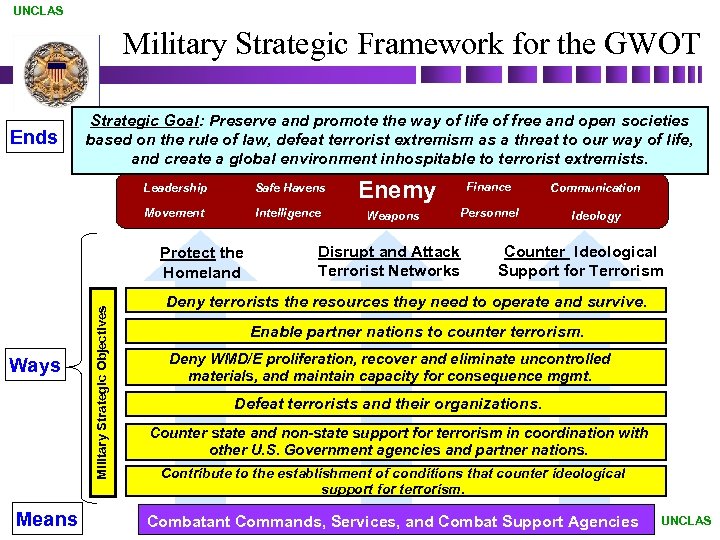 UNCLAS Military Strategic Framework for the GWOT Ends Strategic Goal: Preserve and promote the way of life of free and open societies based on the rule of law, defeat terrorist extremism as a threat to our way of life, and create a global environment inhospitable to terrorist extremists. Leadership Ideological support Safe Havens Funds Comms & Movement Intelligence Safe havens Movement Ways Means Military Strategic Objectives Protect the Homeland Enemy Weapons Finance Leadership Communication Weapons Foot soldiers Personnel Access to Targets Ideology Disrupt and Attack Terrorist Networks Counter Ideological Support for Terrorism Deny terrorists the resources they need to operate and survive. Enable partner nations to counter terrorism. Deny WMD/E proliferation, recover and eliminate uncontrolled materials, and maintain capacity for consequence mgmt. Defeat terrorists and their organizations. Counter state and non-state support for terrorism in coordination with other U. S. Government agencies and partner nations. Contribute to the establishment of conditions that counter ideological support for terrorism. Combatant Commands, Services, and Combat Support Agencies 18 UNCLAS
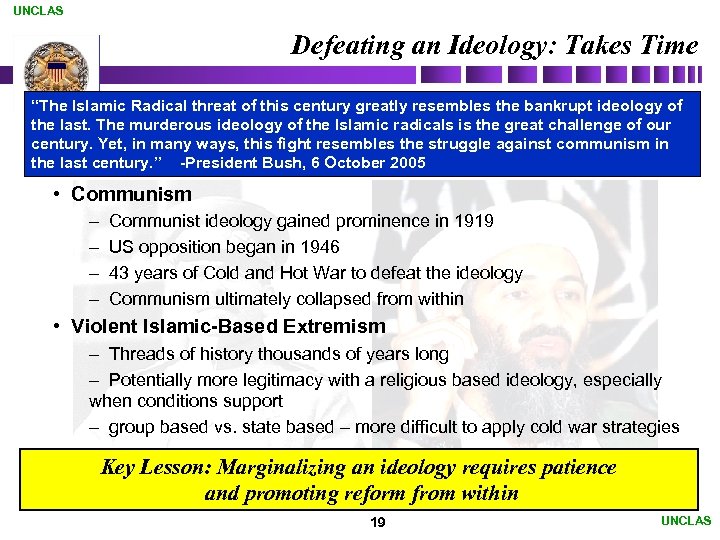 UNCLAS Defeating an Ideology: Takes Time “The Islamic Radical threat of this century greatly resembles the bankrupt ideology of the last. The murderous ideology of the Islamic radicals is the great challenge of our century. Yet, in many ways, this fight resembles the struggle against communism in the last century. ” -President Bush, 6 October 2005 • Communism – – Communist ideology gained prominence in 1919 US opposition began in 1946 43 years of Cold and Hot War to defeat the ideology Communism ultimately collapsed from within • Violent Islamic-Based Extremism – Threads of history thousands of years long – Potentially more legitimacy with a religious based ideology, especially when conditions support – group based vs. state based – more difficult to apply cold war strategies Key Lesson: Marginalizing an ideology requires patience and promoting reform from within 19 UNCLAS
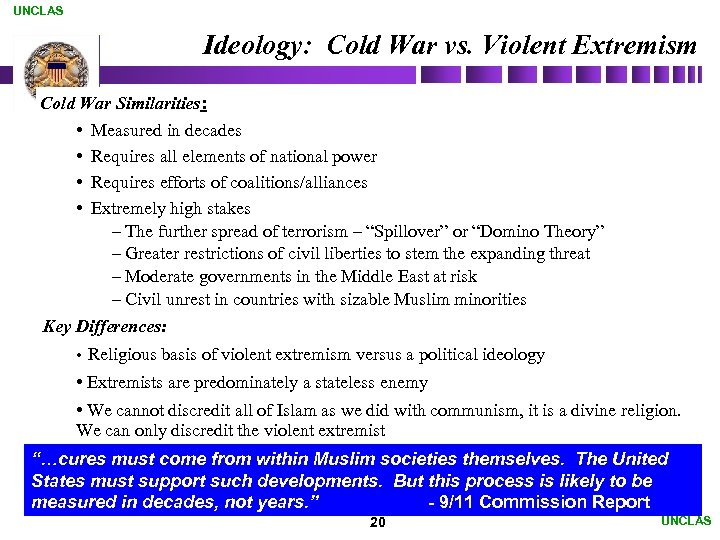 UNCLAS Ideology: Cold War vs. Violent Extremism Cold War Similarities: • • Measured in decades Requires all elements of national power Requires efforts of coalitions/alliances Extremely high stakes – The further spread of terrorism – “Spillover” or “Domino Theory” – Greater restrictions of civil liberties to stem the expanding threat – Moderate governments in the Middle East at risk – Civil unrest in countries with sizable Muslim minorities Key Differences: • Religious basis of violent extremism versus a political ideology • Extremists are predominately a stateless enemy • We cannot discredit all of Islam as we did with communism, it is a divine religion. We can only discredit the violent extremist “…cures must come from within Muslim societies themselves. The United States must support such developments. But this process is likely to be measured in decades, not years. ” - 9/11 Commission Report 20 UNCLAS
 UNCLAS Building Capacity in the Cold War • Long Term Examples of Success (Decades of Support) – Germany, Japan, South Korea • Commonalities – Sustained American Presence – still today (over 50 years) – Significant American Investment – Democratic societies with free market economies • Payoff – Partner nations stood up to Communist threats – All are significant allies and trading partners – Each is a stabilizing force within their region Key Lesson: Capacity building takes decades…but it is what allows the United States to win this war in the long term. 21 UNCLAS
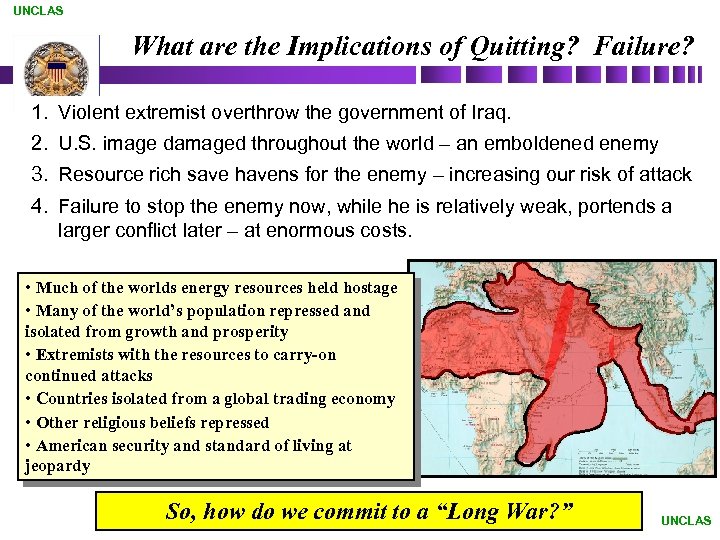 UNCLAS What are the Implications of Quitting? Failure? 1. Violent extremist overthrow the government of Iraq. 2. U. S. image damaged throughout the world – an emboldened enemy 3. Resource rich save havens for the enemy – increasing our risk of attack 4. Failure to stop the enemy now, while he is relatively weak, portends a larger conflict later – at enormous costs. • Much of the worlds energy resources held hostage • Many of the world’s population repressed and isolated from growth and prosperity • Extremists with the resources to carry-on continued attacks • Countries isolated from a global trading economy • Other religious beliefs repressed • American security and standard of living at jeopardy So, how do we commit to a “Long War? ” 22 UNCLAS
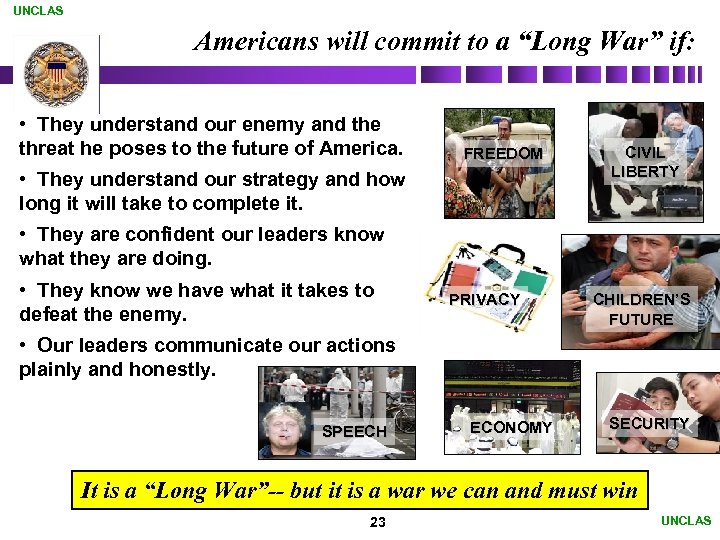 UNCLAS Americans will commit to a “Long War” if: • They understand our enemy and the threat he poses to the future of America. FREEDOM • They understand our strategy and how long it will take to complete it. CIVIL LIBERTY • They are confident our leaders know what they are doing. • They know we have what it takes to defeat the enemy. PRIVACY CHILDREN’S FUTURE • Our leaders communicate our actions plainly and honestly. SPEECH ECONOMY SECURITY It is a “Long War”-- but it is a war we can and must win 23 UNCLAS
 UNCLAS QUESTIONS? 24 UNCLAS
 UNCLAS Backup 25 UNCLAS
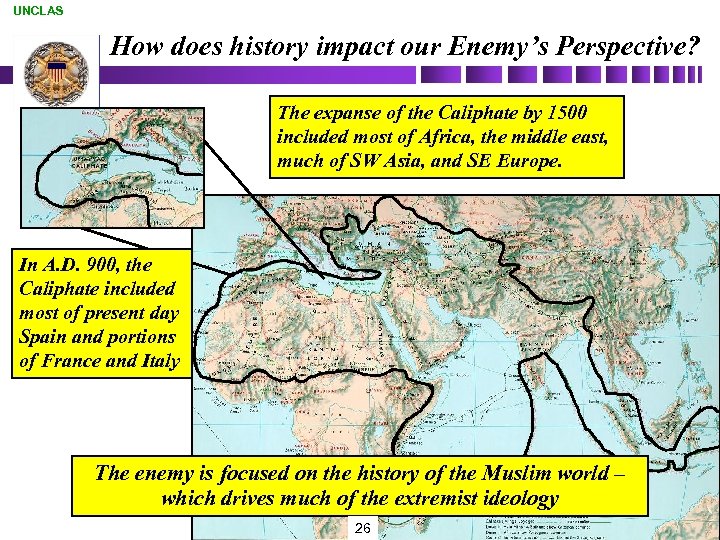 UNCLAS How does history impact our Enemy’s Perspective? The expanse of the Caliphate by 1500 included most of Africa, the middle east, much of SW Asia, and SE Europe. In A. D. 900, the Caliphate included most of present day Spain and portions of France and Italy The enemy is focused on the history of the Muslim world – which drives much of the extremist ideology 2626 UNCLAS
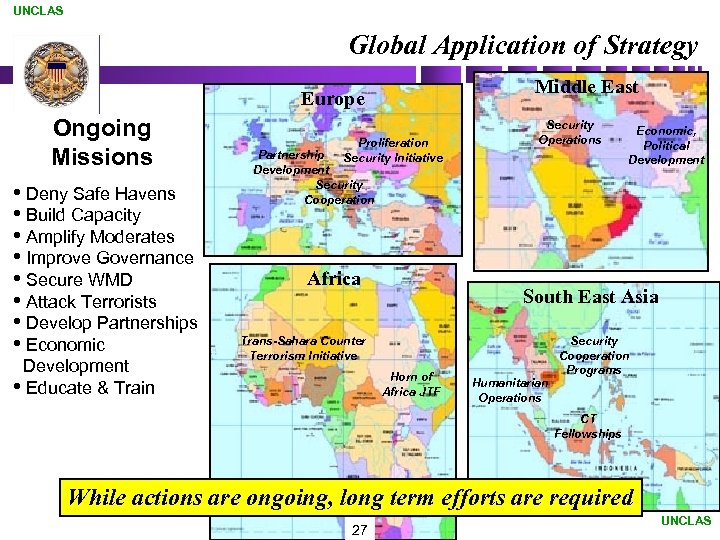 UNCLAS Global Application of Strategy Middle East Europe Ongoing Missions • Deny Safe Havens • Build Capacity • Amplify Moderates • Improve Governance • Secure WMD • Attack Terrorists • Develop Partnerships • Economic Development • Educate & Train Proliferation Security Initiative Security Operations Partnership Development Security Cooperation Africa Economic, Political Development South East Asia Trans-Sahara Counter Terrorism Initiative Horn of Africa JTF Humanitarian Operations Security Cooperation Programs CT Fellowships While actions are ongoing, long term efforts are required 27 27 UNCLAS