


 Скачать презентацию Uncertainty in Greenhouse Gas Inventories How to Go
badb3d0df7a1f13480f234f6a1d3df68.ppt
- Количество слайдов: 30
 Uncertainty in Greenhouse Gas Inventories: How to Go About It M. Jonas 1, T. White 2, Z. Nahorski 3 and S. Nilsson 1 1 International Institute for Applied Systems Analysis, Laxenburg, Austria 2 Canadian Forest Service, Victoria, BC, Canada 3 Systems Research Institute, Polish Academy of Sciences, Warsaw, Poland Coping with Uncertainty (Cw. U) Workshop 2007: Robust Decisions IIASA, Austria; 10– 12 December 2007 Jonas et al. 10 Dec. 2007 – 1
 Contents: 1. Background 2. Question 1: Do we have an uncertainty problem? 3. Question 2: Can we reduce it? 4. Uncertainty analysis in the context of commitments 5. Conclusions Jonas et al. 10 Dec. 2007 – 2
 2 nd International Workshop on Uncertainty in GHG Inventories IIASA, Austria; 27– 28 September 2007 Web: http: //www. ibspan. waw. pl/ghg 2007/ 3– 14 Dec. 2007 Cw. U ‘ 07 Workshop Jonas et al. 10 Dec. 2007 – 3
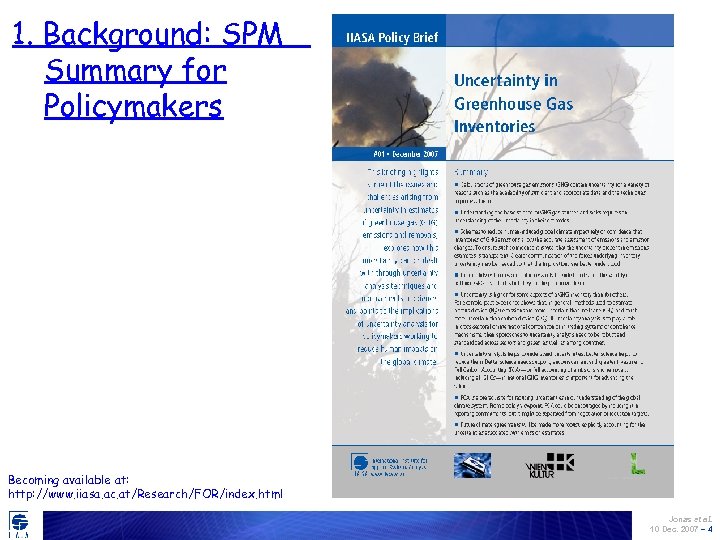 1. Background: SPM Summary for Policymakers Becoming available at: http: //www. iiasa. ac. at/Research/FOR/index. html Jonas et al. 10 Dec. 2007 – 4
 1. Background: The SPM in a general context Given that policy/decision-makers prefer unstructured certainty over structured uncertainty, let’s ask two simple questions (Q): Q 1. Do we have an uncertainty problem? Q 2. If we do, can we reduce the problem? The answers are: ‘No/Yes’ and ‘Yes—but uncertainty cannot be eliminated’! Jonas et al. 10 Dec. 2007 – 5
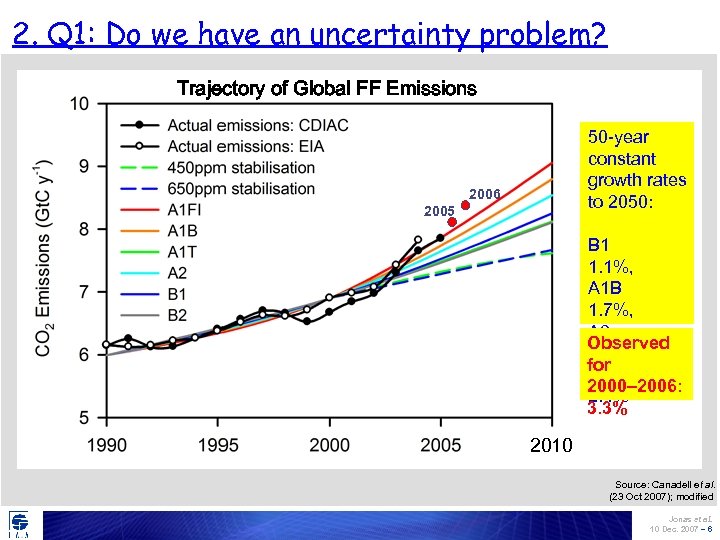 2. Q 1: Do we have an uncertainty problem? Trajectory of Global FF Emissions 50 -year constant growth rates to 2050: 2006 2005 B 1 1. 1%, A 1 B 1. 7%, A 2 Observed 1. 8% for A 1 FI 2000– 2006: 2. 4% 3. 3% 2010 Source: Canadell et al. (23 Oct 2007); modified Jonas et al. 10 Dec. 2007 – 6
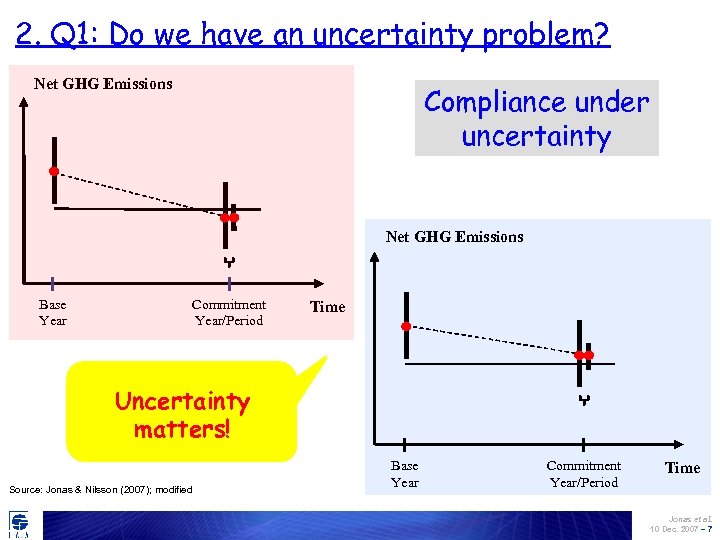 2. Q 1: Do we have an uncertainty problem? Net GHG Emissions Compliance under uncertainty Net GHG Emissions Base Year Commitment Year/Period Time Uncertainty matters! Source: Jonas & Nilsson (2007); modified Base Year Commitment Year/Period Time Jonas et al. 10 Dec. 2007 – 7
 2. Q 1: Interim summary 1) The gigantic task to be tackled: We have not yet managed to swing round our life style and increased use of fossil fuels! To recall: 20% of the population in the developed world is responsible for about 80% of the cumulative carbon emissions since 1751. And since a few years, we are back to producing more global wealth by using more carbon intensive energy systems than we did in the past. 2) This task can be tackled by setting binding emission targets. It is at this point in time when uncertainty begins to become important! Jonas et al. 10 Dec. 2007 – 8
 3. Q 2: Can we reduce the uncertainty problem? In our answer we consider two perspectives: → bottom-up/top-down → ‘one-by-one versus altogether’ Jonas et al. 10 Dec. 2007 – 9
 3. To Q 2: Bottom-up/top-down (I) SPM (2007: p. 1): Full Carbon Accounting (FCA) is a prerequisite for reducing uncertainties in our understanding of the global climate system. From a policy viewpoint, FCA could be encouraged by including it in reporting commitments, but it might be separated from negotiation or reduction targets. → basis for accounting → verification Jonas et al. 10 Dec. 2007 – 10
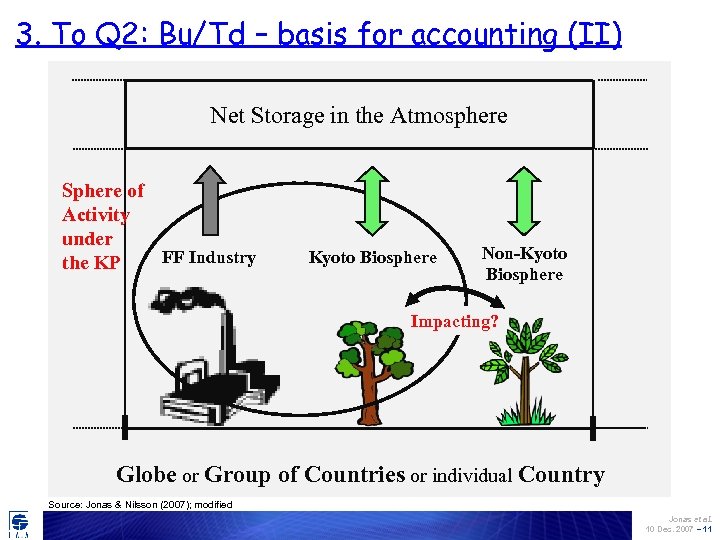 3. To Q 2: Bu/Td – basis for accounting (II) Net Storage in the Atmosphere Sphere of Activity under FF Industry the KP Kyoto Biosphere Non-Kyoto Biosphere Impacting? Globe or Group of Countries or individual Country Source: Jonas & Nilsson (2007); modified Jonas et al. 10 Dec. 2007 – 11
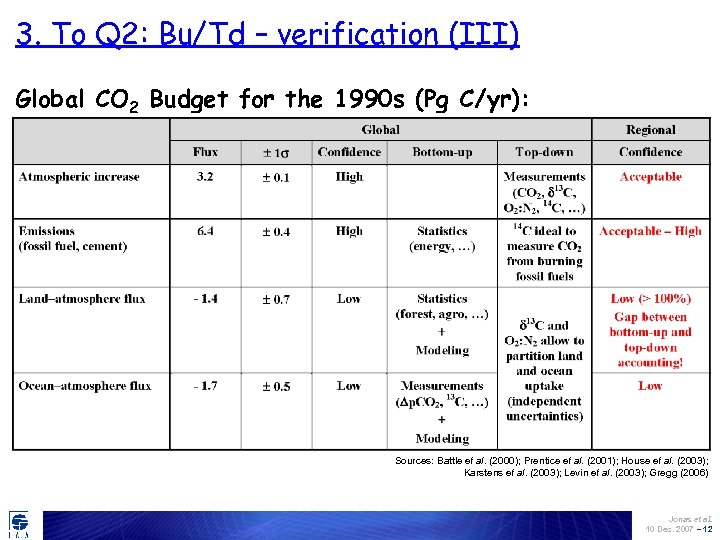 3. To Q 2: Bu/Td – verification (III) Global CO 2 Budget for the 1990 s (Pg C/yr): Sources: Battle et al. (2000); Prentice et al. (2001); House et al. (2003); Karstens et al. (2003); Levin et al. (2003); Gregg (2006) Jonas et al. 10 Dec. 2007 – 12
 3. To Q 2: One-by-one versus altogether (Ia) SPM (2007: p. 1): Uncertainty is higher for some aspects of a GHG inventory than for others. . If uncertainty analysis is to play a role in cross-sectoral or international comparison or in trading systems or compliance mechanisms, then approaches to uncertainty analysis need to be robust and standardized across sectors and gases and between countries. Jonas et al. 10 Dec. 2007 – 13
 3. To Q 2: One-by-one versus altogether (Ib) SPM (2007: p. 3): Improving inventories requires one approach: improving emissions trading mechanisms another. Inventories will be improved by increasing their scope to include FCA. In contrast, one option for improving emissions trading mechanisms would be to reduce their scope. Jonas et al. 10 Dec. 2007 – 14
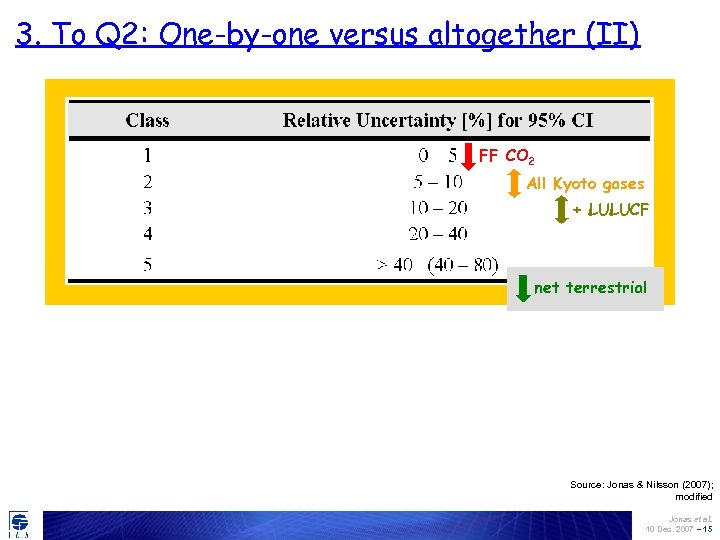 3. To Q 2: One-by-one versus altogether (II) FF CO 2 All Kyoto gases + LULUCF net terrestrial Source: Jonas & Nilsson (2007); modified Jonas et al. 10 Dec. 2007 – 15
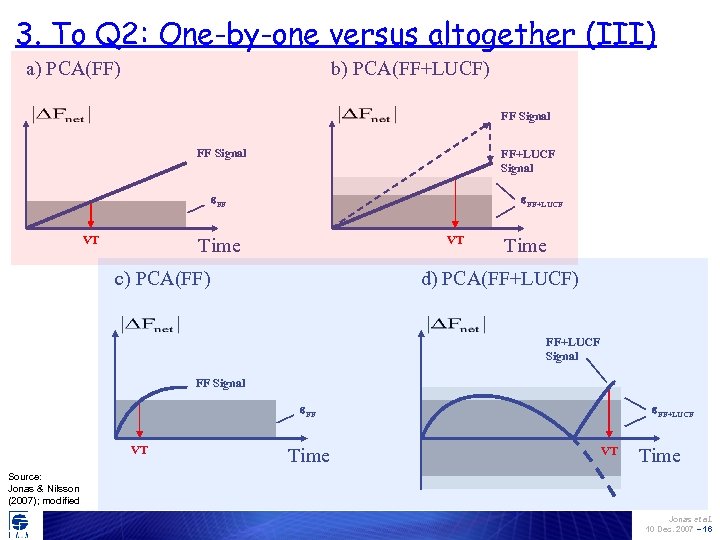 3. To Q 2: One-by-one versus altogether (III) a) PCA(FF) b) PCA(FF+LUCF) FF Signal FF+LUCF Signal FF VT FF+LUCF VT Time d) PCA(FF+LUCF) c) PCA(FF) FF+LUCF Signal FF VT Time FF+LUCF VT Time Source: Jonas & Nilsson (2007); modified Jonas et al. 10 Dec. 2007 – 16
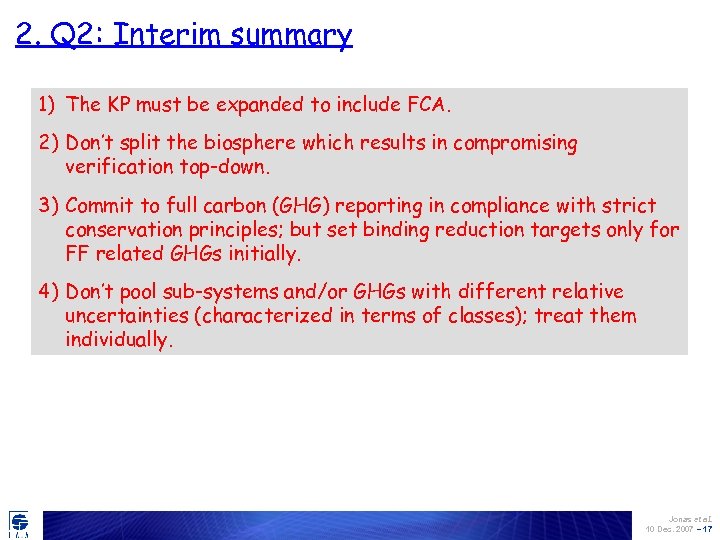 2. Q 2: Interim summary 1) The KP must be expanded to include FCA. 2) Don’t split the biosphere which results in compromising verification top-down. 3) Commit to full carbon (GHG) reporting in compliance with strict conservation principles; but set binding reduction targets only for FF related GHGs initially. 4) Don’t pool sub-systems and/or GHGs with different relative uncertainties (characterized in terms of classes); treat them individually. Jonas et al. 10 Dec. 2007 – 17
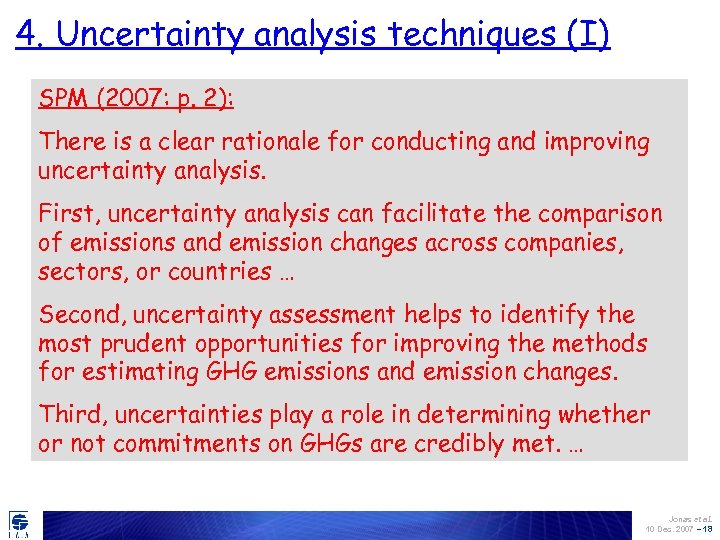 4. Uncertainty analysis techniques (I) SPM (2007: p. 2): There is a clear rationale for conducting and improving uncertainty analysis. First, uncertainty analysis can facilitate the comparison of emissions and emission changes across companies, sectors, or countries … Second, uncertainty assessment helps to identify the most prudent opportunities for improving the methods for estimating GHG emissions and emission changes. Third, uncertainties play a role in determining whether or not commitments on GHGs are credibly met. … Jonas et al. 10 Dec. 2007 – 18
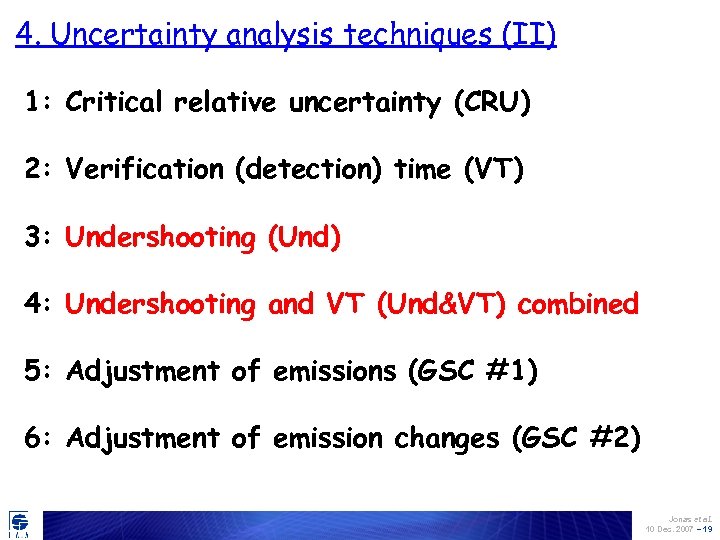 4. Uncertainty analysis techniques (II) 1: Critical relative uncertainty (CRU) 2: Verification (detection) time (VT) 3: Undershooting (Und) 4: Undershooting and VT (Und&VT) combined 5: Adjustment of emissions (GSC #1) 6: Adjustment of emission changes (GSC #2) Jonas et al. 10 Dec. 2007 – 19
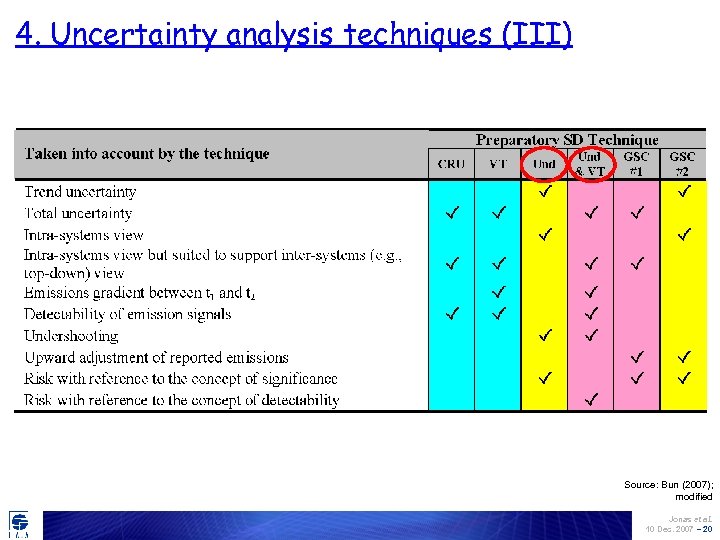 4. Uncertainty analysis techniques (III) Source: Bun (2007); modified Jonas et al. 10 Dec. 2007 – 20
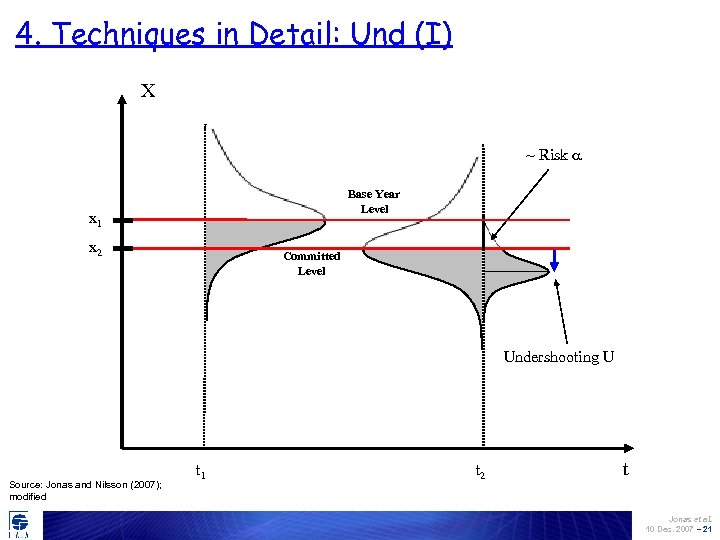 4. Techniques in Detail: Und (I) X ~ Risk a Base Year Level x 1 x 2 Committed Level Undershooting U Source: Jonas and Nilsson (2007); modified t 1 t 2 t Jonas et al. 10 Dec. 2007 – 21
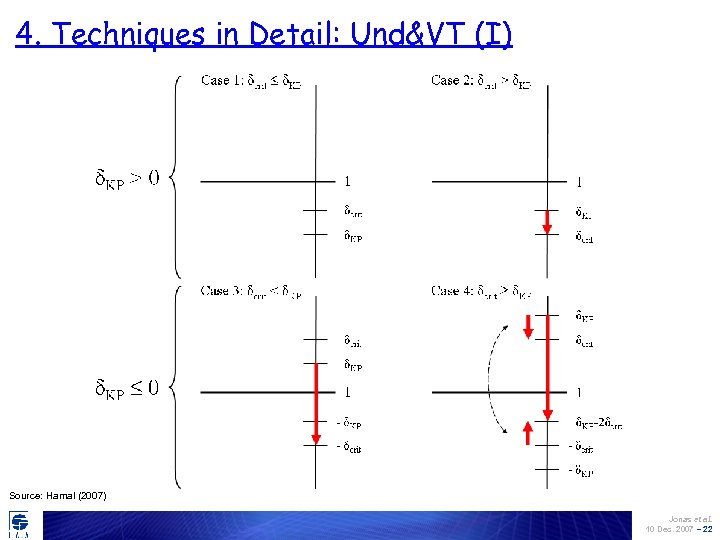 4. Techniques in Detail: Und&VT (I) Source: Hamal (2007) Jonas et al. 10 Dec. 2007 – 22
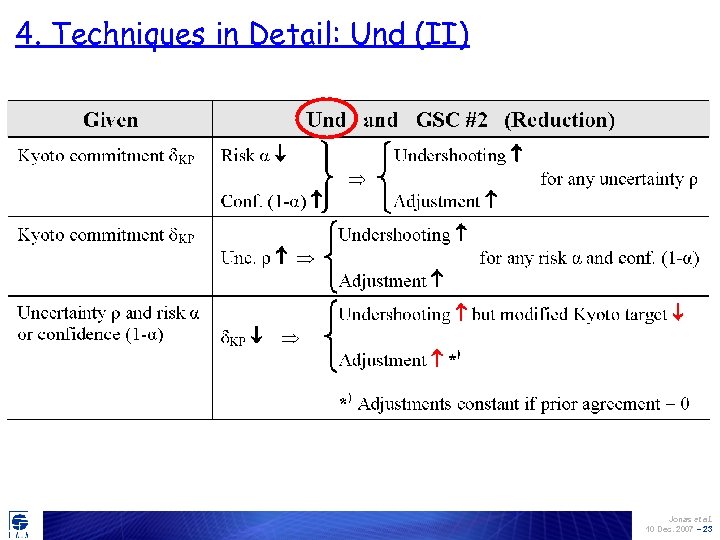 4. Techniques in Detail: Und (II) Jonas et al. 10 Dec. 2007 – 23
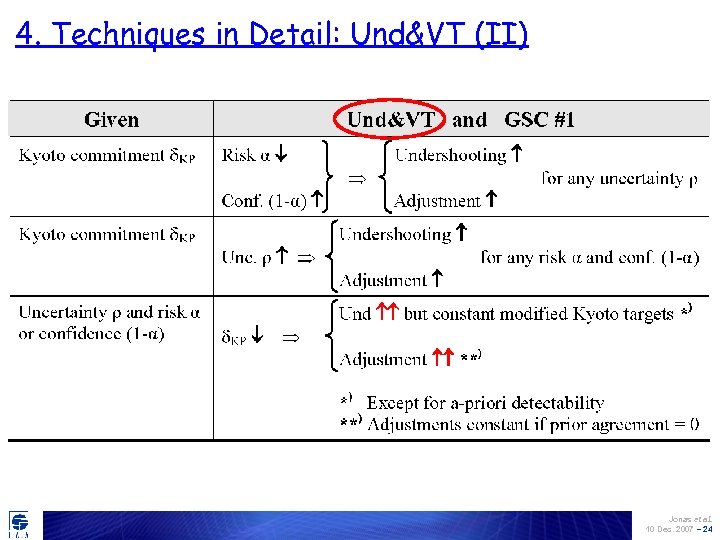 4. Techniques in Detail: Und&VT (II) Jonas et al. 10 Dec. 2007 – 24
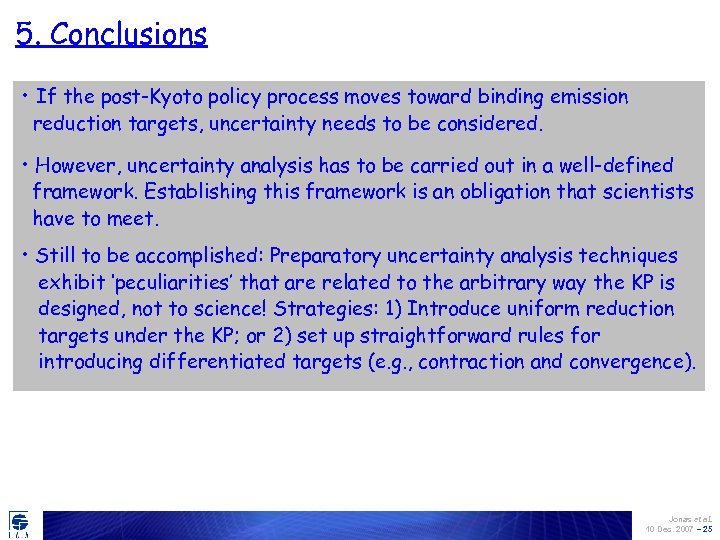 5. Conclusions • If the post-Kyoto policy process moves toward binding emission reduction targets, uncertainty needs to be considered. • However, uncertainty analysis has to be carried out in a well-defined framework. Establishing this framework is an obligation that scientists have to meet. • Still to be accomplished: Preparatory uncertainty analysis techniques exhibit ‘peculiarities’ that are related to the arbitrary way the KP is designed, not to science! Strategies: 1) Introduce uniform reduction targets under the KP; or 2) set up straightforward rules for introducing differentiated targets (e. g. , contraction and convergence). Jonas et al. 10 Dec. 2007 – 25
 References Jonas et al. 10 Dec. 2007 – 26
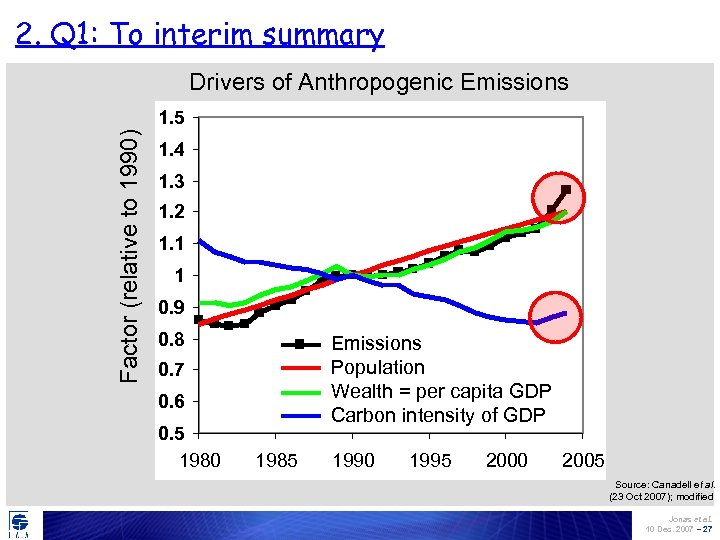 2. Q 1: To interim summary Drivers of Anthropogenic Emissions Factor (relative to 1990) 1. 5 1. 4 1. 3 1. 2 1. 1 1 1 0. 9 0. 8 0. 7 0. 6 0. 5 1980 1985 0. 8 Emissions F (emissions) Population P (population) 0. 7 Wealth g = G/P = per capita GDP 0. 6 Carbon h = F/G intensity of GDP 0. 5 1990 1995 2000 2005 Source: Canadell et al. (23 Oct 2007); modified Jonas et al. 10 Dec. 2007 – 27
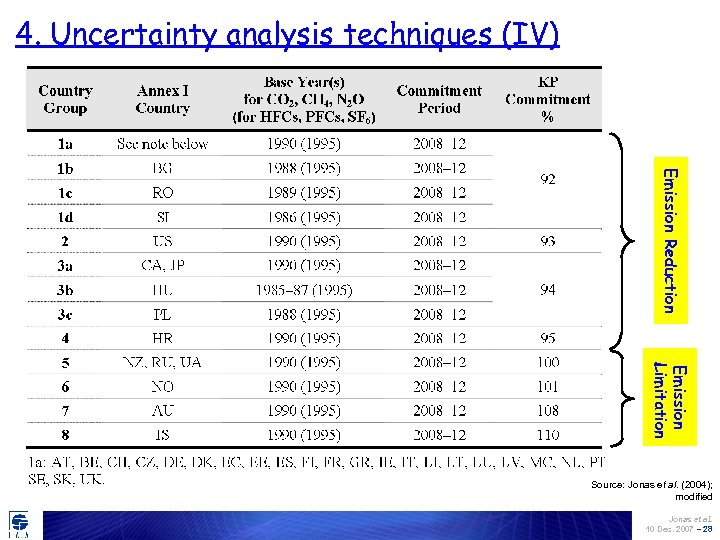 4. Uncertainty analysis techniques (IV) Emission Reduction Emission Limitation Source: Jonas et al. (2004); modified Jonas et al. 10 Dec. 2007 – 28
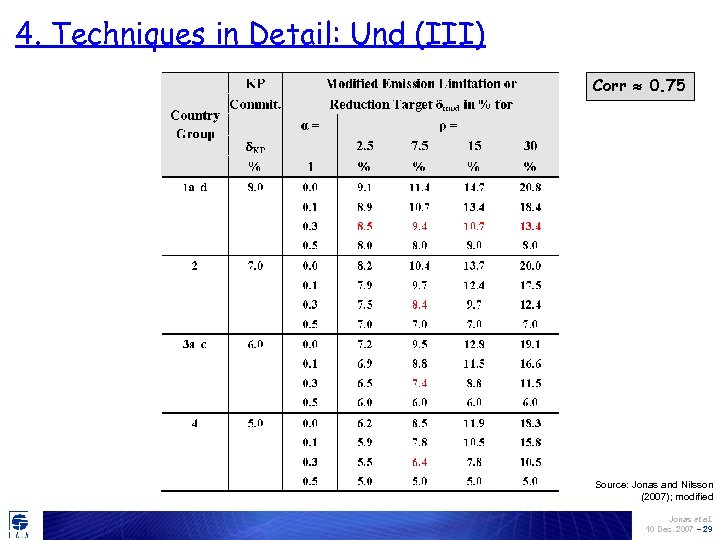 4. Techniques in Detail: Und (III) Corr 0. 75 Source: Jonas and Nilsson (2007); modified Jonas et al. 10 Dec. 2007 – 29
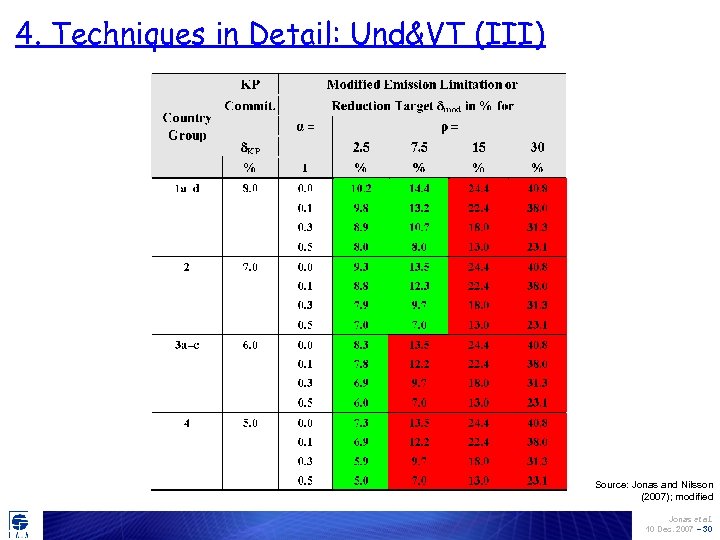 4. Techniques in Detail: Und&VT (III) Source: Jonas and Nilsson (2007); modified Jonas et al. 10 Dec. 2007 – 30