 Скачать презентацию Unbundling and Monopoly Privileges in Electricity Transmission Alexander
2015-FVZ.ppt
- Количество слайдов: 25




Unbundling and Monopoly Privileges in Electricity Transmission Alexander Filatov, Mikhail Vasiliev, Roman Zaika Irkutsk State University, Energy Systems Institute Irkutsk, Russia alexander. filatov@gmail. com, vassiliev@ieee. org, zaika@isem. sei. irk. ru http: //sibscience. org, http: //youtube. com/sibscience Oslo, February, 3, 2015
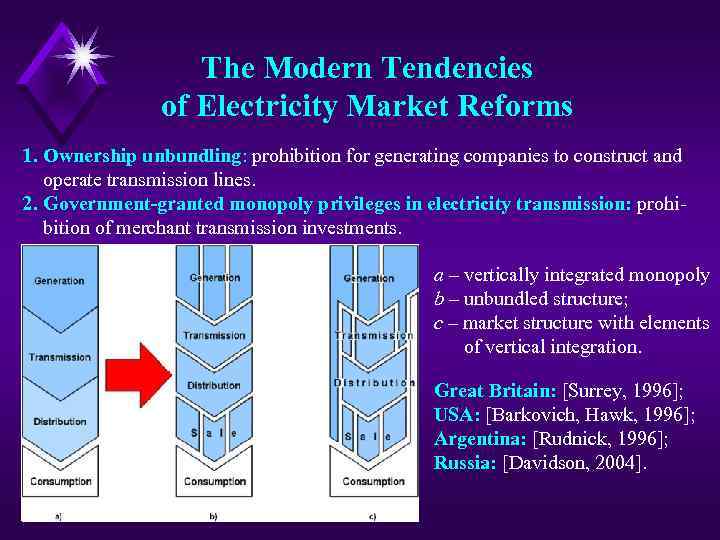
The Modern Tendencies of Electricity Market Reforms 1. Ownership unbundling: prohibition for generating companies to construct and operate transmission lines. 2. Government-granted monopoly privileges in electricity transmission: prohibition of merchant transmission investments. a – vertically integrated monopoly b – unbundled structure; c – market structure with elements of vertical integration. Great Britain: [Surrey, 1996]; USA: [Barkovich, Hawk, 1996]; Argentina: [Rudnick, 1996]; Russia: [Davidson, 2004].
Overview of the Literature: Ownership Unbundling The main reason – to decrease market power! [Joscow, Tirole, 2000]; [Pollitt, 2007]: Unbundling decreases the ability of generating companies to exercise market power and leads to the most effective markets. [Cremer, de Donder, 2006]: Positive externalities of transmission investment are captured by the other firms. [Leautier, Thelen, 2009]: Vertically integrated provider discriminates against non-affiliated users. It also has incentives to reduce transmission expansion from the social optimum. But unbundling alone doesn’t reduce congestion. Special mechanisms, including merchant transmission investments, are required.
Overview of the Literature: Merchant Lines The main reason – to reduce congestion! [Hogan, 1992]; [Bushnell, Stoft, 1996, 1997]; [de Hauteclocque, Rious, 2009]: There could be situations when merchant transmission investments lead to the optimum grid expansion. The corresponding conditions are proposed. The advice to allow merchant transmission investments is given. [Joskow, Tirole, 2005]: Transmission is not perfectly competitive: significant economies of scale, limitations and difficulties in siting new lines create high entry barriers. [Blumsack, Lave, Ilic, 2008]: Even new merchant line can decrease transfer capability of the network. It should be centralized transmission expansion planning. [Littlechild, 2012]: Bureaucratic processes, interest group capture, and political influence for regulated transmission are more serious problems in practice than market power and transaction costs for merchant transmission.
Overview of the Literature: Regulation The main problem – optimal regulation is usually impossible! [Laffont, Tirole, 1993]: No regulator has comprehensive information about the production technology and costs of the monopoly, market demand other important things. [Owen, Braeutigam, 1978]: The monopoly itself can use the lack of the regulator’s knowledge for its benefit. [Stiegler, 1971]: The regulator can be captured by the monopoly. [Joskow, 2010]: Regulation itself needs great financial and human resources and results in significant growth of «bureaucratic costs» : increased time to make decisions, more conservative policy, including investment policy.
![Overview of the Literature: Potential Competition The possible alternative – potential competition! [Demsetz, 1968]:](https://present5.com/presentation/8733459_363985109/image-6.jpg "Overview of the Literature: Potential Competition The possible alternative – potential competition! [Demsetz, 1968]:")
Overview of the Literature: Potential Competition The possible alternative – potential competition! [Demsetz, 1968]: If the competition in the market is hindered then competition for market entry can work well. [Baumol, Panzar, Willig, 1982]: Contestable markets theory is proposed for the markets with low entry barriers and loss-free exit. The only incumbent company not enjoying the government-granted monopolistic right will keep low prices because of risk of a competitor’s entry. [Martin, 2000]: Potential competition model taking into account possible price change due to the new competitor entrance.
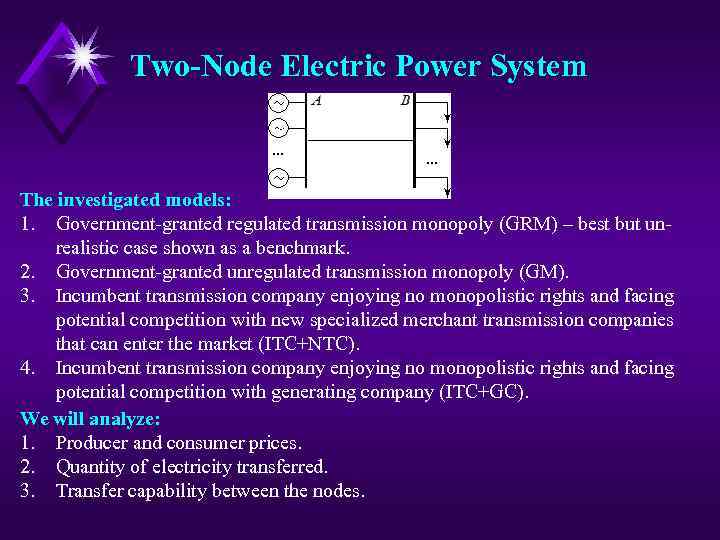
Two-Node Electric Power System The investigated models: 1. Government-granted regulated transmission monopoly (GRM) – best but unrealistic case shown as a benchmark. 2. Government-granted unregulated transmission monopoly (GM). 3. Incumbent transmission company enjoying no monopolistic rights and facing potential competition with new specialized merchant transmission companies that can enter the market (ITC+NTC). 4. Incumbent transmission company enjoying no monopolistic rights and facing potential competition with generating company (ITC+GC). We will analyze: 1. Producer and consumer prices. 2. Quantity of electricity transferred. 3. Transfer capability between the nodes.
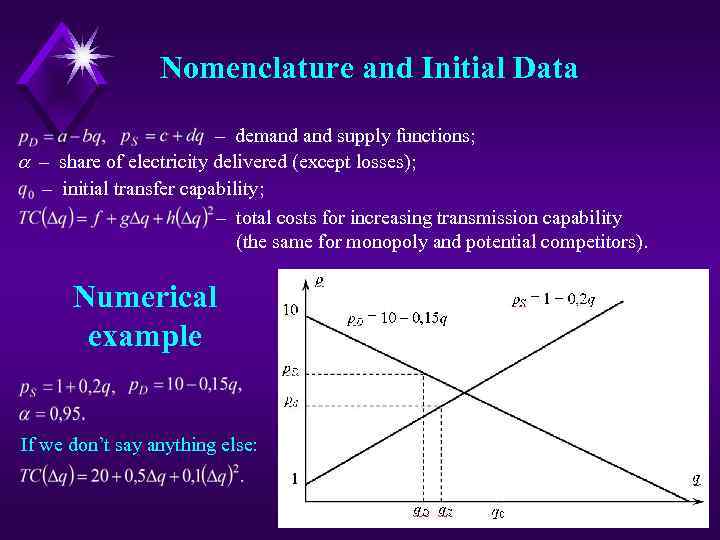
Nomenclature and Initial Data – demand supply functions; – share of electricity delivered (except losses); – initial transfer capability; – total costs for increasing transmission capability (the same for monopoly and potential competitors). Numerical example If we don’t say anything else:
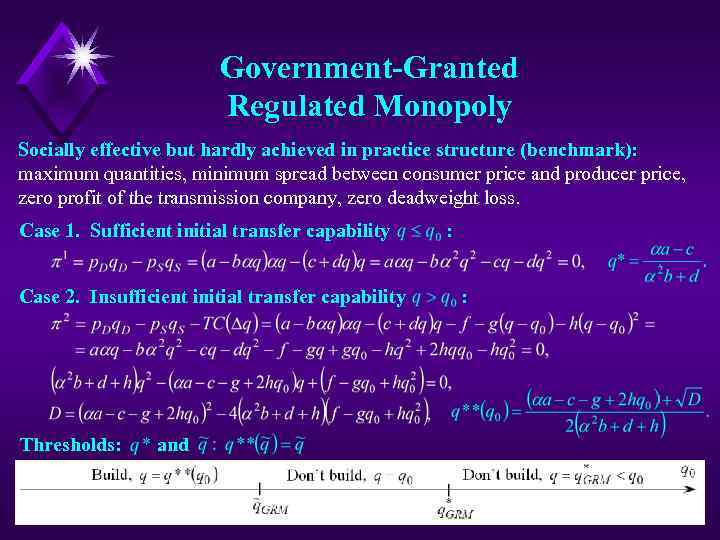
Government-Granted Regulated Monopoly Socially effective but hardly achieved in practice structure (benchmark): maximum quantities, minimum spread between consumer price and producer price, zero profit of the transmission company, zero deadweight loss. Case 1. Sufficient initial transfer capability Case 2. Insufficient initial transfer capability Thresholds: and : :
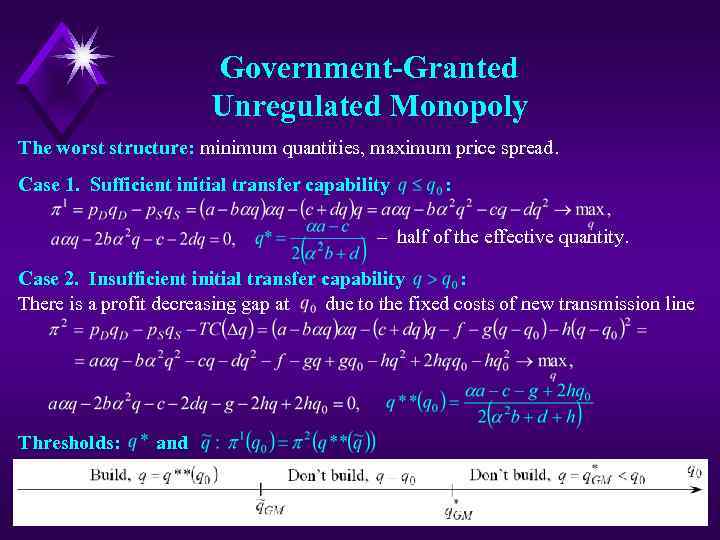
Government-Granted Unregulated Monopoly The worst structure: minimum quantities, maximum price spread. Case 1. Sufficient initial transfer capability : – half of the effective quantity. Case 2. Insufficient initial transfer capability : There is a profit decreasing gap at due to the fixed costs of new transmission line Thresholds: and
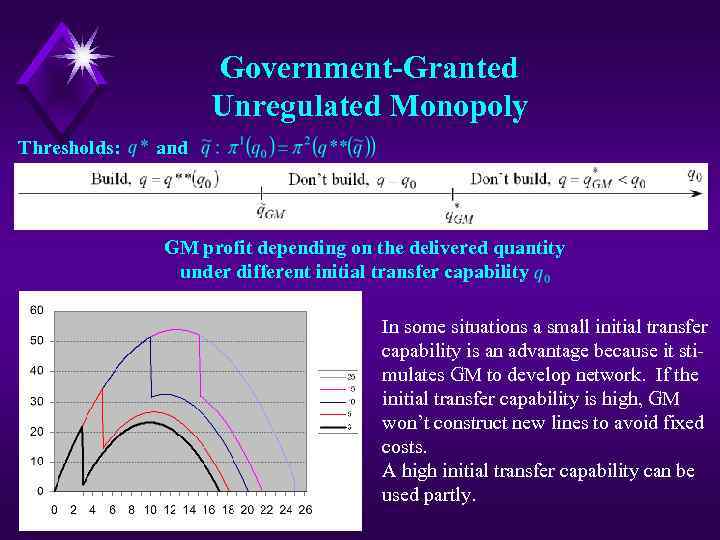
Government-Granted Unregulated Monopoly Thresholds: and GM profit depending on the delivered quantity under different initial transfer capability In some situations a small initial transfer capability is an advantage because it stimulates GM to develop network. If the initial transfer capability is high, GM won’t construct new lines to avoid fixed costs. A high initial transfer capability can be used partly.
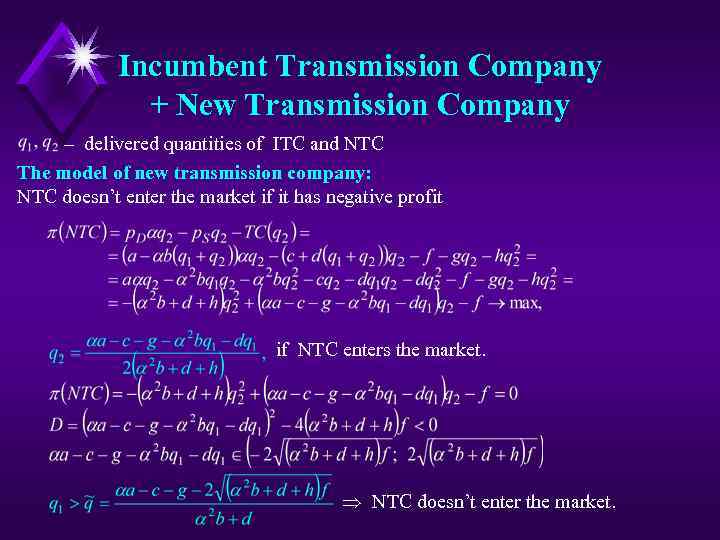
Incumbent Transmission Company + New Transmission Company – delivered quantities of ITC and NTC The model of new transmission company: NTC doesn’t enter the market if it has negative profit if NTC enters the market. NTC doesn’t enter the market.
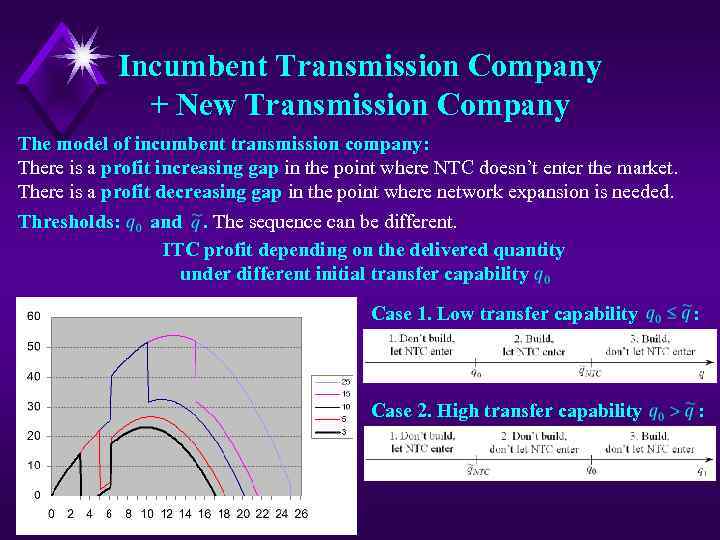
Incumbent Transmission Company + New Transmission Company The model of incumbent transmission company: There is a profit increasing gap in the point where NTC doesn’t enter the market. There is a profit decreasing gap in the point where network expansion is needed. Thresholds: and. The sequence can be different. ITC profit depending on the delivered quantity under different initial transfer capability Case 1. Low transfer capability : Case 2. High transfer capability :
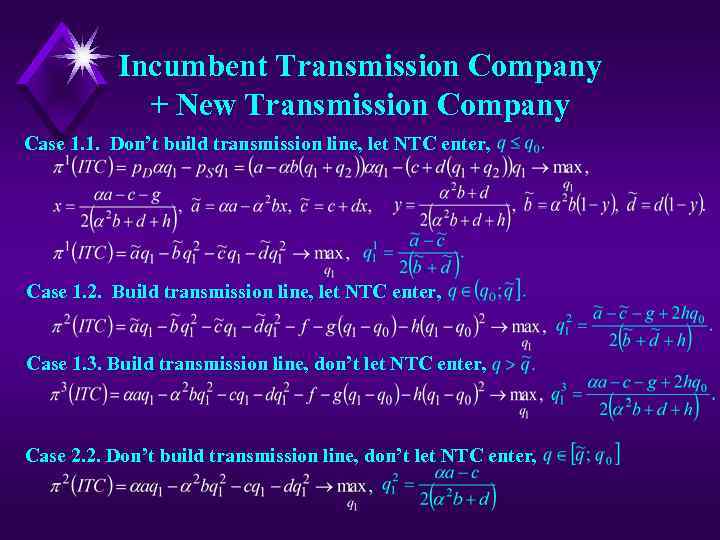
Incumbent Transmission Company + New Transmission Company Case 1. 1. Don’t build transmission line, let NTC enter, Case 1. 2. Build transmission line, let NTC enter, Case 1. 3. Build transmission line, don’t let NTC enter, Case 2. 2. Don’t build transmission line, don’t let NTC enter,
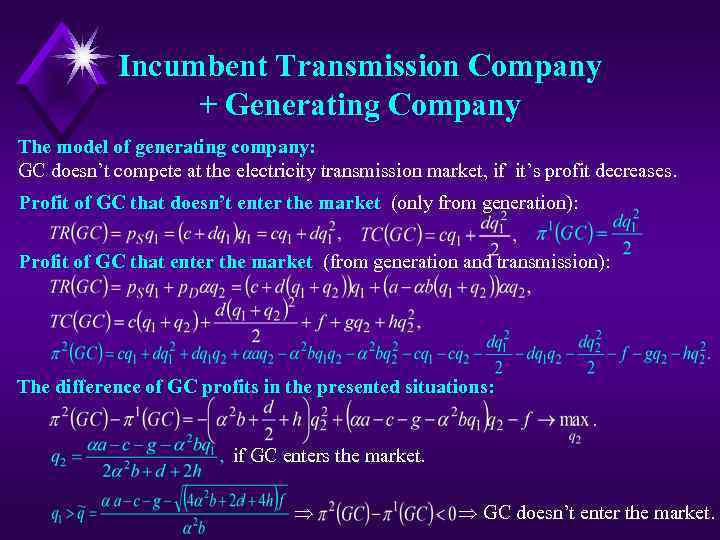
Incumbent Transmission Company + Generating Company The model of generating company: GC doesn’t compete at the electricity transmission market, if it’s profit decreases. Profit of GC that doesn’t enter the market (only from generation): Profit of GC that enter the market (from generation and transmission): The difference of GC profits in the presented situations: if GC enters the market. GC doesn’t enter the market.
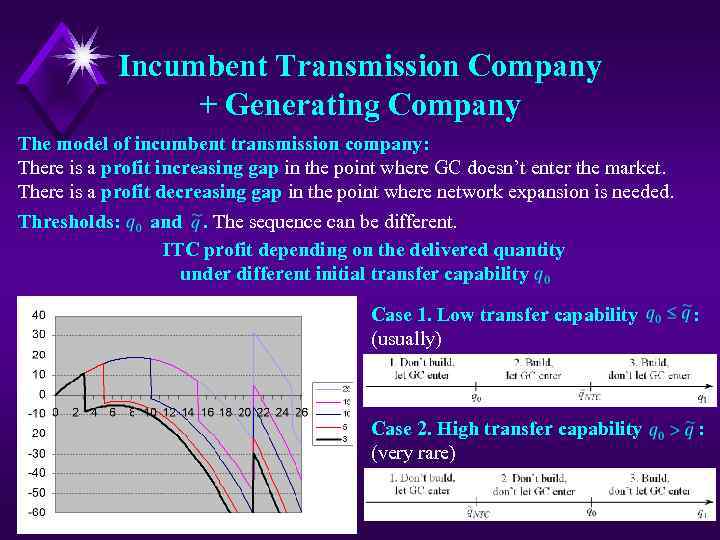
Incumbent Transmission Company + Generating Company The model of incumbent transmission company: There is a profit increasing gap in the point where GC doesn’t enter the market. There is a profit decreasing gap in the point where network expansion is needed. Thresholds: and. The sequence can be different. ITC profit depending on the delivered quantity under different initial transfer capability Case 1. Low transfer capability (usually) : Case 2. High transfer capability (very rare) :
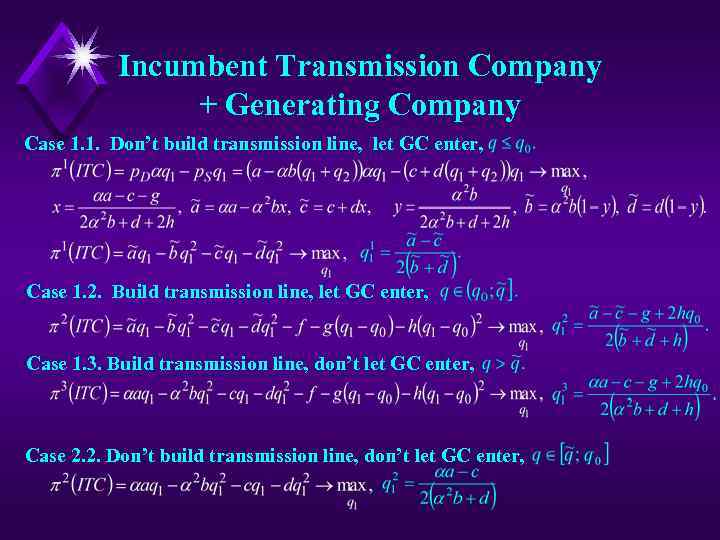
Incumbent Transmission Company + Generating Company Case 1. 1. Don’t build transmission line, let GC enter, Case 1. 2. Build transmission line, let GC enter, Case 1. 3. Build transmission line, don’t let GC enter, Case 2. 2. Don’t build transmission line, don’t let GC enter,
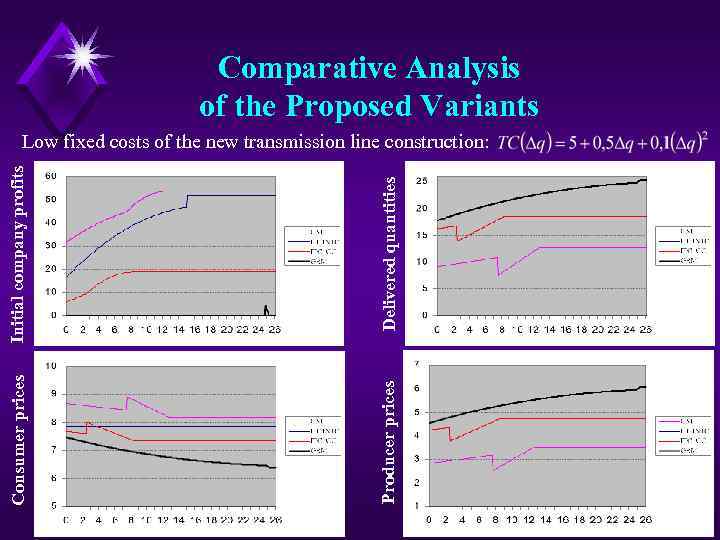
Comparative Analysis of the Proposed Variants Initial company profits Delivered quantities Consumer prices Producer prices Low fixed costs of the new transmission line construction:
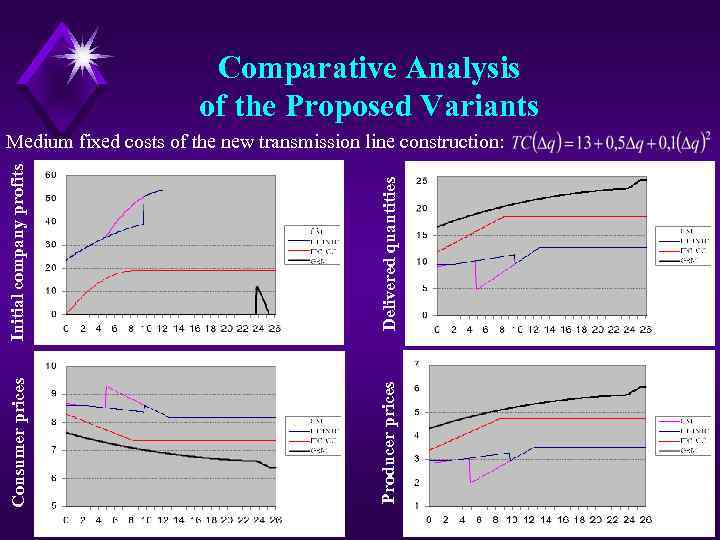
Comparative Analysis of the Proposed Variants Initial company profits Delivered quantities Consumer prices Producer prices Medium fixed costs of the new transmission line construction:
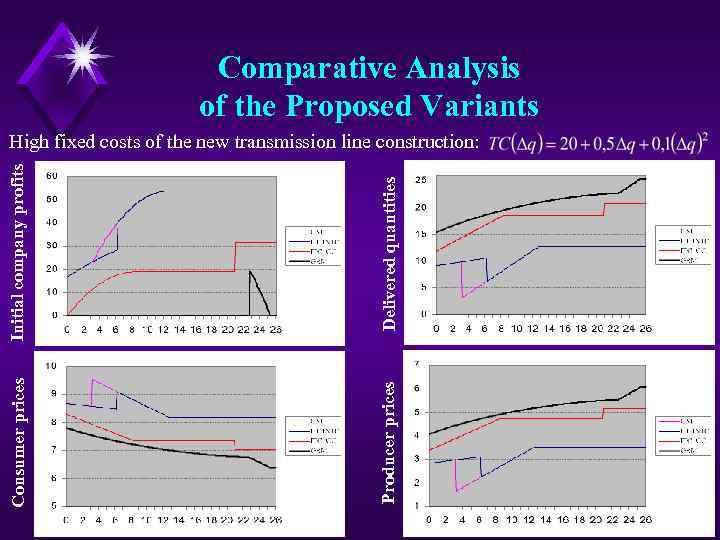
Comparative Analysis of the Proposed Variants Initial company profits Delivered quantities Consumer prices Producer prices High fixed costs of the new transmission line construction:
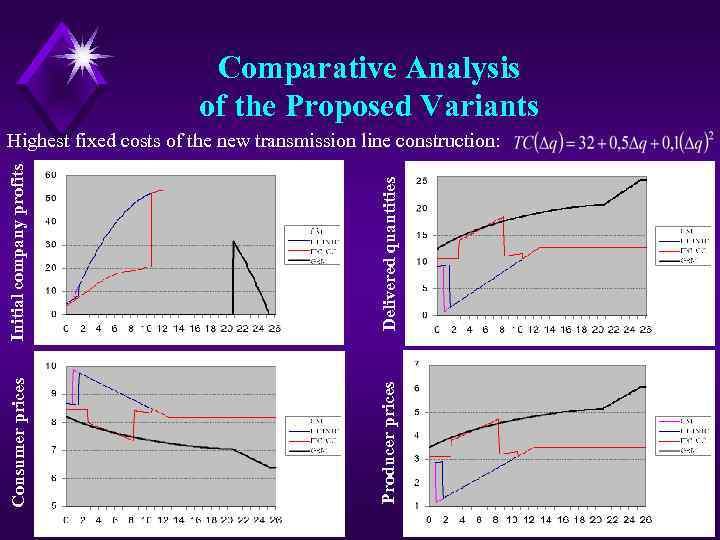
Comparative Analysis of the Proposed Variants Initial company profits Delivered quantities Consumer prices Producer prices Highest fixed costs of the new transmission line construction:
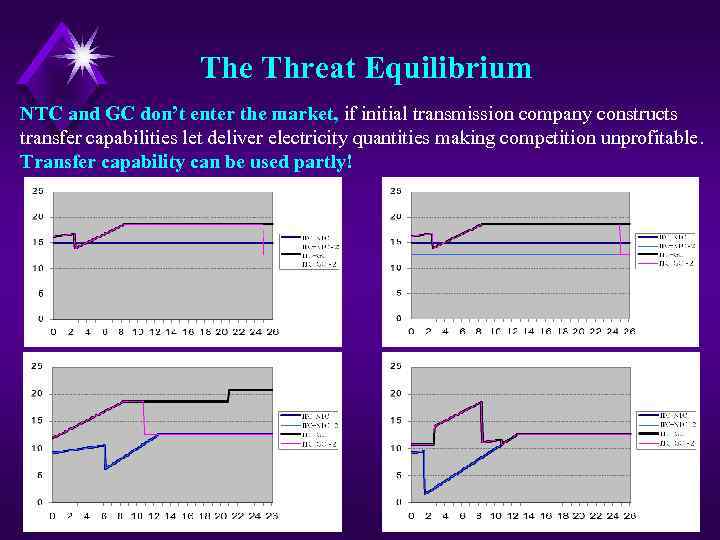
The Threat Equilibrium NTC and GC don’t enter the market, if initial transmission company constructs transfer capabilities let deliver electricity quantities making competition unprofitable. Transfer capability can be used partly!
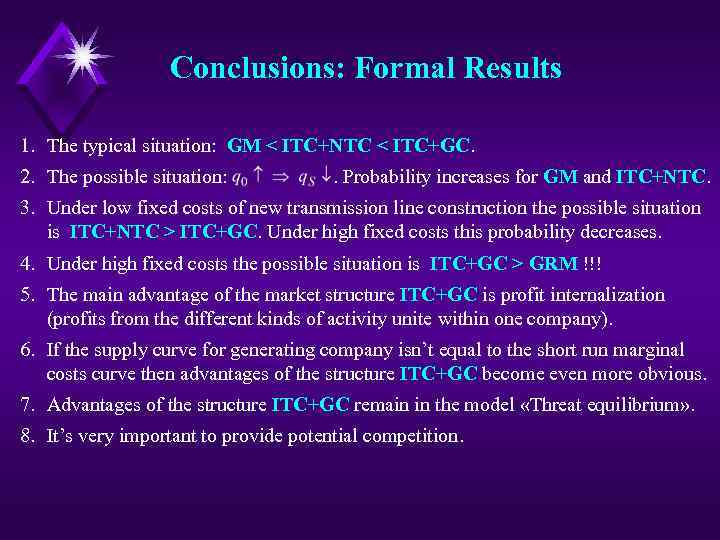
Conclusions: Formal Results 1. The typical situation: GM < ITC+NTC < ITC+GC. 2. The possible situation: . Probability increases for GM and ITC+NTC. 3. Under low fixed costs of new transmission line construction the possible situation is ITC+NTC > ITC+GC. Under high fixed costs this probability decreases. 4. Under high fixed costs the possible situation is ITC+GC > GRM !!! 5. The main advantage of the market structure ITC+GC is profit internalization (profits from the different kinds of activity unite within one company). 6. If the supply curve for generating company isn’t equal to the short run marginal costs curve then advantages of the structure ITC+GC become even more obvious. 7. Advantages of the structure ITC+GC remain in the model «Threat equilibrium» . 8. It’s very important to provide potential competition.
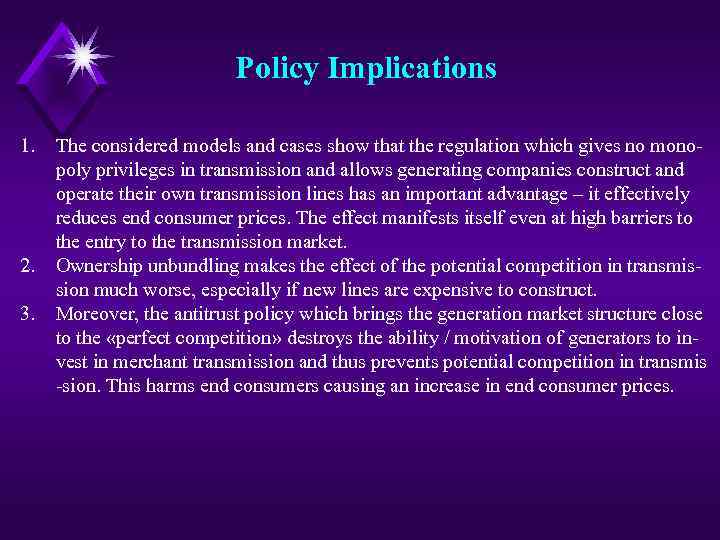
Policy Implications 1. 2. 3. The considered models and cases show that the regulation which gives no monopoly privileges in transmission and allows generating companies construct and operate their own transmission lines has an important advantage – it effectively reduces end consumer prices. The effect manifests itself even at high barriers to the entry to the transmission market. Ownership unbundling makes the effect of the potential competition in transmission much worse, especially if new lines are expensive to construct. Moreover, the antitrust policy which brings the generation market structure close to the «perfect competition» destroys the ability / motivation of generators to invest in merchant transmission and thus prevents potential competition in transmis -sion. This harms end consumers causing an increase in end consumer prices.

Takk for meg! alexander. filatov@gmail. com, vassiliev@ieee. org, zaika@isem. sei. irk. ru http: //sibscience. org, http: //youtube. com/sibscience
Скачать презентацию Unbundling and Monopoly Privileges in Electricity Transmission Alexander
2015-FVZ.ppt