


 Скачать презентацию Una introduction corta de Espanol Medical A Short
178b60bb02b85539905a4c22ee31340b.ppt
- Количество слайдов: 25
 Una introduction corta de Espanol Medical A Short Introduction to Medical Spanish
 Please note: 1. Phrases in this lecture have been translated directly, thus if it says: “Yo soy Sam” I have translated it as literally as I can to “I am Sam”. 2. Cognates are words that are similar sounding in two languages. “Constipation” does not mean “recipe” in Spanish. Find and hold onto cognates for dear life, they are pearls. 3. Practice phrases first, show an interest in learning, and remember how good it is to hear things in your mother tongue. Spanish people are very liberal in their tolerance of grammatical errors and mis-pronounciations. Any (grammatical) error is already forgiven. 4. Spanish reads as it is written, take a stab at “Yo Soy la enfermera” and chances are you are pronouncing it adequately, if not correctly. 5. “Despacio”= slowly. Tell your patients to slow down and obscure phrases become common words. 6. This is a work in progress.
 Conjugation l l Spanish is a language that modifies its verbs to reflect who is doing the action. The modifications are made at the end of the word.
 Conjugation: the concept There are three types of verbs in Spanish: ones that end in AR, end in ER and end in IR, there also irregular verbs. The verb endings are different depending on who is doing the action. I/ Yo You (relaxed)/ Tu He, She, You formal/ El, Ella, Usted We/ Nosotros You (plural) You’all/ Ustedes
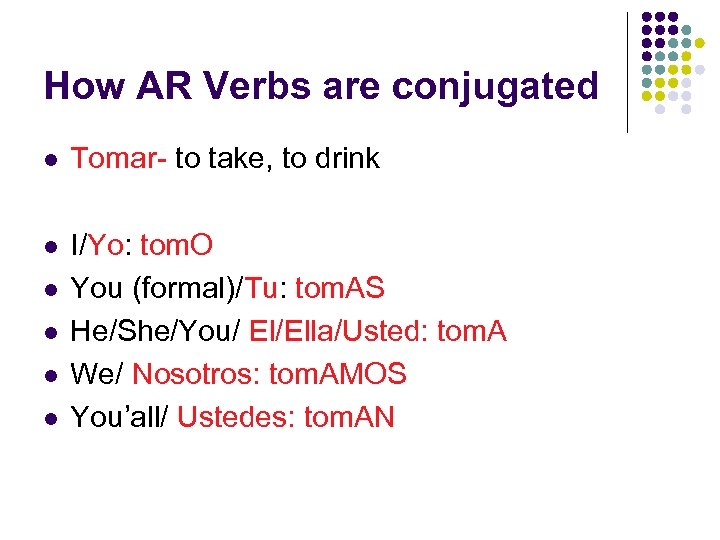 How AR Verbs are conjugated l Tomar- to take, to drink l I/Yo: tom. O You (formal)/Tu: tom. AS He/She/You/ El/Ella/Usted: tom. A We/ Nosotros: tom. AMOS You’all/ Ustedes: tom. AN l l
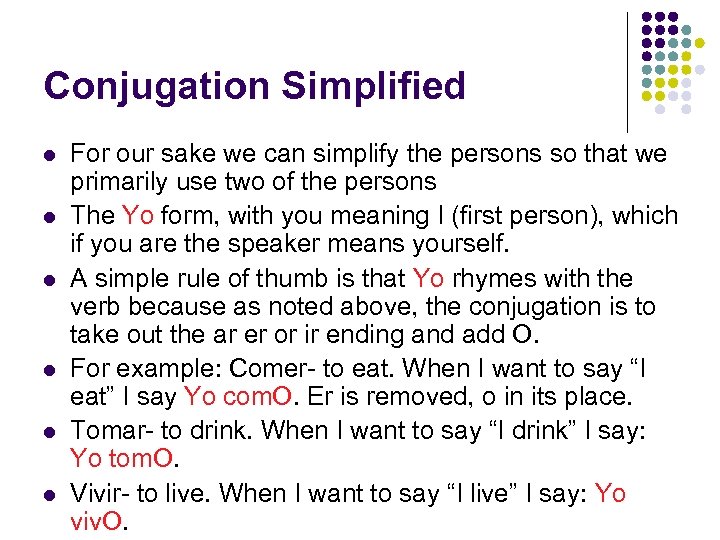 Conjugation Simplified l l l For our sake we can simplify the persons so that we primarily use two of the persons The Yo form, with you meaning I (first person), which if you are the speaker means yourself. A simple rule of thumb is that Yo rhymes with the verb because as noted above, the conjugation is to take out the ar er or ir ending and add O. For example: Comer- to eat. When I want to say “I eat” I say Yo com. O. Er is removed, o in its place. Tomar- to drink. When I want to say “I drink” I say: Yo tom. O. Vivir- to live. When I want to say “I live” I say: Yo viv. O.
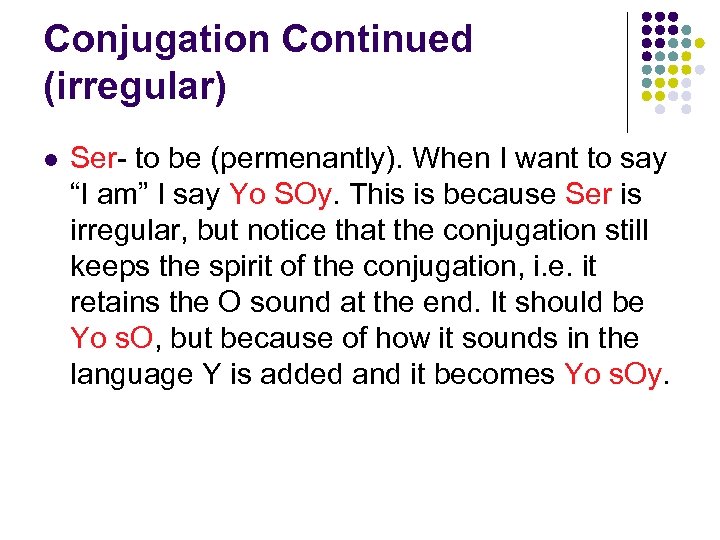 Conjugation Continued (irregular) l Ser- to be (permenantly). When I want to say “I am” I say Yo SOy. This is because Ser is irregular, but notice that the conjugation still keeps the spirit of the conjugation, i. e. it retains the O sound at the end. It should be Yo s. O, but because of how it sounds in the language Y is added and it becomes Yo s. Oy.
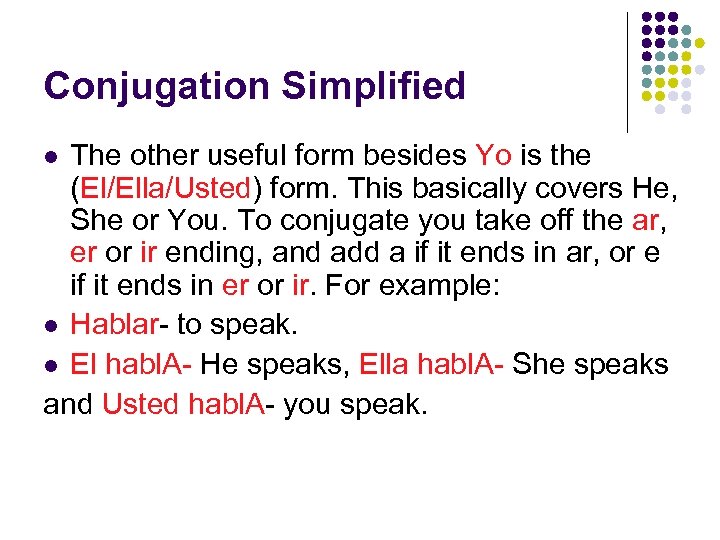 Conjugation Simplified The other useful form besides Yo is the (El/Ella/Usted) form. This basically covers He, She or You. To conjugate you take off the ar, er or ir ending, and add a if it ends in ar, or e if it ends in er or ir. For example: l Hablar- to speak. l El habl. A- He speaks, Ella habl. A- She speaks and Usted habl. A- you speak. l
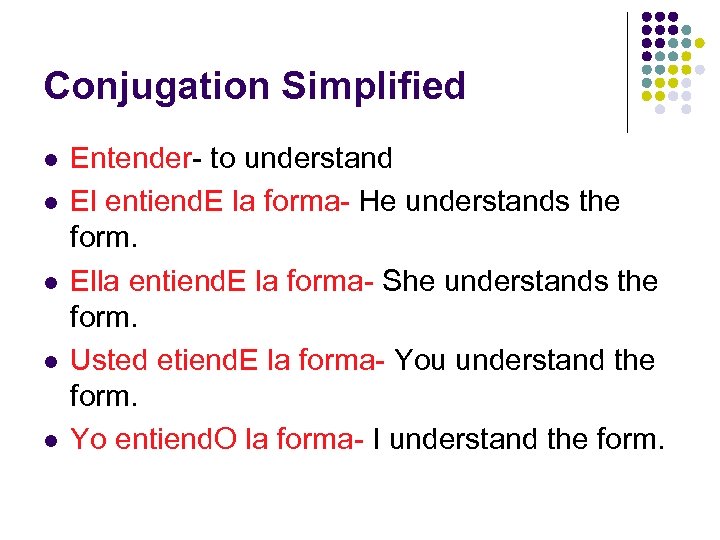 Conjugation Simplified l l l Entender- to understand El entiend. E la forma- He understands the form. Ella entiend. E la forma- She understands the form. Usted etiend. E la forma- You understand the form. Yo entiend. O la forma- I understand the form.
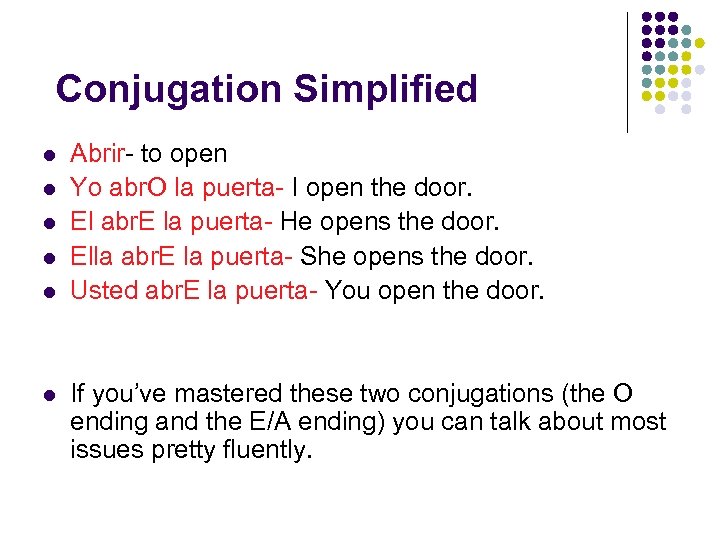 Conjugation Simplified l l l Abrir- to open Yo abr. O la puerta- I open the door. El abr. E la puerta- He opens the door. Ella abr. E la puerta- She opens the door. Usted abr. E la puerta- You open the door. If you’ve mastered these two conjugations (the O ending and the E/A ending) you can talk about most issues pretty fluently.
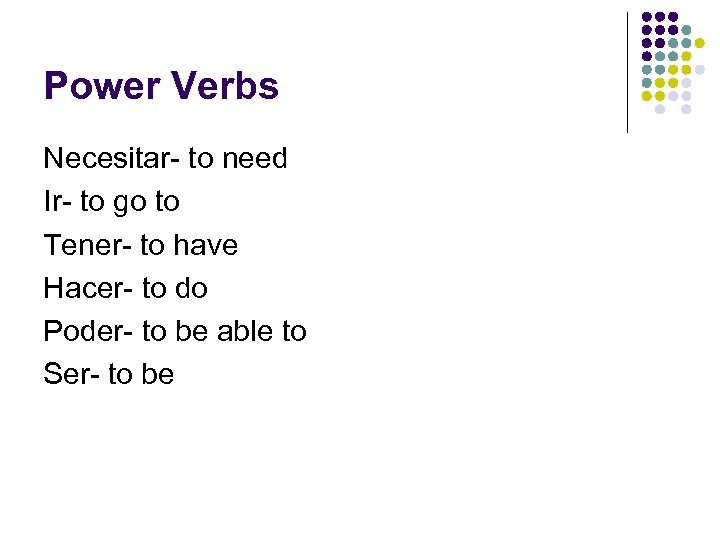 Power Verbs Necesitar- to need Ir- to go to Tener- to have Hacer- to do Poder- to be able to Ser- to be
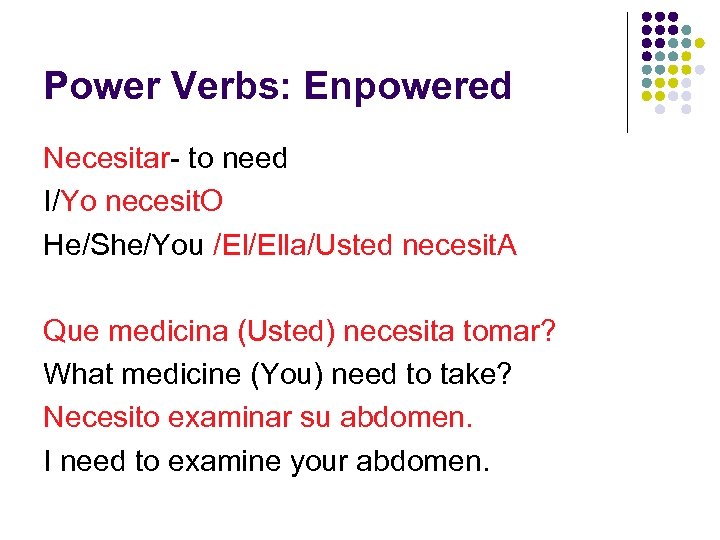 Power Verbs: Enpowered Necesitar- to need I/Yo necesit. O He/She/You /El/Ella/Usted necesit. A Que medicina (Usted) necesita tomar? What medicine (You) need to take? Necesito examinar su abdomen. I need to examine your abdomen.
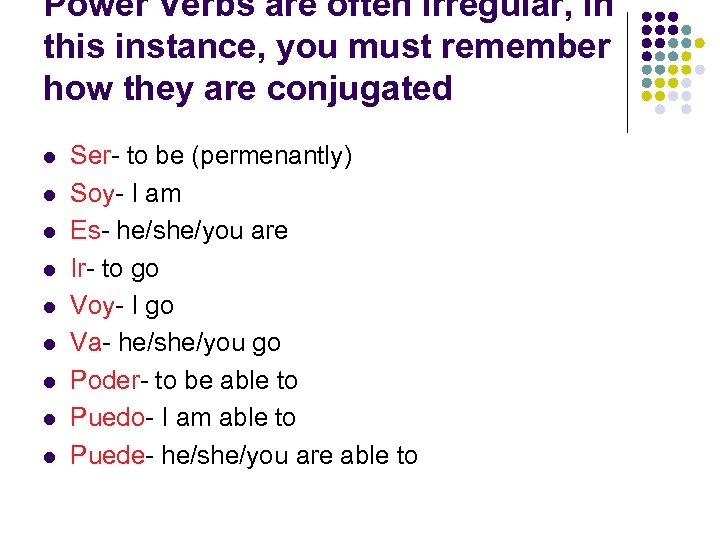 Power Verbs are often irregular, in this instance, you must remember how they are conjugated l l l l l Ser- to be (permenantly) Soy- I am Es- he/she/you are Ir- to go Voy- I go Va- he/she/you go Poder- to be able to Puedo- I am able to Puede- he/she/you are able to
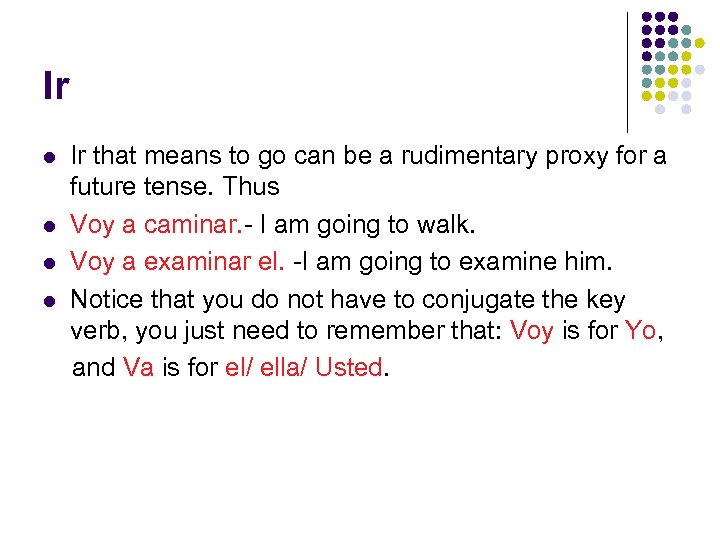 Ir l l Ir that means to go can be a rudimentary proxy for a future tense. Thus Voy a caminar. - I am going to walk. Voy a examinar el. -I am going to examine him. Notice that you do not have to conjugate the key verb, you just need to remember that: Voy is for Yo, and Va is for el/ ella/ Usted.
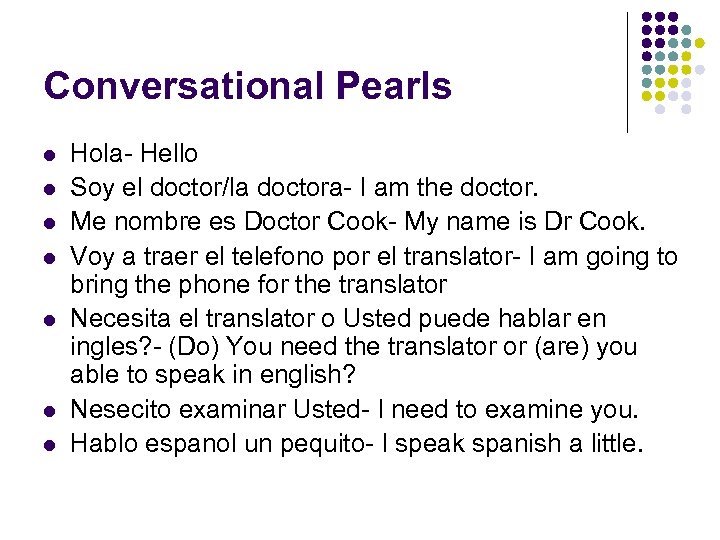 Conversational Pearls l l l l Hola- Hello Soy el doctor/la doctora- I am the doctor. Me nombre es Doctor Cook- My name is Dr Cook. Voy a traer el telefono por el translator- I am going to bring the phone for the translator Necesita el translator o Usted puede hablar en ingles? - (Do) You need the translator or (are) you able to speak in english? Nesecito examinar Usted- I need to examine you. Hablo espanol un pequito- I speak spanish a little.
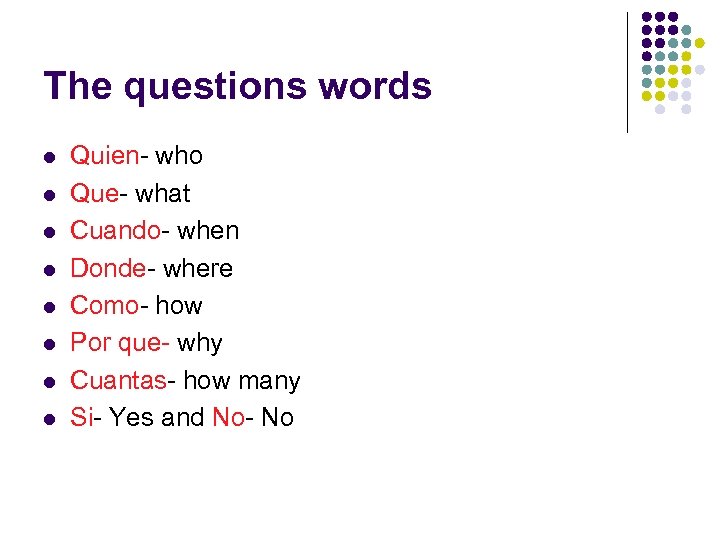 The questions words l l l l Quien- who Que- what Cuando- when Donde- where Como- how Por que- why Cuantas- how many Si- Yes and No- No
 Questions/ Preguntas Questions in Spanish are just a matter of vocal inflection, raise the tone at the end of the phrase like in English and a statement of fact becomes a question. El toma medication. - He takes medication El toma medication? - Does he take medication? The previous words are needed to guide the question. The vocal inflection just indicates that you are questioning whether what is being said is true. El es bueno- He is good, El es bueno? - He is good? Como el es bueno? - How is he good? Some additional detail is being sought.
 Commands are all in the tone l l l In like manner to say something can be a way of commanding that it be done. Usted levanta!- You get up! Or likewise, Yo examino usted- I examine you.
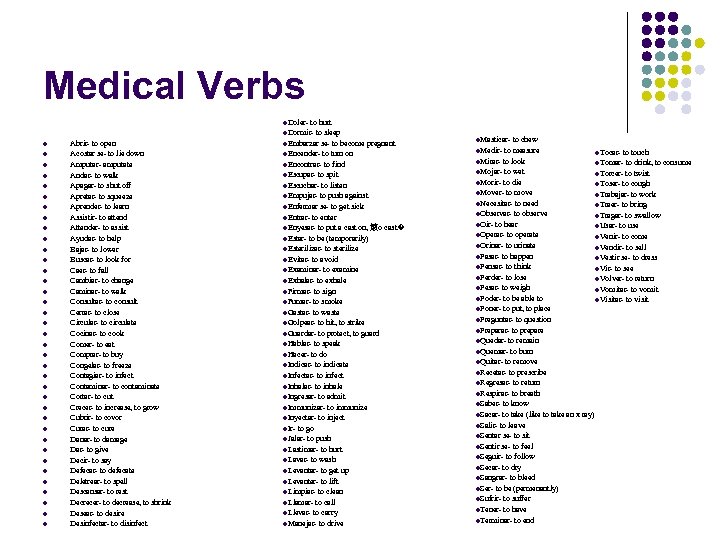 Medical Verbs l. Doler- to hurt to sleep l. Embarzar se- to become pregnant l. Encender- to turn on l. Encontrar- to find l. Escupar- to spit l. Escuchar- to listen l. Empujar- to push against l. Enfermar se- to get sick l. Entrar- to enter l. Enyesar- to put a cast on, 鍍o cast� l. Estar- to be (temporarily) l. Esterilizar- to sterilize l. Evitar- to avoid l. Examinar- to examine l. Exhalar- to exhale l. Firmar- to sign l. Fumar- to smoke l. Gastar- to waste l. Golpear- to hit, to strike l. Guardar- to protect, to guard l. Hablar- to speak l. Hacer- to do l. Indicar- to indicate l. Infectar- to infect l. Inhalar- to inhale l. Ingresar- to admit l. Immunizar- to immunize l. Inyectar- to inject l. Ir- to go l. Jalar- to push l. Lastimar- to hurt l. Lavar- to wash l. Levantar- to get up l. Levanter- to lift l. Limpiar- to clean l. Llamar- to call l. Llevar- to carry l. Manejar- to drive l. Dormir- l l l l l l l l l l Abrir- to open Acostar se- to lie down Amputar- amputate Andar- to walk Apagar- to shut off Apretar- to squeeze Aprender- to learn Assistir- to attend Attender- to assist Ayudar- to help Bajar- to lower Buscar- to look for Caer- to fall Cambiar- to change Caminar- to walk Consultar- to consult Cerrar- to close Circular- to circulate Cocinar- to cook Comer- to eat Comprar- to buy Congelar- to freeze Contagiar- to infect Contaminar- to contaminate Cortar- to cut Crecer- to increase, to grow Cubrir- to covor Curar- to cure Danar- to damage Dar- to give Decir- to say Defecar- to defecate Deletrear- to spell Descansar- to rest Decrecer- to decrease, to shrink Desear- to desire Desinfectar- to disinfect l. Masticar- to chew to measure l. Tocar- to touch l. Mirar- to look l. Tomar- to drink, to consume l. Mojar- to wet l. Torcer- to twist l. Morir- to die l. Toser- to cough l. Mover- to move l. Trabajar- to work l. Necesitar- to need l. Traer- to bring l. Observar- to observe l. Tragar- to swallow l. Oir- to hear l. Usar- to use l. Operar- to operate l. Venir- to come l. Orinar- to urinate l. Vendir- to sell l. Pasar- to happen l. Vestir se- to dress l. Pensar- to think l. Vir- to see l. Perder- to lose l. Volver- to return l. Pesar- to weigh l. Vomitar- to vomit l. Poder- to be able to l. Visitar- to visit l. Poner- to put, to place l. Preguntar- to question l. Preparar- to prepare l. Quedar- to remain l. Quemar- to burn l. Quitar- to remove l. Recetar- to prescribe l. Regresar- to return l. Respirar- to breath l. Saber- to know l. Sacar- to take (like to take an x ray) l. Salir- to leave l. Sentar se- to sit l. Sentir se- to feel l. Seguir- to follow l. Secar- to dry l. Sangrar- to bleed l. Ser- to be (permenantly) l. Sufrir- to suffer l. Tener- to have l. Terminar- to end l. Medir-
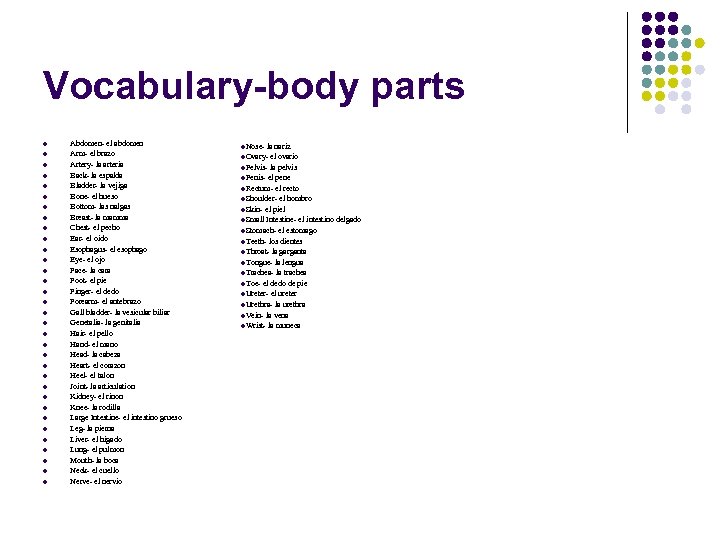 Vocabulary-body parts l l l l l l l l l Abdomen- el abdomen Arm- el brazo Artery- la arteria Back- la espalda Bladder- la vejiga Bone- el hueso Bottom- las nalgas Breast- la mamma Chest- el pecho Ear- el oido Esophagus- el esophago Eye- el ojo Face- la cara Foot- el pie Finger- el dedo Forearm- el antebrazo Gall bladder- la vesicular biliar Genetalia- la genitalia Hair- el pello Hand- el mano Head- la cabeza Heart- el corazon Heel- el talon Joint- la articulation Kidney- el rinon Knee- la rodilla Large Intestine- el intestino grueso Leg- la pierna Liver- el higado Lung- el pulmon Mouth- la boca Neck- el cuello Nerve- el nervio l. Nose- la nariz el ovario l. Pelvis- la pelvis l. Penis- el pene l. Rectum- el recto l. Shoulder- el hombro l. Skin- el piel l. Small Intestine- el intestino delgado l. Stomach- el estomago l. Teeth- los dientes l. Throat- la garganta l. Tongue- la lengua l. Trachea- la trachea l. Toe- el dedo de pie l. Ureter- el ureter l. Urethra- la urethra l. Vein- la vena l. Wrist- la muneca l. Ovary-
 Case l You are on a hike in Fairmount Park, climbing one of the small hills when half way up you come upon an elderly couple, the man is lying upon the ground and the woman looks distressed. She is speaking in Spanish and you notice that your cell phone does not have any reception. What key pieces of information would you like to have regarding the man’s health? What Spanish phrases would you like to know?
 EMERGENCY PHRASES l l l l Usted tiene falta de aire? - (Do) you have difficulty breathing (fault of air)? Usted tiene problemas de salud? - Do you has problem of health? Que son los problemas de salud para el? - What are the problems of health with him? El tiene allergias? - He have allergies? Usted tiene dolor? - You have pain? Usted tiene dolor de pecho? - You have chest pain? Donde esta el dolor? - Where is the pain? Con que dura el tiene este problema? - With what duration he has this problem ? (how long? ) Soy el doctor- I am the doctor Voy a ayudar Usted- I am going to help you. Va a acostar- You are going to lie down. Si / No- Yes / No Haga Eso- do this
 When you are self sufficient… l l Que es la palabra en espanol para este? What is the word in spanish for this?
 Then the learning begins
 Referencias l l Joanna Rios Ph. D. and Jose Fernandez Torres (2004). Mc. Graw-Hill’s Complete Medical Spanish. New York: Mc. Graw-Hill Publishing Company Robert O Chase and Clarisa Medina de Chase (2003). An Introduction to Spanish for Health Care Workers. New Haven: Yale University Press