


 Скачать презентацию UN Expert Group Meeting on Measuring International Migration
e2acbc2db6bf14de5f0d57200ba9a2d2.ppt
- Количество слайдов: 18
 UN Expert Group Meeting on Measuring International Migration: Concepts and Methods 4 -7 December 2006, New York International Migrations Statistics in ESCWA Region Neda Jafar United Nations Economic and Social Commission for Western Asia (ESCWA) jafarn@un. org
 Contents n n ESCWA ACTIVITIES IN INTERNATIONAL MIGRATION: 1990 -2006 REGIONAL TRENDS INTERNATIONAL MIGRATION STATISTICS STATUS: SOURCES, METHODOLOGY AND CHALLENGES ESCWA PROPOSED FUTURE ACTIVITIES FOR 2007 -2009
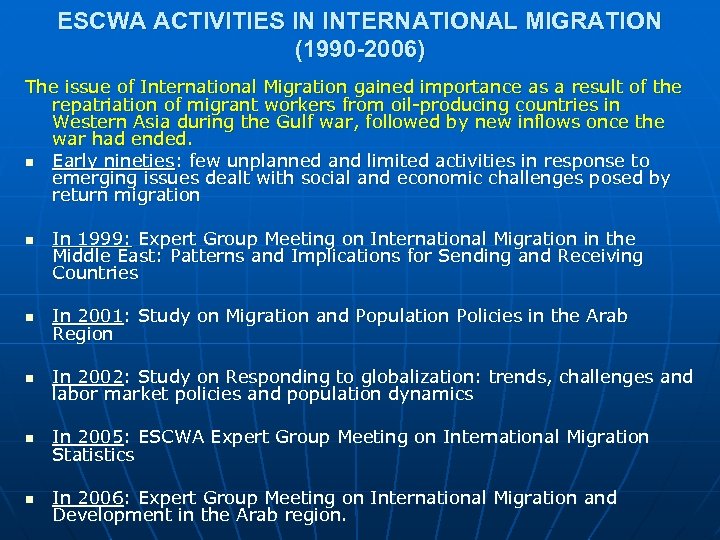 ESCWA ACTIVITIES IN INTERNATIONAL MIGRATION (1990 -2006) The issue of International Migration gained importance as a result of the repatriation of migrant workers from oil-producing countries in Western Asia during the Gulf war, followed by new inflows once the war had ended. n Early nineties: few unplanned and limited activities in response to emerging issues dealt with social and economic challenges posed by return migration n In 1999: Expert Group Meeting on International Migration in the Middle East: Patterns and Implications for Sending and Receiving Countries n In 2001: Study on Migration and Population Policies in the Arab Region n In 2002: Study on Responding to globalization: trends, challenges and labor market policies and population dynamics n In 2005: ESCWA Expert Group Meeting on International Migration Statistics n In 2006: Expert Group Meeting on International Migration and Development in the Arab region.
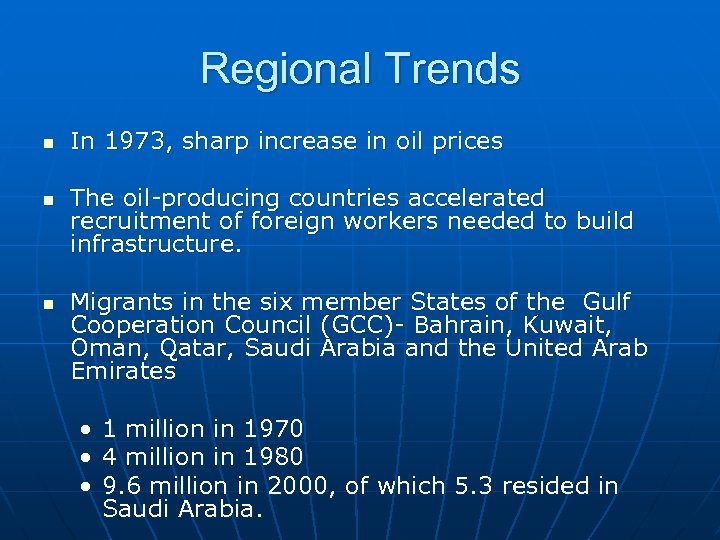 Regional Trends n n n In 1973, sharp increase in oil prices The oil-producing countries accelerated recruitment of foreign workers needed to build infrastructure. Migrants in the six member States of the Gulf Cooperation Council (GCC)- Bahrain, Kuwait, Oman, Qatar, Saudi Arabia and the United Arab Emirates • 1 million in 1970 • 4 million in 1980 • 9. 6 million in 2000, of which 5. 3 resided in Saudi Arabia.
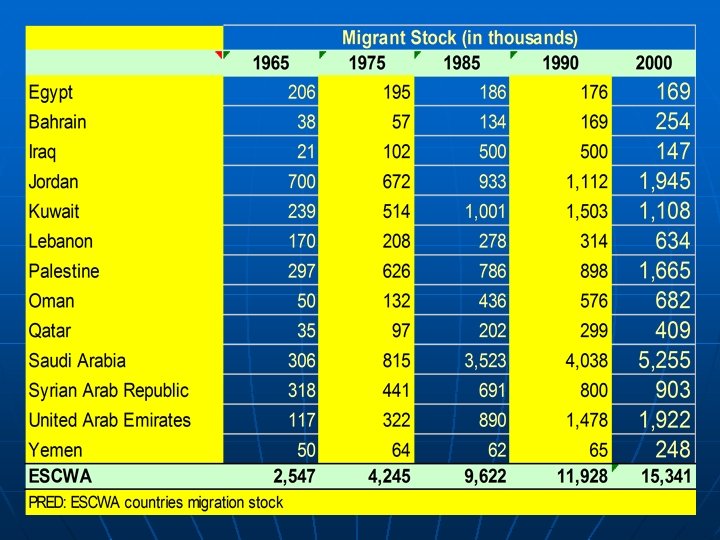
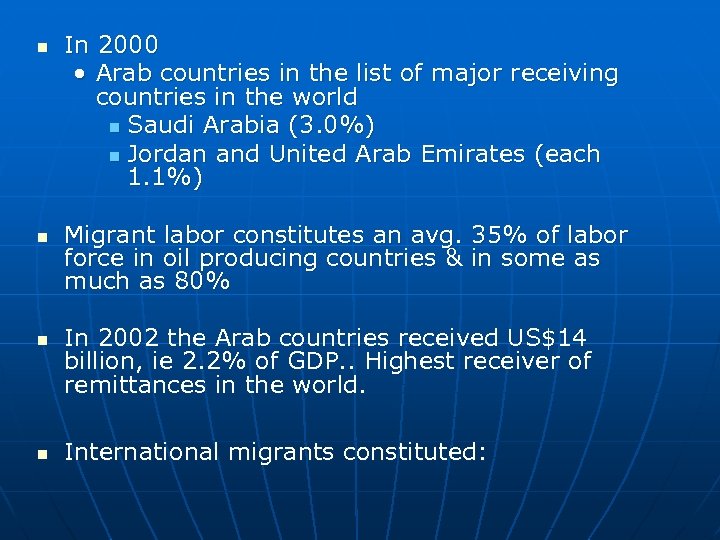 n n In 2000 • Arab countries in the list of major receiving countries in the world n Saudi Arabia (3. 0%) n Jordan and United Arab Emirates (each 1. 1%) Migrant labor constitutes an avg. 35% of labor force in oil producing countries & in some as much as 80% In 2002 the Arab countries received US$14 billion, ie 2. 2% of GDP. . Highest receiver of remittances in the world. International migrants constituted:
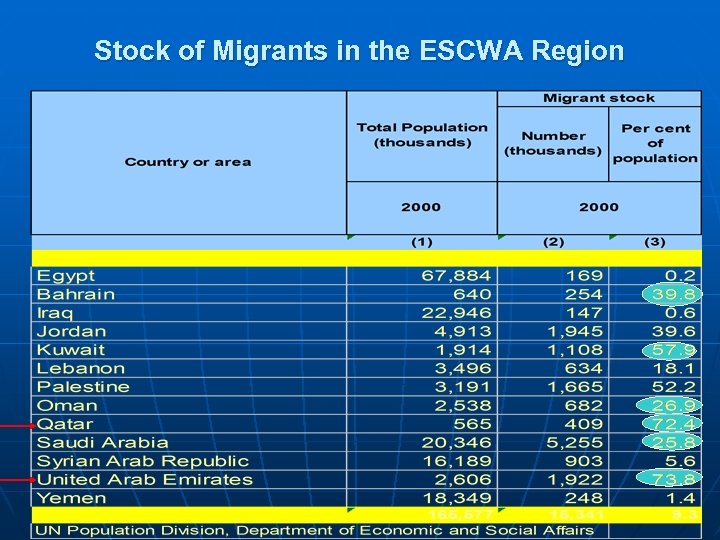 Stock of Migrants in the ESCWA Region
 INTERNATIONAL MIGRATION STATISTICS STATUS: SOURCES, METHODOLOGY AND CHALLENGES n The dearth of data as a result of: • wide spectrum and incongruent sources • lack of comprehensive framework and methodology • weakness of capacity and limited resources • inadequacy of administrative records • lack of surveys
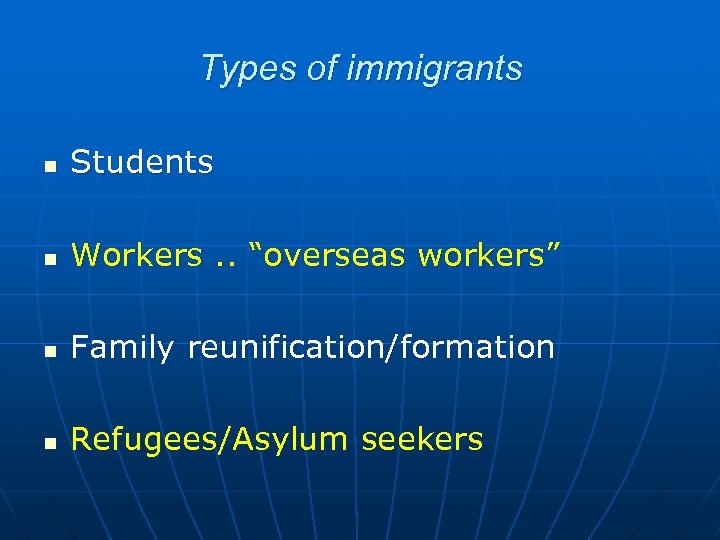 Types of immigrants n Students n Workers. . “overseas workers” n Family reunification/formation n Refugees/Asylum seekers
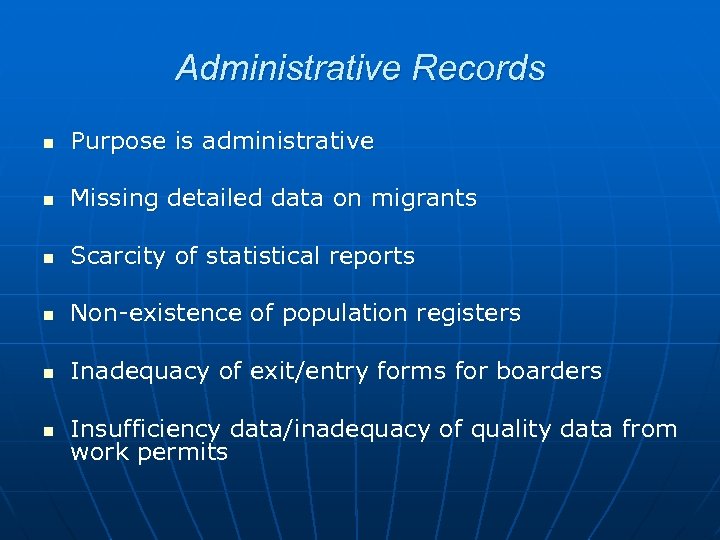 Administrative Records n Purpose is administrative n Missing detailed data on migrants n Scarcity of statistical reports n Non-existence of population registers n Inadequacy of exit/entry forms for boarders n Insufficiency data/inadequacy of quality data from work permits
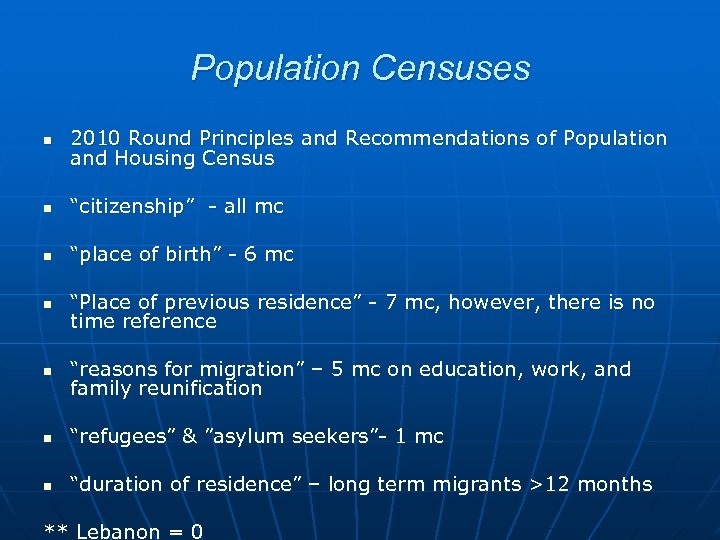 Population Censuses n 2010 Round Principles and Recommendations of Population and Housing Census n “citizenship” - all mc n “place of birth” - 6 mc n “Place of previous residence” - 7 mc, however, there is no time reference n “reasons for migration” – 5 mc on education, work, and family reunification n “refugees” & ”asylum seekers”- 1 mc n “duration of residence” – long term migrants >12 months ** Lebanon = 0
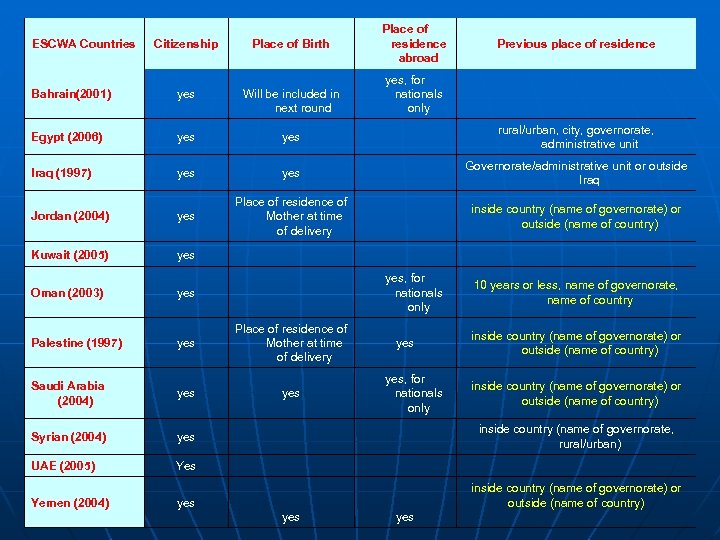 ESCWA Countries Citizenship Place of Birth Place of residence abroad Previous place of residence yes, for nationals only Bahrain(2001) yes Will be included in next round Egypt (2006) yes rural/urban, city, governorate, administrative unit Iraq (1997) yes Governorate/administrative unit or outside Iraq Jordan (2004) yes Place of residence of Mother at time of delivery inside country (name of governorate) or outside (name of country) Kuwait (2005) yes Oman (2003) yes Palestine (1997) yes Saudi Arabia (2004) yes Syrian (2004) yes UAE (2005) yes, for nationals only yes 10 years or less, name of governorate, name of country inside country (name of governorate) or outside (name of country) Yes Yemen (2004) Place of residence of Mother at time of delivery yes, for nationals only yes inside country (name of governorate) or outside (name of country) inside country (name of governorate, rural/urban) inside country (name of governorate) or outside (name of country) yes
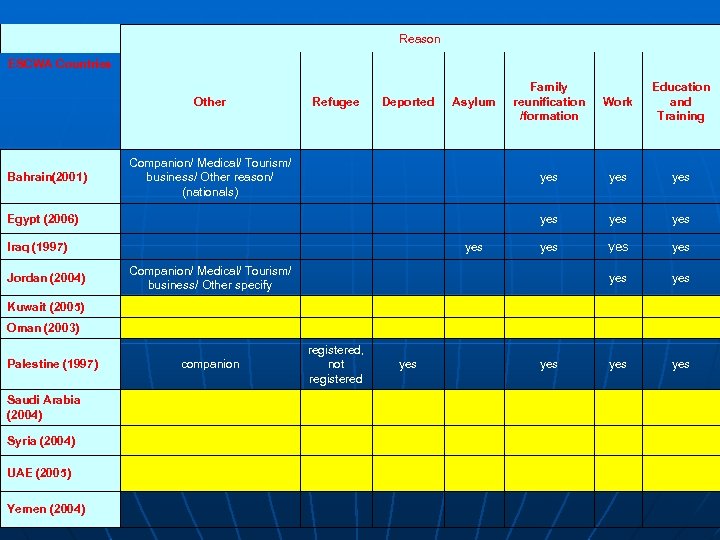 Reason ESCWA Countries Bahrain(2001) Egypt (2006) Refugee Deported Companion/ Medical/ Tourism/ business/ Other reason/ (nationals) yes yes yes Work Education and Training yes Other Family reunification /formation Asylum Iraq (1997) Jordan (2004) Companion/ Medical/ Tourism/ business/ Other specify Kuwait (2005) Oman (2003) companion registered, not registered yes yes Saudi Arabia (2004) Syria (2004) Palestine (1997) UAE (2005) Yemen (2004)
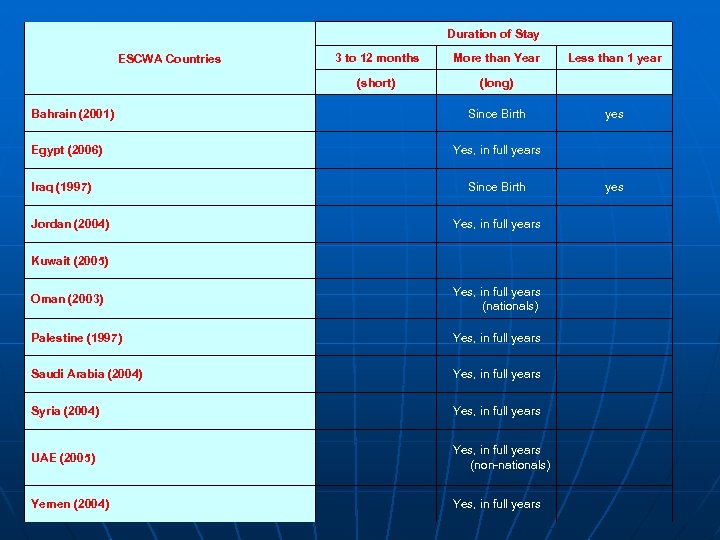 Duration of Stay Bahrain (2001) Egypt (2006) Iraq (1997) Jordan (2004) Kuwait (2005) Oman (2003) Palestine (1997) Saudi Arabia (2004) Syria (2004) 3 to 12 months More than Year Less than 1 year (short) ESCWA Countries (long) Since Birth yes Yes, in full years (nationals) Yes, in full years (non-nationals) Yes, in full years UAE (2005) Yemen (2004)
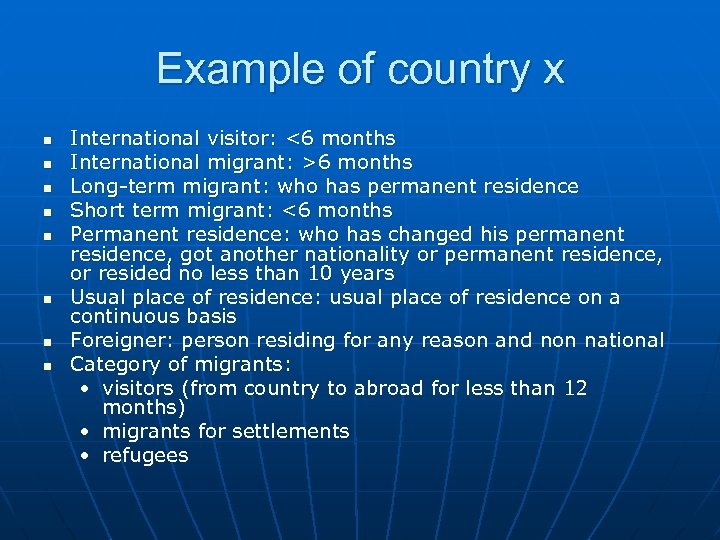 Example of country x n n n n International visitor: <6 months International migrant: >6 months Long-term migrant: who has permanent residence Short term migrant: <6 months Permanent residence: who has changed his permanent residence, got another nationality or permanent residence, or resided no less than 10 years Usual place of residence: usual place of residence on a continuous basis Foreigner: person residing for any reason and non national Category of migrants: • visitors (from country to abroad for less than 12 months) • migrants for settlements • refugees
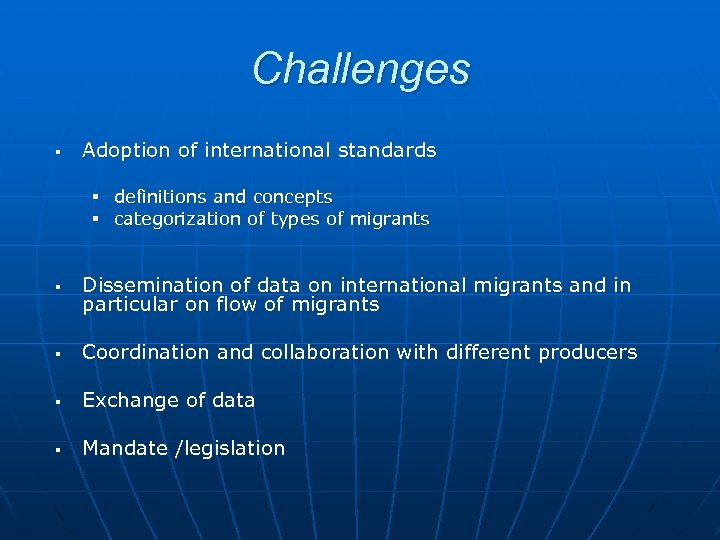 Challenges § Adoption of international standards § definitions and concepts § categorization of types of migrants § Dissemination of data on international migrants and in particular on flow of migrants § Coordination and collaboration with different producers § Exchange of data § Mandate /legislation
 ESCWA PROPOSED FUTURE ACTIVITIES 2007 -2009 n n Workshop on International Migration Statistics and Data Exchange among the GCC UNSD Questionnaire on International Migration Statistics Social Compendium on international migration statistics in the ESCWA region Project proposal for the Development of International Migration Statistics in the Region
 Thank you. .