 Скачать презентацию UN Collaborative Programme on Reducing Emissions from Deforestation
90225a4193a972d4852dc325cfe12232.ppt
- Количество слайдов: 14



UN Collaborative Programme on Reducing Emissions from Deforestation and Forest Degradation in Developing Countries FAO-UNDP-UNEP April 2008
UN Collaboration on REDD • A response to Bali decision • Coalition for Rainforest Nations and donor requests for joint UN action • To support country-led, integrated REDD programmes • To facilitate the informed involvement of national stakeholders, including forestdependent local communities • To coordinate with other players including WB FCPF, GEF etc. on making REDD work for people • Increase UN effectiveness “Delivering as One UN”
Issues • The underlying causes of deforestation vary from country to country and even within a country and are often complex in nature. • Addressing deforestation and forest degradation can yield significant sustainable development benefits • REDD may generate new financing forest management in developing countries • But involves substantial risks that need to be managed – “performance” or “delivery” risks
Issues – On-delivery Payments • REDD countries bear all the delivery risk, thus limiting the incentive to invest in timeconsuming participatory, community-based measures • Could reduce livelihood opportunities for rural people, including indigenous groups • This in turn, may affect the sustainability of REDD interventions and thus compromise the permanence of REDD carbon savings
UN Collaborative REDD Programme Rationale To assist forested developing countries and the international community to gain experience with various risk management formulae and payment structures. Components • Country Actions • International Support
Country Actions • Will be identified and led by the government • Will vary from country to country • Aim to establish cross-sectoral & multi-stakeholder responses • Aim to facilitate & support the challenging national processes in which REDD actions are defined and agreed
Country Actions q Scoping and Alliance Building q REDD Readiness for Monitoring and Assessment q REDD Dialogue q National REDD strategy q Support for implementing the REDD measures q REDD Data Management q REDD Payment Distribution q REDD Payment structuring
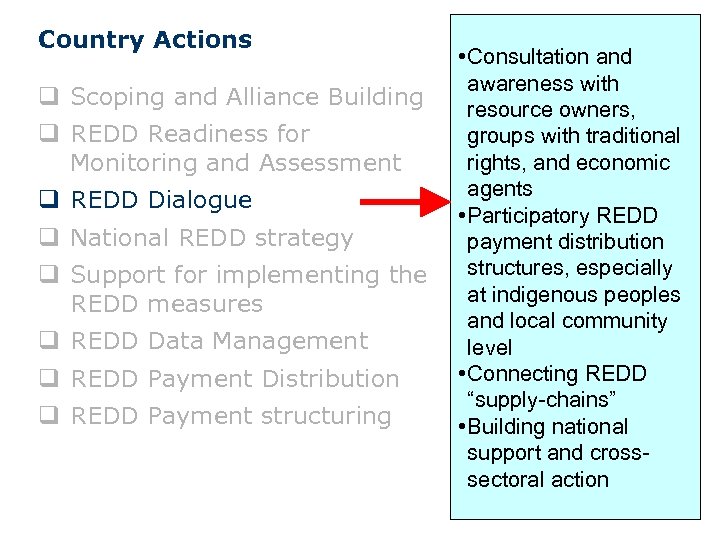
Country Actions q Scoping and Alliance Building q REDD Readiness for Monitoring and Assessment q REDD Dialogue q National REDD strategy q Support for implementing the REDD measures q REDD Data Management q REDD Payment Distribution q REDD Payment structuring • Consultation and awareness with resource owners, groups with traditional rights, and economic agents • Participatory REDD payment distribution structures, especially at indigenous peoples and local community level • Connecting REDD “supply-chains” • Building national support and crosssectoral action
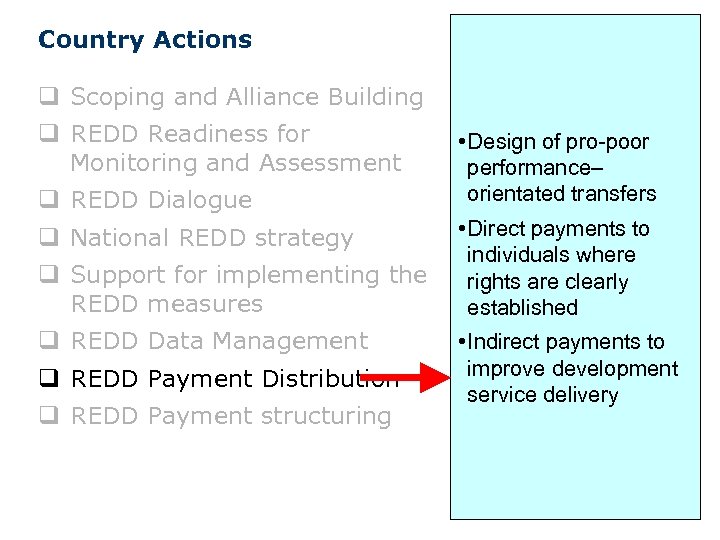
Country Actions q Scoping and Alliance Building q REDD Readiness for Monitoring and Assessment q REDD Dialogue q National REDD strategy q Support for implementing the REDD measures q REDD Data Management q REDD Payment Distribution q REDD Payment structuring • Design of pro-poor performance– orientated transfers • Direct payments to individuals where rights are clearly established • Indirect payments to improve development service delivery
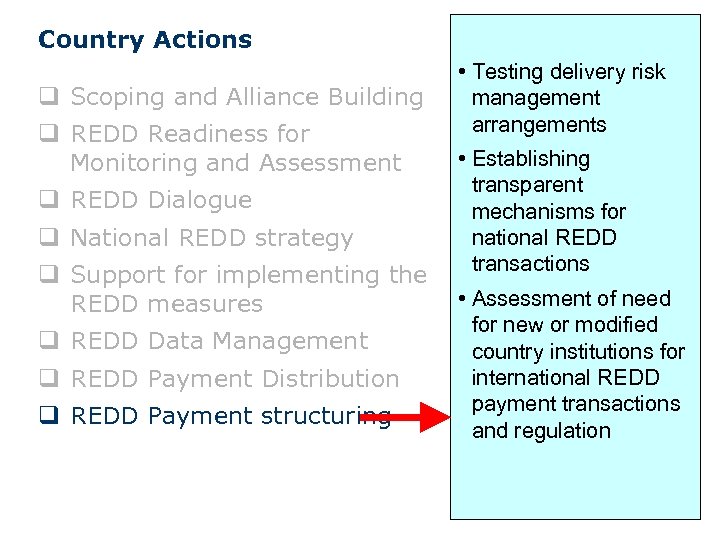
Country Actions q Scoping and Alliance Building q REDD Readiness for Monitoring and Assessment q REDD Dialogue q National REDD strategy q Support for implementing the REDD measures q REDD Data Management q REDD Payment Distribution q REDD Payment structuring • Testing delivery risk management arrangements • Establishing transparent mechanisms for national REDD transactions • Assessment of need for new or modified country institutions for international REDD payment transactions and regulation
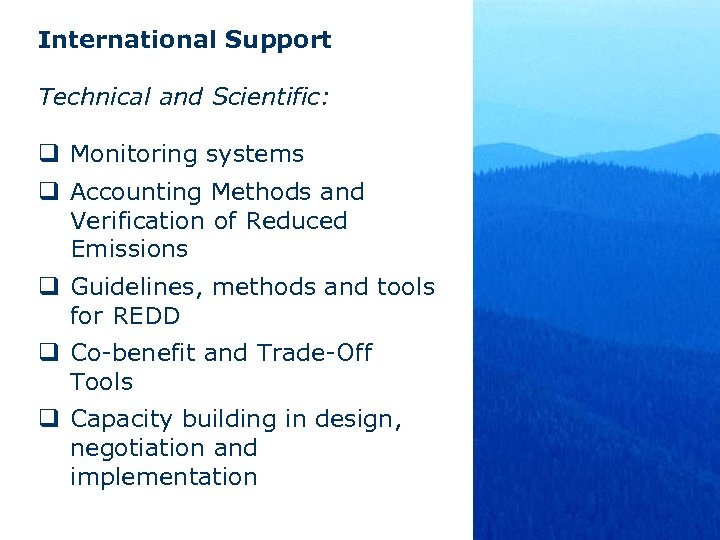
International Support Technical and Scientific: q Monitoring systems q Accounting Methods and Verification of Reduced Emissions q Guidelines, methods and tools for REDD q Co-benefit and Trade-Off Tools q Capacity building in design, negotiation and implementation
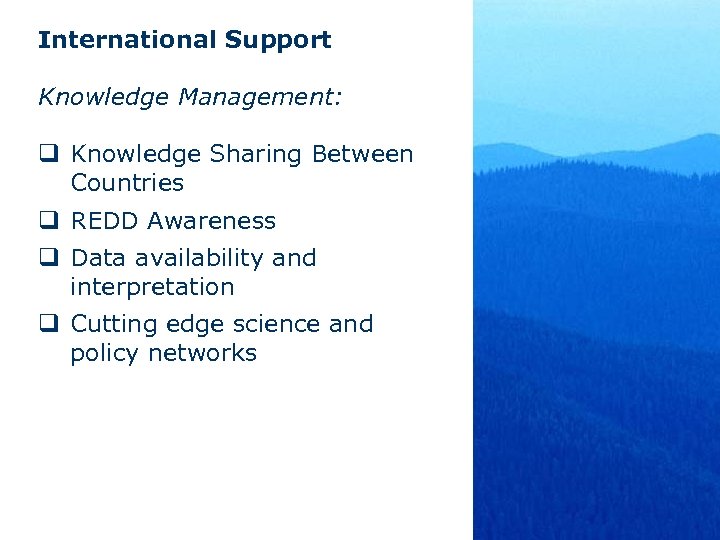
International Support Knowledge Management: q Knowledge Sharing Between Countries q REDD Awareness q Data availability and interpretation q Cutting edge science and policy networks
Management Arrangements • Country-driven “Joint Programmes” • Supporting cross-sectoral responses • Ensuring stakeholder participation • Utilising the UN Country Team mechanisms • Building on comparative advantages of FAO, UNDP and UNEP
Advice & Guidance Requested from Participants Today • Is there a role for a UN Collaborative Programme on REDD? • Does the UN Collaborative Programme respond to the needs of forested developing countries? • Does it sufficiently respond to the concerns of different stakeholders? • What should be the next steps?
Скачать презентацию UN Collaborative Programme on Reducing Emissions from Deforestation
90225a4193a972d4852dc325cfe12232.ppt