


 Скачать презентацию UML and Patterns Dr Zhen Jiang West Chester
6e1fcd96f58d47b2c021e0e5a987eff7.ppt
- Количество слайдов: 58
 UML and Patterns Dr. Zhen Jiang West Chester University E-mail: zjiang@wcupa. edu url: www. cs. wcupa. edu/~zjiang
 Outline l Introduction to UML l Objects and Classes l Class Diagrams – Class Icon – Relationships – Constraints
 Introduction to UML l What’s UML l Goals of UML l Overview
 UML: Unified Modeling Language l The Unified Modeling Language (UML) is an industry-standard language for specifying, visualizing, constructing, and documenting the artifacts of software systems l The UML definition was led by Grady Booch, Ivar Jacobson, and Jim Rumbaugh (all now at Rational Software)
 l. UML simplifies the process of software design, making a "blueprint" for construction Target Usage: for building object-oriented and component-based systems In Essence: a tool used through the analysis and design phases of system development for expressing the constructs and relationships of complex systems
 l. Or in a simple word: Target on: class components In Essence: analysis and design of relations (among components)
 l. Many free learning materials on the web – e. g. www. rational. com/uml l. Standard of UML www. cs. wcupa. edu/~zjiang/01 -09 -67. pdf l. Some recommended texts on UML: – The Unified Modeling Language User Guide, [G. Booch, J. Rumbaugh, I. Jacobson, 2000] – UML Explained, [Kendall Scott, 2001] – Applying UML and Patterns 2 nd Ed. , [Craig Larman, 2002] – UML Distilled 2 nd Ed. , [Martin Fowler with K. Scott, 2000] – UML and C++, [R. Lee & W. Tepfenhart, 2001]
 UML Overview l What is the target of UML, class?
 Objects and Classes l What’s object – Identity – State – Behavior l l Sequence Diagram Statechart Diagram Messages and methods What’s class – – – – Objects and Classes Nature of a class Class Attributes Operation (Method) Interfaces and Implementation Corresponding C++ code
 Objects and Classes l Fundamentals Programming of Object-Oriented
 Objects l Conceptually, there are many ways to think of an object – something that can be seen or touched – a thing to which some action is directed – something that performs an action l The structure and behaviour of similar objects are defined in their common class l Objects have thee properties: identity , state, and behaviour
 Object Property 1: Identity l Identity is that property of an object which distinguishes it from all other objects l Most programming languages use variable names to refer to objects l Keep in mind, however, that an object may not have a name; Similarly, an object might have multiple names (aliases) – For this reason, there is a subtle distinction made between the concepts of "name" and "identity"
 Object Property 2: State l The state of an object encompasses all of the (usually static) properties of the object plus the current (usually dynamic) values of each of these properties
 Object Property 3: Behaviour l Behavior is how an object acts and reacts, in terms of its state changes l The state of an object represents the cumulative results of its behavior l In object-oriented programming, a behavior is invoked by an interaction to this object l If the receiver object does not have a method for that message, an error is reported
 Example Objects l There are many physical objects we can examine right in this room – each person is an object – any chair is not an object – each light bulb is an object – Any book is not an object – this room itself is an object (full or not)
 l See if the followings are objects or not, in a system to handle our CST class: – – – – l Desk Light Person Log The Earth Clock Computer Saving account Answer: N, Y, Y, N, N, Y, Y, Y
 Objects versus Classes l How would we describe the state, behaviour, and identity for each of these objects l We have looked at rows as objects and we have seen that objects can be "classified" into a table, i. e. , class. l As programmers, we work with both classes and objects
 Classes and Objects l An object is called an "instance" of a class l The terms instance and object are interchangeable l Creating an object from a class is often called instantiation l For example, there are many person objects in this room -- each person is an instance of the person class
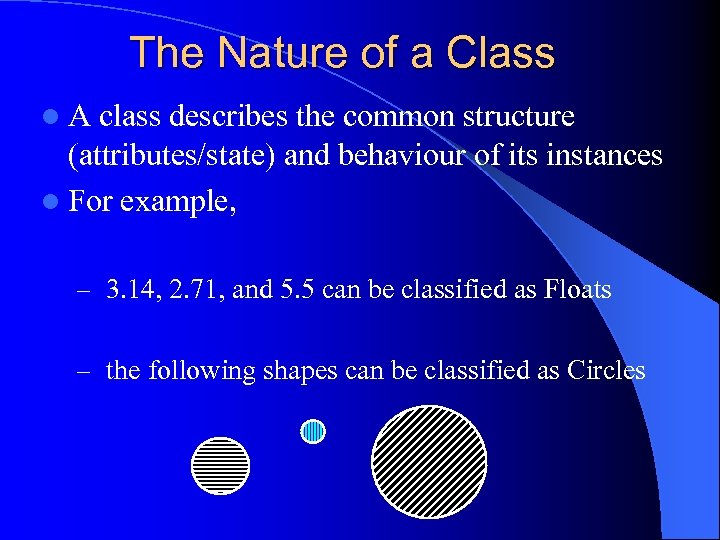 The Nature of a Class l. A class describes the common structure (attributes/state) and behaviour of its instances l For example, – 3. 14, 2. 71, and 5. 5 can be classified as Floats – the following shapes can be classified as Circles
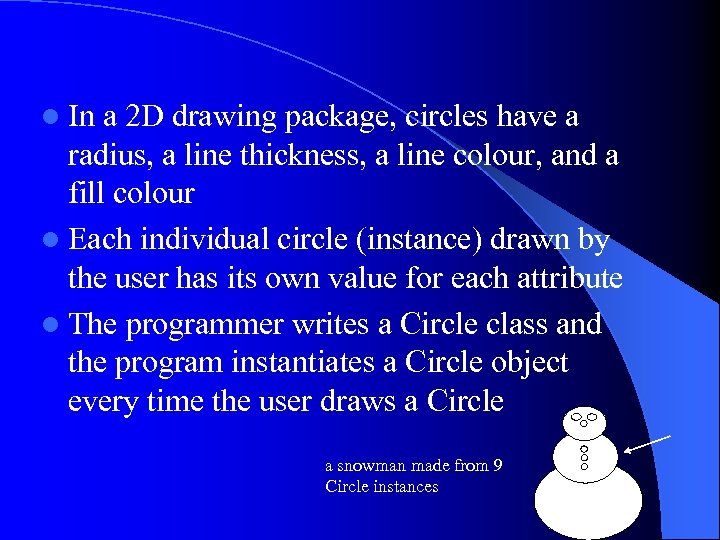 l In a 2 D drawing package, circles have a radius, a line thickness, a line colour, and a fill colour l Each individual circle (instance) drawn by the user has its own value for each attribute l The programmer writes a Circle class and the program instantiates a Circle object every time the user draws a Circle a snowman made from 9 Circle instances
 Class Attributes An attribute is a named property of a class that describes the range of values that instances of the property may hold. (Booch, 1999) l An attribute has a type that defines the type of its instances. l Only the object itself should be able to change the value of its attributes. l The values of the attributes define the state of the object l
 Operation (Methods) l An operation is the implementation of a service that can be requested from any object of the class to affect behavior (Booch, 1999) l An operation in database can be: – Creation (or adding a new one) – Search & read – Write / update – Closing / deletion
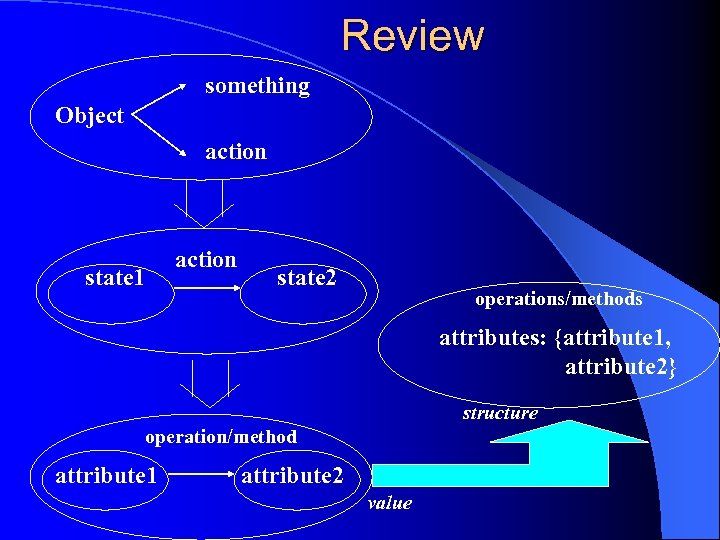 Review something Object action state 1 state 2 operations/methods attributes: {attribute 1, attribute 2} structure operation/method attribute 1 attribute 2 value
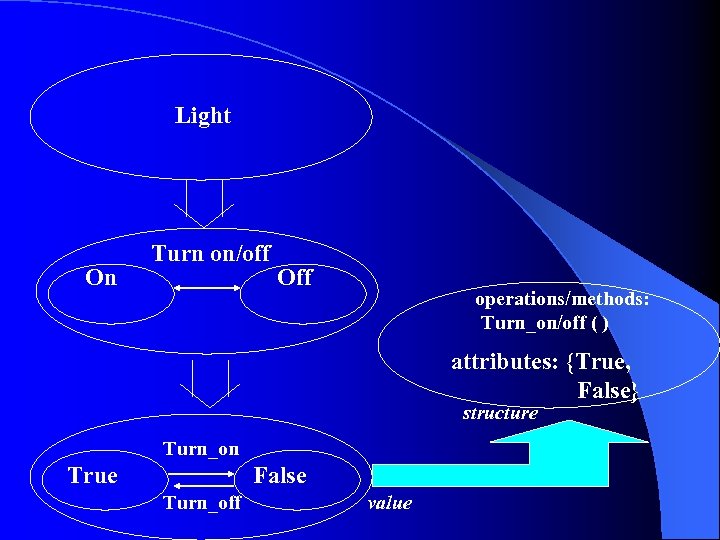 Light On Turn on/off Off operations/methods: Turn_on/off ( ) attributes: {True, False} structure Turn_on True False Turn_off value
 UML Class Diagram l Introduction l Class Icon l Relationships l Constraints
 Introduction l The class diagram is fundamental to objectoriented programming l UML’s class diagrams capture the attributes and operations of each class as well the relationships (information ownership) that exist between classes
 Class Icon l l l Class Icon Hiding Details Visibility Notation Attribute Specification Operation Specification
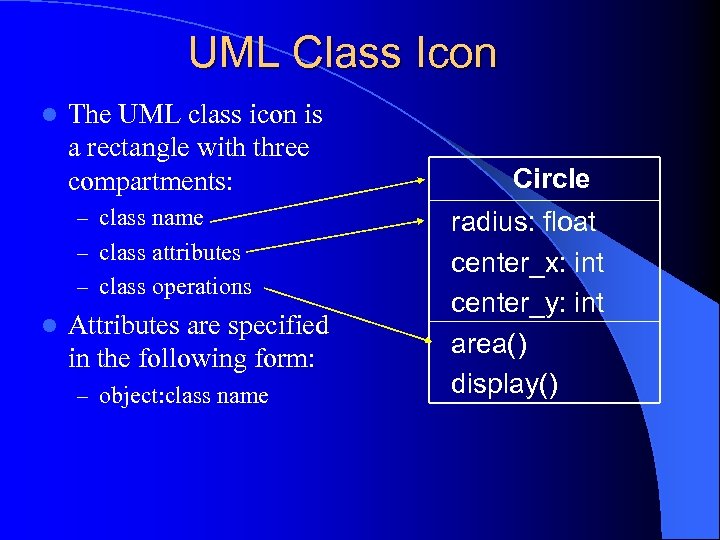 UML Class Icon l The UML class icon is a rectangle with three compartments: – class name – class attributes – class operations l Attributes are specified in the following form: – object: class name Circle radius: float center_x: int center_y: int area() display()
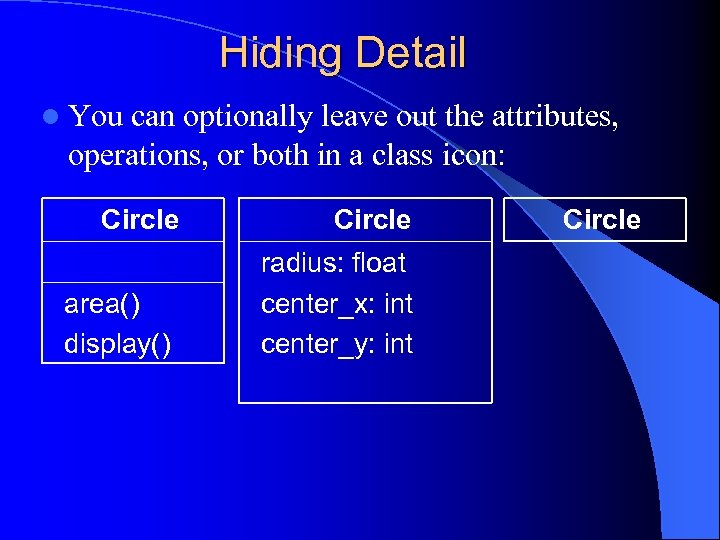 Hiding Detail l You can optionally leave out the attributes, operations, or both in a class icon: Circle area() display() Circle radius: float center_x: int center_y: int Circle
 UML Class Relationships l. A class relationship is a connection between two (or more) classes l The three most important class relationships are generalizations, associations, and aggregations l UML provides a graphical representation for each of the relationships using a different line type for each relationship
 Class Relationships l Generalization l Association Class l Qualified Association l Ternary Association l Aggregation
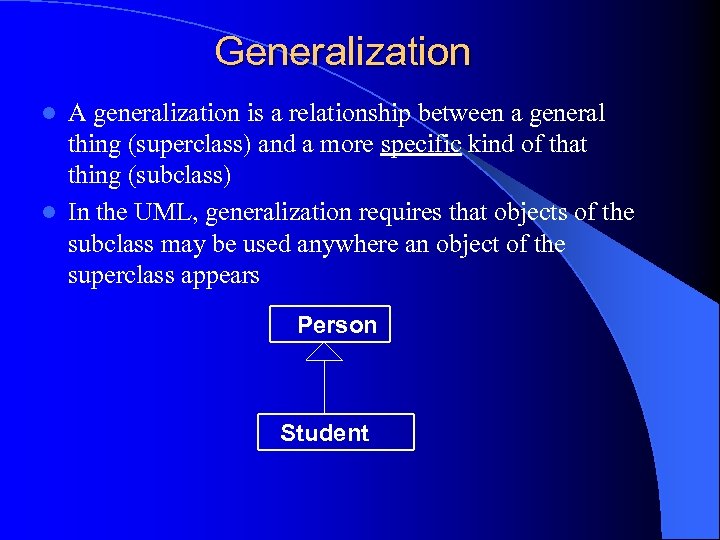 Generalization A generalization is a relationship between a general thing (superclass) and a more specific kind of that thing (subclass) l In the UML, generalization requires that objects of the subclass may be used anywhere an object of the superclass appears l Person Student
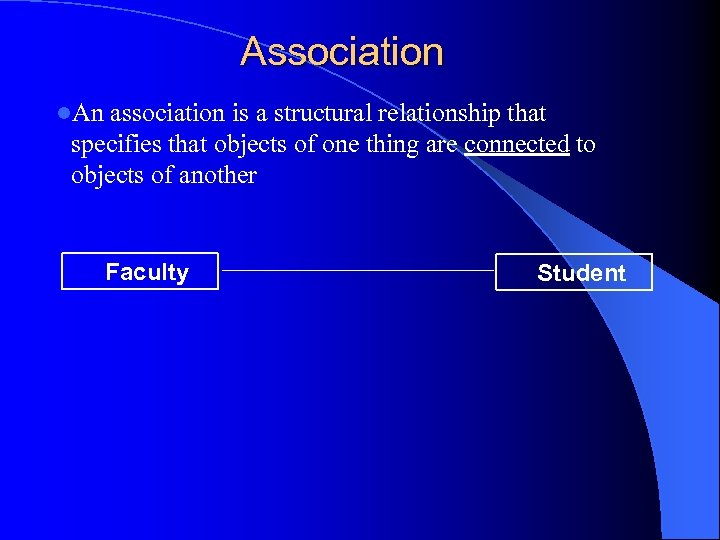 Association l. An association is a structural relationship that specifies that objects of one thing are connected to objects of another Faculty Student
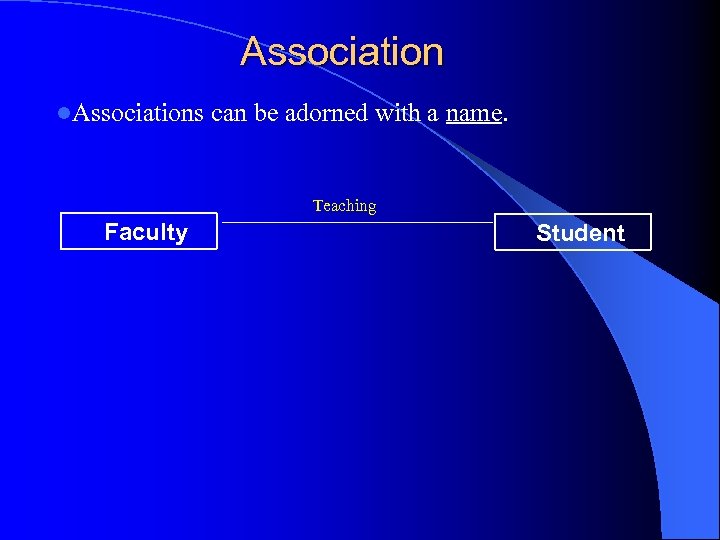 Association l. Associations can be adorned with a name. Teaching Faculty Student
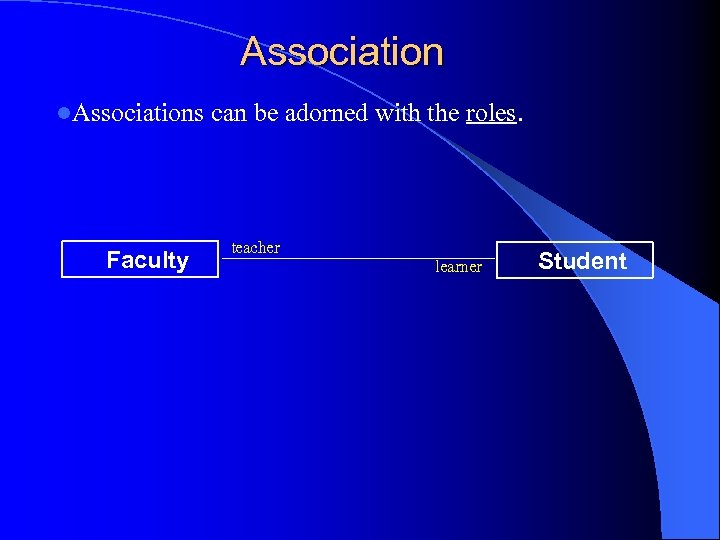 Association l. Associations Faculty can be adorned with the roles. teacher learner Student
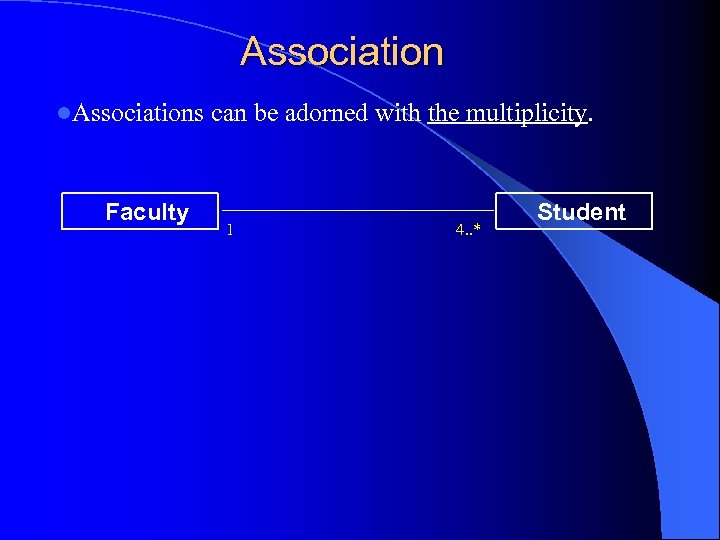 Association l. Associations Faculty can be adorned with the multiplicity. 1 4. . * Student
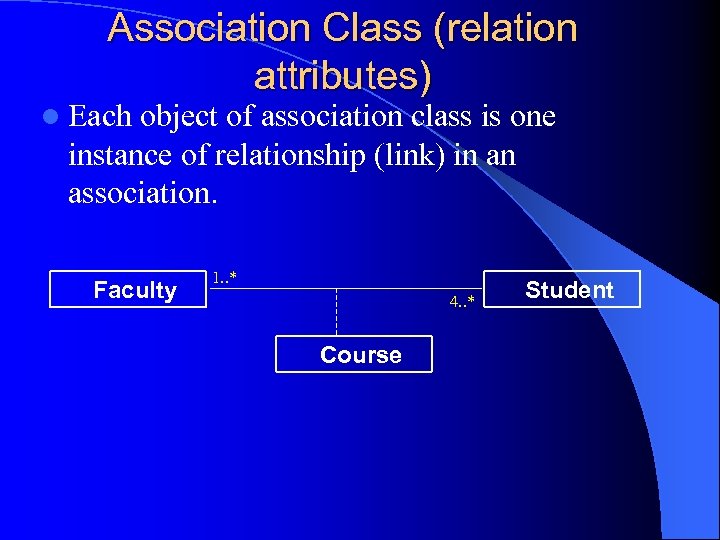 Association Class (relation attributes) l Each object of association class is one instance of relationship (link) in an association. Faculty 1. . * 4. . * Course Student
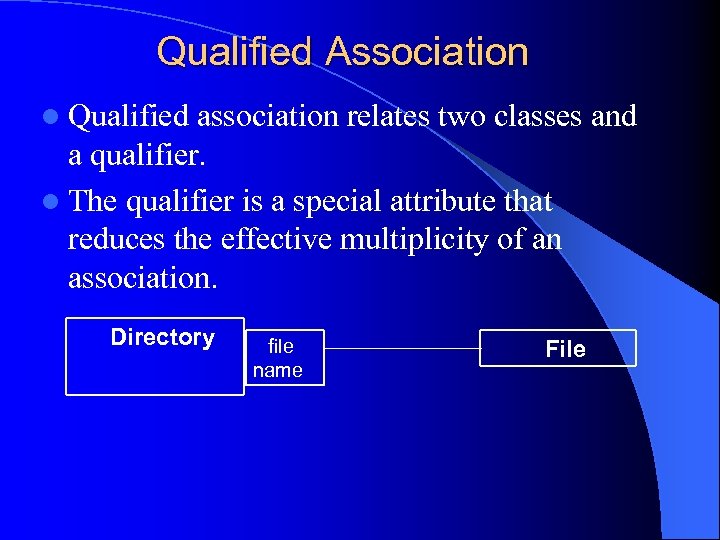 Qualified Association l Qualified association relates two classes and a qualifier. l The qualifier is a special attribute that reduces the effective multiplicity of an association. Directory file name File
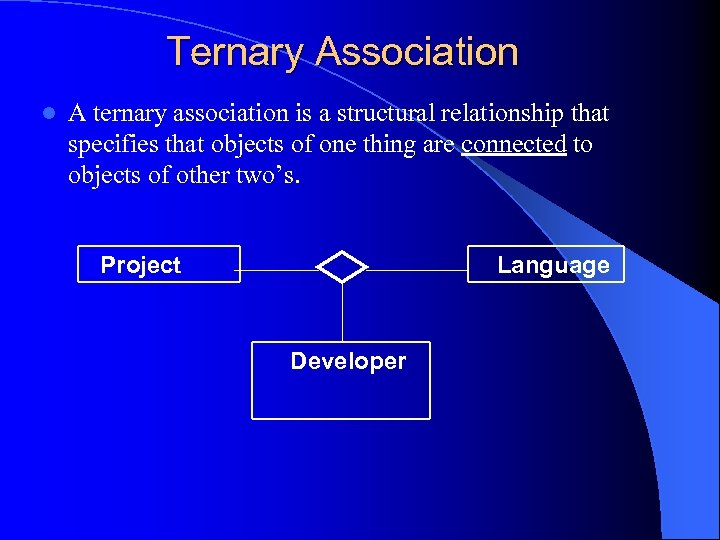 Ternary Association l A ternary association is a structural relationship that specifies that objects of one thing are connected to objects of other two’s. Project Language Developer
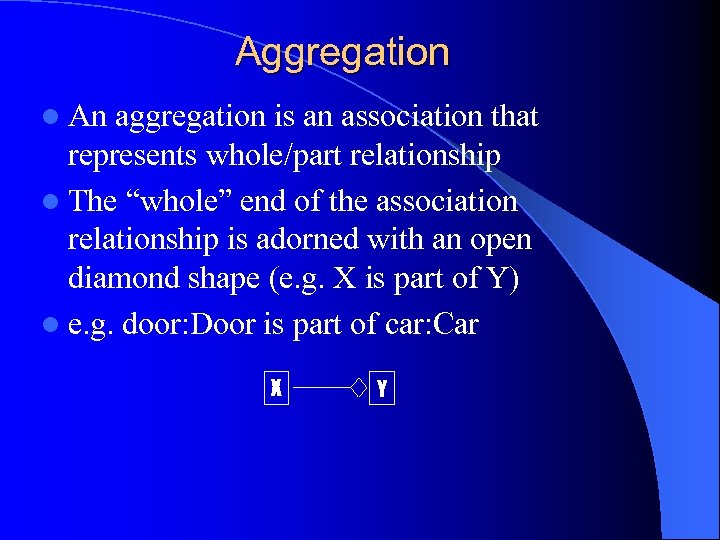 Aggregation l An aggregation is an association that represents whole/part relationship l The “whole” end of the association relationship is adorned with an open diamond shape (e. g. X is part of Y) l e. g. door: Door is part of car: Car X Y
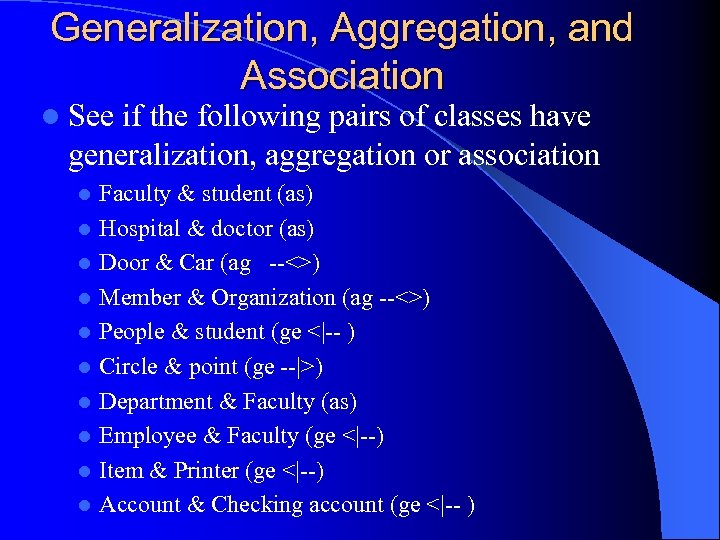 Generalization, Aggregation, and Association l See if the following pairs of classes have generalization, aggregation or association l l l l l Faculty & student (as) Hospital & doctor (as) Door & Car (ag --<>) Member & Organization (ag --<>) People & student (ge <|-- ) Circle & point (ge --|>) Department & Faculty (as) Employee & Faculty (ge <|--) Item & Printer (ge <|--) Account & Checking account (ge <|-- )
 Constraints l Constraints on Object l Constraints on Relations (Ordering) l General Constraints (Dependency)
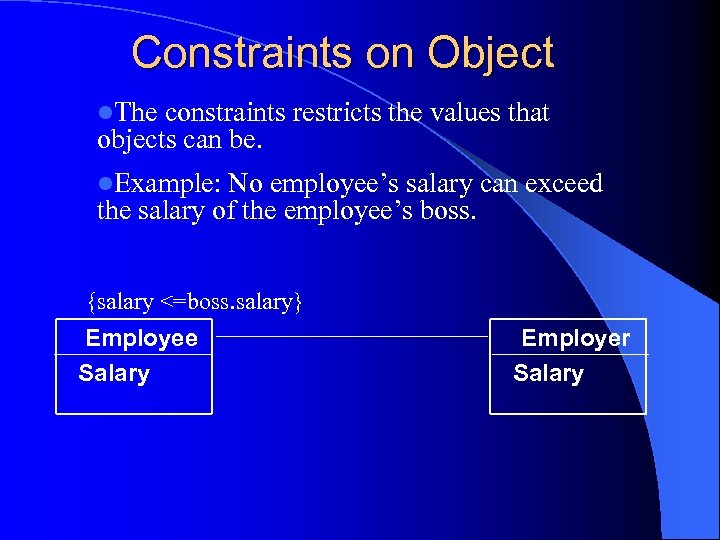 Constraints on Object l. The constraints restricts the values that objects can be. l. Example: No employee’s salary can exceed the salary of the employee’s boss. {salary <=boss. salary} Employee Salary Employer Salary
 General Constraints (Dependency) l A dependency is a using relationship that states that a change in specification of one thing may affect another thing that uses it (but not necessarily the reverse)
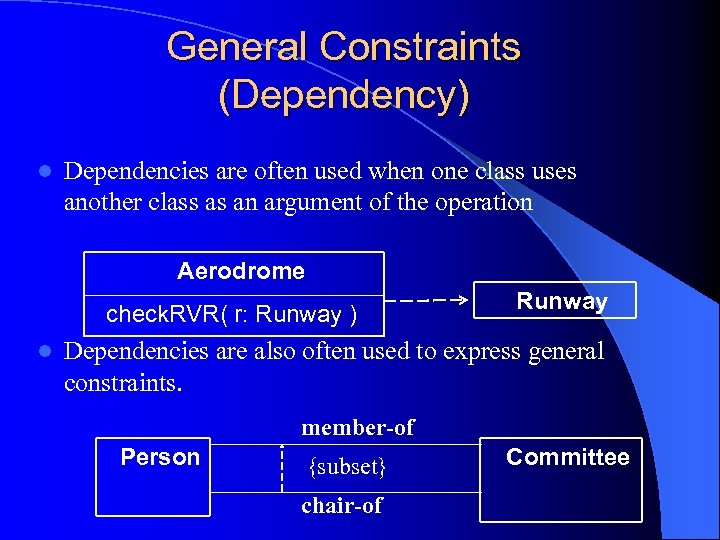 General Constraints (Dependency) l Dependencies are often used when one class uses another class as an argument of the operation Aerodrome check. RVR( r: Runway ) l Runway Dependencies are also often used to express general constraints. member-of Person {subset} chair-of Committee
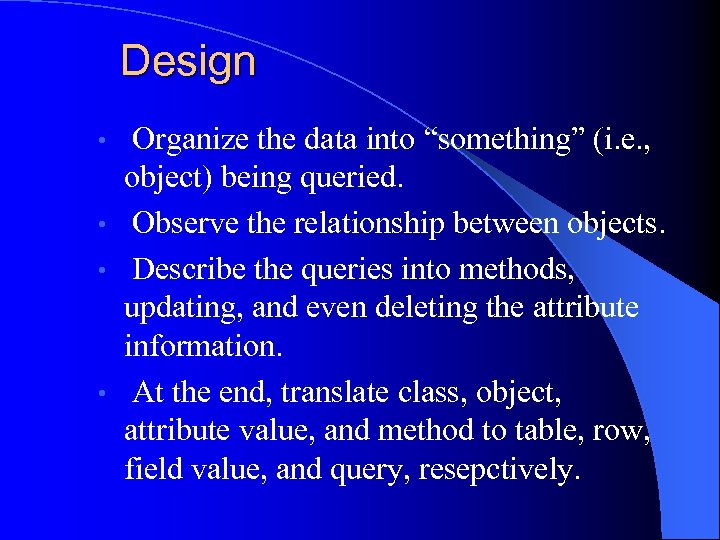 Design Organize the data into “something” (i. e. , object) being queried. • Observe the relationship between objects. • Describe the queries into methods, updating, and even deleting the attribute information. • At the end, translate class, object, attribute value, and method to table, row, field value, and query, resepctively. •
 For example, this CST class! • • • What you think important? What are objects? What are relations? Class? TA? Attributes, and methods?
 Mischief l UML class diagram is not object diagram. l How to describe the behaviors/actions of objects in UML class diagram? l UML class diagram is not data flow chart. l What kind of relationship is generalization? l How to keep the consistency of all the constraints?
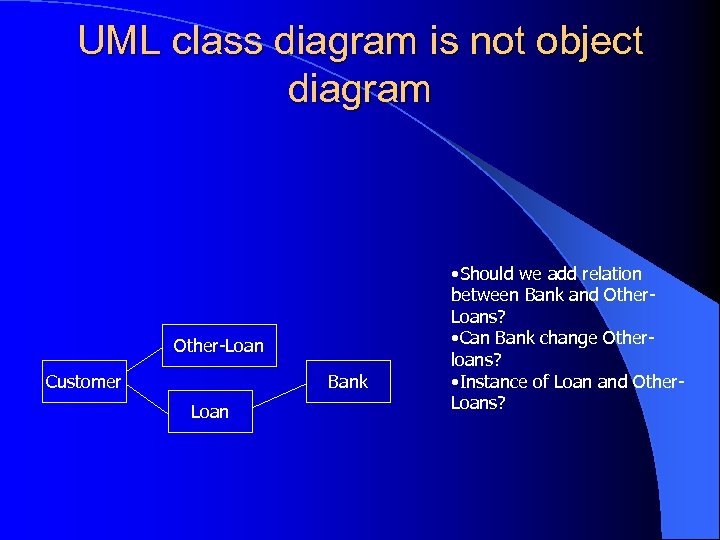 UML class diagram is not object diagram Other-Loan Customer Bank Loan • Should we add relation between Bank and Other. Loans? • Can Bank change Otherloans? • Instance of Loan and Other. Loans?
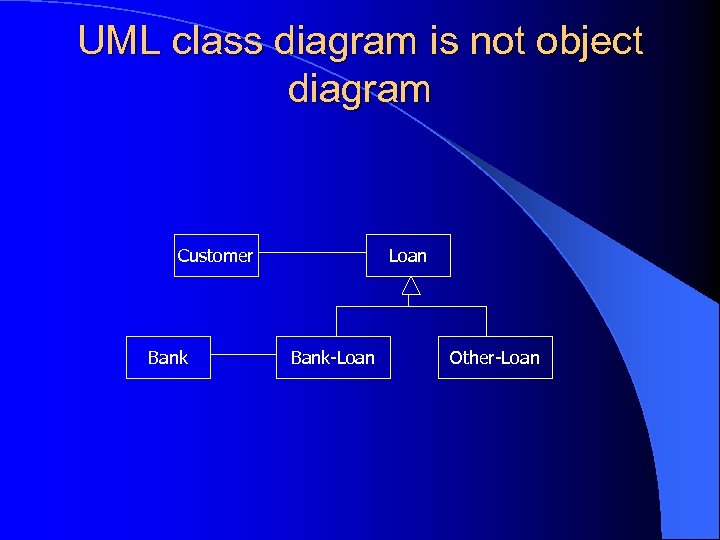 UML class diagram is not object diagram Customer Bank Loan Bank-Loan Other-Loan
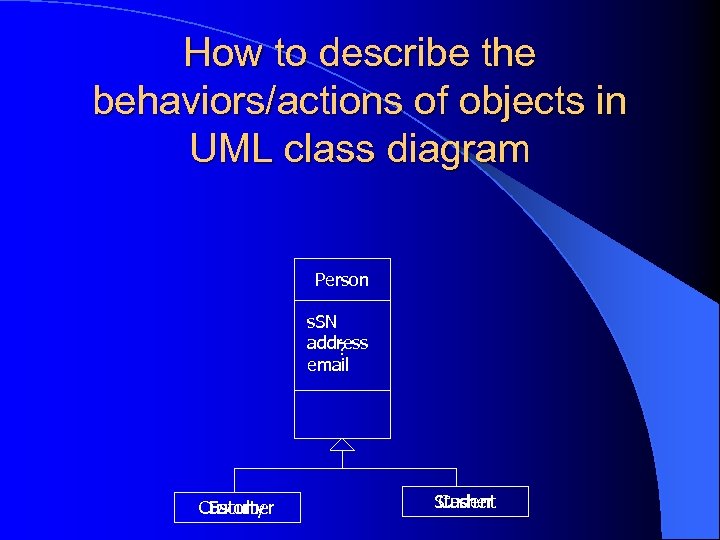 How to describe the behaviors/actions of objects in UML class diagram Person s. SN address ? email Customer Faculty Casher Student
 Operation (Methods) l An operation is the implementation of a service that can be requested from any object of the class to affect behavior (Booch, 1999) l An operation can be: – Question (does not change the value of the object) – Command (may change the value of the object)
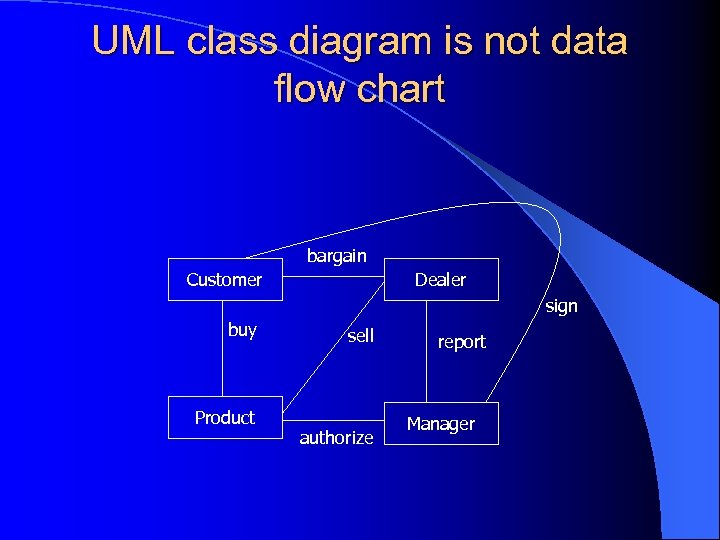 UML class diagram is not data flow chart bargain Customer Dealer sign buy Product sell authorize report Manager
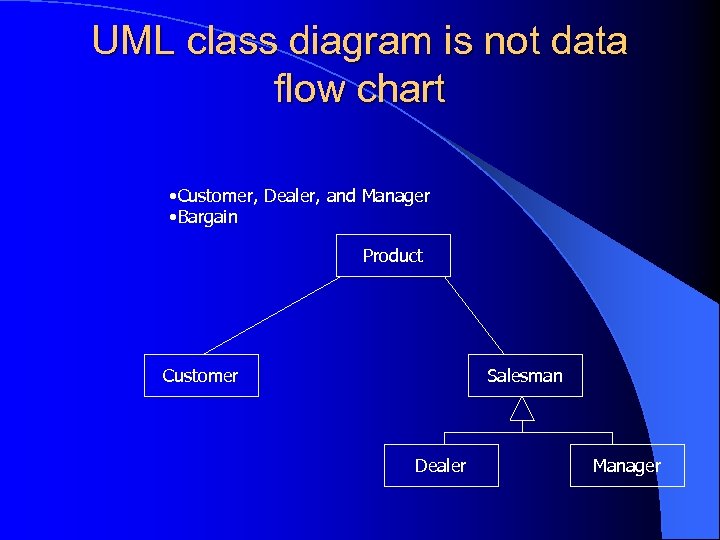 UML class diagram is not data flow chart • Customer, Dealer, and Manager • Bargain Product Customer Salesman Dealer Manager
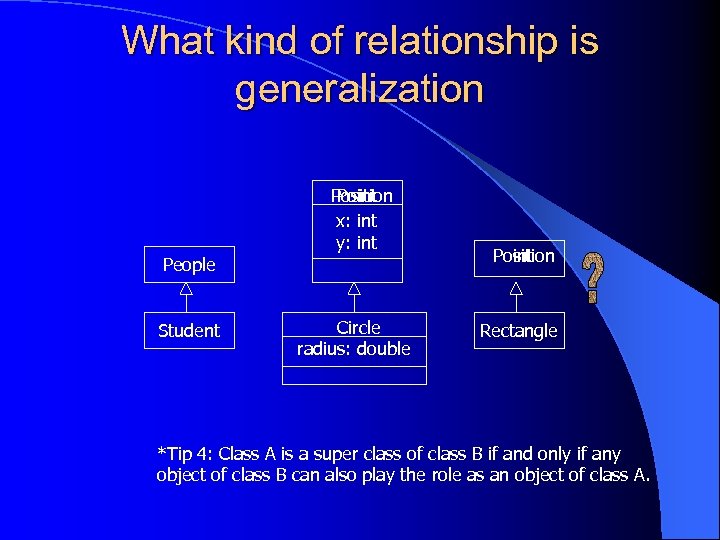 What kind of relationship is generalization Position Point x: int y: int People Student Circle radius: double Point Position Rectangle *Tip 4: Class A is a super class of class B if and only if any object of class B can also play the role as an object of class A.
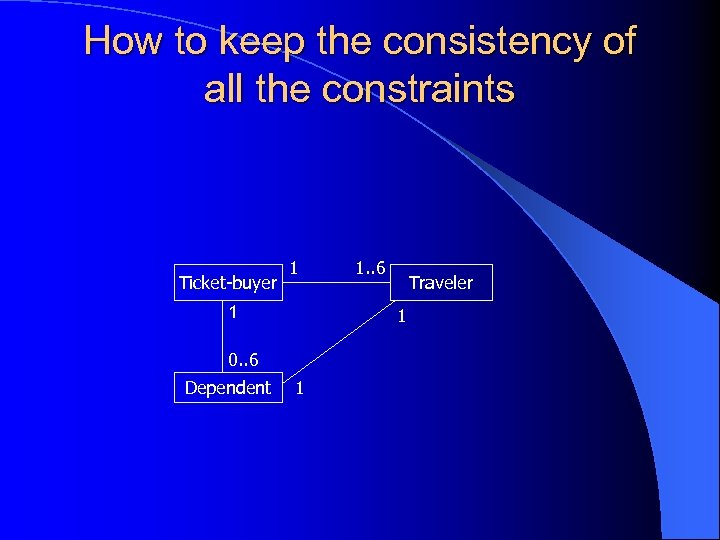 How to keep the consistency of all the constraints Ticket-buyer 1 1 Traveler 1 0. . 6 Dependent 1. . 6 1
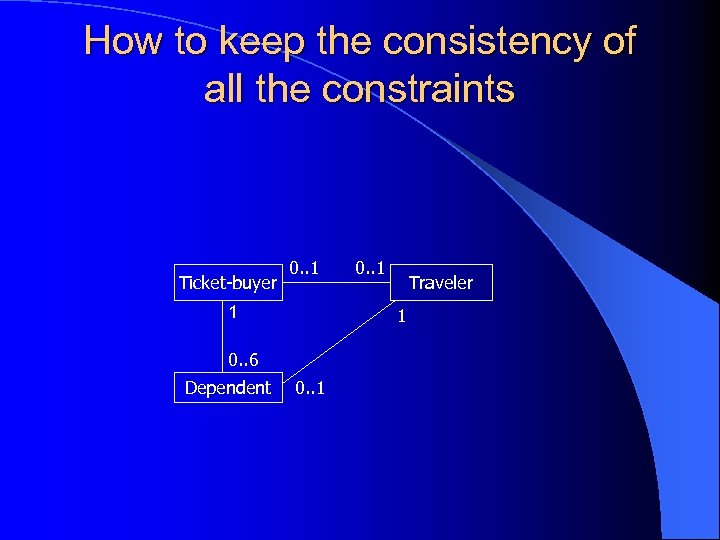 How to keep the consistency of all the constraints Ticket-buyer 0. . 1 1 Traveler 1 0. . 6 Dependent 0. . 1
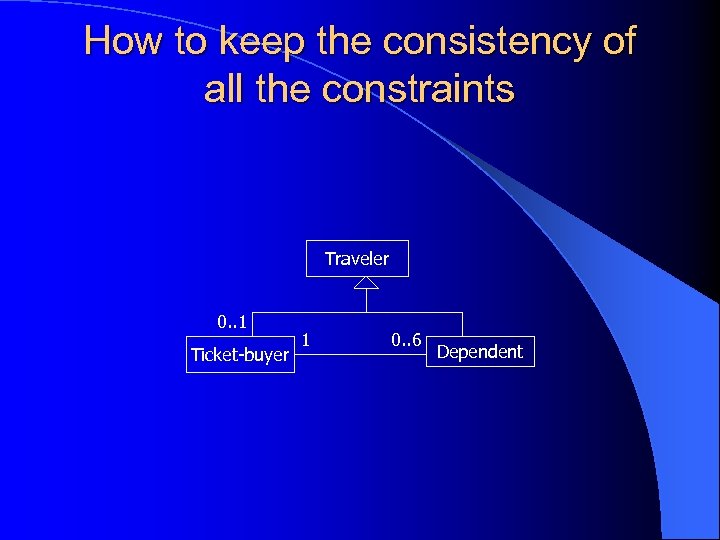 How to keep the consistency of all the constraints Traveler 0. . 1 Ticket-buyer 1 0. . 6 Dependent